Summary
-
Putin tells FM Araghchi that he’s been in contact with the new Supreme Leader, and says Iran fighting for ‘sovereignty’
-
After a weekend of stalemate malaise, Iran reportedly offers new proposal for opening ship traffic, while postponing the thorny nuclear issue; Rubio says ‘will not tolerate’ Iran control of strait
-
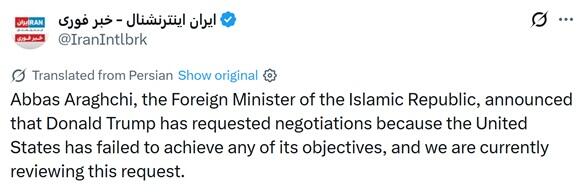
Trump says peace could come via telephone rather than face-to-face meetings, also warning Iranian oil infrastructure could explode from within unless flow resumes; Tehran later says Trump has requested new talks
-
Iranian FM has been sending written messages to US via Pakistani intermediaries
-
Israel strikes deep into Lebanon in Beqaa Valley for first time of 3-week ceasefire.
* * *
Rubio: ‘Will Not Tolerate’ Iran Control of Strait
The latest via WSJ on what Iran is proposing, centered on immediately lifting the US naval blockade on Iranian ports:
Iran has presented regional mediators with a new offer to stop its attacks in the Strait of Hormuz in exchange for a full end to the war and a lifting of the U.S. blockade of Iranian ports, according to officials familiar with the matter. The proposal, presented by Iranian Foreign Minister Abbas Araghchi during his tour of the region and Pakistan over the weekend, is designed to break the deadlock in the conflict and set talks back in motion, the people said. It would see discussions about Iran’s nuclear program shelved. Washington hasn’t responded to the proposal, one of the people said. Iran’s mission to the United Nations didn’t respond to a request for comment.
But US Secretary of State Marco Rubio has told Fox News on Monday that the US will not tolerate Iran controlling or establishing a toll system in the Strait of Hormuz. Rubio further asserted that the strait would remain open either through international pressure or a coalition-led effort.
Iranian Foreign Minister told Russia’s President Putin that US ‘destructive habits’, ‘unreasonable demands’ and frequent changes in positions are slowing diplomatic progress
Just days ago Iran began declaring that the first toll passage funds had been successfully transferred to the Central Bank of Iran, after Trump stated the US won’t allow a toll system. Rubio further said the US will not normalize the Iranians being essentially a gatekeeper, with countries seeking permission from Iran.
We will not tolerate a system where Iran plays gatekeeper to the world.” 🚨
Secretary Marco Rubio draws a line. As the “dual blockade” chokes global energy, the U.S. stance is clear: The Strait of Hormuz is an international waterway, not an Iranian toll booth. pic.twitter.com/YECpK8SUi4
— Martin (@Martin_Sedi) April 27, 2026
Putin Says He’s in Contact with Ayatollah in Araghchi Moscow Meeting
President Putin, FM Lavrov, and Iranian FM Araghchi have been meeting in Moscow, after warm greetings and amid competing narratives over the future of the Strait of Hormuz. The Russian leader said something surprising right out of the gate, at a moment Ayatollah Mojtaba Khamenei has not been seen since the US-Israeli war began: “Last week I received a message from the Supreme Leader of Iran,” he told Iran’s Araghchi
Additionally Putin pledged, “The people of Iran are courageously and heroically fighting for their sovereignty.” This certainly stands in sharp contrast from the US and Western consensus. Putin also stressed, “Russia will do everything that serves the interests of Iran and the region to achieve peace as soon as possible.” This after Tehran on Monday made clear that it sees the future of the Strait of Hormuz as being under Iranian military control – an earlier headline which pushed crude prices up, and within hours later on this as well:
Hours prior, Kremlin spokesman Dmitry Peskov described of Araghchi’s arrival, “the importance of this conversation is difficult to overestimate in terms of how the situation around Iran and in the Middle East is developing.” Araghchi to Putin: “It’s been proven to everybody that Tehran has friends and allies such as Russia… Allies that, in times of need, are standing next to Iran – and we are grateful to you for your support.”

The moment Putin greeted the Iranian top diplomat and his team (below), and where things stand on Iran’s proposal…
Iran has reportedly sent a new proposal to the U.S. that would reopen the Strait of Hormuz, but only after an end to the war and guarantees it will not resume, according to sources and regional reports. Under the plan, broader talks on the nuclear program and maritime navigation would come later.
Vladimir Putin greets Iranian FM Abbas Araghchi and his team https://t.co/Zgto3ZyVVI pic.twitter.com/ObAOkfMmPN
— RT (@RT_com) April 27, 2026
Meanwhile President Trump is expected to hold a situation room meeting soon on Monday, related to Iran and the Hormuz crisis with his top national security and foreign policy team.
IDF Hits Beqaa Valley for First Time of Lebanon Truce
A three-week Lebanon ceasefire is officially in place, but in reality it exists on paper or in name only, as Israel has intensified and expanded its attacks, now striking the distant Beqaa Valley for the first time since the truce began. “The IDF says it has launched a wave of airstrikes against Hezbollah infrastructure in the Beqaa Valley and several areas of southern Lebanon,” Israeli media reported Monday. “The strikes come following repeated Hezbollah attacks on IDF troops and Israel during the ceasefire, including a deadly drone attack yesterday,” according to The Times of Israel.
The latest coverage notes that “Israel has not struck in Lebanon’s eastern Beqaa Valley in some three weeks.” The IDF frames the escalation as a response to Hezbollah violations of the ceasefire, while Hezbollah argues Israeli ground forces are on Lebanese territory and therefore legitimate targets.
Meanwhile, Joseph Aoun told representatives from southern villages that negotiating with Israel “is not betrayal,“ but necessary for stability. The Maronite Catholic leader added that “Betrayal is carried out by those who take their country to war to serve foreign interests.”
Iran Offers New Path To Opening Strait
Running a little ahead of schedule, Sunday evening brought this week’s infusion of pre-Monday-open optimism about prospects of ending the US-Israel war on Iran. Axios’ Barak Ravid, a veteran of Israeli intelligence who routinely posts anonymously-sourced scoops, reported that Iran has presented a new proposal for opening the Strait of Hormuz and ending the shooting — though Iran’s concept includes a potential non-starter via a proposed postponement of nuclear negotiations. No details were reported, beyond the notion of either an extended ceasefire or permanent end of the war that would accompany a full reopening of the strait.
Earlier on Sunday, President Trump said face-to-face discussions with the Iranians weren’t essential to ending the war. “If they want to talk, they can come to us, or they can call us. You know, there is a telephone. We have nice, secure lines,” he told Fox News. “They know what has to be in the agreement. It’s very simple: They cannot have a nuclear weapon; otherwise, there’s no reason to meet.”
Iran’s Foreign Minister Abbas Araghchi:
Incorrect approaches and excessive demands by the U.S. caused the previous round of talks—despite progress—not to reach its objectives. pic.twitter.com/Bt7ikClaoe
— Clash Report (@clashreport) April 27, 2026
Sunday’s micro-dose of hope capped a weekend in which negotiations were perceived as grinding to a clear stalemate marked by a lack of warfare but also a continued choking of traffic through the vital Strait of Hormuz. On Saturday, Trump’s lead negotiators, Steve Witkoff and Trump son-in-law Jared Kushner, were poised to travel to Islamabad for another round of negotiations with the Iranians when Trump nixed their trip at the last minute.
Iran’s Fars news agency reported that Araghchi has “conveyed written messages regarding Iran’s red lines to the American side through Pakistani intermediaries.”
Iranian Foreign Minister Shuttles Between Pakistan, Oman, Russia
Iranian Foreign Minister Abbas Araghchi has been on the go. On Saturday, he left Pakistan after meeting with Pakistan’s military chief, Asim Munir, Prime Minister Shehbaz Sharif and Foreign Minister Ishaq Dar. On parting, Araghchi said he’d had a “very fruitful visit,” while cautioning it’s unclear “if the US is truly serious about diplomacy.”

Then he was off to Oman for talks centered on re-opening the strait — which lies between the two countries — then back to Pakistan. By Monday, Araghchi was in St Petersburg, Russia for discussions with President Putin. Commenting on the relationship via X, Iran’s envoy in Russia said:
“Iran and Russia are present in a united front in the campaign of the world’s totalitarian forces against independent and justice-seeking countries, as well as countries that seek a world free from unilateralism and Western domination.”
Trump: Iranian Oil Infrastructure In Peril From Limited Capacity
Trump told Fox News on Sunday that the US blockade on traffic to and from Iranian ports is putting major pressure on the country’s export infrastructure:
“When you have, you know, lines of vast amounts of oil pouring through your system, if for any reason that line is closed because you can’t continue to put it into containers or ships, which has happened to them — they have no ships because of the blockade — what happens is that line explodes from within, both mechanically and in the earth.”
“It’s something that happens where it just explodes. And they say they only have about three days left before that happens. And when it explodes, you can never, regardless, you can never rebuild it the way it was.”
That approximate scenario has also been outlined by the Critical Threats Project at the American Enterprise Institute. “Once the tanks are filled, Iran would have to shut down its oil fields, which risks long-term damage to the fields,” AEI’s Annika Ganzeveld told the New York Post. A worst-case scenario doesn’t only imperil Iran’s economy, but also threatens to put more upward pressure on global energy prices. Analysts differ on how much time Iran has before a forced shutdown of production — with estimates ranging from mere days to seven weeks.
TankerTrackers.com on Sunday reported that Iran has loaded roughly 4.6 million barrels of oil at its terminals, without specifying the time-frame in which the feat had occurred. The outlet said another 4 million barrels have somehow evaded the US blockade. That volume of oil buys a few more precious days of storage capacity, the Wall Street Journal says.
BREAKING: IRAN LOADS 4.6 MILLION BARRELS AT CRUDE OIL TERMINALS
ADDITIONAL FOUR MILLION BARRELS APPEAR TO HAVE EXFILTRATED US BLOCKADE LINE
— TankerTrackers.com, Inc. (@TankerTrackers) April 26, 2026
Meanwhile, citing claims made by the secretary-general of the Iran Shipping Association, FARS reported that “Iran’s maritime trade flow has not stopped, and ships are reaching ports by crossing the blockade.” The report also said the bolstering of alternative routes — including northern ports on the Caspian Sea and rail links to China and central Asia — had also buffered the country’s “economic resilience.”
Iranian Leadership Divided On Deal Terms
Iran’s leadership is reportedly split on how flexible they should be on nuclear terms of a deal. Last year, at the encouragement of Israel and pro-Israel forces inside the United States, the Trump administration had adopted a maximalist position demanding that Israel agree to never again enrich nuclear material, even to levels far below weapon-grade.
For many observers, this was seen as a demand that Israel knew Iran would never consent to, ensuring the all-out US-Israel war on Iran that Prime Minister Netanyahu himself admitted he had “yearned to do for 40 years.” It’s been the long-running conclusion of the US intelligence community that Iran has not been developing a nuclear weapon. Netanyahu has been warning of an imminent Iranian nuclear weapon for 34 years — since 1992.
Donald Trump has been repeating the same claims Benjamin Netanyahu has pushed for over 30 years:
“Iran is very close to obtaining nuclear weapons” – often framed as “a few months” or even “a few weeks.”
For 30 years, the same pretext – and Iran still without nuclear weapons. pic.twitter.com/pagRS2hQ0I
— Mr. Whale (@CryptoWhale) April 15, 2026
* * *

Tyler Durden
Mon, 04/27/2026 – 11:25