Two months ago, at the end of March, we reported that Turkey was aggressively dumping its gold reserves in a panic scramble to obtain dollar funding, which Erdogan’s regime was using to keep the Turkish lira from crashing, and to also pay for energy imports which had suddenly soared in price as a result of the Iran war.

The violent selling by Turkey (and other emerging markets) was behind the brutal plunge in gold prices, which tumbled by more than $1000 from near all-time highs at the start of the war to the low 4000s by the time Turkey had done selling much of its gold.

Then earlier this week, we got another confirmation of Turkey’s wild liquidation spree when the latest central bank data showed that Turkey’s foreign reserves had their biggest monthly decline on record in March, as the Iran war triggered global selloffs in emerging market assets and strained the lira.
According to balance-of-payments data, Turkey’s official reserves cratered by $43.4 billion in March. Part of the decline reflected state intervention to offset portfolio outflows. The current-account deficit, meanwhile, widened to $9.7 billion in March from $7.3 billion in February as a result of soaring commodity prices.

A major energy importer, Turkey has been hit hard by higher oil and gas prices caused by the effective closing of the Strait of Hormuz and the resulting disruptions to world supplies of crude and refined products. Meanwhile, global banks have started changing their formerly favorable outlook on the lira, citing the exploding current-account deficit. Should inflation pressures persist, Turkey will have no choice but to pursue another accelerated devaluation of the Turkish lira.
“As international institutions continue to raise their average oil price forecasts for 2026, disruptions in supply chains and ongoing regional tensions — and their potential negative impact on transportation and tourism revenues — keep upward risks alive in year-end projections” for Turkey, said Istanbul-based economist Haluk Burumcekci.
Turkish central bank Governor Fatih Karahan said last week that the ratio between the current-account deficit and gross domestic product would be “below historical averages” this year while acknowledging the upside risks.
Yet as we said in March, while selling gold is a step of clear desperation for Turkey which had put in much efforts in recent years to build up a substantial gold stock, it is understandable for a regime that suddenly finds itself in a dollar funding crisis, the bigger question is did Turkey do the same with its holdings of Treasuries which are far more liquid and thus far less likely to move the market even when facing a sizable liquidation.
The answer, we learned today, is a resounding yes.
According to Bloomberg calculations based on US Treasury data, Turkey sold almost all of its US Treasuries in March as it stepped up efforts to support its currency during the first month of the Iran war. The amount of Treasuries held by Turkey crashed to just $1.8 billion by the end of March, down from $16 billion the previous month, the data showed. The figure includes securities held by the central bank and other Turkish entities, including corporates.

The decline coincided with a selloff in Turkish markets after the Middle East conflict erupted, sending oil prices sharply higher. The central bank moved immediately to prevent a crash in the lira by tightening funding conditions and selling off foreign exchange and gold assets. Its interventions also included swapping gold from reserves, although now that it has also dumped the bulk of its last ditch dollar reserves, those swaps will almost certainly end up forcing Turkey to hand over whatever gold was pledged.
Turkey’s Treasury holdings were as high as $21 billion in February 2025 after the country spent a year rebuilding reserves. They had peaked about a decade ago at $80 billion, before steadily declining as relations with the US soured over a range of political and geopolitical disputes, and as Turkey consistently sold reserves to maintain a smooth devaluation of the lira.
Despite the interventions, the lira has remained under pressure as the war drags on. Last week, the central bank raised its year-end inflation target to 24% from 16%, after data showed annual inflation accelerated to 32.4%. Turkish bonds have also suffered steep losses, with 10-year yields hitting record highs of 35.75%.
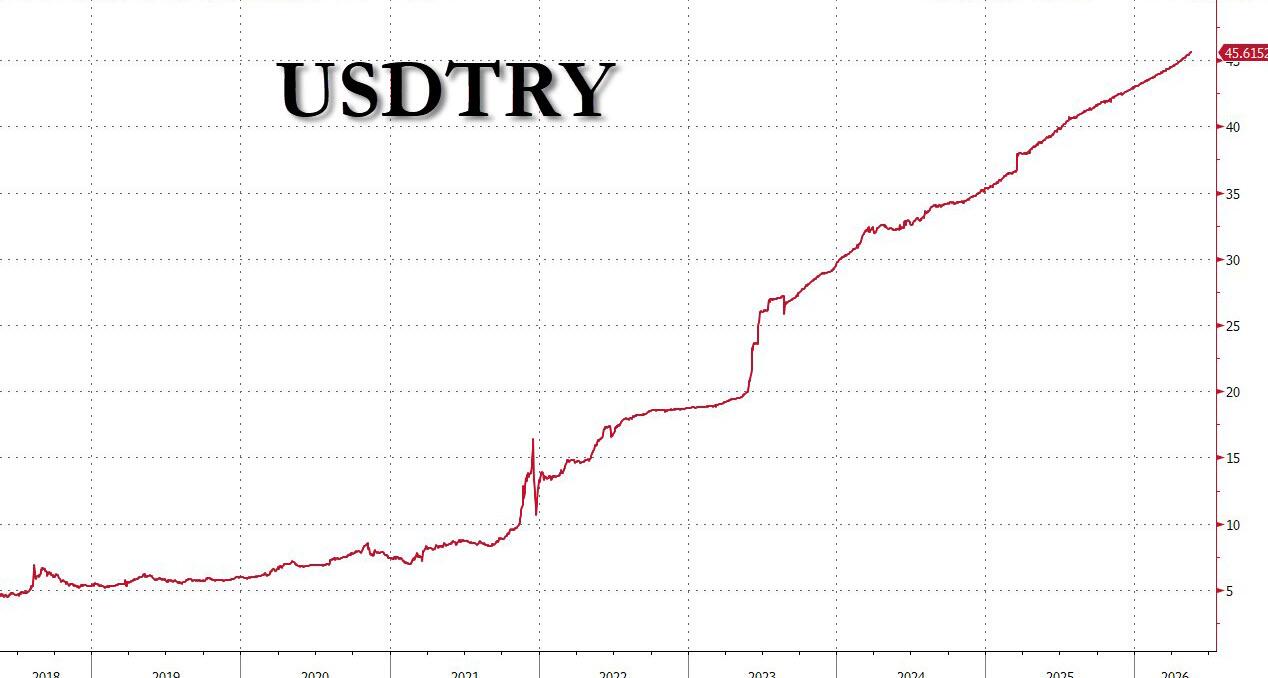
And now that Turkey has no more gold or Treasurys with which to defend the currency, expect a sharp and painful death in the currency which has gone from less than 10 against the dollar five years ago to a record 45.6 today..
Tyler Durden
Thu, 05/21/2026 – 11:20