The reopening of the Hormuz chokepoint has proceeded relatively smoothly for weeks, but an overnight development shows that the process remains fragile. At least eight ships attempting to exit the Persian Gulf abruptly reversed course near the critical waterway.
Bloomberg cites ship-tracking data showing that the vessels, including oil tankers, product carriers, bulk carriers, and vehicle carriers, were moving toward the strait along the Omani coast before abruptly turning back. Several ships later resumed their transits through the strait by shifting northward onto a route closer to the Iranian coast, in line with Tehran’s request that ships use authorized Iranian-designated lanes.
via Bloomberg:

It is unclear why the ships abruptly altered course, though Tehran has repeatedly warned vessels by VHF radio to follow designated routes.
Earlier on Saturday, Iran warned Western powers that the Hormuz waterway is not a “theater for the military display of extra-regional powers.”
Deputy Foreign Minister Kazem Gharibabadi said Iran views itself as the responsible power and security guarantor of the strait, adding that Tehran would closely monitor any foreign military movements in the waterway.
Gharibabadi’s warning came shortly after the UK and France announced that their navies were ready to support freedom-of-navigation operations in the waterway.
“Iran, as the responsible power and guarantor of the Strait’s security, warns with sensitivity to any military movement in this waterway,” Gharibabadi said on X.
He added, “The security of Hormuz lies with the coastal states; the crisis-makers will be held accountable for the consequences of their adventurism; this is a serious warning.”
While daily commodity vessel crossings have averaged around 34 since Monday, Hormuz vessel traffic remains well below pre-war levels.
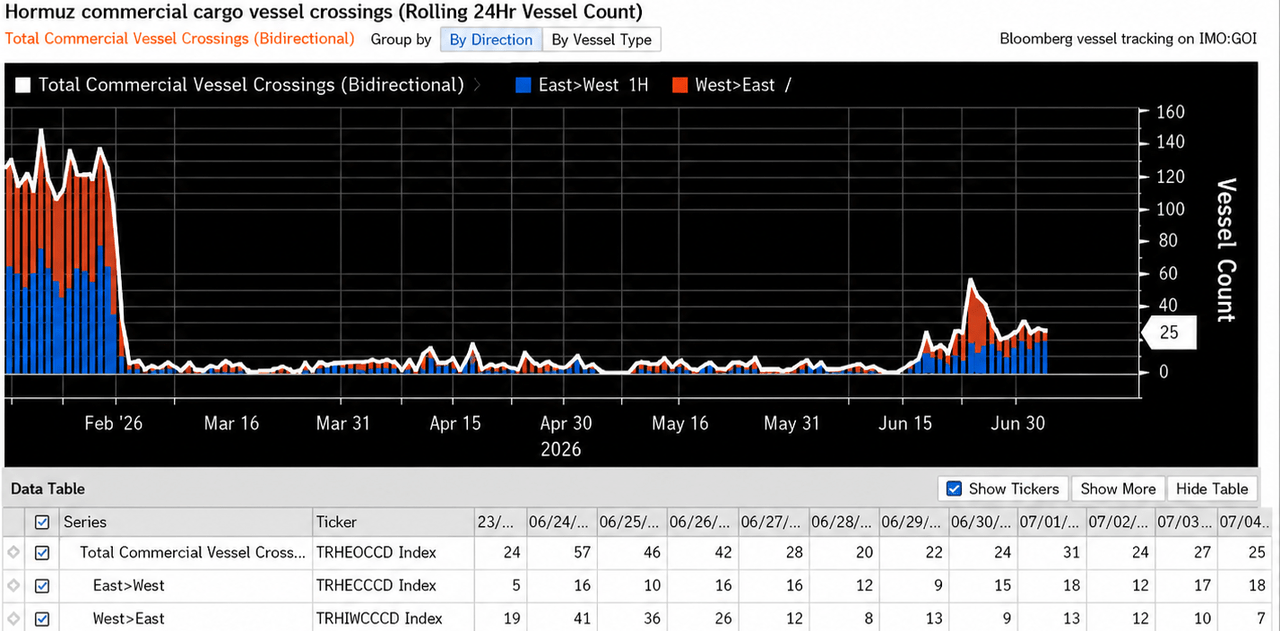
Natasha Kaneva, JPMorgan’s top commodities strategist, provided clients with more color on Hormuz ship flows and what it means for energy markets:
There is now a rush to move stranded cargoes out of the Strait of Hormuz. Average crude exports from the Persian Gulf plus re-routed volumes over the last ten days have already recovered to about 19 mbd, just 3 mbd below pre-war levels. The backlog is also disappearing quickly: floating storage has fallen to just 20 million barrels, while another 10 million barrels remain in onshore tanks awaiting exports.
Meanwhile, inbound tankers are lining up to enter the Strait, preparing to load barrels that have been sitting in storage tanks for months. More entering vessels will be needed as production across the Gulf gradually returns to normal operating levels. We are already seeing a growing queue of ballast VLCCs moving towards the Gulf.
The line is long and deep—an important signal that the logistical chain is reconnecting and that loadings can continue uninterrupted as the system works its way back toward normal.
Professional subscribers can read more about Hormuz and Gulf energy markets on our new Marketdesk.ai portal.
Tyler Durden
Sat, 07/04/2026 – 11:05