Submitted by Peter Tchir of Academy Securities
Let’s start with the important stuff: Hope you are having a great 4th of July 250th Anniversary Weekend.
Yields gained back some ground after the relatively weak jobs report (headline plus revisions was negative, the private sector underwhelmed, and unemployment only dropped because the labor force participation rate dropped by a relatively large 0.3%).

I will continue to pound the table (or rant and rave as the case may be) that this Fed Will Cut Rates in September. That was our main topic of discussion on the Bloomberg Radio segment above (and I did get to hear Tom Keene say my view looked smarter after the jobs data, than it had before the jobs data, when we spoke). MarketWatch also picked up on the interview and our prospect for cuts rather than hikes.
I have yet to hear compelling arguments on:
- Why the Cleveland Fed’s Rent metrics are not more accurate than what is currently used in “official” data?
- Why Truflation doesn’t deserve a lot more attention than it gets?
If anything, we’ve received comments pointing us to additional indices, surveys, etc., that likely present a more accurate picture of inflation (and they virtually all signal that we understated inflation post-Covid (hence Affordability is the Issue) and we are overstating the inflation rate now).
I really like the 2-year Treasury here, given what the market is pricing versus what I expect the reality to be.
The TV interview wound up focusing on AI. It wasn’t the topic I was most looking forward to, but was difficult to avoid when overnight headlines included:
- OpenAI potentially “giving” the U.S. a 5% stake.
- Meta offering to sell compute rather than using all of their compute for themselves.
- Apple requesting the ability to use Chinese made memory chips, in phones to be sold in China.
On any given day, one of those headlines would be interesting. To get all 3 in one day certainly attracted a lot of attention! It gave us a chance to talk about some of our main themes in AI:
- The need for the AI and Data Center Industry to ramp up their community outreach. My view that this industry needs to do a better job convincing people why they not only want and need AI, but that they also want it in their backyard.
- The comparisons to the fiber buildout during the dot.com boom!
- The risks of an AI “Revolution” (i.e., political backlash with negative consequences) and the risk to jobs. Trying to answer the question of whether humans are the horses in the current “Buggy Whip” transformation playing out. I admit that every time I write Buggy Whip, Rihanna’s song comes to mind, which is maybe why I didn’t say it on national TV.
In case you missed it, Academy published this month’s Around the World this week focusing on Iran, Cuba, Russia/Ukraine, and Economic Tensions with China.
ProSec 2026 and Vertically Integrated Nations
We started 2026 with a comprehensive view of ProSec 2026 (yes, the font is obnoxiously large, but if you haven’t read that report, we urge you to read it now). The concept had evolved from National Production for National Security and Resilience to ProSec. There are many names attached to what is going on (HALO, Mercantilism, etc.) but we think ProSec captures the concept of “needing to produce more of some things for true national security” more fulsomely. Academy does have the advantage of being able to tap into the Geopolitical Intelligence Group for behind the scenes insight into national security discussions, both here and abroad.
Before we update our thoughts on ProSec, I want to go back to something we published back in October of 2025 – Is ProSec the New ESG? Even suggesting that something could replace ESG, let alone something along the lines of ProSec replacing ESG, less than a year ago, seemed half (or fully) insane. Now, people mostly shrug, or provide us examples (at the very least) of how they’ve seen thinking in their organization adapt ESG to incorporate the key elements of ProSec.
We won’t spend much time on these two thoughts today, but they should be highlighted:
- ProSec is Going Global. We won’t spend time on this today because it seems self-evident (and also I haven’t been able to work in the lyrics of Going Underground to Going Global, but I’m confident that eventually I will).
- ProSec will continue regardless of election outcomes. We won’t dwell on this, but the 250th birthday of a nation doesn’t seem like the appropriate time to sound political, and it is pretty difficult to not sound political when addressing this subject (though I think we have done a decent job on that front in reports, interviews, and presentations).
A Nation as a Human Being
We have discussed Vertically Integrated Nations, but I think this concept of trying to think of a nation as a living breathing organism (which it pretty much is) helps frame the prioritization of ProSec Industries.
The decision to include this chart from the start of the year report makes me cringe for a couple of reasons:
- The chart is pretty pathetic looking, even by my relatively basic charting skills. I spent some time using AI to try to make some cooler looking charts, but I was struggling, and it is a long weekend, and I might as well just accept my inability to make nice charts.
- I was horribly worried the chart would be missing a lot! Not like 6 months is a long time to withstand the pressures of time, but the chart (as ugly as it is) has held up reasonably well, at least in terms of the information it was trying to convey.
- One regret (and poor decision) that we rectified months ago is that we gave SPACE short shrift. We did not highlight space appropriately. We did “lump it into” Defense, but if we wanted to redo the industry table, SPACE would have its own vertical.
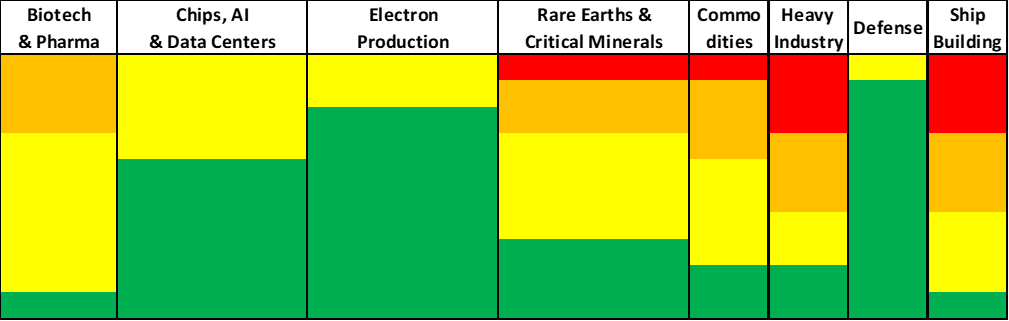

The “chart” attempts to convey the following information:
- The sectors that we view as playing a crucial role in ProSec. For many people, their first thoughts on Production for Security is Military and Defense spending and production. That is only a small part of ProSec (at least in the U.S. which has invested heavily in this space for decades; whereas it might be a bigger part of ProSec for countries that have neglected spending to protect themselves on the military front).
- The width of the columns was meant to give an indication of the importance (the wider the column, the more there is to be done in that sector). I’d probably give SPACE its own column now.
- The colors were meant to be a “guesstimate” of how easy or difficult it would be. I’d probably reduce the amount of green in AI and Data Centers, as well as Electron Production, because I did think there would be a lot more progress on deregulation than there has been. NIMBY is strong in much of this country. I thought the defense spending would be easier (green), and may have underestimated entrenched politics and how long it can take the military to change direction. Drones seem like such an obvious area to focus on, and Undersecretary of War (for Personnel and Readiness) Tata had discussed the importance even before he submitted his information for the confirmation process. It seems slower to develop. I do think that Europe needs an Airbus type of consortium framework for drones to get some sort of reasonable defense capability built in a reasonably short time.
Let’s look at how we’d prioritize them now.
The ProSec Equivalents of Air
Humans cannot go more than a few minutes without air. We cannot exist without air. It is just that plain and simple.
What is the equivalent of air to a nation?
- Electricity. Not too long ago Spain suffered a major disruption in its ability to get electricity to its people. Industry (and the economy) ground to a halt. People died. Lack of electricity is hampering rescue efforts in Venezuela. The ability to generate electricity and get it to where it is needed should be one of the most important priorities for a country! We were trying to “solve” for many things with “sustainable energy” and I fully expect over time, we will get there on sustainable energy, but first and foremost we must prioritize our ability to generate plentiful amounts of electricity and ensure that it can get to where it is needed. This is a hill I’m prepared to die on. We need all forms of electricity and a plan to build out a backbone with supplemental capacity, that can, over time, include a different mix than today, but we (and every nation) needs to focus on this (possibly with a single-minded determination that I don’t think we’ve seen, even in the U.S.).
- Semiconductors. Every time I think that maybe chips aren’t the equivalent of “air” to a nation, at least a developed nation, I find it difficult to move it lower in prioritization. I had picked Intel in my start of the year favorites, but I regret not being even more vocally bullish on companies with strong U.S. roots in the industry.
- Fresh Water. Maybe living in the United States and Canada has made me “complacent” on water. I didn’t really include it as a critical industry or part of our U.S. ProSec theme, largely because it is so abundant. We have been arguing that areas with access to fresh water are increasingly attractive to industry, but that was more a function of ProSec than part of ProSec. We will be thinking of how to correct this mistake, especially for nations where access to fresh water is far from a given and needs to be part of their version of ProSec.
We will discuss the allocations between:
- Domestic production.
- Working with close allies and neighbors.
- Using the “open” market and global trade.
Those allocations will differ by country (maybe even by region). They will differ based on their trust of their neighbors and allies, as well as what the neighbors and allies can produce.
In conversations, the 80/20 rule has been discussed. That makes sense to a large degree. Achieve 80% of what you can, for 20% of the cost. Having said that, I would be willing to pay more to do more domestically with respect to sectors that are the equivalent of air to a nation.
The ProSec Equivalents of Hypothermia
General Spider Marks is a wealth of knowledge. He pointed out that humans in cold water die within 3 hours. He is correct, and it would fill a gap in my narrative, but it just doesn’t resonate with how I think about humans – sorry Spider.
The ProSec Equivalents of Water
Humans cannot last more than about 3 days without water.
What are the ProSec sectors that are the equivalent of water? Yeah, I get that I put fresh water in the air category, but work with me.
- Some processed and refined rare earths and critical minerals. First, for almost all rare earths, critical minerals, and commodities, I would prioritize the smelting, processing, and refining over the extraction. Sourcing the underlying elements is important, but the current/real bottleneck is the processing, refining, and smelting! The U.S. Department of the Interior is one source that can help prioritize which subsectors will be treated as the highest priorities. It is clear that the U.S. has taken the time to prioritize certain things and is executing a plan around those priorities.
- Defense. Other countries probably need to do this. For the U.S. I would prioritize drones (surface, air, underwater, etc.) as well as SPACE. Where are we at risk of being deficient? It seems incredibly difficult to argue that after years of Russia/Ukraine and a couple months of Iran/U.S. that we don’t need to close the gap in asymmetric warfare. We still need the exquisite platforms, but we cannot be expending difficult to make, time consuming to make, and expensive to make weapons systems to defend against cheap drones. In space, the U.S. is the world leader, but we may not have spent enough time and energy on “protecting” space, from potential bad actors. For the U.S., for the vast majority of areas, I’d put defense into the next category, but right now, it is difficult to argue that drones and space aren’t the equivalent of water when we look to the nation’s ability to be secure and prosperous.
- Some portion of biotech and pharma. Similar to the rare earths sector, not everything within the biotech and pharma sectors should be given the same priority that humans give to having access to fresh water, but some should be. This industry is incredibly complex, and I’m not yet sure of how I would even think about prioritizing this. I suspect that the current administration has some of the same issues. Tiering rare earths and critical minerals seems relatively simple compared to tiering things in this sector (not that it is less important to do so, it is just a lot more difficult). Should we be more worried about the highest end of tech? Or should we be more worried that the precursors and base drugs come primarily from China and India? Or both?
- A smattering of some heavy industry, commodities, and maybe even ship building. On the ship building side, drones and subs would be a priority. Surface and underwater drones will play a key role in warfare going forward. Submarines, according to most of Academy’s GIG members, is one area where we are still massively ahead of any other nation. Let’s maximize that advantage.
The ProSec Equivalents of Food
Apparently, humans can go 3 weeks without food. 3 weeks without food seems ridiculous, but I’m told it is true. So, if you are part of ProSec but not given the priority of air or water, you are part of the “food” category.
I did not include food as a sector, which might be fair in the U.S. with the amazing agricultural bounty we have, but it would be a sector for many other countries.
Just because the “food equivalent” is the “third” category of ProSec doesn’t mean these sectors shouldn’t be given a much higher priority than they have been. The rest of biotech, pharma, rare earths, commodities, ship building, heavy industry, and defense all need attention and prioritization.
We all spend time making sure that we can put food on the table for our families. Prayers include “our daily bread.” We celebrate as a nation – Thanksgiving – of which an element of the thanks is directed toward food.
Investment, prioritization, etc. will be done for these sectors (and subsectors too), but there is probably more time before it is urgent to be overweight these areas in your portfolio (for asset managers) or in your supply chain (for corporations).
The Founding Fathers Would Likely Be In Favor of ProSec
While I don’t want to appropriate the 4th of July, it does seem like ProSec is about as American as things can get in the economy. I do argue that ProSec is doing a couple of major things:
- Revitalizing areas and geographic regions that may not have been engines of growth for the past few decades. Areas that are ideal for manufacturing, that struggled while the U.S. was busy de-industrializing? Could we see the return of the “Company Town”? Think about the access to logistics for some of the “company towns.” Highways were built around their production. Many are situated on useful waterways. Certainly, access to fresh water helped situate many of these “company towns.” There are the bones of real prosperity there – historic, often magnificent buildings. Affordability may also be addressed by this revitalization. There may well be new “company towns” formed. I think the potential benefits for affordability and to geographically spreading wealth cannot be overestimated. Think about pride in communities, which already abounds in the U.S., growing! I’m excited about this front and think commercial real estate needs to be thinking about what areas will benefit from ProSec.
- A Resurgence of the Middle Class. I’ve always thought that the “middle class” was more of a vibe than an “income level.” Going home for the weekend and knowing will you have a job Monday morning, and that job is important to the fabric (and survival/sustainability) of a nation is very different than wondering if the owners found someone, somewhere in the world, who will deliver something 20% cheaper than you can. Pride in jobs and knowing that whatever you are doing (maybe even writing weekend financial missives) is part of something bigger.
Since I’m sounding a bit like I’ve got the rose-colored glasses on, I will say one thing that can be construed as negative, because it probably is.
When I think about humans’ ability to live without air, water, or food, versus our ability to adapt to a 1 degree temperature change over the course of a decade, you can guess what I’d prioritize. I am all for having bigger plans for a “better” future, but that “better” future should make sure we are taken care of with respect to things we cannot live long without.
I hope everyone is enjoying their long weekend and I hope that not only does this report resonate with you on the business front, but that I can also convey why I’m so excited about this concept on a much bigger level than what we do in our day jobs!
Tyler Durden
Sun, 07/05/2026 – 12:50