A sharp drop in oil prices prompted by a quieter weekend for geopolitics and a pause in MidEast hostilities also sparked a drop in bond yields and the USD. A powerful relief rally in stocks and bonds emerged after a lull in hostilities in the Middle East, and started a week packed with earnings and a stack of interest-rate decisions on a positive note. As of 8.00am ET, Nasdaq futures surged after the index logged its first back-to-back weekly declines since March; S&P 500 futures rose 1%. After Friday’s rout, all Mag 7 stocks gained amid the relief rally in tech and AI-related stocks (Meta Platforms +1.8%, Alphabet +1.7%, Amazon +1.4%, Tesla +1.3%, Microsoft +1%, Nvidia +0.9%, Apple +0.1%). While Asian markets closed mixed, European stocks advanced as broader risk sentiment gets a boost from a pullback in energy prices. Brent crude futures for September fell 9% to around $88 a barrel (these hit $100 late last week) after a lull in hostilities in the Middle East over the weekend. Bond yields fell around the world, with the rate on 10-year Treasuries declining four basis points to 4.64%. The easing came after the US paused a nearly two-week run of strikes against Iran for a third straight night, sending Brent 8.2% lower to $89 a barrel. The dollar fell 0.2%, while gold hit $4,100 an ounce. UK and German 10-year borrowing costs dropped 4-5 bps each. The Bloomberg Dollar Spot Index fell 0.2%; the Swedish krona and Swiss franc are the best performing G-10 currencies, rising 0.4% each. Precious metals advance, with spot silver up around 2%. Today’s eco calendar has US Durable goods and the Dallas Fed Mfg Activity (est. 2.0). A slew of earnings, including fresh clues on the pace of AI infrastructure investment, will keep traders on their toes in coming days. On top of that, there’s a Fed interest-rate decision and a reading of its preferred, core PCE inflation index this week.

In premarket trading, Magnificent 7 stocks all gained, boosting US stock futures, as a sharp drop in crude prices spurred a relief rally in tech and AI-related stocks (Meta Platforms +1.6%, Alphabet +1.2%, Amazon +1.2%, Tesla +0.8%, Microsoft +1.4%, Nvidia +0.6%, Apple +0.2%)
- Chipmakers and other AI infrastructure stocks are rallying as traders return to risk, heartened by a pause in US strikes against Iran that’s causing oil prices to slide.
- D-Wave Quantum (QBTS) climbs 8% after AT&T signed an agreement to expand its use of the company’s quantum computing technology.
- Ford Motor (F) gains 2% as Jefferies upgrades to buy ahead of second quarter earnings report, saying with US market conditions healthy, management could raise guidance.
- Forte Biosciences (FBRX) rises 39% after Argenx SE agreed to buy the company for about $2.2 billion in cash to expand its portfolio of immunology medicines.
- General Motors (GM) rises 1.9% as Jefferies upgrades the stock to buy on confidence that 2027 will further strengthen the automaker’s position “within the US profit oligopoly.”
- Gossamer Bio (GOSS) climbs 30% on plans to submit a new drug application for seralutinib in pulmonary arterial hypertension in September 2026.
- MapLight Therapeutics (MPLT) sinks 54% following Phase 2 trial results for a drug aimed at treating adults with acute schizophrenia.
Elsewhere in AI, Nvidia is in talks to back OpenAI’s lease of a $500 billion data center, highlighting the circular financing supporting the AI boom. Samsung won a contract worth more than $200 billion to make chips for Broadcom. And memory is back in focus, after CXMT’s blockbuster trading debut in Shanghai and a WSJ report of Micron warning the US against letting Apple buy China chips. In deals news, Jack Daniel’s owner Brown-Forman said its board of directors rejected an unsolicited takeover offer from Sazerac, which asked the company to reconsider the $15 billion bid that was rebuffed earlier this year. Meanwhile, Argenx agreed to buy Forte Biosciences for about $2.2 billion in cash to expand its portfolio of immunology medicines.
Traders are finding some respite from weaker oil prices after Brent surged by more than a third this month, stoking concerns that central banks will need to tighten monetary policy to contain inflation. Questions over whether Big Tech firms’ spending spree on artificial intelligence is sustainable have also fueled a prolonged stretch of volatility.
Monday’s rally is doing little to ease caution ahead of the busiest week of the earnings season, when a raft of megacaps including Amazon.com Inc., Meta Platforms Inc. and Microsoft Corp. will put AI spending back in the spotlight. Another major event is the Federal Reserve’s rate decision on Wednesday, with markets still pricing around a one-in-three chance of an interest rate hike.
“I expect a volatile week with the Fed, tech results, and a bunch of European inflation data coming out,” said Andrea Gabellone at KBC Securities. “Moreover, the Iran situation is still very fragile. For now, the President said that ‘all options are still open,’ so it will be difficult to put risk back on the table.”
US equity investors are likely to rotate into high-quality stocks as the focus returns to free cash flow generation and margin expansion, according to Morgan Stanley strategists. Meanwhile, Deutsche Bank’s Parag Thatte notes positioning has fallen sharply in large-cap tech from extended levels to near neutral, with rotation out of the sector about three-quarters of the way through.
A busy week of data releases includes June durable goods today, consumer confidence Tuesday and the Fed’s preferred inflation gauge of core PCE for June on Thursday. Sandwiched in between is the FOMC rate decision, when a hawkish hold is expected. Dissent may come from some officials – possibly Dallas Fed President Lorie Logan and Cleveland’s Beth Hammack – who favor a rate increase now. There’s also been widespread discussion over whether new Chairman Kevin Warsh might surprise investors with a hike. No major US earnings are due ahead of the bell on Monday, but that’s the calm before the storm. More than 170 companies in the S&P 500 are set to report this week. The narrative around AI capex is in sharp focus, with last week’s selloff in Alphabet signaling a market in revolt about spending on the tech. It creates a tough setup for earnings from Microsoft and Meta Platforms due on Wednesday and those from Apple and Amazon on Thursday.
Big tech’s appetite for AI investment is also driving a wave of bond sales, having a greater impact on the US corporate debt market than might be obvious. SoftBank’s $40 billion bridge loan for its investment in OpenAI has attracted a new group of 21 lenders in a broader syndication phase.
In the latest market structure lunacy, CME Group will launch single-stock futures today, allowing investors to hedge or speculate on more than 50 of the largest US companies. The contracts, offering leverage without the complexity of options, will be cash-settled on the closing price of the stocks they’re tied to.
The political uncertainty surrounding November’s US midterm election adds to a near-term argument for owning index volatility, according to Goldman strategists. Record low correlations across stocks continue to suppress index volatility, a trend highlighted over the weekend.
Turning to earnings, of the 135 S&P 500 companies to have reported to date, 86% have beaten analysts’ EPS forecasts, while 10% have missed. On sales, 69% of companies have positively surprised, while 15% have missed. Bank of Hawaii and Northwest Bancshares are among those due to report before the market opens. Earnings from Welltower and Cadence Design come later in the day.
European stocks also rose as tensions ease in the Middle East, broadly shrugging off comments from a European Central Bank rate-setter, who said the institution will have to raise interest rates at least one more time to curtail inflation risks. Energy is the worst performing sector as oil prices slid while tech and retail outperformed. Stoxx 600 rises 0.8% to 649.47. Here are some of the biggest movers on Monday:
- AstraZeneca shares rise as much as 2% after the drugmaker reported better-than-expected core earnings per share for the second quarter.
- Evolution shares rise as much as 4.4% in Stockholm, the most in a week, after Candle Lake crossed the threshold for a mandatory offer for the Swedish gaming company.
- Vodafone shares are up as much as 4.3% after the telecom operator reported growth in organic service revenue in Germany, a positive surprise to analysts that have forecast almost no growth in the company’s biggest market.
- SES, Eutelsat rally on Monday after both companies said they are expecting to receive payments from the release of C-band spectrum in the US.
- Interroll jumped as much as 7.5% after Oddo Bhf raised its rating, arguing that a drop in the shares of the Swiss maker of automation equipment and storage solutions had made them “too cheap to be ignored.”
- Pharos Energy shares soar as much as 31% after the firm agreed to a takeover by fellow London-listed Serica Energy, with shares almost reaching the total offer price.
- Kinepolis shares rise as much as 6.2% after Degroof Petercam set a Street-high price target for the Belgian cinema chain and reiterated its buy rating ahead of 1H results due on Aug. 20.
- Irish Continental Group surged as much as 30% after agreeing to a management buyout, with the stock hitting a new all-time high and briefly surpassing the offer price.
- Inditex shares climb 3.3% after Barclays raises its recommendation on the Zara parent to overweight from equal-weight, saying recent muted shareholder return performance presents an opportunity with the Spanish retailer’s valuation at reasonable levels.
- Zabka shares fell as much as 14%, the most on record, after Seven & i abandoned plans to buy an equity stake in the Polish convenience-store operator.
- Havas shares fall as much as 3.8% after JPMorgan analysts say the stock had outrun its growth potential and reduce their rating to neutral from overweight.
- Cranswick shares erase early gains to fall as much as 2.2% after the British meat producer reported a slowing in its like-for-like revenue growth rate.
- IP Group shares fall as much as 3.3% after Railpen said it does not intend to make an offer for the science investor in a statement.
- Vesuvius shares plunge as much as 12% as analysts warned of potential cuts to consensus estimates after the materials technology company adjusted its guidance lower due to ongoing operational issues.
Earlier in the session, Asian stocks gained after Friday’s selloff, boosted by a slump in global oil prices and gains in Chinese internet companies as investors brace for an event-heavy week. The MSCI Asia Pacific Index rose 1%, with SK Hynix, Samsung and Tencent the biggest contributors. Chinese equities gained, with sentiment getting a lift as memory chipmaker CXMT debuted with a 466% jump. Stocks also rose in Australia and India, helped by a more than 7% drop in oil prices.
Traders are closely watching as an event-packed week gets underway. The US Federal Reserve is set to review monetary policy, while mega-cap technology giants like Meta and Microsoft are scheduled to report earnings. Investors will be paying particular attention to hyperscalers’ spending plans for signs of continued AI investment. Indonesian stocks fell as much as 0.8% before paring losses after the country’s central bank head Perry Warjiyo resigned citing personal reasons.
“For Asia more broadly, a falling oil price is very beneficial,” said Leonid Mironov, portfolio manager at Gavekal Capital Ltd. “There are outstanding issues with the yen weakness, but the core drivers of performance this year — chip and AI names — are more levered to global AI capex rather than domestic issues.”
Looking at today’s calendar, the provisional June reading of durable goods due at 8:30 a.m. ET, followed by Dallas Fed manufacturing activity for July at 10:30 a.m. The Fed’s external communications blackout continues.
Market Snapshot
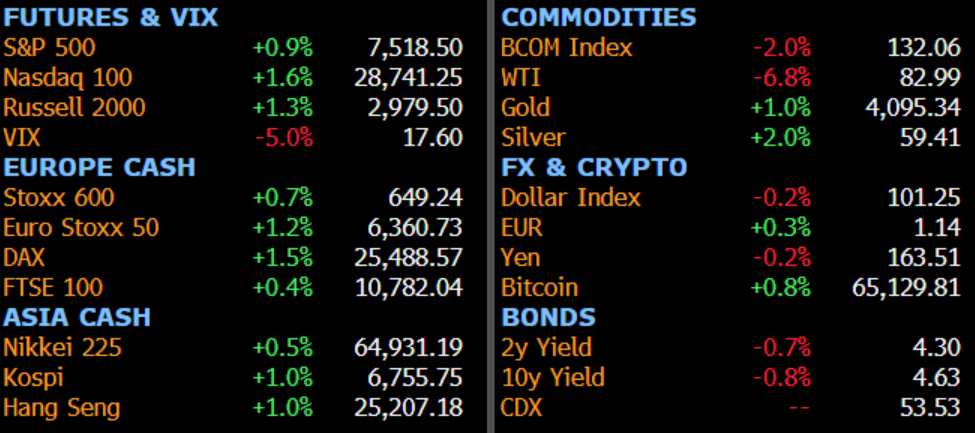
Top Overnight News
- Iran will halt its own attacks as long as the United States does the same, a senior Iranian official told Reuters on Sunday. The development comes as the United States pressed pause on its bombing campaign after President Donald Trump’s advisers told him they were running out of targets and expressed worries about depleting the U.S. arsenal. RTRS
- A US appeals court refused the DOJ’s request to let federal officials move ahead with Trump’s mail-voting overhaul ahead of the November midterm elections. BBG
- DeepSeek is said to have told prospective investors it’s pausing a fundraising round, after comments widely attributed to its founder about US-China AI competition went viral. BBG
- CXMT jumped 466% in its Shanghai debut after the chipmaker raised $9.8 billion in its IPO, turning it into China’s largest onshore-listed company. BBG
- The ECB will have to raise interest rates at least one more time to ensure that inflation risks don’t spin out of control, Governing Council member Peter Kazimir said. BBG
- The Agriculture Department is lifting a more than yearlong ban on Mexican cattle imports, a move that could ease soaring beef prices. The U.S. plans to resume importing Mexican cattle at the port of entry in Douglas, Ariz., in 30 days and eventually open two additional ports of entry in New Mexico.
- Big Companies Are Starting to Hire Again, Defying Predictions of AI Wipeout. After a year of holding back on new hires, companies from tech and transportation to defense now say they need more people to work alongside AI. WSJ
- Employers fear labor shortage as many immigrants lose protected status. A recent Supreme Court ruling cleared the way for the Trump administration to end a humanitarian program that has allowed about 1 million immigrants to work illegally in the US. NYT
- Nvidia is in talks to provide a guarantee of as much as $250 billion to help OpenAI lease computing from a data center project in Ohio, people familiar said. BBG
- Mirroring the pre-election patterns in uncertainty, volatility, and investor flows, US equities have typically traded sideways in the few months ahead of midterms. US equity returns are generally modest during this part of the calendar year but have been weaker on average in midterm election years. During midterm election years of the past few decades, the S&P 500 has generated a median return of 0% from the start of August through Election Day. Returns have typically improved as uncertainty subsided post-election, with the S&P 500 returning a median of 6% in the subsequent 3 months. Goldman Research
- Sources say Bipartisan Senate talks over funding federal agencies past the 30th September deadline are trending in the right direction: Punchbowl
- A more detailed look at global markets courtesy of Newsquawk
APAC stocks were mostly positive, with risk sentiment underpinned as oil prices and yields declined following a halt in US-Iran strikes over the weekend, although some of the gains are capped, with price action somewhat choppy during the session as participants also await several major central bank meetings and key earnings later in the week. ASX 200 was led higher by strength in tech, materials and miners, while energy and defensives lag.
Nikkei 225 swung between gains and losses with price action choppy amid recent currency moves, intervention risks, lower yields, and softer-than-expected Services PPI data, while participants also await the BoJ later in the week. KOSPI saw two-way trade and ultimately declined despite reports of NVIDIA deals with South Korean firms including SK Group and Naver, with the sector cautious ahead of key tech earnings. Hang Seng and Shanghai Comp were positive as Hong Kong was led higher by tech stocks including CXMT stakeholders such as Xiaomi and Meituan, with energy at the other end of the spectrum following the drop in oil prices, while the attention in the mainland was on CXMT, which soared over 500% on its debut in Shanghai’s STAR Market, making it mainland China’s most valuable company by market cap.
Top Asian News
- Chinese President Xi holds phone talks with Brazilian President Lula, while Xi called for China and Brazil to play a greater role in improving the global governance and upholding international fairness and justice. said:. China is ready to further strengthen bilateral multilateral strategic coordination with Brazil. China and Brazil should jointly promote high-quality development of the Greater BRICS Corporation. Supports Brazil in rejecting external interference.
- Seven new suspected H5 bird flu cases were identified in South Australia.
- Japanese PM Takaichi said the government is ready to take further timely action as needed to cushion economic blow from the Middle East conflict, adds FX rates move on various factors and it’s hard to identify impacts of any specific factor. said:. Raising Japan’s growth potential and its competitive advantage will boost market trust in the yen. Monetary policy adjustment and specific monetary policy means are up to the BoJ to decide.
- Japanese PM Takaichi will address measures including a consumption tax reduction in her press conference later today.
- Japanese PM Takaichi said cutting debt-to-GDP ratio is key to fiscal management.
- Japanese PM Takaichi does not comment about the possibility of a cabinet reshuffle.
- Japanese panel said to be looking at revising up minimum wage target; looking at hiking to “high JPY 1100 range”, Kyodo reported.
- Japan PM Takaichi noted Japanese inflation is amongst the lowest in the G7, adds that there are encouraging signs emerging for the wage outlook.
European Bourses – Begin the week firmer (STOXX 600 +0.8%) as oil prices and yields fall after the US halts strikes on Iran. The DAX outperforms as SAP continues to climb, while Spain’s IBEX is supported by strength in Retail and Travel. The FTSE 100 and OMX Copenhagen lag as Shipping and Oil majors come under pressure. Sectors – Trade broadly higher, with the exception of Energy and Utilities. Moves are driven by geopolitical de-escalation, with Retail and Travel & Leisure leading, while Tech also outperforms following CXMT’s surge on its Shanghai debut.
Top European News
- European Commission is considering watering down a large business levy which was designed to raise funding relating to the next 7yr budget, Politico reported citing sources. Officials said to be considering exempting loss-making companies and raising the revenue threshold to exclude smaller businesses for the “Corporate Resource for Europe” charge.
- UK PM Burnham hinted he will make it more difficult to claim benefits to bring down the welfare bill, according to Huffington Post. It was separately reported that Burnham said UK must get really serious about cutting welfare.
- France questioned UK involvement in EU’s EUR 5bln tech start-up fund, according to FT.
- Italy cabinet to meet at 16:30EDT/17:30CET to discuss diesel costs.
FX
- DXY – Softer (-0.2%) as oil and yields moderate following the US halt to strikes on Iran. The index trades within a tight 101.11–101.32 range, with the geopolitical pause and easing tightening bets weighing on the Buck, though the outlook remains fluid ahead of the Fed this week.
- JPY – Firmer amid the softer USD backdrop and lower yields though moves remain contained in a 163.32-163.71.
- EUR- EUR is stronger against the USD, with EUR/USD briefly moving above 1.14 to a 1.1418 peak before paring gains. Newsflow light, with Ifo broadly in line and focus turning to upcoming growth and inflation data later in the week.
- GBP – GBP is modestly firmer vs USD but underperforms EUR, with EUR/GBP higher. Price action is likely driven by the unwinding of recent Sterling outperformance, while attention turns to the BoE meeting where a pause is expected, with the vote split in focus.
- Antipodeans – Antipodeans outperform as risk sentiment improves, supported by the pullback in oil and yields alongside the broader USD softness.
- RBI likely sold USD via state run banks to lift INR past 96, according to traders.
- PBoC set USD/CNY mid-point at 6.7911 vs exp. 6.7703 (prev. 6.7939).
Fixed Income
- UST – Firmer, benefiting from the pullback in energy prices following the pause in US strikes on Iran. The contract reaches a 108-22 peak, up around 10 ticks on the day, though remains shy of recent 109-00 and 109-08+ highs. Focus turns to upcoming 2yr and 5yr supply, while broader attention also builds around US midterm developments.
- Bund – Bunds move in tandem, lifting to a 124.95 peak but failing to test the 125.00 handle or last week’s 125.10 high. There was little reaction to the Ifo release, which is broadly constructive despite softer current conditions, nor to ECB’s Kazimir, who reiterated a hawkish stance with a high bar to avoid a September hike.
- Gilt – Gilts gap higher and extend gains by over 50 ticks, approaching but not reaching last week’s 87.37 peak. The move is driven by the broader fixed income bid on lower yields, with some additional support from reporting around PM Burnham’s approach to the welfare bill.
- Australia sold AUD 300mln 3.00% March 2047 bonds b/c 3.22, avg yield 5.4319%.
Commodities
- Crude futures – Crude was sharply lower following the US pause in strikes on Iran, though losses were trimmed into the European morning. Brent Oct’26 fell over 7% at worst to USD 84.91/bbl (vs high USD 88.95/bbl), while WTI Sep’26 dropped to a USD 82.46/bbl trough (vs peak USD 86.20/bbl). Dutch TTF also slumped, dipping below EUR 58/MWh before recovering towards EUR 59.50/MWh.
- Precious metals – Precious metals were firmer intraday but off best levels as energy pared losses. Spot gold traded towards the lower end of a USD 4,083.80–4,116.19/oz range (vs Friday’s USD 4,052/oz close). Spot silver similarly sat towards the bottom of a USD 59.08–60.09/oz range (vs Friday’s USD 58.20/oz low).
- Base metals – Base metals posted modest gains but also came off highs as energy recovered. 3M LME copper traded within a narrow USD 13,615.00–13,730.43/t range.
- CPC’s Black Sea terminal expected to resume oil loadings today following a one week suspension after drone attacks, sources say.
- Iraqi militias and political parties have received official approvals to establish oil facilities; Iraq has allocated about 1.5mln BPD for domestic consumption, including 300K BPD for the Ministry of Electricity. The reported note that more than a third of Iraq’s oil production revenues since 2011 have gone to militias and political parties.
- A magnitude 5.5 earthquake struck the Antofagasta region of Chile, according to EMSC.
Central Banks
- ECB’s Kazimir said second round effects are costly to reverse, ECB must act before they are visible; at least one more hike needed as part of measured adjustment to inflation risks. A rate hike will be warranted even if the inflation situation improves somewhat. Should the situation escalate, with the price pressures becoming stronger and more persistent, we will need to tighten more over the next quarters than is currently expected. Incoming data and geopolitical developments would need to be very convincing to do for me not to advocate another hike in September; We didn’t surprise the markets now, we shouldn’t surprise them in September.
- Swiss Total Sight Deposits (w/e Jul 18) 469.27bln (prev. 469.4bln W/W), Domestic 442.66bln (prev. 443bln W/W).
- Indonesia Central Bank Governor Perry Warjiyo steps down due to personal reasons, while Deputy Governor Destry Damayanti will act as interim Governor. Damayanti said Bank Indonesia will continue to prioritise professional governance and will work with the government to run the economy, also said they will do their mandate as normal and in accordance with best practices.
- Monetary Authority Singapore slightly raises the rate of appreciation of the SGD NEER policy band, while it makes no change to the width and level it is centred. said:. Inflation could pick up more strongly than anticipated if energy price spikes anew. MAS core inflation is projected to step up from July and remain elevated, but should moderate discernibly from around mid-2027. Expectation is that overall GDP will be sustained at high levels in the near term. Singapore’s economy is forecast to record a firm pace of growth for 2026 as a whole. Singapore’s imported costs are likely to rise in the quarters ahead.
Trade/Tariffs
- China Foreign Ministry said China’s countermeasures on EU do not target any one country.
Geopolitics: Russia-Ukraine
- US President Trump will meet with Ukrainian President Zelensky at the White House on Tuesday, according to Axios.
- Ukraine air force noted ballistic missile threat from the east and UAV detected in Dnipropetrovsk region.
- Multiple apartments and 15 vehicles are on fire in Russia’s Belgorod after a UAV attack, according to TASS.
Geopolitics: Middle East
- Iranian Foreign Ministry spokesperson said some countries in the region are continuing to be involved in the conflict, they need to stop. The conversation between Iran and Oman regarding Hormuz have been positive.
- Iranian Foreign Ministry spokesperson, in an interview on Sunday, said Iran has no fear of negotiations, but it will not accept negotiations whose goal is to dictate or impose demands.
- Yemen Navy official said that a Navy patrol boat was attacked and destroyed on Sunday in the Red Sea, which left three crew members missing and the official blamed Houthi militants firing from several small boats.
- Fewer than 10 ships transited the Strait of Hormuz daily over the weekend, according to shipping data. It was separately reported that shipping traffic through Bab el-Mandeb fell on Sunday after Yemeni Houthis attacked Saudi oil installations along the Red Sea coast.
- US Central Command Commander Cooper stressed that the two weeks of strikes in the Strait of Hormuz area had significantly degraded Iran’s ability to attack ships, according to Axios’s Ravid.
- Iran’s Foreign Ministry spokesperson said diplomacy remains open, but our priority is defending the nation.
- Yemen’s Houthis said on Sunday that it attacked three Saudi oil tankers in the past 48 hours and is enforcing maritime blockade measures against vessels linked to Saudi Arabia.
- Houthi-Affiliated Al Masirah TV said Saudi strikes attack Yemen’s Kamaran Island.
- Iranian Foreign Ministry Araghchi met with his Chinese counterpart, Mehr News reported; the sides discussed the Middle East situation.
- Iranian Foreign Ministry spokesperson said they have not accepted a 10 day ceasefire.
- Iranian Foreign Ministry spokesperson said they have not requested the resumption of talks with the US, intermediaries are conveying messages to the US. Kuwait has effectively made its territory available to the US.
- Iranian Foreign Ministry spokesperson said the situation around Hormuz has not changed, it remains shut.
- IDF intercepted two drones over the border with Jordan, TimesofIsrael’s Fabian reported.
- Iranian army reiterates that it will response more severely to “any possible incursions by the enemies”, Tasnim reported.
- Saudi Foreign Ministry said Saudi Arabia discussed with Oman the issue of ensuring the freedom and safety of navigation in the Strait of Hormuz, Al Hadath reported.
- Iranian TV said a ship was involved in an accident, and five ships that attempted to pass through the Strait of Hormuz via the unsafe passage this morning were turned back.
- Explosion reported in Erbil, Northern Iraq, according to Press TV.
- Israeli forces raid areas in West Bank and Jerusalem, according to IRNA.
- Sources told Asharq that Trump and Aoun are discussing a security agreement between Washington and Beirut.
- UK PM Burnham and Saudi Crown Prince MBS discussed regional developments in a telephone conversation, according to IRNA.
- An oil tanker exploded in the Strait of Hormuz after hitting a naval mine when it deviated from a navigation route designated by Iran, Mehr News reported.
- Iranian media reported of explosions in Jordan.
- Jordan Army said it downed two drones.
- Israel PM Netanyahu is travelling to Washington for a White House meeting with President Trump tomorrow, I24 reporter said.
Geopolitics: Other
- Israeli official said PM Netanyahu’s planned visit to Washington has been postponed; no reason cited, and no new date has been set.
- CPC’s Black Sea terminal expected to resume oil loadings today following a one week suspension after drone attacks, sources say.
US Event Calendar
- 8:30 am: Jun P Durable Goods Orders, est. 1.8%, prior -4.5%
- 8:30 am: Jun P Durables Ex Transportation, est. 0.8%, prior 1.4%
- 10:30 am: Jul Dallas Fed Manf. Activity, est. 2, prior 0
DB’s Jim Reid concludes the overnight wrap
Thankfully, in light of my weekend golf-a-thon, the escalating conflict in Iran has paused somewhat. After 13 consecutive nights of US strikes aimed at degrading Iran’s ability to threaten commercial shipping, Washington has refrained from further attacks since late Friday, while Tehran has publicly stated that it has also suspended retaliatory operations. The pause falls short of a formal ceasefire, but both sides are presenting it as an opportunity for diplomacy, with Omani-mediated talks continuing over the weekend focused on navigation through the Strait of Hormuz. US officials, including UN Ambassador Mike Waltz, have stressed that all military options remain on the table and that President Trump is simply giving negotiations more space. However, reports from the New York Times and Axios suggest an active debate within the administration over both the effectiveness and costs of further strikes, with some military officials reportedly arguing that key objectives have largely been achieved. For now, the market is treating the lull as a positive development, although the situation remains highly fluid.
The main market risk remains the energy and shipping front. Traffic through Hormuz remains severely disrupted, while the conflict has broadened into the Red Sea, where Iran-backed Houthi forces reportedly launched missile and drone attacks against Saudi energy infrastructure around Jizan and Yanbu over the weekend, prompting retaliatory Saudi strikes. This raises the prospect of simultaneous disruption to both Gulf and Red Sea export routes. So a welcome pausefrom the main actors but a fragile one, especially with side battles still ongoing.
However there is no doubt the weekend news is positive and this morning Brent crude prices are around -4.5% lower to $92.42 and 10yr USTs are down -4.5bps. S&P 500 futures are up +0.71% with Nasdaq futures gaining +1.17%.
Also on the positive side, the S&P/ASX 200 (+1.14%) is leading regional gains, while the Hang Seng (+0.81%), CSI 300 (+0.25%), and Shanghai Composite (+0.40%) are all higher. However the KOSPI (-0.28%) and Nikkei (-0.14%) are lagging with their tech stocks on the weaker side.
Looking forward, and as more and more of the financial world steps off the ever-turning carousel of market news and disappears towards sunnier shores, a busy global week lies ahead, with central bank decisions, major economic releases and a heavy slate of corporate earnings all competing for investors’ attention. The Federal Reserve meeting concluding on Wednesday remains the standout event, but investors will also hear from the Bank of England (Thursday) and the Bank of Japan (Friday). Meanwhile, key economic releases include US Q2 GDP and June core PCE inflation (both Thursday), Euro Area Q2 GDP and July inflation data (Thursday/Friday), Japan’s Tokyo CPI (Friday) and China’s official PMIs (Friday). Adding to the significance of the week, four of the world’s most influential companies—Microsoft, Meta, Apple and Amazon, which together account for 17% of the S&P 500—will report earnings, with the first two on Wednesday and the latter two a day later.
The headline event of course comes with the FOMC meeting (Wednesday), where our economists continue to expect the Fed to leave rates unchanged. However, the decision appears unusually finely balanced. The renewed escalation in the Middle East and the sharp rise in energy prices have complicated the inflation outlook, while recent market-based measures of inflation compensation have moved higher as concerns around energy supply disruptions have intensified. Against that backdrop, policymakers face a difficult trade-off between evidence that inflation had been moderating and growing signs that higher oil prices could create a more persistent inflation shock.
It’s rare for a Fed meeting to be this finely balanced so close to the decision. Futures are still assigning a 34% probability to a rate hike this week (-4pps overnight in Asia), a level of uncertainty we seldom see at such a late stage. During the post-Covid hiking cycle, markets did receive a steer via the financial press during the blackout period if the Fed was considering a surprise move. Under the current regime, that appears far less likely.
The Fed decision will sit in the middle of several important data releases. Durable goods orders (today) and the advance goods trade balance (tomorrow) will help shape expectations for the first estimate of Q2 GDP (Thursday). Our economists expect annualised GDP growth of 1.9% in Q2. Although this would mark a downgrade from earlier estimates, much of the weakness reflects a drag from net exports linked to strong AI-related imports. Beneath the surface, domestic demand remains considerably healthier. Indeed, our economists expect final sales to private domestic purchasers, their preferred measure of underlying demand, to rise by a robust 3.3%, which would be the strongest reading since Q3 2024.
Attention will then turn to inflation. The June personal income and spending report (Thursday) includes the latest reading of core PCE, the Fed’s preferred inflation gauge. Our economists expect core PCE to increase by 0.19% month-on-month, which would leave the annual rate at 3.3% assuming no significant revisions. That will be followed by the Employment Cost Index (Friday), one of the Fed’s preferred measures of labour cost pressures. Our economists expect the annual growth rate to remain at 3.4%, a level many policymakers would still view as broadly consistent with returning inflation towards target over time.
Alongside the macro data, earnings season moves into a critical phase. Around 35% of the S&P 500’s market capitalisation is scheduled to report this week. Technology will dominate attention, with Microsoft and Meta releasing results (Wednesday), followed by Apple and Amazon (Thursday). Together, those companies account for 17% of the S&P 500 and will help determine whether investor enthusiasm around AI-related spending remains intact. Elsewhere, notable US earnings releases include Visa and Mastercard in financials, ExxonMobil and Chevron in energy, and Coca-Cola and Procter & Gamble in consumer staples.
In Europe, attention will be split between monetary policy and inflation. The Bank of England announces its latest policy decision (Thursday), and our UK economists expect Bank Rate to remain unchanged at 3.75%, accompanied by a 7-2 vote split. See more in their full preview here.
On the data side, Germany and Spain release flash July CPI figures (Thursday), before France, Italy and the Euro Area publish their inflation readings (Friday). Our European economists expect Euro Area headline HICP inflation to rise to 3.0% from 2.8%, while core HICP is forecast to edge higher to 2.52% from 2.36%. The Euro Area’s preliminary Q2 GDP estimate is also due (Thursday), while Germany’s Ifo survey (today) should provide an updated read on business sentiment.
In Asia, the Bank of Japan decision (Friday) will be the key event. Our economists expect policymakers to keep their current policy settings unchanged. See the preview here. Japan will also release Tokyo CPI, retail sales, industrial production, labour market data and housing starts (all Friday), offering a comprehensive snapshot of the economy at the start of the third quarter. In China, the official manufacturing and non-manufacturing PMIs (Friday) will provide the latest evidence on growth momentum. Elsewhere, Australia’s June CPI report (Wednesday) will be closely watched for indications about the Reserve Bank’s policy path. See the day-by-day calendar at the end for the fuller slate of events this week.
Recapping last week now and oil prices continued to surge as the US-Iran conflict escalated further, with Brent crude up another +9.85% last week (-3.88% Friday) to $96.78/bbl, and peaking above $100. So that added to fears that the global economy was facing a prolonged inflation shock, and that the Fed might need to hike rates more aggressively in response. Indeed, market expectations for a Fed rate hike on Wednesday moved up from 14% to 38% over the course of the week.
The prospect of more inflation and faster rate hikes meant that sovereign bond yields rose sharply around the world. For instance, the US 10yr Treasury yield was up +12.9bps last week (-1.6bps Friday) to 4.68%, and on Thursday it closed at its highest level since January 2025, at 4.69%. There were also some big milestones for real yields, with the US 30yr real yield up +7.9bps last week (+0.3bps Friday) to a post-2008 high of 2.97%. It was a similar story elsewhere, with Germany’s 10yr bund yield up +4.7bps last week (-3.1bps Friday) to 3.17%, and on Thursday it closed at a post-2011 high of 3.20%.
Against that backdrop, equities put in a mixed performance around the world. In the US, the S&P 500 fell -0.61% (+0.05% Friday), marking back-to-back weekly declines for the first time since March. That happened despite a recovery in chip stocks, with the Philly semiconductor index up +1.24% last week (-4.25% Friday). And outside the US, equities put in a stronger performance, with the STOXX 600 up +0.46% last week thanks to a +0.82% recovery on Friday as hopes for new US-Iran talks rekindled. The Nikkei was up +0.73% (-2.73% Friday).
Finally in other asset classes, geopolitical fears offered support to the US dollar, with the dollar index +0.70% last week, whilst gold rose +0.88%. Meanwhile, credit spreads widened in the US, with IG spreads (+2bps) and HY spreads (+12bps) both moving higher. And in Europe, IG spreads were flat, while HY spreads widened by +5bps.
Tyler Durden
Mon, 07/27/2026 – 08:22