Chicago wheat futures are coiling for a breakout (one way or another) as ongoing Russia-Ukraine attacks on Black Sea grain infrastructure and bulk carriers threaten exports from one of the world’s most important breadbaskets.
Most-active Chicago wheat has been choppy in the last few days…

Hard red winter wheat gained as much as 2.7% to $7.505 a bushel.
Soft Red Winter wheat futures are poised for a much larger breakout if prices sustain a move above $7 a bushel.
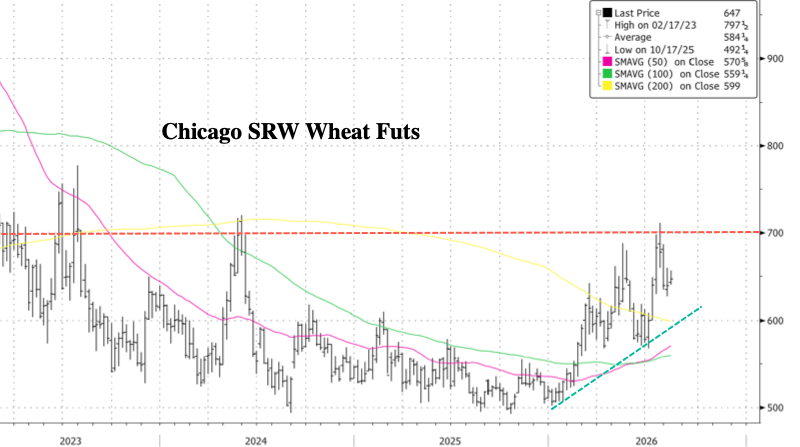
Bloomberg noted Monday that Turkey temporarily suspended Black Sea transits by its cargo ships over the weekend amid ongoing maritime security risks in the critical shipping corridor. Ukraine warned that its agricultural exports for the 2026-27 season could be halved due to Russian attacks.
Joe Davis, director of commodities at brokerage Futures International, was quoted by the outlet as saying that potential supply disruptions had boosted US-grown hard red winter varieties more sharply because the grain is seen as a direct competitor to higher-protein milling wheat from the Black Sea region and Europe.
“While the disruptions don’t necessarily translate into immediate additional US export business,” Davis said, adding, “they do tighten the global exportable supply outlook and balance sheets, forcing importers to diversify origins and keeping support under higher-quality wheat values.”
With wheat prices inching higher and approaching $7, which could spark upside momentum, a gauge of global food prices tracked by the UN climbed to a three-year high in July.
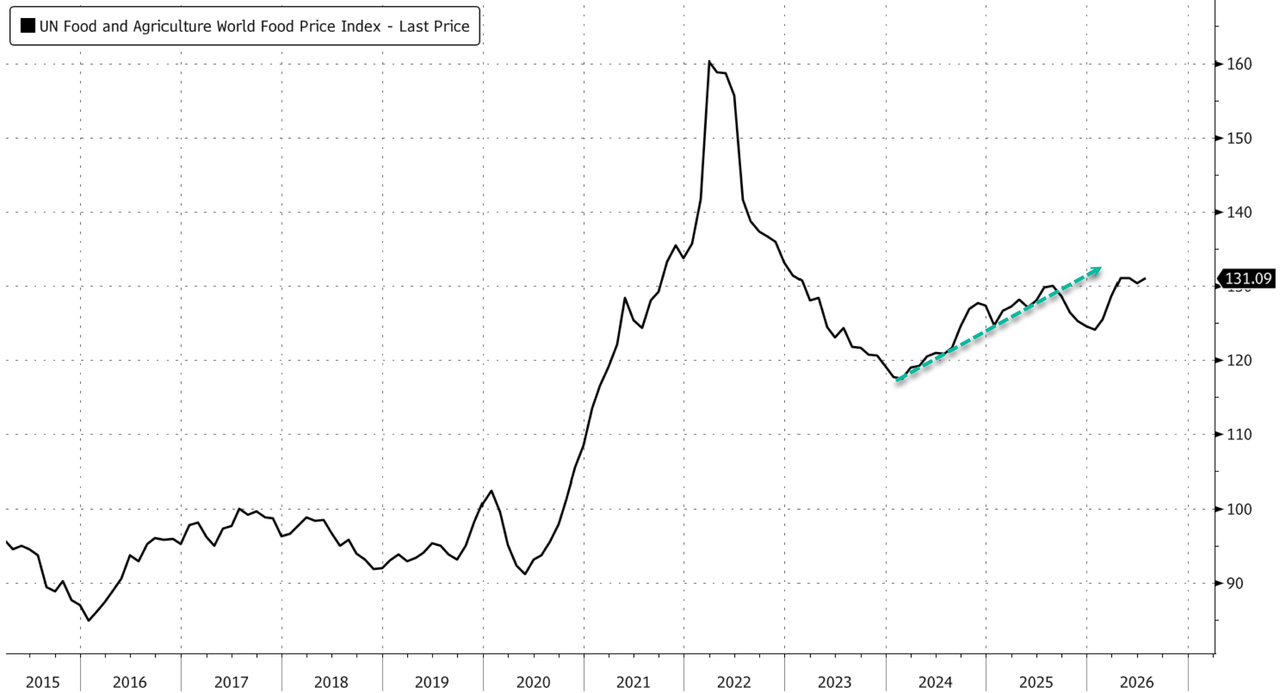
Disruptions not only in the Black Sea but also in the Strait of Hormuz, combined with adverse weather conditions across key US and other key growing regions as El Niño risks rise, are certainly putting a bid under food prices, as the worst may be yet to come.
UBS analysts outlined five forces driving grocery bills higher in a note last week (report here). They asked a very important question: Is this the end of cheap food?
Tyler Durden
Tue, 08/11/2026 – 10:50