Wall Street Warns About “Perfect Storm” Diesel Crunch:
- Goldman’s Daan Struyven Shows Global Diesel Exports Crashing
- Citi’s Anthony Yuen Warns: Global Diesel Inventories “Below 5YR Minimum“
- BofA’s Francisco Blanch Warns: “Diesel’s Perfect Summer Storm” Unfolding
- Jefferies’ Sam Burwell Warns: Hormuz Shock “Manifesting Itself In Cracks, Not Crude”
Brent crude remains hostage to daily geopolitical developments in the Gulf region more than five months into the conflict, with muted traffic through the Strait of Hormuz (read the latest US-Iran wrap) constraining tanker flows and driving refined-product markets to new, dire extremes as they become the focal point of the energy crisis.
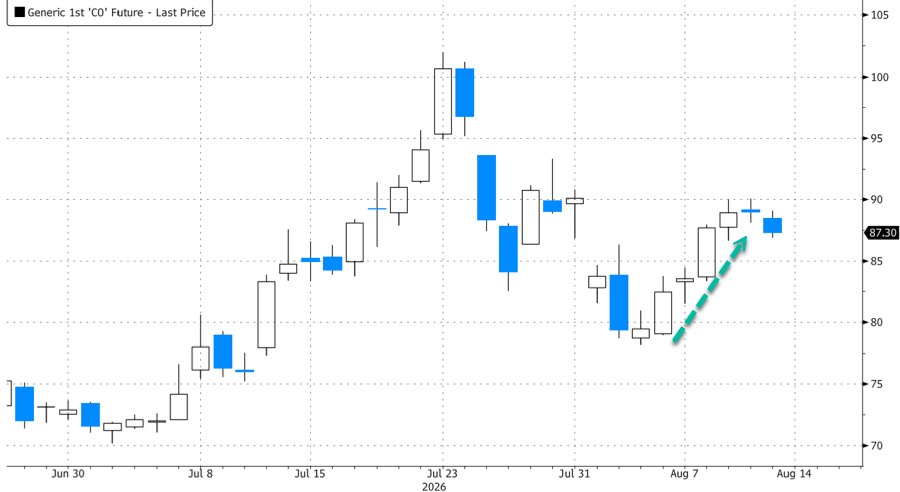
Brent briefly fell below $80 a barrel last week as prospects improved for an Iran-Oman deal to reopen the maritime chokepoint, before rebounding toward $90 as negotiations stalled this week.
Hormuz traffic has stabilized at about 10 crossings a day, down from 30 to 40 before the latest escalation. Liquids flows are averaging roughly 4 million barrels a day, well below public estimates of 9 million, according to HSBC analysts.
We earlier cited Jefferies analyst Sam Burwell, who warned clients:
“What this all shows is that global oil-market tightness is manifesting itself in cracks, not crude, at least for now. Wide cracks suggest refining runs should remain strong, however, which is positive for crude.
By lunchtime Thursday, the front-month US diesel crack spread (HOCL1 on the Terminal) had exceeded the $97 level reached in mid-March, when the US-Iran conflict was just three weeks old, and was closing in on $100. That signals extreme tightness in diesel.
Diesel crack spread hits record high, just shy of $100 https://t.co/pxNKK1OUeR pic.twitter.com/uAciv62yPk
— zerohedge (@zerohedge) August 13, 2026
Francisco Blanch, head of commodities at Bank of America, warned clients in a note earlier titled “Diesel’s Perfect Summer Storm” that the industrial fuel is “materially disrupted in 3 of 4 major regions” around the world.
As we recently warned (see report: The crude reality of oil markets), supply disruptions are amplifying the squeeze on petroleum markets.
Three of the world’s four major refining hubs remain impaired for one reason or another.
First, the closure of the Strait of Hormuz and adjacent military activity has reduced Middle East fuel exports, with the recent Houthi strike on Saudi Arabia’s Jazan refinery being the latest example.
Second, record Russian refining disruptions following Ukrainian strikes have removed significant volumes from the global diesel pool.
Third, fearful of potential domestic shortages, China has yet to restart petroleum product exports to the Asia region. As such, Europe has increasingly relied on record US exports to fill the gap.
Yet those flows are drawing down already tight US inventories, the only major hub open for business, creating a global competition for fuel that is pushing diesel cracks back toward record seasonal highs.
Beyond Ukraine drone-striking Russian energy assets, Moscow has decided to ban diesel exports; yet again, more evidence of dwindling global supplies:
One month later, Diesel spreads hit all time high https://t.co/3GROS40xsr
— zerohedge (@zerohedge) August 13, 2026
Separately, Anthony Yuen, managing director and head of energy strategy at Citi Research, warned clients that global observed diesel inventories are “below the five-year minimum and not substantially lower than this,” adding, “The last time inventories were at a similar level was in 2022, when gasoil cracks globally were about $20/bbl lower than currently observed, and they were meaningfully lower in 2018.”

Goldman’s commodities expert Daan Struyven told clients earlier today:
Since the Iran war began, we have viewed the Hormuz shock as more disruptive for refined products, especially diesel, than for crude.
Near-record prompt diesel margins have already triggered a strong supply response from refiners with spare capacity, including higher utilization and a shift in yields toward diesel. As a result, outright diesel shortages still look unlikely this year.
Struyven showed that global diesel exports are crashing.

Kpler data suggest that Persian Gulf flows are down 80% year over year for diesel, versus 48% for crude.

BofA’s Blanch noted, “In short, absent a meaningful supply recovery, the diesel market appears poised to stay tight, volatile, and expensive well into next year.”
The clearest signal of how far the energy crisis has spread, even as Brent and WTI remain relatively calm, is now visible in refined-product markets, particularly diesel, where the blowout in crack spreads signals a severe global supply squeeze.
Hormuz Shock “Manifesting Itself In Cracks, Not Crude,” Jefferies Says
Brent crude futures held near recent highs of $90 a barrel before fading to around $87 early Thursday morning, as traders awaited progress toward reopening the Strait of Hormuz. Stalled US-Iran negotiations and tightening global fuel supplies continued to support prices and concern some top energy experts, who warn of a looming supply shock.
US-Iran talks remain deadlocked to end the week as the Trump administration maintains its blockade of Iranian ports and Tehran demands compensation for war-related damage. Pakistan, which has served as a mediator, said the broader peace talks had stalled.
Late Wednesday, President Trump wrote in a Truth Social post that the USA has “total control” over the Strait of Hormuz and “I think we will keep it.” It’s also yet more confirmation that he’s opting for economic siege warfare while the US military campaign is on hold.
Polymarket odds for “US-Iran 60-day negotiation period extended?“ currently stand at around 25%, down from 80% one week ago.
So far, Brent crude is headed for a weekly advance of nearly 5% as a near-term resolution to the US-Iran conflict remains murky and Ukrainian and Russian attacks on energy infrastructure tighten oil and, more critically, diesel markets.
Last week, our note titled “Winter Is Coming“ for Europe outlined how the energy-stricken continent faces a twin diesel and natural gas crunch.
Samantha Dart, co-head of global commodities research at Goldman Sachs, told Bloomberg TV early last week that the global diesel-supply crunch is “what keeps her up at night.”
Saxo Markets strategist Charu Chanana said volatility will remain elevated until Hormuz reopens and the outlook for production becomes clearer.
Making matters worse, the International Energy Agency released a report on Wednesday that forecast a 1.8 million-barrel-a-day deficit this quarter, more than double its previous estimate. The agency also warned that elevated prices are beginning to crush demand and projected the widest annual supply shortfall in five years.
Offsetting higher prices was bearish US inventory data showing that crude stockpiles surged by 17.4 million barrels last week, the largest increase since January 2023, as exports weakened and imports from Saudi Arabia and Venezuela increased.
Jefferies analyst Sam Burwell, who specializes in oil, gas and energy infrastructure equities, wrote in a note Wednesday that showed oil-market extremes in three charts:
Three Pictures Worth 1,900 Characters – Oil Market Extremes
We return from an earnings hiatus (and step outside Canada) to show some current extremes in global oil markets. Chinese crude imports bounced a bit in July but remain far below the prior run rate. While crude is well off its highs and never made a historic spike, diesel cracks are far above prior all-time highs (gasoline is strong, too). China remains the wild card, but we think this setup is constructive for crude (and, by extension, the Canadian energy complex).

Chart #1 shows monthly Chinese crude imports. The massive ~5 mmbpd downshift in imports following the Hormuz closure demonstrated the extent of China’s demand elasticity. July did see a ~1 mmbpd m/m increase from June’s low. With somewhat higher crude prices and fewer vessels moving through Hormuz more recently, we’ll see what August and beyond bring. However, we note that a return to the ~11 mmbpd five-year average would imply ~3 mmbpd of incremental demand.

Chart #3 shows that while diesel and gasoline prices are, of course, elevated, they are much closer to, or within, prior historical highs. Notably, clean-product prices in 2008 were similar to today’s on a nominal basis (and therefore higher in real terms).

What this all shows is that global oil-market tightness is manifesting itself in cracks, not crude, at least for now. Wide cracks suggest refining runs should remain strong, however, which is positive for crude. While US refinery utilization dipped w/w, it remains near 20-year seasonal highs.
China is the crude-demand wild card, but with such wide cracks, one wonders how long it will be before the Chinese begin importing more crude to export more refined products (or simply replenish their own product/petchem stocks). Imports in the coming months will be telling as to how elastic China’s buying remains.
In short, unless the Strait of Hormuz reopens soon and fuel supplies recover meaningfully, the focus will remain on refined-product markets, particularly diesel. The critical industrial fuel is being squeezed globally, and as Bank of America’s commodities team warned, “the diesel market appears poised to stay tight, volatile, and expensive well into next year.”
Professional subscribers can read a lot more energy content at our new Marketdesk.ai portal.
Tyler Durden
Thu, 08/13/2026 – 12:50