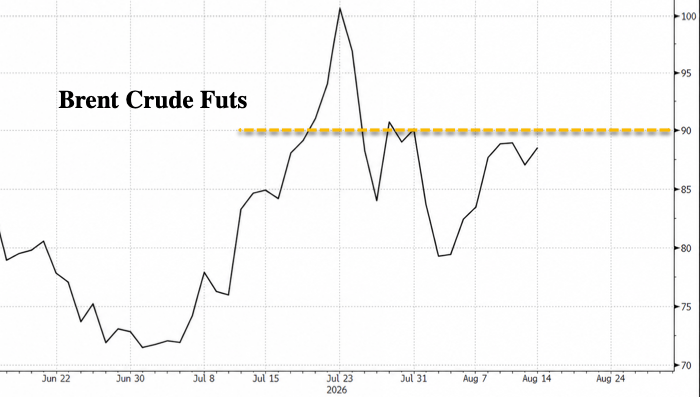
Brent crude futures ended last week near $88.50 a barrel as traders awaited details of Treasury Secretary Scott Bessent’s planned escalation campaign of the economic war against Iran.
Bessent said Friday that Washington would announce unprecedented economic-isolation measures next week, warning that the coming pressure campaign would be unlike anything “seen in the history of economic isolation on a country.”
US Treasury Secretary Scott Bessent announced upcoming unprecedented economic measures against Iran amid ongoing blockades of its ports pic.twitter.com/OV3etgd2k0
— Chay Bowes (@BowesChay) August 14, 2026
For clarity on Bessent’s upcoming economic-isolation operation against Iran, Derek Holt, head of Capital Markets Economics at Scotiabank in Toronto, provided clients with an assessment in which Bessent’s warning could signal a move well beyond sanctioning shadow tankers and refiners, toward dismantling the entire financial network supporting Iranian oil exports.
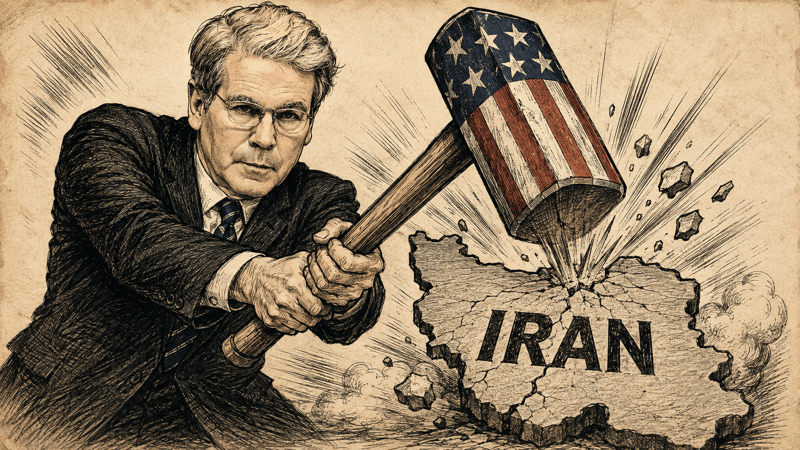
Holt explained:
WHAT COULD BESSENT MEAN?
What could Bessent do to economically isolate Iran further that has “never been seen”?
• Target China and India: China is the main buyer of Iranian oil and is involved in undermining US sanctions. The US sanctions some individual Chinese entities and, in April, announced sanctions against Chinese “Teapot” refineries (here). The US could step up its actions by sanctioning all Chinese banks, this time including large institutions, and blocking their access to the US and global financial systems. That would push China further away from the SWIFT system and block access to correspondent and other forms of banking. It could block access to US dollar funding markets. This would very likely enrage China and risk multiple forms of retaliation and escalation.
• Broaden the scope of sanctions on Iran: This would extend the scope to any global group, company or entity involved in buying, financing, insuring or shipping Iranian oil. Looking at you, global banks, currency exchanges, commodity traders, shippers, etc. Actions under this category would aim to entirely thwart the sale of oil from Iran to China in yuan and its conversion into dollars and other currencies via exchange houses in Iran and elsewhere. You target other Middle Eastern nations facilitating this trade by blocking their access to dollar funding and global banking markets, such as Dubai’s one-foot-in-and-one-foot-out stance on the war, which continues to facilitate Iranian transactions. Dubai fancies itself a financial center; you destroy such ambitions.
• Target Iranian crypto assets: This Treasury announcement last month targeted individuals and entities under a specific Iranian person’s name. The US could broaden this action to include freezing access to all Iranian global holdings of crypto, gold, real estate, foreign accounts, etc.
• Target global ports: Any foreign port that facilitates trade and transactions with shipping companies that transited Iranian ports could be targeted.
He continued:
And there may well be other creative options in scale and scope. The broad point is to escalate the economic and financial blockade of the Iranian economy and financial system by enveloping all parts of the global economy, namely China, and the global financial system that allow Iran to continue to sell oil and access funding markets.
Would it work? I’m not sure. Iran knows suffering. Iran is used to being a pariah. Iran still has friends in low places. Iran has its own means of escalating, including unleashing unspeakable terror.
The consequences to the global economy and financial system could also limit or entirely thwart the chances of success. I’m sure they know the risks, but Treasury would sharply amplify tensions with China and India and could potentially cripple individual banks while not ruling out increased systemic risk within the broader financial system. Cutting off access to dollar funding markets could destabilize major players in the financial system. The spillover effects through a complicated web of connections shouldn’t be treated lightly.
The US is finally getting that it can’t just bash and bomb its way to victory against Iran. I’m not sure it gets the limitations and risks that could be associated with escalating broader measures at an all-encompassing global level. It could well take a bungled war that the US and Israel entered without much thought, without a strategy and without an exit plan, while not consulting Congress or allies, and compound the missteps even further and potentially more seriously.
For context, China buys more than 90% of Iran’s oil exports, making it the most likely target in any effort by Bessent to cut Tehran’s energy revenues. But the escalating economic war would carry significant risks. Sanctions on large Chinese companies or financial institutions could escalate tensions with Beijing ahead of a planned meeting between Presidents Trump and Xi Jinping.
Also removing discounted Iranian crude from the global market could also tighten supplies and push already elevated Brent and WTI prices higher.
Professional subscribers can read more institutional commentary on the Gulf region, covering energy markets and policies, at our new Marketdesk.ai portal.
Tyler Durden
Sun, 08/16/2026 – 15:45