Almonty Industries has evolved from a junior miner into an established tungsten producer and a pure play on the China decoupling theme, the incoming defense rearmament supercycle in the West, AI infrastructure, and, of course, critical-mineral scarcity. As Western governments race to rebuild a tungsten supply chain outside China, Almonty’s producing assets and the ramp-up of its Sangdong and Panasqueira mines position the miner as a potentially critical supplier to the Western world.
Let’s begin with the catalyst. Beijing tightened tungsten export controls in February 2025, citing national security concerns, and has continued to subject the metal to strict controls. The restrictions have severely curbed available supply, triggering a squeeze in the physical market and driving prices above $3,125 a ton as of Wednesday morning.
Image via Cantor Fitzgerald:

Earlier this year, an inquiry from the US Defense Logistics Agency about potential tungsten purchases unsettled an already tight market, according to industry commentary circulated by Almonty. The agency, which manages critical stockpiles of tungsten for the government, ultimately did not proceed after industry players raised alarm bells that a massive government purchase could drive prices even higher.
Tungsten supplies are certainly turning out to be a major chokepoint: much of the metal available outside China is already committed under long-term contracts, leaving very little supply for the US government to add to its national stockpile.
Meanwhile, Japan is facing a critical shortage. Shipments of Chinese APT, or ammonium paratungstate, a vital white-powder intermediate used to create tungsten products, have reportedly stopped entirely since the beginning of this year, placing immense pressure on Japanese hard-metal and tool manufacturers. Japan has since increased its imports of tungsten scrap, but the US Department of Commerce’s Bureau of Industry and Security has issued a new rule requiring US suppliers to allocate 100% of their tungsten scrap to domestic buyers, not overseas ones.
The great tungsten squeeze has positioned Almonty as a pure play on ex-China supplies, especially as it advances its Sangdong Mine in South Korea toward full production. The project is expected to become a major source of non-Chinese tungsten for Western defense manufacturers and critical-mineral supply chains. The miner also operates one of the world’s longest-producing tungsten mines in Portugal.
On the earnings front, the company’s existing operations benefited from record tungsten prices during the second quarter. Revenue increased 498% from one year ago. Almonty reported net income of about $182 million, though most of that reflected a noncash accounting gain related to convertible securities.
Image via Cantor Fitzgerald:

It’s that very supply gap that shows why Almonty’s mines in South Korea and Portugal are becoming extraordinarily important to the West, not just for defense industries facing a weapons-production supercycle because of depleted stockpiles and the urgent need to resupply, but also for the semiconductor industry, where tungsten hexafluoride is used to create microscopic connections inside advanced memory chips. The supply squeeze ties Almonty to Samsung, SK Hynix, other chipmakers, and the broader AI infrastructure boom.
At the start of the week, Almonty authorized a $300 million stock buyback, allowing it to purchase up to 5% of its outstanding shares over three years.
CEO Lewis Black wrote in a statement, “The Board authorized this program because we do not believe today’s share price reflects the underlying value of this Company or the assets behind it.”
“Almonty controls one of the largest and highest-grade tungsten deposits outside of China at precisely the moment Western governments and defense manufacturers are rebuilding their critical minerals supply chains around non-Chinese sources,” Black said.
He added, “With Sangdong advancing toward full capacity, we believe our own shares are one of the most attractive investments available to us at current market pricing, and repurchasing them is a direct way to build value for the shareholders who own this business alongside us.“
The buyback comes as Almonty’s shares have diverged from tungsten prices since late April.
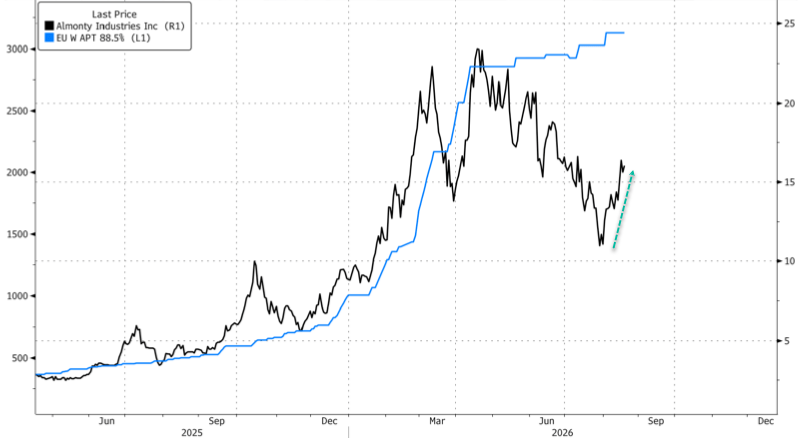
Almonty’s story should be viewed within the broader China decoupling theme, a trend likely to accelerate as the Trump administration seeks to reindustrialize the US and secure critical supply chains. The underlying move here is to reduce exposure to Chinese supply chains before a potential invasion of Taiwan disrupts access to strategic minerals, semiconductors, and other materials essential to the Western defense-industrial base and now the entire AI data center buildout.
Tyler Durden
Wed, 08/19/2026 – 15:25