One day after veteran commodities strategist Jeff Currie told investors to “get long and buckle up“ for the next leg of the commodities rally, UBS strategist Sagar Khandelwal issued a similarly bullish call, urging clients to “position for a commodity upcycle.”
Khandelwal said electrification, surging power demand, artificial-intelligence infrastructure spending, persistent supply constraints, and years of underinvestment are converging to create a perfect storm for a sustained upcycle in hard assets.
Commodities can generate returns while protecting portfolios against energy disruptions and renewed inflation, he said. That defensive role becomes valuable when the toxic mixture starts hitting stocks and bonds.
Here’s how the UBS strategist framed the trade:
Position for commodity upside
We believe commodities can provide both a structural source of return and portfolio protection in scenarios where higher inflation expectations challenge equities and bonds. While commodities have historically offered valuable diversification benefits due to their relatively low correlation with traditional asset classes, we also see a supportive longer-term backdrop driven by electrification, rising power demand, AI infrastructure investment, and supply constraints across several markets. In our view, investors should maintain diversified exposure across precious metals, energy, industrial metals, and agriculture to capture a broad range of opportunities. Given fast-shifting leadership within commodity markets, we think an actively managed approach can help investors navigate the commodity upcycle.
Gold
Gold has resumed its upward trend as US inflation concerns have ebbed, and markets have reined in expectations for near-term Federal Reserve rate hikes. Looking ahead, however, we believe central bank demand, continued diversification away from the US dollar, and global debt concerns will remain important structural supports. For investors with substantial gains following the strong rally over the past year, higher prices may provide an opportunity to rebalance some exposure into other commodity sectors. We continue to view gold as a useful strategic diversifier, and we remain constructive on gold prices over the next 12 months.
Energy
The ongoing conflict between the US and Iran highlights the fluid nature of geopolitical events and how they can impact energy. With crude supply remaining restricted and both sides facing constraints in reaching a compromise, uncertainty over how quickly shipping conditions and production will normalize is likely to keep energy markets sensitive. In our view, energy exposure can help protect against lingering supply uncertainty and inflation spillovers, while robust demand supports a constructive medium-term outlook.
Industrial metals
Industrial metals, such as copper, have benefited from secular demand drivers such as electrification, the energy transition, and the ongoing global buildout of AI infrastructure. Prices have remained resilient despite periodic global economic growth worries. While factors like tariffs and trade policy risks may keep prices volatile in the near term, demand trends remain constructive for the asset class over the longer term. In copper specifically, supply constraints and projected market deficits reinforce our positive longer-term outlook.
A look at the Quantix Commodity Index Total Return shows that the broad commodity complex has surged to a record high, gaining more than 22.5% since late June. The index tracks 24 US-dollar-denominated futures across energy, agriculture, livestock, industrial metals, and precious metals, suggesting the rally is no longer confined to a single corner of the physical world.
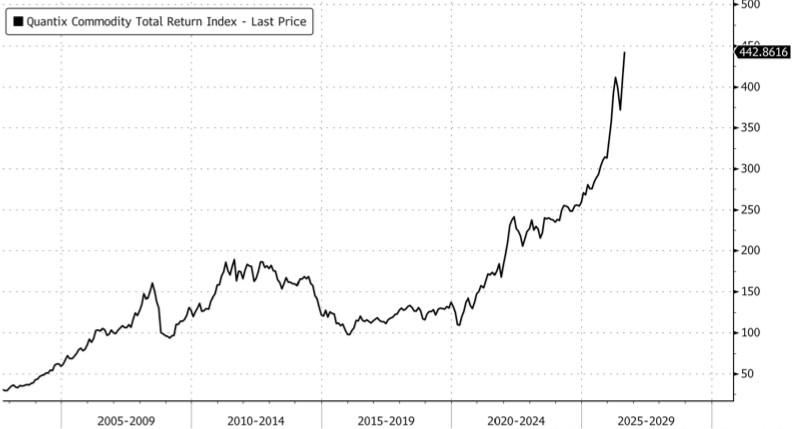
That momentum in the commodities index reinforces veteran Currie’s warning last week that “scarcity in the physical world” is reemerging. Already, we’re seeing London copper trading above $14,000 a ton, the Bloomberg Agriculture Spot Index breaking out to a three-year high, and European tungsten prices exceeding $3,000 a ton.

Currie’s conclusion was very blunt: “The illusion of abundance is likely behind us.”
Tyler Durden
Fri, 08/28/2026 – 05:45