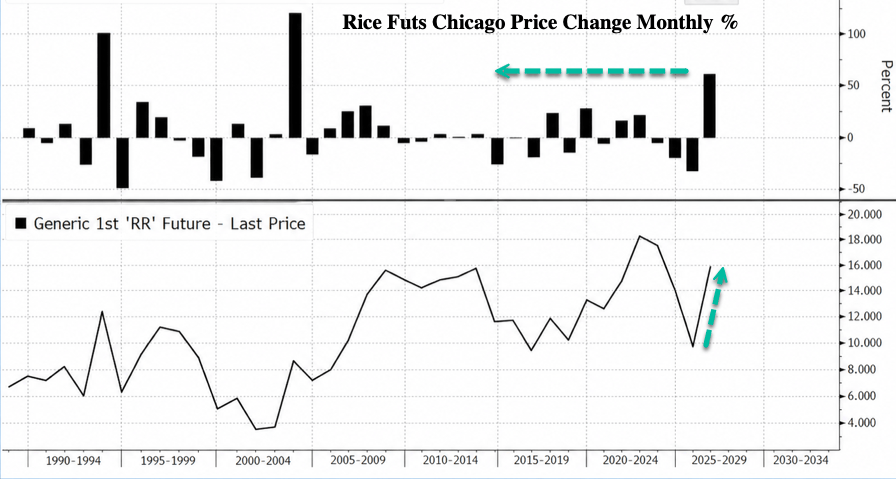
Chicago rice futures are on track for their largest annual gain since 2003 as the grain that feeds much of the world becomes increasingly expensive amid an intensifying El Niño and diesel-fuel and fertilizer supply disruptions stemming from turmoil in the Strait of Hormuz and the Russia-Ukraine war. Despite encouraging signals of a potential Black Sea peace deal, which sent wheat futures tumbling earlier today, the risk of a broader food crisis next year remains elevated.
Chicago rice futures have surged more than 50% this year, while benchmark Thai prices have advanced for six consecutive weeks. Bloomberg says the rally reflects growing anxiety that adverse weather conditions and elevated agricultural input costs will curb production across Asia, which dominates global rice output and exports.
India’s monsoon rainfall was 13% below normal as of Wednesday, while US rice-crop conditions were weaker than a year earlier.
BMI commodities analyst Bin Hui Ong said monsoon-dependent producers such as Thailand and Indonesia are particularly vulnerable because dry conditions could coincide with critical planting and early crop development periods.
“We think monsoon-dependent Southeast Asian producers, particularly Thailand and Indonesia, are among the most exposed, as the anticipated dry conditions could significantly overlap with critical planting and early crop development periods,” Ong wrote in a note.
Ong said, “We expect the implications to be felt most acutely by net rice-importing and lower-income markets, where higher rice prices can feed directly into food inflation and affordability pressures.”
Rice futures in Chicago have jumped to near two-year highs. If the gains hold through year-end, this would mark the largest annual increase since 2003.
Several countries in sub-Saharan Africa already have limited stock buffers, the analyst added.
Several Wall Street desks, including Barclays and JPMorgan, have warned about mounting food-supply risks next year.
Tyler Durden
Fri, 09/04/2026 – 02:45