US futures are choppy, trading between unchanged and modestly higher, ahead of today’s jobs report which sees a modest increase in August payrolls (but the risk is for another negative print, see our preview here). As of 8:00am ET, S&P futures are flat and Nasdaq futures gain 0.5% as Mag 7 stocks trade mixed premarket, with NVDA (+1.4%) and AMZN (+0.7%) leading and TSLA (-2.1%) lagging. Bond yields are steady as traders wait to see whether Friday’s payrolls report will offer the Fed enough justification to hold off on an interest-rate hike in September. The USD is 20bp higher as the yen drops after yesterday’s surge. Commodities are mixed: oil fell, while base metals and Ags are both higher. Overnight, macro headlines were largely muted following yesterday’s bond market rally after Waller’s comments. All eyes are on the 8:30am ET NFP release (see our preview here), but investors are increasingly more focused on next week’s CPI than the payroll number, given Warsh’s assessment of the labor market and Waller’s comments yesterday.

In premarket trading, Mag 7 stocks are mixed: Tesla falls 2% as the electric-car maker’s invite-only, closed-door Cybercab launch event resulted in little splash. Nvidia +1.1%, Amazon +0.5%, Meta +0.5%, Alphabet +0.3%, Microsoft -0.3%, Apple -0.3%
- Adobe (ADBE) falls 3% after naming Anil Chakravarthy as its next chief executive officer, thrusting the company veteran into a challenging competition with artificial intelligence upstarts.
- Asana (ASAN) falls 10% after the software company gave an outlook that was seen as disappointing.
- Equifax (EFX) falls 5% and TransUnion (TRU) slips 6% after US Federal Housing Finance Agency Director Bill Pulte issued renewed criticism of credit bureaus for overcharging Americans.
- Guidewire Software (GWRE) falls 15% after the company gave a first-quarter forecast that was weaker than expected on key metrics, including revenue and adjusted operating profit. Analysts said the outlook could be conservative.
- Planet Labs (PL) rises 12% after the satellite-imaging service firm reported second-quarter revenue that beat the average analyst estimate and lifted the low end of its full-year revenue outlook for 2027.
- Samsara (IOT) climbs 14% after the fleet management technology provider boosted its guidance for this year’s total revenue and adjusted earnings per share. The ranges for both metrics topped analyst estimates.
In other corporate news, Tesla’s much-anticipated Cybercab launch, an event nearly two years in the making, resulted in little splash or detail as the two-seat vehicle was added to the company’s robotaxi fleet. Lululemon comparable sales fell 9% in the second quarter and lowered its full-year outlook for a second straight quarter, signaling deep challenges for incoming CEO Heidi O’Neill. Speaking of ECM, health and fitness ring-maker Oura filed for an IPO, showing soaring revenue. Its listing could raise as much as $3 billion, based on prior Bloomberg News reports.
While market volatility remains subdued, with the VIX matching its lowest reading of the year, things promise to get livelier post the Labor Day holiday, however, and next week looks busy according to BBG. The traditional fall conference season kicks off, with hundreds of corporates presenting across the country, and there’s a CPI inflation print and a possible massive AI IPO filing to keep traders occupied.
The August jobs report arrives at a time when the odds of a quarter-point Fed hike this month are roughly even. While Fed Chair Kevin Warsh last week emphasized that policymakers’ focus is firmly on inflation, the employment report could help buy them time to assess whether current policy is restrictive enough to bring price pressures under control. Economists estimate the report will show a 55,000 increase in payrolls after an unexpected dip in July employment. Such a result would be broadly in line with average job growth this year. The unemployment rate is seen holding at 4.1% (full preview here).

One of the major events on the calendar over the next few weeks is likely to move markets and close the implied-realized gap, but for now short-dated index optionality looks more like a sell than a buy. The option implied SPX swing around NFPs is priced about the same as last month, when the 0.55% option-implied move ended up being very close to the realized move of 0.62%.

“The market needs a result weak enough to give the Fed a reason to keep interest rates unchanged, but not so weak that it intensifies concerns about a recession,” noted Linh Tran at XS.com. “Stronger-than-expected employment and wage growth could push yields higher again and weigh on equities.” By contrast, figures close to expectations and accompanied by moderating wage growth would create favorable conditions for the S&P 500 to retest its record high, Tran said.
JPMorgan’s Market Intelligence desk expects a “Good news is bad news” environment for market reaction to the print in most outcomes, with a Goldilocks scenario in the 30k to 70k range.

Bloomberg Economics’ Anna Wong expects the payrolls number to undershoot consensus, citing a pattern of the data disappointing in August. JPMorgan’s Market Intelligence desk sees a Goldilocks scenario in the 30,000-to-70,000 range.
“We are in the territory where bad news is good news, as both equities and credit are likely to be driven by what rates do,” said Mohit Kumar at Jefferies. “A small positive number would be a sweet spot for the markets.”
In AI news, the launch of a new Astra model sent OpenAI proxy SoftBank’s shares soaring in Tokyo trading. Astra benchmark scores of AGI — where artificial general intelligence surpasses human capabilities – gives OpenAI confidence to claim it has overtaken Anthropic on some measures. DeepSeek is planning to power a new data center with an order for one of the largest known clusters of Huawei AI chips as part of China’s efforts to replace Nvidia. Elsewhere, Anthropic is set to finalize an expansion of its revolving credit facility to $15 billion, clearing a hurdle before a public filing by the AI firm for its highly anticipated IPO.
In other assets, trading in yen call options against the dollar expiring this month was more than two-and-a-half times the volume of puts on Thursday, CME data shows. It’s part of a rush to unwind yen-funded carry trades, while the latest positioning data from CFTC data suggests scope for further short covering.
Europe’s Stoxx 600 edged higher 0.1%. Volkswagen AG rose as much as 9.7% after a major restructuring announcement. Here are the biggest movers Friday:
- Volkswagen shares gain as much as 9.7%, the biggest intraday move since March 2023, after the carmaker’s supervisory board backed a sweeping restructuring that includes 50,000 additional job cuts
- Continental shares rise as much as 4%, the most in two months, after Oddo BHF upgraded the tire maker. Analysts said the company is one of the most profitable within the sector
- AT&S shares rise as much as 10%, extending a huge year-to-date rally, after Oddo upgraded the printed circuit board maker to outperform, saying new contracts should maintain momentum
- Accor shares gain as much as 3.2% as Morgan Stanley upgrades the hotelier to overweight, naming it a top pick among the travel and leisure companies it covers
- Vodafone gains as much as 2.3% after Goldman Sachs upgraded its view on the company to buy from sell in a wider review of the European digital infrastructure and telecoms sector
- Studsvik gains as much as 8.1%, after the founder and CIO of US hedge fund Segra Capital Management bought shares in the Swedish nuclear technology company
- Oxford Nanopore shares drop as much as 12% after one of its investors, Novo Holdings, offered shares at a hefty discount to Thursday’s close
- Kuehne+Nagel shares fall as much as 2.5% after being downgraded to underweight from equal-weight at Morgan Stanley, which sees better execution as priced in and downside risks to Ebit
- Navitas Petroleum and Rockhopper Exploration are trading lower today as tensions around the Falklands Islands rise and Argentina targets their Sea Lion project
Earlier, Asian stocks rose on Friday as investors pared bets on a Federal Reserve interest-rate hike this month, easing some of the pressure that higher bond yields had put on equities earlier in the week. The MSCI Asia Pacific Index climbed 0.8% and is on track for a weekly gain. Stocks had come under pressure as rising global bond yields stoked concerns about the outlook for interest rates, though sentiment improved after Fed Governor Christopher Waller said he’d be inclined to leave rates unchanged if inflation continues to slow. Most markets in the region advanced, including South Korea, Taiwan and Hong Kong. Japan’s Topix was little changed as investors assessed the impact of the yen’s recent gains. SK Hynix, Samsung Electronics and TSMC were up as well. The regional stock gauge is on course for a second straight week of gains, with financials providing the biggest boost as the sector heads for its best week in almost five months.
In FX, the Bloomberg Dollar Spot Index swung between gains and losses after falling as much as 0.7% to the lowest since May 11 on Thursday. The yen held most of its gains after advancing more than 2% on Thursday. The currency has strengthened this week to around 156 amid growing expectations that the Bank of Japan will tighten monetary policy faster than previously thought. BOJ policymakers could raise rates at three consecutive meetings through December in an extreme scenario where yen weakness persists, according to Nomura Securities Co. A quarter-point increase this month “looks reasonable,” while “it’s possible that we can have back-to-back rate hikes in October and December,” Yujiro Goto, head of FX strategy in Japan, told Bloomberg TV.
- USD/JPY rose 0.4% to 156.45 as a rush to unwind yen-funded carry trades helped propel the Japanese currency higher
- EUR/USD little changed at 1.1622; it’s up 0.3% this week
- NZD/USD gained 0.3% to 0.5897 before erasing gains; New Zealand’s central bank is more likely to wait until December before raising interest rates again, according to Assistant Governor Karen Silk
In rates, treasuries are little changed ahead of August employment data at 8:30 a.m. New York time amid similarly muted price action in European bonds, keeping US yields within a basis point of Thursday’s closing levels. US 10-year yield near 4.76% is less than 1bp lower while German and UK counterparts are slightly higher on the day; US front-end tenors lag slightly on the curve, flattening 2s10s spread by more than 1bp vs. Thursday’s close. Thursday’s session saw traders ramp up a range of hedges around the jobs report. Ahead of the data, swaps are pricing in around 14bp of Fed tightening for the September policy meeting and a combined 35bp by the end of the year. IG dollar issuance slate empty so far after just one deal was priced Thursday, bringing weekly total to about $10 billion, broadly in line with dealer estimates.
In commodities, WTI crude oil , though down about 1%, remains on course for biggest weekly gain since July following renewed US-Iran hostilities.
US economic data calendar includes only the jobs report, for which median economist estimate of nonfarm payrolls change is 55k and crowdsourced whisper number is 30k.. Fed speaker slate empty for the session. External communications blackout period around the Sept. 16 policy announcement begins Saturday
Market Snapshot
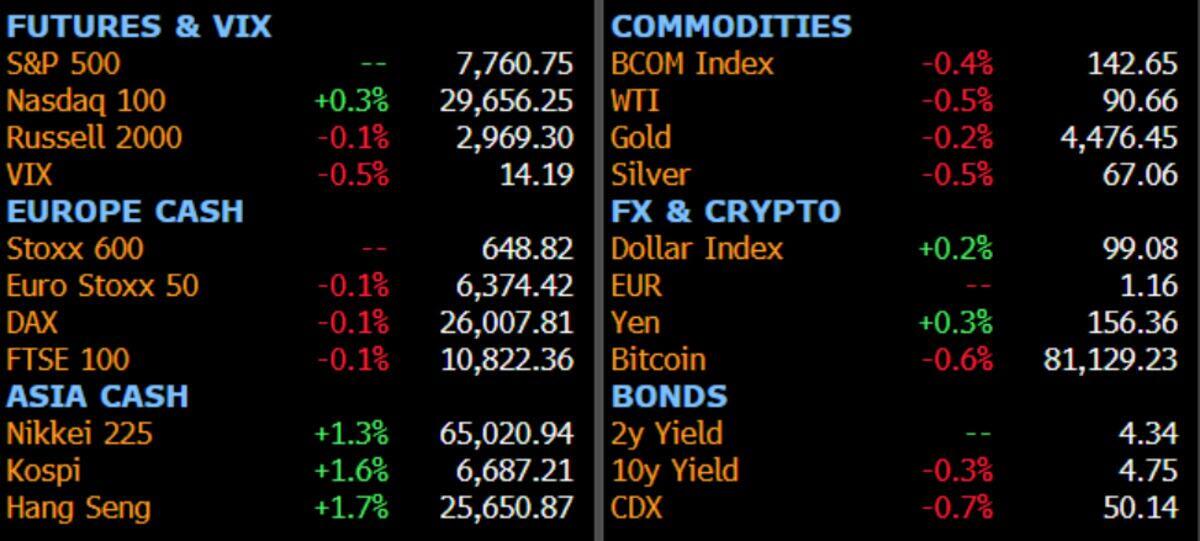
Top Overnight News
- A U.S. campaign to throttle Iran’s economy by blockading its oil exports and stopping sanctions evasion is growing increasingly difficult to withstand, three senior Iranian sources said. Washington has in recent weeks sought to ratchet up the economic pressure on Tehran, in an effort to extract concessions in any future negotiation that six months of conflict have so far failed to secure: RTRS
- Israel says it has cleared Hezbollah fighters from tunnels under key Lebanon ridge: RTRS
- Norway’s sovereign wealth fund proposed reducing the amount of government bonds in its portfolio to boost holdings of riskier debt, with Treasuries the most affected. The proposed reduction in government bonds would imply a decrease of about $58 billion of government bonds, with holdings of US Treasuries projected to drop by $75 billion and those of Japanese government bonds possibly increasing by $20 billion. BBG
- US military turns off ad trackers on devices amid Middle East targeting reports: RTRS
- A rush to unwind yen-funded carry trades helped send the currency to a one-month high against the dollar as traders ramped up bets on further Bank of Japan rate hikes: BBG
- Australia’s bonds, caught up in the global fixed-income selloff, have seen their yields rise more than any of their peers in the past month, despite arguments that the country’s finances are in much better shape: BBG
- Some of the world’s biggest money managers have rebuilt their gold holdings after prices dropped, betting that long-term drivers of the precious metal will endure.
- Fund managers at companies including Amundi SA, Pictet Asset Management Ltd., and Fidelity International Ltd. added to holdings cut earlier this year, during bullion’s retreat from an all-time high: BBG
- Pimco fund beating 97% of peers cuts ‘Mag Seven’ to bet on Asia: BBG
- Deadly strike on Iranian wedding was likely a direct hit by a US munition, analysis shows: RTRS
- Former Labor Secretary Oversaw a ‘Toxic, Intimidating’ Workplace, Report Finds: WSJ
- The ‘Deeply Nerdy’ Founders Behind Nvidia’s $13 Billion Bet on Hugging Face: WSJ
- OpenAI agents hijacked German website in previously undisclosed AI breakout: RTRS
- Volkswagen flags 50,000 job cuts across group as board approves turnaround plan: RTRS
- Drugmakers Halt Autoimmune Trials After Deaths, Life-Threatening Side Effects: WSJ
- Trump Administration Again Asks Supreme Court to Allow New Mail Voting Rules: WSJ
A more detailed look at global markets courtesy of Newsquawk
APAC stocks took impetus from the positive global risk sentiment and lower yield environment after Fed’s Waller kept a September rate hold in play and following no major new geopolitical developments, while participants look ahead to the key US jobs data. ASX 200 lagged with price action rangebound as the outperformance in tech and telecoms was overshadowed by weakness in mining, resources, materials, utilities and energy, while a quiet calendar and lack of drivers kept the index in check. Nikkei 225 shrugged off the disappointing Household Spending data from Japan and briefly returned to above the 65,000 level amid lower yields and after a source report noted that the BoJ favours a 25bps rate hike this month and a flexible future pace, which helped ease concerns of a more aggressive move. KOSPI rallied amid strength in tech heavyweights with notable gains in SK Hynix, while Samsung Electronics was also firmer after industry data showed it narrowed the gap with market leader SK Hynix in the global HBM market during Q2. Hang Seng and Shanghai Comp were underpinned with the Hong Kong benchmark spearheading the advances alongside strength in property, tech and auto stocks, while the gains in the mainland were limited after the PBoC continued to drain liquidity with today’s open market operations amount remaining at zero.
Top Asian News
- Japanese PM Takaichi will keep Finance Minister Katayama, in cabinet reshuffle, according to Mainichi.
- Japan’s Finance Minister Katayama said interest rate moves are determined by various factors in markets and they will control FY bond issuance properly, while she added that FY27 budget requests total about JPY 143tln and don’t represent a large increase. Katayama said they are closely watching bond markets with a high sense of urgency and noted that there were no specific requests from US Treasury Secretary Bessent. Furthermore, she said Bessent assessed PM Takaichi’s economic policies very highly and has long held a view that the yen has been undervalued, due largely to interest rate differentials.
European bourses start the final trading session of the week on the backfoot, albeit only modestly. Focus will be on the US jobs report, with NFP expected at 58k. Although this data point is key for the Fed, most policymakers will be focused on the inflation print expected in a week’s time. Sectors lack a clear bias. Tech tops the sector pile, with Travel & Leisure and Autos rounding out the sector gainers. To the downside is Media, following Vivendi earnings (see more below), with Chemicals and Banks following behind. The biggest story of the morning came from Volkswagen (+6.2%), after the Co.’s supervisory board approved a plan that would include an additional 50k job cuts.
Top European News
- UK Energy Secretary could recommend new North Sea drilling as soon as next week, a Rosebank oilfield announcement expected to follow, The Guardian reported citing sources.
- BoE DMP (Aug): 1-year CPI expectation 3.1% (prev. 3.4%), 3-year CPI expectation 2.8% (prev. 2.8%).
- European Retail Sales (Jul MM) -0.6% vs. Exp. 0.3% (Prev. 0.2%).
- German Factory Orders (Jul MM) 2.5% vs. Exp. 0.3% (Prev. 3.1%).
- Italian Retail Sales (Jul MM) -0.4% vs. Exp. 0.2% (Prev. -0.1%).
FX
- Mixed action across G10FX where there is no real bias. Stealing leads for no particular reason, JPY lags after large gains this week.
- Choppy USD action this morning which sees EUR/USD within a narrow 15 pip range and DXY flat into NFP. Some broad based, but modest USD upside was seen after the EU cash open, lifting DXY from 99.00 to a high just below 99.10 with EUR and GBP pairs sent to lows. While NFP is the highlight of the day, officials’ keen eye on inflation will be the deciding factor in the Fed’s September meeting, especially after Waller’s remarks on Thursday.
- With a 25bps ECB hike next week fully priced, EUR will likely remain at the whim of the Buck into Payrolls. Focus will be on the first of three significant state elections in September, Saxony. Polling has AfD clearly in the lead with 40-43% of the vote; if materialised, will add to the pressure on the German Grand coalition nationally, though not change the power balance or impact economic/fiscal policy. Lane did not add anything, given ECB is in blackout. EUR/USD choppy, but found support at 1.1620.
- GBP saw some weakness on the DMP which showed easing 1yr inflation expectations, though the reaction was limited to around ten pips and Sterling is still the best G10 performer with BoE’s Bailey not providing commentary on monetary policy. Cable’s 1.3550 will likely provide resistance to further Cable gains absent an NFP surprise. JPY is the underperformer today as it pulls back from recent gains of over 3% vs. the Buck. The pair bottomed at 155.22 and now lies just above 156.00.
Fixed Income
- Global fixed benchmarks trade with mild gains after initially holding in the red early morning. USTs (+1 tick) trades tentatively heading into US NFP, whilst Bunds (+4 ticks) and Gilts (+6 ticks) post modest gains. Overnight, JGBs (+30 ticks) posted decent gains, tracking the advances made in USTs on Thursday; a couple of decent auctions earlier in the week, and speculation surrounding the GPIF upping its allocation in domestic bonds have also boosted sentiment.
- USTs currently trade at the upper end of a 107-17 to 107-23+ range, at levels more-or-less similar to the week’s open. Focus this morning has been on an FT article which suggested that Norway’s Sovereign Wealth Fund has proposed cutting government bonds to 50% of its bond portfolio (from 70%). The fund now aims to look at other types of debt to try to boost returns. The piece suggests that its allocation to Gilts would remain unchanged, whilst its position in JGBs would rise by 2.8%. On the flip side, a Reuters report suggested that some Chinese commercial banks have upped their purchases of USTs in recent months.
- Bunds and Gilts are incrementally firmer this morning. German benchmarks specifically, focus is on the upcoming Saxony-Anhalt state election. The far-right AfD are expected to win, but attention will be on whether it can achieve an absolute majority. This is because other major parties have ruled out forming a coalition with the AfD. Even if the AfD does fall short, the CDU will face the issue of forming a new coalition, potentially leading to political instability and hence reducing confidence in German debt.
- For UK specifically, focus will be on a speech from BoE Governor Bailey. Elsewhere, the BoE DMP saw the 1-year-ahead expectation fall to 3.1% (prev. 3.4%), spurring mild strength in Gilts.
- Norway’s sovereign wealth fund sent a letter to the finance ministry recommending the reduction of holdings of US Treasuries from 70% to 50%, according to FT.
- Some Chinese commercial banks have raised US dollar deposit rates above 3% and subsequently increased purchases of US Treasuries in recent months, according to sources.
- Australia sells AUD 800mln in 4.75% October 2037 Bonds b/c 3.21x, avg. yield 5.2133.
Commodities
- WTI Oct and Brent Nov futures are softer intraday amid a lack of notable geopolitical updates overnight to shift the dial. The former resides in a USD 90.38-92.17/bbl range (vs yesterday’s 89.57-93.14/bbl), and the latter in a USD 94.81-96.21/bbl parameter (vs yesterday’s 84.03-97.62/bbl). Over the weekend, the OPEC+ JMMC is scheduled to meet, with market sources suggesting no changes will be made to October’s overall output targets as the committee focuses broadly on market conditions and member compliance.
- Metals are also trading broadly flat/firmer intraday amid as drivers remain light ahead of the US jobs report. The consensus expects the US economy to have added 58K nonfarm payrolls in August, analysts say that a payrolls print close to expectations alongside a steady unemployment rate would be consistent with a stable labour market that is cooling but not deteriorating sharply, and that should keep policymakers focused on the inflation side of the mandate.
- Spot gold resides in a narrow USD 4,460-4,491/oz range at the time of writing, within yesterday’s parameter (USD 4,381-4,511/oz) and in between its 200 DMA (USD 4,534/oz) and 100 DMA (USD 4,355/oz). Spot silver is flat just under its 100 DMA (67.52/oz), in a current USD 66.29-67.20/oz range. Base metals are uneventful with 3M LME copper eking mild gains in a narrow USD 14,299.10- 14,392.73/oz.
- Oil production in Kazakhstan for 2027 is planned at 96mln tonnes, IFX reported citing the budget project.
- Russia’s Deputy PM Novak said China will account for more than 60% of Russia’s total natural gas exports by 2030.
- Some Chinese rare earth suppliers have reportedly halted some US shipments over geopolitical worries, Reuters reported.
Trade/Tariffs
- USTR Greer said Canada wanted more tariff relief and that he’s had a couple of texts and outreach with Canada, but hasn’t had negotiations with Canada since. Greer also stated he met with Mexico’s Trade Minister on Thursday and that Mexico is eager to do things to protect North America from Chinese imports. Furthermore, Greer said the US is looking to reduce its deficit with China and will probably make agriculture announcements during Chinese President Xi’s visit, adding that he is optimistic about the US-China relationship.
- USTR Greer told the FT that the UK is choosing the EU over the US, which is causing a problem for the UK to expand a trade deal with the US. Greer said the UK had failed to take advantage of Brexit by aligning with EU-made rules and closing its market to American goods and still had “pretty high tariffs”.
- Brazil warned of reciprocal measures against the EU if talks to lift the meat ban stall.
- South Korea’s Interior Minister said South Korea and the US are continuing chip tariff talks.
Central Banks
- BoE’s Bailey said Fed Chair Warsh is “right to see some dangers in forward guidance” and that central bankers should avoid giving unconditional guidance. He added that we do exercise choice on how fast to bring inflation back to target, “but must do so”.
- RBNZ Assistant Governor Silk said a rate hike in October or December is still open, but stated a hike is more likely in December and that the RBNZ wants to support continuing improvement in the economy.
- RBNZ MPC member Hansen said Wednesday’s rate hike was a clear consensus decision and that further policy decisions will depend on trends in a wide range of economic datasets, while he is watching for surprises in data, not a single indicator, before deciding what should happen in October.
Geopolitics: Iran
- US Treasury Secretary Bessent said the EU has joined Operation Economic Outcast and that he appreciates the EU’s strong and early stance on Iran.
- Oman and Qatar are intensifying efforts to resume Iran-US talks, and that the Strait of Hormuz, sanctions, and the nuclear file are the focus of new disputes, Nour News reported citing diplomatic sources.
- Direct US-Iran talks have stopped, but mediators are maintaining back channels and trying to build a framework that could bring both sides back to negotiations on a new agreement, FT reported.
- IRNA reported several explosions were heard in Iraq’s Erbil province.
- South Korea prepared a plan to deploy non-combat naval assets to the Strait of Hormuz, according to Chosun Daily.
Geopolitics: Ukraine
- US Special Envoy Witkoff and Kushner is to visit Russia and Ukraine on September 5th-6th, TASS reported citing sources.
- Ukraine’s next goal is to shut down Russia’s commercial airspace, according to WSJ.
- Ukrainian Energy Ministry said Russia launched a large-scale missile and drone attack on energy infrastructure in Ukraine’s Odessa region.
Geopolitics: Other
- Argentina’s President Milei will sign a decree sanctioning companies working on oil exploration of the Falkland Islands, while he stated that the Falkland’s Sea Lion Project presents a clear danger and plans to build a naval base in Tierra del Fuego.
US Event Calendar
- 8:30 am: Aug Change in Nonfarm Payrolls, est. 55k, prior -23k
- 8:30 am: Aug Change in Manufact. Payrolls, est. 5k, prior 5k
- 8:30 am: Aug Unemployment Rate, est. 4.1%, prior 4.1%
DB’s Jim Reid concludes the overnight wrap
Welcome to the 384th payroll Friday of my career. For the first one I was ordered to get the coffees in for the whole trading floor, keep quiet, and watch the spectacle. Imagine if I asked a graduate to do that today.
Ahead of the big day, the relentless global bond selloff has finally paused over the last 24 hours, with a cross-asset rally driven by dovish comments from Fed Governor Waller. He cast doubt on whether the Fed would hike rates this month, which led to a dovish repricing that led futures to slash the chance of a hike to 51% as of this morning, down from 63% at the close on Wednesday. Moreover, there was also relief on the energy front, as European natural gas prices came down -2.48% yesterday, after rising almost 10% over the previous three days. So collectively, all that pushed back against the hawkish newsflow of recent days. That said, the benefits were much more visible for equities, with the S&P 500 (+1.06%) having its best day in almost a month, than for US long-end bonds, with 10yr Treasury yields a modest -1.1bps lower on the day.
European bonds saw a much bigger yield decline though.
Those comments from Waller drove the biggest move of the day, as he made several dovish points. For instance, he said that “recent data suggest we are finally seeing some signs of disinflation”, and that if this continued, he would be “inclined to support holding” rates. In addition, he said “my take is that underlying inflation is doing better than the core numbers suggest.” So again, that leant in a dovish direction. Admittedly, Waller said he’d consider a hike “if inflation comes in hot”, but given the rest of his comments were more dovish, market pricing for a September hike fell back to 51% by the close.
With expectations for a hike in the balance again, that’s heightened the focus on today’s US jobs report, which is out at 13:30 London time. In general, the labour market has been robust in the last few months. But the most recent jobs report for July was much weaker than expected, with payrolls unexpectedly contracting, along with downward revisions to the previous couple of months. So that cast further doubt on a September hike, and it was only thanks to Fed Chair Warsh’s speech at Jackson Hole last week that investors had grown more confident of a September hike once again. For this report, our US economists are expecting nonfarm payrolls to rebound by +65k, with the unemployment rate holding steady at 4.1%. So if realised, that would cement the view that the labour market is holding up and keep the Fed’s focus on inflation.
Ahead of that report, yesterday’s data generally leant in a more hawkish direction, which acted as a bit of a counterweight to Waller’s comments. Most obviously, the ISM services index for August beat expectations, rising to a 6-month high of 55.4 (vs. 54.1 expected). And digging into the details, the prices paid component moved up to a 4-year high of 72.6 (vs. 70.0 expected), which is notable given that this series is strongly correlated to inflation with a 3-month lag. In the meantime, weekly initial jobless claims were also at just 206k in the week ending August 29 (vs. 205k expected). And the July trade deficit was a bit smaller than expected at $88.6bn (vs. $90.2bn expected).
Despite all that data, the comments from Governor Waller won out when it came to market pricing, though the pull back in Treasury yields did vary across the curve. The decline was most obvious at the front-end, which showed how it was the Fed commentary driving the moves, with the 2yr yield (-3.2bps) falling to 4.34%. By contrast, the rally was more marginal further out, with the 10yr yield (-1.1bps to 4.77%) and the 30yr yield (-1.1bps to 5.25%) actually closing a touch above their levels just before Waller’s comments.
For US equities, the combination of strong data and dovish commentary offered more decisive support. So the S&P 500 (+1.06%) posted back-to-back gains for the first time in 3 weeks, with the index also back within 1% of its record high from last month. That was led by a very strong performance for the Magnificent 7 (+2.38%), which hit a 3-month high as it posted its best day in the last month. But it was still a broad-based rally, with the S&P 500 seeing the most daily advancers since early August, as more than two-thirds of the index moved higher.
As all that was going on, bonds and equities received further support from the latest moves in energy prices, with Brent crude (-0.12% to $95.52/bbl) settling lower for the first time in four sessions. But otherwise, the moves under the surface weren’t so bad for other asset classes. Moreover, longer-dated oil futures fell back, meaning that investors were slightly pricing out a prolonged period of high oil prices and the chances of stagflation. The 12-month Brent future fell -1.12% on the day to $76.67/bbl. And natural gas futures also fell back on both sides of the Atlantic, which eased concerns about a wider spike in energy prices this winter. So the European natural gas future fell -2.48% to €71.80/MWh, whilst the US natural gas futures also fell -1.45%.
Those moves in energy prices offered plenty of support to European assets, with yields finally pulling back from their multi-year highs on Wednesday. That happened across the continent, with yields on 10yr bunds (-3.3bps) down to 3.34%, alongside declines for 10yr yields on OATs (-4.8bps), BTPs (-5.0bps) and gilts (-9.6bps). Then for equities we also saw a recovery, with the STOXX 600 (+0.49%) stabilising after 3 consecutive declines, including gains for the DAX (+0.63%), the CAC 40 (+0.07%) and the FTSE 100 (+0.70%).
Asian equity markets are generally riding the tech train this morning with the Hang Seng (+2.12%), KOSPI (+1.88%) and the Nikkei (+1.30%) all strong. Elsewhere, mainland Chinese markets are posting more modest gains, with the CSI 300 up +0.43% and the Shanghai Composite advancing +0.35%. In contrast, Australia’s S&P/ASX 200 (-0.21%) is bucking the regional trend. US and European equity futures are all up less than a tenth of a percent.
Meanwhile, data released earlier this morning showed that Japanese household spending contracted in July at the fastest annual pace in two and a half years, underscoring weak private consumption ahead of the BoJ policy meeting two weeks from today. Consumer spending fell -3.6% year-on-year, significantly worse than the market expectation of a -1.6% decline, marking the eighth consecutive month of contraction. The drop was the steepest since January 2024, when household spending declined by -6.3% year-on-year.
That has helped see a small decline for the yen this morning (-0.36%) following on from a huge jump yesterday, as it strengthened +1.86% against the US dollar. Thats a four big figure move in 48 hours now. To be fair, a small part of that was dollar weakness after Fed Governor Waller’s remarks. But that was only part of it, as the yen was also up +1.55% against the euro as well. The moves came amidst mounting speculation that the Bank of Japan would take further action in two weeks. However speculation that they would supersize the hike faded as Bloomberg reported yesterday they were leaning towards a 25bp rate hike this month and would leave open the possibility of a faster pace of hikes afterwards. Their next meeting is just a couple of days after the Fed’s decision. So that’ll be a big couple of days for markets mid-month.
Looking at the day ahead, the main highlight will be the US jobs report for August. Other data releases include German factory orders and Euro Area retail sales for July. Otherwise, central bank speakers include BoE Governor Bailey and the ECB’s Lane.
Tyler Durden
Fri, 09/04/2026 – 08:25