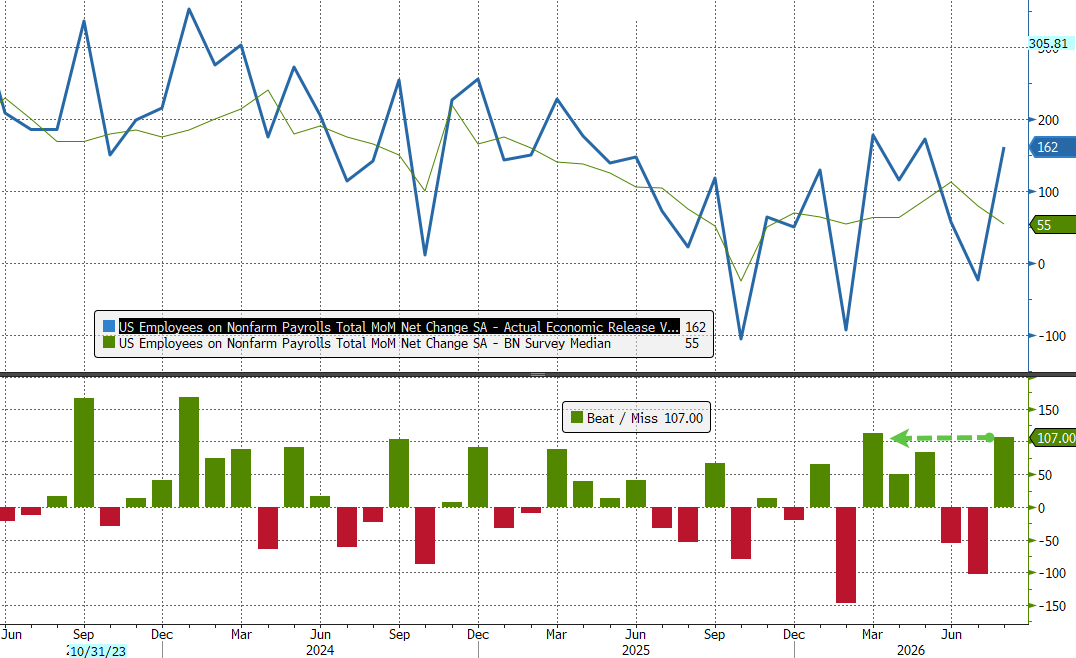
In our jobs report preview we quoted JPM’s Market Intel desk which said that today’s August payrolls number will be a case of “good news is bad news”, and sure enough futures are sliding and yields surging after moments ago the BLS reported that in August, the US added a whopping 162K jobs, up from an upward revised 21K (July is no longer negative -23K), and the second highest monthly increase of 2026 (only March was higher)…

… and printed not only above the median estimate of 50K but above the highest Wall Street estimate of 125K (from Pantheon). In fact, this was a a 4-sigma beat to expectations.

Understandably, today’s blowout print was the biggest beat of estimates going back to March.
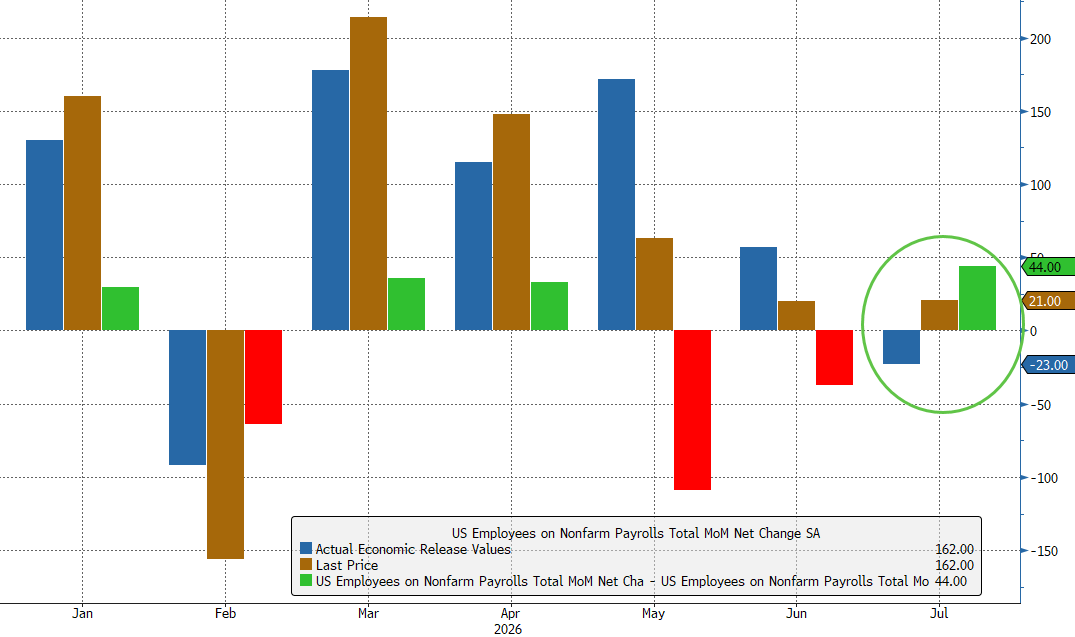
For once, revisions were quite favorable, with June numbers revised up by 11,000, from +20,000 to +31,000, and July revised up by 44,000, from -23,000 to +21,000. With these revisions, employment in June and July combined is 55,000 higher than previously reported.
Remarkably, unlike previous months when jumps in payrolls were met with declines in employment, in August we saw a surge of 569K employed workers from 162.177MM to 162.746MM alongside the 162K increase in payrolls.

This meant that after steadily declining for the past year, and diverging with the number of payrolls, the number of employed Americans posted a sizable jump as shown below.

The unemployment rate remained flat at 4.1%, and in line with expectations. Among major groups, the unemployment rate for people who are Asian declined to 3.2%, The rate for teenagers edged up to 14.1% over the month, mostly offsetting a decline in the prior month. The jobless rates for adult men (4.0 percent), adult women (3.5 percent), and people who are White (3.7 percent), Black (6.0 percent), or Hispanic (4.8 percent) showed little change in August.

Average hourly earnings rose 0.3% MoM, in line with expectations, and 3.1% YoY. In August, average hourly earnings of private-sector production and nonsupervisory employees rose by 11 cents, or 0.3 percent, to $32.53. The average workweek for all employees on private nonfarm payrolls edged up by 0.1 hour to 34.4 hours in August. In manufacturing, the average workweek edged up by 0.1 hour to 40.5 hours, and overtime was unchanged at 3.1 hours. The average workweek for production and nonsupervisory employees on private nonfarm payrolls remained at 33.8 hours.

Some more details from the report:
The number of long-term unemployed (those jobless for 27 weeks or more) changed little at 1.9 million in August. The long-term unemployed accounted for 27.0 percent of all unemployed people.
The labor force participation rate edged up to 61.6 percent in August but is down by 0.5 percentage point since January. The employment-population ratio, at 59.1 percent, changed little over the month and since January.
The number of people employed part time for economic reasons decreased by 414,000 to 4.4 million in August. These individuals would have preferred full-time employment but were working part time because their hours had been reduced or they were unable to find full-time jobs.
In August, the number of people not in the labor force who currently want a job changed little at 5.7 million. These individuals were not counted as unemployed because they were not actively looking for work during the 4 weeks preceding the survey or were unavailable to take a job.
Among those not in the labor force who wanted a job, the number of people marginally attached to the labor force changed little at 1.7 million in August. These individuals wanted and were available for work and had looked for a job sometime in the prior 12 months but had not looked for work in the 4 weeks preceding the survey. The number of discouraged workers, a subset of the marginally attached who believed that no jobs were available for them, changed little in August at 441,000.
Taking a closer look at the composition of jobs per the Establishment survey we find the following:
- Employment in food services and drinking places increased by 59,000 in August, well above the average monthly gain of 12,000 over the prior 12 months.
- Local government education added 42,000 jobs in August, largely offsetting a decrease in the prior month. Local government education has shown little net change since January 2025.
- In August, employment in manufacturing continued its upward trend (+16,000) and is up by 58,000 since a recent low in December 2025. Employment in machinery manufacturing (+6,000) and in fabricated metal product manufacturing (+6,000) continued trending up in August.
- Employment in health care continued to trend up in August (+13,000) but at a slower pace than the average monthly gain over the prior 12 months (+32,000). Over the month, home health care services (+11,000) and hospitals (+8,000) added jobs.
- Information employment declined by 23,000 in August, following losses that had averaged 8,000 per month over the prior 12 months. In August, job losses occurred in computing infrastructure providers, data processing, web hosting, and related services (-8,000), in publishing industries (-7,000), and in broadcasting and content providers (-5,000).
- Construction employment changed little in August (+22,000). Employment in nonresidential specialty trade contractors continued to trend up (+8,000), similar to the average monthly gain over the prior 12 months (+6,000).
Employment showed little change over the month in other major industries, including mining, quarrying, and oil and gas extraction; wholesale trade; retail trade; transportation and warehousing; financial activities; professional and business services; social assistance; and other services.

Remarkably, unlike previous months where the data was gamed to cover up underlying weakness, this time we saw a very powerful increase in qualitative components, as full-time jobs surged by 735K to 134.288 million, while part-time jobs dropped by 223K!

The unexpectedly strong print has understandably sent Sept rate hike odds spiking and has hammered risk assets, although the real decider whether we get a rate move this month will be next week’s CPI print. As a reminder, according to JPM, a print above 95K will lead to a 0.5% to -1.25% down day for the S&P.

Tyler Durden
Fri, 09/04/2026 – 08:47