The global push toward electrification carries several risks, including replacing dependence on foreign oil and natural gas with reliance on Chinese technology and critical materials, as access to cheap electricity dictates investment flows and where AI and industrial bases thrive.
Christian Keller, Barclays’ global head of economics research, co-authored a note Tuesday on how rapidly accelerating geopolitical fragmentation and surging power demand are rewiring the global economy. He argued that countries must secure traditional fuel supplies while investing heavily in electricity generation, grids and storage.
Keller identified China’s near-total control of more than 95% of critical material refining in areas such as heavy rare earths as a major vulnerability for countries dependent on those supplies.
Critical materials whose mining or refining China controls are critical inputs for electricity infrastructure, industrial production, the upcoming rearmament cycle, and the AI data center buildout. Replacing Chinese supplies requires far more than discovering new deposits and will take years.
For the West, building competitive supply chains outside China, from mining critical materials such as tungsten to refining rare earths and manufacturing magnets, will be extraordinarily difficult and time-consuming. China’s dominance in the space is expected to persist through at least 2030 despite ongoing Western efforts to diversify.
“China’s quasi-monopolistic position provides it with significant geopolitical leverage,” Keller warned.
A Reuters report late last week revealed that some Chinese rare-earth suppliers were refusing to ship materials to US customers. The report suggests supply disruptions remain a major issue ahead of the Trump-Xi meeting scheduled for later this month.
Here is Keller’s warning for the West:
Negotiating critical minerals supply chains
Electrification is only likely to advance as a global trend. Especially in energy-importing countries, being key for achieving energy sovereignty (next to lowering carbon emissions). In turn, that transition towards an electricity-dominated system is contingent on critical minerals (Transition minerals: unearthing opportunities from a $500bn supercycle). However, the global reserves of these minerals are often concentrated in certain locations: eg, lithium (over 30% in Chile), cobalt (over 50% in DR of Congo), nickel (over 40% in Indonesia). Moreover, the degree of processing is often crucial, potentially also making small reserves valuable, if fully processed.
In this context, China plays a crucial role, given its tight control over the global critical mineral supply chain and refining capacity, including graphite, gallium and rare earths (Figure 10 & Figure 11). China’s quasi-monopolistic position provides it with significant geopolitical leverage. Other countries also use export controls for minerals where they have dominant positions to gain strategic leverage, eg, Indonesia with nickel and bauxite.


Hence, critical minerals will likely play central roles in international negotiations about trade or geopolitical settlements. The US tariff concession to Beijing in order to retain access to rare earths and its plan to build its own rare earth mining and refining capacities are likely only the beginning . Efforts to re-shore minerals mining and refining capacity are also likely to take time, as shown by the persistent concentration of value chains projected out to 2030 (Figure 12). Potential conflicts over critical minerals access in some of the already unstable African regions are also likely. Australia could play an increasingly important role, given its abundance and diversity of reserves in critical minerals and rare earths.

The key complement to resources in the ground are the capital flows to provide the necessary financing. Here, capital-rich advanced economies such as those in Europe could try to increase their role. However, as Figure 13 and Figure 14 show, despite the industrial strategy efforts of governments in the West, building out a comprehensive and cost-effective ‘mine to magnet’ value chain decoupled from China is extremely difficult and likely to take time.

Overall, economic statecraft involved in securing critical mineral supply chains will become a mix of export controls, foreign investment restrictions, access to foreign capital, and sanctions, possibly project-focused and with changing alliances.
Keller’s warning underscores why we’ve made China decoupling a core investment theme, building on our nuclear theme, AI buildout, and powering up America themes, highlighting companies such as MP Materials and Almonty as the West races to secure alternative critical material supplies.
Breaking Beijing’s “quasi-monopolistic” grip will require operating mines, processing capacity, and reliable deliveries. Many junior miners still face years of permitting, financing and construction before producing their first commercial shipments. Companies that can bring supply online sooner could capture a crucial early market advantage, such as Almonty’s ex-China tungsten production ramping up in South Korea.
Jefferies initiates critical mineral companies Almonty, Materion, USA Rare Earth and Neo Performance with Buy; the firms are expected to benefit from increased demand for supply outside of China.
Almonty (buy, PT $26.25)
Sees Almonty offering public exposure to Western tungsten…
— zerohedge (@zerohedge) September 2, 2026
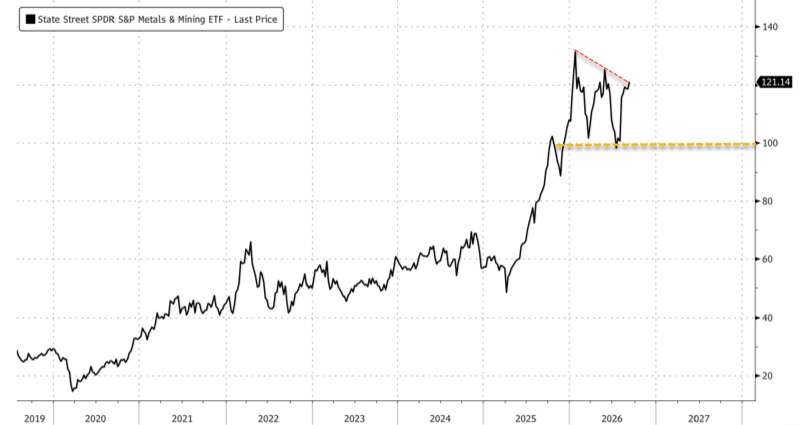
The SPDR S&P Metals & Mining ETF (XME) has yet to confirm another breakout but certaintly coiling.
Related:
For readers, the decoupling theme is about identifying miners already producing and able to close the supply gap. The opportunity lies in who can deliver first in size.
Tyler Durden
Tue, 09/08/2026 – 21:20