China, the world’s largest oil importer, is bidding up crude prices across Africa, Canada, and Latin American markets as disruptions in the Hormuz chokepoint and limited Iranian supplies intensify competition for alternatives. The scramble is squeezing smaller Chinese refineries that once relied on heavily discounted Iranian barrels, according to a new Bloomberg report.
The renewed Chinese buying marks a major shift from a period when subdued Chinese buying helped restrain crude oil prices. With Iranian exports almost entirely shut off by the US blockade and fighting flaring again, as seen Monday when Saudi Aramco’s Jizan oil facilities were reportedly hit, the race to find replacement supplies around the world is becoming an increasingly expensive task for the Chinese.
Traders spoke with Bloomberg. Here’s what they had to say:
The turnaround is producing spikes in the price of various grades. Congo’s Djeno crude was offered to Chinese buyers at premiums of as high as $20 a barrel over ICE Brent this week, up from around $15 a couple of weeks ago, according to traders who asked not to be named as they’re not authorized to speak to the media.
Chinese buyers are also buying tanker loads of crude from Canada, Brazil, and Argentina, while stronger demand has lifted prices for Russia’s ESPO crude. Asian buyers are also pushing Dubai crude futures toward $100 per barrel.
Chinese seaborne crude imports aren’t back to prewar levels and are currently trending toward 10 million barrels per day – still below pre-conflict levels. That means the race for alternative supplies may still intensify.

Bloomberg pointed out that the rebound in crude imports comes as refinery math improves and inventories are being rebuilt in China. Improved processing margins, the resumption of fuel exports, and commercial restocking are encouraging refiners to ramp up purchases, according to GL Consulting founder Liao Na.
Smaller independent refiners, known as teapots, face the greatest pressure because their traditional sourcing channels for Iranian and Venezuelan crude have eroded this year as access to those supplies has collapsed amid the Trump administration’s push to rewire global energy markets.
Liao said, “China’s robust buying lately is largely driven by refiners taking advantage of decent margins,” adding, “Active restocking by commercial players has also helped, but it’s not necessarily a sign of stronger underlying demand that’s supporting the recovery.”
Separately, Goldman Sachs energy expert Daan Struyven expects China’s ability to adjust purchases to prices to help moderate any spikes in crude prices.
Brent Crude
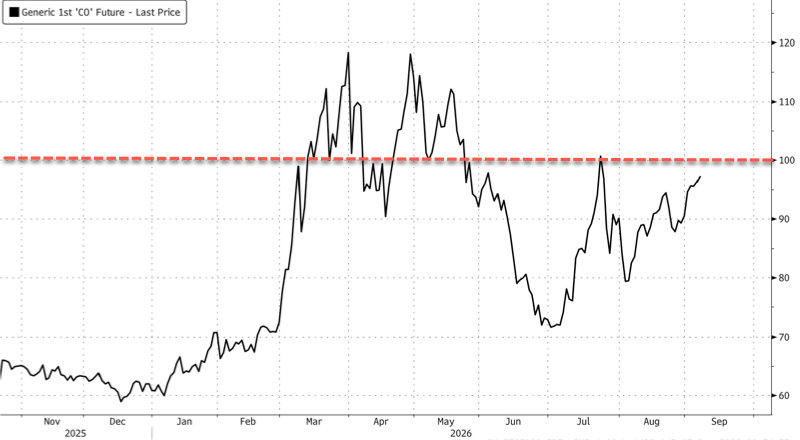
Notably, China has a massive SPR against Brent crude prices in triple-digit territory. Its crude inventories are estimated at at least 1 billion barrels, giving buyers room to reduce purchases when prices become unattractive.
Tyler Durden
Wed, 09/09/2026 – 04:15