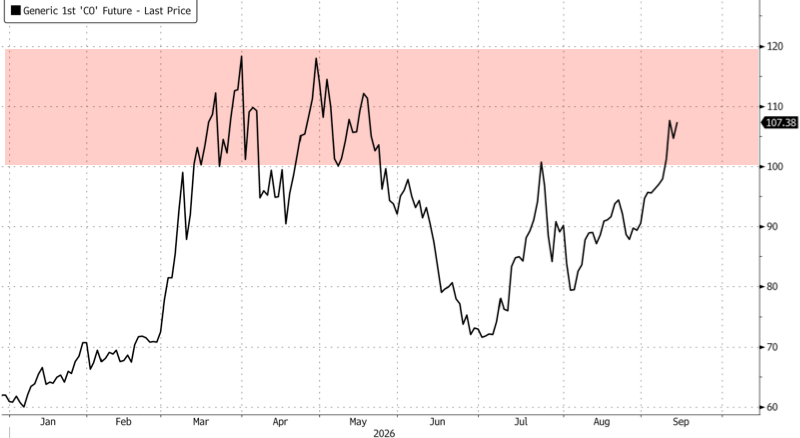
Brent crude futures jumped overnight after Saudi Arabia shut its East-West pipeline following drone attacks last week, threatening a critical route for bypassing the highly contested Strait of Hormuz chokepoint and a loss of what could amount to 4% of global supply.
The global oil benchmark rose as much as 3.7% to above $108 a barrel before trimming gains to $107.70 by 6:00 a.m. ET, while WTI futures traded around $103.
Riyadh described the shutdown as precautionary but gave no timetable for restarting the pipeline, which can transport upwards of 7 million barrels a day.
New geospatial intelligence shows what appears to be high-resolution satellite imagery of the aftermath of the drone attack that destroyed pumping infrastructure. Vantor produced this satellite imagery and shared it on X via The Hormuz Letter.
BREAKING: New high-resolution satellite imagery shows the pumping station on Saudi Arabia’s East-West oil pipeline burned out end to end, with the entire process area blackened and crude oil that escaped the site pooled across the desert beyond the perimeter, per Vantor imagery. https://t.co/DFJAplGNcC pic.twitter.com/uQEdn2YVFe
— The Hormuz Letter (@HormuzLetter) September 14, 2026
UBS energy expert Dominic Ellis summarized the weekend and overnight events unfolding across the Gulf region:
Brent has risen over $107/b on reports planned talks between Iran and GCC leaders on establishing a safe route through the Strait of Hormuz have been postponed indefinitely, and following reports Saudi Arabia closed its East-West pipeline following attacks late last week.
The pipeline, with capacity of 7mb/d, had played an important role in re-routing oil away from the Strait of Hormuz, and the impact of the pipeline’s closure on Red Sea exports (combined with recent Houthi efforts to disrupt Red Sea flows) will continue to support oil prices for the foreseeable future.
Near-term impact on energy equities is positive – the UBS team flagged 40% upside to consensus 3Q earnings earlier this month (with refining-leveraged names like Repsol, Galp and OMV having 80-90% upside), and while buy-side numbers have likely responded to rapidly-changing macro conditions more frequently than those on the sell-side, I still believe market-wide caution on the sector means there is upside to expectations.
Saudi oil traders told Reuters on Sunday that if the East-West pipeline is not restarted promptly, then Saudi Arabia will run out of oil stocks for Red Sea exports.
More color per the outlet:
Sources that spoke to Reuters gave varying estimates, with one saying the damage could take as long as five to six weeks to repair, while another said it could be fixed sooner and could resume pumping partially while repairs are ongoing.
Saudi Arabia’s government media office and energy ministry did not immediately respond to requests for comment.For the past six months, the pipeline running through the desert across the Arabian Peninsula has spared Saudi Arabia from the brunt of the impact of the wartime shutdown of the Strait of Hormuz that has crippled exports from its neighbours.
The world’s biggest exporter has used the pipeline to reroute around 4 million barrels per day — around 4% of global supply — to the port of Yanbu on the Red Sea.But with the pipeline out of service, Yanbu now has stocks to maintain exports for just five to seven days, according to three industry sources familiar with Saudi exports.Saudi Arabia also has stocks to supply customers for several days from Egypt’s ports of Ain Sukhna on the Red Sea and Sidi Kerir on the Mediterranean, a fourth source said.
Yanbu storage capacity stands at around 35 million barrels, according to industry estimates, with Ain Sukhna and Sidi Kerir able to store 18 million and 20 million barrels respectively.Stocks are not full and will ultimately run out without the east-west pipeline resuming operations, the four sources said.Saudi oil supply has already fallen to a more than three-decade low in August on reduced flows via Hormuz and the Red Sea, the International Energy Agency said on Friday.World oil supply will decline this year by 5.7 million bpd, or about 6%, the IEA, which coordinates Western energy policies, said.In addition to the attack on the pipeline, Houthi fighters in Yemen who have threatened Saudi oil shipments seized an island on Friday in the mouth of the Red Sea
Gulf developments over the weekend prompted Bernstein analysts Neil Beveridge and Brian Ho to warn that Brent could rally to between $120 and $150 a barrel as East-West pipeline disruptions collide with ongoing troubles along the Strait of Hormuz and the Bab el-Mandeb Strait in the southern Red Sea.

Beveridge described the market as “chronically undersupplied” and said their existing $90 Brent forecast for 2026 had been “overtaken by events.”
Combined flows through Hormuz, Bab el-Mandeb and the Suez Canal remain below 7 million barrels a day, compared with roughly 20 million before the conflict, according to Bloomberg.
One of the biggest restraints on crude prices this summer has been the 5 million-barrel-a-day reduction in Chinese imports. But analysts said that decline partly reflects Beijing tapping its estimated 1.5 billion barrels of SPR. Imports are now recovering and bidding up oil prices around the world.
Tyler Durden
Mon, 09/14/2026 – 07:20