On Monday we flagged that September was shaping up as the worst month for junk since 2022. We also noted that Paramount’s $12.4 billion high-yield tranche would be bigger than SoftBank’s recently issued record $11 billion junk deal. The next morning the company kicked off the high-grade portion. By Tuesday afternoon it reported $109 billion of demand.
With so much excess demand, the offering was supposed to fly off the shelves. It did not: the deal priced on Wednesday, the same day a judge accepted the states’ settlement and the merger was scheduled to close on Oct. 6. It is the biggest takeover financing Hollywood has seen, for the biggest Hollywood buyout ever. Paramount won Warner Bros. from Netflix back in February.
While underwriters usually leave a little on the table for new-issue buyers, they didn’t this time, and all the new issues faceplanted the moment they broke for trading.
What was sold
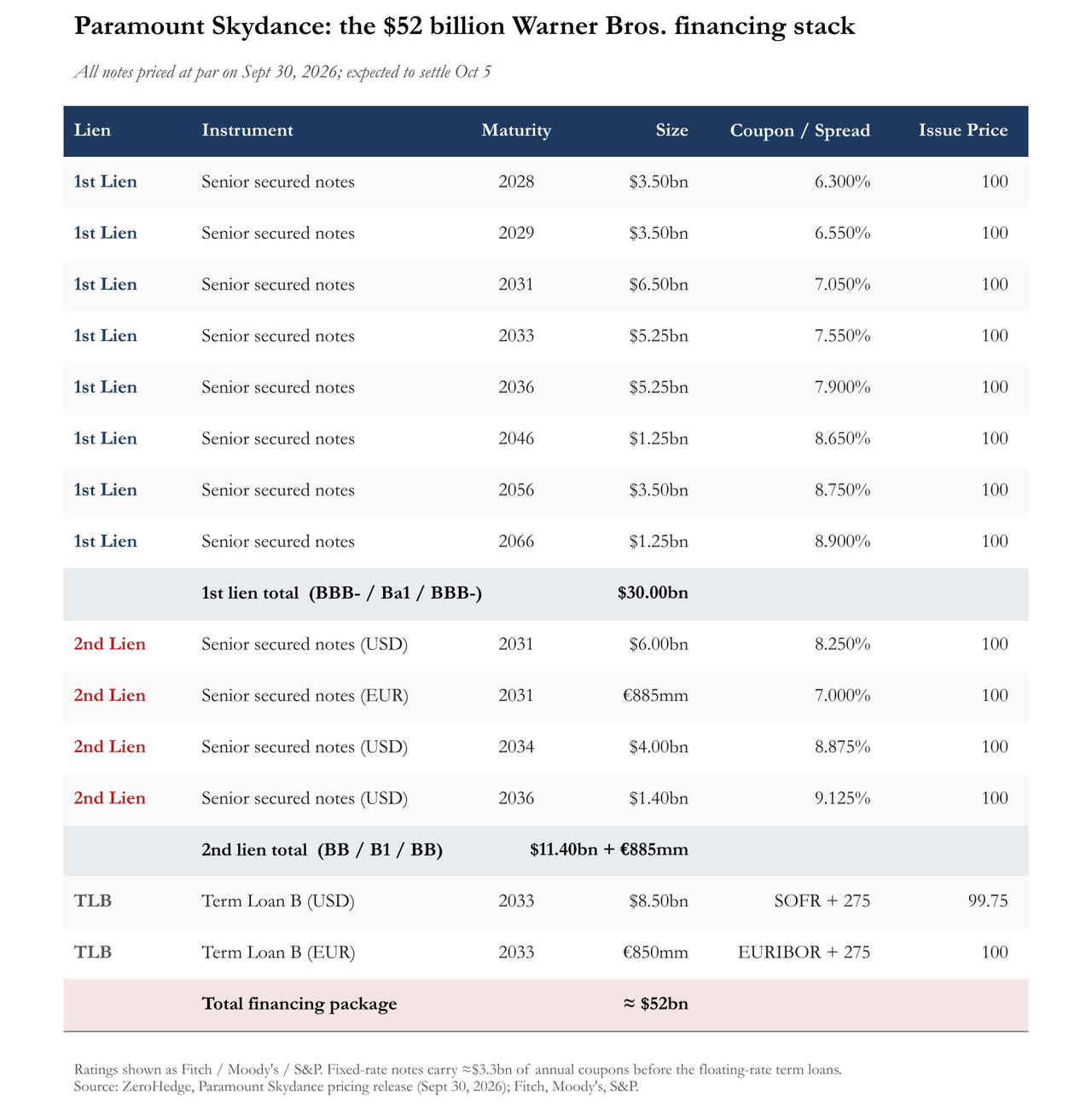
Here is the full stack from the company’s pricing release. The $52 billion package has three parts:
- $30 billion of first-lien notes across eight tranches, from 2028 to 2066, rated BBB-/Ba1/BBB-.
- $11.4 billion plus €885 million of second-lien notes (i.e. junk) rated BB/B1/BB.
- An $8.5 billion and €850 million term loan B at SOFR/EURIBOR+275.
Every note priced at par.

Every tranche priced at par. The junk second-lien notes come with junk-sized coupons.
What happened next
On Wednesday evening, Goldman’s credit desk wrote that “IG cash felt firm, supported by beta compression and outperformance from PSKY.” That lasted about one night.
Here is Goldman’s credit desk Thursday’s 7:38am macro update:
“Despite IG cash feeling firm most of the day, PSKY traded heavy and is now +10 from the break, and the WBD 2L bonds are down ~3pts from new issue price. Generically, HY cash has continued to lag HQ with insurance and mortgage originators feel the most pain.”
Things got much worse from there. According to Bloomberg and TRACE data:
- The 8-year dollar second-lien notes, which priced at 100 on Wednesday, traded a touch above 95. That works out to a yield of about 9.7%. On the $4 billion tranche, that is roughly $200 million of paper losses within minutes of breaking .
- The $5.25 billion 10-year first-lien bond, issued at T+262.5, was quoted near T+278.
- Investment-grade paper alone booked more than $200 million of unrealized losses.
- Paramount’s 5-year CDS rose as much as 53bp to 432bp, the highest since April 2009.
- The stock fell as much as 7.5%.
Day-one returns for anyone who got a full allocation.

While widely trumpeted as a sign of relentless demand ahead of pricing, the (alleged) $109 billion order book shrank to about $80 billion by pricing. Demand at the long end fell by more than half. That is the same pattern as June’s $25 billion SpaceX deal, which also struggled once it was free to trade. The investors who stayed in received most or all of what they asked for, especially in the long bonds. Many of them didn’t feel like staying after the bonds didn’t rise after the break… and immediately sold on Thursday morning.
Traders reportedly called and messaged the lead banks (Apollo, BofA and Citi, syndicated across 18 banks) to complain. The bank, for their part, were quick to point out what a great offering this was (for them, and the company perhaps): Citi’s Leon Kalvaria said the financing “turned out incredibly well in a choppy market.” CFO Dennis Cinelli called the selloff “one-day choppiness.”
Goldman’s desks saw it coming
To be fair to the bankers, nobody who reads Goldman’s credit traders should be surprised. Goldman’s portfolio-trading desk (Sarah Zappone) wrote on Sept 26, before launch:
“$32bn in 1L secured IG bonds (whispered ~50bps steep on 10s30s!)… We suspect this package prices well wide of CHTR given the deal scale and elevated pro-forma leverage.”
Brad Shelofsky on the IG trading desk said the same day that “~$30bn will be wide trading 1L secured IG bonds.” Just the whispers about the deal had been enough to hit the market. Bonds trading wider than 200bp ended that week 9bp wider, versus 3.5bp for the 0-100bp bucket. He also warned that the risk was to credit curves steepening, since “the likes of PSKY will bring some wide trading duration.” Paramount alone was expected to push September high-grade supply close to the desk’s $230 billion estimate.
Alisha Pasi’s weekly “What’s Trending Across Credit” summed up the setup. SoftBank had just printed the largest non-IG bond sale on record, and Paramount was lining up “another potentially record-setting ~$12.4bn HY financing.” Pasi wrote:
“The ability of the market to absorb back-to-back jumbo transactions should be a useful test of demand at still-tight valuations… the margin for error has clearly narrowed.”
The test had a clear result.

Paramount also had no control over its timing. The lawsuits blocking the financing were only settled late last month, and the ticking fee kept running every day the deal stayed open. Goldman’s special situations desk calculates that WBD holders will receive $31.0167 a share at the Oct. 6 close, based on a ticking fee of 0.278 cents per day. Impax’s Tony Trzcinka put it simply: the timing was “partly forced.”
Needless to say, the window Paramount was forced into was one of the worst for credit in years. As we noted on Wednesday, credit was “cracking big time.” CCC spreads turned distressed for the first time since the 2023 bank crisis. Goldman’s credit monitor (Reid Zhou) shows how lopsided the damage was as of Wednesday’s close:
- USD HY OAS 311bp, up 37bp in a week (98th percentile over one year)
- CCCs at 1,007bp, a three-year high, up 76bp on the week
- IG OAS up just 4bp
- iBoxx IG all-in yields at 6.50%, the 100th percentile going back to 2004
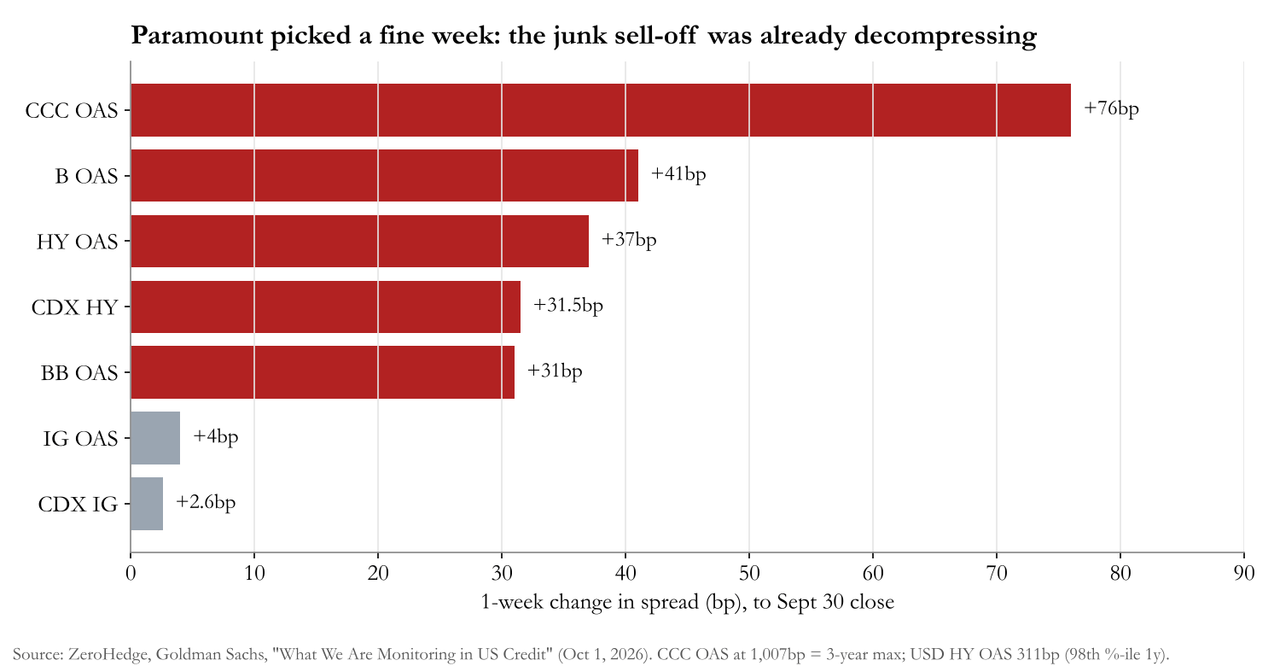
The lower the rating, the bigger the move, and Paramount just brought $12.4bn of BB/B1 paper smack into the middle of it.
Rates added to the pressure. Goldman’s rates desk said the long end hit new highs on Wednesday “after US consumer spending rose at this fastest pace in a year… and Paramount priced their $30bn eight part offering.” It also said the long end was “potentially weighed down by corporate supply alongside hedging flows.” The 10-year went above 5.30% for the first time since 2002. The 30-year touched 5.60%. As Deutsche’s Jim Reid put it this week, “Equity investors see the growth, and bond investors see the bill.”
The “cycle’s TXU”?
The Bear Traps chat was less charitable. One CIO wrote:
“A mkt taking on 2 or 3 record / MONSTER equity IPOs (SpaceX, Anthropic) and this MONSTER debt offering at the same time – these are cycle TOP signposts… Paramount’s existing unsecured bonds? Primed. TXU (2007) is still the largest LBO ever, but this is our cycle’s TXU.”
That point about priming deserves attention. Holders of Paramount’s legacy unsecured debt now rank behind $30 billion of first-lien and $12.4 billion of second-lien secured paper.
And here is a technical twist on the Paramount loans, flagged by Goldman. The new Paramount term loan (marketed at $7.5 billion and upsized to about $9.5 billion at pricing) comes alongside repayment of WBD’s roughly $15 billion term loan. Nearly 90% of US CLOs under Fitch surveillance hold that loan, and O’Connor says “upon settlement, it will amount to one of the largest paydowns in history.” That is a large amount of CLO cash that will need a new home, at the same time the CLOs’ favorite collateral is being repriced.
The other side
For the bulls, JPMorgan’s Saul Doctor notes that the bank’s Fear & Greed index has hit oversold (83, versus a trigger of 80). CDX IG is just shy of 60bp, which is 6bp from the YTD wides. According to Doctor, three months of carry on CDX IG (30c) would recoup a move back to the wides. In other words, panic sellers of high grade have historically been the ones who lost money.
The problem is that Paramount’s new bonds are not CDX IG. They are a split-rated, 7x-levered, record-sized new issue whose biggest buyers were left holding more than they wanted. Those investors also learned within 24 hours that the “concession” was a markdown. Whether this was “one-day choppiness” will be clear soon enough: Paramount is still looking for equity, CDS is at 2009 levels, and the deal closes on Tuesday. And as for the key sponsor, Larry has many other problems on his mind.
Tyler Durden
Thu, 10/01/2026 – 21:38