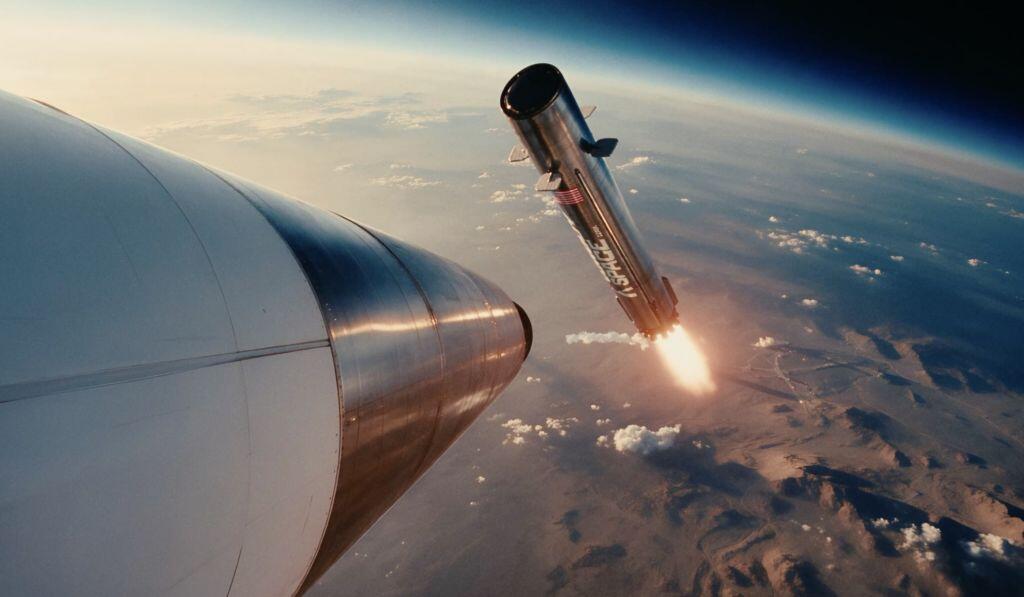
Cowboy Space Corporation, the former Aetherflux founded by Robinhood co-founder Baiju Bhatt, on Monday unveiled “Big Iron,” a rocket whose upper stage is designed to stay in orbit as a megawatt-class data center, rather than be discarded or release a separate satellite, according to the company.

The rocket stands 86 meters (about 282 feet) tall, and its stainless-steel first stage is powered by nine liquid oxygen and methane “Clydesdale” engines rated at 300,000 pounds of thrust each, or 2.7 million pounds in total. The company says it can lift more than 15,000 kilograms to sun-synchronous orbit.
Once deployed in a dawn-dusk orbit, the upper stage becomes a satellite measuring 132 by 73 meters that can carry five racks of Nvidia Vera Rubin GPUs. The design is meant to do double duty: the rocket’s skin serves as the radiator, its ammonia propellant doubles as coolant, and the nitrogen used to pressurize the stage also unfolds the solar wings.
“Our design puts us on a path to cost parity with terrestrial data centers,” Bhatt said in the release. Chief operating officer Joseph Yaffe told Axios the company aims to build the first rocket by the end of 2027, with a first flight in 2028.
Nothing here has flown. Yaffe told Payload that government customers “want to see a completed rocket,” and Payload notes that many alternative launch vehicles, Big Iron among them, have yet to reach orbit. The company says part of a Clydesdale engine was tested last week at NASA’s Stennis Space Center, where a team of about 30 built and tested the combustion chamber in 90 days.
The rocket is the launch half of a larger bet. In May, Cowboy filed with the FCC for a 20,000-satellite constellation called Stampede, and it has no approval yet while asking the commission to waive its deployment schedule and milestone rules. It says commercial service could begin with as few as one satellite in orbit. The company raised a $275 million Series B this spring, and its first demonstration satellite, Reason-1, launched Oct. 1 on SpaceX’s Transporter-18 to test laser power beaming from orbit to Earth. Reason-2, due in 2027, is slated to run GPUs in orbit.
Cowboy is also selling rides. The company’s “Big Iron Express” program offers the launch to outside customers who need up to a megawatt of power in orbit, and Yaffe said it wants the military’s National Security Space Launch business too, where Axios reports SpaceX plans to retire its Falcon 9, citing Politico. “We’ve commenced discussions with the right folks to walk down that path,” Yaffe told Axios.
The competitor looming over all of it is SpaceX, which filed in January for a million data-center satellites, roughly 100 gigawatts of compute, and already flies the rockets that would be needed to launch them. Cowboy’s pitch is that it can build the launch vehicle and the data center as one machine.
Bhatt left Robinhood in March 2024, and the company began as Aetherflux, a space solar power venture. Cost parity with terrestrial data centers, the 2028 first flight and the FCC waiver are the company’s own claims or requests, and none of them has been tested or approved.