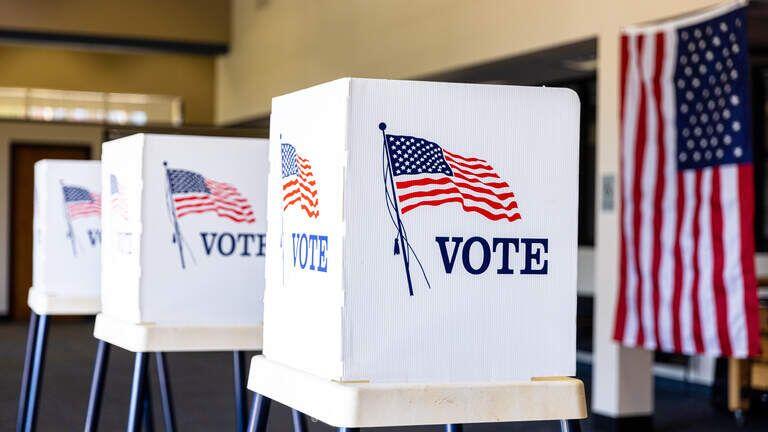
Senate Republicans are making another push to pass the SAVE America Act, the voter ID and proof-of-citizenship bill, before the current Congress runs out of time. The effort comes days after the midterm elections and weeks before lawmakers leave Washington for the year.

“I’ve been fighting for over two years to get the SAVE/SAVE America Act passed in the Senate,” Sen. Rick Scott (R-FL) wrote Sunday on X. “We have two months to get it done. Every candidate for a leadership job must commit to passing it. Failure is not an option.“
I’ve been fighting for over two years to get the SAVE/SAVE America Act, passed in the Senate.
We have two months to get it done. Every candidate for a leadership job must commit to passing it. Failure is not an option.
— Rick Scott (@SenRickScott) November 8, 2026
The formula remains the same:
(1) Put the SAVE America Act on the Senate floor.
(2) Require filibustering senators to speak, calling the vote at a simple-majority threshold when they stop speaking.
(3) Announce that debate will continue until it passes. https://t.co/lbtqlZRWsl
— Mike Lee (@BasedMikeLee) November 8, 2026
Senate Republicans trying to figure out what to do in the next 6 weeks? Here you go:
DEFUND Planned Parenthood
MORATORIUM on data centers
SUSPEND the gas tax
FUND rural hospitals
SAVE AMERICA ACT— Josh Hawley (@HawleyMO) November 11, 2026
🚨 BREAKING: House Republicans just LAID OUT the path forward after Democrats won Congress and it involves ACTING FAST during the lame duck period
REP. KEITH SELF: “NO PACKING UP EARLY! Codify President Trump’s border policies. Under no circumstances AMNESTY. Act fiscally… pic.twitter.com/YuQBto5Ft3
— Eric Daugherty (@EricLDaugh) November 11, 2026
The House passed the SAVE America Act in February. The bill has sat stalled in the Senate ever since, blocked by the filibuster. Republicans still hold the chamber but lack the 60 votes needed to advance the measure, and a group of Republican holdouts refused to eliminate the filibuster earlier in this Congress.
Despite the current push, Senate Majority Leader John Thune says forcing a talking filibuster is off the table, even though Democrats are promising to eliminate the filibuster when they’re back in the majority.
🚨 JUST NOW: Senate Leader John Thune says he has NO CLUE how to “force” the SAVE America Act to the floor, because a talking filibuster is OFF THE TABLE for him
Q: Should you have forced the SAVE America Act fight on the floor?
JOHN THUNE: “I don’t know how we’d force that… pic.twitter.com/GnKOLujLGu
— Eric Daugherty (@EricLDaugh) November 10, 2026
Democrats are set to take the Senate majority in the next Congress.
President Donald Trump pressed lawmakers to pass the SAVE America Act before the midterms. The legislation failed to advance before Election Day.
The bill would require proof of U.S. citizenship to register to vote in federal elections. In May, a Rasmussen Reports survey found that 63% of likely US voters support the SAVE Act, including 45% who strongly support it. Thirty-one percent oppose the bill. It also found broader agreement on the underlying principle. Eighty-four percent of respondents said only US citizens should be allowed to vote in US elections, while 10% disagreed. Rasmussen also reported that 52% of likely voters believe noncitizens are likely illegally registered to vote in their state, including 31% who said it is very likely. Thirty-eight percent said they consider it unlikely.
Rasmussen found that 84% of Republicans back the SAVE Act, compared to 64% of unaffiliated voters and 42% of Democrats.
Support for voter ID requirements in general runs higher. CNN data analyst Harry Enten said earlier this year that voter ID is “not controversial,” citing polling that showed 83% of Americans support it. Enten also noted that support crosses lines of political affiliation and race.
“The bottom line is this: Voter ID is not controversial in this country,” Enten concluded. “A photo ID to vote is not controversial in this country. It is not controversial by party, and it is not controversial by race.”
Americans agree with Nicki Minaj when it comes to voter id.
83% of favor photo voter id to vote per Pew. This includes 70%+ of Democrats and Republicans, as well as 75%+ of Americans across races…. White, Black, and Latino.
It’s not controversial. pic.twitter.com/9Kocw85Uh8
— (((Harry Enten))) (@ForecasterEnten) February 3, 2026
Back in March, Florida passed its Voter ID law, and Oklahoma followed suit in August, approving a voter ID measure 54.6% to 45.4%, months ahead of the general election.
Even as Democrats rode a blue wave on Election Day, election integrity measures quietly racked up wins, often by lopsided margins.
In Nevada, Question 7, which requires photo ID for in-person voting and identification numbers on mail ballots, passed 62.2%-37.9%. North Carolina voters extended the photo ID requirement already in the state constitution to mail ballots, and Ohio wrote its existing voter ID rules into its own constitution, making them much harder for future legislatures or courts to undo.
The citizenship question was even more one-sided. Measures reinforcing that only citizens can vote passed in four states: Arkansas, Kansas, South Dakota, West Virginia. Alaska also approved a citizenship requirement as state law. The wins bring the number of states with explicit constitutional prohibitions on noncitizen voting to 22.
Despite these victories, not every state got on board. Voter ID measures failed in California (60.4%-39.6%), Colorado (63.3%-36.7%), and Arizona, where Proposition 144, which also would have reinforced citizenship requirements, lost 53.3%-46.7%.
Still, in a year when the political winds blew hard against Republicans, voters in red and purple states alike made clear that asking people to prove who they are, and that they’re citizens, isn’t a partisan idea.