Amazon Shares Tumble Amid News Of FTC ‘Advertiser Deception’ Lawsuit
The Federal Trade Commission (FTC) is about to drop a lawsuit on Amazon today alleging that the e-commerce platform manipulated prices paid by businesses to advertise on its retail platform, which made the company tens of billions of dollars over a seven-year period, WSJreports, citing agency officials.
According to the report:
The lawsuit, joined by a bipartisan group of more than 20 state attorneys general, will allege that Amazon deceived advertisers by secretly raising the minimum price advertisers had to pay to place ads promoting their products, FTC officials said.
The case, to be filed in a Seattle federal court, will become the consumer-protection agency’s third major case against Amazon, which agreed to pay $2.5 billion last year to settle an earlier suit alleging it tricked people into signing up for its Prime service and made it hard to cancel the subscription. Another lawsuit alleging that Amazon engaged in illegal monopolization is headed for trial next year. -WSJ
Amazon’s digital advertising platform is the third-largest in the world, behind Alphabet’s Google and Meta – earning $68 billion in ads in 2025, according to the report – which claims that advertisers suffered billions of dollars in harm by paying higher prices for ads. Some states may attempt to claw some of the money back.
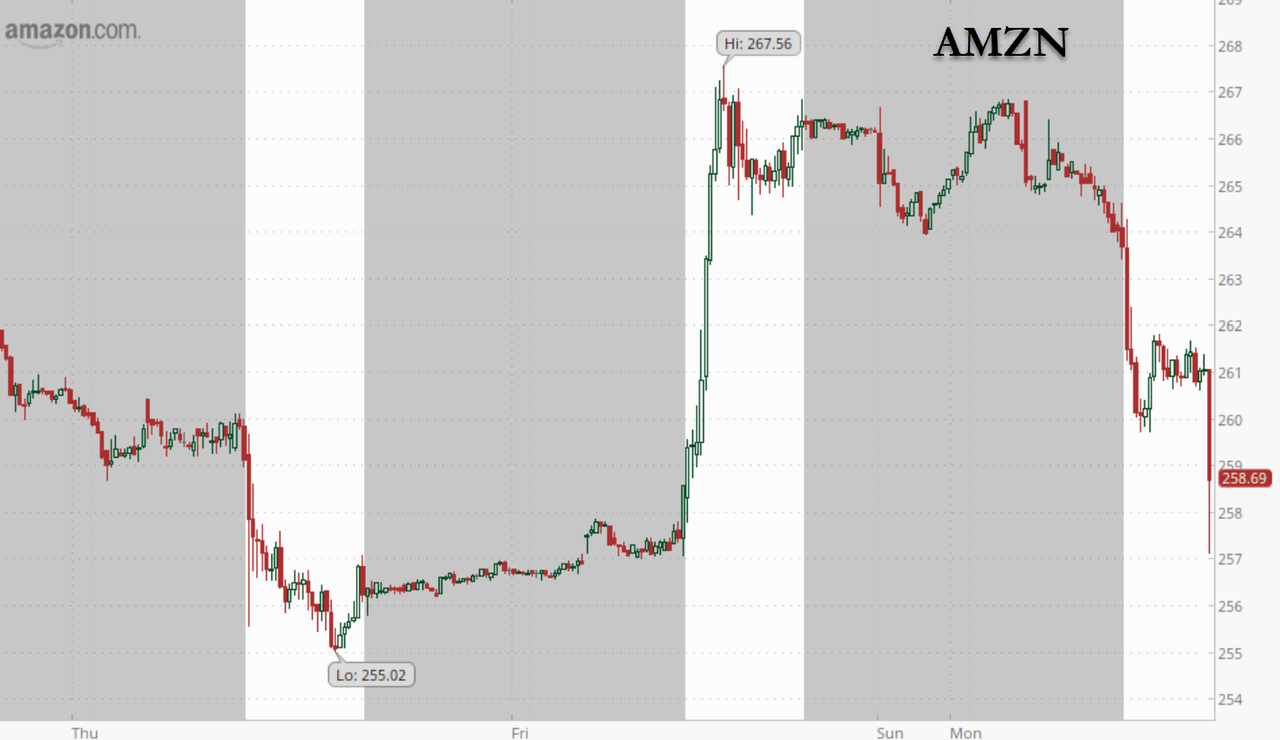
Shares shot sharply lower on the news.
Every time a shopper searches for a product on Amazon, merchants compete to offer different types of ads to get in front of consumers. According to the FTC, Amazon began changing its ad auction strategy in 2018 – raising prices on advertisers in a way they wouldn’t notice.
The way this worked was through a mechanism called a “soft reserve”:
The company had historically run a special type of auction, popular in Silicon Valley, designed to attract more bids and protect winners from dramatically overpaying. That formula tended to reduce the price a merchant paid to advertise.
To raise the price, Amazon began entering its own bid, known as a “soft reserve,” which was higher than the price of the runner-up bidder, the FTC will allege. Under the rules of the auction, that raised the price paid for an ad. Amazon knew the merchants’ competing bids and didn’t disclose its new practice, officials said.
Amazon’s ad executives tracked the “surcharge” they earned from the strategy and sought to limit how much others knew about it, FTC officials said. The executives initially deployed the strategy only on popular shopping days when companies would think higher ad rates resulted from intense competition for shoppers’ attention, the officials said. -WSJ
According to the FTC, Amazon’s goal was to capture more of the value of each retail sale connected to a successful ad – in recent years intervening in auctions to raise the minimum price 70% – 80% of the time.
“Prepare For More Severe Scenarios”: Bank Of England Chief Warns Of AI Threat To Global Financial System
As the world marches towards open-weight, efficient, unrestricted frontier AI models out of China, Western leaders are starting to panic over the lack of guardrails. Most recently, Bank of England Governor Andrew Bailey suggested that the threat posed by AI could lead to a chaotic correction in global financial markets, as frontier models are now showing “increasingly sophisticated autonomy and problem-solving abilities, as well as threat capabilities.”
“Financial institutions, financial market infrastructures, and technology providers will therefore need to strengthen vulnerability management, response and recovery capabilities, and prepare for more severe scenarios involving simultaneous disruption across multiple firms or shared technology dependencies,” Bailey wrote in a two-page letter published Monday to G20 finance ministers and central bank governors in his capacity as chair of the Financial Stability Board – an international body that coordinates international policy and provides recommendations to national authorities.
Bailey says the cyber risk posed by AI is “the most immediate concern” for the global financial system.
“Frontier AI may have the ability materially to alter the speed, scale and economics of cyber risk, which could undermine market confidence system-wide, especially due to highly concentrated third-party service providers,” he wrote, adding. “Recent developments have also highlighted to me that many jurisdictions do not have the protocols in place to manage the development, release, and deployment of advanced frontier AI models, heightening risks for the financial sector and beyond.”
Bailey’s warning comes one month after the Bank for International Settlements warned that the AI bubble itself is one of three of the most alarming threats to global prosperity at this time.
“Disappointment in returns could trigger a sudden pullback in financing and turn the capex boom into a protracted investment bust, with potential knock-on effects on financial conditions,” the BIS said, before observing that “a major equity-market correction could have larger macroeconomic consequences today than in the past.”
Google Maps has updated its site to include Lake America in place of Lake Ontario, following the direction of President Donald Trump’s executive order renaming the Great Lake.
“It’s official! LAKE AMERICA on Google Maps,” Steven Cheung, assistant to the president and White House director of communications, posted on X on Aug. 30.
Google released a statement on the changing of the name of the body of water.
“The U.S. Geographic Names Information System (GNIS) has formally changed the name for ‘Lake Ontario’ to ‘Lake America’ in the United States,” the company said.
Since it updates Google Maps to reflect name changes in official government sources, people using the application in the United States will see “Lake America,” Google said.
In Canada, users of Google Maps will continue to see “Lake Ontario,” and those outside of the two countries will see both names, the statement reads.
Trump signed an executive order on Aug. 27 directing the Department of the Interior and the U.S. Board on Geographic Names to update federal records to identify Lake Ontario as Lake America.
The president said the change recognizes the United States’ role in protecting and maintaining the Great Lakes. The order cites nearly $4 billion in U.S. spending on the Great Lakes ecosystem during the past decade and said the U.S. Coast Guard operates nine of the 11 icebreaking vessels serving the lakes.
Canadian Prime Minister Mark Carney rejected the change, saying that Canadians would continue calling it Lake Ontario. New York Gov. Kathy Hochul has also said the state will retain the lake’s traditional name.
Mexican President Claudia Sheinbaum announced on May 9 that her government had sued Google over the company’s decision to label the Gulf of Mexico as the Gulf of America after Trump changed the name of that body of water.
Google made the change for U.S. users after Trump’s executive order directed the federal government to adopt the new name. Users in Mexico continued to see the Gulf of Mexico, while users elsewhere saw both names.
Sheinbaum had threatened legal action in February, arguing that the United States could rename only the portion of the gulf under its jurisdiction, not the body of water. She disclosed the lawsuit during her briefing but provided no details about where it was filed or what relief Mexico was seeking.
After the publishing of George Orwell’s 1984, communist governments and organizations around the world condemned the book as “anti-Soviet slander” and “capitalist propaganda.” Orwell died only eight months after the book’s release and his personal feelings on the details of the story are limited to a few personal letters to friends and publishers.
Orwell was a Democratic Socialist, but even he was disturbed by the path that socialist movements had taken in light of genocidal far-left governments. His criticisms of Stalinist politics were treated by leftists as a betrayal.
However, it was Orwell’s depiction of women within authoritarian systems that angered the political left most of all. They have attacked 1984 for decades as “misogynistic”and “blind to gender oppression”. But as time passes, Orwell’s views on leftist women have proven more and more prophetic and they were written well before second wave feminism became a reality. In 1984, the character of Winston Smith described them thus:
“He disliked nearly all women, and especially the young and pretty ones. It was always the women, and above all the young ones, who were the most bigoted adherents of the Party, the swallowers of slogans, the amateur spies and nosers-out of unorthodoxy…”
“She had not a thought in her head that was not a slogan, and there was no imbecility, absolutely none, that she was not capable of swallowing if the Party handed it out to her…”
The women in Orwell’s Stalinist world were a key tool in controlling society. They are easily brainwashed to serve “Big Brother”, turning them into affection-less robots. Their ability to nurture a family is conditioned out of them and if they are allowed to have children, they have no care for them. The children immediately become property of the state.
It’s not just women’s biological habit of following the dictates of the herd, it’s also their inherent desire for chaos that makes them destructive to society at large. Nearly every civilization from the beginning of recorded history has understood this problem and sought to keep it contained. Only in the modern west in the past century have we abandoned reason for madness.
I have said it many times in previous articles and I will repeat it here now: Feminism is by far the most destructive movement in the history of western civilization. In the US, almost every political and social crisis we face today can be linked directly or indirectly back to the rise of feminist ideology. The weaponization of mentally ill women is the single most effective attack on the foundations of our culture.
It’s not because women are particularly scary or dangerous. It’s because, as western men we have adopted principles of fairness; to care about elevating those who are weaker than us and value their contributions. Feminism is designed to exploit our love of fairness and our love of women and it turns our love into a weakness.
Compare the west to almost any other civilization in this regard and you will find undeniable differences. There is no such thing as fairness, equal rights or feminism throughout most of the world. Women are, at best, barely tolerated. At worst, they are chattel to be abused with impunity.
Often considered one of the greatest accomplishments of the First World (as opposed to the third world), men have ALLOWED women to rise to equal standing. In many cases, we have prioritized them and given them privileged status, and this is where we made a big mistake.
All of our problems with feminism are self created. Western men allowed the ideology to spread. Conservatives talk a lot about the dangers of “suicidal empathy” when it comes to liberals and mass immigration, but we suffer from suicidal empathy when it comes to women.
The early women’s suffrage movement had numerous ties to Marxist causes and the communists saw very early how useful women could be in destabilizing western nations. Marxists like Friedrich Engels argued that women’s oppression began with the institution of private property and class division, not biology.
This, of course, is pure nonsense – A great lie which requires us to ignore thousands of years of recorded history from every feudal monarchy and empire that existed previous to the 18th Century Enlightenment.
Because of their biology, women are naturally removed from the power dynamic except for influencing men to take actions in their favor. For women as a group to have power requires numerous artificial social constructs and laws be put in place.
Marxists also argued that the family unit must be targeted for deconstruction as a social pillar. They claim that the family unit is “how capitalism uses women as free labor to raise new workers for the system.” In reality, the family unit represents the atomic core of any civilization. Breaking it apart, and using women to do it, will inevitably destroy that civilization and make it ripe for conquest.
Leftists and their globalist cohorts do not care about women. Feminism does not care about women. The goal of these movements is to turn women into suicide bombers. Their goal is to radicalize women to forsake their biological and psychological imperatives, turning them into corrosive saboteurs willing to sacrifice their own happiness for the sake of the Marxist cult.
Millions of women have even been convinced that their grand mission requires them to kill their own children. Sometimes this is done in the name of freeing themselves from the “shackles” of the family unit. Sometimes it’s done as an offering to the collective feminist coven to prove they are “worthy.”
This is why a child killer like Lindsay Clancy, a woman who openly confessed to the crime, has attracted the full attention, adoration and protection of the liberal congregation. She didn’t just go to a clinic and abort a baby, she went the Full Monty; she murdered her own growing children in cold blood. She looked into their eyes when she did it, and the feminists are impressed and they want more.
What has followed is a sort of hysterical worship, a swirling vortex of dark-feminine chaos as the brood searches for ways to protect Lindsay Clancy from punishment while also rationalizing her crimes. The case has become a nexus point for the ever festering conflict between the champions of moral order and the terrorism of morally relative chaos.
In my recent articles I have talked about the eternal battle between the producer class and the pillager class, but this is only half the story. The other half is the battle between the champions of conscience and the purveyors of subjective nihilism. The political left has happily embraced nihilism.
We might find it bewildering, but this is why these people are defending a child murderer. If Lindsay Clancy can be glorified, even deified as a oracle of the feminist calling, then any evil can be justified. “Do as thou wilt” could become the prevailing ideal of a soulless age brought into being by female insanity.
All they have to do, in their view, is help Clancy to escape blame and responsibility for her crime.
The postpartum excuse is the most common strategy because it works. Around half of all female child murderers who use this defense get off with a jury decision of “not guilty by reason of insanity.” The concept ignores the fact that ANYONE who kills kids is mentally ill or broken in some way. Postpartum is simply a more acceptable excuse for diminishing the crime.
It’s a way to paint the killer as a victim; a more empathetic victim than the dead children.
If western women can be convinced that they can get away with murdering their offspring out of the womb, we would be setting a new and horrific precedent. The feminist mob will jump on every crime involving a woman in an effort to leverage them out of repercussions. The legal system already has so many double standards in favor of women, but we are getting dangerously close to a two tier system.
If Clancy escapes with a lesser charge or institutionalization instead of prison, leftist women will see this as political victory. That said, the case is opening the door to an awakening among men. Young men are using the case to “test” their girlfriends and wives. If these women show any inkling of sympathy for Lindsay Clancy, men are dumping and divorcing them without a second thought.
It’s a smart move and, for now, it’s the only strategy against the ongoing cancer of liberal female derangement. But it doesn’t solve the greater issue of feminism as a societal influence. In the meantime, families are not being built.
I would point out that there are men who kill their own children as well. It’s not as if this crime is exclusive to women. However, I can’t find a single instance in which a mob of men rallied together to defend a father who murdered his family. This is strictly female behavior.
The Clancy trial is nearly over, and regardless of what the jury decides to do there’s no denying that the event has reminded us, once again, that western men have ignored the single most poisonous problem in our society for far too long.
Liberal women are the most privileged, most entitled and most coddled people on the planet. No other group comes close. Their obsessive grasping for power by any means necessary is corrosive. Their rabid efforts to elevate their own egos as the focal point of politics, government and the social contract is sinking our nations one by one.
Perhaps this quest for power needs to end? Perhaps western men need to finally abandon the liberal experiment in equality or “equity” and bring our countries back to the models they were founded on? Or at the very least, we need to bring back certain limitations. Not all freedoms are good and we have seen where our current path leads.
If liberal women have been weaponized, then liberal women need to be nullified and controlled. Or, at the very least, their level of participation in institutions of power needs to be restricted. In other words, we would have to set aside our empathy, be the bad guys and TAKE power (and rights) away from the leftist cabal. We would have to fundamentally overturn every facet of feminism and erase it from our daily lives.
We have seen what these women do with liberty and we’re not impressed. The celebration and adoration of a child murderer is, in my view, the last straw. If their first inclination is to use their freedoms as a license to tear the world down instead of building things up, then they no longer deserve those freedoms.
We publish a variety of perspectives. Nothing written here is to be construed as representing the views of ZeroHedge.
Words cannot do justice to the sheer idiocy of the story that broke this past week. It is hilarious, depressing, fascinating and deeply embarrassing for the human race all at once…a story that is proof that we may collectively be both far more gullible and far more comfortable with deception than even the most cynical among us previously imagined.
The story centers on a man named Daejon Love who, according to federal prosecutors, allegedly spent years convincing women that he was a professional football player for the San Francisco 49ers when he wasn’t.
Not trying out for the 49ers. Not once affiliated with the team. Not played professionally somewhere else and exaggerated the details. He convinced women that he was an actual NFL player for one of the most famous franchises in American sports when we wasn’t.
Yes. You read that right. In an era in which the entirety of all human knowledge is accessible from a 6 inch by 2 inch rectangle sitting in literally everyone’s front pocket, this 35 year old allegedly constructed an elaborate fictional life around himself that everyone believed and no one took the time to fact check. He did it by, among other things, carrying a 49ers helmet and gear around with him and wearing them…no matter how absolutely f*cking ridiculous it looked…all the time.
He even had a 49ers birthday cake made with his name on it and apparently created a video of himself “signing” with the team. He carried the helmet everywhere, including to the beach, where he filmed himself running some of the worst wide receiver routes ever captured on camera while some rando with a vermicelli noodle for an arm underthrew him passes as he lumbered around full sized telephone company construction cones set up on a beach.
Eventually, according to reporting on the FBI investigation, Love’s fake online footprint became convincing enough that search engines and artificial intelligence occasionally helped perpetuate it. AI started listing him as a professional NFL wide receiver when he wasn’t.
I couldn’t help but read the story yesterday and realize it is a perfect analogue to our modern stock market. You don’t have to be an actual NFL player anymore. You just need the helmet, the jersey, some followers, a few pictures standing next to expensive shit and enough people repeating the story. Eventually an algorithm looks around, sees that everybody else appears to believe you’re an NFL player and concludes that you must, in fact, be an NFL player.
Look, many of today’s big name stocks are exceptional businesses generating actual free cash and net income. Just like Jerry Rice used to actually make his way onto the field and catch actual passes in real NFL games.
But there’s also a growing number of Daejon Love companies in today’s market, because somewhere along the way Wall Street decided that actually turning a profit no longer mattered. If Jerry Rice is a fat free cash flow yield, Daejon Love is the 10-K of a company posting massive losses while pointing to its revenue, narrative and bullshit future projections instead of its net income and capital needs.
Nowadays, revenue can be projected decades years into the future and slapped with a multiple that would have gotten you involuntarily committed in 1995.
Revenue projections are faking you’re an NFL player when you’re not. Like with Daejon, narratives get you “investors”. If you’re a 35 year old dipshit pretending to be someone else with all your free time instead of working an actual job for a living, revenue projections get you laid under false pretenses by women who’d never want to talk to you otherwise.
Net income, on the other hand, is terribly inconvenient. The line of thirsty women dries up quick when it comes down to profit and loss. The second that reality starts inching into the picture, you become the guy no one can stand or wants to talk to.
The modern market would much rather hear that revenue grew 48% than that you lost $2 billion last year.
Nowadays, when investors ask, “Did the company actually make any money?” analysts respond, “Why are you being so negative? Revenue grew 48%!”
When investors ask, “Okay, but did free cash flow grow?” analysts respond, “You’re missing the opportunity. Revenue grew 48%.”
When investors ask, “How much capital expenditure did it take to generate that growth?” analysts respond, exasperated, “This guy just doesn’t understand AI. Revenue. Grew. 48%.”
This is essentially the Daejon Love method of equity valuation: don’t ask whether I play for the 49ers. Just look at my helmet.
Federal prosecutors say Love and his alleged accomplice, Taylor Jamie Chan, built an elaborate system designed to convince women that Love was extraordinarily wealthy. Fake investment accounts were allegedly displayed. Chan allegedly played the role of Love’s successful financial adviser. Three way FaceTime calls reportedly showed supposed investment gains. The government says at least 26 women ultimately sent approximately $1.3 million.
The appearance of wealth established credibility. Credibility attracted money. The incoming money helped finance the appearance of wealth. That appearance attracted additional money. Every additional participant therefore helped validate the story for the next participant. Daejon invented the public relations department of a Ponzi scheme.
The stock market has developed its own similar loop. A company projects enormous future revenue, investors bid up the stock, and the higher valuation gives the company access to more capital. It raises money, makes acquisitions, increases spending, and uses its expensive stock as currency to generate the growth needed to justify its valuation. That growth pushes the valuation higher, allowing the cycle to repeat. In effect, the company is trying to grow into a valuation that is itself financing the growth. It works until the market stops providing cheap capital, the promised cash flows fail to materialize, and the entire loop begins to reverse.
This is when everyone in the world discovers you don’t play for the 49ers.
This is what makes the Love story such a wonderful metaphor. Again, Love’s fabricated internet presence became substantial enough that Google searches and AI generated results occasionally identified him as an actual 49ers player. The internet had effectively begun marking his bullshit to market. He could point toward the search result and say, effectively, don’t take my word for it. Google says I’m an NFL player.
Wall Street does this every day. Don’t believe the narrative? Look at the stock price. Don’t believe the stock price? Look at the market capitalization. Don’t believe the market capitalization? Look at the revenue growth. Don’t believe the revenue growth? Look at total addressable market. Don’t believe total addressable market? Look at the analyst price targets.
Why did the analysts raise their price targets? Because the stock price went up. Excellent. Due diligence complete. Look at the f*cking helmet.
Then, at some point nobody remembers which piece of evidence was originally supposed to independently validate which other piece of evidence. The machine is simply validating itself.
This isn’t entirely irrational. Rapidly growing companies should often prioritize expansion over maximizing near term profits. Amazon famously spent years reinvesting enormous amounts of money into its business. Many of the greatest companies in history would have been badly misunderstood if investors had looked exclusively at current year earnings.
But Wall Street has taken a reasonable idea and, as Wall Street tends to do, driven it directly through the guardrail. Remember WeWork’s “Community Adjusted EBITDA”?
We have entered an environment where investors can seemingly forgive almost anything if the revenue chart points northeast. No profits? Growth company. Negative free cash flow? Investing for the future. Massive stock based compensation? Noncash expense. Enormous capital expenditures? Building the infrastructure for the future. Constant dilution? Funding growth. Acquisition spending? Expanding the platform. Adjusted EBITDA? Now we’re talking.
This becomes especially entertaining when discussing AI. The AI revolution is real. The demand is real. The infrastructure buildout is real. The revenues are real. And some of the companies supplying the boom are producing extraordinary amounts of actual free cash flow and net income.
But the market doesn’t stop with those companies. It takes the legitimate economics at the center of the boom and radiates them outward. The chip company makes enormous profits, therefore the data center company deserves a giant multiple. The data center company is growing rapidly, therefore the electricity provider deserves an AI premium. The electricity provider needs generation, therefore nuclear is an AI trade. Nuclear needs uranium, therefore uranium is an AI trade. Data centers need cooling, so cooling is an AI trade. They need copper, so copper is an AI trade. They need buildings, so buildings are an AI trade. They need financing, so private credit is an AI trade.
Eventually the non-English speaking man on an e-bike from Senegal delivering the DoorDash lunch to another man responsible for emptying the portable shitters at the construction site of a data center will soon trade at 28x revenue himself…because he has “exposure to the AI infrastructure ecosystem.” This is how things lead up to a crash.
🔥 85% OFF IF YOU SUBSCRIBE TODAY: Anyone who becomes a paid annual subscriber to Fringe Finance today gets 85% off a subscription — a discount they can keep for as long as they wish to remain a subscriber:Get 85% off forever
Once the narrative attaches itself to a company, investors begin valuing revenue differently. Revenue is where imagination lives. Net income is where imagination goes to die. Free cash flow is worse because it asks the deeply antisocial question of whether shareholders will ever actually receive any money.
You can build magnificent valuation models when you don’t concern yourself with that detail. Take a company with $1 billion in revenue. Assume the addressable market is $100 billion. Assume it captures 20% of that market. Assume 30% margins once it reaches scale. Assume the market continues paying a premium multiple in 2032. Discount everything back using whatever rate produces the number you wanted before opening Excel. Congratulations. Your $15 billion company is worth $60 billion.
Valuation increasingly seems to work the same way. A company worth $20 billion can look speculative. At $50 billion, it becomes interesting. At $100 billion, institutions start paying attention. At $250 billion, analysts explain why it has a defensible moat. At $500 billion, portfolio managers explain why they have to own it. At $1 trillion, CNBC installs a permanent camera outside headquarters. At $2 trillion, somebody explains that you’re thinking too small. At $4 trillion, the valuation itself becomes part of the bull case. Obviously the market wouldn’t value it at $4 trillion if it weren’t worth $4 trillion. Right?
Price creates legitimacy. Legitimacy attracts capital. Capital pushes up price. Price creates more legitimacy. It’s the custom 49ers helmet of finance.
And if the stock gets there before the earnings do, simply extend the forecast another five years. Again: look at the jersey. Don’t ask who’s wearing it.
QTR’s Disclaimer:Please read my full legal disclaimer on my About page here. This post represents my opinions only.In addition, please understand I am an idiot and often get things wrong and lose money. I may own or transact in any names mentioned in this piece at any time without warning. Contributor posts and aggregated posts have been hand selected by me, have not been fact checked and are the opinions of their authors. They are either submitted to QTR by their author, reprinted under a Creative Commons license with my best effort to uphold what the license asks, or with the permission of the author. I cannot guarantee the accuracy of all facts and figures included in this article though I made my best effort to get them right. I have been wrong before and will be wrong again, and encourage you to always double check, do your own research and speak to a licensed financial professional.
This is not a recommendation to buy or sell any stocks or securities, just my opinions. I often lose money on positions I trade/invest in. I may add any name mentioned in this article and sell any name mentioned in this piece at any time, without further warning. None of this is a solicitation to buy or sell securities. I may or may not own names I write about and are watching. Sometimes I’m bullish without owning things, sometimes I’m bearish and do own things. Just assume my positions could be exactly the opposite of what you think they are just in case. If I’m long I could quickly be short and vice versa. I won’t update my positions.
And all positions can change immediately as soon as I publish this, with or without notice and at any point I can be long, short or neutral on any position. You are on your own. Do not make decisions based on my blog. I exist on the fringe. If you see numbers and calculations of any sort, assume they are wrong and double check them. I failed Algebra in 8th grade and topped off my high school math accolades by getting a D- in remedial Calculus my senior year, before becoming an English major in college so I could bullshit my way through things easier.
The publisher does not guarantee the accuracy or completeness of the information provided in this page. These are not the opinions of any of my employers, partners, or associates. I did my best to be honest about my disclosures but can’t guarantee I am right; I write these posts after a couple beers sometimes. I edit after my posts are published because I’m impatient and lazy, so if you see a typo, check back in a half hour. Also, I just straight up get shit wrong a lot. I mention it twice because it’s that important.
Key Events This Week: Jobs, JOLTS, Beige Book And ISM
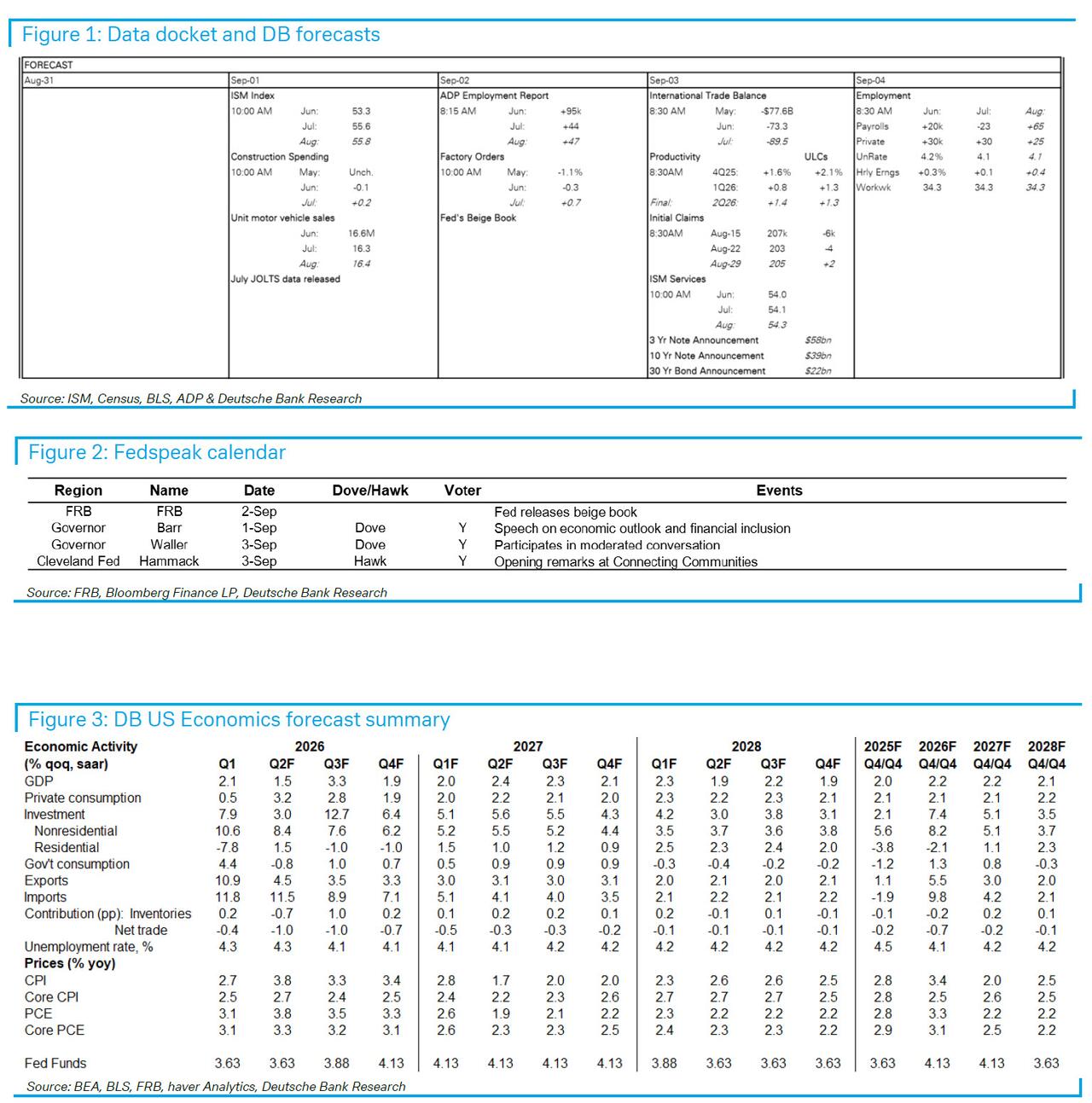
Following on the heels of Warsh’s speech at Jackson Hole last Friday, which was hawkish yet which also sent yields to multi-year highs thus refuting claims the Fed Chair regained some credibility, the data docket picks up this week with the main event being Friday’s August employment report. Regarding Warsh, he delivered a crisp message to market participants last Friday that resolved much of the confusion from his July post-meeting press conference. Indeed, Warsh went one step further and provided his own views on recent data trends. On inflation Warsh stated, “And while this summer’s PCE and CPI readings were better than expected, they do not tell me that underlying trends have meaningfully improved.” It will be interesting to see if Governor Waller reinforces this message when he takes part in a moderated discussion on inflation this Thursday at Reuter’s Next conference.
On the labor market, Warsh noted that “When labor supply is barely growing, monthly job gains are naturally going to run low. There are always areas of concern in the labor market—for example, among recent graduates. In general, though, people who want to work, by and large, are holding or finding jobs. They may well be concerned about possible future labor disruptions, but as of now, I believe the labor markets are consistent with full employment.” In short, Warsh delivered a message that was bullish on the economy and hawkish on inflation, reinforcing our longstanding view that the Fed will hike rates at the September 16 FOMC meeting.
Market participants will no doubt be trading upcoming data within the context of the views Warsh laid out last Friday. Though economists expect headline nonfarm payrolls to rebound (+65k forecast vs. -23k previously) due to payback from state and local education hiring, the private payroll forecast is somewhat more muted (+25k vs. +30k). Meanwhile, Bloomberg economists say there is a “decent chance” of a second consecutive negative print… and the Fed has never hiked after two negative prints.
I think next week’s payrolls print will disappoint, and has decent (though not our baseline) chance of being negative.
Supposed it is a negative print. There is no modern Fed era precedent of Fed hiking after two negative payrolls prints.
That said, with average hourly earnings (+0.4% vs. +0.1%) also expected to rebound following some unusually soft prints in specific sectors last month, the year-over-year growth rate of the DB payroll proxy for nominal income should remain around 4.0%. To be sure, Fed officials are likely to focus greater attention on the unemployment rate, which economists expect will remain unchanged at 4.1%, though there is some risk that it rounds up to 4.2%. However, even if the unemployment rate ticks up a tenth, it is unlikely to result in the Fed reappraising its labor market view, particularly given as Chair Warsh noted “Unemployment claims, on a four-week average—an empirically robust real-time indicator—are near their lowest level in decades.”
As DB notes in its weekly preview, there are a few data points ahead of Friday’s employment report print that could on the margin impact sentiment heading into the print. While Tuesday’s JOLTS data are somewhat dated given that they correspond to July, they will nonetheless provide the latest readings on the hiring, layoffs and quits rates. Broadly speaking, most of these rates are expected to remain unchanged from recent tight ranges – still painting the picture of a “low hiring / low firing” labor market environment that we’ve been accustomed to for the past three years. Wednesday’s ADP private employment survey (+44k exp) should reinforce the picture of a stable labor market, albeit at depressed levels of gains partly due to low labor supply growth that Chair Warsh mentioned. Our ADP forecast is consistent with the latest reading for their weekly series.
Lastly, Tuesday’s manufacturing ISM (55.8 vs. 55.6) and Thursday’s services ISM (54.1 vs. 54.1), while not directly impacting forecasters’ payroll expectations, will nevertheless provide a more forward-looking view from businesses on hiring trends. Note that while the employment component of the manufacturing survey has been trending up over the last three months, the employment component of the services series has been moving in the opposite direction and remains below 50.
In summary, should this week’s labor market data come in close to expectations, it will reinforce monetary policymakers’ view of a stable labor market that is consistent with their maximum employment mandate. As Chair Warsh emphasized “Inflation is running above our 2 percent target. So the Fed’s predominant focus right now should be on prices.” As we noted in our Jackson Hole recap note, the specificity of Warsh’s comments and the uniformity of the color in a hawkish direction, has changed the setup for the September FOMC meeting. As long as incoming data do not surprise meaningfully to do the downside, Warsh’s speech has established a rate hike as the most likely policy outcome next month.
Here is a day by day preview courtesy of Rabobank
Monday:sees German inflation numbers for August, starting with the regional states and followed later that day by the first estimate for the nationwide and harmonised gauge. Last week, data from France, Belgium and Spain already indicated that the rebound in energy prices would push inflation higher again following its easing trend since May. We expect the same in Germany. In the US, the main figure to watch is the (second-tier) Dallas Fed Manufacturing Activity survey for August.
Tuesday: German retail sales (July), Italian GDP details (Q2) and UK money supply and credit (July) all feature in the morning session, but the key figures to watch are Eurozone headline and core inflation for August. In particular, a renewed rise in core inflation (not our base case, but a possibility) could trigger further rate hike expectations beyond the September meeting. No change in the Eurozone unemployment rate for July would only underscore those risks. In the US, we have the JOLTS (July) labor-market flows data. Normally not a market mover, it could nevertheless shed more light on the recent slowdown in job growth. Meanwhile, only a small fall in the US ISM manufacturing survey for August (as per the consensus) could be interpreted by the market as a sign that US, as well as global, manufacturing activity is recovering despite ongoing concerns over tensions in the Middle East.
Wednesday: Australia releases its Q2 GDP numbers. Consensus expects quarterly growth to match Q1 at 0.3%. The Fed also releases its Beige Book, but Wednesday’s key event is likely to be the Bank of Canada’s interest rate decision, which investors may suddenly see in a different light since the eruption of the US-Canadian trade war. There are no signs that negotiations will resume anytime soon.
Thursday: Australia releases July trade balance figures, while the US calendar includes the July trade balance and August ISM services survey. Final S&P Global PMI releases and country extensions are also due, including for Spain and Italy, alongside Eurozone PPI and German factory orders for July.
Friday: The US nonfarm payrolls and unemployment figures are the highlight of the day. The street forecasts net job creation of 55,000 in August, following an unexpected dip in July. Although the jobs report is always a market mover, Fed Chair Warsh’s comments at Jackson Hole suggest the Fed’s focus is now on the near-term path for inflation rather than the labour market. Eurozone retail sales for July are expected to recover from a dip in June, but the underlying trend remains lacklustre as households face slowing real wage growth. The ECB’s Lane speaks in Dublin, but since –by then– the ECB’s pre-rate decision quiet period has commenced, he may not address current policy issues.
Finally, looking at just the US, Goldman writes that the key economic data release this week is the employment report on Friday. There are several speaking engagements with Fed officials this week including events with Governor Barr on Tuesday and Governor Waller on Thursday.
Monday, August 31
There are no major economic data releases scheduled.
Tuesday, September 1
09:05 AM Fed Governor Barr speaks: Fed Governor Michael Barr will speak about the economic outlook and financial inclusion at the Second Chance Lending Forum in Washington DC. Speech text and Q&A are expected.
09:45 AM S&P Global US manufacturing PMI, August final (consensus 53.3, last 53.2)
10:00 AM ISM manufacturing index, August (GS 56.0, consensus 55.2, last 55.6): We estimate that the ISM manufacturing index edged slightly higher to 56.0 in August, reflecting a modest improvement in regional manufacturing surveys—our manufacturing survey tracker increased by 0.3pt to 56.3 in August—and a slight tailwind from residual seasonality.
10:00 AM Construction spending, July (GS -0.1%, consensus flat, last -0.1%)
10:00 AM JOLTS job openings, July (GS 7,300k, consensus 7,313k, last 7,359k): We estimate that JOLTS job openings edged down to 7.3mn in July based on the signal from online measures of job postings from Indeed and LinkUp.
Wednesday, September 2
08:15 AM ADP employment change, August (GS +55k, consensus +47k, last +44k)
10:00 AM Factory orders, July (GS -0.2%, consensus +0.6%, last -0.3%)
02:00 PM Fed releases Beige Book, September meeting period: The Fed’s Beige Book is a summary of regional economic anecdotes from the 12 Federal Reserve districts. The Beige Book for the July FOMC meeting period noted that economic activity increased at a slight to moderate pace in all but one Federal Reserve Districts and that consumer spending edged up as higher prices, particularly for fuel, dampened sales in other categories. In this month’s Beige Book, we will mainly look for anecdotes related to how consumers and firms are responding to the increase in energy prices from the conflict in the Middle East, the evolution of labor demand, and firms’ expectations of activity growth for the remainder of the year.
Thursday, September 3
08:30 AM Trade balance, July (GS -$91.1bn, consensus -$90.0bn, last -$73.3bn)
08:30 AM Nonfarm productivity, Q2 final (GS +1.4%, consensus +1.4%, last +1.4%); Unit labor costs, Q2 final (GS +1.1%, consensus +1.3%, last +1.3%): We estimate that nonfarm productivity growth will be unrevised at +1.4% quarterly annualized in the second release for 2026Q2. Since 2019Q4, labor productivity has grown at an annualized rate of 2.1%, a much stronger pace than the 1.6% average pace of the prior cycle. We estimate that unit labor costs—compensation divided by output—will be revised down by 0.2pp to +1.1%.
08:30 AM Initial jobless claims, week ended August 29 (GS 205k, consensus 205k, last 203k): Continuing jobless claims, week ended August 22 (consensus 1,787k, last 1,778k)
08:30 AM Fed Governor Waller speaks: Fed Governor Christopher Waller will speak in a moderated conversation at the Reuters Next event about the outlook for inflation, the U.S. economy more broadly, and the Fed’s policy response;
S&P Global US services PMI, August final (consensus 56.8, last 56.8); 10:00 AM ISM services index, August (GS 54.1, consensus 54.1, last 54.1) We estimate that the ISM services index was unchanged at 54.1 in August, reflecting a decline in our non-manufacturing survey tracker (-1.1pt to 53.5) but a tailwind from potential residual seasonality.
03:00 PM Cleveland Fed President Hammack (FOMC voter) speaks: Cleveland Fed President Beth Hammack will give pre-recorded opening remarks at an event called Connecting Communities: When Every Dollar Counts: Worker Perspectives on the Economy. On August 27, Hammack said, “I think it’s appropriate for us to put some restraint there to help bring inflation back down to target… The longer inflation stays above our objective, the harder it will be for us to bring it back down.”
Friday, September 4
08:30 AM Nonfarm payroll employment, August (GS +40k, consensus +55k, last -23k); Private payroll employment, August (GS +40k, consensus +53k, last +30k); Average hourly earnings (MoM), August (GS +0.4%, consensus +0.3%, last +0.1%); Unemployment rate, August (GS 4.1%, consensus 4.1%, last 4.1%): We estimate nonfarm payrolls increased 40k in August, reflecting a softer signal from alternative data. Additionally, August payrolls have exhibited a consistent negative bias—particularly in initial prints—over the last decade. We estimate average hourly earnings rose 0.4% month-over-month in August, reflecting positive calendar effects. We estimate that the unemployment rate was unchanged at 4.1% in August, reflecting a stabilization in continuing claims.
Bessent To Unveil Weekly Iran-Related Secondary Sanctions, After 1st Round Falls Flat
The US Treasury Department plans to roll out new secondary sanctions every week to intensify economic pressure on Iran, US Treasury Secretary Scott Bessent revealed Sunday.
“You’re going to see a lot more of these every week,” Bessent said ahead of a meeting of Group of 20 (G20) financial leaders in Asheville, North Carolina, confirming that announcements will come on a weekly basis.
The warning and threat follows on the heels of the US having sanctioned a couple UAE branches of a major Egyptian bank last week, after which some pundits called out the weakness and flimsiness of the action.
Treasury named the UAE branches of Egypt’s Banque Misr, alleging financial ties to Iran and money laundering, cutting them off from the US financial system for obtaining dollars.
However, Banque Misr itself – which is Egypt’s second largest financial institution – is at the moment not facing any direct Washington punitive measures. Treasury had made clear the new measures wouldn’t apply to “Banque Misr operations in any other country.“
What’s more is that even the targeted UAE branches of the Egyptian institution appear to have an appeals window of sorts, and may be given a chance to rectify the matter over a period of 30 days. No other UAE bank has come under the same threats so far.
Banque Misr UAE’s customers include “front companies used by Iran’s Ministry of Defence and the Islamic Revolutionary Guard Corps to evade US sanctions, as well as to launder money on behalf of Iranian Supreme Leader Mojtaba Khamenei,” the Treasury said.
The US government’s proposed punishment is expected to come into effect in 30 days after a public comment period, and will not impact any other branches of the bank.
So much for ‘Economic D-Day’…
And recall this scene from just a week ago:
Reporter: You describe this as an economic D-Day, but D-Day wasn’t a threat of invasion, and the U.S. didn’t give a timeline to Germany. Why not impose the sanctions today?
Bessent: Well, we are giving everyone the opportunity to remedy bad behavior. Why would I want to blow up the global financial system? We believe that it is important to level set, and give people a cure period, but they should know that will move very quickly and we are serious. Secondary sanctions are a very powerful tool.
Still, Bessent continues to talk tough, telling the AP in a Sunday interview, “This is going to be financial violence if we have to.“
“We are showing people that we know who you are, you know who you are, and this has got to stop,” he added.
Bessent further previewed his plan to reinforce the message to G20 finance ministers and central bank governors this week, stressing: “There can be no leakage. You’re either with us, or you’re with the Iranians.”
Treasury is trying to thread an untenable needle. It wants to look like it’s acting forcefully following its D-Day announcement, but has limited options without, as Secretary Bessent said, blowing up the global financial system. They also appear to want to avoid UAE banks for now
Notably, the Trump admin has been relatively silent on whether it intends to target Chinese entities, with Beijing having long been in effect an Iranian economic “lifeline”.
The whole ‘weekly’ secondary sanctions rollout seems intended to just keep kicking the can down the road, as the US administration appears still in frantic search of a strategy for dealing with a continually defiant Iran. The endgame remains perfectly unclear.
By Elwin de Groot, head of macro strategy at Rabobank
Icelanders voted “no” to reopening EU membership talks in a referendum over the weekend, albeit by the fairly narrow margin of 2.8 percentage points. Against a backdrop of uncertainty over global trade and geopolitical ructions – including the Greenland crisis at the turn of the year – one intriguing conclusion is that the vote appears to have been driven by economic interests rather than security concerns. Iceland has no military and relies on its NATO allies for defense. Yet it already enjoys good trade relations with the EU, while some voters feared that membership would leave its large fishing industry vulnerable to EU policies. At the same time, Europe’s recent inability to project geopolitical power convincingly and collectively probably did not help sway voters towards the “yes” camp. In a response, PM Frostadóttir said that negotiations with the EU would not continue and that “[…] something big has to change in the next 24 months for this [EU membership] to be at the top of the agenda.” Perhaps she had an ‘Iceland crisis’ in mind?
Staying with European politics, the latest Elabe presidential poll – conducted on 29-30 August 2026 for BFMTV and La Tribune Dimanche – unsurprisingly shows a highly fragmented French political landscape with one dominant feature: Marine Le Pen is the clear front-runner for the 2027 presidential election. Across the scenarios tested, Le Pen (RN) attracts 34% to 35.5% of first-round voting intentions, putting her well ahead of every rival. The contest for second place is much tighter. Édouard Philippe currently appears best placed, polling at around 47.5% against 52.5% for Le Pen. The poll also suggests that Mélenchon has lost momentum and may find it harder to reach the run-off, while social-democratic candidate Glucksman appears to be consolidating support on the centre-left. Most strikingly, Le Pen wins every run-off tested by Elabe: she is the overwhelming favorite to reach the second round and, on current projections, to win the presidency.
For investors worried about fiscal profligacy under a Mélenchon presidency, these probabilities – though they could still shift considerably with more than seven months to go – may offer some comfort. For the EU, however, a Le Pen presidency would still create a more difficult environment. Although she no longer openly advocates leaving the euro or holding a referendum on EU membership, she continues to seek a reduction in EU powers over areas including immigration, budgetary decisions, trade policy, and judicial and constitutional sovereignty. The current discussion over an expansion of the EU budget for 2028-2034 to almost €2 trillion – which requires unanimity – could become a flashpoint should discussions be delayed into 2027.
Le Pen’s stance broadly resembles the approach of parties such as Meloni’s Brothers of Italy: not seeking to leave the EU, but deeply sceptical of further integration. Meloni has pursued that strategy with surprising success in Italy (and without major consequences for the EU), but France’s fiscal position is considerably more fragile. Could something big still change the polls?
Turning to financial markets, Friday certainly delivered something big. Fed Chair Kevin Warsh appeared to rebuild some of his credibility as an inflation fighter in his first speech at the annual Jackson Hole Symposium, stressing that the Federal Reserve still has “work to do” to return inflation to its 2% target. The message marked an important shift from the communication strategy he had followed since taking office. After the 17 June FOMC meeting, the US yield curve steepened and Treasury term premia rose noticeably as investors concluded that Warsh’s tough rhetoric on inflation was not being matched by policy action.
Part of that unease reflected Warsh’s outspoken opposition to forward guidance. In his view, excessive guidance encourages investors to pay less attention to incoming data and underlying economic trends, while constraining the central bank’s policy flexibility. Markets, however, read the combination of policy inaction and limited communication as a sign that Warsh was content to let higher market interest rates do part of the Fed’s work by tightening financial conditions and containing inflation.
At Jackson Hole, Warsh sought to dispel that impression without abandoning his broader philosophy – or at least that is our reading. He emphasised that “price stability does not emerge on its own, nor does inflation automatically return to target. It is the Fed’s responsibility to deliver price stability.” More importantly, for the first time since becoming Chair, he explicitly expressed dissatisfaction with recent inflation developments and signalled that he was open to further rate hikes unless underlying inflation began to improve convincingly. As he put it: “We must be convinced that underlying inflation is moving toward our target clearly and at a sufficient pace. Otherwise, we still have work to do.”
Markets accordingly priced a greater probability of additional rate increases. Yet longer-dated Treasury yields fell, suggesting that investors saw Warsh’s remarks as reducing policy uncertainty and reinforcing the Fed’s commitment to restore price stability. Put differently, the reaction combined a slightly more hawkish near-term policy outlook with lower longer-term inflation and policy-risk premia.
So Warsh’s prepared remarks seemed designed to lift rate-hike expectations, rebalance the September debate towards the hawks and rebuild his inflation-fighting credibility after July’s “all talk, no action” criticism. Yet this creates a difficult balancing act, as the White House may oppose a hike so close to November’s midterms. On balance, we still think the FOMC is more likely to remain on hold for the rest of the year, but the upside risks to our forecasts have clearly rebounded, as our US Strategist and Fed watcher Philip Marey writes here.
Even so, Warsh delivered an important signal: the Fed is not relying on tighter financial conditions alone and remains willing to tighten further if underlying inflation stalls. The next round of data – especially the 4 September employment report and 11 September CPI – could therefore prove crucial for the Committee’s swing voters.
On inflation, medium- to longer-term gauges such as 5y/5y inflation swap forwards remain broadly consistent with central-bank policy targets – an observation also highlighted by Stephen Miran in a recent FT opinion piece. That is true in both the US and Europe. Yet these measures may not fully capture the upside risks, particularly as energy prices have continued to climb in recent weeks. Over the weekend, the US and Iran exchanged strikes for the first time in more than a month, as Iran launched a missile-and-drone attack on US air bases in Jordan early Monday in response to an American airstrike on Iranian rocket launchers on Sunday.
The weakening correlation between energy prices and inflation swaps could be reassuring: markets may simply trust central banks to keep long-run inflation anchored. But it could also indicate that investors view long-term inflation mainly through the lens of policy credibility and structural regime risks, such as a return of fiscal dominance. Such regimes rarely change gradually; they tend to shift suddenly. And that would take something big.
President Donald Trump said on Sunday that NBC News’s “Meet the Press” host Kristen Welker will be reported to the Federal Communications Commission (FCC).
Welker had “just stated that Donald Trump has ‘mixed results’ on his Endorsements of Candidates, when the recent WINS of Darline Graham and Mike Mazzei, stand at 100 percent for the U.S. Senate, and 98 percent for the U.S. House, recently and over the longterm,” the president wrote on Truth Social.
Trump added: “How can anyone be allowed to say this, working for freely given Public Airwaves? Results are attached. Because of this purposeful inaccuracy, she will be reported to the FCC for rebuke or punishment.”
According to a transcript of “Meet the Press,” Welker did not make the comment about “mixed results” on Sunday’s program. Trump did not say in his social media post where he heard the comment.
Welker made the comment during a recent appearance on the NBC 4 Washington local affiliate station, reported Mediaite.
“He’s going to loom large over these midterms,” Welker stated, according to the outlet. “There’s no doubt about that. He, of course, has endorsed a slate of candidates in the primaries. He’s had some mixed results, but most recently, his pick of Senator Darline Graham, of course, the sister of the late Senator Lindsey Graham, was successful in her primary battle, so now she takes on Dr. Annie Andrews in South Carolina.”
Graham defeated Rep. Ralph Norman (R-S.C.) in the GOP primary last week. Graham won with about 52.4 percent of the vote to Norman’s 47.6 percent.
In his post on social media, Trump said that media outlets are “going out of their way to harass, demean, and libel anything ‘TRUMP'” and that he has a “99% SUCCESS Rate on Endorsements, [and] 100% on Senatorial Endorsements.”
“In actuality, it is, without question, the strongest Endorsement in the History of Politics,” the president added. “If it were not, I would be the first to admit it. Darline Graham’s run for the Senate was the biggest story in all of Politics, because she wasn’t expected to win, and then, when I Endorsed her, and she easily won, the story of her Victory was hardly covered by anybody. Likewise, the future Governor of Oklahoma, who was behind in every Poll, I Endorsed him, he won, and the story was barely covered!”
Later, Trump wrote that he hopes that FCC Chair Brendan Carr and other commissioners in the agency will take the media’s coverage of his endorsement record “very seriously.”
NBC did not immediately respond to an Epoch Times request for comment Sunday.
A spokesperson for NBC said in a statement provided to media outlets that Welker “is one of the best in the business and we stand by her.”
The comment comes roughly a year after Carr said that ABC host Jimmy Kimmel may have violated federal broadcasting regulations when Kimmel made comments about Charlie Kirk in the wake of his assassination. ABC suspended Kimmel’s late-night show before he returned to the air around a week later.
And in June of this year, Trump abruptly ended an interview with Welker and said that “Meet the Press” was presenting a one-sided viewpoint.
Stock Futures Drop To Close Out August As Oil Jumps On Renewed Iran Hostilities
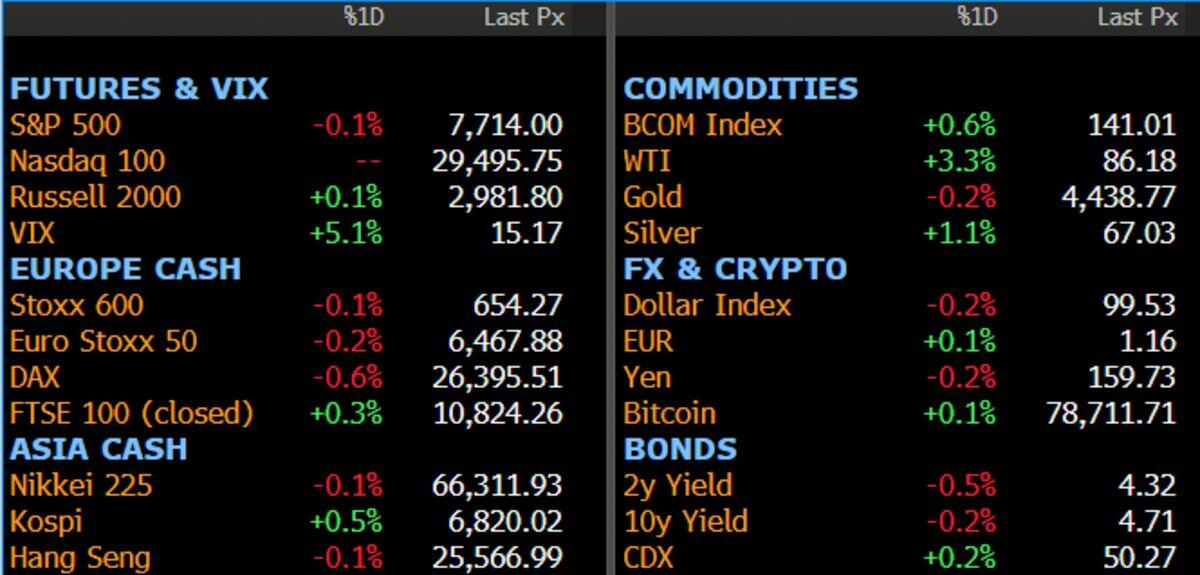
US stock futures dropped in thin trading with most traders out as summer draws to a close, while oil prices jumped after the US and Iran exchanged attacks for first time in weeks. Brent futures rallied almost 4% topping $90-handle and WTI contracts rise above $86 a barrel. As of 8:00am ET, S&P futures dropped about 0.2% and contracts on the Nasdaq 100 dipped 0.1% as most Mag 7 stocks drop while energy stocks rise (CVX +2%, XOM +2%) with as tensions resume in the Middle East. Europe’s benchmark Stoxx 600 equity index edged 0.2% lower, with UK markets closed for a holiday. Asian equities fall across the region. Nikkei sheds almost 1% while the Kospi closed flat, reversing an earlier loss. Hang Seng drifts 0.7% lower and ChiNext is down 1.3%. The dollar weakens against most FX majors. The yen strengthens back below 160/USD following Treasury Secretary Bessent’s BOJ remarks. Offshore yuan is 0.1% firmer after a small manufacturing PMI beat. Treasury 10-year yields are flat at 4.72% after Friday’s post J-Hole blowout as the curve bull steepens despite higher energy prices. In commodities, the overnight Middle East attacks are driving oil prices higher with WTI above $85/bbl and Brent above $90/bbl. Elsewhere base metals are outperforming precious even as gold recovered from a $50 drop to trade unchanged around $4,460 an ounce. This week’s macro data include ISM / NFP with NFP one of 2 key prints (CPI) for the Fed to determine a Sept hike. Stronger ISM may boost the broadening portion of the rally. AVGO earnings may boost the Tech / AI theme.
In premarket trading, Mag 7 stocks are mostly lower with the exception of NVDA which rises 0.6% after Friday’s slide (Apple -0.3%, Meta -0.1%, Amazon -0.4%, Alphabet -0.5%, Tesla -0.6%, Microsoft -0.6%)
BioMarin Pharmaceutical (BMRN) rises 4% after the company said it had entered into binding terms with Ascendis Pharma, resolving the patent and ancillary disputes concerning Ascendis’s Yuviwel.
Energy stocks (CVX +2%, XOM +2%) rise with oil as tensions spiked in the Middle East, with the US and Iran exchanging strikes for the first time in about a month and Tehran claiming a tanker was hit by mines in the Strait of Hormuz.
Kaiser Aluminum (KALU) rises 2% after UBS analyst Alex Stansbury raised the recommendation on to buy from neutral.
PG&E (PCG) falls 15% and Edison International (EIX) declines 5.5% as California legislators introduced a bill that would update the state’s wildfire response without shifting liability away from publicly traded utilities.
Pinterest (PINS) slips 3% after announcing Chief Financial Officer Julia Brau Donnelly will step down from her role on Oct. 30 after three years with the company.
Science Applications (SAIC) rises 8% after the government IT services contractor boosted its revenue guidance for the full year.
SLB (SLB) inches 1% higher after agreeing to acquire Kelvion, a firm that provides data center cooling solutions, from investors including Apollo Funds for $3.4 billion in cash.
In other corporate news Amgen’s Repatha (evolocumab) reduced the risk of death by 20% in high-risk adults without prior heart attack or stroke, versus placebo, in a pre-specified Phase 3 trial. SpaceX and NASA are delaying the launch of a planned mission to the International Space Station to fix an oxidizer leak in the Dragon spacecraft’s propulsion system. Shein Global Holdings Ltd. priced its IPO in Hong Kong. The fast-fashion retailer raised $1.7 billion, giving it a market value of $26 billion that’s a far cry from the $100 billion it once commanded. The shares fell as much as 17% in gray market trading.
US markets are set to open lower in the last trading session of a low-volume August as oil prices jumped on the back of renewed hostilities in the Middle East. A renewed rise in oil prices complicates the outlook for interest rates as investors digest Federal Reserve Chairman Kevin Warsh’s hawkish inflation comments at Jackson Hole. Traders boosted bets on a September rate hike after he spoke, although some market commentators expressed skepticism about such a move. That said, traders already have an eye on the month ahead, with cross-current signals from other assets including bonds, the energy complex and currencies, while conversations on AI capex are never far from earshot.
A lot of weekend commentary was devoted to digesting the Warsh speech at Jackson Hole, with some commentators of the view that it wasn’t as epochal as the volume of attention suggests. Yes, the tone was hawkish, but some bond investors are voicing skepticism about Fed hikes. Warsh said financial conditions aren’t currently restrictive and described rates as the Fed’s “predominant tool” for achieving its mandate, while stopping short of signaling support for a hike in September. Even so, bond investors at ABN Amro Investment Solutions and Brandywine Global Investment Management are skeptical that higher rates will happen
The Federal Reserve Reform Act of 1977 lists three objectives: maximum employment, stable prices, and moderate long-term interest rates. The third receives remarkably little attention, with the first two hogging the limelight, notes Gary Paulin of Northern Trust Asset Management. “Could that objective become more important if the other two prove difficult to manage simultaneously?” Paulin thinks it could.
Meanwhile, real-world inflation remains in view: Brazil, the world’s biggest exporter of soybeans, cotton, coffee, sugar and orange juice, is about to kick off planting season facing a global diesel crunch colliding with a seasonal spike in demand for the fuel. Goldman Sachs stepped up warnings of tightness in global refining driven by wars in the Middle East and between Moscow and Kyiv, with the bank more than doubling its forecasts for profits from making diesel.
Additionally, the US-China AI funding divide remains a perplexing question for investors. While hyperscalers have gone from accounting for 2% of US nonfinancial investment-grade bond issuance in 2025 to 19% this year, China’s AI race is creating no such pressure on yields as its tech firms rely predominately on bank loans and equity financing rather than the bond market. But a resource-hungry AI revolution will require broader funding avenues over the long run. Speaking of AI, SK Hynix is studying the feasibility of a joint venture to make memory chips in Japan to meet surging AI demand while controlling production costs. And Amazon is expected to be the next hyperscaler to tap Australia’s debt market for billions of dollars in capital, according to the Financial Review.
The VanEck Semiconductor ETF (SMH) has increasingly become an expression of semiconductor/AI FOMO, with investors chasing upside through long calls, creating a “vol up/spot up” dynamic at times this year before the recent reversal. And the semiconductor cohort that drove the early summer tech melt-up is giving way to other pockets in tech, as explored in today’s Taking Stock column.
In geopolitics, this week’s G20 meeting in North Carolina is in focus. The US Treasury has excluded journalists from several media outlets, including Bloomberg News, from the gathering. Bessent is said to be pushing the G20 to rethink China trade terms, Reuters reported.
European stocks trade sideways at the start of the week with the Stoxx 600 down 0.1% as oil prices and bond yields rose amid simmering tensions between the US and Iran, and on low volumes, with London closed for a bank holiday. Here are the biggest movers Monday:
Engcon gains as much as 9.5%, the most since July, after Swedish business daily Dagens Industri named the construction equipment firm its stock of the week, recommending readers buy shares in the company
InPost trades little changed after its stronger than expected 2Q profitability was overshadowed by a weaker outlook for the remainder of the year, with new EU customs rules on small parcels set to weigh on volumes in Poland
Bakkafrost shares fall as much as 7.6%, the most since July, after the salmon farmer reported its latest earnings. SB1 Markets says another weak quarter in Scotland weighs on the result due to “significant” biological issues
Asian stocks recovered from earlier declines as South Korean shares swung to a gain, while regional financial companies also advanced. The MSCI Asia Pacific Index was little changed after earlier dropping more than 1%. Korea’s Kospi closed up 0.5%, led by gains in Samsung Electronics and SK Hynix, while China’s CSI 300 Index rose 0.3%. Regional stocks had fallen at the start of trade after Fed chair Kevin Warsh sounded hawkish in his comments at Jackson Hole on Friday. MSCI’s regional equity gauge has risen 3.1% in August, snapping two months of declines. A gauge of Asia’s bank shares led gains on expectations of higher yields. Energy and utilities stocks also rose on higher oil prices stemming from the US attack on Iranian rocket launchers that were preparing to send mines into the Strait of Hormuz. A gauge of Asia’s bank shares led gains on expectations of higher yields. Energy and utilities stocks also rose on higher oil prices stemming from the US attack on Iranian rocket launchers that were preparing to send mines into the Strait of Hormuz. Warsh had warned inflation isn’t meaningfully slowing and added policymakers must be confident that it is clearly moving to their objective. Otherwise, they “have work to do.”
Warsh’s remarks “were the clearest signal yet that the Fed sees inflation, not growth, as the bigger risk right now,” said Billy Leung, an investment strategist at Global X Management. “Markets have quickly repriced September hike odds.” “On the positive story, under the surface is that AI monetization is broadening out,” Leung said. “We saw enterprise software and cybersecurity names post some of their strongest moves of the year on earnings, which tells you the AI trade is no longer just about chips and hyperscalers.”
In FX, the dollar weakens against most FX majors. The yen strengthens back below 160/USD following Treasury Secretary Bessent’s BOJ remarks. Offshore yuan is 0.1% firmer after a small manufacturing PMI beat.
In rates, treasury 10-year yield eases a basis point to 4.71%. Australian yields are little changed. JGB futures inch slightly lower.
In rates, treasuries mixed with the yield curve steeper in thin trading conditions with UK market closed for a bank holiday. Front-end tenors outperform as investors continue to digest Federal Reserve Chairman Kevin Warsh’s hawkish comments on inflation last week in Jackson Hole, which spurred the biggest increase in 2-year yields since June 17 as additional tightening was priced in. Front-end yields are 1bp-2bp richer on the day, long-end tenors cheaper by about 1bp, steepening 2s10s by about 2.5bp, 5s30s by about 2bp, unwinding a small portion of Friday’s dramatic flattening move; 10-year yields are little changed around 4.72% Long-end tenors may benefit over Monday’s session from anticipation of buying related to the month-index index rebalancing at 4pm, which will increase its duration by an estimated 0.10 year. Regarding Fed policy expectations, around 16bp of tightening remains priced in for the Sept. 16 decision; Barr, Waller and Hammack are scheduled to speak this week before the Sept. 5 start of the external communications blackout around that meeting. IG dollar issuance slate empty so far, and Treasury coupon issuance is on hiatus until next week’s 3- and 10-year note and 30-year bond auctions.
In commodities, oil benchmarks are up more than 3%, after tensions rose in the Middle East, with the US and Iran exchanging strikes for the first time in about a month while Tehran claimed a tanker was hit by mines in the Strait of Hormuz. Brent futures rally almost 4% topping $90-handle and WTI contracts rise above $86 a barrel. Gold falls more than $40 to near $4,410 an ounce.
US economic data calendar includes August Dallas Fed manufacturing activity at 10:30am; ahead this week are ISM manufacturing and services gauges, JOLTS job openings, ADP employment change and, on Friday, the August jobs report
Market Snapshot
Top Overnight News
Iran and the United States traded attacks for the first time in over a month overnight into Monday. Iran fired missiles toward US military targets in Jordan and the United Arab Emirates in retaliation for a strike on Iranian rocket launchers that the US said were trying to launch sea mines into the Strait of Hormuz. The exchange of strikes came just days after President Donald Trump declared the Strait of Hormuz free from mines and is a break with Washington’s recent shift in focus to maximizing economic pressure on Iran rather than military actions. CNN
Iranian leaders are acknowledging the economic toll of war with the U.S., with the supreme leader urging the government to address the hardship and the president saying foreign trade has shrunk by a third due to the American sanctions and blockade. Yet Tehran signaled no retreat on Saturday, vowing to withstand U.S. pressure, pursue diplomacy and maintain what it said was control over the Strait of Hormuz. Reuters
President Donal Trump said Friday night the United States has reached an oil agreement with Venezuela, a move he said will “more than double” American oil reserves, increase oil supply and lower gas prices. The deal is said to “secure majority control” of more than 65B barrels worth of oil reserves in Venezuela, or ~20% of the country’s total. CNN / FT
U.S. Treasury Secretary Scott Bessent said on Sunday he will encourage G20 members to re-examine terms of trade with China to shrink global imbalances and press Beijing to rebalance its economy away from exports and toward domestic consumption. Bessent said in an interview ahead of a G20 finance leaders meeting that the current flood of exports from China was unsustainable, even though the U.S. direct trade position with China was “rapidly improving.” Reuters
China’s official manufacturing PMI remained in contraction in August, suggesting that momentum has yet to rebound after July’s sharp downturn. BBG
China will start checking the security of its military supply chains, joining other nations in ramping up self-reliance of their defense industries.
Iranian authorities seized an unidentified bulk carrier for polluting waters in the Persian Gulf near Bandar Abbas, state-run Islamic Republic News Agency reports.
SK Hynix is exploring a joint venture to make memory chips in Japan to meet surging AI demand, Chairman Chey Tae-won said. BBG
South Korea’s industrial production for Jul came in ahead of expectations at +0.2% M/M (vs. the Street -0.5%). BBG
Russia’s Defense Ministry said it is planning “massive strikes” on Ukraine’s energy infrastructure, days after launching a devastating attack on a warehouse near Kyiv, amplifying fears of another winter assault. CNBC
September is historically the worst month for Wall St, and traders are preparing for volatility during the coming weeks, with the FOMC meeting on 9/16 potentially a major catalyst. Barron’s
A bipartisan US bill would permanently ban Chinese internet-connected vehicles, and target Chinese software and hardware in US autos: NYT
Geopolitical Update
US attacked two missile launchers of the IRGC on Larak Island on Sunday, which were said to be on standby to launch missiles with sea mines toward the Strait of Hormuz, while there were later reports of explosions heard near Larak Island.
US Central Command said IRGC claims of US aggression in the Strait of Hormuz are false, but added the US conducted limited precise action against IRGC minelaying forces that posed an imminent threat in the Strait of Hormuz.
Iran’s Revolutionary Guards warned the US strike on Larak Island would be met with a response and punishment, while it said several soldiers and civilians were killed and wounded in the assault.
Iran’s Revolutionary Guards later announced that they retaliated with missiles and drones against two US bases in Jordan and warned that any attack against them will be met with a more devastating response, although a US official cited by Fox News stated no major damage in Iranian attacks on US forces in Jordan and that all missiles were intercepted.
Iran’s Press TV noted reports of Iran firing missiles towards US vessels in the Strait of Hormuz, and there were reports of explosions heard in the UAE and in Qatar, while Iran’s army later said it launched tens of drones at the Al Minhad air base in the UAE.
IRGC said a supertanker caught fire and was halted after being struck by two naval mines in the Strait of Hormuz, while it added that the tanker was attempting to pass illegally through the Strait of Hormuz and that ships must comply with its rules for passage. IRGC separately announced that it shot down a US MQ-9 drone over the Strait of Hormuz.
Iran’s Foreign Ministry said it will respond decisively to any further enemy military aggression, and stated that the US and parties supporting its military actions bear full responsibility for consequences of escalation.
US President Trump reiterated in a pre-recorded Fox News interview that Iran cannot have a nuclear weapon and said the Iran blockade has been unbelievable, while he also commented that the US had to intervene in the Middle East to prevent Iran from using a nuclear weapon against Israel and other countries in the region and possibly against the US.
US President Trump posted a generated video with the caption “Kharg Island being blown to smithereens!!!”
US Treasury Secretary Bessent said the US Treasury plans to impose more Iran secondary sanctions every week, starting with banks. He also stated that they are telling banks it’s not okay to have Iranian money and to aid the Iranian regime, and they will probably just sanction a bank outright next time, after the US imposed curbs on an Egyptian bank’s United Arab Emirates branches.
Iranian President Pezeshkian said they are not looking for war, but will give a decisive response to the aggressors, while he added that instability and unrest in the region are not in the interest of any countries and will create challenges for everyone.
Iran’s President said on Friday that Iran is ready for cooperation and understanding with regional countries, including Saudi Arabia and the UAE, while it is to open its route if four commitments are met. He also stated that Iran is to increase gasoline prices, and that exports and imports have decreased by up to 35% because of US sanctions and the blockade.
US officials said they are monitoring the Strait of Hormuz and will strike any forces that threaten navigation in the waterway, Al Arabiya reported.
Iran’s IRGC Navy said compliance with regulations issued for the Strait of Hormuz is mandatory and warned against being “misled” by the US, Press TV reported.
Yemeni armed forces reportedly targeted Saudi ships in the Red Sea, ISNA reported citing Yemeni media reports.
UAE Ministry of Defense denied reports that Al Minhad Air Base was targeted by missiles, calling the claims unfounded and saying it remains on high alert and fully prepared to respond to any threats.
Iranian oil operations are continuing on Kharg Island, and the oil sector there has not stopped, Al Hadath reported.
A more detailed look at global markets courtesy of Newsquawk
APAC stocks were mostly lower heading into month-end and after recent hawkish comments from Fed Chair Warsh at Jackson Hole, while tensions in the Middle East escalated over the weekend after the US and Iran resumed strikes for the first time in over a month. ASX 200 saw mixed price action and was initially kept afloat amid strength in the top-weighted financials sector and with gains also seen in energy, utility and consumer industries, although upside was limited and eventually reversed following disappointing Private Sector Credit and Company Profits data. Nikkei 225 gapped lower at the open to below the 66,000 level, although it was off today’s worst levels as participants also reflected on stronger-than-expected Japanese Industrial Production and Retail Sales data. KOSPI retreated amid weakness in its tech heavyweights and with a report noting that day traders are abandoning Korean chip leveraged ETFs in large numbers, with leveraged ETFs targeting twice the daily returns of chipmakers Samsung Electronics and SK Hynix, on course for their first monthly outflow. Hang Seng and Shanghai Comp were subdued, with risk appetite not helped by the latest official PMI data, in which headline Manufacturing topped forecasts, but Non-Manufacturing disappointed and both remained in contraction territory.
Top Asian News
Japanese government is to request JPY 143tln for the budget (general account) in FY27, Nikkei reported citing sources.
South Korean President Lee nominated Lee Hyoung-il as the new finance minister and Kang Shin-chul as defence minister.
China’s MOFCOM targets around CNY 60tln in total retail sales of consumer goods by 2030.
New Zealand government cancelled fuel tax hike planned for next year.
European bourses are mixed to start the week, with Italy’s FTSE MIB outperforming while Germany’s DAX 40 lags. To note, UK markets are closed today for a Summer Bank Holiday. Little in terms of newsflow; however, the US and Iran exchanged strikes for the first time in around a month at the weekend, with the US targeting Larak Island while Iran struck two US bases in Jordan. Overnight, South Korea’s KOSPI gapped lower and traded with losses as much as 3.6%, before reversing and closing with gains of 0.5%. Samsung Securities’ Roy Lim explains this reversal by pointing to notable buying by pension funds, primarily in tech names. Lim said pensions bought KRW 120bln worth of shares over a 20-minute period heading into the close. Sectors are mixed. Chemicals top the sector pile, with Autos and Energy completing the sector outperformers. Tech is the laggard, with worries that the Fed hiking rates will drag yields higher and, in turn, weigh on tech. Real Estate and Industrials round out the sector laggards.
Top European News
German North Rhine Westphalia CPI (Aug MM) 0.2% (Prev. 0.9%).
German North Rhine Westphalia CPI (Aug YY) 2.9% (Prev. 2.7%).
FX
Some USD weakness emerged this morning with DXY falling to a base around 99.50 which is the 50% Fibonacci retracement of the 99.19-99.72 rally seen after Warsh’s speech. Sell side commentary viewed the speech as hawkish, but Morgan Stanley said it was “not convinced it means hikes are coming” while GS said nothing is yet baked in and with focus on incoming data. Some also note algos reacted to Warsh’s use of “hike” within the context of “hikes on the trails”, in his use of a Kohn/Bernanke analogy. Note, month end may be playing a part in some of the moves seen this morning, where Barclays sees moderate USD selling.
Action elsewhere paints the picture of the weaker USD, with all majors firmer vs. the Buck.
JPY leads with earlier, modest losses accelerated around 160.00 where it fell to a 159.74 base. Data overnight showed better-than-expected Japanese Industrial Production and Retail Sales data, though nothing which moved JPY at the time.
EUR keeps focus on French politics where PM Lecornu’s preview of the 2027 budget ruled out tax increases and de-indexing small pensions. In terms of the 2027 presidential election, an Elabe poll showed Le Pen victorious in every run-off tested, while Philippe (centre) currently appears best placed to challenge, polling at around 47.5%. On the left is Mélenchon, whose odds have ticked lower in recent days, perhaps a welcome development to EUR and EGBs. For now, EUR within a thin 1.1578-1.1606 with UK participants away on Bank holiday. To remind, Barclays sees moderate EUR buying vs USD.
Fixed Income
A contained start to the week for fixed income. The European morning has been particularly quiet, owing to the fact that the UK is away on Bank Holiday. USTs are currently firmer by a few ticks, in 108-01 to 108-09 parameters; note, the initial low went below last week’s trough by half a tick, and any resumption of the move looks to 107-31+ from the last week of July.
Overnight, USTs, JGBs and Bunds were all in relatively narrow ranges and ultimately didn’t significantly differ from the unchanged mark. Broadly speaking, the main focus was the weekend’s geopolitical updates and particularly US action on Larak Island and then Iranian retaliation.
Geopolitics aside, desks remain focused on the speech by Fed Chair Warsh last week, which had a hawkish skew and has contributed to the implied probability of a September 25bps hike increasing to just under 60% currently via CME, vs around 41% one week ago.
Bunds reside in the red by a few ticks. Nonetheless, the benchmark holds at the upper-end of 123.43-60 parameters. No move to the German State CPIs, which saw the Y/Y tick up modestly from the prior, in-fitting with consensus for the 13:00BST mainland figure. On Tuesday, we get the Flash EZ HICP series, and given what we have seen so far the energy component may be the most pertinent.
Commodities
Over the weekend, tensions between the US and Iran escalated after US forces struck IRGC missile and minelaying capabilities on Larak Island, prompting Iran to retaliate with missile and drone attacks against US and regional military targets. Further, Iran reported striking a tanker with mines, downing a US drone and targeting US vessels, while both sides exchanged warnings of further retaliation. President Trump reiterated that Iran cannot obtain nuclear weapons, while Washington is also intensifying economic pressure through additional sanctions. Despite the escalation, Iranian leaders said they do not seek war and remain open to regional cooperation, whilst also warning of a decisive response to further attacks.
WTI Oct and Brent Nov futures gapped higher at the open after the US and Iran resumed strikes for the first time in over a month. The contracts are firmer by over 3%, with USD 84.11-86.53/bbl and USD 89.03-91.38/bbl ranges respectively. Dutch TTF surged by some 4% intraday and tested EUR 70/MWh this morning. “Tight supply entering the heating season leaves the market vulnerable to spikes higher later in the year”, ING says.
Metals are flat/mixed with the complex somewhat cushioned by the softer USD despite the backdrop of higher energy prices. Spot gold moves closer to its 100 DMA to the downside (USD 4,370/oz) after dipping under Friday’s low (4,445/oz) to trade in a current USD 4,396-4,472/oz range. 3M LME copper trades in a narrow USD 14,223.68- 14,388.55/t.
Central Banks
Riksbank Deputy Governor Jansson said Sweden’s inflation outlook has become more uncertain after unexpectedly high inflation readings this summer but the Riksbank’s have scope to wait before adjusting monetary policy, even if there are some risks of elevated inflation going forward. Jansoon added that Sweden’s economic recovery could prove more persistent than expected but does not currently see signs that Sweden’s economy is at risk of overheating soon.
New Zealand NZIER Shadow Board recommended the RBNZ hike the OCR by 25bps to 2.75% at its meeting this week.
Geopolitics: Ukraine
The EU is to unveil “one of the biggest” Russia sanctions list in retaliation of hybrid threats, with the package to come alongside bilateral measures being prepared by Berlin, POLITICO reported citing sources.
Ukrainian President Zelensky is to send top sanctions adviser to Capitol Hill this week in a bid to convince House lawmakers to drop their opposition to the Senate-passed Russia sanctions bill, Punchbowl reported.
US Event Calendar
10:30 am: Aug Dallas Fed Manf. Activity, est. 1.6, prior 1.3