Ukrainian Drones Damage, Set Fire To One Of Russia’s Biggest Oil Terminals On Black Sea
Another Ukrainian drone attack targeting Russia’s oil export infrastructure has occurred Sunday, which saw one of Russia’s main Black Sea oil ports set ablaze.
A tanker and another ship was also set ablaze at Tuapse, one of the biggest oil terminals on the Black Sea. Russian emergency services in the region said, “As a result of the drone attack on the port of Tuapse on the night of November 2, two foreign civilian ships were damaged.”
“The buildings and infrastructure of the terminal” had sustained damage, it said – though noted there were no casualties among the crews of the ships and that all fires had been extinguished.
The Tuapse Black Sea oil terminal and an oil refinery is controlled by Russia’s biggest oil company Rosneft – which has been targeted by the newest US Treasury sanctions last month.
According to Reuters, “The export-oriented Tuapse plant, which has a processing capacity of 240,000 barrels of oil per day (bpd), produces naphtha, fuel oil, vacuum gasoil and high-sulphur diesel. It mainly supplies China, Malaysia, Singapore and Turkey.”
The Russian defense ministry said that more broadly the country’s anti-air defenses were able to intercept a little over 280 drones during the assault on various regions of Russia.
Ukraine’s General Staff boasted that its drones landed five hits on the Tuapse port and oil export infrastructure. Ukrainian media has meanwhile hailed the recent attacks on Russian oil refineries and terminals as putting a sizeable dent in Moscow’s war funding:
Russia’s exports of refined fuels have dropped to levels unseen since the war began, as the country’s energy trade is hit by a combination of shutdowns at major refineries and escalating Western sanctions, according to a report by Bloomberg on Oct. 30.
Citing Vortexa Ltd. figures, the outlet reported that overall seaborne oil product shipments amounted to 1.89 million barrels a day in the first 26 days of October, marking the lowest volume recorded since early 2022.
Although diesel exports edged higher, weaker loadings of naphtha and fuel oil – particularly from the Baltic ports affected by strikes on the Ust-Luga terminal – pulled overall shipments down. Bad weather may also have slowed port activity.
Russia for its part has been punishing Ukraine in equal measure, with the month of October alone seeing hundreds of missile strikes, and over 5000 drones sent against Ukrainian cities their energy grids.
Most of the United States will “fall back” to standard time this Sunday, Nov. 2. The majority of Americans, however, just want the twice-yearly clock change to end.
There has been extensive debate about whether to stop this change, or “lock the clock,” but so far, no national change has been made.
Here’s what to know about the Daylight Saving Time debate.
What Is Daylight Saving Time?
Daylight Saving Time begins on the second Sunday in March every year, and clocks are set forward by one hour, an action often referred to as “spring forward.”
The hour is gained on the first Sunday in November when Daylight Saving Time ends, and the clocks are set back one hour to “fall back.”
This is observed nationwide, with some exceptions. They are: Hawaii, American Samoa, Guam, Northern Mariana Islands, Puerto Rico, the Virgin Islands, and most of Arizona. However, if Daylight Saving Time is observed, it is required to begin and end on the federally mandated dates.
The practice of changing the clock twice a year has been observed since 1918, and was enacted through the Standard Time Act, which also created standard time zones.
Later, in 1966, the Uniform Time Act amended the practice to allow a state to exempt itself, or a part of itself that lies in a different time zone, from the observance of Daylight Saving Time, meaning they would have to lock their clocks on standard time.
The rules for Daylight Saving Time changed in 2007 for the first time in over 20 years, and the amount of time for the change was lengthened in the interest of a reduction of energy consumption.
Daylight Saving Time was lengthened by about one month, now taking up 238 days, or around 65 percent, of the year.
State and National Legislation
The National Conference on State Legislatures reports that state legislatures have considered more than 750 bills and resolutions to establish year-round daylight saving time when it is allowed by federal law.
Almost every state in the union has considered some legislation in the last few years that would lock the clocks on either standard or daylight saving time. Currently, by federal law, states are not allowed to lock the clock on daylight saving time.
In the past seven years, 19 states have enacted legislation that would lock the clocks on daylight saving time—if Congress passes a law that would allow the change and if the surrounding states enact the same legislation.
Despite efforts year after year, a federal law to lock the clock on a fixed time hasn’t garnered enough support to pass Congress.
As of Oct. 28 of this year, the Senate failed to reach a consensus on the “Sunshine Protection Act,“ which would have made daylight saving time permanent, despite bipartisan support.
Sen. Rick Scott (R-Fla.) took up the charge this year, sponsoring the act. He took to the Senate floor, asking for a quick passage, given the states’ reaction to the prospect of being given the right to choose which time they’d prefer to settle on.
“This bill is about states’ rights,” Scott said. “It allows the people of each state to choose what best fits their needs and the needs of their families.”
In 2022, Sen. Sheldon Whitehouse (D-R.I.) co-sponsored an identical bill, which passed the Senate but was never brought to a vote in the House.
President Donald Trump has been a strong supporter of a fixed, year-round time, as has Secretary of State Marco Rubio, who co-sponsored the 2022 legislation when he was a senator representing Florida.
What Americans Think Now
Polling from October of this year indicated that around 12 percent of adults in the United States favor the current bi-annual clock changing system.
The AP-NORC poll showed that 47 percent of Americans polledare opposed to the current plan, and about 40 percent are neutral.
However, age seems to have a strong impact on opinion, since 51 percent of young adults under the age of 30 were neutral.
When asked which they prefer, 56 percent of Americans would prefer daylight saving time year-round, with less light in the morning and more in the evening. Around 42 percent would rather have year-round standard time, with more light in the morning and less in the evening.
Of those who identified themselves as a “night person,” 61 percent preferred permanent daylight saving time, and 50 percent of those who identified themselves as a “morning person” preferred permanent standard time.
However, in the 1970s, when the United States attempted to switch to daylight saving time year-round, the planned two-year experiment was cut short after less than a year due to the public’s negative reaction.
Impact on Health
The American Academy of Sleep Medicine has taken up the position that “permanent standard time is the optimal choice for health and safety.”
According to the group, “the United States should eliminate seasonal time changes in favor of permanent standard time (ST), which aligns best with human circadian biology.”
The academy says that evidence supports the benefits of standard time.
During an AprilCommerce, Science, and Transportationhearingin the Senate, Dr. David Harkey, the president of the Insurance Institute for Highway Safety, testified that adjusting the clock has shown “a strong relationship between increased darkness and fatal crashes, particularly for pedestrians and bicyclists.”
Additionally, Scott Yates, the founder of the Lock the Clock Movement, testified to negative repercussions attributed to the change,and cited a 2016 study by researchers at the University of Washington, which found that the day after the March daylight saving time change, referenced as “sleepy Monday,” was the harshest sentencing day of the entire year.
“Judges, like all of us, have been jolted awake an hour earlier than their bodies have been expecting,“ Yates said. ”That one seemingly harmless government mandate, dialing our clocks back one hour, means some people receive harsher sentences than they otherwise would.”
Practicing sleep medicine physician Dr. Karen Johnson also testified, citing evidence of the negative health impacts of changing the clocks, including an increased risk of chronic disease, depression, and suicide.
“The sun is one of the most powerful drivers of health and well-being, but the timing of sunlight is what’s critically important,” Johnson said.
Johnson strongly advocates for permanent standard time, saying that daylight saving time would deprive Americans of critical morning light and that while the spring clock change is bad, “permanent daylight saving time is worse.”
“Permanent daylight saving time does not make days longer, nor is it the reason why people feel better in the summer,” Johnson said.
“Instead, permanent daylight saving time is a hidden mandate to wake Americans up an hour earlier, rather than to their alarm clocks or the sun.
“If we called it the ‘Go to Work an Hour Earlier Act,’ rather than the ‘Sunshine Protection Act,’ no one would be voting for it.”
D.C. Mayor Imposes Juvenile Curfew After Mobs Of Kids Wreak Halloween Night Havoc
The D.C. Mayor, who in 2020 renamed a stretch of 16th Street NW as Black Lives Matter Plaza to honor the now-discredited Marxist BLM nonprofit currently under federal investigation for alleged donor fraud, appears to have had another reality check.
Leftist Muriel Bowser declared a “limited juvenile curfew” in the nation’s capital after clashes between mobs of kids, local police, and National Guard troops erupted near the Navy Yard Metro station on Halloween night.
“We are declaring a limited juvenile curfew in Washington, DC,” Bowser wrote on X on Saturday evening.
She continued, “Effective immediately, all juveniles under the age of 18 are subject to a curfew from 11PM until 6AM, which will extend through 11/5,” adding, “This is in response to several weeks of disorderly juvenile behavior which endangered both themselves and others.”
We are declaring a limited juvenile curfew in Washington, DC.
Effective immediately, all juveniles under the age of 18 are subject to a curfew from 11PM until 6AM, which will extend through 11/5.
This is in response to several weeks of disorderly juvenile behavior which…
The DC Police Union chimed in on X, “Keep in mind earlier this week, several DC Councilmembers argued that reinstating the juvenile curfew was inappropriate because it “criminalized young people.”
Keep in mind earlier this week, several DC Councilmembers argued that reinstating the juvenile curfew was inappropriate because it “criminalized young people.” https://t.co/aHidLn2iZ7
The Metropolitan Police Department outlined the perimeter of the curfew zone.
Mobs of lawless youth are nothing new across the D.C.-Baltimore metro area (read here & here), a region long controlled by far-left politicians who’ve robbed generations of kids of a real education (read report) while enriching the Democratic Party and its corrupt unions. This cycle of progressive destruction is financially crushing the Mid-Atlantic, particularly Maryland, as its unfolding fiscal crisis deepens. It’s time for reform. Some of the first political cracks first appeared in Maryland’s third-largest county on Friday (read the report).
9 People In Critical Condition After Mass Stabbing On UK Train
British police said 10 people have been hospitalized, nine with critical, life-threatening injuries, following a mass stabbing attack on a London-bound train Saturday evening, and that counter-terrorism police are supporting the investigation.
The attack was carried out by two unidentified suspects at 7:35pm as the Doncaster to London King’s Cross train headed south toward Huntingdon, a market town a few miles northwest of the university city of Cambridge. The two men dressed in all-black were tasered, restrained, and taken into custody by police, according to that report.
Two men arrested after mass stabbing on LNER train at Huntingdon. Attack at 19:30, emergency stop 19:44. Multiple passengers slashed, blood on floors, passengers barricaded in toilets. One guard critical. Three air ambulances. Over 30 armed officers. One suspect tasered, one… pic.twitter.com/IvmgcUq90c
Emergency services, including armed police and air ambulances, responded quickly as the train drew into Huntingdon. The attack appears to have been contained swiftly after the train arrived at the station, and police officers wearing forensic suits, with a police dog, could be seen on the platform.
Cambridgeshire Constabulary, the local police force, said armed police attended the incident after officers were called to the scene at Huntingdon station at 7:39 p.m. on Saturday. It added that the two people were arrested at the station, which is around 75 miles (120 kilometers) north of London.
A mad rush commenced in the train during the attack, sending bloodied riders rushing down aisles and hiding in bathrooms to avoid further carnage. The life-preserving dash led to travelers being “stamped [on] by others, according to The Times of London.
One witness stated that there was “blood everywhere” after the attack, The Times of London reported.
“They were making their way through the carriage to get away from the suspects. They were extremely bloodied,” a man using the name Gavin told Sky News.
That witness stated he saw one of the attackers on the platform with a “quite a large knife.”
“The suspect had also come off the train as well. So while we were being told to come out of the station the suspect was obviously running rampant,” Gavin told Sky News.
In a statement early Sunday, British Transport Police said two individuals have been arrested in connection with the stabbings. One of them was described on social media as “two black men.“
Witness said 2 black men went on a killing spree slitting peoples throats stabbing them in the back absolute carnage from Peterborough all the way to Huntingdon.
But hey. white middle age angry man hanging flags on that lamppost is the problem.🤷🏻♂️ pic.twitter.com/sL969LXFjJ
No motive for the attack has been given, but British terror cops were probing the incident.
“Ten people have been taken to hospital with nine believed to have suffered life-threatening injuries,” the statement said. “This has been declared a major incident and Counter Terrorism Policing are supporting our investigation whilst we work to establish the full circumstances and motivation for this incident.”
The police force also said that “Plato,” the national code word used by police and emergency services when responding to what could be a “marauding terror attack,” was initiated. That declaration was later rescinded but no motive for the attack was disclosed.
The mass stabbing in Huntingdon was a “Code Plato” which is a “marauding terror attack”.
“We’re conducting urgent enquiries to establish what has happened, and it could take some time before we are in a position to confirm anything further,” Chief Superintendent Chris Casey said. “At this early stage it would not be appropriate to speculate on the causes of the incident.”
British Prime Minister Keir Starmer lamented the bloodshed and offered condolences in a social media post. He did not say anything about the identity of the attackers for their motive.
“The appalling incident on a train near Huntingdon is deeply concerning. My thought are with those affected, and my thanks go to the emergency services for their response,” the British leader said on X.
Paul Bristow, the mayor of Cambridgeshire and Peterborough, said he had heard of “horrendous scenes” on the train.
London North Eastern Railway, or LNER, which operates the East Coast Mainline services in the U.K., confirmed the incident had happened on one of its trains and urged passengers not to travel because of “major disruption.”
An eyewitness to the attack said “We ran from the back of the train to the end as everyone was screaming to run, explaining there was somebody stabbing everyone and everything.” His conclusion recaps how so many Brits are feeling in a country they can no longer recognize, overrun with illegal immigrants: “Knowing somebody has weapons and you have nothing, knowing they’re willing to strike woman and I think children. It wasn’t the England I grew up in.”
Knowing somebody has weapons and you have nothing, knowing they’re willing to strike woman and I think children. It wasn’t the England I grew up in.
A hero older man blocked a knife-wielding attacker from stabbing a younger girl as victims fought back with a bottle of Jack Daniels during Saturday’s UK train attack, according to a report. The unidentified man suffered gashes to his head and neck while preventing the train attackers from slaughtering a youngster on the blood-soaked LREN train from Peterborough to London, Witness Olly Foster told the BBC.
Tulsi Gabbard, the U.S. national intelligence director, said on Oct. 31 that America’s former strategy of “regime change or nation building” had ended under President Donald Trump, with Gabbard describing the previous practice as counterproductive and wasteful of taxpayer resources.
“For decades, our foreign policy has been trapped in a counterproductive and endless cycle of regime change or nation building,” Gabbard said. “It was a one-size-fits-all approach, of toppling regimes, trying to impose our system of governance on others, intervene in conflicts that were barely understood and walk away with more enemies than allies.”
“The results: Trillions spent, countless lives lost and in many cases, the creation of greater security threats,” said Gabbard, a former congresswoman from Hawaii and U.S. Army National Guard veteran.
Gabbard’s comments echoed Trump’s message earlier this year in Riyadh, Saudi Arabia, where he declared that the era of U.S. “nation-building” was over and that America would no longer impose its system of governance abroad.
“In the end the so-called nation-builders wrecked far more nations than they built, and the interventionalists were intervening in complex societies that they did not even understand themselves,” Trump said. “Peace, prosperity, and progress ultimately came not from a radical rejection of your heritage, but rather from embracing your national traditions. … You achieved a modern miracle the Arabian way.”
Trump praised the Gulf states as “forging a future where the Middle East is defined by commerce, not chaos,” contrasting their success with failed U.S. interventions in Afghanistan and Iraq, criticizing “so-called nation-builders, neocons or liberal nonprofits like those who spend trillions and trillions of dollars failing to develop Kabul, Baghdad, so many other cities.”
Gabbard’s remarks in Bahrain further cemented what is shaping up to be a hallmark of Trump’s second-term foreign policy—a break from the interventionism of prior administrations in favor of economic cooperation, regional partnerships, and selective use of force.
In a recent assessment for the Hoover Institution, former U.S. Ambassador to Iraq and Turkey James Jeffrey wrote that Trump’s Middle East policy “is not isolationist focused on resolving major international problems.” The administration, he said, considers the Middle East a continuing priority, seeking to expand the Abraham Accords of Trump’s first administration and entrench regional stability amid Iran’s diminished leverage.
“Together, these trends aim at aligning Israel with Arab states and creating regional stability that will still require American engagement but not major resources or the risk of war,” Jeffrey wrote.
Jeffrey wrote that Trump’s speech in Riyadh represented “a dramatic shift” in U.S. policy, that he sees as resting on three principles: rejection of American interference in other nations’ internal affairs; reliance on local actors to advance stability; and focus on business opportunities that serve both U.S. and regional interests.
In Trump’s second term, those principles appear to have guided Washington’s approach to securing a cease-fire that halted the Israel–Hamas war in Gaza and to ending Israel’s 12-day conflict with Iran after U.S. bombers struck Iranian nuclear sites.
During her speech in Bahrain, Gabbard said that the Gaza cease-fire remains “fragile” and that Iran’s nuclear activity is again drawing scrutiny from the International Atomic Energy Agency.
“The road ahead will not be simple or easy,” Gabbard said. “But the president is very committed down this road.”
$124 Trillion And Counting… These Are The World’s Largest Economies
The 2026 world economy has a cautious outlook, according to the October report put out by the International Monetary Fund (IMF).
The organization says that global growth is slowing amid fragmentation and rising protectionism. Significant downside risks are present, ranging from a potential tech stock repricing to eroding institutional independence which could weaken policy decisions.
It tracks the size of each economy in current-dollar terms.
The U.S. is the Largest Economy in the World
At first place for the last 100 years, and destined to perhaps continue for the next 100?
The American economy is expected to reach $31.8 trillion in GDP by 2026. This is roughly the size of China (2nd), Germany (3rd), and India (4th) combined.
Rank
Region/Country
GDP (Billions USD, 2026)
1
🇺🇸 U.S.
$31,821.29
2
🇨🇳 China
$20,650.75
3
🇩🇪 Germany
$5,328.18
4
🇮🇳 India
$4,505.63
5
🇯🇵 Japan
$4,463.63
6
🇬🇧 UK
$4,225.64
7
🇫🇷 France
$3,558.56
8
🇮🇹 Italy
$2,701.54
9
🇷🇺 Russia
$2,509.42
10
🇨🇦 Canada
$2,420.84
11
🇧🇷 Brazil
$2,292.69
12
🇪🇸 Spain
$2,041.83
13
🇲🇽 Mexico
$2,031.00
14
🇦🇺 Australia
$1,948.23
15
🇰🇷 South Korea
$1,936.62
16
🇹🇷 Türkiye
$1,576.11
17
🇮🇩 Indonesia
$1,550.24
18
🇳🇱 Netherlands
$1,413.08
19
🇸🇦 Saudi Arabia
$1,316.25
20
🇵🇱 Poland
$1,109.96
21
🇨🇭 Switzerland
$1,074.59
22
🇹🇼 Taiwan
$971.45
23
🇧🇪 Belgium
$761.17
24
🇮🇪 Ireland
$750.11
25
🇸🇪 Sweden
$711.50
26
🇦🇷 Argentina
$667.92
27
🇮🇱 Israel
$666.41
28
🇸🇬 Singapore
$606.23
29
🇦🇹 Austria
$604.20
30
🇦🇪 UAE
$601.16
31
🇹🇭 Thailand
$561.51
32
🇳🇴 Norway
$547.69
33
🇵🇭 Philippines
$533.92
34
🇧🇩 Bangladesh
$519.29
35
🇻🇳 Vietnam
$511.06
36
🇲🇾 Malaysia
$505.36
37
🇩🇰 Denmark
$500.05
38
🇨🇴 Colombia
$462.25
39
🇭🇰 Hong Kong
$446.65
40
🇷🇴 Romania
$444.81
41
🇿🇦 South Africa
$443.64
42
🇨🇿 Czech Republic
$417.13
43
🇪🇬 Egypt
$399.51
44
🇮🇷 Iran
$375.64
45
🇵🇹 Portugal
$364.53
46
🇨🇱 Chile
$363.30
47
🇫🇮 Finland
$335.53
48
🇳🇬 Nigeria
$334.34
49
🇵🇪 Peru
$326.61
50
🇰🇿 Kazakhstan
$319.77
51
🇬🇷 Greece
$304.84
52
🇩🇿 Algeria
$284.98
53
🇳🇿 New Zealand
$280.55
54
🇮🇶 Iraq
$273.91
55
🇭🇺 Hungary
$269.92
56
🇶🇦 Qatar
$239.14
57
🇺🇦 Ukraine
$224.26
58
🇲🇦 Morocco
$196.12
59
🇸🇰 Slovak Republic
$167.73
60
🇰🇼 Kuwait
$162.90
61
🇺🇿 Uzbekistan
$159.20
62
🇧🇬 Bulgaria
$142.20
63
🇰🇪 Kenya
$140.87
64
🇩🇴 Dominican Republic
$138.34
65
🇪🇨 Ecuador
$134.71
66
🇬🇹 Guatemala
$129.47
67
🇵🇷 Puerto Rico
$129.19
68
🇪🇹 Ethiopia
$125.74
69
🇬🇭 Ghana
$113.49
70
🇭🇷 Croatia
$113.13
71
🇷🇸 Serbia
$112.11
72
🇨🇮 Côte d’Ivoire
$111.45
73
🇦🇴 Angola
$109.86
74
🇨🇷 Costa Rica
$109.14
75
🇴🇲 Oman
$108.91
76
🇱🇺 Luxembourg
$107.76
77
🇱🇹 Lithuania
$104.65
78
🇵🇦 Panama
$95.91
79
🇹🇿 Tanzania
$95.35
80
🇺🇾 Uruguay
$90.64
81
🇧🇾 Belarus
$90.56
82
🇨🇩 DRC
$88.13
83
🇸🇮 Slovenia
$85.74
84
🇦🇿 Azerbaijan
$80.02
85
🇻🇪 Venezuela
$79.92
86
🇹🇲 Turkmenistan
$76.90
87
🇺🇬 Uganda
$72.46
88
🇨🇲 Cameroon
$67.52
89
🇲🇲 Myanmar
$65.17
90
🇹🇳 Tunisia
$60.43
91
🇯🇴 Jordan
$59.29
92
🇿🇼 Zimbabwe
$55.43
93
🇲🇴 Macao SAR
$54.94
94
🇱🇻 Latvia
$52.25
95
🇵🇾 Paraguay
$51.67
96
🇰🇭 Cambodia
$51.51
97
🇪🇪 Estonia
$51.04
98
🇧🇭 Bahrain
$49.19
99
🇱🇾 Libya
$49.16
100
🇳🇵 Nepal
$49.11
101
🇮🇸 Iceland
$43.40
102
🇨🇾 Cyprus
$43.16
103
🇭🇳 Honduras
$40.82
104
🇬🇪 Georgia
$40.18
105
🇸🇳 Senegal
$39.99
106
🇸🇩 Sudan
$39.47
107
🇸🇻 El Salvador
$37.98
108
🇧🇦 Bosnia & Herzegovina
$36.24
109
🇿🇲 Zambia
$33.95
110
🇵🇬 Papua New Guinea
$33.46
111
🇦🇱 Albania
$32.41
112
🇭🇹 Haiti
$31.10
113
🇬🇳 Guinea
$30.92
114
🇧🇫 Burkina Faso
$30.71
115
🇲🇹 Malta
$30.44
116
🇦🇲 Armenia
$29.08
117
🇲🇱 Mali
$28.48
118
🇬🇾 Guyana
$27.49
119
🇧🇯 Benin
$27.45
120
🇹🇹 Trinidad & Tobago
$26.76
121
🇲🇳 Mongolia
$26.52
122
🇲🇿 Mozambique
$26.51
123
🇳🇪 Niger
$26.11
124
🇯🇲 Jamaica
$24.13
125
🇹🇩 Chad
$23.56
126
🇬🇦 Gabon
$22.73
127
🇳🇮 Nicaragua
$21.86
128
🇰🇬 Kyrgyz Republic
$21.56
129
🇲🇬 Madagascar
$21.09
130
🇲🇩 Moldova
$21.02
131
🇲🇰 North Macedonia
$20.75
132
🇧🇼 Botswana
$20.71
133
🇹🇯 Tajikistan
$18.94
134
🇲🇼 Malawi
$17.86
135
🇱🇦 Lao P.D.R.
$17.78
136
🇾🇪 Yemen
$17.24
137
🇨🇬 Congo
$16.95
138
🇧🇸 The Bahamas
$16.84
139
🇲🇺 Mauritius
$16.76
140
🇧🇳 Brunei Darussalam
$16.46
141
🇳🇦 Namibia
$16.10
142
🇷🇼 Rwanda
$15.47
143
🇬🇶 Equatorial Guinea
$14.10
144
🇽🇰 Kosovo
$14.10
145
🇸🇴 Somalia
$13.91
146
🇲🇷 Mauritania
$12.85
147
🇹🇬 Togo
$12.18
148
🇲🇪 Montenegro
$10.23
149
🇱🇮 Liechtenstein
$10.12
150
🇸🇱 Sierra Leone
$9.30
151
🇧🇮 Burundi
$9.21
152
🇲🇻 Maldives
$8.22
153
🇧🇧 Barbados
$7.94
154
🇫🇯 Fiji
$6.70
155
🇸🇸 South Sudan
$6.03
156
🇱🇷 Liberia
$5.59
157
🇸🇿 Eswatini
$5.50
158
🇩🇯 Djibouti
$5.00
159
🇸🇷 Suriname
$4.87
160
🇦🇩 Andorra
$4.72
161
🇦🇼 Aruba
$4.47
162
🇧🇹 Bhutan
$3.77
163
🇨🇫 Central African Republic
$3.71
164
🇧🇿 Belize
$3.44
165
🇨🇻 Cabo Verde
$3.14
166
🇱🇨 Saint Lucia
$2.77
167
🇬🇼 Guinea-Bissau
$2.76
168
🇬🇲 Gambia, The
$2.67
169
🇱🇸 Lesotho
$2.47
170
🇦🇬 Antigua and Barbuda
$2.46
171
🇸🇲 San Marino
$2.39
172
🇸🇨 Seychelles
$2.25
173
🇹🇱 Timor-Leste
$2.21
174
🇸🇧 Solomon Islands
$2.05
175
🇰🇲 Comoros
$1.77
176
🇬🇩 Grenada
$1.52
177
🇼🇸 Samoa
$1.33
178
🇻🇨 Saint Vincent & the Grenadines
$1.30
179
🇰🇳 Saint Kitts & Nevis
$1.19
180
🇻🇺 Vanuatu
$1.18
181
🇸🇹 São Tomé & Príncipe
$1.13
182
🇩🇲 Dominica
$0.79
183
🇹🇴 Tonga
$0.62
184
🇫🇲 Micronesia
$0.52
185
🇵🇼 Palau
$0.36
186
🇰🇮 Kiribati
$0.34
187
🇲🇭 Marshall Islands
$0.33
188
🇳🇷 Nauru
$0.18
189
🇹🇻 Tuvalu
$0.06
N/A
🌍 World
$123,584.49
A somewhat resilient labor market and continued consumer spending underpin this dominance.
However its growth projections have been revised downward since this time last year after trade wars rattled global markets and contributed to rising prices for the world’s largest consumer economy.
ℹ️ Related: Check out this breakdown of America’s $19 trillion consumer economy.
Meanwhile, China’s GDP is projected at $20.7 trillion, 35% below the U.S. total but still threefold that of the third-ranked Germany.
Structural headwinds—from an aging population to a tepid property market—are cooling GDP growth to the 4% range, the slowest multi-year pace in four decades.
Added disruption from tariffs on Chinese goods will also affect the world’s largest export sector.
India ($4.5 trillion) is on track to hold on to fourth place after leapfrogging Japan in 2025, helped by its domestic demand. Elsewhere, Indonesia and Türkiye edge up the list, illustrating the demographic advantage and policy reforms of many mid-income nations.
A Regional Breakdown of Global GDP
Asia pips North America as the world’s largest economic region.
With China, Japan, and India, the region has a slight advantage over the U.S. and Canada.
Europe ranks third by GDP, followed by the Middle East, South America, Africa, and finally, Oceania.
Ranked: Countries by GDP per Capita in 2026
The top three richest countries (by GDP per Capita) are also unchanged: Luxembourg ($154,115), Ireland, ($135,247), and Switzerland ($118,173).
All three benefit from significant foreign inflows that boost their economies relative to their population.
Rank
Country
ISO
Region
GDP Per Capita 2026
1
🇱🇺 Luxembourg
LUX
Europe
$154,115
2
🇮🇪 Ireland
IRL
Europe
$135,247
3
🇨🇭 Switzerland
CHE
Europe
$118,173
4
🇮🇸 Iceland
ISL
Europe
$108,591
5
🇸🇬 Singapore
SGP
Asia
$99,042
6
🇳🇴 Norway
NOR
Europe
$96,580
7
🇺🇸 U.S.
USA
North America
$92,883
8
🇩🇰 Denmark
DNK
Europe
$82,706
9
🇳🇱 Netherlands
NLD
Europe
$77,881
10
🇲🇴 Macao
MAC
Asia
$77,443
11
🇶🇦 Qatar
QAT
Middle East
$76,534
12
🇸🇲 San Marino
SMR
Europe
$69,493
13
🇦🇺 Australia
AUS
Oceania
$69,358
14
🇸🇪 Sweden
SWE
Europe
$66,124
15
🇦🇹 Austria
AUT
Europe
$65,640
16
🇮🇱 Israel
ISR
Middle East
$64,275
17
🇧🇪 Belgium
BEL
Europe
$63,896
18
🇩🇪 Germany
DEU
Europe
$63,600
19
🇬🇧 UK
GBR
Europe
$60,011
20
🇫🇮 Finland
FIN
Europe
$59,750
21
🇭🇰 Hong Kong
HKG
Asia
$58,999
22
🇨🇦 Canada
CAN
North America
$58,244
23
🇦🇪 UAE
ARE
Middle East
$53,842
24
🇲🇹 Malta
MLT
Europe
$53,082
25
🇳🇿 New Zealand
NZL
Oceania
$52,181
26
🇫🇷 France
FRA
Europe
$51,708
27
🇦🇩 Andorra
AND
Europe
$51,681
28
🇮🇹 Italy
ITA
Europe
$45,883
29
🇨🇾 Cyprus
CYP
Europe
$45,601
30
🇹🇼 Taiwan, China
TWN
Asia
$41,586
31
🇦🇼 Aruba
ABW
South America
$41,026
32
🇵🇷 Puerto Rico
PRI
North America
$40,707
33
🇪🇸 Spain
ESP
Europe
$40,582
34
🇧🇸 The Bahamas
BHS
North America
$40,409
35
🇸🇮 Slovenia
SVN
Europe
$40,164
36
🇨🇿 Czech Republic
CZE
Europe
$38,373
37
🇰🇷 South Korea
KOR
Asia
$37,523
38
🇪🇪 Estonia
EST
Europe
$37,195
39
🇯🇵 Japan
JPN
Asia
$36,391
40
🇱🇹 Lithuania
LTU
Europe
$36,225
41
🇸🇦 Saudi Arabia
SAU
Middle East
$35,839
42
🇧🇳 Brunei
BRN
Asia
$35,414
43
🇬🇾 Guyana
GUY
South America
$34,307
44
🇵🇹 Portugal
PRT
Europe
$33,972
45
🇰🇼 Kuwait
KWT
Middle East
$31,242
46
🇸🇰 Slovakia
SVK
Europe
$31,026
47
🇵🇱 Poland
POL
Europe
$30,651
48
🇧🇭 Bahrain
BHR
Middle East
$29,778
49
🇬🇷 Greece
GRC
Europe
$29,412
50
🇭🇷 Croatia
HRV
Europe
$29,368
51
🇭🇺 Hungary
HUN
Europe
$28,304
52
🇱🇻 Latvia
LVA
Europe
$28,024
53
🇧🇧 Barbados
BRB
North America
$27,175
54
🇺🇾 Uruguay
URY
South America
$26,041
55
🇷🇴 Romania
ROU
Europe
$23,768
56
🇦🇬 Antigua
& Barbuda
ATG
North America
$23,117
57
🇰🇳 Saint Kitts
& Nevis
KNA
North America
$23,071
58
🇧🇬 Bulgaria
BGR
Europe
$22,896
59
🇸🇨 Seychelles
SYC
Africa
$21,940
60
🇵🇦 Panama
PAN
North America
$20,754
61
🇵🇼 Palau
PLW
Oceania
$20,718
62
🇨🇷 Costa Rica
CRI
North America
$20,134
63
🇲🇻 Maldives
MDV
Asia
$19,682
64
🇴🇲 Oman
OMN
Middle East
$19,182
65
🇹🇹 Trinidad
& Tobago
TTO
North America
$18,562
66
🇹🇷 Türkiye
TUR
Middle East
$18,232
67
🇨🇱 Chile
CHL
South America
$17,876
68
🇷🇸 Serbia
SRB
Europe
$17,292
69
🇷🇺 Russia
RUS
Europe
$17,287
70
🇲🇪 Montenegro
MNE
Europe
$16,380
71
🇰🇿 Kazakhstan
KAZ
Asia
$15,527
72
🇱🇨 Saint Lucia
LCA
North America
$15,163
73
🇲🇽 Mexico
MEX
North America
$15,111
74
🇳🇷 Nauru
NRU
Oceania
$14,959
75
🇲🇾 Malaysia
MYS
Asia
$14,762
76
🇨🇳 China
CHN
Asia
$14,730
77
🇦🇷 Argentina
ARG
South America
$13,895
78
🇲🇺 Mauritius
MUS
Africa
$13,362
79
🇬🇩 Grenada
GRD
North America
$13,041
80
🇩🇴 Dominican Republic
DOM
North America
$12,605
81
🇦🇱 Albania
ALB
Europe
$12,147
82
🇻🇨 Saint Vincent
& the Grenadines
VCT
North America
$11,663
83
🇲🇰 North Macedonia
MKD
Europe
$11,527
84
🇹🇲 Turkmenistan
TKM
Asia
$11,387
85
🇬🇪 Georgia
GEO
Europe
$10,886
86
🇧🇷 Brazil
BRA
South America
$10,709
87
🇧🇦 Bosnia
& Herzegovina
BIH
Europe
$10,546
88
🇩🇲 Dominica
DMA
North America
$10,459
89
🇧🇾 Belarus
BLR
Europe
$10,016
90
🇬🇦 Gabon
GAB
Africa
$9,647
91
🇵🇪 Peru
PER
South America
$9,398
92
🇦🇲 Armenia
ARM
Europe
$9,393
93
🇲🇭 Marshall Islands
MHL
Oceania
$9,391
94
🇲🇩 Moldova
MDA
Europe
$8,984
95
🇽🇰 Kosovo
XKX
Europe
$8,972
96
🇯🇲 Jamaica
JAM
North America
$8,756
97
🇨🇴 Colombia
COL
South America
$8,644
98
🇬🇶 Equatorial Guinea
GNQ
Africa
$8,378
99
🇧🇿 Belize
BLZ
North America
$8,116
100
🇹🇭 Thailand
THA
Asia
$7,979
101
🇦🇿 Azerbaijan
AZE
Europe
$7,624
102
🇪🇨 Ecuador
ECU
South America
$7,384
103
🇧🇼 Botswana
BWA
Africa
$7,379
104
🇵🇾 Paraguay
PRY
South America
$7,324
105
🇲🇳 Mongolia
MNG
Asia
$7,320
106
🇸🇷 Suriname
SUR
South America
$7,300
107
🇫🇯 Fiji
FJI
Oceania
$7,170
108
🇱🇾 Libya
LBY
Africa
$6,972
109
🇬🇹 Guatemala
GTM
North America
$6,851
110
🇿🇦 South Africa
ZAF
Africa
$6,835
111
🇺🇦 Ukraine
UKR
Europe
$6,718
112
🇼🇸 Samoa
WSM
Oceania
$6,253
113
🇹🇴 Tonga
TON
Oceania
$6,221
114
🇹🇻 Tuvalu
TUV
Oceania
$6,137
115
🇨🇻 Cabo Verde
CPV
Africa
$6,069
116
🇩🇿 Algeria
DZA
Africa
$5,956
117
🇸🇻 El Salvador
SLV
North America
$5,933
118
🇮🇶 Iraq
IRQ
Middle East
$5,873
119
🇫🇲 Micronesia
FSM
Oceania
$5,492
120
🇮🇩 Indonesia
IDN
Asia
$5,398
121
🇳🇦 Namibia
NAM
Africa
$5,182
122
🇲🇦 Morocco
MAR
Africa
$5,154
123
🇯🇴 Jordan
JOR
Middle East
$5,149
124
🇻🇳 Vietnam
VNM
Asia
$4,965
125
🇹🇳 Tunisia
TUN
Africa
$4,826
126
🇧🇹 Bhutan
BTN
Asia
$4,710
127
🇩🇯 Djibouti
DJI
Africa
$4,681
128
🇵🇭 Philippines
PHL
Asia
$4,619
129
🇸🇿 Eswatini
SWZ
Africa
$4,610
130
🇸🇹 São Tomé
& Príncipe
STP
Africa
$4,591
131
🇮🇷 Iran
IRN
Middle East
$4,250
132
🇺🇿 Uzbekistan
UZB
Asia
$4,136
133
🇭🇳 Honduras
HND
North America
$3,699
134
🇪🇬 Egypt
EGY
Africa
$3,579
135
🇨🇮 Côte d’Ivoire
CIV
Africa
$3,294
136
🇻🇺 Vanuatu
VUT
Oceania
$3,185
137
🇬🇭 Ghana
GHA
Africa
$3,179
138
🇿🇼 Zimbabwe
ZWE
Africa
$3,127
139
🇳🇮 Nicaragua
NIC
North America
$3,084
140
🇮🇳 India
IND
Asia
$3,051
141
🇻🇪 Venezuela
VEN
South America
$2,972
142
🇧🇩 Bangladesh
BGD
Asia
$2,960
143
🇰🇭 Cambodia
KHM
Asia
$2,939
144
🇰🇬 Kyrgyzstan
KGZ
Asia
$2,925
145
🇲🇷 Mauritania
MRT
Africa
$2,717
146
🇦🇴 Angola
AGO
Africa
$2,701
147
🇰🇮 Kiribati
KIR
Oceania
$2,615
148
🇰🇪 Kenya
KEN
Africa
$2,596
149
🇵🇬 Papua New Guinea
PNG
Oceania
$2,560
150
🇨🇬 Republic of Congo
COG
Africa
$2,542
151
🇸🇧 Solomon Islands
SLB
Oceania
$2,522
152
🇭🇹 Haiti
HTI
North America
$2,444
153
🇱🇦 Laos
LAO
Asia
$2,254
154
🇨🇲 Cameroon
CMR
Africa
$2,195
155
🇸🇳 Senegal
SEN
Africa
$2,030
156
🇬🇳 Guinea
GIN
Africa
$1,909
157
🇰🇲 Comoros
COM
Africa
$1,904
158
🇹🇯 Tajikistan
TJK
Asia
$1,799
159
🇧🇯 Benin
BEN
Africa
$1,788
160
🇳🇵 Nepal
NPL
Asia
$1,658
161
🇹🇱 Timor-Leste
TLS
Asia
$1,547
162
🇿🇲 Zambia
ZMB
Africa
$1,523
163
🇺🇬 Uganda
UGA
Africa
$1,458
164
🇹🇿 Tanzania
TZA
Africa
$1,378
165
🇳🇬 Nigeria
NGA
Africa
$1,378
166
🇬🇼 Guinea-Bissau
GNB
Africa
$1,342
167
🇧🇫 Burkina Faso
BFA
Africa
$1,246
168
🇹🇬 Togo
TGO
Africa
$1,215
169
🇹🇩 Chad
TCD
Africa
$1,209
170
🇲🇲 Myanmar
MMR
Asia
$1,176
171
🇪🇹 Ethiopia
ETH
Africa
$1,124
172
🇲🇱 Mali
MLI
Africa
$1,094
173
🇷🇼 Rwanda
RWA
Africa
$1,069
174
🇸🇱 Sierra Leone
SLE
Africa
$1,033
175
🇱🇸 Lesotho
LSO
Africa
$1,024
176
🇱🇷 Liberia
LBR
Africa
$956
177
🇬🇲 Gambia, The
GMB
Africa
$925
178
🇳🇪 Niger
NER
Africa
$864
179
🇨🇩 DR Congo
COD
Africa
$801
180
🇸🇴 Somalia
SOM
Africa
$798
181
🇸🇩 Sudan
SDN
Africa
$763
182
🇲🇼 Malawi
MWI
Africa
$721
183
🇲🇿 Mozambique
MOZ
Africa
$720
184
🇲🇬 Madagascar
MDG
Africa
$653
185
🇨🇫 Central African Republic
CAF
Africa
$651
186
🇧🇮 Burundi
BDI
Africa
$618
187
🇾🇪 Yemen
YEM
Middle East
$401
188
🇸🇸 South Sudan
SSD
Africa
$369
N/A
🌍 World
WRLD
World
$15,280
Notably, European countries take up half of the top 20 spots, indicating the region’s overall standard of living.
And on the other end, 17 African countries are in the top 20 poorest countries by GDP per capita.
Ohio Secretary of State Frank LaRose says he’s found 1,084 alleged cases of noncitizens who appear registered to vote and is referring them to the U.S. Department of Justice (DOJ) after county prosecutors failed to act.
LaRose said his office has also uncovered instances of 167 people who have allegedly voted in a federal election as far back as 2018.
“In these cases, the county prosecutor has decided for whatever reason not to take them up. In some cases they’ve been referred to the attorney general as well, and we’re sending them along to the federal government to see if they want to prosecute these cases,” LaRose said.
LaRose had asked county prosecutors to act on 633 cases of suspected voter fraud last year but prosecutors took up just 12 of them, saying the others lacked evidence to pursue indictments.
The number of election fraud allegations in Ohio are a direct challenge to Democrat claims that noncitizens registering to vote in U.S. elections never happens.
The real amount of illegal voting is vastly greater than this.
Consider that California and New York banned the use of ID for voting! They legalized fraudulent voting. https://t.co/aprvhBu3Bf
Secretary LaRose gave credit to a special investigative unit in his office for uncovering the cases, although he noted that, while unusual, there does not appear to be a pattern to them.
LaRose stated:
What we know is that noncitizens registering is exceedingly rare. It’s even more rare for noncitizens to actually cast a ballot, especially now that we’ve got a really good process in place for identifying that at the time of registration and checking for that. But in some cases it has happened. And we’re talking about hundreds of cases, not thousands and thousands of cases.
A press release from LaRose’s office says the Ohio Sec. of State is also referring to the DOJ, 99 individuals who appear to have voted in two states in the same federal election, 16 individuals who appear to have voted twice in Ohio in the same federal election and 14 individuals who appear to have voted in a federal election after the date of their deaths.
Four individuals also are suspected of ballot harvesting and 2 individuals appear to have registered to vote at a residence where they were not entitled to register.
In his letter to the DOJ Criminal Division, LaRose wrote:
I have made numerous criminal referrals throughout my administration, with much of the evidence related to unlawful registration and voting activity. These cases have encountered varying degrees of adjudication from Ohio’s 88 county prosecutors. We now have an executive administration at the White House and the Department of Justice that has expressed an interest in actively reviewing and potentially prosecuting evidence of federal election crimes.
The Secretary’s letter also gives credit to constructive feedback from state and local prosecutors in helping his office improve the quality of evidence referred for investigation.
Americans are always worrying about debt: their own and their government’s.
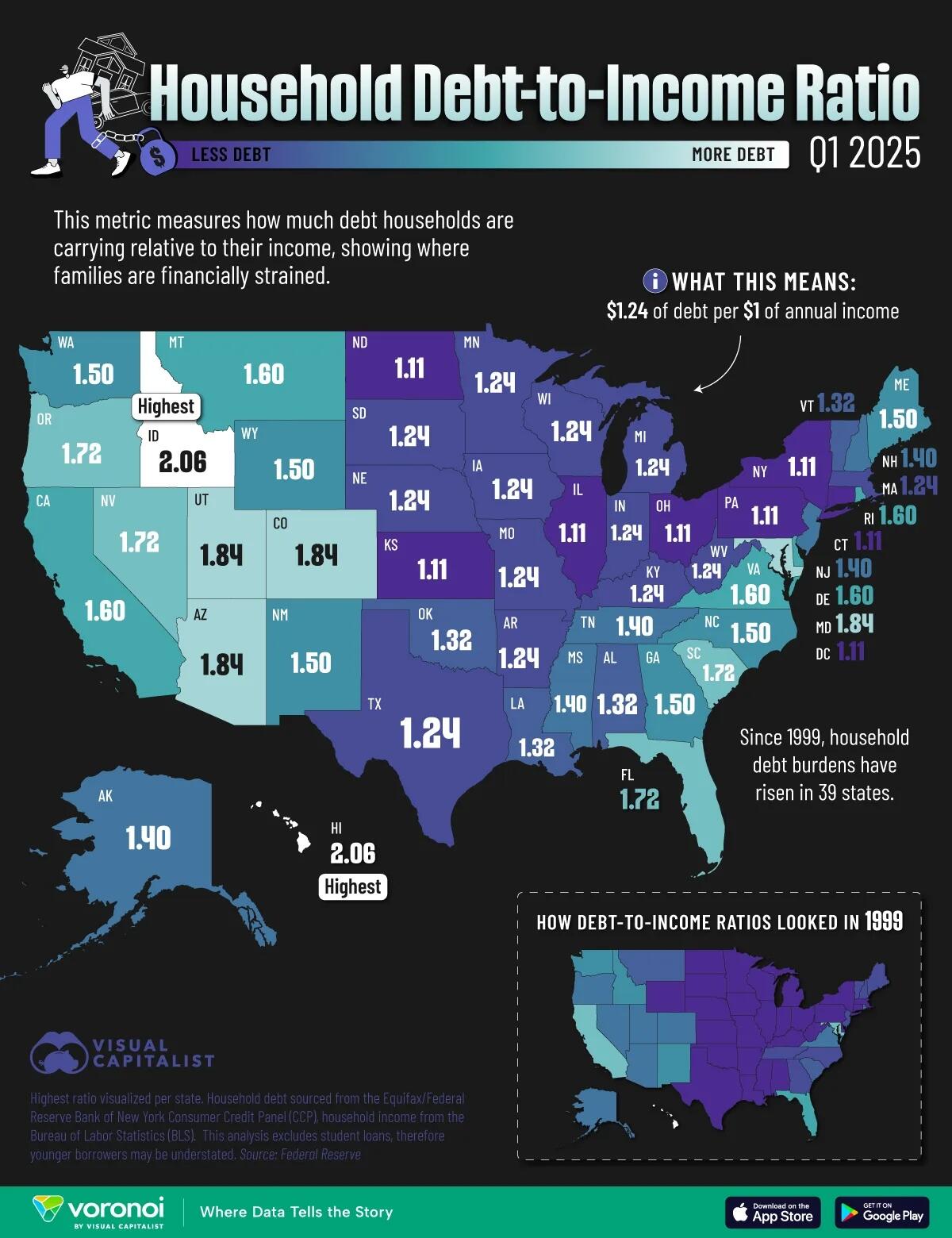
This visualization, via Visual Capitalist’s Pallavi Rao, maps each state by their household debt-to-income ratios (DTI) in Q1, 2025, revealing which states carry the heaviest burdens and which ones keep borrowing in check.
Data for this visualization comes from the Federal Reserve. The highest ratio is visualized per state.
ℹ️ Debt includes mortgages, autos, credit cards, etc., and excludes student loans. Income is based on unemployment insurance-covered wages, as reported to the Bureau of Labor Statistics.
Which States Carry the Most Debt?
Two states share the top spot: Idaho and Hawaii both post a DTI of 2.06, meaning households owe just over twice their annual after-tax income.
Rank
State
State Code
Debt-to-Income Ratio (2025)
Debt-to-Income Ratio (1999)
1999–2025 Change
1
Idaho
ID
2.06
1.50
0.56
2
Hawaii
HI
2.06
2.06
0.00
3
Arizona
AZ
1.84
1.40
0.44
4
Colorado
CO
1.84
1.40
0.44
5
Utah
UT
1.84
1.40
0.44
6
Maryland
MD
1.84
1.72
0.12
7
South Carolina
SC
1.72
1.32
0.40
8
Nevada
NV
1.72
1.40
0.32
9
Oregon
OR
1.72
1.40
0.32
10
Florida
FL
1.72
1.60
0.12
11
Delaware
DE
1.60
1.11
0.49
12
Montana
MT
1.60
1.32
0.28
13
Rhode Island
RI
1.60
1.32
0.28
14
Virginia
VA
1.60
1.40
0.20
15
California
CA
1.60
1.72
-0.12
16
Wyoming
WY
1.50
1.11
0.39
17
Georgia
GA
1.50
1.24
0.26
18
Maine
ME
1.50
1.24
0.26
19
North Carolina
NC
1.50
1.24
0.26
20
New Mexico
NM
1.50
1.50
0.00
21
Washington
WA
1.50
1.50
0.00
22
Mississippi
MS
1.40
1.11
0.29
23
New Hampshire
NH
1.40
1.24
0.16
24
New Jersey
NJ
1.40
1.24
0.16
25
Tennessee
TN
1.40
1.24
0.16
26
Alaska
AK
1.40
1.32
0.08
27
Alabama
AL
1.32
1.11
0.21
28
Louisiana
LA
1.32
1.11
0.21
29
Oklahoma
OK
1.32
1.11
0.21
30
Vermont
VT
1.32
1.24
0.08
31
Arkansas
AR
1.24
1.11
0.13
32
Indiana
IN
1.24
1.11
0.13
33
Iowa
IA
1.24
1.11
0.13
34
Kentucky
KY
1.24
1.11
0.13
35
Massachusetts
MA
1.24
1.11
0.13
36
Michigan
MI
1.24
1.11
0.13
37
Minnesota
MN
1.24
1.11
0.13
38
Missouri
MO
1.24
1.11
0.13
39
Nebraska
NE
1.24
1.11
0.13
40
South Dakota
SD
1.24
1.11
0.13
41
Texas
TX
1.24
1.11
0.13
42
West Virginia
WV
1.24
1.11
0.13
43
Wisconsin
WI
1.24
1.11
0.13
44
Connecticut
CT
1.11
1.11
0.00
45
District of Columbia
DC
1.11
1.11
0.00
46
Illinois
IL
1.11
1.11
0.00
47
Kansas
KS
1.11
1.11
0.00
48
New York
NY
1.11
1.11
0.00
49
North Dakota
ND
1.11
1.11
0.00
50
Ohio
OH
1.11
1.11
0.00
51
Pennsylvania
PA
1.11
1.11
0.00
In Hawaii’s case, elevated housing costs push mortgage balances sky-high. In Idaho, a surge of migrants since 2020 has driven up home prices and left many newcomers with large, fresh mortgages.
Rounding out the top five are Arizona, Colorado, and Utah (all 1.84). Once again, fast-growing markets where rising prices and younger populations translate into higher leverage.
ℹ️ Related: Hawaii has the fifth-lowest homeownership rate in the country.
States With the Lowest Household Debt
At the other end of the spectrum, Pennsylvania, Ohio, and North Dakota come in at just 1.11.
Many low-debt states share three traits. They have lower housing costs, older homeowner bases with significant equity, and slower population growth that tempers new borrowing.
However, even high-income states like Connecticut and the District of Columbia can land in this cohort thanks to well-paid residents who keep balances in check.
The gap underscores how regional housing dynamics, more than incomes alone, dictate household debt.
Finally, due to how this ratio is calculated, younger households’ true burden may be understated (student loan exclusion).
At the same time, the income measure is unemployment insurance-covered wages wages (not total personal income), which can overstate the ratio in high-capital-income areas (e.g., states with finance-heavy metros).
Ben & Jerry’s was blocked by its parent company, Unilever, from creating a Palestinian-themed ice cream, the company’s co-founder, Ben Cohen, said in an Oct. 28 video post on Instagram.
“A while back, Ben and Jerry’s tried to make a flavor to call for peace in Palestine, to stand for justice and dignity for everyone, like Ben and Jerry’s always has. But they weren’t allowed to. They were stopped by Unilever/Magnum, the company that owns Ben and Jerry’s. Just like when Ben and Jerry’s tried to stop selling ice cream in the occupied territories, they were blocked again by their parent company,” Cohen said in the video.
“So, I’m doing what they couldn’t. I’m making a watermelon-flavored ice cream that calls for permanent peace in Palestine and calls for repairing all the damage that was done there.”
Watermelon is symbolically linked to the Palestinians since the fruit comes in the same colors—red, black, and green—as seen on the Palestinian flag. They are also commonly grown in the region.
Cohen called on people to come up with the ingredients for the ice cream and a name for the product.
Ben & Jerry’s operates as a wholly owned subsidiary of The Magnum Ice Cream Company, the largest ice cream company in the world. Magnum is a Unilever brand that operates as a standalone company, with the demerger process between the two currently underway.
In an emailed statement to The Epoch Times, a spokesperson for Magnum said that the proposal for a flavor in support of Palestine was made by members of Ben & Jerry’s board of directors this summer.
“The independent members of Ben & Jerry’s Board are not, and have never been, responsible for the Ben & Jerry’s commercial strategy and execution. Recommendations are considered by Ben & Jerry’s leadership, and Ben & Jerry’s management has determined it is not the right time to invest in developing this product,” said the spokesperson.
Ben & Jerry’s has a history of supporting various causes, including LGBT activism, Black Lives Matter, and immigration. The company’s activism has been a point of conflict with Unilever.
In 2021, Ben & Jerry’s decided to stop selling ice cream in Israeli settlements located in East Jerusalem and the West Bank regions. In 2022, Unilever resolved the matter by selling the ice cream brand’s Israeli business rights to a local company.
In November 2024, Ben & Jerry’s filed a lawsuit against Unilever, accusing the parent company of suppressing free speech. In an amended complaint filed in March, the ice cream brand said Unilever removed its CEO, David Stever, as retaliation for the company’s activism.
Last month, Jerry Greenfield, the other co-founder of Ben & Jerry’s, resigned from his role as the company’s brand ambassador, accusing Unilever of silencing their activism.
In a statement to The Epoch Times following the resignation, a spokesperson for The Magnum Ice Cream Company dismissed Greenfield’s allegations.
“We disagree with his perspective and have sought to engage both co-founders in a constructive conversation on how to strengthen Ben & Jerry’s powerful values-based position in the world,” the spokesperson said.
‘Divisive Political Activism’
Ben & Jerry’s has faced criticism from Jewish groups for its characterization of the Israel-Gaza conflict.
In a May 30 statement, the Anti-Defamation League (ADL)—a group that combats anti-Semitism—and JLens, a Registered Investment Advisor (RIA) and Jewish values-based investor network, condemned a statement made by the independent board of Ben & Jerry’s on Israel’s actions in Gaza.
The board had accused Israel of committing genocide in Gaza.
ADL said the statement was “factually inaccurate, inflammatory, and harmful” while distorting Israel’s fight against terror in Gaza.
“We strongly believe in freedom of expression—but Ben and Jerry’s inflammatory and irresponsible accusations about Israel, including genocide, while failing to mention the plight of the hostages or the threats posed by Hamas does nothing to get this conflict resolved,” said Ari Hoffnung, managing director of JLens.
“The Ben & Jerry’s board should not use their brand as a platform for divisive political activism that risks inflicting irreparable harm on its reputation—and its parent company’s shareholders.”
Ben & Jerry’s has faced backlash from authorities due to the nature of its activism. States such as New Jersey, Arizona, Florida, New York, and North Carolina have divested investments in Unilever following Ben & Jerry’s boycott of Israel.
For instance, in 2023, North Carolina state Treasurer Dale R. Folwell ordered North Carolina Retirement Systems to divest $40 million in Unilever assets.
“This is particularly important in this case as we have witnessed the atrocities perpetrated against the Israeli people. There is no place for antisemitism in this state or this country,” he said at the time.
Moreover, Ben & Jerry’s co-founders have been arrested in the past during protests. In 2016, both Greenfield and Cohen were taken into custody while protesting on the steps of the U.S. Capitol Building.
In 2023, Cohen was arrested amid a demonstration in support of WikiLeaks founder Julian Assange.
Meanwhile, the demerger between Magnum and Unilever, initially expected to be completed by mid-November, has been delayed, Unilever said in a statement released on Oct. 21.
The delay is due to “the ongoing US federal government shutdown,” the company said.
“The preparatory work for the Demerger is on track and progressing well, and Unilever remains committed to and confident of implementing the Demerger in 2025. Further updates on the revised timetable will be provided as soon as practicable.”
Driven by geopolitical tensions, economic uncertainty and sustained central bank buying, the price of gold reached record levels, gaining nearly 60 percent this year to pass the $,4,000-per-ounce mark this month (closing price average from October 1st to 27th) before falling back to find support around $4000.
The level of demand for gold is now prompting questions about whether reserves of the commodity are being exhausted and if humanity has reached “peak gold”.
Indeed, some analysts believe that global mining production has already reached or is close to its peak, having stagnated between 3,000 and 3,300 metric tons annually over the last decade.
While new gold deposits are still being discovered, as recently reported by CNBC in the Hunan province of China (Wangu gold field), large reserves are gradually becoming scarce, with the majority of production still happening in older mines that have been in use for decades.
So which mines are producing the most gold every year?
As Statista’s Tristan Gaudiat shows below, using data from company reports published by the website Mining.com, gold mines in Nevada produced 2.70 million ounces (76.5 metric tons) of the precious metal in 2024, which is a similar output to the estimated production of the Muruntau gold deposit (2.68 million ounces that year), which has been exploited since the late 1960s in Uzbekistan.
Discovered in the 1980s, the Grasberg gold mine, located in the Indonesian province of West Papua, is the world’s third largest supplier (1.86 million ounces or 59 tons in 2024), followed by the Olimpiada deposit (1.44 million ounces or 40 tons), discovered in 1975 in the Severo-Yeniseysky district of Russia.