Federal Court Rules Sexual AI Images Of Children Are Legal To Possess
Perhaps sometimes it’s best for judges to ignore technical loopholes and rigid legal precedent for the sake of doing the right thing? Maybe, in extreme cases where absolute evil is involved, our system could dismiss the “rights of artists” and enforce restrictions based on the potential long term damage to society as a whole?
Yes, the constitutional conundrums are plenty, but can’t we also simply use common sense? Because if we can’t, these kinds of artistic “expressions” are going to inspire independent vigilantism and it will be the fault of the courts when this inevitably happens.
A federal appeals court says a Supreme Court precedent set in 2002 forces it to protect the in-home possession of AI-generated child sexual abuse material. The court warned that rapidly advancing technology has complicated legal lines drawn nearly 25 years ago.
The Seventh Circuit said it was bound by the Supreme Court decision that rejected restrictions on sexually explicit depictions of fictional children when no actual child was involved in their creation. But two judges warned that modern AI can now generate images virtually indistinguishable from material depicting the abuse of real children.
In other words, artistic depictions of child abuse are legal to possess in private because no real children were harmed in their creation. The use of AI exploits this loophole for the creation of hyper-realistic images very similar to real pornographic content.
“Indeed, in Free Speech Coalition, the Supreme Court addressed the scope of First Amendment protections for virtual CSAM, but that was nearly twenty-five years ago, and the image-generation technology available today was likely unimaginable back then,” Judge John Lee wrote. “Given the relentless advancement in artificial intelligence models, we have some concerns about the lines these cases draw, but we are not free to redraw them ourselves.”
If we give these judges the benefit of the doubt and accept their explanation that the Supreme Court ruling prevents them from taking action, we are still left with the moral question. There are constitutional purists out there who might argue that “artwork” is protected speech under the 1st Amendment. There are others (progressives) who will argue that a private individual owning such images hurts no one and they should be left alone to bask in their AI generated pedophilia.
This brings us to the deeper question: Should known pedophiles be allowed to roam free within society because they haven’t abused a child “yet”? Or, should these people be locked up the moment they are identified for the sake of protecting communities from “potential” harm?
It’s generally not constitutionally legal to arrest someone for something they might do, but obviously, the legalized possession of AI child abuse images cannot be allowed to stand. Even if the materials could be labeled “art” that does not harm real children, they act as a useful identifier for some of the worst monsters within any given community. That is to say, these images should be used as an excuse to round up such people.
It doesn’t matter if they have not yet harmed a child; given the opportunity, they likely will. The Supreme Court should change their precedent for this reason alone.
The Seventh Circuit affirmed a lower court’s dismissal of one of four charges against Steven Anderegg, who investigators said had hundreds of AI-generated sexually explicit images depicting children on devices seized from his Wisconsin home.
Anderegg was charged with producing and distributing the AI-generated material, transferring it to a minor under 16, and possessing it. A federal district court dismissed only the possession charge on First Amendment grounds, leaving the other three charges intact.
For now, the distribution of these images is still illegal. Generating the images, while still considered illegal, is difficult to prove, which is why the possession issue is so important. Any AI images that use pictures of real children as a reference are also illegal. AI is testing legal lines that many people thought impossible only a decade ago and limitations need to be addressed before extensive damage is done.
Another week with so many competing narratives driving markets. The information flow was coming so fast and furious that it is difficult to believe that Economic D-Day kicked off the week (it already seems longer than that).
Today, we will take a quick romp through how things seem to be playing out.
Opportunities Lost?
As anyone reading recent T-Reports knows, I was hopeful Warsh would take the stage on Friday and try to “shake things up.” Try to drive home some new (and in my view, much needed) paradigms. We got to discuss this ahead of Warsh’s speech on Friday morning on Bloomberg TV.
Warsh does deserve some credit for using the word “hike” three times at the start of his speech (but all in reference to the activity involving walking outdoors, rather than anything to do with rates). Not sure it was wise, as it likely set the algos off on the 2-year note, but I do applaud the effort to mislead the algos and speed readers.
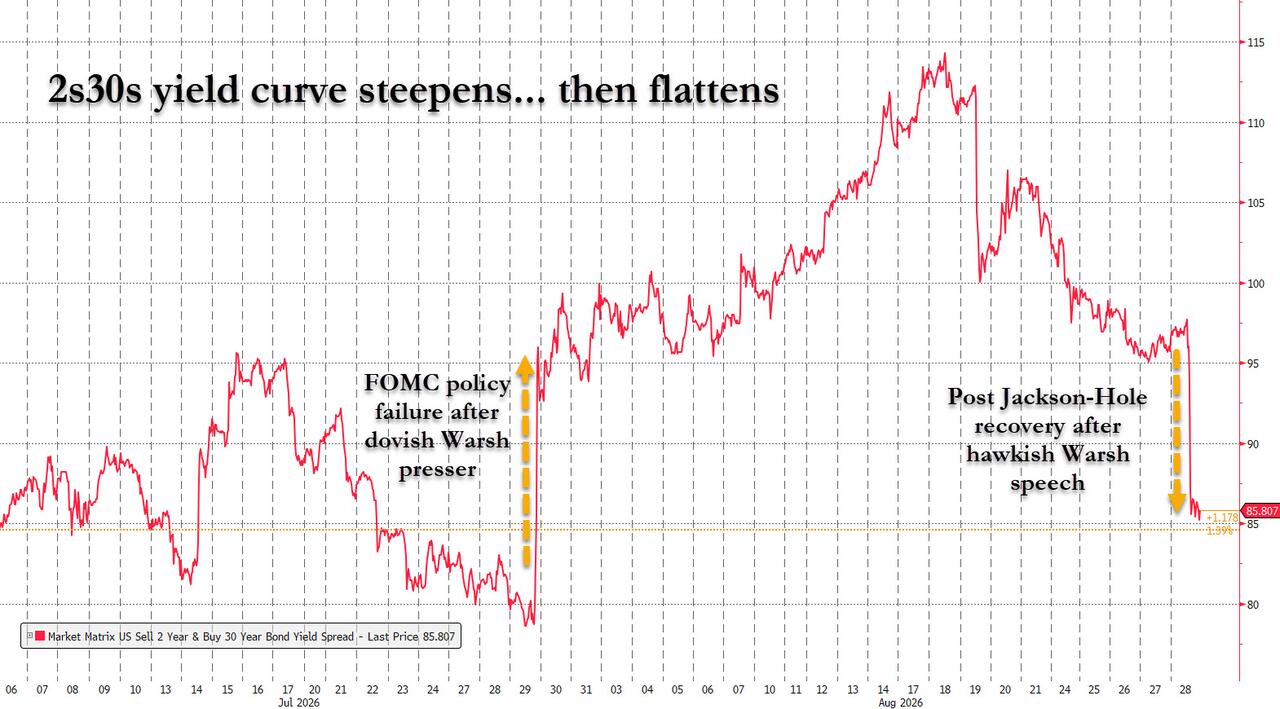
In the end, bonds bear flattened. Stocks fell a little bit, but the bear flattening was the big takeaway from what I found was quite a boring speech, that really didn’t provide any new information.
The 30-year bond rallied initially and tried to hold on to those gains, but finished the day with higher yields. Part of that afternoon selling on longer-dated Treasuries could well be hedging (yield locks) for some IG new issues on Monday. As we wrote about in Yields Behaving Normally, both Bessent and Warsh need to pay far more attention to the massive supply of long-duration bonds (primarily from corporates in the “compute” space) and bonds in general (including increased global sovereign/quasi-sovereigns).
Had he gone down the path I would have liked to see, Friday might have even been messier than it was, but at least we’d have something interesting to discuss. Instead, I expect by the middle of next week, we will be back to lamenting the lack of specificity on the reaction function.
As the chair of the Fed, he has plenty of opportunities to speak, and people will listen, but the set-up for something more exciting than we got was almost perfect on Friday. An Opportunity Lost, in my view, but one that will be re-addressed as nothing is going to stop the data from coming in and the Fed from having to make decisions.
Opportunities Gained?
Every major news source is reporting increased oil flows out of the Middle East. Between alternative routes and increased passage through the Strait, pressure on the crude market is being relieved.
The blockade remains incredibly successful, preventing trade with Iran via the Strait.
CENTCOM’s Commander, Admiral Brad Cooper, announced the Strait has been cleared of mines. Another very positive development on reducing the leverage Iran has.
The U.S. is also increasing staffing at embassies in the Gulf States, which is another step towards our view that neither the U.S. nor the Gulf Region has any interest in re-escalating “kinetic” warfare (the “cool” way to say shooting and blowing things up).
If we see renewed escalation, it seems likely to be initiated by Iran, and they don’t seem to have the will, or ability to do much at the moment (they have allegedly disabled some ships trying to transit, but no large-scale attacks on infrastructure in the region – which is the main fear).
While we haven’t seen diesel or gasoline drop materially, the more oil that can make its way to refineries, the better.
Bessent’s announcement of Economic Outcast on Monday was a bit disappointing. Well, disappointing from launching concrete, obvious effects, that would really pressure the regime to give up (really needs to be tough on China to do that). But that also soothed markets which have less to worry about if we aren’t ramping up the rhetoric with China. A bit of a catch-22.
Basically, Bessent saying that we’ve put everyone on warning/high alert (and they have some time to change their behavior before we come down with the hammer) seems logical. It will take longer that way, but if the threat of the “hammer” works, then it will have accomplished the mission.
On the other hand, what happened to “Sanctioning a Major Financial Institution” on Friday? Maybe it is taking longer to get the legal side of things right, before implementing the sanctions? Maybe the “guilty party” has come to the table to negotiate a deal favorable to the U.S.? Those would be good outcomes and are plausible. But why make such a “direct statement” and not live up to it? On that topic, why didn’t this press conference happen the prior week, which seemed to be the initial target for launching the Economic Armageddon?
As a whole, the direction of travel on the issue of oil and energy products in the Middle East is heading in the right direction (less clear on nuclear deals and change of regime behavior).
Stories are hitting the tape this weekend about a major deal between the U.S. and Venezuela. We continue to see success in working with Venezuela since Maduro has been captured. Having said that, it is difficult to tell from the details provided so far, what the real impact is with this potential “deal.” If it is as good as the Truth Social posts say it is, that could be very good (primarily in the medium to longer term). But as we discussed last week, in the section Done Means Done, we have seen social media pronouncements, or soundbites (even soundbites from the Oval Office), that don’t always materialize the way they were initially touted.
Would be a great win, and I do think Venezuela can be a hub for processing, refining, and smelting materials that the U.S. needs.
Opportunities Squandered?
Since the trade negotiations fell apart (wow, that was only last Friday, that seems even longer ago), there has been a lot of discussion about who caused the deal to break down. Some argue that Carney views it as politically in his interests to not do a deal, even if he could have had a “good” deal. Others discuss last-minute demands on the U.S. side, which seems to fit in with the “art of the deal.” Where this all winds up, who knows.
We are going to lump this into the Opportunities Squandered section, though maybe not in the way you think this is going.
Let’s start with Canada. Let’s start a decade or so ago.
On Friday on Bloomberg TV (during the second segment), I say something that will probably get me in trouble, but once in a while you need to take that risk to get a soundbite across.
I argue that Canada cannot have BOTH a Green Economy and a Real Economy right now. I am not saying that over time you cannot achieve both a robust economy and one that is sustainable for your own nation and the world. I am saying that even if the ultimate end goal skews heavily towards sustainable and green, the priorities in the near term may have to be adjusted. You might never get to the “green” economy if you don’t survive long enough. We argued that the “energy companies of the future are the energy companies of today” during peak “Hopium.” By Hopium, I meant that the vision drove everything and ignored certain realities, that were really needed to turn that vision into reality. I’m not sure I’ve dug myself out of any hole I’ve dug myself into with this attempt at explaining my view, so I’ll just move on.
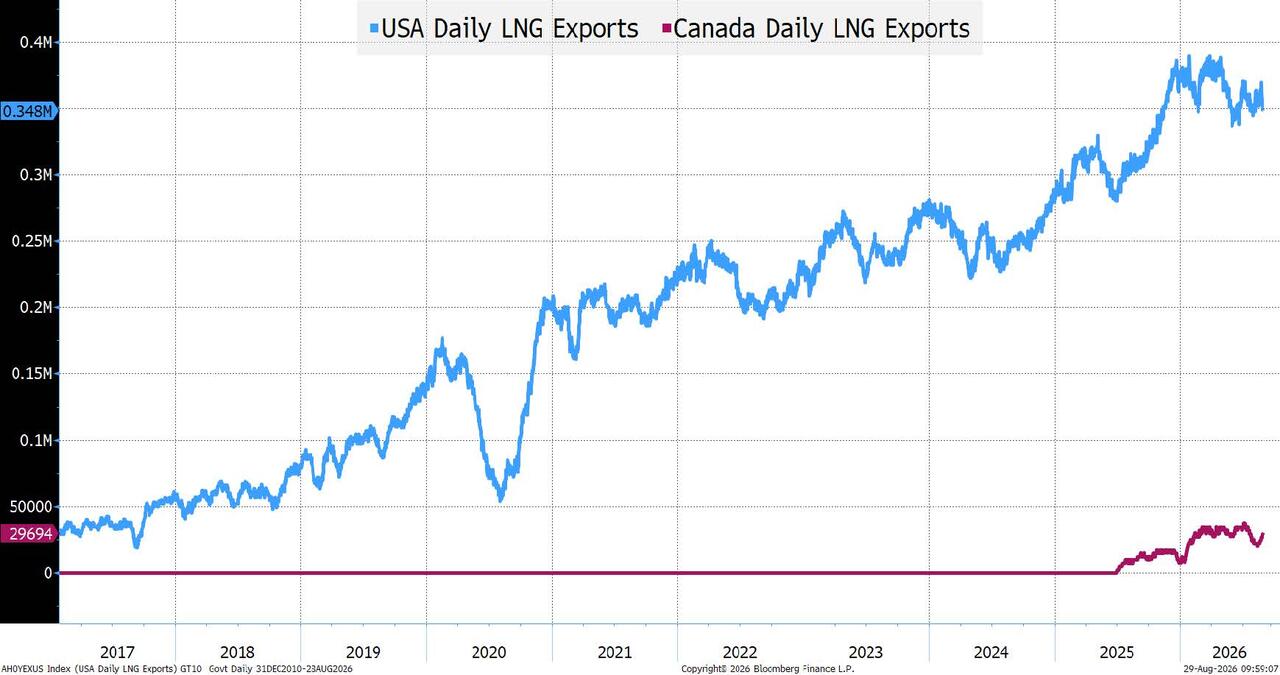
LNG exports. The U.S. has built a robust business around LNG. Not only is it bringing in revenue for America, and creating jobs, in America and abroad, but you could argue it is helping importers diversify away from LNG imports from less trustworthy, or reliable counterparties.
While there are a myriad of reasons why the U.S. can do better than Canada, and has done better, there is truth to the concept that Canada regulated themselves out of business. Or, more precisely, in this case, regulated themselves out of creating a new business.
This to me, is just another example of why ProSec needs to go global (and is going global).
If you have the resources, why not extract them?
Once you’ve extracted the resources, why not refine them?
As we’ve seen with the Strait, the bottlenecks occur primarily around the refined versions of oil. Yes, oil in itself is troublesome, but it is the refined products that are even more important.
Whether Canada listens to this wake-up call (and there are signs that they have been doing it — heck, we even have a tiny blip in the export line from Canada) is yet to be determined. As we’ve highlighted recently, Australia is planning on their first refinery in 60 years!
ProSec is going global. It is in every nation’s interest to ensure that their supply chains for things that are imperative to their existence are as stable, safe, reliable, and resilient as possible.
Having said that, we will discuss two other subjects in this section, even though I’m not sure they are squandered.
Trade with Canada.
At least some of what the U.S. needs for reshoring and, possibly more importantly, the compute build, does or could come from Canada. Aluminum. Data centers need it. Canada has it. There is very little evidence of domestic production that can come on-line quickly, hence, the cost of compute build will go higher. If I’m Canada, I’m trying to harness all the things at my disposal that go into compute and will try to maximize that revenue source (whether in the U.S. or elsewhere). Not sure Canada will do that, but I’m not sure why the U.S. is doing anything making it more difficult or expensive for the compute build, when they are facing enough cost, energy, and NIMBY hurdles.
Farming. Potash. The U.S. imports it at scale. It is an important cost to farmers. Canada has it. The U.S. may have it, but it isn’t readily available. I’ve lost track of what the U.S. is doing on some ag things. Importing ground beef from somewhere (presumably Argentina). Changing how the processing is done. Food costs are a key issue for many voters, so not sure what the nation gets more benefit from – tariffs or coordinated effort?
The China Summit.
While it is simplistic, my “working view” is that:
China is aiming to catch up on compute, faster than the U.S. can catch up on processing, refining, and smelting.
We are purposely avoiding the term – rare earths and critical minerals, because that tends to make people think about the rare earths and critical minerals themselves, rather than what is more important, which is processing, refining, and smelting. Not just rare earths and critical minerals, but even some basic commodities and metals.
If we think back to the “cards” on the table when the trade teams were negotiating in Geneva, to now, who has improved their hand?
I am not sure. Our compute is growing, but China seems to keep popping up as well. The admin is doing some great work on the processing, refining, and smelting side, but we started so far behind China that we need to continue to operate at lightning speed!
It will be interesting to see if I’m correct and ProSec truly moves global, or if countries will remain content to let others do the heavy lifting, even if it risks their economic future.
Bottom Line
I continue to like owning “compute” bonds on a yield basis (no rate hedge).
The Treasury bear steepener likely has more room to run, but we did have downward revisions to the prior year’s worth of jobs data. Not as draconian as last year, but another hint that the job market might be something the Fed needs to keep an eye on (especially as I don’t see how hiking helps war-related inflation or compute-build inflation). Will want to be adding to the front end. I remain indifferent on the long end, but suspect the global supply of debt will outweigh what Bessent has announced so far, and ultimately, the Fed will need to implement some form of Operation Twist to really shift the pricing of the long end.
If oil keeps coming down, it will help rates and equities. I remain concerned how much (in either direction) equities are being driven by the semis where the number of leveraged ETFs astounds me (creating mechanical buying and selling, amplifying every move).
I do think even with oil prices coming down, energy companies, globally, should remain a key overweight in portfolios (XLE is up 42% YTD) and global demands to harness and deliver energy are only increasing!
I don’t think I “squandered” the summer, but have to admit it went by a lot faster with a lot more work and angst than I would have hoped for! Enjoy this last week of summer and hope you have great plans for Labor Day weekend! (which is a holiday both in Canada and the U.S. though it is spelt differently).
The State Department has revoked the visa of an Iraqi national who was placed on the FBI’s Terror Watchlist, ending her ability to enter the United States years after she received a high-profile award from the Biden administration.
Taif Sami Mohammed Al Shakarchi is no longer present in the United States, according to a statement released Friday by Assistant Secretary Dylan Johnson.
The revocation followed her placement on the Federal Bureau of Investigation’s Terror Watchlist. No further details on the underlying intelligence were provided in the department’s announcement.
“Under President Trump and Secretary of State Marco Rubio, suspected terrorists will never be allowed to remain in the United States,” the statement read.
Al Shakarchi was given the International Woman of Courage Award in 2022 by then-Secretary of State Antony Blinken and then-First Lady Jill Biden. The department said she had been recognized for her purported role in fighting corruption and her advocacy for “gender equity.”
The award recognized “women from around the globe who have demonstrated exceptional courage, strength, and leadership in advocating for peace, justice, human rights, gender equity and equality, and the empowerment of women and girls, in all their diversity.”
Al Shakarchi, also referred to in State Department materials as Taif Sami Mohammed, had served as Iraq’s deputy finance minister. She was described at the time of the 2022 award as a longtime official in the Ministry of Finance who started out as a budget analyst in 1985 and rose to director general of the Budget Department. Officials then called her a front-line leader against corrupt practices and noted she was known as the “Iron Woman.” She was listed as a political independent.
The 2022 ceremony, held virtually, was hosted by Blinken with Jill Biden delivering remarks. Twelve women from various countries received the honor that year.
The Trump administration has made clear it prioritizes removing individuals it views as security risks. In recent months, the State Department has revoked hundreds of visas in targeted efforts, including nearly 900 people targeted by a birth tourism task force launched in early August. Broader continuous-vetting operations have led to more than 175,000 visa revocations for a range of violations, crimes, and national security concerns.
The International Women of Courage Award itself continues under the Trump administration. First lady Melania Trump and Rubio presented the 2025 honors in April, recognizing women from countries including Burkina Faso, Israel, Papua New Guinea, the Philippines, Romania, South Sudan, Sri Lanka, and Yemen. The department has noted that more than 200 women from over 90 countries have received the award since it began in 2007.
Al Shakarchi’s case stands apart due to the later watchlist designation. The State Department says its visa action is a straightforward application of its policy against allowing suspected terrorists to stay.
The department’s release did not specify where she is now or provide additional biographical updates beyond the watchlist status and her departure from the United States.
Visa decisions rest with the executive branch, with courts offering limited recourse to many such revocations, a principle reinforced in prior Supreme Court rulings on related immigration matters.
The move arrives amid wider efforts by the administration to tighten scrutiny of foreign nationals already inside the country or seeking entry. Officials tie those steps to national security priorities under the Trump administration.
The Mother Of All Mean Reversions: Commodities Have Never Been This Cheap Versus Stocks
Across Wall Street, from Barclays and UBS to HSBC, JPMorgan and Goldman Sachs, a common view is taking shape: physical scarcity is emerging across multiple commodity classes, driving prices sharply higher and signaling a broader hard-asset squeeze.
Last week, UBS strategist Sagar Khandelwal issued a similar call heard across Wall Street, telling clients to “position for a commodity upcycle.”
On Saturday, Christopher LaFemina, who heads Jefferies’ global metals and mining research and is one of Wall Street’s veteran commodity experts, told clients that commodities remain historically cheap relative to US stocks.
LaFemina compared the S&P GSCI with the S&P 500, showing the ratio hovering near its lowest level in more than five decades. Similar troughs emerged during the Nifty Fifty and dot-com bubbles before commodities sharply outperformed stocks.
Previous upcycles in the ratio coincided with the 1970s oil embargo and inflation shock, the Gulf War, and the 2008 oil-price surge. Today’s depressed reading comes as retail and institutional investors remain bullish up to their eyeballs on hyperscalers and memory stocks while remaining highly concentrated in a handful of other AI names. And really, what could go wrong if the AI boom begins to deflate?
The trough in the ratio comes as traders ignore commodity markets, where the theme of scarce physical resources is rearing its ugly head:
Agricultural prices are soaring; copper is trading above $14,000 per ton in London; tungsten is above $3,000 per ton; uranium is back above $90 per pound; and many other critical materials (seen as the building blocks for the AI boom) are surging as demand accelerates. Electrification, AI buildout demand, rising power consumption, geopolitical fragmentation, including China’s weaponization of export supplies (tungsten and germanium), and years of underinvestment are colliding to create a perfect storm of constrained supplies across energy, metals, and other raw materials.
Agricultural commodities have just broken decisively above nearly 20 years of resistance.
And this is happening while:
▪️Diesel prices approach all-time highs
▪️Mortgage rates hover near 7%, with housing already deeply unaffordable
▪️Wealth inequality stands near historic… pic.twitter.com/rgJfZgUPBC
“The 10-year rolling change in the US dollar remains one of the most important macro developments in the world today,” Azuria Capital’s Otavio Costa wrote on X.
The 10-year rolling change in the US dollar remains one of the most important macro developments in the world today.
We are likely witnessing the beginning of a secular decline in the dollar — a necessary adjustment to the significant trade deficit the US economy faces today.… pic.twitter.com/uWqXcX3QUr
It’s time to focus on “scarcity in the physical world,” according to veteran commodities strategist Jeff Currie, who also warned, “The illusion of abundance is likely behind us.”
Pentagon Strikes Iranian Island Target, In First US Military Action In Weeks
Update(1615ET): Things have been quiet for many days and weeks on the military front when it comes to the Iran war, but on Sunday there are some emerging reports of new but limited US strikes. According to the latest late Sunday from Axios:
Senior American official: Earlier today, American forces attacked two Iranian launchers on Larzac Island. Revolutionary Guard forces were observed preparing to launch rockets carrying sea mines toward the Strait of Hormuz.
So despite the White House signaling a move away from military action and toward the economic warfare front, it’s also clear that more sporadic tit-for-tat blows could follow. But Trump has lately made clear that military options are still on the table, and strikes will be utilized as needed.
CENTCOM says that they attacked two Iranian missile launchers on Larak island. This is the first time that they have struck an Iranian target in weeks.
Propaganda has always been a problem when it comes to the fog of war. The internet and social media add a new dimension to the confusion as conflicting information is allowed to spread like wildfire using civilians and media outlets as tools for propagation.
The lack of confirmation is exploited, often by both sides, and the truth becomes lost in the mire. That said, the facts on the ground will eventually see the light regardless of spin. In the case of the war in Iran, the facts on the ground do not bode well for the Islamic Regime.
Iranian leaders now openly admit that the US blockade has crippled around 35% of the nation’s exports and imports while domestic prices continue to skyrocket by 60% or more. This, however, is not the most immediate problem for the regime.
It would appear that initial reports of gasoline shortages across Iran did not convey the true scope of the crisis. In the past week alone more evidence from within Iran has hit social media, showing mass lines at gas stations and panic among citizens as rationing is introduced.
Energy officials have acknowledged a gasoline deficit of roughly 15 million liters every day, warning that strategic reserves have reached “dark red” territory.
Iran has ten main operating oil refineries plus the large Persian Gulf Star condensate refinery, which is the country’s biggest gasoline producer, meaning, they do have the capability to produce their own domestic gasoline supply. So, why the shortages?
Some refined products are shipped into Iran from foreign sources and the US blockade is stifling that supply. However, there is also the possibility that the blockade has forced Iran to shut down a number of oil wells due to lack of storage. Depending on the type of well, a shutdown can cause extensive damage and prevent new production for years to come. It’s likely that Iran’s crisis is rooted in an oil supply problem as much as a refining problem.
The Iranians have recently called for a return to the standards set by the MOU agreement with the US, and they have also accused the US of committing “war crimes”, arguing that the blockade is causing a humanitarian crisis.
The recent admissions of economic damage, the fuel shortages and the assertions of humanitarian crisis are a sharp tone shift from Iran’s posture only a month ago. Couple this with the 400% surge in ships traversing the Strait of Hormuz and it would seem that Iran is losing the war outright. If the blockade continues for another few months the financial damage could be irreversible and repairing resource flows could take years.
It’s not enough for the regime to survive if the economy they oversee dies.
Ceding leadership in AI to China’s Chinese Communist Party (CCP), what could go wrong?
Just about everything. Yet that is precisely what some here in the U.S.-and all in Beijing-want to occur.
America is currently being swept by misguided attempts to curtail AI’s development and the development of the data centers on which AI’s development will depend. Some of these stem from legitimate concerns (though often inaccurate) about what AI can and will do. Some stem from concerns about what data center development will mean for their communities. [The answer is jobs, investment, and growth-something that West Virginia’s governor Pat Morrisey and statehouse leaders presciently see as they pitch their state for just such responsible development.]
However, some of this opposition also stems from foreign influence from those who would love nothing more than to see America not be the leader in a technology that has the potential to define this century’s development and beyond.
The history of mankind’s development could be shorthanded into a history of mankind’s harnessing of energy. This history began with humanity’s use of its own muscle power. It moved from our muscle power to harnessing (literally) the muscle power of animals. This power was supplanted by the power of the elements-wind (with sails, mills, etc.) and water (mills, dams, and more). Then there was steam. Then the internal combustion engine. Electricity. Nuclear. And yes, renewable forms as well.
We shifted back and forth between these as refinements were made to their production and application; however, they largely served first to supplement, and soon to supplant, our muscle power. Certainly, there were enhancements to our “mental energy” too, writing and the printing press, for example; however, it was not until relatively recently (in the 1940s) that the “mental energy” revolution exploded with the advent of the computer.
AI is different, and in that difference lies its potentially revolutionary aspect. AI offers the power to supplement our mental power far beyond what the computer can. Our mental power is the distinguishing feature of the human species, which underscores just what AI could do for humanity.
This brings us back to those who want to curtail America’s leadership in this vast potential. Clearly, China’s CCP is at the forefront of those who would like to see America not have this leadership. Even more, it is clearly at the forefront of those seeking to prevent American leadership in AI.
China’s efforts to slow America’s AI development are many. Undoubtedly, the CCP will find more ways, and more examples will come to light.
All this leads to the question: If America does not lead in AI, who will? China’s answer is already clear. Even more important, then, is the question: What would China’s leadership in AI entail? We can largely answer that question based on past and present experiences.
The virtual monopoly the West gave to China in rare earth mining, production, and manufacturing of products heavily dependent on these minerals has not served us well. It has given the CCP leverage in many instances. It has undoubtedly increased the price volatility of rare earth-dependent products, which has also encumbered the adoption of such products. It has also shifted these rare earth activities to a country with lower environmental standards (one even more pronounced in the past, when the West gave China its rare earth monopoly).
China’s laxer oversight standards have had global repercussions beyond the environment. COVID’s origin from China’s Wuhan Institute of Virology is increasinglyaccepted; concerns about its safety and management standards were known years before COVID. At the very least, China’s delayed revelation of important information about COVID allowed the virus to spread. The escape of an earlier SARS virus in 2004 is also widely known.
None of these argue for security when it comes to AI oversight in China. How then could China be trusted in the development of a technology that is widely predicted to potentially be the world’s most powerful?
There should be even less confidence in the CCP’s deployment of AI. China regularly targets its adversaries (both at home and abroad) with every tool available-and increasingly with AI-making its citizens among the most surveilled in the world. There are growing reports of China’s funding of U.S. protests. China’s Belt and Road Initiative uses investment to gain influence and build dependency across the globe-particularly in developing nations.
China’s direct aggression has been increasingly on display for years. There are its recurrent border conflicts with India. There is the building of island bases in waters near the Philippines (and other areas in the Pacific for years) and confrontations with that government. There has been the abrogation of its deal with Hong Kong for recognized rights, and its jailing of political opponents there. There have been continual threats of aggression against Taiwan; bellicose warnings have also been issued against Japan.
The CCP’s internal repression is even greater than its external actions. Its recently passed “Ethnic Unity” law builds on past charges of genocidal practices against the Uyghurs and Tibetans. Internal surveillance, already severe, has only been enhanced by the CCP’s use of AI.
If the CCP uses a myriad of ways to confront foreign governments and intrusive means against its own citizens at home and abroad, there is no reasonable expectation that it would not use AI against foreign nations and their citizens too.
The CCP desires AI supremacy, just as they have been allowed to have it in rare earth minerals. They are working to secure this for the obvious reason that AI has the potential to be far more valuable than rare earth minerals.
And because the West was shortsighted enough to cede China leadership in rare earth minerals, the CCP has some reasonable expectation of success in its AI efforts. That the West is so willing to allow its own culture and values to undergo assault from within (in contrast to the CCP’s enforcement of its cultural hegemony internally with its new ethnic unity law) is just another signal to Beijing that the West is unwilling to defend its interests.
How fast China is progressing in the 21st century’s technology race is evidenced by its leadership in the development of humanoid robotics and other areas. So, the threat is not only real; it is already here.
To recap, China’s already using AI for surveillance internally and externally. China’s oversight of its science has proven inadequate in medical research, just as its oversight of the environment has been. Yet some, such as Senator Bernie Sanders (I-VT), would not only have us ignore these warning signs, but dramatically exacerbate their potential for danger with AI by curtailing its development and de facto ceding AI leadership to China.
The history of energy has written the history of human development. This history of energy was largely one of supplementing muscle energy. The new revolutionary energy is not physical energy but mental energy. It is AI, and it will supplement humanity’s mental energy. Beyond the question of what AI can do is who will control it?
We all recognize that AI will be overseen; such oversight is a hallmark of the U.S. However, doing so to the extent that it curtails AI development and renounces leadership in a technology of unprecedented power to the world’s least accountable government is extremely naive. Doing so to a government that has demonstrated, and continues to demonstrate, that it will use all the means at its disposal to the detriment of those it perceives to be adversaries would be the biggest mistake in history-with potentially the most powerful technology in history.
J.T. Young is the author of the recent book, Unprecedented Assault: How Big Government Unleashed America’s Socialist Left from RealClear Publishing. Follow him on Substack.
US Democrats on Friday slammed the Trump administration for dragging out the war on Iran to its six month anniversary, warning Republicans would pay the price in the upcoming midterm elections.
The joint US-Israeli attack on Iran, beginning on February 28, was initially meant to last a few weeks, by President Donald Trump’s own estimates. Half a year later, the war has seen the US lose at least 18 of its troops and cost $100bn in military spending, most of which was approved by the Republican-controlled Congress late last month after Secretary of War Pete Hegseth requested additional funds north of $60bn.
The war has cost each American taxpayer around $600 to $1,000 in extra energy costs because of Iran’s response in blocking the Strait of Hormuz, according to a Brown University study and estimates from Moody’s Analytics.
Estimates for the number of Iranian dead vary between 3,400, according to the UN’s OCHA agency, and 6,000, according to the Israeli military.
“Trump and his chief dealmaker [Vice President JD] Vance have failed to reach an agreement to end their war. Back in March, Trump and Vance said the war would be over ‘soon’ – but just this week, Trump said he is ‘not in a hurry’ to end the war,” Democratic National Committee (DNC) chair Ken Martin said in a statement on Friday. The DNC oversees all party activities and vets candidates for elections.
“[They] dragged the US into a deadly and costly war they clearly cannot find a way out of – at the expense of the American people who are struggling to make ends meet. Trump and Vance explicitly promised no new foreign wars, yet six months in, there is no end in sight to the conflict that has driven up prices on everything from gas to groceries,” Martin said.
“While Republicans claim they cannot bring down costs or fund affordable healthcare for everyday Americans, they continue to spend billions of dollars on a war no one wanted or asked for – and voters will remember this betrayal when they head to the polls in November.”
The Silver Bulletin, which tracks and analyses public sentiment, noted on Friday that repeat polling has shown around 37 percent of Americans support the US-Israeli war on Iran, while 55 percent oppose it.
Half hearted opposition?
While Democrats in the House of Representatives latched onto an effort by the progressive wing of the party in late February to force a War Powers vote – which would insist on Congress having the power to declare war and not the president – it was not clear they would have actually opposed any attacks in their capacity as lawmakers.
Earlier this year, before the 28 February US-Israeli onslaught began, reports emerged that Democratic Party leadership was trying to curb more grassroots efforts to restrain Trump’s war-making authority.
Establishment Democrats, many of whom failed to condemn Israel for what the United Nations and Holocaust scholars have called a genocide in Gaza, have not shied away from consistent condemnation of Iran, believing that, if not now, then at some point Tehran would have to be militarily confronted.
Iran itself had said that, while it must be ready for a war with the US – largely egged on by Israel – it would rather cut a deal that allows it the weapons it says it needs to defend itself as a sovereign state.
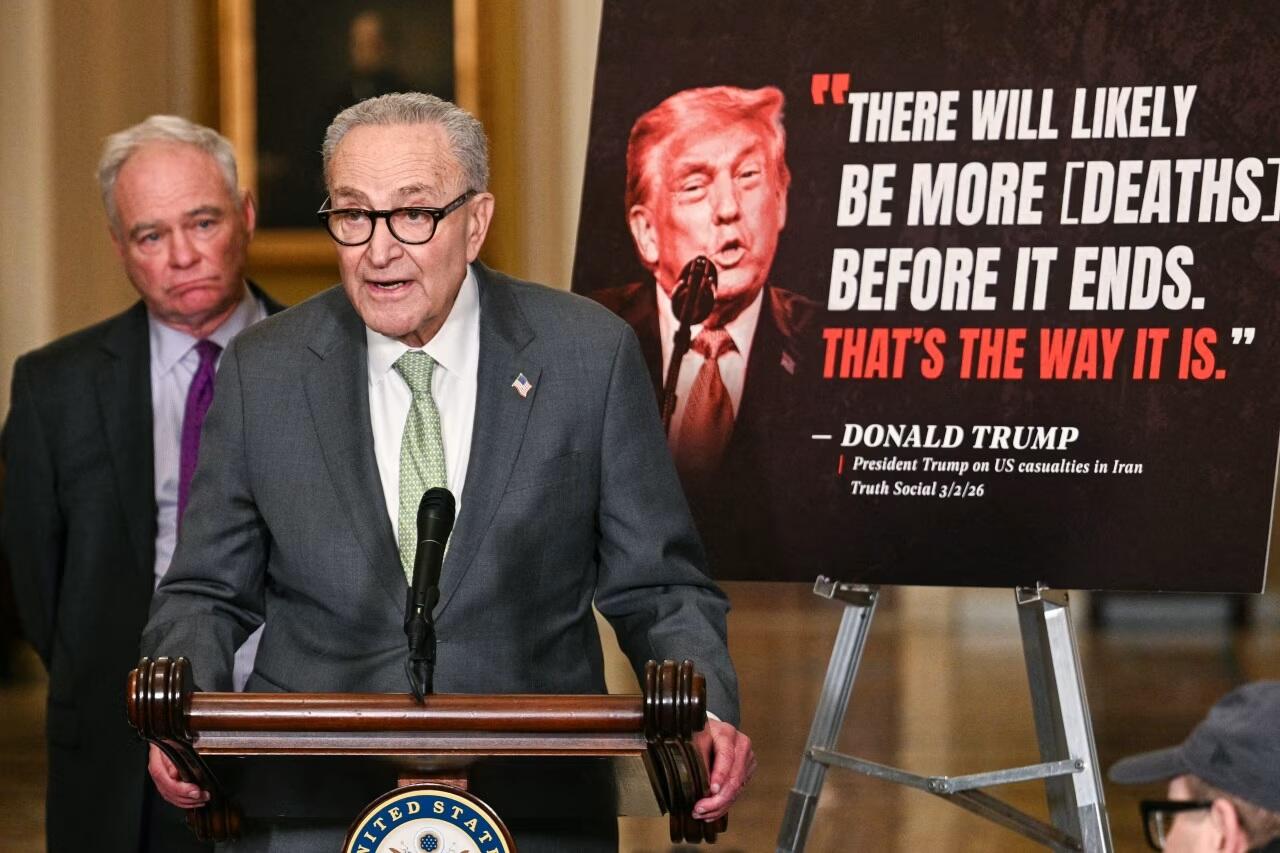
A week before the US and Israel began joint air strikes, Secretary of State Marco Rubio and CIA Director John Ratcliffe briefed House and Senate leadership on the latest Iran developments behind closed doors. The top Democrat in the Senate, Chuck Schumer, emerged only to say to reporters: “This is serious, and the administration has to make its case to the American people.”
Four days earlier, Schumer said in a statement that “confronting Iran’s ruthless campaign of terror, nuclear ambitions, regional aggression, and horrific oppression of the Iranian people demands strength, resolve, regional coordination, and strategic clarity”.
Where things stand
If there is a diplomatic track that Trump is still pursuing, there are no signs that it’s yet at a senior enough level to bear fruit. Two attempted ceasefires have quickly collapsed.
Qatar’s prime minister arrived in Iran on Thursday in a bid to seek a joint Iran-Oman solution to reopening the Strait of Hormuz. The talks have slightly lowered the price of oil this week, but Trump’s new deployment of the USS Theodore Roosevelt for a seven-month stint in the region suggests tensions are not winding down any time soon.
US Treasury Secretary Scott Bessent on Monday announced a new wave of sanctions against Iran and its “enablers”, towards what he described as an “asphyxiation of this regime”. He called it “Operation Economic Outcast”.
Most Democrats have all along shared the same hawkish attitudes and assumptions when it comes to Iran…
Ro to Dem Iran hawks:
“The last thing we want is to goad Donald Trump into more conflict”
“Is this the time to be saying to Donald Trump, you haven’t blown up enough stuff in Iran? Absolutely not!”
Using a “zero leakage approach”, Bessent said the Treasury had “mapped every node, every facilitator, and every network that Iran has used to smuggle oil and evade sanctions”, and that Trump had already made phone calls to counterparts around the world “with specific requests to cease their interactions with the regime”. He did not specify which leaders, nor on what timeline they may act.
Then there’s the critical shortfall in US munitions, given the Pentagon has moved many to the Gulf, as it strikes back at Iranian retaliation against US military bases and energy facilities in the region. A Reuters report this month said the US had exhausted its stockpile of sophisticated long-range missiles during the war on Iran, including surface-to-surface ATACMS and Precision Strike Missiles (PrSM).
The Associated Press also reported a “beyond critical” shortage of advanced missile interceptors, especially Patriots, which have been used to shoot down Russian ballistic missiles in the war with US-backed Ukraine.
“Profound Game-Changer”: Musk Launching New Turbine Blade Factory To Solve Shortage Threatening AI Boom
SpaceX is making an aggressive push into the power generation market, with The Information reporting that Elon Musk is preparing to address one of the most critical bottlenecks threatening America’s data-center buildout: the shortage of advanced gas turbine components, particularly theblades and vanes needed to power massive data center campuses.
SpaceX is laying the groundwork for a new factory in Bastrop, Texas, that would manufacture high-temperature blades and vanes for industrial gas turbines. The move could allow Musk to circumvent the severe turbine blade shortage that has pushed availability toward 2030.
On X, Musk responded to the report, saying, “The limiting factor for nat gas turbine production is casting the blades & vanes. By doing in-house casting at SpaceX, we can accelerate nat gas turbines coming online by up to 18 months, which is a profound game-changer.”
SpaceX and Tesla are each building 100GW/year of solar production capacity as fast as possible, but natural gas will still be needed to supplement and bootstrap solar for several years.
The limiting factor for nat gas turbine production is casting the blades & vanes. By doing…
Musk previously warned about the shortage during a recent podcast, saying, “Turbines are sold out through 2030. In order to bring enough power online, SpaceX and Tesla will probably have to make the turbine blades and vanes internally. There are only three casting companies in the world that make these, and they’re massively backlogged.“
ELON MUSK: “Turbines are sold out through 2030. In order to bring enough power online, SpaceX and Tesla will probably have to make the turbine blades and vanes internally. There are only three casting companies in the world that make these, and they’re massively backlogged.” pic.twitter.com/YlKHznBXhK
A Federal Trade Commission filing shows that Musk has acquired APR Energy, a provider of mobile gas turbine power plants used by data centers, utilities, and industrial customers.
Musk’s acquisition of APR Energy also gives him access to a mobile fleet built around GE TM2500 and Mitsubishi FT8 turbines, which typically produce 20-35 MW per unit.
SpaceX is targeting roughly 10 gigawatts of AI computing capacity by the end of 2027, while Musk has said the company wants substantially more power and cooling infrastructure.
Consensus estimate is that ~15GW of AI compute produced in 2027 cannot be turned on in 2027.
This is harder than just finding power, as you also need to build out all the transformers, wiring, liquid-cooling, (massive) chillers & complex networking. https://t.co/cRXJ1Wrkri
This all signals that Musk views the turbine shortage as a direct threat to SpaceX’s data center buildout timeline. Rather than wait on constrained outside suppliers, he is moving aggressively to vertically integrate another critical layer of the AI infrastructure stack across his business empire.
Iceland Voters Reject Reopening Talks To Join European Union
Iceland voters on Saturday rejected a proposal to reopen negotiations to join the European Union, after the island nation of some 400,000 people chose to maintain independence after shelving its membership bid more than a decade ago.
Heading into the vote, the “yes” camp was ahead by just 2.6 points – however opponents defeated the measure by a margin of 52.8% to 47.2%, according to RUV.
A “yes” vote would have sent the government back to Brussels – while any deal would have required a second referendum and ratification by all 27 member states. Now, the issue is shelved and moot.
Before the ‘no’ vote, Social Democrat Prime Minister Kristrún Frostadóttir described the vote as “an opportunity.”
Opponents suggested this was nothing more than deception – with the government trying to convince people “that we are not really applying, that we are merely looking into what membership would entail,” Gudlaugur Thor Thordarson, a former foreign minister and current lawmaker for the opposition Independence Party, said in an interview with The Epoch Times. “If you apply to join the EU, you are applying to join the EU.”
Membership, he said, would mean EU law overriding Icelandic law, a sweeping transfer of legislative and executive power, and the jurisdiction of the EU’s courts on top.
Haraldur Ólafsson, a physics professor who chairs the eurosceptic movement Heimssýn, told The Epoch Times the question was worded so that people “find it very difficult to say no to discussions.”
Applying without wanting to join, he added, makes “a fool of the European Union.” “You should try to win over the people of the country before you submit an application, instead of submitting one in camouflage,” he said.
As the Epoch Times notes further, Iceland applied to join the EU in July 2009, months after its banks collapsed. Talks opened in 2010, and 11 of 35 policy chapters had been provisionally closed by the time a new center-right government froze the process in 2013. The fisheries chapter, the most sensitive of all, was never opened.
In March 2015, Reykjavík asked Brussels to no longer regard it as a candidate country.
The current government contends that the application nonetheless remains valid, a view the European Commission has endorsed. Thordarson disputes this. The “still valid” line, he said, was the product of government lobbying in Brussels and “came as a total surprise to all of us.”
He also said that visits by European ministers to Reykjavík over the summer to urge a “yes” amount to “foreign interference.”
Spanish Foreign Minister José Manuel Albares and his Austrian counterpart, Beate Meinl-Reisinger, both spoke favorably of Icelandic membership during visits to the country in June, with the referendum on the agenda.
France’s Jean-Noël Barrot struck a similar note during an official visit in July, saying Iceland “had nothing to lose” by reopening talks.
The Greenland Factor
The government’s own explanation for the timing points not to Brussels but to Washington. Frostadóttir’s center-left coalition, formed after the late-2024 election, had pledged a referendum by 2027. In March it brought the vote forward, weeks after U.S. President Donald Trump renewed his push to acquire Greenland, which he said has become a national security concern for the United States because of increasing Russian and Chinese influence over the Arctic.
Foreign Minister Thorgerdur Katrín Gunnarsdóttir said it would be “both naive and irresponsible” not to take the moment in history into account.
Snærós Sindradóttir Bachmann, executive director of the European Movement in Iceland, told The Epoch Times that the vote is “about human rights and democracy, and about standing with like-minded nations against this threat from the West,” a reference to Washington’s pressure on Greenland.
“Greenland is 290 kilometers [about 180 miles] away from us. We have to be realistic,” she said.
Eggertsson, for his part, said he was “very cautious about speculating that similar pressure will be directed at Iceland,” citing the country’s “strong and longstanding ties with the United States.”
But as larger powers grow more willing to apply pressure, he said, “stronger cooperation with allies and like-minded countries becomes increasingly important.” He added: “I would not frame this as turning away from the United States or from NATO.”
Iceland has no armed forces of its own. A founding member of NATO, it relies for its defense on a 1951 agreement with the United States. In March, it also signed a security and defense partnership with the EU covering Arctic and maritime security, cyber issues, and economic security.
The Greenland episode weighs on her, Bachmann said, and she’s concerned it does not seem to worry many of her compatriots.
Thordarson, who said he too objected to Trump’s statements on Greenland, dismissed the argument as “a pretext” and a narrative that “does not hold up.” Frostadóttir, he added, had not campaigned on a referendum on reopening accession talks.
Ólafsson was blunter: the government, he said, had blown the Greenland issue “light-years out of proportion.”
Greenland has weighed on the debate “much less than people abroad would think,” Oddsson said. “The topics actually being discussed are much closer to home: the currency, fisheries, agriculture, and questions of sovereignty.”
Britain’s largest local authority has spent a year treating the Union Flag and the St George’s Cross as a public-order problem. On Saturday the picture sharpened again: the legal squeeze now circulating around Birmingham’s flag war is being described as a ban aimed at England and the United Kingdom, while other national colours keep their place in the city’s official life.
Birmingham City Council has gone to the High Court to stop “unauthorised attachments” on the highway. Breach of an injunction of this kind can mean unlimited fines and up to two years in prison.
The people named in the papers are the campaigners who put British flags on lampposts. But the council still finds time to raise other nations’ flags outside the town hall and light the city library in foreign colours. To top it all off, they have reportedly confirmed that anyone raising foreign flags will be exempt from the new ban.
?NEWS: Birmingham City Council have confirmed that the Flag Ban will only apply to the flags of England??????? and the UK ??
Flags from other countries such as Pakistan, India, Bangladesh and Palestine will all be exempt
On 26 August the council submitted its application to the High Court. The named respondents include Raise the Colours co-founder Ryan Bridge, Elliott Stanley, Julian Keane, Ross Child, Billy Allison, Ben Cullen, Mark Keating and “persons unknown.”
The catch-all clause is the point. If a judge grants the order, it is not only the named men who are in the frame. Anyone who keeps putting flags on lamp columns, railings or other street furniture without permission can be pulled into contempt proceedings.
Green councillor Jane Baston, cabinet member for equalities, communities and social justice, said: “The council is taking a lawful, proportionate and evidence-led approach to unauthorised attachments on the highway. This includes pursuing injunctive action based on the evidence gathered to date.”
She added: “Our priority is to protect public safety, staff and contractor welfare, community cohesion and the responsible use of public funds. We ask residents and community groups to support this approach and to ensure any displays are placed only where permission exists.”
The authority insists the action “is not directed at any particular community, belief or viewpoint.” It says officers have “witnessed incidents that have involved harassment, intimidation or obstruction during removal activity.”
That is the official script. The record of the last twelve months tells a different story about which flags trigger the machinery of the state.
Raise the Colours started in the Birmingham area last summer and spread across England. Thousands of St George’s Crosses and Union Flags went up on lampposts, roundabouts and bridges. The council answered with safety language: attachments on tall columns, risk to motorists, LED upgrades, highways law. Flags twenty-five feet in the air became a danger to life.
Bridge has not offered the council the surrender it wants. On Talk TV he said he would keep going. “100% I will be carrying on. If I go to jail for it, so be it.”
FLAG BAN FURY
Birmingham City Council wants to stop groups such as Raise the Colours putting up the national flag — but co-founder Ryan Bridge vows to defy the ban.
Times columnist Matthew Syed, sitting with Kevin O’Sullivan, refused to treat the flag as a social contaminant. “I believe in the flag, I believe in the nation,” he said. “I think that if you don’t have a strong sense of nationhood, it’s very difficult to do anything.” He further argued that without a coherent nation, you get caste, clan and tribe. You do not get a country that can function.
“I believe in the flag, I believe in the nation.”
Times columnist Matthew Syed and Kevin O’Sullivan react to Birmingham City Council seeking a High Court injunction to stop members of anti-migrant group Raise the Colours from putting up flags across the city.@TVKev… pic.twitter.com/fG2OxnjP3F
Former Metropolitan Police detective Peter Bleksley called the jail threat “absolutely scandalous.” The Free Speech Union called it “truly mental.” Reform UK’s Birmingham group leader, councillor Jex Parkin, said: “It is extraordinary that we have reached a point where people peacefully displaying the Union Flag or St George’s Cross could potentially find themselves before the courts, with breach of any eventual injunction carrying extremely serious consequences, including imprisonment.”
He added: “The Union Flag and St George’s Cross belong to everybody in this country. They should unite us, not divide us.”
Conservative group leader councillor Robert Alden said the flags are “a unifying force celebrating our shared culture and heritage” and called on the council to enable formal neighbourhood displays instead of dragging patriots into court.
The phrase that is repeated ad nauseam in Birmingham is “community cohesion,” yet it was not the governing principle when other flags were raised in the street.
For months after October 7 2023, Palestinian flags flew from lampposts in parts of the city. Nearly a third of Birmingham’s residents are Muslim. The council did not race to the High Court. A leaked internal message from cabinet member Majid Mahmood, reported in 2025, explained the real constraint. On Palestine flags he wrote: “We are taking these down, but we need the support of the police due to issues that have cropped up when we first tried to take them down.”
Reform UK’s Robert Jenrick commented, “It is ridiculous that the council is taking down England flags and Union flags while Palestine flags are allowed to remain,” adding “It’s blatant two-tier bias against the British people.”
Remember, Birmingham Council never moved for an injunction when it was just Palestine flags being flown from lampposts.
No threats of up to two years imprisonment.
“Community cohesion” wasn’t a concern until people put up St George’s and Union flags. A two-tier approach. pic.twitter.com/j7EAow80BY
Foreign colours get to stay, yet the national flag is treated as an attachment to be litigated out of existence.
The hypocrisy is not confined to protest banners. It is civic policy.
In July the Somali flag was raised outside Birmingham Council House in Victoria Square, with civic representatives present. The Library of Birmingham was lit blue and white for the occasion.
Reform UK’s Birmingham group put the contrast in writing: “Only weeks ago the Somali flag was officially raised outside Birmingham Council House with civic representatives present. Earlier this month the Pakistan flag was raised outside the Council House at a ceremony hosted by the Lord Mayor.”
“There is something badly wrong,” the group said, “if Birmingham City Council can proudly accommodate the national flags of countries around the world while people are made to feel that displaying the Union Flag or St George’s Cross is somehow provocative.”
The same authority now determined to strip British flags from the streets has been happy to fly the Somali flag from the civic building itself.
Birmingham council seeking to ban British flags ‘for public safety’ yet happy to fly Somali flag outside its council house. pic.twitter.com/4aVCNPeNTy
The library routine is now a seasonal fixture. Green and white for Pakistan Independence Day. Orange, white and green for India. The same council that scrambles to criminalise British flags will bathe a landmark in another country’s colours overnight.
Birmingham Council will happily raise the Somali flag, Pakistan flag and light up the Library of B’ham in Pakistan flag colours.
This would be fine in Pakistan or Somalia. However, we’re not. Somehow, raising the Union and St George’s flags creates “community cohesion” concerns. pic.twitter.com/1PUh08Ijnq
Jamaica has had the same civic courtesy. Footage from Council House shows the Jamaican flag raised for independence day on the same steps now being used to lecture English residents about cohesion.
?This is the same central Birmingham square where the city council banned Britain First, claiming the group didn’t share their values. ?A Pakistani flag flies over that exact spot.
Councillor Alan Feeney, the Conservative shadow cabinet member for city services, said the obvious thing the cabinet will not. “This simply is not a priority for residents. Birmingham has an ongoing bin strike, roads filled with potholes and travellers breaking onto parks across the city, costing the taxpayers hundreds of thousands of pounds. The council’s focus should be on dealing with these issues, not taking down flags that were placed as a symbol of national pride.”
Labour’s remaining voice on the council, group leader Nicky Brennan, offered the opposing theology: “We cannot allow a small group of people to attempt to divide the communities of Birmingham.”
The communities he is referring to claim to be divided by the English flag. They are apparently knitted together by the Somali flag on the Council House and a library washed in the colours of Islamabad.
Birmingham is the prize because it is huge, broke, and demographically transformed. Almost a third Muslim. Large Pakistani, Indian, Bangladeshi and Somali populations. A political class that has learned to speak the language of cohesion while practising a hierarchy of flags.
The enforcement now taking shape singles out England and the UK while other countries’ colours remain in the clear.
A nation that will jail a man for the Cross of St George, and light a library for Pakistan, has told its own people where they stand.
Your support is crucial in helping us defeat mass censorship. Please consider donating via Locals or check out our unique merch. Follow us on X @ModernityNews.