64.3 F
Chicago
Monday, October 12, 2026
Home Blog Page 1143

US Cyber Agency Issues Emergency Directive Amid Major Hacking Campaign Targeting Cisco

0
US Cyber Agency Issues Emergency Directive Amid Major Hacking Campaign Targeting Cisco

Authored by Naveen Athrappully via The Epoch Times (emphasis ours),

The Cybersecurity and Infrastructure Security Agency (CISA) has issued an emergency directive asking federal agencies to take immediate action to identify and mitigate system vulnerabilities to protect their devices from a major hacking campaign, the agency said in a Sept. 25 statement.

A member of the hacking group Red Hacker Alliance using a website that monitors global cyberattacks on his computer in Dongguan, Guangdong Province, China, on Aug. 4, 2020. Nicolas Asfouri/AFP via Getty Images

“This widespread campaign poses a significant risk to victims’ networks by exploiting zero-day vulnerabilities that persist through reboots and system upgrades,” CISA said.

Zero-day vulnerabilities refer to unknown or unaddressed security flaws in computer hardware, firmware, or software. Such vulnerabilities are called “zero-day” since the software or device with such flaws has zero days to fix the issue, thus enabling hackers to immediately exploit them.

According to the directive, Cisco has assessed that the hacking campaign is linked to the threat actor ArcaneDoor.

A May 2024 post by computer and network security company Censys said an investigation of IPs controlled by ArcaneDoor suggested “the potential involvement of an actor based in China, including links to multiple major Chinese networks and the presence of Chinese-developed anti-censorship software.”

Four out of five IP hosts analyzed by Censys were found to be in China, with some linked to Chinese conglomerate Tencent and Chinese telecom company ChinaNet.

“Networks like Tencent and ChinaNet have extensive reach and resources, so they would make sense as an infrastructure choice for a sophisticated global operation like this one,” Censys said in its post.

In a Sept. 25 statement, Cisco said it had been engaged by multiple government agencies in May to provide support to an investigation into attacks targeting the company’s ASA devices.

The company said it has “high confidence” that the hacking activity was related to ArcaneDoor.

“Cisco assesses with high confidence that upgrading to a fixed software release will break the threat actor’s attack chain and strongly recommends that all customers upgrade to fixed software releases,” the company said.

The CISA directive comes as Chris Butera, the agency’s acting deputy executive assistant director for cyber, discussed helping organizations tackle the growing number of vulnerabilities during a Sept. 25 panel discussion held by media company FedScoop.

Butera discussed the Known Exploited Vulnerabilities (KEV) catalog CISA uses to prioritize system vulnerabilities that require patching.

“The number of vulnerabilities that have been published has increased to over 40,000 last year. And so for any organization to try to track and patch against 40,000 different vulnerabilities within their IT ecosystem is a very complex challenge,” he said.

“We have to do a lot more with automation, and I think that’s where maybe AI can come in and help with some of the automation pieces.

“In the federal space, we’ve had great results, with over 99 percent of the KEVs that are internet-facing being patched quickly by our federal agencies.”

Exploiting CISCO Devices

CISA’s emergency directive was issued due to the threat actor targeting Cisco Adaptive Security Appliances (ASA).

Cisco ASA is a family of firewall security devices that offers users “highly secure access to data and network resources,” according to the Cisco website. Vulnerabilities on ASA devices can allow malicious actors to access user data.

In the directive, CISA asked federal agencies to account for all Cisco ASA and Firepower devices, collect forensic data, and analyze any compromises using procedures and tools provided by CISA.

Agencies are required to “disconnect end-of-support devices and upgrade those that will remain in service by 11:59 PM EST on September 26, 2025,” the statement said.

End-of-support devices are those that continue to be used by agencies but no longer receive direct support or security updates from their manufacturers.

“As the lead for federal cybersecurity, CISA is directing federal agencies to take immediate action due to the alarming ease with which a threat actor can exploit these vulnerabilities, maintain persistence on the device, and gain access to a victim’s network,” said CISA Acting Director Madhu Gottumukkala.

“The same risks apply to any organizations using these devices. We strongly urge all entities to adopt the actions outlined in this Emergency Directive.”

According to the directive, agencies are required to report to CISA a full inventory of all affected products, including details regarding the actions taken and the results of such actions. This must be done by Oct. 2.

This is the second emergency directive issued under the Trump administration, CISA said. In August, the agency issued an emergency directive for agencies to update their systems to prevent vulnerabilities in Microsoft Exchange.

Tyler Durden
Fri, 09/26/2025 – 21:25

Help Wanted: These Are The Most In-Demand Jobs Of The Next Decade

0
Help Wanted: These Are The Most In-Demand Jobs Of The Next Decade

In light of the rapid advancements that AI tools have made since the release of ChatGPT in late 2022, people have been pondering the potential of artificial intelligence to replace certain occupations, trying to figure out if and how the nascent technology will change the way people work.

And while the focus of discussions like this is often on the risk of certain jobs being replaced by emerging technologies, these shifts, as well as societal changes, usually offer new employment opportunities as well.

Think of the rise of e-commerce for example: while it has led to a decline in retail jobs and is projected to continue to do so, it has supported strong job growth in transportation and warehousing and still does. According to the U.S. Bureau of Labor Statistics’ Occupational Employment Projections, transportation and material moving will be among the faster-growing occupational groups for the coming decade as well, projected to add 580,000 jobs by 2034, with warehouse workers and truck drivers particularly in demand.

But as Statista’s Felix Richter shows in the chart below, by far the biggest increase in employment is expected in the healthcare and social assistance sector, which is driven less by technological changes and more by demographic shifts.

Infographic: Wanted: The Most In-Demand Jobs of the Next Decade | Statista

You will find more infographics at Statista

Due to the ageing population and the growing prevalence of chronic conditions, the wider healthcare sector is projected to account for 1.7 million new jobs by 2034, making up one third of all new jobs expected by the end of the projection period.

Looking at individual occupations, this trend is also evident, with home health and personal care aids projected to be by far the fastest-growing occupation over the next decade, adding 740,000 jobs by 2034. With registered nurses, medical and health service managers as well as nurse practitioners also in the top 10, it’s clear that the health sector as a whole is going to be a major driver of employment growth in the near future.

Tyler Durden
Fri, 09/26/2025 – 21:00

In 20th Win – SCOTUS Lets Trump Withhold $4 Billion In Foreign Aid

0
In 20th Win – SCOTUS Lets Trump Withhold $4 Billion In Foreign Aid

The Supreme Court on Friday handed the Trump administration another emergency-docket victory, allowing it to pause spending on $4 billion in foreign aid that Congress had appropriated for the current fiscal year.

In a brief order, the court said the government made a “sufficient showing” that the plaintiffs – aid groups led by the Global Health Council – are likely barred from suing under the 1974 Impoundment Control Act. The majority also noted that “the asserted harms to the Executive’s conduct of foreign affairs appear to outweigh the potential harm” to the organizations, and left in place a Sept. 9 administrative stay Chief Justice John Roberts had issued while the justices considered next steps.

The decision blocks a lower-court ruling by U.S. District Judge Amir Ali, who on Sept. 3 ordered the administration to spend the money unless Congress affirmatively withdrew it. The administration has told lawmakers it intends not to obligate the $4 billion while proceeding with roughly $6.5 billion in other foreign-aid outlays.

The dispute centers on whether the White House can use “rescission” – formally notifying Congress that it does not plan to spend certain funds – to run out the clock as the fiscal year ends Sept. 30. Critics have labeled the end-stage tactic a “pocket rescission,” a maneuver not seen in nearly half a century and, they argue, at odds with Congress’s power of the purse. The administration counters that Judge Ali’s ruling imposes unacceptable constraints on diplomacy by forcing officials into late-stage negotiations with foreign counterparts over funds the Executive has decided to withhold.

Friday’s order arrived without full briefing or oral argument, prompting a dissent from the court’s three liberals. Justice Elena Kagan wrote that the legal questions have not been presented to the court before, placing the case in “uncharted territory,” and said the justices should have allowed the litigation to proceed in the lower courts. “We therefore should have denied this application… and ensured that the weighty question presented here receives the consideration it deserves,” she wrote.

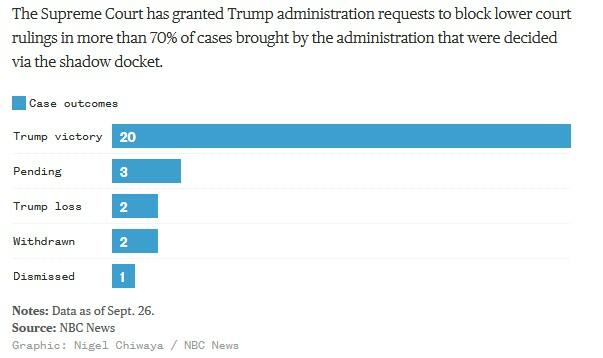
Per NBC News, the ruling marks the 20th time the justices have granted an emergency application from the administration since President Donald Trump’s second term began in January – an unprecedented volume and success rate on the so-called “shadow docket” (without full briefing or oral arguments), according to critics in the legal community, including some lower-court judges.

The stakes extend beyond separation-of-powers doctrine. The administration has moved swiftly to reorient the U.S. Agency for International Development, which traditionally disburses billions for global health, water access and disease prevention. With Republicans controlling both chambers and engaged in broader fiscal talks to avert a shutdown before Oct. 1, Congress is unlikely to muster a response to the rescission notice in the few remaining days.

What to Watch Next

  • Merits posture: The case now returns to the lower courts to litigate whether the Impoundment Control Act permits the administration’s approach – and who, if anyone, has standing to challenge it.

  • Clock pressure: If funds expire on Sept. 30 without obligation, subsequent court rulings may be overtaken by events, effectively vindicating the “pocket rescission” strategy.

  • Hill dynamics: Any congressional pushback would require swift agreement in a Capitol consumed by year-end funding negotiations.

  • Foreign-policy fallout: Aid groups warn of program interruptions abroad; the administration frames the pause as necessary to align spending with its diplomatic priorities.

The Global Health Council and allied organizations argue that the administration’s theory would flip the Impoundment Control Act “on its head,” transforming a statute designed to curb presidential impoundments into a vehicle for expanding them while insulating such decisions from judicial review. The Supreme Court’s order leaves that debate for another day—but, for now, allows the withholding to continue.

In short, reeeeeee!

*  *  *

Tyler Durden
Fri, 09/26/2025 – 18:30

Chinese Oil Import Port Targets Shadow Fleet Tankers

0
Chinese Oil Import Port Targets Shadow Fleet Tankers

By Charles Kennedy of OilPrice.com

Several terminal operators in China’s Shandong province plan to ban entry to old vessels and such with fake or suspicious certificates in a move that appeared to be aimed at the shadow fleet, Reuters reported on Friday, quoting a notice from the operators it has reviewed.

The terminal operators Qingdao Haiye Oil Terminal Co, Qingdao Shihua Crude Oil Terminal Co, Qingdao Gangxin Oil Products Co, and Qingdao Lixing Logistics Co, last week issued an official notice for the Huangdao Port.

The communication, seen by Reuters, will ban – effective November 1 – tankers operating for 31 years or more and vessels using fake International Maritime Organization (IMO) identification numbers from docking at the terminals of the Huangdao Port, which is part of the greater Qingdao port area.

Qingdao is the key entry point of Iranian oil into China, which continues to be the main customer of Iran, purchasing more than 90% of its oil exports.

The terminal operators at Huangdao Port will also ban tankers with invalid or expired certificates from international certification and regulatory bodies. Vessels with a record of accidents or pollution for the prior three years will also be denied entry, per the notice reviewed by Reuters.

The notice comes a month after the U.S. sanctioned two Chinese crude oil terminals and storage operators as the Treasury took additional actions to disrupt Iranian oil exports and the shadow fleet enabling them.

The U.S. Department of the Treasury’s Office of Foreign Assets Control (OFAC) designated a China-based crude oil terminal and storage operator in the Dongjiakou Port Area in Shandong.

Dongjiakou and Huangdao are both part of the greater Qingdao port area.

But the measures of the Huangdao port operators may not have much effect on flows, as Huangdao has a minor role in handling shadow fleet compared to other ports in the Qingdao area, Emma Li, China analyst at tanker tracker Vortexa Analytics, told Reuters.

“The new tanker risk-rating rules appear to be a precautionary step driven by environmental concerns and rising U.S. sanctions pressure, even though the latter is not explicitly mentioned in the notice,” Li told Reuters.

Iran, meanwhile, appears unfazed by the prospect of UN snapback sanctions coming into effect this weekend, saying that it will continue to sell its oil to its biggest and nearly only buyer, China.

Tyler Durden
Fri, 09/26/2025 – 18:05

Buffett Rings The Register After Making Billions On BYD

0
Buffett Rings The Register After Making Billions On BYD

Berkshire Hathaway has sold its final stake in BYD, closing the book on a 17-year partnership that propelled the Chinese automaker into the global spotlight and delivered one of Warren Buffett’s most lucrative investments, according to Nikkei Asia.

Berkshire first bought 225 million shares in September 2008 for about HK$8 apiece, just weeks after Lehman Brothers collapsed. The deal gave Berkshire a 9.9% stake, which BYD’s founder Wang Chuanfu hailed at the time as a vote of “confidence” in the company’s future. The funds went toward batteries and EV development, fueling BYD’s global rise.

Buffett himself praised the automaker to shareholders, once describing its plug-in EV as “the future” and “amazing.” BYD became a fixture in Berkshire’s annual reports and at one point ranked among its largest equity holdings, alongside Coca-Cola and American Express.

Nikkei Asia writes that the payoff was immense for the man who always claimed to “never bet against America”. Berkshire disposed of most shares at over HK$200 before a recent stock split, compared to HK$113.5 last Friday, when news of the full exit emerged. A $230 million investment turned into billions in profit.

Photo: Nikkei

Buffett credited his late partner Charlie Munger with championing the bet. “Charlie twice pounded the table with me and just said, you know, ‘buy, buy, buy.’ And BYD was one of them, and Costco was the other,” Buffett recalled at Berkshire’s 2024 meeting.

Yet Buffett has long warned of the auto sector’s volatility. “Don’t count on us foreseeing who the winners will be, and don’t count on us for predicting when something will happen,” he said in 2024. A year earlier, he cautioned that even Henry Ford “owned the world” before losing money two decades later. “They’re not going to go away, and they look like a winner at any given time, but it doesn’t get you a permanent place.”

BYD itself faces mounting challenges. It ranked seventh globally in auto sales last year, ahead of Honda but behind Ford, yet is now under pressure from rising Chinese rivals and global scrutiny of low-priced EV exports.

The exit also reflects Berkshire’s shifting focus. Buffett sold out of PetroChina in 2008 amid controversy and later doubled down on BYD, but more recently pivoted to Japan’s top trading houses. With Munger gone and Buffett preparing to hand the CEO role to Greg Abel in January, Berkshire is entering a new era.

BYD acknowledged the moment on Monday. Li Yunfei, its head of PR, thanked Buffett and Munger for 17 years of partnership. The company has reason to be grateful: since Berkshire’s investment, revenue has jumped 37-fold to 777 billion yuan ($109 billion), while net profit climbed 25 times to over 40 billion yuan.

For Buffett, the BYD chapter is closed. For BYD, the challenge is whether it can keep its momentum in a tougher global market—without the backing of the “Oracle of Omaha.”

Buffett has long preached “never bet against America,” but when it came to cars, it seems even the Oracle of Omaha knew better than to bet on himself.

Tyler Durden
Fri, 09/26/2025 – 17:40

Trump Says Others May Be Charged After Comey Indictment

0
Trump Says Others May Be Charged After Comey Indictment

Authored by Jack Phillips via The Epoch Times (emphasis ours),

President Donald Trump told reporters on Friday that other former officials may be prosecuted after former FBI Director James Comey was indicted for allegedly making a false statement during a Senate hearing.

U.S. President Donald Trump speaks at the White House in Washington on Sept. 25, 2025. Kevin Lamarque/Reuters

The Department of Justice (DOJ) filed criminal charges against Comey on Thursday, alleging that he made false statements and obstructed a congressional investigation.

“It’s not a list, but I think there will be others,” Trump told reporters as he was leaving the White House to partake in the Ryder Cup in New York.

He added that these people “were corrupt” and are members of the “radical left.”

“They weaponized the Justice Department like nobody in history,” he said. “What they’ve done is terrible. I hope, frankly, there are others because you can’t let this happen to a country.”

Trump has frequently criticized Comey’s handling of the FBI investigation into whether Russia interfered in the 2016 presidential election. In 2017, he fired Comey as FBI director.

Since Trump returned to office in January, the DOJ has been examining Comey’s 2020 testimony, when the former FBI director denied that he had authorized disclosures of sensitive information to the news media.

“It’s a pretty easy case, because, look, he lied. … That was a very important question that he was asked, and he wanted to be specific, but … he didn’t think he’d get caught. That was a very important answer … it was a very good answer if he didn’t get caught, but he got caught lying to Congress,” Trump told reporters on Friday, referring to the charges against Comey.

The indictment alleges that Comey misled Congress by claiming he had not authorized anyone else to be an anonymous source in news reports about an FBI investigation.

Trump told reporters that the charges are “about justice really” and that “it’s not revenge.”

Comey, in a video posted on Instagram, said: “My heart is broken for the Department of Justice, but I have great confidence in the federal judicial system, and I’m innocent. So let’s have a trial and keep the faith.”

Responding to criticism about the DOJ and FBI, FBI Director Kash Patel said on Friday morning that the Comey indictment was the result of “career FBI agents, intel analysts, and staff” who “called the balls and strikes” in the case.

Comey came under fire earlier this year when he uploaded a photo of shells that were arranged on the beach to read, “86 47.” There were public concerns that “47” was referring to Trump, who became the 47th president in his second term, while “86” is slang for “get rid of.”

*  *  *

Tyler Durden
Fri, 09/26/2025 – 17:15

Zelensky Asks Trump For Tomahawk Missiles Capable Of Hitting Moscow

0
Zelensky Asks Trump For Tomahawk Missiles Capable Of Hitting Moscow

Ukrainian President Volodymyr Zelensky has revealed in an interview with Axios that he asked President Trump on Tuesday to provide Ukraine with Tomahawk missiles, which would allow Ukrainian forces to strike deep into Russia, even as far away as Moscow.

Zelensky made the dubious argument that this would force President Putin to the negotiating table to make significant compromise and end the war. Zelensky suggested that the Ukrainians might not even have to use the Tomahawks it was given, only that the threat alone could be enough to scare Putin.

The Ukrainian leader was responding to a question on “The Axios Show” on his view of the one thing Trump could do to allow Kiev to win the war. Zelensky responded: “I think President Trump knows.” He then said he conveyed “what we need” is “one thing.”

American Tomahawk missile, AP

“By the way, we need it, but it doesn’t mean that we will use it. Because if we will have it, I think it’s additional pressure on Putin to sit and speak,” he continued, alluding to a long-range, precision-guided US missile.

Axios on Friday followed by publishing the following commentary:

Zelensky did not name that weapons system during his interview with Axios’ Barak Ravid, but he said that if Russia knew Ukraine had it, the pressure to talk would greatly increase.

A Ukrainian official and another source familiar with the Trump-Zelensky meeting confirmed it was the Tomahawk — a long-range, precision-guided missile.

If it happens, the Tomahawk would become by far the longest missile in the Ukraine’s arsenal. It can travel over 1,000 miles, compared to the nearly 200 miles of US-made ATACMS, the latter which has already been provided.

The Telegraph reviews:

Joe Biden, the former US president, rebuffed a similar request, which came as part of a 10-point “Victory Plan” presented by Mr Zelensky at the end of Mr Biden’s tenure in the White House.

The provision of the long-range missile was deemed too risky because it would be able to strike targets in Moscow and would be likely to be able to evade Russia’s most advanced air-defense systems, potentially escalating the conflict.

But in a sign of growing confidence for a more positive decision, Mr Zelensky told the Axios news agency that, during their meeting earlier this week, Mr Trump had said “we will work on it”.

Zelensky had also told Axios that Russian officials “have to know where their bomb shelters are,” adding: “If they will not stop the war, they will need it in any case.”

The Wall Street Journal is reporting in follow-up that Trump is ‘open’ to the idea, but it’s anything but clear whether this is an accurate assessment of how Trump views it:

President Trump told Ukrainian President Volodymyr Zelensky he was open to lifting restrictions on Ukraine’s use of American-made long-range weapons to strike inside Russia, but he didn’t commit to doing so during a meeting Tuesday, according to a senior U.S. official and a Ukrainian official.

During the sideline discussion at the United Nations, Zelensky asked Trump for more long-range missiles and approval to use such weapons to strike targets on sovereign Russian territory. Trump replied that he didn’t oppose the idea, though both officials said the president didn’t make any commitments to reverse a U.S. ban on such attacks.

It seems he’s already previewing what he intends to do with long-range missiles if he receives them: attack Moscow and government buildings. This would likely be the very thing that sparks WW3, and Trump would be wise to stay far away from sending Tomahawks or any other long-range system.

Tyler Durden
Fri, 09/26/2025 – 16:50

Sex Dungeon? Former Soros Fund Manager Arrested On Allegations Of ‘Sadistic Abuse’

0
Sex Dungeon? Former Soros Fund Manager Arrested On Allegations Of ‘Sadistic Abuse’

A former New York financier who managed money for George Soros has been arrested on charges spanning bank fraud to sex trafficking.

Howard Rubin, 70, was taken into custody Friday morning at his home in Fairfield, Connecticut. According to a 10-count indictment unsealed in a Brooklyn federal court, Rubin is accused of sex-trafficking at least 10 women between 2009 and 2019 – luring them to various NYC hotels and a Manhattan penthouse with a soundproofed BDSM sex dungeon – where he restrained, beat, and shocked them with electricity, according to the US Attorney’s Office in Brooklyn. 

Rubin reportedly spent at least $1 million on said activities. He has also been charged with bank fraud related to false statements on financial documents during a civil lawsuit stemming from these activities.

“As alleged, the defendants used Rubin’s wealth to mislead and recruit women to engage in commercial sex acts, where Rubin then tortured women beyond their consent, causing lasting physical and/or psychological pain, in some cases physical injuries,” Brooklyn US Attorney Joseph Nocella said in a statement.

One of the West 57th Street penthouse bedrooms was soundproofed and painted red, and had a device that was used to shock or electrocute the women, the feds said. The room also had a cross and bed with restraints where the women would be bound and gagged, according to the authorities. -NY Post

Allegations against Rubin are not new, as he’s been on the radar since at least 2017. Among the alleged acts he paid $2,000 – $5,000 per session (via the NY Post);

  • Rubin gagged, tied up and viciously abused the women – even punching one in the head, according to a 2017 lawsuit filed on behalf of two Playboy Playmates and another alleged victim. 

“I’m going to rape you like I rape my daughter,” he reportedly shouted during one of the alleged assaults. 

  • In one session, he beat one of the women’s “breasts so badly that her right implant flipped.”
  • One plaintiff was tied up, gagged and shocked with a cattle prod in her groin before Rubin allegedly raped her

Some of the women agreed to a safe word – that Rubin allegedly ignored. Others were gagged so they couldn’t object, and prosecutors say he would even continue if a woman passed out. 

  • “I don’t care if she screams,” Rubin wrote one of two women who he said he planed to “abuse” for hours, the feds allege. 

Rubin also reportedly referenced Disney movies (like Jes Staley with Epstein), telling another alleged victim that rape was natural – referencing “Beauty and the Beast” (though in the movie Belle was clearly ready to have sex with Beast before he turned back into a human).

From 2009–2019; Rubin initially used luxury Manhattan hotels, then a leased the ‘sex dungeon’ penthouse. There were also encounters in Las Vegas. 

Personal Assistant

According to the indictment, Rubin’s personal assistant – Jennifer Powers, is also facing sex-trafficking charges tied to her boss’s proclivities. Powers Assisted Rubin from 2011–2019. Her role allegedly included recruiting women (often former Playboy models via social media or prostitution networks), arranging flights and accommodations (e.g., to New York airports in Queens), securing NDAs, procuring BDSM equipment, managing payments (sometimes structured to avoid $10,000 thresholds), and handling complaints/injuries (e.g., advising ice or bruise cream, minimizing Rubin’s behavior). Rubin funded her lifestyle – some $8 million from 2018–2023 – including rent, schooling, legal fees, and a Texas home mortgage he co-signed.

In one text exchange, Rubin allegedly texted Powers that he had a woman tied to his cross, to which Powers replied “I can only imagine what you did to her on that cross!!! Did you shock her p—y??”

Rubin reportedly replied that he did, but complained that his electrocution device was “losing strength.”

Bank Fraud

On June 3, 2020, Rubin emailed a signed financial statement to co-sign Powers’ mortgage, answering “No” to “Are you a party to any suit or unsatisfied judgments?” despite the ongoing Civil Case brought by the Playmates. 

Then on April 4, 2022, Powers emailed a renewed statement signed by Rubin which also did not disclose the lawsuit. 

Here’s lookin’ at you Howard, you (allegedly) sick fuck. 

*  *  *

ATTENTION: Buy some meat before free shipping goes away Sunday night… Several items already sold out.

Just the Steaks (10 lbs)

Filet Mignon and other goodies (11 lbs)

Ground Beef (on sale in addition to free shipping)

Texas Lasagna & Meatballs (comfort food, holy shit it’s good)

Beef, Chick & Pork Trio

Tyler Durden
Fri, 09/26/2025 – 15:40

Electronic Arts Soars Most In Years On Reported $50 Billion Take-Private Deal 

0
Electronic Arts Soars Most In Years On Reported $50 Billion Take-Private Deal 

Shares of Electronic Arts (EA) surged late in the US cash session after a Wall Street Journal report revealed that EA is finalizing a deal to go private, potentially marking the largest leveraged buyout (LBO) ever, not adjusting for inflation.  

The LBO is being led by a consortium of private-equity giants, such as Silver Lake, and Saudi Arabia’s Public Investment Fund is expected to announce the transaction as soon as next week. 

EA (known for FIFA/FC, Madden NFL, The Sims, and other top gaming franchises) shares jumped 15.5%, hitting record highs. Please note that EA has not yet confirmed the details of the story.

If gains are held through the end of the cash session, today’s 15.5% would be the highest since February 08, 2019.

EA’s market capitalization pre-WSJ report was around $42.8 billion. The deal could value EA at around $50 billion. 

WSJ provided some context about the potential LBO transaction: 

Assuming a deal comes together, it is likely to rank as the largest leveraged buyout ever, not adjusting for inflation. The largest to date was the 2007 purchase of Texas utility TXU by a group of private-equity firms for around $32 billion, which doesn’t include assumed debt, according to Dealogic.

Massive leveraged buyouts all but disappeared after a number of them performed poorly in the wake of the 2008-09 financial crisis. A group of private-equity firms made a big splash in 2021 when they agreed to buy medical-supply company Medline Industries for more than $30 billion.

Two decades of “EA SPORTS – It’s in the game.” 

. . . 

Tyler Durden
Fri, 09/26/2025 – 15:13

Electric Bills: The Pivotal Issue In Pennsylvania’s Midterms

0
Electric Bills: The Pivotal Issue In Pennsylvania’s Midterms

Authroed by Athan Koutsiouroumbas via RealClearPennsylvania,

Electric bills may be the pivotal issue of Pennsylvania’s 2026 Midterm.

Don’t believe me? 

Just look eastward in New Jersey.

A near majority of digital ads are focused on defining who is to blame for New Jersey’s escalating electric prices in a heated, competitive race for governor. Just as many likely run on television.

The Democratic gubernatorial candidate, incumbent U.S. Rep. Mikie Sherrill, is blamed for backing the status quo, resulting in skyrocketing electric bill rate hikes.

Projecting toughness as an executive, Sherrill points the finger at utility companies and campaigns on declaring an electric bill emergency.

As the New Jersey blame game continues through the fall, it is unlikely that anybody will point out that the Garden State gets much of its energy from Pennsylvania in the first place. 

Through the miracle of fracking, Pennsylvania has transformed itself into an energy juggernaut.  Without Pennsylvania’s ability to make more energy than it currently consumes, states like New Jersey would likely face rolling brownouts on the coldest and hottest days of the year.

However, Pennsylvania’s ability to export electricity is about to change. 

Quietly this month, the Pennsylvania Public Utility Commission released a report validating what a handful of insiders already know: Pennsylvania’s energy demand is expected to double in the next three years. 

It does not take an economics degree to understand that doubling demand while keeping supply unchanged is a recipe for disaster. Meanwhile, there is no planned construction for any new baseload electric generation in Pennsylvania. 

As a gas-fired power plant can take up to five years to build while nuclear power plants can take nearly a decade to construct, Pennsylvania, New Jersey, and the rest of the Mid-Atlantic states are poised to be in a world of pain.

Pennsylvania’s Gov. Shapiro may have reached his breaking point, announcing at a meeting of the Mid-Atlantic’s grid operator that if a plan does not materialize fast to bring new generation online, he intends to remove Pennsylvania from the regional grid.

It is the utility equivalent of “going nuclear.”

Within a matter of hours, Pennsylvania’s powerful executive mainstreamed what was once considered a fringe policy.  Seceding the Keystone State from the regional power grid of the Northeastern United States would be like the United States withdrawing from NATO. 

With 86% of likely voters concerned about their electric bill, Gov. Shapiro is wise to get ahead of the issue. Finger pointing can only get incumbents so far before even greater rate hikes take effect next year. If Pennsylvania wants to avoid crisis, policymakers must move beyond blame and act.

Fortunately, there is some low-hanging fruit. The process Pennsylvania uses to gauge pending energy demand is severely broken. In a little-noticed hearing in the Pennsylvania state legislature, a stunning admission came to light: Pennsylvania’s electric utilities may be double – and even triple – counting the number of data centers and other large energy projects projected to come online in the Commonwealth.

The rise of data centers deploying artificial intelligence is what has driven newfound energy demand not only in Pennsylvania, but nationwide.

Data centers and hyperscalers appear to be venue shopping for the most electricity and the fastest interconnection to the grid. These potentially inflated figures, fed to the regional grid operator responsible for managing the electricity supply for Americans in more than 13 states, have contributed to sharply revised projections for energy demand.

The byproduct is voters are already paying the price for higher energy demand that may not exist. 

The Pennsylvania Legislature should compel action.

First, it should mandate a full audit of pending data center projections submitted by electric utilities.

Second, it should direct the Pennsylvania Public Utility Commission to revise how future demand is counted and reported to ensure that only substantiated projects are used in demand forecasting.

And third, it should insist on transparency from the regional grid operator about how those projections influence price-setting and capital deployment.

As far as actions the grid operator can take, it should take every step to approve all viable projects currently in the queue to get interconnected to the grid. Many of these projects have languished for years, for no clear reason.

With focus and resolve, these issues can be resolved by the end of the calendar year. 

These reforms will paint a clearer picture of exactly what policymakers need to tackle in spring 2026 ahead of the midterms. 

Failure to do so may result in candidates learning that their re-election was contingent on the electric bill, stupid. 

Tyler Durden
Fri, 09/26/2025 – 15:00