Washington Forcing Speeding Offenders To Install GPS Speed Limiters
Our nation’s complete loss of freedom is, for sure, progressing on or ahead of schedule. The latest example? Washington is now forcing repeat speed offenders to install GPS-based speed limiters, joining a growing national trend that curbs how fast drivers can go, according to Ecoportal.
Under the new law, anyone caught driving 20 mph over the limit on highways — or 10 mph over on smaller roads — must use the limiter if they want their license back.
The device works like the breath-test locks used for DUIs, but instead of measuring alcohol, it tracks speed through GPS and electronically caps the car’s top speed. Offenders must keep it installed for at least 120 days, or 150 if convicted of reckless driving. Drivers get only three temporary bypasses a month before the limiter locks them down completely. Refusing to comply means more penalties and longer suspensions.
Ecoportal writes that lawmakers pushed the measure after 2023 became the deadliest year on Washington’s roads in more than three decades, with speeding behind a third of all traffic deaths. The bill is named after four victims killed near Renton by a repeat offender who had already been in two crashes earlier that year.
Advocates say the technology will save lives, pointing out that Europe already requires limiters in all new cars. But critics see it as a dangerous precedent: the state taking control of how fast your car can move.
Once activated, the limiter doesn’t allow flexibility — emergencies, wide-open highways, or personal judgment no longer matter.
Other states are watching closely. Virginia and D.C. already use similar devices for repeat offenders, and Pennsylvania is considering its own. California’s governor vetoed a bill, warning against government overreach.
Still, with momentum growing, the “freedom of the road” could soon mean driving under electronic supervision — a future where speed is no longer a choice.
War Secretary Pete Hegseth has terminated a 74-year-old military advisory committee for women as it harms America’s combat capabilities, Pentagon press secretary Kingsley Wilson said in a Sept. 23 post on X.
“Secretary Hegseth has decided to terminate the Defense Advisory Committee on Women in the Services,” Wilson said.
“The Committee is focused on advancing a divisive feminist agenda that hurts combat readiness, while Secretary Hegseth has focused on advancing uniform, sex-neutral standards across the Department.”
The Defense Advisory Committee on Women in the Services (DACOWITS) was established in 1951 to advise on strategies for boosting female recruitment into the U.S. military during the Korean War, according to the committee website.
The committee states that since its inception, it “has submitted over 1,100 recommendations to the Secretary of War for consideration. As of 2025, approximately 94 percent have been either fully or partially adopted.”
According to a December 2020 report published by DACOWITS, the committee has put forward several recommendations over the past decades, including “integrating women into previously closed positions or units,” boosting the number or percentage of women in underrepresented fields, and other gender equality measures.
The committee has also made recommendations on the portrayal of female service members in media, such as in television, print, radio, and video.
In its 2023 annual report, DACOWITS raised concerns about the Supreme Court striking down the Roe v. Wade ruling in 2022, questioning the department on matters regarding abortion and contraception.
The termination of DACOWITS has attracted criticism.
“Absolutely disgusting. DACOWITS was formed in 1951 to support the increase and success of women in the Armed Forces. We cannot field a fighting force without women. Period. These children are destroying our military with their stupid sexist games,” Fred Wellman, who runs the “On Democracy with FPWellman” podcast, said in a Sept. 24 X post.
Hegseth shared a post from the DOW Rapid Response account on X, dismissing claims that the termination of DACOWITS amounted to him eliminating a pathway that encouraged women to join the military.
“FACT CHECK: Wrong. We axed the committee that is focused on advancing a divisive feminist agenda that hurts combat readiness. We are cleansing the Department of wokeness,” the post stated.
Revamping the US Military
In April, Hegseth announced action against the Women, Peace & Security (WPS) program inside the Department of Defense, according to an April 29 X post.
WPS is a United Nations resolution that called on nations to address the impacts conflicts have on women and girls, according to a U.N. Development Programme handbook. It also asked to systematically include females in peacebuilding efforts.
“WPS is yet another woke divisive/social justice/Biden initiative that overburdens our commanders and troops—distracting from our core task: WAR-FIGHTING,” Hegseth wrote.
“WPS is a UNITED NATIONS program pushed by feminists and left-wing activists. Politicians fawn over it; troops HATE it.”
The department will execute “the minimum of WPS required by statute, and fight to end the program for our next budget. GOOD RIDDANCE WPS!” he added.
Under the Trump administration, there has been a growing focus on revamping the military.
The department is focusing on three key initiatives—reestablishing deterrence, rebuilding the military, and restoring warrior ethos, Hegseth said in a July 20 post on X.
This includes reevaluating diversity, equity, and inclusion (DEI) practices.
“The results so far? Distractions like DEI, [critical race theory], social justice, politically correct stuff—gone,” Hegseth said. “Focus on standards that are high, gender neutral, equal, and unwavering. We’ve got unprecedented recruitment numbers.”
He also said his department was looking to restructure current promotion systems to ensure that those who engage in military and combat operations get top posts.
Another military rule change was announced by the U.S. Army in a Sept. 10 statement, which exempted all soldiers from body fat standards as long as they score at least 465 points on the new Army Fitness Test.
“This is a welcome continuation of our previous policy under the former Army Combat Fitness Test,” Sgt. Maj. Christopher Stevens said. “It rewards Soldiers who consistently demonstrate high levels of fitness, which supports readiness, health, and creates a culture that values performance.”
India, China, Europe, & The US Are On Very Different Population Paths
This chart, via Voronoiapp.com, tracks the UN’s latest demographic projections for four large populations: India, China, Europe, and the United States.
Together, they account for about half of today’s world population.
The curves are shaped by what the UN expects to happen to future fertility, life expectancy, and migration worldwide.
India and China are the world’s most populous countries today, and the UN projects that both will remain at the top through the end of the century.
Yet their trajectories diverge sharply in these projections.
China’s population has already begun to fall and is projected to more than halve to around 630 million by 2100. India, by contrast, is expected to keep growing for nearly four more decades, reaching about 1.7 billion people in 2060 and gradually declining to around 1.5 billion.
In contrast, the United States and Europe are projected to change more gradually. The US is expected to grow slowly and steadily, reaching about 420 million people by the end of the century. Europe’s population, meanwhile, is projected to decline. Based on these figures, its population peaked around 750 million in 2020, and is expected to fall to about 590 million by 2100, not far from China’s projected level.
The UN’s model is the most widely used baseline for international population comparisons, but all population projections are sensitive to the underlying assumptions. Other research groups use different demographic assumptions about fertility, life expectancy, and migration to reach different long-term population figures.
Trump To Sign EO Targeting ‘Domestic Terror Networks’ After “Despicable” Attack At Dallas ICE Facility
Latest developments:
Sniper attack by leftist Joshua Jahn, 29 (confirmed by Daily Mail), killed two detainees at an ICE facility in Dallas and critically injured another.
Jahn then killed himself with his rifle.
The FBI described the incident as “an act of targeted violence.”
The shooter opened fire from an elevated position.
Investigators found an unspent round with “Anti-ICE” political messaging.
Jahn’s alleged socials show ties to far-left causes.
* * *
Update (1640ET): President trump has been briefed on the shooting at the Dallas ICE facility and is readying an EO to expand targeting of Domestic Terror Networks:
I have been briefed on the deadly shooting at the ICE Field Office in Dallas, Texas. It has now been revealed the deranged shooter wrote “Anti-ICE” on his shell casings. This is despicable!
The Brave Men and Women of ICE are just trying to do their jobs, and remove the “WORST of the WORST” Criminals out of our Country, but they are facing an unprecedented increase in threats, violence, and attacks by Deranged Radical Leftists. This violence is the result of the Radical Left Democrats constantly demonizing Law Enforcement, calling for ICE to be demolished, and comparing ICE Officers to “Nazis.”
The continuing violence from Radical Left Terrorists, in the aftermath of Charlie Kirk’s assassination, must be stopped. ICE Officers, and other Brave Members of Law Enforcement, are under grave threat.
We have already declared ANTIFA a Terrorist Organization, and I will be signing an Executive Order this week to dismantle these Domestic Terrorism Networks.
I AM CALLING ON ALL DEMOCRATS TO STOP THIS RHETORIC AGAINST ICE AND AMERICA’S LAW ENFORCEMENT, RIGHT NOW!
The Trump Administration is fully committed to backing Law Enforcement, Strong Borders, securing our Homeland, deporting Violent Illegal Criminals, and fully rooting out the Left Wing Domestic Terrorism that is terrorizing our Country.
Thank you for your attention to this matter!
* * *
Update (1343ET):
Civil terrorism expert Jason Curtis Anderson explains the broader, alarming trend of left-wing radicals becoming activated, which reflects a form of nihilistic accelerationism.
The trend here is alarming. Anderson explains:
Earlier today, Joshua Jahn, the shooter at the Dallas ICE facility, shot three people before taking his own life.
This incident reflects what many call nihilistic accelerationism—a rising phenomenon in domestic extremism that mirrors the martyrdom embraced by jihadist terrorists. These are individuals who feel so driven by their extremist beliefs that they are willing both to kill and to die for their cause.
Many conversations must take place, and much work remains to be done, but none of it can begin until Democrats acknowledge that far-left extremism exists, and recognize the importance of toning down political rhetoric.
This is not the first time left-wing extremists have attempted to assassinate ICE officers, a recurring theme the left has used to rally voters against the current administration.
The federal government has significant catching up to do, and an interagency approach will be necessary to address the problem.
Far-left extremism extends far beyond groups like Antifa. There is an entire revolutionary (marxist) ecosystem of interconnected entities: billion-dollar progressive NGOs, anarchist networks, political organizations such as the DSA, foreign influence operations like the Singham network, gaming platforms, Discord servers and reddit threads, the dark web, and even civil-rights organizations staffed with “movement lawyers” fully dedicated to waging war against the West until it collapses.
Until the government addresses the root causes, it will only be treating the symptoms. Experts must be brought in to dismantle this machine before it’s too late.
As soon as we have more government leaders with the same pro-Luigi worldview as the DSA, Hasan Piker, and Taylor Lorenz, political assassination will become normalized in the same way that we decriminalized crime in major cities.
🚨 Earlier today, Joshua Jahn, the shooter at the Dallas ICE facility, shot three people before taking his own life.
This incident reflects what many call nihilistic accelerationism—a rising phenomenon in domestic extremism that mirrors the martyrdom embraced by jihadist… https://t.co/afmAGPPaB1
A sniper attack at a Dallas ICE facility left at least one migrant dead and several others wounded early Wednesday morning.
According to the Daily Mail, the gunman, identified as 29-year-old Joshua Jahn, opened fire around 0700 local time into the ICE building. ICE confirmed in a statement that Jahn “fired indiscriminately,” and multiple law enforcement sources verified his identity.
FBI Director Kash Patel stated earlier, “While the investigation is ongoing, an initial review of the evidence shows an idealogical motive behind this attack (see photo below). One of the unspent shell casings recovered was engraved with the phrase “ANTI ICE.”
While not confirmed, X users have been digging through public records to profile Jahn. Here’s what they’ve found so far:
NEW:
I did a background check on Joshua Jahn, the ICE shooter in Dallas, Texas.
Joshua Jahn’s profile picture from his now-wiped Facebook page per the background check results reveals ANTIFA and communist imagery. The profile photo is of an armed communist with the hammer and… pic.twitter.com/ziLiSmFU5J
Confirmed. I exclusively reported that Joshua Jahn, who shot up an ICE facility in Dallas, Texas today is a radical leftist with communist imagery in his since deleted Facebook page.
FBI Special Agent in Charge Joe Rothrock told reporters that the ICE facility shooting in Dallas was a “targeted attack,” and agents at the scene recovered rounds marked with “anti-ICE messages.”
Rothrock reminded reporters, “This is the most recent example of targeted violence.” He referred them to the July 4th attack on ICE in the state.
🚨BREAKING: The FBI confirms it is investigating the fatal shooting at a Dallas ICE facility as an act of targeted violence.
The FBI also confirms that bullet rounds found near the suspected shooter contained messages that are “anti-ICE in nature.” pic.twitter.com/0i8uVZNNVF
This morning just before 7am local time, an individual fired multiple rounds at a Dallas, Texas ICE facility, killing one, wounding several others, before taking his own life. FBI, DHS, ATF are on the ground with Dallas PD and state authorities.
While the investigation is ongoing, an initial review of the evidence shows an idealogical motive behind this attack (see photo below). One of the unspent shell casings recovered was engraved with the phrase “ANTI ICE.” More updates will be forthcoming.
These despicable, politically motivated attacks against law enforcement are not a one-off. We are only miles from Prarieland Texas where just two months ago an individual ambushed a separate ICE facility targeting their officers. It has to end and the FBI and our partners will lead the these investigative efforts to see to it that those who target our law enforcement are pursued and brought to the fullest extent of justice. Thankfully, no law enforcement personnel were injured. Please pray for the injured and deceased.
This morning just before 7am local time, an individual fired multiple rounds at a Dallas, Texas ICE facility, killing one, wounding several others, before taking his own life. FBI, DHS, ATF are on the ground with Dallas PD and state authorities.
The White House has also declared war on radical leftist NGO groups that subvert the nation and push for a Marxist takeover.
Meanwhile, Democrats, dark-money funded NGOs, and corporate media have spewed dangerous rhetoric against President Trump and his MAGA base – more than half the country, such as “fascists” and “nazis” while at least one armed radical leftist group with 10,000 members is “planning war against fascists.”
* * *
Update (1013ET):
A shooting at an ICE facility in Dallas left two detainees dead and one critically wounded earlier, according to NBC News, citing an ICE spokesperson. No ICE agents were harmed in the sniper attack, though the suspected gunman died by a self-inflicted gunshot wound.
There was a shooting this morning at the Dallas @ICEgov Field Office. Details are still emerging but we can confirm there were multiple injuries and fatalities.
The shooter is deceased by a self-inflicted gunshot wound.
While we don’t know motive yet, we know that our ICE law enforcement is facing unprecedented violence against them. It must stop.
There was a shooting this morning at the Dallas @ICEgov Field Office. Details are still emerging but we can confirm there were multiple injuries and fatalities.
The shooter is deceased by a self-inflicted gun shot wound.
While we don’t know motive yet, we know that our ICE…
Around 0700 local time, the suspected shooter opened fire on a Dallas ICE facility from an adjacent building, in what some local media outlets described as a “sniper” attack.
The Dallas ICE facility appears to have an apartment building directly adjacent with clear views down to the rear of the building.
This cannot be safe for ICE agents given the current wave of political violence against them. pic.twitter.com/owkSyRTnjg
Police said the investigation is ongoing and a media briefing will occur later today. The motive remains unclear.
Vice President JD Vance wrote on X, “The obsessive attack on law enforcement, particularly ICE, must stop. I’m praying for everyone hurt in this attack and for their families.”
Journalist Andy Ngo noted, “This is the second shooting attack on an ICE facility in Texas. The other one, an ambush attack in July, was allegedly committed by a North Texas Antifa cell.”
* * *
Local media in Texas reports three people were critically wounded at an Immigration and Customs Enforcement facility in the Dallas metro area early Wednesday.
Sources tell WFAA that a “possible sniper or multiple shooters” on a nearby roof targeted three people who were wounded at the ICE facility on 8101 North Stemmons Freeway in Dallas, just off Interstate 35E.
Sources confirmed to the local outlet that the “shooter was found dead on the roof of a nearby immigration attorney’s office.”
“Three people were injured at a Dallas ICE facility on Wednesday morning and police are searching for a possible sniper or multiple shooters, police sources tell WFAA,” the outlet wrote on X.
Three people were injured at a Dallas ICE facility on Wednesday morning and police are searching for a possible sniper or multiple shooters, police sources tell WFAA.
Shooter: One gunman was found dead on the roof of a nearby immigration attorney’s office. Authorities are still investigating whether others may have been involved.
Location: The incident happened around 7 a.m. at the ICE office at 8101 North Stemmons Freeway, near I-35E.
Response: Police and emergency crews remain at the scene, with Texas Department of Transportation cameras showing dozens of vehicles lining the access road.
Fox News confirms shots were fired into the ICE facility, more specifically into an office area where detainees are brought in.
🚨 JUST IN: Acting ICE Director Todd Lyons says shots were fired INTO the ICE office in Texas, where detainees are brought in.
All ICE employees are ACCOUNTED FOR. There are confirmed fatalities. Victims appear to be detainees. pic.twitter.com/hSKR5cpZaW
This shooting comes shortly after the Trump administration designated the leftist group Antifa as a domestic terrorist organization and declared war on leftist NGOs sowing chaos.
Democrats and their allied leftist groups have fueled toxic and harmful rhetoric against federal agents, whether it’s ICE or Border Patrol, as well as everyday Americans, calling anyone they disagree with “Nazis” or “Fascists,” which only normalizes assassination culture.
The wave of violence – and even terrorism – emanating from the Democratic Party is a serious threat that must be addressed.
Given multiple ICE attacks by radical leftists in the state and elsewhere this year, the question now is whether Antifa or an affiliated group carried out this latest attack. No updates on the shooter have been released so far, other than confirmation of a self-inflicted gunshot wound.
Pattern of violence …
Now, possibly this?
This is very interesting. A major Muslim Brotherhood official was just detained by ICE in Dallas, Texas yesterday.
Hours later, 3 people have just been shot at an ICE facility in Dallas, Texas.
On The One Year Anniversary Of China’s Stealthy But Stunning Stock Market Rally
One year ago to the day, China’s top financial regulators and central bankers appeared together in an unprecedented press conference to unleash a raft of stimulus measures aimed at stabilizing the financial markets and support the country’s economic recovery.
The decision prompted billionaire hedge fund icon David Tepper to appear on CNBC and declare that he is buying “everything” in China: ‘ETFs…futures…everything.’ In retrospect, he was right again.
The market jolted higher on the following days, and over the following 12 months the move materialized into one of the strongest rallies amongst global assets. The past month, in particular has seen an epic meltup, just as we told our premium subscribers on August 25.
During this time, China A-shares total market cap surpassed 100TN yuan for the first time (+45% from 70TN yuan). SHCOMP surged from 2700 to 3900 level, while tech-focused benchmarks fared even better: STAR50 +115% and ChiNEXT +110%. During the same time, S&P returned a modest +16% and the Nasdaq rose +24%.
Meanwhile, in China over 3000 stocks in A-shares had gains of more than 50% in the past year, and nearly 1500 stocks more than doubled. Tech shares clearly took the lead here, with telco, electronics, computing names notching the highest gains by sector.
And, as Goldman executive director and trader, Fred Yin writes this morning, China’s momentum clearly has legs – just today, despite the strongest storm on earth so far this year ravaging Hong Kong throughout the day, the equity market remained open and posted solid gains. HSTECH +2.6% surged with internet shares posting solid gains as AI optimism continues to drive sentiment. Furthermore, Goldman’s HK Top Short basket +0.3% only on the day, suggesting short covering had little to do with the move.
Below we share some more observations from the Goldman trader:
Alibaba stock gained nearly 10%, the largest single day return since the +18.5% gain post earnings earlier in Sep which brings MTD gains for this mega-cap name to an incredible +50%. The HK line is now trading at 4-year highs.
On news front, a few things contributed to the move today:
Side note: Alibaba has been getting support from Southbound flows too, the stock was net bought for 23 days in a row with US$8b+ of inflows on this stretch. The name is now 2nd largest holding by Southbound with nearly $42b worth of holding, behind only Tencent’s US$83.5b.
The good news doesn’t just stop there – elsewhere in China Internet space, Meituan +1.2% and JD +3.3% also climbed as the “anti-involution” drive finally comes to food delivery space after months-long price war: the SAMR released draft rules to regulate food delivery platforms with a focus on fees, promotions, and safety. The anti-monopoly watchdog calls for “fair competition” and seeks to halt “price wars”. Tencent +2% was not left behind either, stock climbing along with other gaming names as its title “Delta Force” has become one of the most downloaded apps on the Apple App Store.
Thematically, Goldman’s China Semis basket 4.6% higher after Microngave positive outlook in its Q4 earnings and Huawei unveiled a 3-year plan to overtake Nvidia. Solar, Solid State Battery, Anti Involution also stood out with strong gains.
Where does this leave us, big picture? We still think the rally is only just beginning. In fact Kinger believes the setup for a “slow bull’ market seems better constructed now than ever before in A-shares.
Activity level in A-shares has been elevated since early August and remains high. This is the longest such stretch on record.
Source: BBG as of 24Sep25, past performance not indicative of future results
Retail sentiment is not stretched yet…
…with more dry powder. Chinese households hold just 11% of assets in equities versus 55% in property and 27% in cash/deposits, leaving substantial “cash on the sidelines,” including about 55TN yuan of excess savings from the roughly 80TN yuan deposit buildup since 2020, much of which is maturing and thus re-deployable.
Additional potential equity inflows could come from 31TN yuan in WMP and 15TN yuan in MM funds (with flows sensitive to real-rate declines) plus more than 14TN yuan of annual “new money” seeking deployment amid a weaker property market.
…while both domestic and foreign institutions still only represent a tiny part of overall market…
…with as much as 20-40t yuan of potential institutional buying over time
For example – last week’s inflow into China-dedicated equity funds was US$5.4b, the largest weekly inflow since Apr of this year
If you’ve made it far – what does the desk like here in terms of upside exposure? Funding levels (outperformance) has been slowing creeping higher again after dipping briefly late-summer so we still like taking advantage of the cheap forward.
However, with implied vol spiking higher and remains persistently elevated and skew inverted, we prefer structures that would cheapen the outright premium spent such as call spreads or up-and-out structures. For example, CSI1000 1y 95% Call w 130% E KO costs less than intrinsic value of the ITM call.
Alternatively, consider taking advantage of NKY/SPX correl in the mix, worst-of [GSC1000P 96%C / SPX 96.5%C / NKY 96.5%C] into Dec 2026 has no carry cost with premium equal to intrinsic value. Please reach out to the desk for more details.
Good luck – and to those of you in Hong Kong, stay safe and dry.
Court Records Reveal FBI Did Seize Classified Docs At John Bolton’s Office
Back on August 22, federal agents raided former national security adviser John Bolton’s office and his home in Bethesda, Maryland, as part of an investigation related to allegations that he unlawfully disclosed classified information in his 2020 memoir, The Room Where It Happened – or else has mishandled classified information by keeping it.
Newly unsealed court records revealed by Politico this week show that FBI agents did seize classified documents during the search of his downtown office. These recovered materials were described as “secret” or “confidential” or “classified”.
US District Court for the District of Columbia documents further included information referencing weapons of mass destruction, as well as sensitive information on the US government’s strategic communications.
Federals investigators are mulling possibly bringing federal criminal charges against Bolton, and the unsealed documents given insight into evidence on which they might build their case.
According to an inventory list complied by FBI agents, property removed from Bolton’s Washington, DC, office on August 22 included the following:
“Travel memo documents with pages labeled secret”
“US Mission to the United Nations – Confidential Documents”
“U.S. Government Strategic Communications Plan – Confidential Documents”
“Confidential Documents with (redacted) heading Weapons of Mass Destruction Classified Documents”
Confidential and Secret are both what can be described as lower levels of classification for national security information which tends to get distributed widely, but requires security clearances for the people viewing or handling it, and is kept in government offices and files, or maintained via secure and approved channels.
Secret is a middle tier of classification, and mishandling such information would be viewed as more serious compared to records marked ‘Confidential’ – which is the lowest tier, often including routine diplomatic information.
Bolton’s lawyer, Abbe Lowell, has already seized on the lower-level aspect, arguing that the records had already been cleared for Bolton’s use a long time ago and that many were more than two decades old.
Lowell issued a statement saying, “These materials, many of which are documents that had been previously approved as part of a pre-publication review for Amb. Bolton’s book, were reviewed and closed years ago.”
“These are the kinds of ordinary records, many of which are 20 years old or more, that would be kept by a 40-year career official who served at the State Department, as an Assistant Attorney General, the U.S. Ambassador to the United Nations, and the National Security Advisor. Specifically, the documents with classification markings from the period 1998-2006 date back to Amb. Bolton’s time in the George W. Bush Administration,” Lowell continued. “An objective and thorough review will show nothing inappropriate was stored or kept by Amb. Bolton.”
But this is unlikely to satisfy people calling the shots at the DOJ during this new Trump administration, who want to see Bolton suffer serious repercussions – though Trump himself has previously insisted this is not retaliatory in nature, and that he’s not directly involved.
Iran has begun reconstructing missile-production facilities damaged during its 12-day war with Israel in June, though analysts caution that the planetary mixers – key components for the production of solid fuel – remain absent, AP reported Wednesday.
New satellite imagery reviewed by AP shows work underway at both Parchin and Shahroud. Sam Lair, a research associate at the James Martin Center for Nonproliferation Studies, said mixing halls at Parchin appear to be under repair, with parallel efforts at Shahroud. “If they’re able to reacquire some key things like planetary mixers, then that infrastructure is still there and ready to get rolling again,” he noted.
Planetary mixers, designed with blades revolving around a central hub like orbiting planets, are essential for evenly blending propellant. Experts believe Israeli strikes in June deliberately hit the buildings housing the mixers, along with facilities that could manufacture them, in an effort to cripple Iran’s missile production.
Tehran has offered no public comment on its reconstruction drive. Iran’s mission to the UN declined to answer questions, while Defense Minister Aziz Nasirzadeh stated, “We are now focused on producing military equipment with higher precision and greater operational capabilities.”
The pace of rebuilding highlights the weight the Islamic Republic places on its missile arsenal – Iran’s main military deterrence in the absence of nuclear weapons. Unlike its bombed nuclear sites, which remain inactive, Parchin and Shahroud are being actively restored.
Carl Parkin, a summer fellow at the James Martin Center, said Iran had been on track to produce over 200 solid-fuel missiles monthly before the war, a capability that drew Israeli attention.
According to the Washington-based Jewish Institute for National Security of America, Iran launched 574 ballistic missiles during the June war. Another 330 were fired in two earlier exchanges, meaning more than a third of its estimated 2,500-strong arsenal was expended.
Analysts describe the absence of mixers as a critical limitation, with Parkin saying Israel’s strikes suggest it judged mixing to be Iran’s main production bottleneck, making them a high-priority, high-impact target.
• Iran has rebuilt some of its damaged ballistic missile production facilities in Shahroud and Parchin, with the rest still under construction, according to the latest satellite imagery obtained by the AP.
“If Iran is able to overcome their mixing limitations, they’ll have all the casting capacity that they need to start producing at high volumes again,” he explained.
Oklahoma has struck a deal with the conservative group Turning Point USA to open chapters in all state high schools, Superintendent of Public Instruction Ryan Walters announced Tuesday.
“I am very excited to announce a partnership with @TPUSA to establish chapters in ALL Oklahoma high schools. Radical leftist teachers’ unions have dominated classrooms for far too long, and we are taking them back,” Walters wrote in a post on X.
The decision comes after Charlie Kirk, who founded the group in 2012, was assassinated on Sept. 10 at Utah Valley University. His wife, Erika Kirk, will take over the organization.
“We have seen the outpouring from parents, teachers and students that want to be engaged in a meaningful work going on at Turning Point,” Walters said in a video attached to the post on X. “They want their young people to be engaged in a process that understands free speech, open engagement, dialogue about American greatness, a dialogue around American values.”
Walters said the move seeks to respond to “radical leftists with the teachers’ union” who he says “dominate classrooms and push woke indoctrination on our kids.”
Oklahoma Superintendent of Public Instruction Ryan Walters speaks at a Board of Education meeting in Oklahoma City on April 12, 2023. Sue Ogrocki/AP Photo
He said these individuals “fight parents’ rights, push parents out of the classroom, and lie to our kids about American history.”
Walters said Oklahoma is “going to continue to … make sure that our kids understand American greatness, engage in civic dialog and have that open discussion. We will continue to do all that we can to make sure Oklahoma students have the best education possible.”
Walters’s post was reposted by Turning Point USA.
Oklahoma is one of the most Republican states in the nation, with the GOP holding 81 of 101 seats in the state House and 40 of 48 seats in the state Senate. President Donald Trump carried the state by over 34 percentage points in 2024.
Historically, Turning Point USA has focused on engagement with students at the college level, and this would mark the group’s largest expansion into the high school sphere.
In a letter from Walters addressed to “Parents and Guardians,” Walters described the process for forming a new chapter at a school. Students will need at least three potential members and would need to fill out a form to be officially recognized.
At that point, Turning Point USA officials would help students with details such as getting a teacher sponsor and receiving recognition from the school.
In the letter, Walters wrote, “Charlie Kirk inspired a generation to love America, to speak boldly, and to never shy away from debate. Our kids must get involved and active. We will fight back against the liberal propaganda, pushed by the radical left, and the teachers unions. Our fight starts now.”
MSM ‘Forgets’ They’ve Been Warning About Tylenol And Pregnancy For Over A Decade
After the Trump administration warned pregnant women not to take Tylenol over a link to autism, the left started predictably shrieking.
Not only did pregnant morons start chugging Tylenol to prove Trump wrong, CNN and MSNBCwrote ‘gotcha’ articles (‘without evidence’ blah blah blah) – only to forget they’ve been reporting on the dangers of Tylenol and pregnant women for years.
You can’t make this sh*t up!
CNN THEN:
2021: Painkillers should be investigated to developing fetuses
2017: Study links acetaminophen in pregnancy to ADHD
2016: Acetaminophen during pregnancy may increase risk of hyperactivity in kids
And look at Reuters trying to get one on Trump – only to forget their own reporting… which was apples-to-apples:
Expectant mothers often take Tylenol, with the active ingredient acetaminophen, to deal with back pain, headaches or mild fevers during pregnancy. But frequent use may be linked to poorer language skills and behavior problems among their children, according to a new study.
“This Was Absolutely Sabotage”: Trump Rages After UN Escalator, Teleprompter ‘Mishaps’
Update (1840ET): President Trump took to Truth Social on Wednesday to call out the UN for the bullshit with their escalator and his teleprompter.
A REAL DISGRACE took place at the United Nations yesterday — Not one, not two, but three very sinister events! First, the escalator going up to the Main Speaking Floor came to a screeching halt. It stopped on a dime. It’s amazing that Melania and I didn’t fall forward onto the sharp edges of these steel steps, face first. It was only that we were each holding the handrail tightly or, it would have been a disaster. This was absolutely sabotage, as noted by a day’s earlier “post” in The London Times that said UN workers “joked about turning off an escalator.” The people that did it should be arrested!
Then, as I stood before a Television crowd of millions of people all over the World, and important Leaders in the Hall, my teleprompter didn’t work. It was stone cold dark. I immediately thought to myself, “Wow, first the escalator event, and now a bad teleprompter. What kind of a place is this?” I then proceeded to make a Speech without a teleprompter, which kicked in about 15 minutes later. The good news is the Speech has gotten fantastic reviews. Maybe they appreciated the fact that very few people could have done what I did.
And third, after making the Speech, I was told that the sound was completely off in the Auditorium where the Speech was made, that World Leaders, unless they used the interpreters’ earpieces, couldn’t hear a thing. The first person I saw at the conclusion of the Speech was Melania, who was sitting right up front. I said, “How did I do?” And she said, “I couldn’t hear a word you said.” This wasn’t a coincidence, this was triple sabotage at the UN.
They ought to be ashamed of themselves. I’m sending a copy of this letter to the Secretary General, and I demand an immediate investigation. No wonder the United Nations hasn’t been able to do the job that they were put in existence to do. All security tapes at the escalator should be saved, especially the emergency stop button. The Secret Service is involved. Thank you for your attention to this matter!
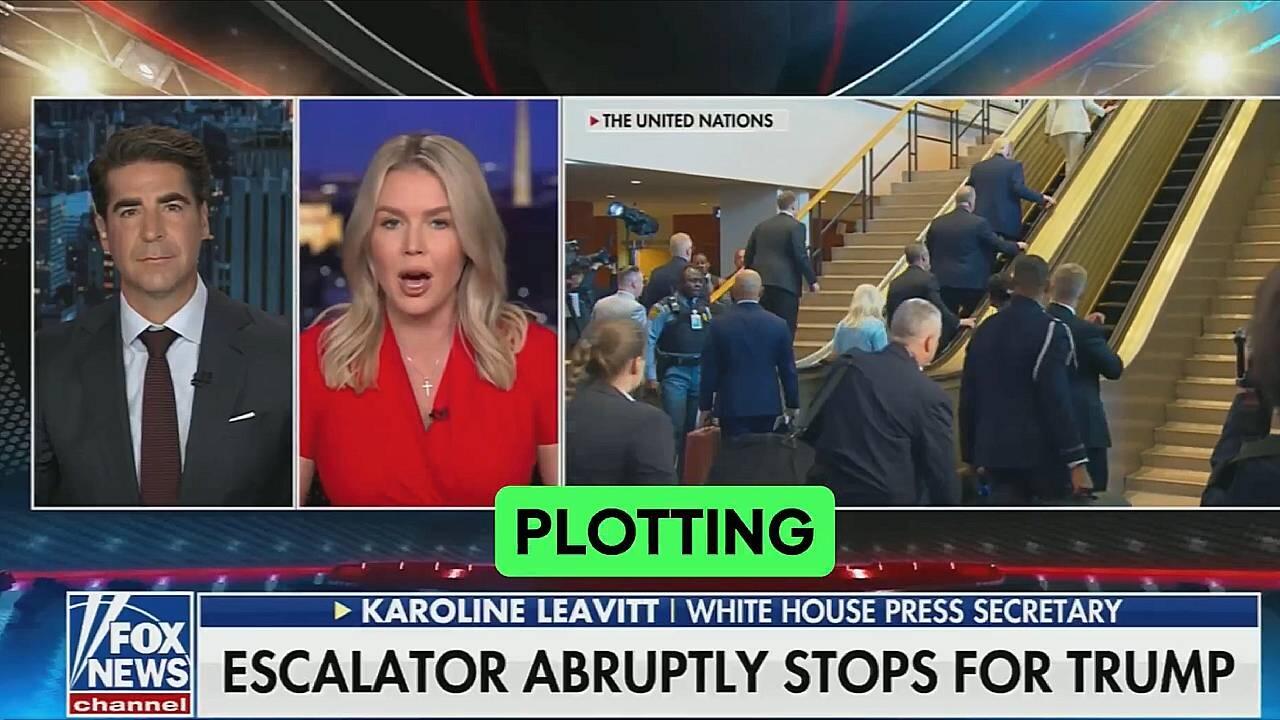
President Trump’s Press Secretary Karoline Leavitt has stated that the Secret Service are looking into incidents prior to and during President Trump’s speech to the UN where an escalator was seemingly purposefully stopped the moment he stepped onto it, and a teleprompter malfunctioned just as he was about to speak.
Appearing on Jesse Watters’ show, Leavitt noted “There was some concerning reporting over the weekend from the London Times, as you pointed out, that U.N. globalist staffers were basically plotting to set up the president of the United States.”
She continued, “And first it was the escalator, then it was the teleprompter, and then Katie Pavlich from Townhall, who we offered a seat in the press pool to cover the president’s historic speech today, noticed that the audio inside of the room was much lower and different for the president of the United States than the previous speaker.”
Karoline Leavitt says it wasn’t just a broken teleprompter or a stalled escalator…none of it was coincidence.
And if it turns out UN staffers tried to sabotage a sitting U.S. president…there will be hell to pay.
“So when you put all of this together, it doesn’t look like a coincidence to me,” the Press Secretary further asserted, adding “I know that we have people, including the United States Secret Service, who are looking into this to try to get to the bottom of it.”
Leavitt further remarked that “if we find that these were U.N. staffers who were purposefully trying to trip up, literally trip up the president and the first lady of the United States, well, there better be accountability for those people. And I will personally see to it.”
In addition to lambasting the UN for its “empty words” on global conflicts, Trump quipped “These are the two things I got from the United Nations: a bad escalator and a bad teleprompter.”
“I ended seven wars and never even received a phone all from the UN. These are the two things I got from the UN, a bad escalator and a bad teleprompter.”😭🤣pic.twitter.com/1DuYTtzAKm
While the teleprompter glitch was an embarrassing tech hiccup, it’s the escalator stoppage that demands scrutiny as a glaring security lapse.
UN officials quickly attributed it to a safety mechanism triggered accidentally by Trump’s videographer backing up the stairs, and the White House has demanded an investigation into potential sabotage. But even if unintentional, the incident exposes deep vulnerabilities in protecting a leader with a massive target on his back.
I can’t believe the President and First Lady were allowed to wait on a stopped escalator. How is this even possible?
Trump has survived two assassination attempts in 2024 alone, and the recent murder of conservative firebrand Charlie Kirk, a brazen campus shooting by a lone gunman with leftist derangements, has only amplified the threats.
Kirk’s killing, amid a surge in politically motivated violence on the left, underscores a rising tide of leftist aggression: from arson attacks on officials’ homes to targeted hits on high-profile voices challenging progressive orthodoxy.
Imagine the escalator halting not by glitch, but by design—or worse, exploiting a momentary freeze in Secret Service protocols. Trump, frozen in place on a confined, elevated platform, surrounded by international delegates and staff in a building teeming with potential bad actors. No quick exit, no buffer zone; just seconds of vulnerability where a concealed assailant could strike.
The second it stopped, guns should have been out and a perimeter secured. This was a tactical failure. It sent the wrong message. Time to bring in Ranger regiment. https://t.co/DFTD3F5e9Y
This a near-miss that could have echoed the chaos of Butler, Pennsylvania, or the golf course attempt last year. The Secret Service, still reeling from those failures, must up their game: pre-clear every mechanism in high-threat venues, deploy redundant transport like private elevators, and drill for “stuck” scenarios that turn routine movements into kill zones.
Anything less invites disaster, especially as Trump’s unfiltered rhetoric continues to provoke extremists on the left.
Your support is crucial in helping us defeat mass censorship. Please consider donating via Locals or check out our unique merch. Follow us on X @ModernityNews.