Global stocks rose as chipmakers rebounded, with falling bond yields adding support to risek sentiment after Brent crude slid below $90 a barrel, down more than 3% after a New York times reports that “evacuated foreign service officers could begin heading back to their posts as early as this week… suggesting Washington does not anticipate a renewal of full-scale conflict with Iran.” Oil is also lower on positive signals from Pakistan’s army chief, and Al-Arabiya reporting that he carried an offer to lift sanctions under the MOU. As of 8:00am ET, S&P 500 futures climbed 0.4%, while those for the Nasdaq 100 advanced 0.9% and leading the charge in a reversal of yesterday’s cash performance. In premarket trading, semis lead with Memory, Mag7, Software, and Low/Unprofitable Tech all higher too. This is occurring with bond yields down 1-2bp. Nvidia was poised to break its longest losing streak since 2022. Semis are up 2% and Memory +3.5%, reversing all of yesterday’s drop. NVDA is also leading Mag7 higher with 5 / 7 higher ex-AAPL, MSFT. The AI theme is boosting other sectors as Cyclicals ex-Energy lead Defensives. Monday saw the second-lowest tape volume of the year despite the update from Bessent and renewed noise around debasement trades. Gold snapped a four-day run of gains, while the dollar held steady. The yield on 10-year Treasuries declined four basis points. In a WSJ Op-ed, Stan Druckenmiller gives his view on the likelihood that Bessent – his former junior trader at Soros – is making with intervention. In commodities all 3 complexes are lower with Base Metals the bright spot; gold is outperforming broader Precious on the move lower. Today’s macro data focus is on Housing Data, regional Fed activity indicators, weekly ADP, and Consumer Confidence.

In premarket trading, Mag 7 names are mostly higher: Nvidia climbs 0.9%, with the chipmaker set to snap its seven-session losing streak as Wall Street awaits the company’s quarterly update due Wednesday. Meta Platforms +0.9%, Tesla +0.5%, Amazon +0.4%, Alphabet +0.4%, Apple -0.1%, Microsoft -0.2%.
- Alibaba ADRs (BABA) rise 0.5% after the South China Morning Post reported that the company’s founder Jack Ma bought more than $76.5 million worth of the company’s Hong Kong-listed shares, citing people familiar with the matter.
- Artificial intelligence-linked stocks are rising and on track to end days of share price declines. Micron (MU) climbs 2%, Seagate (STX) gains +2%.
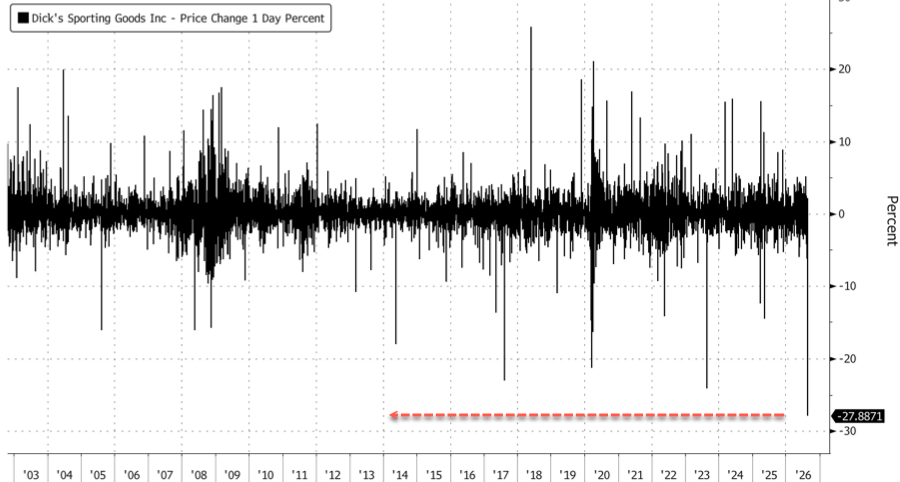
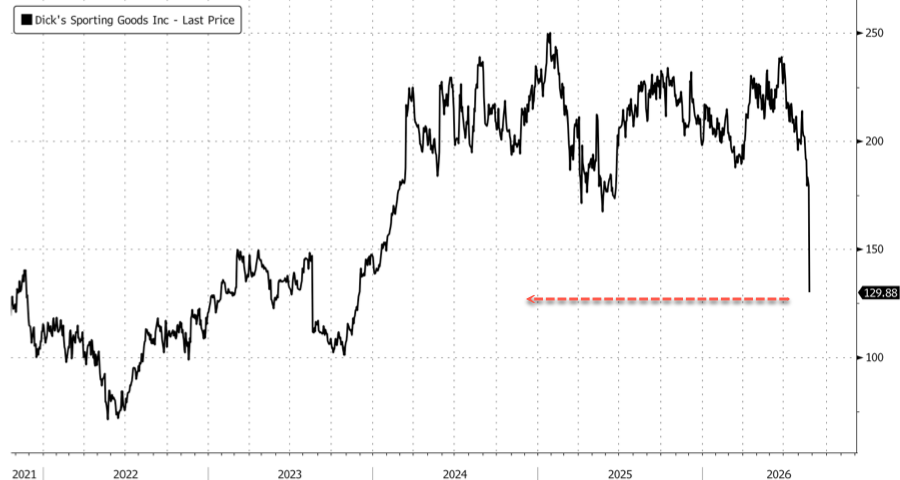
- Dick’s Sporting Goods (DKS) falls 12% after lowering its full-year outlook amid weakness at its recently acquired Foot Locker unit, overshadowing sales gains during the World Cup.
- Dynatrace (DT) climbs 3% after Morgan Stanley upgraded the infrastructure software company to overweight, citing faster growth prospects.
- Kura Oncology (KURA) rises 9% after CEO Troy Wilson reported buying $1.24 million of shares in the company.
- Navitas Semiconductor (NVTS) gains 5% after the company announced a deal to acquire Claros Inc.
In other corporate news, investment bankers and would-be buyers have been eyeing potential assets that might be for sale with Paramount Skydance’s legal fight to buy Warner Bros. Discovery dragging on. In other assets, private equity managers using structured equity deals to placate investors frustrated by a lack of cash returns. Bitcoin climbed above $80,000 for the first time since mid-May, back in favor amid dollar debasement chatter.
Brent oil fell to the lowest level in a week after the New York Times reported the US is preparing to send diplomats back to embassies in the Middle East, suggesting Washington doesn’t anticipate a renewal of a full-scale conflict with Iran (expect this latest burst of geopolitical optimism to be reversed shortly).
Technology shares remained in the spotlight, with chip stocks firming in the run-up to earnings from Nvidia, which has for years been a bellwether for the artificial-intelligence trade. More recently, it has also become involved in orchestrating funding for projects across the technology’s ecosystem.
“Nvidia needs to give investors a reason to raise forward numbers,” said Amanda Lyons at Energy Group Capital. “The fundamental debate has shifted from whether AI demand exists to whether the extraordinary infrastructure buildout can continue generating sufficient economic returns.”
Traders are also looking out for the US Treasury’s next moves, with long-dated yields still trading near multi-decade highs. A slate of economic data and a key speech by Federal Reserve Chair Kevin Warsh at the end of the week will further shape the direction of bonds and expectations for interest rates. Warsh’s first major speech as Fed chief will be a trial of his pared-back communications style. His challenge is to address criticism that he hasn’t been forthcoming about his views on the economy without compromising his resolve not to spoon-feed traders clues about future policy moves.
Investors are awaiting key events “that could define the direction of markets heading into September,” said Laura Cooper, global investment strategist at Nuveen. “From clarity on the Fed’s reaction function and the potential need for a September hike to whether AI earnings can revive tech enthusiasm, there is plenty for investors to digest.”
Tied to the sudden burst of dollar debasement, bitcoin briefly surged past $80,000 before paring its advance. The cryptocurrency is benefiting from a return of optimism to the sector after Treasury Secretary Scott Bessent’s intervention in the bond market last week fueled demand for dollar alternatives.
Stanley Druckenmiller, the billionaire investor who mentored Bessent in his early career as a hedge fund trader, suggested his former pupil was making a mistake by wading into the bond market. “Governments defending prices against fundamentals always lose,” Druckenmiller wrote in a Wall Street Journal opinion column.
In politics, the US is set to impose a 7.5% tariff on Chinese goods over allegations of excess manufacturing capacity before a planned summit between Xi Jinping and Donald Trump. Meanwhile, Bessent’s Iran threat hinges on the willingness of the US to escalate tensions with China, which buys around 90% of Iran’s oil.
The consumer confidence reading is in focus later in the session, following alarming signs from bellwether Walmart last week and with retail gas prices elevated — unleaded remains above $4/gallon, while diesel is approaching recent highs. Consumers likely lost some confidence in August amid renewed concerns about the labor market and inflation, while elevated long-term yields will weigh on confidence for the foreseeable future, notes Bloomberg Economics.
Zoom Communications and Intuit kick off a busy week for software earnings tonight, with the broader sector the best-performing group in the S&P 500 Index over the past month. In contrast, Nvidia heads into numbers on Wednesday with the stock currently on the longest losing streak since Sept. 2022.
The mood music in Europe is also upbeat with the Stoxx 600 up 0.5% alongside a 3.1% pullback in Brent crude.
In FX, the greenback has failed to hold onto an initial gain with the Bloomberg Dollar Spot Index now slightly lower with pound the marginal G10 outperformer.
In rates, softer crude has dragged global borrowing costs lower with US yields down 1-3bp, inside last week’s ranges; 10-year near 4.66% is 3bp lower on the day with UK and German counterparts similarly richer.
Treasuries hold modest gains, trading just off session highs as US trading gets under way, as oil benchmarks extend retreat from last week’s monthly highs. Treasury auction cycle begins with 2-year notes, following a raft of second-tier US economic data. Key events later this week include July personal income and spending data including PCE price indexes and Federal Reserve Chairman Kevin Warsh’s speech at the Jackson Hole Symposium. $69 billion 2-year note auction at 1 p.m. New York time has WI yield near 4.23%; last month’s 2-year sale drew 4.315%, the highest result since December 2024; $70 billion 5-year and $44 billion 7-year note auctions follow over next two days. IG credit new-issue calendar is anticipated to be light through month-end; Sumitomo Mitsui Trust was Monday’s only issuer with a $2.25 billion three-part offering
In commodities, energy prices are weaker in the wake of the US ramping up economic pressure on Iran, positive signals from Pakistan’s army chief, and Al-Arabiya reporting that he carried an offer to lift sanctions under the MOU. WTI crude oil futures are down about 3% amid assessment of latest US measures against Iran. Spot gold printed a fresh multi-month peak before fading upside, now lower by 0.4%. Bitcoin is up 1.3% but back below the $80k mark.
US economic data calendar includes ADP weekly employment change (8:15 a.m.), August Philadelphia Fed non-manufacturing activity (8:30 a.m.), June FHFA house price index and S&P Cotality home price index (9 a.m.), August Richmond Fed manufacturing index and Conference Board consumer confidence and July new home sales (10 a.m.). Fed speaker slate includes only Richmond Fed’s Tom Barkin repeating Aug. 13 comments at 8 a.m. and 4 p.m.; Barkin, the only Fed speaker with scheduled appearances ahead of Warsh’s address at the Jackson Hole Symposium Friday, also is set to make unscripted comments in a panel discussion Wednesday
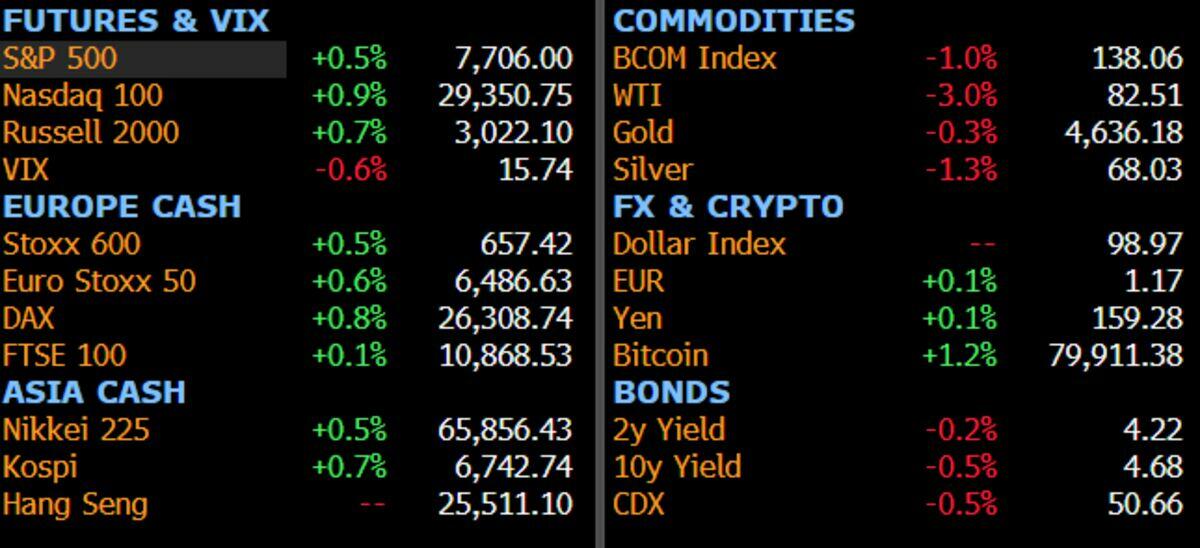
Market Snapshot

Top Overnight News
- Treasury Secretary Scott Bessent’s threat to unleash an economic assault against Iran risks setting the US on a collision course with China, its main trading partner: BBG
- Iran vows to resist widened US sanctions, says Washington seeks talks: RTRS
- U.S. Squeezes Iran but Avoids Targeting Its Biggest Lifeline: China: WSJ
- Stanley Druckenmiller, the billionaire investor who mentored US Treasury Secretary Scott Bessent in his early career as a hedge fund trader, suggested his former pupil is making a mistake by wading into the bond market: WSJ
- Oil extended Monday’s drop as a US plan to ramp up economic pressure on Iran so far spared the country’s trading partners from harsher measures for now: BBG
- The debasement narrative is back, and has propelled Bitcoin to a three-month high. The crypto rally isn’t just about a weaker dollar and fiscal concerns, however, and the key level that could prove that is $83,000: BBG
- Trump’s approval holds at record low as US support for Iran war falls: RTRS
- The AI-debt deluge is getting so extreme in most major global credit markets that a global borrower is turning to far-flung New Zealand to try to escape it, in its first overseas issuance there in almost a decade: BBG
- New installations emerge on islet as China accelerates South China Sea build-up: RTRS
- Global stocks rose as chipmakers rebounded, while Bitcoin briefly topped $80,000 and oil extended declines.
- US Supreme Court sides with President Trump for now regarding his mail-in ballots curbs. US Supreme Court lifted a judicial decision that blocked in 23 states and Washington DC, President Trump’s order restricting mail-in ballots.
- US is preparing to rescind up to 200,000 business and tourism visas in largest mass visa revocation ever, reported AP citing officials.
- Oura and Dunkin’ Get Ready to Join IPO Bonanza: WSJ
- Lutnick’s Intervention in Canada Talks Draws Praise, Blame: BBG
- Trump administration moves to impose more than $100,000 fee for H-1B worker visas: RTRS
- Goldman Sachs revises its timeline for the next Bank of Japan interest-rate hike to September from January 2027, according to a note by economists including Tomohiro Ota and Yuriko Tanaka.
A more detailed look at global markets courtesy of Newsquawk
APAC stocks were mixed following the subdued lead from Wall Street, where most major indices declined amid tech weakness and headwinds from Economic D-Day sanctions on Iran and the US-Canada trade war. ASX 200 traded higher amid strength in the domestic tech, healthcare and financial sectors, while participants digested a plethora of earnings and somewhat balanced RBA August Meeting Minutes. Nikkei 225 saw two-way price action and gradually clawed back initial losses to move into the green, with recent reports noting that Japan is considering exempting gains from non-core business sales from corporate tax if companies reinvest the proceeds in acquisitions. KOSPI underperformed amid recent tech headwinds and with SK Hynix shares also pressured after union members narrowly rejected the tentative wage agreement through a 50.1% vote against. Hang Seng and Shanghai Comp were subdued amid earnings releases and cautiousness as US sanctions on Iran and warnings against countries with economic ties to Iran, increase risks of stoking US-China frictions, while the US is also mulling 7.5% overcapacity tariffs on China.
Top Asian News
- Japanese PM Takaichi said Govt. plans to continue keeping the gasoline price at around JPY 170/Litre.
- Japanese Ministry of Finance requests a FY27 budget of JPY 38.6 tln, 15.1% increase compared to the initial budget for FY26, Kyodo reported; “the increase is due to rising interest rates”.
- Japan PM Takaichi has reportedly requested the LDP to “actively promote” measures against rising inflation, in a recent meeting, Nikkei reported.
- Japanese Finance Minister Katayama said can’t comment on budget requests for fiscal 2027, adds will focus on key policies in FY27 budget to drive economic growth and will balance fiscal sustainability and economic growth and will communicate with market. said:. Have received various opinions on scheme for JGBs for retail investors.
European bourses (STOXX 600 +0.4%) are broadly firmer this morning, digesting the positive mood music following the recent Pakistan-Iran talks in Tehran. In brief, Pakistani officials suggested that “we had a constructive exchange of views on the issues raised”, noting “big progress”. Most recently, mild risk-on action was seen after sources suggested that the Pakistani Army Chief conveyed a message from the US to Iran. The Americans reportedly offered to halt the naval blockade, in exchange for opening the Strait. Nonetheless, the gains are modest at this stage, as talks are only at preliminary stages and amidst the heightened uncertainty. European sectors hold a positive bias. Industrials takes the top spot, joined closely by Energy and then Utilities. The leader today has been buoyed by strength in Melrose (+8%) after it announced that the GKN probe has ended without criminal charges, and as it sets out a reopening timeline for the Garden Grove plant. To the downside, Autos parks itself at the foot of the pile, followed closely by Consumer Products & Services. Key Stories: NatWest (-0.2%, FT reports that the Co. plans to expand into the US), Next (+1.9%, upgraded at Citi), CD Projekt (-6%, delays release of The Witcher IV), Gerresheimer (-5.7%, CEO Rohrhoff to step down as interim CEO), Siemens Energy (+1.5%, working with Goldman Sachs to field offers for a majority stake in its steam turbines business).
Top European News
- German real wages projected at 0.7% in 2026, Handelsblatt reported citing the WSI Archive.
- EU Commission is being urged by the EPP and RE groups to withhold EUR 770mln of funding from Romania, due to concerns around rule of law, Politico reported citing a letter.
- UK PM Burnham has shelved plans to put Thames Water into a special administration regime amid concerns about the costs and legal risks involved, according to The Times.
FX
- DXY was bid through APAC trade, marking a peak of 99.11 in Europe, thereafter entirely erasing gains to a 98.94 trough following an optimistic readout of the Pakistan-Iran meeting via Saudi press sources (see commodities for details). Focus remains on the geopolitical situation and its follow through to yields, where the US 30yr currently sits at the middle of Wednesday’s Treasury announcement fall, around 5.22%. Brent contracts trade USD 3/bbl off session highs, the Brent November contract looking below to 88.50/bbl. The session ahead is light with ADP’s weekly Employment Change data and a 2yr auction scheduled.
- EUR did not take too much of a lead from the aforementioned action in energy markets. TTF around EUR 67/MWh remains at an uncomfortable level for the ECB, which, alongside a strong Ifo, paints a hawkish mood in today’s session. EUR/USD is just off recent 1.17 highs, within 1.1651-1.1671. GBP action is similarly quiet with focus on the upcoming week’s risk events; domestic updates include PM Burnham failing to rule out tax increases in the Budget, remarks which have not given much of a lead to UK assets. GBP outperforms vs. USD just below 1.1650 and EUR, at 0.8550.
- SEK is weaker against the EUR and flat against the Buck with no reaction to Riksbank minutes, which showed members were optimistic about the Swedish economy, though revealed a split on the future rate path, with some members maintaining a wait-and-see stance.
- Barclays month-end FX: moderate USD selling against all majors.
- PBoC set USD/CNY mid-point at 6.7852 vs exp. 6.7219 (prev. 6.7841).
- PBoC sold CNY 15bln of 3-month yuan bills at 1.30% and CNY 15bln in 1-year yuan bills at 1.35% in Hong Kong, as previously indicated.
Fixed Income
- Fixed benchmarks saw some modest pressure in the first part of the APAC session, before lifting in the early European morning and then falling again on data, pressure that was unwound shortly after by energy action.
- The mentioned overnight pressure sent USTs to a 108-11 base, holding above Monday’s 108-08+ trough. Since, the benchmark has been as high as 108-16, and is holding flat on the day a tick or two off that high. Recent upside a function of energy pressure, as sources report that the US told Pakistan to tell Iran that it would halt the siege and lift sanctions under the MOU, if Hormuz opens and proxy attacks stop. We now await an update from Iran, who are said to be consulting and are expected to respond soon.
- Ahead, USTs look to 2yr supply, in addition to a handful of data points.
- Bunds in-fitting with the above, just with a slightly larger range. The overnight base was 123.76, since taken out by two ticks just after the cash equity open and into Ifo where the stronger-than-expected series sparked some fresh downside. In more recent trade, the discussed energy pullback has allowed Bunds to lift back into the green, to a peak of 124.03. Some of that upside came alongside a 2028 auction, which drew a b/c of 1.49x (prev. 1.37x). However, it may not directly compare because the prior outing had EUR 6bln on offer vs EUR 5bln today.
- Gilts in-fitting with the above, as UK specifics are light. Firmer by a tick or two in 86.02-48 parameters. A 2033 Gilt auction was well received, with a b/c of 3.4x (prev. 3.16x).
- TenneT Germany to sell EUR-denominated hybrid 30-year noted; yield guidance seen at 4.875%.
- Australia sold AUD 1.2bln 1.00% November 2031 bonds, avg. yield 4.6310%, b/c 3.63.
- UK sells GBP 4bln 4.125% 2033 Treasury Gilt: b/c 3.4x (prev. 3.16x), average yield 4.761% (prev. 4.519%) & tail 0.2bps (prev. 0.2bps)
- Germany sells EUR 3.83bln vs exp. EUR 5bln 2.70% 2028 Schatz; b/c 1.49x (prev. 1.37x), average yield 2.85% (prev. 2.78%) & retention 23.4% (prev. 24.1%)
Commodities
- On diplomacy, Pakistan has been optimistic once again. Energy futures saw downticks on reports that Pakistan has reported “significant progress” in high-level diplomatic talks held in Tehran, aimed at de-escalating the ongoing US-Iran war, whilst further downside were seen after Al Arabiya/Al Hadath sources said Pakistani Army Chief Munir conveyed an offer to Iran, from the US, to halt the siege and lift sanctions under the MOU, in exchange for opening the Strait of Hormuz and stopping proxy attacks. Tehran will continue its consultations to submit its response soon, according to these reports.
- WTI Oct and Brent Nov are subdued and hit new incremental lows on the Al Hadath/Al Arabiya reports from Pakistan. The former resides towards the bottom end of a USD 82.25-85.84/bbl range and the latter in a USD 87.92-91.29/bbl parameter. As it stands, the complex is at fresh incremental lows after the NYT reported that US is reportedly mulling returning diplomats to Middle Eastern embassies as soon as this week, “suggesting that the Trump administration does not anticipate a return to all-out hostilities”.
- Dutch TTF is choppy and flat at the time of writing, but still near elevated levels north of EUR 68/MWh after earlier finding support just under EUR 67.50/bbl and then briefly topping EUR 69/MWh. “Supply concerns continue to grow in the European natural gas market, particularly with storage levels, as the region moves closer towards the heating season”, ING posits, “At the current rate, it will be difficult for the EU to hit even the lower storage target of 75% ahead of the heating season. This raises the prospects of forced buying, increasing upside risk for gas prices.”
- Metals are lower across the board with precious metals show slightly deeper losses vs base metal counterparts, with the former weighed on by a resilient DXY despite the losses in oil, whilst the latter is underpinned by continued hopes of Chinese stimulus. Spot gold resides in a USD 4,617-4,697/oz range after topping yesterday’s USD 4,681/oz high. Spot silver fell from a USD 67.56-69.95/oz. 3M LME copper resides in a narrow USD 14,197.25- 14,278.00/t parameter.
- Japanese Government is set to launch state support for construction of oil pipelines which bypass the Strait of Hormuz, Nikkei reported. PM Takaichi reportedly will announce this at the Green Transformation meeting on the 26th August.
- Oil refinery in Russia’s Rostov temporarily suspended operations following Ukrainian attack, TASS reported.
- Kazakhstan’s Kondensat refinery will process Russian crude and send 30% of refined products to Russia, IFX reported.
- Japan’s Trade Minister Akazawa said won’t release government oil stockpile in September and October.
- South Korean Finance Minister said stronger KRW will help ease rise in crude oil-related import costs, will extend naphtha supply steps through January.
- Kazakhstan Energy Ministry said oil production plans are to be tweaked due to CPC attacks, with production loss to reach 3.5mln tonnes.
- Kazakh Energy Ministry said repairs at Karachaganak are scheduled for mid-September, with oil production losses expected to reach up to 450k tons, Interfax reported.
- Mosaic (MOS) predicts a phosphate shortage in Brazil starting in September, citing waning domestic stockpiles, CNN Brasil reported citing an executive.
Trade/tariffs
- Canada is reportedly to announce retaliatory tariffs against the US on Tuesday, according to an AP source.
- US President Trump said in tele-rally that the country desperately needs aluminium and mainly gets it from Canada, while he also comments that he wants to get beef prices down.
Central Banks
- Former BoJ Board Member Adachi said the BoJ will probably raise the benchmark interest rate next month, stating the BoJ is pretty much boxed in, markets have almost fully priced in a hike, and if the BoJ doesn’t hike, the yen could weaken sharply.
- RBA’s markets head Jacobs goal is a system that can flexibly supply whatever quantity the banking system demands, while keeping the cash rate close to the board’s target. said:. As reserves become more demand driven active liquidity management will become more important for financial institutions.
- RBA Minutes from the August meeting stated board is ready to increase rates if upside risks materialise and several members judged it is possible upside risks to inflation would crystallise, others saw offsetting downside risks and time to assess data.
- Riksbank Minutes: Seim said still concerned that inflation might become too high. Seim: I am concerned that inflation might become too high. There are a further number of international factors that risk increasing inflationary pressures going forward, for instance, the extreme weather in parts of Europe and Russia’s war of aggression in Ukraine. Jansson: Overall, my assessment given this is that the inflation picture now is somewhat poorer than in June. But it deserves to be emphasised that the shifts are small. Currently have more of an impact on how we communicate future inflation risks than a direct quantitative effect on our monetary policy plan, in line with the text in the draft Update. Have scope to wait before adjusting our monetary policy, even if there are some risks of elevated inflation going forward. Thedeen: I am becoming increasingly convinced that the upturn in economic activity is now on firmer ground. My conclusion is that the level of vigilance with regard to rising inflation must be high. I assess that our next change in the policy rate needs to be a raise. Hjelm: It is appropriate to begin thinking about monetary policy in a scenario where the conflict becomes long-lasting and low intensive and where consideration for possible future escalation is no longer reasonable. It is appropriate that the policy rate remains slightly expansionary, which I assess the level of 1.75 per cent to be. I consider that the risk of an escalation of the war, resulting in substantial price increases, justifies a probability of rate increases over the year. Bunge: Overall, I think that it is reasonable to wait before adjusting the policy rate and to communicate today that the probability of a rate increase still stands since June.
- RBI is likely intervening to support the rupee, according to traders.
Geopolitics
- Ukraine military said it struck the Afipsky refinery (180k bpd) in Russia’s Krasnodar region.
- Oil refinery in Russia’s Rostov temporarily suspended operations following Ukrainian attack, TASS reported.
- Kazakhstan’s Kondensat refinery will process Russian crude and send 30% of refined products to Russia, IFX reported.
- Ukrainian forces strike Afipsky oil refinery in Russia’s Krasnodar Krai overnight.
- UK PM Burnham plans a US trip next month to lobby US President Trump on Ukraine aid.
Middle East
- Pakistani Army Chief Munir conveyed an offer to Iran, from the US, to halt the siege and lift sanctions under the MOU, in exchange for opening the Strait of Hormuz and stopping proxy attacks, Al Arabiya/Al Hadath sources report. Al Hadath reported Washington offered to halt the naval blockade and lift sanctions on Iran in exchange for opening the Strait of Hormuz and stopping proxy attacks. Pakistani Army Chief told Senior Iranian official that the agents’ attacks are ongoing despite the stopping of direct attacks. Pakistani Army Chief said that the direct attacks between Iran and America have stopped. Iran will continue the fighting in the event of a new escalation. Tehran will continue its consultations to submit its response soon.
- Iranian official said the visit of Pakistani Commander of the Army to Iran was highly fruitful…the results of which will soon become apparent.
- A senior Iranian official told Al Jazeera journalist that the talks with [Iran and] Pakistani Field Marshal Munir were constructive, with useful ideas exchanged, “though no messages were passed in either direction”. “The visit was aimed at reviving Pakistan’s role as a mediator between Iran and the US”.
- Pakistan has reported “significant progress” in high-level diplomatic talks held in Tehran, aimed at de-escalating the ongoing US-Iran war, Iran’s Press TV reported.
- Pakistan’s Interior Minister who accompanied the Chief of Defence Forces on his trip to Tehran wrote that Iran’s President clearly expressed his government’s view and we had a constructive exchange of views on the issues raised. said. There is big progress following talks with Iran’s leadership.
- Iran’s Supreme National Security Council Secretary Rezaei said during meeting with Pakistan Chief of Defence Forces Munir the US must change its behaviour and take practical actions regarding implementation of the terms of the memorandum of understanding. Munir said Pakistan has also made many efforts to establish security between the borders of the two countries.
- US is reportedly mulling returning diplomats to Middle Eastern embassies as soon as this week, NYT reports; “suggesting that the Trump administration does not anticipate a return to all-out hostilities”.
- Iran’s President Pezeshkian said on Monday that the US must change its tone and approach towards Iran, adds US reliance on coercion and bullying will only complicate executive processes.
- UKMTO said it received a report of an incident 9NM northeast of Oman’s Ash Shishah, with the master of an oil tanker reporting the vessel was struck by an unknown projectile causing damage to the engine room and disabling the vessel. Crew are reported safe and environmental impact is unknown at the time of the report.
- US F-35 fighter jet declared an emergency in Saudi airspace and is making a landing at the Mawaqaf Al-Sulti Air Base in Jordan, according to Iranian media.
US Event Calendar
- 9:00 am: United States Jun FHFA House Price Index MoM, est. 0.2%, prior 0.3%
- 10:00 am: United States Aug Richmond Fed Manufact. Index, est. 6.5, prior 5
- 10:00 am: United States Jul New Home Sales, est. 620k, prior 628k
- 10:00 am: United States Aug Conf. Board Consumer Confidence, est. 90.2, prior 90.8
Central Bank Speakers
- 8:00 am: United States Fed’s Barkin Speaks on Economy
- 4:00 pm: United States Fed’s Barkin Speaks on the Economy
DB’s Jim Reid concludes the overnight wrap
Markets started the last week of August in a mixed mood, with bonds supported by a decline in oil prices as the US announcement of economic pressure against Iran didn’t deliver material new measures. However, while yesterday’s decline in Brent crude (-2.35%) helped 10yr Treasuries (-3.7bps) recover, European bond moves were more subdued as European natural gas prices reached their highest level since early 2023. Equities also saw a more cautious performance with the S&P 500 (-0.28%) falling back amid a continued sell-off in chipmakers that saw Nvidia post its longest run of daily declines since 2022 ahead of its results tomorrow.
Starting with Bessent’s announcements on Iran, the US Treasury Secretary threatened secondary sanctions against any country enabling Iran’s economy, calling the move “economic asphyxiation” of Iran’s regime. He noted that Trump is calling world leaders with “specific requests to cease their interactions with the regime”. However, there were no concrete new steps other than sanctioning 60 Iran-linked entities and individuals, with Bessent saying “we are giving everyone the opportunity to remedy bad behavior”. He did add that the US would be sanctioning a major financial institution later this week without naming the target. One of the biggest questions is whether the US could sanction a major Chinese bank for facilitating trade with Iran, with Bessent remaining vague, saying “no one is above the reach of US sanctions” when asked on this.
Iran played down Bessent’s announcement, with its Economy Minister saying “we have been expecting these plans for a long time, and the government has a two-year plan under which it is fully prepared for these developments.” In the continuing war of words, Trump had also posted on Truth Social earlier in the day that Iran was “completely collapsing”.
In the absence of material escalation and amid continuing grey flows through the Strait of Hormuz, oil markets remained mostly in a wait-and-see mode, with Brent Crude falling back by -2.35% to $92.17/bbl after its +6.63% gain last week. It is largely flat this morning. The dip in oil prices helped bring some relief to bond markets, with US Treasury yields lower across the curve. That was led by the 10yr (-3.7bps to 4.70%) and 30yr (-4.5bps to 5.22%), while the 2yr was little changed (-0.3bps to 4.23%). Treasuries have given up some of those gains overnight, with 10yr USTs trading +1.5bps higher as we go to print.
Yesterday’s bond rally was also helped by a CNBC report that the US Treasury could use the cash in the Treasury General Account to help fund the increase in the buyback operations announced last week. Using the TGA may help fund the larger buyback operations without resorting to higher issuance of short-term debt. Note that while “excess” cash represents a relatively small portion of the $953bn currently in the TGA, this should still be easily sufficient for the larger buybacks planned for the weekly operations in September and October, which were increased from a maximum of $2bn to at least $4bn. However, the amounts involved are trivial in the context of the roughly $2trn annual US federal deficit. It’s also not clear if this reported TGA use will actually take place – Bessent refrained from any new signals on debt management strategy when asked during his press conference yesterday.
The rally in Treasuries also helped longer-dated bond performance in Europe, with yields on 10yr bunds (-0.5bps), OATs (-1.0bps) and gilts (-0.4bps) edging lower. However, shorter-dated yields rose across Europe, with the 2yr bund yield up +2.6bps to a 1-month high of 2.87% with 63bps of further ECB hikes now being priced by next June (+2.9bps on the day).
European bonds weren’t helped by a continued rise in natural gas prices. Front-month TTF prices rose +3.73% to EUR 68.94/MWh, their highest since January 2023 amid concerns over low gas storage levels. At 63% full, EU gas storage is the lowest for this time of the year since the current data begins in 2009. In other commodity-driven inflation concerns, wheat prices traded within touching distance of their two-year highs reached last month, before pulling back to +0.04% on the day after President Zelenskiy said that Ukraine will seek talks with Russia on grain exports and that Ukraine’s maritime grain exports are not fully blocked by recent Russian strikes.
In equities, sentiment was apprehensive, with the S&P 500 (-0.28%) and Nasdaq (-0.76%) moving lower, though the equal-weighted version of the S&P (+0.10%) inched up to within 0.5% of its all-time high. But the main indices were weighed down by renewed concerns over AI-chipmaker stocks, with Sandisk (-6.45%) and Micron (-5.83%) among the worst performers in the S&P 500 and the Philly Semiconductor Index falling -2.70%. Nvidia fell -2.91% ahead of its earnings release tomorrow, posting a seventh consecutive decline. That’s its longest losing streak since September 2022, two months before the public release of ChatGPT by OpenAI that then triggered Nvidia’s meteoric rise to become the world’s most valuable company.
Yesterday’s tech declines have largely carried over into Asian markets this morning, with the KOSPI (-0.72%) leading on the downside, though it has recovered from being down more than -2% down early in the session. Elsewhere, the CSI 300 (-0.46%), Shanghai Composite (-0.15%), and Hang Seng (-0.25%) are also trading lower. However, the Nikkei (+0.49%) and Australia’s S&P/ASX 200 (+0.54%) are bucking the negative trend. Meanwhile, US equity futures on both the S&P 500 (+0.12%) and Nasdaq (+0.35%) are slightly higher after yesterday’s declines.
In Europe, equities were mixed yesterday. The Stoxx 600 (+0.005%) was flat, with gains for the FTSE 100 (+0.35%) and IBEX 35 (+0.69%) offsetting losses for the CAC 40 (-0.37%) and DAX (-0.11%).
In yesterday’s other news, the tariff saga between the US and Canada continued as Trump announced a 50% tariff on cars, trucks and auto parts from Canada, effective Jan 1, 2027. Current US tariffs on Canadian automobiles stand at 25%. That followed comments from US Trade Representative Greer that trade talks had broken down because Canada had wanted more, and that political reasons were a driver for Canada. Meanwhile, Canada’s Prime Minister Carney said his government was still working on options for retaliating against the new 50% US tariffs on around $20bn of Canadian products that came into force late last week. With this escalatory backdrop, the Canadian dollar was the weakest performing G10 currency on Monday, falling by -0.61% against the US dollar.
In other overnight news, the Reserve Bank of Australia’s (RBA) minutes confirmed that policymakers considered a 25bps hike at their August meeting, reflecting growing concerns about inflation risks, though this was weighed against the possibility of a sharper slowdown in employment, housing activity, and overall demand. The board ultimately concluded that, after earlier hikes, there was sufficient time to wait before making further policy adjustments. Markets are currently pricing a 58% chance of another RBA rate hike by year-end (up from 54% yesterday).
Finally, Bitcoin rose by +1.97% yesterday and is trading another +1.7% higher this morning at just over $80k, its highest level since May. Gold also rose +1.07% yesterday to its highest level since May, at $4,652/oz.
To the day ahead now, we’ll get the US August Conference Board consumer confidence index, Philadelphia Fed non-manufacturing activity, Richmond Fed manufacturing index, business conditions, July new home sales, and June FHFA price index. The Fed’s Barkin will also speak and we’ll have the $69bn US 2-year note auction. European data releases include Germany’s August Ifo survey and France August consumer confidence.