Spain’s construction industry is undergoing rapid demographic changes. Foreign-born workers in unskilled construction roles now make up 52.6 percent of all workers, according to data from Randstad from the first quarter
The data shows that foreign workers now exceed Spanish nationals for these unskilled roles by nearly 11,000 workers. The contrast is stark compared to pre-pandemic figures, when domestic laborers outnumbered foreign counterparts by more than 33,500.
Overall, the construction industry has lost 22,711 Spanish workers since 2019 while gaining 238,451 foreign employees, a figure that includes individuals with dual nationality. As a result, almost 36 percent of all construction workers, both skilled and unskilled, are now of foreign origin in the country.
The shift is equally evident among bricklayers. In 2019, Spanish bricklayers outnumbered foreigners by 111,000. Seven years later, that gap has narrowed to just 18,000 workers. Foreign labor has gained more than 16 percentage points in this category and currently accounts for roughly 48 percent of bricklayers working in Spain. While Spaniards remain the majority in most skilled roles for now, the statistical gap continues to shrink rapidly. Experts also predict that foreigners will increasingly dominate skilled and managerial positions in the future.
This transformation extends into specialized technical trades. The count of Spanish plumbers fell from 70,932 in 2019 to 57,781 today, while foreign representation doubled after adding over 10,000 workers. One in four plumbers in Spain is now foreign-born. Electricians show a similar dynamic, with about 32,000 foreign workers joining the profession since 2019, driving foreign representation up from under 11 percent pre-pandemic to nearly three out of ten today.
Industry analysts expect these patterns to hold due to impending retirements and low replacement rates among younger Spaniards.
Spain, like many other nations, is attempting to automate the construction industry as much as possible. However, instead of relying on advanced robots, Spain has so far shifted toward a modular construction approach in which concrete panels, bathrooms, and complete structural modules are built indoors in automated, factory-controlled settings that use machinery and assembly lines similar to those in the automotive sector. Cranes then assemble these modular components on site, requiring significantly fewer workers and dramatically cutting project delivery times.
Countries such as South Korea, by contrast, are racing ahead in automated construction, precisely because nations like Spain continue to rely on mass immigration, which is often cheaper in the short term but more costly over the long run.
South Korea does not only use automated construction in planning, but also in deploying commercialized robotics, automated modular manufacturing, and government-mandated smart construction.
Automated facilities, such as Space Factory, use advanced robotic arms to cut materials, assemble structural panels, seal joints, and fit window frames without direct manual intervention.
Unlike standard build sites in Spain, South Korean contractors actively deploy field robotics directly to job sites.
Robots are even acting as supervisors to some extent, with autonomous quadruped robots, such as Boston Dynamics’ “Spot,” owned by South Korea’s Hyundai Motor Group, continuously patrolling construction sites, performing 3D laser scans to verify that progress matches digital blueprints.
As Remix News has previously reported, automation, robotics, and AI are all leading elements of Asian economies, which have chosen efficiency and technology over mass immigration and cheap foreign labor.
Fifty-four years ago, a team of researchers at MIT fed population data, resource consumption curves, and pollution metrics into a mainframe computer the size of a shipping container. The machine whirred through calculations and spat out a trajectory that ended in sharp decline. The 1972 Limits to Growth report predicted that without drastic course corrections, industrial civilization would hit terminal constraints by mid-century. At the time, critics dismissed the findings as Malthusian paranoia, pointing to the green revolution and technological optimism as proof that human ingenuity would always outpace scarcity. They were wrong. The variables aligned with terrifying precision.
A reassessment published by KPMG in January 2026 confirmed what the original MIT model suggested: we are not merely on track for the 2040 collapse – we are eighteen months ahead of the worst-case scenario. The report analyzed thirty key indicators including arable land depletion, aquifer drawdown, atmospheric carbon concentrations, and debt-to-GDP ratios across OECD nations. Twenty-seven of those indicators exceeded the 1972 projections. The remaining three—global shipping volume, semiconductor production, and satellite launches – mask underlying fragility by measuring activity rather than resilience. The study concluded that the “business as usual” trajectory now points to systemic rupture between 2032 and 2038, with cascading failures likely to begin manifesting visibly by late 2027.
The mathematics does not care about human optimism. Exponential curves have a way of appearing flat until they go vertical. The MIT model tracked five variables: population, food production, industrial output, pollution, and non-renewable resource depletion. In 2026, global population stands at 8.2 billion, having added the last billion in just twelve years. Food production plateaued in 2023 despite increased fertilizer application, indicating diminishing returns on agricultural intensification. Industrial output continues to rise, but energy return on investment – the amount of usable energy extracted versus the energy required to extract it—has fallen below the critical threshold of 15:1 for most fossil fuel sources. Pollution, measured in particulate matter, oceanic plastic density, and atmospheric methane, exceeds the model’s “pollution crisis” scenario by forty percent. The curves converge toward a singularity of scarcity and toxicity.
The Nine Fractures Already Spiderwebbing Through the Foundation
Economic architecture is not collapsing in a dramatic thunderclap. Instead, it is dissolving like limestone in acid rain—slowly, invisibly, until the cavern opens beneath your feet. Global debt reached $307 trillion in early 2026, representing 333% of global GDP. This is not a number that resolves through growth. It resolves through devaluation, default, or dissolution. Central banks in thirty-seven countries are currently piloting Central Bank Digital Currencies (CBDCs), programmable money that carries expiration dates and usage restrictions. The Bank for International Settlements openly discusses “financial repression” as a necessary tool for managing sovereign debt loads. Translation: your savings will be harvested to keep institutions solvent, and you will have no recourse because the money will be code, not cash.
The banking crisis of 2023 never truly ended; it merely entered a chemically-induced coma. Regional banks in the United States continue to hemorrhage deposits as savers flee to money market funds and Treasury bills. Commercial real estate—office towers built in the 1980s and 1990s—trades at sixty percent below 2019 valuations. Pension funds that loaded up on these “stable” assets face insolvency by 2028. The derivatives market, that opaque web of interconnected obligations, now notionalizes at over one quadrillion dollars. When—not if—a major counterparty fails, the unwind will not be orderly. It will be a stampede toward exits that no longer exist.
Climate systems are not changing. They are destabilizing. The summer of 2026 broke records that had stood for mere months. Phoenix recorded thirty-one consecutive days above 115°F. The wet-bulb temperature in Mumbai exceeded 35°C for six hours on August 3rd, 2026, crossing the threshold for human survivability without air conditioning. The Arctic ice minimum this September will likely establish a new record low, with some models suggesting the first “blue ocean event”—ice-free Arctic waters—could occur as early as 2027, decades ahead of previous estimates. The permafrost in Siberia is not merely thawing; it is exploding. Methane craters half a kilometer wide now pockmark the Yamal Peninsula, releasing ancient greenhouse gases at rates that render human emission reductions irrelevant.
Water is not becoming scarce. It is being weaponized. The Colorado River, which irrigates fifteen percent of American agricultural output, has reached critically low levels that trigger mandatory cutbacks under the 2026 Compact renegotiations. Farmers in Arizona are already bulldozing orchards that took decades to establish. The Ogallala Aquifer, which underlies the American breadbasket, drops an average of two feet annually. It will not recharge within any human timescale. In India, the groundwater beneath the Punjab region—India’s wheat basket—will be economically inaccessible by 2028. Pakistan and India have exchanged fire across the Line of Control three times this year over water rights to the Indus River basin. The first water war of the 21st century is not coming. It is already here, dressed in the rhetoric of territorial sovereignty.
Migration patterns have shifted from streams to torrents. The UN estimates that 1.2 billion people currently live in regions that will become uninhabitable within two decades due to heat, drought, or sea level rise. In 2026 alone, 340,000 people crossed the Darién Gap between Colombia and Panama, heading north. These are not economic migrants seeking opportunity; they are climate refugees fleeing agricultural collapse. The Sahel region of Africa is emptying into Europe at rates that exceed the 2015 crisis by factors of three. Bangladesh, where 160 million people live on a delta that rises one centimeter annually while seas rise three times faster, is negotiating “managed retreat” agreements that will relocate twenty million citizens by 2030. Borders are hardening. Camps are swelling. The infrastructure of compassion is fracturing under the weight of mathematical impossibility.
Food systems operate on margins so thin they resemble tightropes. The world maintains approximately seventy days of grain reserves. When Ukraine’s exports were disrupted in 2022, wheat prices spiked forty percent. When the Mississippi River dropped to historic lows in 2023, barge traffic backed up for months. These were warnings, not aberrations. In 2026, rice prices hit fourteen-year highs due to El Niño-induced droughts across Southeast Asia. The “green revolution” that fed the population boom relied on fossil fuel inputs—natural gas for fertilizer, diesel for tractors, petroleum for pesticides. As energy costs rise, food costs follow with mathematical inevitability. The bread riots that began in Sri Lanka in 2022 and spread to Pakistan, Peru, and Kenya were previews, not finales.
Disease is evolving faster than our defenses. Antibiotic resistance now kills 1.27 million people annually, a figure projected to reach ten million by 2035. Gonorrhea, tuberculosis, and staphylococcus infections are emerging that respond to no known pharmaceutical treatment. The post-antibiotic era means surgery returns to being a life-threatening gamble, childbirth becomes dangerous, and minor wounds can kill. Meanwhile, viral zoonotic spillover events have increased threefold since 2010. The H5N1 avian influenza has achieved mammal-to-mammal transmission in cattle populations across the American Midwest. Virologists give it a forty percent probability of achieving efficient human-to-human transmission within eighteen months. When—not if—it does, mortality rates could exceed those of the 1918 Spanish Flu.
Demographics are inverting with terrifying speed. The global fertility rate has fallen to 2.3 children per woman, barely above replacement level. In South Korea, it is 0.72. In Italy, 1.24. In China, 1.09. The inverted age pyramid—few young supporting many old—creates fiscal impossibilities. Japan is currently spending forty percent of its budget on elderly care and debt service. By 2030, that figure reaches sixty percent. Pension systems are not underfunded; they are unfundable. Simultaneously, youth unemployment in the developing world has reached forty percent in regions where seventy percent of the population is under thirty. The combination of idle young men and resource scarcity produces the historical precursor conditions for war.
Social cohesion is unraveling into constituent threads. Political polarization has reached levels where seventy percent of Americans view members of the opposing party as existential threats. Trust in institutions—media, government, academia, medicine—has fallen below twenty percent across Western democracies. Conspiracy theories move faster than facts because they offer narrative coherence in a world of chaotic complexity. When the official story loses credibility, people construct their own realities. The result is a population that cannot agree on basic facts, rendering collective problem-solving impossible. The public sphere has become a battlefield of competing hallucinations.
The Cascade Mechanics Nobody Modeled Correctly
These nine factors do not operate in isolation. They are coupled oscillators, feeding energy into each other with terrifying efficiency. Climate stress triggers migration. Migration triggers political backlash and border militarization. Resource nationalism disrupts trade. Trade disruption causes economic shock. Economic shock triggers currency crises. Currency crises prevent importation of food and energy. Food and energy shortages trigger social unrest. Social unrest disrupts supply chains further. The feedback loops are not linear; they are exponential.
The 2022 energy crisis in Europe demonstrated this coupling. Sanctions on Russian natural gas triggered price spikes. Price spikes forced industrial shutdowns. Shutdowns reduced fertilizer production. Reduced fertilizer production lowered grain yields. Lower yields increased food prices. High food prices triggered protests in developing nations that imported European wheat. The disruption traveled from pipelines to plazas in six months. Now imagine this cascade occurring simultaneously across water, food, energy, and financial systems. The models suggest that once three critical systems fail, the remaining seven follow within months, not years.
The concept of “resilience” has been strip-mined by corporate consultants who use it to sell software solutions. True resilience is biological, not digital. It is the redundancy of multiple seed varieties, not data backups. It is the muscle memory of manual labor, not cloud storage. It is the trust between neighbors, not blockchain verification. Industrial civilization has optimized for efficiency at the expense of redundancy, creating systems that are “lean” in the same way a razor blade is lean—sharp, but prone to snapping under pressure.
What the Breaking Point Actually Looks Like
The collapse will not announce itself with cinematic flair. There will be no single day when the president declares martial law over a montage of burning cities. Instead, the degradation will be granular, personal, and unevenly distributed. It will arrive as the day your debit card stops working at the grocery store, not because you lack funds, but because the payment processor is down. It will arrive as the week the pharmacy cannot refill your prescription because the supply chain fractured somewhere in a factory district you have never heard of. It will arrive as the month when the water coming from your tap runs brown, then stops running entirely.
Infrastructure does not fail catastrophically at first. It fails in brownouts. The electrical grid, that marvel of twentieth-century engineering, currently operates with less than three percent spare capacity in most developed nations. During the August 2026 heat dome, rolling blackouts affected forty million Americans. Hospitals ran on backup generators. Traffic lights went dark. Refrigerators warmed. The meat in freezers spoiled. These were not third-world conditions; they were suburbs of Dallas and Sacramento. When the grid finally fails completely—and physicists give it a sixty percent chance of major continental failure by 2030—it will not return quickly. Transformers take eighteen months to manufacture. High-voltage cables require specialized ships to lay. The knowledge to repair these systems resides in aging engineers who are not being replaced.
Water scarcity does not mean the taps run dry everywhere at once. It means the price triples. It means the municipal supply is restricted to four hours daily. It means those with private wells become targets. It means the wealthy install reverse-osmosis systems while the poor queue at distribution points with plastic jugs. It means hospitals cancel surgeries because they cannot sterilize instruments. It means the sewage system backs up because there is insufficient water pressure to maintain flow. It means cholera and typhoid return to cities that have not seen them in a century.
Food shortages do not manifest as empty shelves immediately. They manifest as the substitution of fresh produce with processed carbohydrates. They manifest as “meatless Mondays” becoming meatless weeks. They manifest as portion sizes shrinking while prices remain static. They manifest as the disappearance of imported goods—coffee, chocolate, bananas—replaced by local substitutes that taste like memory. They manifest as weight loss that doctors attribute to diet trends rather than caloric deficit. They manifest as the reappearance of “victory gardens” in suburban yards, not as hobbies, but as necessities.
Crime does not explode into Mad Max theatrics. It metastasizes. Petty theft becomes normalized because the police no longer respond to non-violent calls. Home invasions increase because desperation outpaces deterrence. Organized looting of cargo trains and delivery trucks becomes so common that insurance companies stop covering transported goods. Vigilante patrols form in neighborhoods that previously considered themselves progressive. The law does not disappear; it fragments into private security, gang justice, and mob violence. The state retains the capacity for overwhelming force but loses the capacity for consistent order.
Disease spreads not as plague pits but as chronic burden. Hospitals operate at 140% capacity year-round. Elective surgeries are canceled indefinitely. Cancer treatments are rationed by age. Antibiotics are reserved for the wealthy who can pay black market prices. Routine infections kill because the drugs no longer work. Mental health crises spike as anxiety becomes the baseline emotional state. The medical system does not collapse in a day; it erodes like coastal cliffs, losing a meter of capacity annually until the foundation undermines the structure.
Economic collapse does not look like hyperinflation in Weimar Germany, with wheelbarrows of cash. It looks like the cashless society the technocrats dreamed of, but as a prison rather than a convenience. CBDCs arrive as “financial inclusion” and become social control. Your money expires if not spent within thirty days. Your purchases are restricted based on carbon scores. Your accounts are frozen if you violate speech codes or exceed travel allowances. The wealthy move assets into land, precious metals, and cryptocurrency, leaving the masses holding programmable tokens that lose value algorithmically. The stock market does not crash; it is suspended “temporarily” to prevent panic selling, then reopened under capital controls.
The Survival Imperative Beyond Stockpiling
Preparation is not paranoia when the threat is mathematical. However, the survivalist aesthetic of canned goods and bunker construction misses the point. Three months of stored food will not carry you through a decade of decline. The lone wolf dies; the pack survives. The critical resource is not ammunition or freeze-dried rations; it is social capital. Trust is the currency that retains value when fiat fails. Skills are the assets that appreciate when markets crash.
Water security means more than bottled reserves. It means knowing how to purify rainfall, how to access aquifers, how to build solar stills. It means understanding your local watershed, the sources upstream, the contaminants likely downstream. It means community-level infrastructure—cisterns, filtration, distribution networks—that functions when municipal systems fail.
Food security means regenerative agriculture, not industrial agriculture. It means learning to grow calories, not Instagram aesthetics. It means heritage seeds that reproduce true, not hybrids that require annual purchase. It means composting, foraging, preserving, fermenting. It means small livestock—rabbits, chickens, goats—that convert inedible biomass into protein. It means knowing your neighbors’ skills and bartering labor for produce.
Energy security means redundancy. Solar panels with battery backup for when the grid falters. Wood stoves for when the gas lines freeze. Hand tools for when the power tools have no electrons to consume. The ability to repair rather than replace. The knowledge to maintain engines, to wire circuits, to improvise solutions from salvaged materials.
Medical security means primitive skills. Knowing how to set bones, suture wounds, identify medicinal plants. Stockpiling antibiotics while they still work, learning to use veterinary equivalents when human grades become unavailable. Understanding sanitation—proper latrine construction, water purification, waste disposal—to prevent disease rather than merely treat it.
Security means community defense, not individual armament. A fortress mentality invites siege. Mutual aid pacts, neighborhood watches, communication networks that function when cell towers fail. The ability to de-escalate conflict because every bullet fired invites retaliation. The wisdom to share surplus because hoarding invites theft.
Psychological resilience may prove the rarest commodity. The ability to adapt to lower standards of living without despair. The capacity to find meaning outside of consumption and status. The mental flexibility to abandon plans when circumstances change. The emotional stability to witness suffering without becoming numb or broken. The spiritual fortitude to maintain ethics when systems of enforcement dissolve.
The Horizon We Are Actually Walking Toward
The 2040 prediction was not wrong; it was conservative. The KPMG reassessment suggests we are witnessing not a sudden cliff but a steepening slope that began around 2020 and accelerates annually. The collapse is not an event in the future. It is a process we are currently inhabiting. The question is not whether you will live to see societal collapse. You are already living within it. The question is where on the curve you will find yourself when your personal trajectory intersects with the systemic breakdown.
The Roman Empire did not fall in a day. It experienced centuries of decline during which life continued, markets operated, and culture flourished—until they didn’t. The Mayans did not vanish; they abandoned their cities when the agricultural basis could no longer support the population density. The Bronze Age collapse of 1177 BCE saw multiple interconnected civilizations fail within decades due to climate change, seismic disruptions, and invasion. The survivors were those who decentralized, who maintained oral traditions when writing disappeared, who shifted from complexity to resilience.
We face a similar inflection. The next fifteen years will not resemble the last fifteen. The assumptions of perpetual progress, of technological salvation, of infinite growth on a finite planet, are being ground against the whetstone of physical reality. The pain will be unevenly distributed, as it always is. The wealthy will buy islands, citizenships, and security details. The poor will suffer first and most. The middle class will discover that their credentials and retirement accounts are abstractions that dissolve when the infrastructure supporting them fails.
But within this darkness, there is a strange liberation. When the impossible burden of maintaining industrial civilization is lifted by its own weight, space opens for other ways of being. Not utopia, certainly. Hardship, definitely. But also proximity, skill, meaning, and connection that the digital age promised but failed to deliver. The future is not uniformly bleak; it is textured, varied, and still undetermined.
The MIT model offered a choice in 1972. We made it, collectively, through action and inaction. Now we navigate the consequences. The 2040 horizon approaches not as prophecy, but as physics. Those who see it coming, who prepare bodies and minds and communities, will not escape the storm. But they might build boats sturdy enough to reach the other side of it.
Apple builds and sells iPhones. I happen to own one of the older models, for the same reason I own a last-legs older model car. What if Apple could skip the build part and sell only the phone? The money saved would be an enormous boost to its bottom line. And if Apple passed the savings onto customers I could conceivably afford to upgrade.
Where would the phones come from? From a bookkeeping entry, of course.
Unfortunately, Apple’s customers are very demanding and want the real things, so the build operations will have to stay. Perhaps their executives looked upon another business and envied their ability to sell loans without drawing down their savings. Customer with good credit wants a loan? Create the amount with a few taps on a keyboard and send him on his way.
The customer will spend his newly-acquired money, thus keeping people employed. Since he has good credit, he will be able to make monthly payments, and the lender, the bank, will normally apply his payments to extinguish the loan, with the interest being the bank’s profit. Everyone’s happy and the economy keeps expanding until it busts.
Experts will diagnose the bust. The usual fiends will get blamed. Government will step in to cure the problem its monetary and banking interventions helped create. The economy will slowly recover and continue on the same path as before, meaning banks will continue extending credit from ether rather than savings.
How did this racket get started? It’s complicated. That’s one reason it works-the crime doesn’t exist if enough people don’t see it.
Gold and silver coins have long served as money, until more recent times. For government, gold became an economic culprit during the Great Depression, as explained by JM Bullion,
The Great Depression officially began on October 28, 1929, when the Dow Jones Industrial Average lost 13% of its value in a single day. The following day, it dropped an additional 12%, and in a matter of weeks, it was worth half as much as before.
In response, consumer confidence plummeted, and people began withdrawing their money from banks as quickly as possible. Banks, which work with reserves and don‘t keep much of their deposits on hand, began closing their doors. (emphasis added)
Bank-created money was disappearing, and prices fell accordingly. Let’s expand on this.
The Federal Reserve Act of 1913 required the Fed to hold gold equal to only 40 percent of the currency it issued. By adjusting interest rates, the Fed could increase or decrease its stock of gold. Higher interest rates shifted “gold from the pockets of the public (both here and abroad) to the vaults of Federal Reserve district and member banks.” Conversely, lower rates drove gold from the Fed’s “coffers into the hands of the public both at home and overseas.”
During the panics of 1930-1931 people were losing their trust in banks. A depositor with $1,000 in a shaky local bank could protect himself from that bank’s failure by withdrawing $1,000 in currency. The dollars-fully redeemable in gold coin-gave him needed purchasing power. But the bank now had $1,000 less on which to pyramid new loans.
After Britain abandoned the gold standard on September 21, 1931, foreign holders of dollar assets began converting them into gold. Americans rightly feared Roosevelt would do the same when he took office on March 4, 1933. An owner of a $1,000 note or checking account would risk losing his legal ability to convert it into gold at $20.67 per ounce.
People knew what was real and they lined up at banks demanding gold. But the dual legality of fractional reserves and the promise of 100 percent redemption of notes and deposits made banks vulnerable to a panicked crowd demanding redemption. Thirty-six hours after his inauguration, Roosevelt shut down the banks for a week (the Bank Holiday of 1933). A month later he ordered Americans to surrender their gold or face heavy fines and imprisonment.
The inflationary Fed system wasn’t limited to Wall Street, though stock market margin credit played a significant role during the 1920s. Businesses, farmers, real-estate borrowers and ordinary bank customers were also drinking the elixir of Fed bank credit.
Although the gold standard could hardly be portrayed as having produced a period of price tranquility, it was the case that the price level in 1929 was not much different, on net, from what it had been in 1800. But, in the two decades following the abandonment of the gold standard in 1933, the consumer price index in the United States nearly doubled. And, in the four decades after that, prices quintupled. Monetary policy, unleashed from the constraint of domestic gold convertibility, had allowed a persistent overissuance of money. As recently as a decade ago, central bankers, having witnessed more than a half-century of chronic inflation, appeared to confirm that a fiat currency was inherently subject to excess. (emphasis added)
Don’t you love his use of “witnessed,” as if central bankers were mere bystanders?
Inflation is Fed policy-a target of 2 percent. At that rate, and it’s usually higher, the dollar loses roughly half its purchasing power in 35 years.
A month before Greenspan’s speech, Governor Ben S. Bernanke of the Federal Reserve delivered a talk to the National Economics Club in Washington, DC, about making sure it doesn’t happen here. The “it” refers to that terrible malady, falling prices, otherwise known as deflation. In what has become a legendary passage earning Bernanke the nickname “Helicopter Ben,” he said:
Like gold, U.S. dollars have value only to the extent that they are strictly limited in supply. But the U.S. government has a technology, called a printing press (or, today, its electronic equivalent), that allows it to produce as many U.S. dollars as it wishes at essentially no cost. By increasing the number of U.S. dollars in circulation, or even by credibly threatening to do so, the U.S. government can also reduce the value of a dollar in terms of goods and services, which is equivalent to raising the prices in dollars of those goods and services. We conclude that, under a paper-money system, a determined government can always generate higher spending and hence positive inflation.
What’s wrong with deflation? What’s wrong with falling prices?
In his book, Less Than Zero: The Case for a Falling Price Level in a Growing Economy, George Selgin argues that a falling price level is a good thing when central banks either don’t exist (US) or defend the gold standard (Britain). In a free market, one unhampered by the dual threat of government and the central bank, productivity improvements reduce unit costs, and prices should be allowed to reflect those reductions. Between 1882 and 1897, the general price level in the US fell approximately 1.7 percent annually while real output grew about 3 percent annually; during much of the same era, labor productivity increased by more than 2 ½ percent annually.
Falling prices is like getting a raise. Deliberately increasing prices, as the Fed does, steals the raise for first recipients of the new money. The “Great Depression” of 1873-1896, as Selgin called it, was a period of intense deflation because of “unprecedented advances in factor productivity.”
Zero inflation might sound good, but it should be recognized as a stepping-stone towards something much better, Selgin advises.
Conclusion
In the words of Milton Friedman, “If a domestic money consists of a commodity, a pure gold standard or cowrie bead standard, the principles of monetary policy are very simple. There aren’t any. The commodity money takes care of itself.” Central banking is the scourge of civilization.
World’s Largest Refiner Says China’s Oil Demand “Very Likely Peaked Last Year”
One of the most understated stories of 2026, and the reason why oil (and gas) aren’t trading at persistently nosebleed levels (ignore diesel for the time being), has been China’s unexpectedly weak oil demand. And while there has been much speculation surrounding the reason for this chronically weak oil demand, ranging from an accelerated – and offsetting – SPR drain, to a dramatic economic slowdown behind the scenes (or even in front of the scenes based on the latest dismal economic data), today for the first time we got a notable justification for this phenomenon coming from none other than the head of the nation’s – and world’s – largest refiner, who said that China’s oil demand probably peaked last year, earlier than previous estimates.
Clean energy development, electrification and low-carbon goals mean that the country’s oil demand has probably already crested, Sinopec Chairman Hou Qijun said Monday at an earnings briefing in Hong Kong, quoted by Bloomberg.
The company had previously forecast usage to top out in 2027, while the government is targeting oil and coal consumption to reach their limits during the current five-year plan period, which runs through 2030.
“Next year, even if the US-Iran conflict eases up, things might recover, but it won’t hit last year’s level,” Hou said. “So it’s very likely demand peaked last year.”
Since China is the world’s largest oil importer, an earlier start to reducing consumption would help rein in its world-leading emissions while raising questions for the world’s top crude drillers.
Sinopec, known officially as China Petroleum & Chemical Corp., said in its earnings report on Sunday that road fuel demand plummeted in the first half as consumers shied away from higher prices and shifted to electric vehicles. The declines are expected to narrow a bit in the second half because of supportive economic policies, said Tian Hongbin, a senior vice president at the company.
Even as fuel demand drops, the company is making sure domestic supply needs are met, President Wan Tao said during Monday’s briefing. It’s diversifying crude sources away from the Middle East while working with its suppliers in the region on shipping routes safe from the violence of the Iran War. The refiner has received 11 oil tankers previously stuck in the Persion Gulf that were carrying a combined 2.76 million tons of crude, he said.
The company typically keeps about 20 days of crude storage for refining purposes, and 15 days of refined products for marketing, Wan said. Inventory levels have remained steady during the war, and Sinopec will continue to follow directions from the government on its commercial storage levels, he added.
DOJ To Deploy 1,000 Election Monitors For Midterms
The Justice Department is preparing to send a record 1,000 federal monitors to polling places for the 2026 midterms, the largest deployment of its kind in the agency’s history. Harmeet Dhillon, the assistant attorney general who runs the Civil Rights Division, gave the number to Bloomberg last week and the figure alone tells you how central “election integrity” has become to this administration’s second-term agenda.
This is not unprecedented. The Civil Rights Division has monitored polling places for decades under the Voting Rights Act, which bars discrimination, intimidation, or obstruction of voting based on protected characteristics such as race, gender, ethnicity, religion, disability.
According to the Department of Justice, “The Voting Rights Act permits federal observers to monitor procedures in polling places and at sites where ballots are counted in eligible political subdivisions.”
The Division determines whether federal observers are needed in an eligible jurisdiction. If so, the Division notifies the Office of Personnel Management (OPM) that federal observers are needed, which OPM recruits, and then, in cooperation with Division attorneys, supervises federal observers. Federal observers write reports of the activities they witness in polling places and provide those reports to the Division.
The pool of potential monitors is thinner than it used to be. More than 70 percent of the Civil Rights Division’s career staff took early retirement or resigned amid the division’s priority shake-up under Dhillon, and despite a recent hiring push, the office remains understaffed.
This represents a significant escalation of the use of election monitors compared to past elections. The Biden administration’s DOJ sent 289 monitors to polling places during the 2022 midterms. Then, in 2024, the DOJ sent 714 monitors across 27 states and 86 jurisdictions, a majority of them Civil Rights Division attorneys and staff, with a smaller contingent drawn from the Office of Personnel Management’s separate and largely diminished federal observer program, which trains volunteers to watch and take notes at polling sites under court order.
A DOJ spokesperson offered the outline of an answer to how they intend to pull off such a large increase in monitors, saying the department plans to recruit federal employees, including staff from U.S. Attorney’s Offices, to volunteer for the effort.
According to CBS News, the Civil Rights Division has filed 31 lawsuits against states seeking unredacted voter data, arguing the requests are necessary to confirm voter rolls are accurate and that noncitizens are not registered. The states on the receiving end characterize the lawsuits as an effort to manufacture doubt about election administration rather than genuinely clean up the rolls. The DOJ has not won a single one of the 31 lawsuits, and judges have blocked its data requests outright in 23 of them.
The broader push fits into President Trump’s second term agenda, which has made election integrity a signature priority, most visibly through his backing of the SAVE America Act, which would require proof of citizenship to register to vote and a valid photo ID to vote in federal elections. The FBI has also opened a string of criminal investigations tied to the 2020 presidential election, including in Fulton County, Georgia, and in Arizona, keeping that election in active legal limbo nearly six years later.
Supporters of the monitoring surge will call it overdue vigilance against a system Republicans have long argued is vulnerable to fraud and administrative sloppiness, as was recently uncovered in New Jersey, where more than 6,000 noncitizens were found on the voter rolls. However, critics will call it a pretext for a federal presence at polling places, timed to a midterm cycle in which control of Congress hangs in the balance.
Japan’s nationwide day-ahead electricity price soared by 20% in one week to settle on Monday at the highest level since January 2023, as gas supply disruptions from the Middle East and an intense heatwave pushed up prices and consumption.
The day-ahead power price in Japan has jumped to $0.16 (25.18 Japanese yen) per kilowatt-hour (kWh) on Monday, per data from the Japan Electric Power Exchange cited by Bloomberg.
The heatwave in Japan is set to intensify later this week, with temperatures peaking on Wednesday, according to weather forecasts.
While the heatwave is boosting consumption, the oil and gas supply disruption in the Middle East has raised Japan’s fuel costs as LNG prices have doubled from before the Iran war began and Qatar’s LNG supply was trapped behind the Strait of Hormuz.
Japan, one of the world’s biggest LNG importers, earlier this summer reduced gas-fired generation in favor of coal as the price of liquefied natural gas remained elevated.
Japan has been burning more coal and less gas for power generation since the war in the Middle East started, and it is not the only one. All Asian countries have made the switch from gas to coal on affordability and availability grounds.
Moreover, surging oil prices have led to a significant increase in Japan’s import bill for oil and LNG.
The price of spot LNG deliveries into northeast Asia soared to a five-month high at the end of last week amid the renewed hostilities in the Middle East and the return of the blockage of the Strait of Hormuz, which cut off Qatar’s LNG supply again.
The average spot LNG price for October delivery into north-east Asia was estimated at $22.50 per million British thermal units (MMBtu) at the end of last week, the highest level since the early days of the Middle East conflict.
As a result, fuel costs for power supply in resource-poor Japan jumped to the highest level in over three and a half years.
Inside China’s Humanoid Robot Boom: What BofA Analysts Saw On The Ground In Beijing
China put its humanoid robotics industry on full display last week with a series of technological, commercial, and capital-markets milestones. Beijing first hosted the 2026 World Robot Conference, followed by the five-day World Humanoid Robot Games, while Unitree capped the week with a blockbuster IPO.
Bank of America analyst Ming Hsun Lee attended last week’s 2026 World Robot Conference and provided feedback to clients, noting that China’s humanoid-robot industry has shifted from research demonstrations to commercial deployment, with logistics emerging as the first real-world use case.
Lee said the WRC featured more than 300 exhibitors spanning humanoid robots, AI models, and critical components. Unlike last year’s conference, which focused mainly on research and industrial applications, this year’s conference focused on real-world uses for these robots, including logistics, retail, services, and household tasks.
He pointed to one example in which humanoids far exceed human capabilities.
X Square Robot demonstrated a dual-arm system capable of sorting more than 1,800 parcels per hour, far faster than the 1,200 to 1,400 parcels typically handled by a human worker. He also noted that Galaxea AI reported a success rate above 95% for its retail sorting and delivery system.
Other robotics startups featured at the event included Unitree, Galbot, and Spirit AI, which demonstrated robots folding clothes, preparing meals, sorting household objects, and assembling supermarket orders.
Dexterous hands displayed at the conference offered between 6 and 37 degrees of freedom, with these components having completed approximately 1 million operating cycles.
“Tactile sensors have become a must-have for dexterous hands, which account for 20-25% of the BOM cost of a dexterous hand. On the cost front, 6D force & torque sensor/tactile sensor/planetary roller screw are among the key components with fastest cost reduction over the past year, thanks to scale effect and improved manufacturing process. This could support a 45% cost reduction of humanoid robots in 2026-30E, according to our forecast,” the analyst said.
Here’s what Lee told clients:
Wider application scenario for embodied AI
We attended the 2026 WRC, held in Beijing from 19-23 August. The conference featured more than 300 exhibitors spanning humanoid robots and key component manufacturers. Compared with WRC 2025, where applications were primarily in R&D/industrial settings, WRC 2026 showcased a broader range of embodied AI use cases, extending into logistics, retail, services, and household scenarios. Among these, logistics emerged as one of the fastest-commercializing applications. Notably, X Square Robot demonstrated a parcel-sorting capacity of >1,800 parcels per hour using dual robotic arms, higher than the speed of human beings (1,200-1,400 parcels per hour). Many robotics companies (such as Galbot, Galaxea AI, Spirit AI, X Square Robot etc.) also demonstrated long-duration tasks in retail and household scenarios, such as folding clothes, preparing meals, and picking supermarket orders.
Real-world data crucial to model capability
World action models (WAM) are increasingly adopted by embodied AI companies, which enables higher generalization capability and performs well in long-period tasks. Leading robotics companies are seeking to develop a unified base model that can control different body forms (wheeled, bipedal etc.). On the data front, the importance of high-quality real-world data has become a consensus among embodied AI developers. Egocentric data is increasingly used in pre-training, thanks to its cheaper cost and larger scale, while high-quality real-world robot data (teleoperation/ failure-recovery trajectory) are used in post-training. Currently, data availability remains the key bottleneck for embodied AI developers. We estimate a general-purpose embodied AI model with high generalization capability would require 10mn-100mn hours of real-world data. Leading robotics companies now target to collect >1mn hours of real-world data by end-2026. Third-party data service providers (e.g. Lightwheel) also emerge to provide Egocentric/UMI data and simulation platform for model training.
Component: fast cost reduction continues
Dexterous hand companies in WRC demonstrated products with DoF ranging from 6 to 37. In general, high-DoF dexterous hands are preferred for R&D and high-precision manipulation tasks, while 6-DoF hands and grippers are widely used in manufacturing scenarios. Technology routes for dexterous hand haven’t yet converged, with tendon-driven/bar linkage/direct drive solutions co-existing in the market. Leading dexterous hand companies can now achieve a life span of nearly 1mn cycles. Tactile sensors have become a must-have for dexterous hands, which account for 20-25% of a dexterous hand’s BOM cost. On the cost front, 6D force & torque sensor/tactile sensor/planetary roller screw are among the key components with fastest cost reduction over the past year, thanks to scale effect and improved manufacturing process. This could support a 45% cost reduction of humanoid robots in 2026-30E, according to our forecast.
The bigger picture is that China appears to hold an early lead over the US in the humanoid robotics race, supported by control over both critical materials and downstream manufacturing. Beijing dominates rare-earth supply chains and much of the production capacity for critical components, including permanent magnets, motors, actuators, and sensors. That vertically integrated advantage could allow Chinese manufacturers to reduce costs and scale humanoid production faster than any US company.
Last week, JPMorgan analysts toured Tesla’s Fremont humanoid robotics factory and read more about what they uncovered (see here).
Your Tax Dollars At Work: San Fran Shelter Workers Accused Of Hiding Cop Shooter
Two employees at a San Francisco homeless shelter funded through city contracts have been arrested for allegedly helping a suspected cop shooter hide from police, according to the New York Post.
The case stems from a May 31 confrontation near the Bay Bridge involving 36-year-old Norris Reed III. Authorities say what began as an attempted traffic stop escalated into a pursuit, ending when Reed’s vehicle struck a concrete barrier. Police allege Reed then fired at officers, wounding Officer Brittney Taylor in the leg, and escaped on foot.
The Post writes that the search eventually led officers to the Bayshore Navigation Center, where Reed was located roughly two hours after the shooting. Investigators now say two people working at the facility took steps to make finding him more difficult.
Oliver Barcenas, 36, allegedly supplied Reed with a change of clothes, which police say was intended to alter his appearance. Erika Porter, 45, is accused of giving investigators misleading information while officers were trying to locate Reed inside the center.
Reed was ultimately captured, and the investigation into what happened at the shelter continued. Nearly three months later, on Aug. 20, police arrested Barcenas and Porter over their alleged roles in concealing the wanted man.
Police Chief Derrick Lew condemned the alleged actions, saying there was no justification for helping an armed fugitive escape capture after an officer had been wounded.
Barcenas also has a criminal record of his own. He previously received a seven-year federal prison sentence following a conviction for illegally possessing a firearm and ammunition as a convicted felon.
The Bayshore Navigation Center is run by the nonprofit Five Keys with funding provided through San Francisco city contracts. It has space for as many as 128 homeless residents and offers case management and housing-related assistance intended to help people move into permanent housing.
Treasury Secretary Scott Bessent will hold a press conference at 1 p.m. to detail the latest sanctions plan against Iran, which he described to CNBC earlier as the greatest campaign of “coordinated economic isolation in the history of the world.”
Summary: US Treasury Sanctions Nearly 60 Iran-Linked Entities, Individuals And Vessels Across Nuclear, Missile, Cyber And Oil Networks:
Five sectors face potential secondary sanctions: digital assets, technology, gold, aviation and shipping.
Measures target brokerage networks and shadow-fleet vessels operating across the UAE, Hong Kong, China, Singapore, Switzerland and Europe.
Bessent warns that countries failing to take action “will be removed from the US dollar system.”
Bessent launched the Trump administration’s long-awaited “Operation Economic Outcast,” unveiling sweeping sanctions designed to sever Iran from the global financial dollar system and punish any foreign government or entity that continues facilitating Tehran’s trade.
The first wave of sanctions targets nearly 60 Iran-linked entities, individuals and vessels connected to the regime’s nuclear, missile, cyber and oil networks.
The measures span a global web of brokerage companies, financial intermediaries and shadow-fleet vessels operating across China, Hong Kong, the United Arab Emirates, Singapore, Switzerland and Europe.
“No one is above the reach of US sanctions,” Bessent warned during the press conference.
Bessent made clear that Trump’s campaign extends well beyond Iran. Foreign companies dealing with Tehran now face an explicit choice: sever those ties or risk losing access to the US financial system.
Bessent stopped just short of naming countries such as China…
“If others don’t act, Treasury will unilaterally act,” he said, adding that Washington “expects action” from other nations.
Bessent added, “To those who enable Iran, don’t test US resolve.”
The obvious pressure point here is China, which remains the largest buyer of Iranian crude. Washington has previously sanctioned independent Chinese refiners and trading companies.
Live
Trump asked Pakistan to Seek Diplomatic Reopening With Iran; Tehran Threatens More Hormuz Attacks
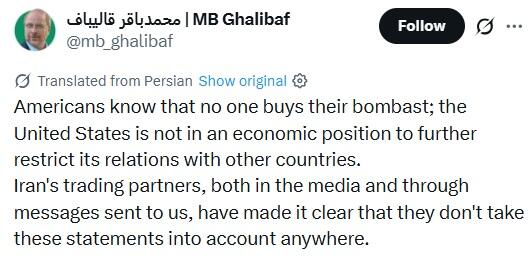
Just hours before the expected Bessent presser where he’s expected to threaten any countries doing business with Iran with severe secondar sanctions (while it remains clear major power like China and Russia won’t readily comply), Iran says it is prepared to attack more foreign tankers in the Strait of Hormuz. The Houthis are in the meantime targeting more Saudi vessels in the Red Sea region.
Tehran announced it has blacklisted 45 tankers for violating its rules to cross Hormuz, while underscoring its intent to take action against future transits and any vessels transferring loads with them. It is demanding ‘fees’ under the Oman-brokered management plan, which Washington has balked at. This comes as the US threatens Iran with “the toughest sanctions in history”.
Iranian response ahead of Bessent presser:
Also being reported by Monday late morning is that Pakistan’s army chief, Field Marshal Asim Munir, held a phone call with President Trump last week wherein the US leader reportedly asked for negotiations with Iran to be opened back up.
Munir has newly arrived in Tehran for talks with Iranian officials, according Tasnim news agency, in what’s clearly ongoing shuttle diplomacy (very indirect, it seems)… amid hopes that future talks could be salvaged.
Big Bessent Iran Presser Set for 2 pm
In the coming hours, the Trump administration is expected to unveil a sweeping campaign to economically isolate Iran and its trading partners, with China likely the primary target. The escalation is designed to force Tehran back to the negotiating table, as its only leverage – the Strait of Hormuz – appears to be quickly eroding. Commercial ships are now transiting the newly opened, US military-supervised shipping corridor off Oman, raising the possibility that Iran has partially lost control of the critical waterway.
Treasury Secretary Scott Bessent told CNBC that he would hold a press conference on Monday to “talk about exactly what we’re going to do” regarding an economic war against Tehran.
“Economic pressure means that we are going to all of our allies, and this is going to be the greatest coordinated economic isolation in the history of the world, and we are going to them and saying, ‘You are either with us or against us,'” Bessent said.
Bessent Claims ‘End Game’ – Tehran Differs
Late Sunday, Bessent wrote on X: “We are now entering the endgame. At dawn begins an economic D-Day, the single greatest financial offensive ever marshaled against an adversary.”
“President Trump has dismantled Iran’s military capabilities, destroyed nearly 100 percent of its military factories, and buried its nuclear program,” Bessent continued.
He noted, “The Islamic Republic has subsisted by dressing extortion as security guarantees. It has drawn strength from a calculus that regards Iranian retaliation as certain and American enforcement as negotiable. Under President Trump, that era is over. And those who fear the danger of defying Tehran ought not to discount the cost of testing Washington.”
President Trump has dismantled Iran’s military capabilities, destroyed nearly 100 percent of its military factories, and buried its nuclear program.
We are now entering the endgame. At dawn begins an economic D-Day — the single greatest financial offensive ever marshaled against…
— Treasury Secretary Scott Bessent (@SecScottBessent) August 23, 2026
Rial Record Low
In markets, Iran’s currency tumbled to a record low. The rial dropped to about 2.02 million per US dollar on the open market (bonbast.com), compared with the central bank’s official rate of roughly 1.5 million.
Even before the US and Israel operation to neuter Iran’s offensive capabilities on Feb. 28, the rial had been under pressure, coupled with persistent double-digit inflation and economic turmoil. Economic conditions have worsened since the US Navy’s blockade of the Strait of Hormuz disrupted trade and government revenue.
The economic shock is increasingly visible across household prices. Rice has jumped 60% in just a few months, while beef prices have soared by 150%. The International Monetary Fund forecasts a 5% contraction in Iran’s economy.
On Friday, Iranian President Masoud Pezeshkian warned of mounting economic pressure on Tehran, while cautioning against “humiliatingly” backing down “before the enemy.”
Truth Social: Iran is Completely Collapsing
Trump posts this short statement on Monday, saying…
BUT… the US has fallen back to merely economic war and sanctions measures, after this:
“The war must come to an end at some point,” Pezeshkian emphasized in a speech quoted by state media. “It is better that we demonstrate our strength and dignity today and tell the world that we have won and that we are ending the war.”
Tehran’s leverage over the critical waterway eroded last week as new data over the weekend showed that commercial transits through the US military-supervised Oman shipping corridor surged 400%. Trump has declared the Strait of Hormuz “an American territory.”
After federal prosecutors charged a Chinese man for registering to vote and casting a ballot under his former landlord’s name, experts are questioning Massachusetts’ verification processes.
Yupeng Sun, a Chinese national living in Andover, allegedly submitted an online voter registration in the name of his former landlord, who was not a U.S. citizen, on Oct. 10, 2024.
Massachusetts regulations – which took effect in June 2023 – require applicants using the state’s online voter registration system to have reliable citizenship information documented in their motor vehicle records before they submit an application online.
If that citizenship documentation is missing, the regulation says the applicant “shall be unable to submit an online application.”
“How did Sun manage to successfully, allegedly, impersonate a green card holder?” Logan Churchwell, research director at the Public Interest Legal Foundation, told The Epoch Times.
“Based on the regulation, a system functioning according to the letter should’ve halted the impersonation at the outset,” he said.
“Massachusetts seems to have everything it needs in place to verify citizenship, but there could be malfunctioning parts needing fixes,” he said.
The Secretary of the Commonwealth’s office has not explained how the application was able to proceed under that requirement.
Prosecutors allege that Sun used his former landlord J.L.’s real name, date of birth, former Malden address, and Massachusetts driver’s license number to register online.
J.L., a Chinese citizen and lawful permanent resident, was not eligible to vote.
The Secretary of the Commonwealth’s office did not respond by publication time to questions about what citizenship information was contained in J.L.’s registry record, how an online application submitted in his identity was able to proceed under the regulation, or whether the state has reviewed the process since learning of the case.
Three weeks after registering, prosecutors allege, Sun went to Malden City Hall, identified himself as J.L., received an early ballot for the presidential election, and signed J.L.’s name on the ballot envelope.
Malden City Clerk Carol Ann Desiderio previously told The Epoch Times that the ballot was processed and counted in the final certified vote. The city had identified no problem with J.L.’s registration or ballot before federal investigators contacted it.
Don Palmer, a former chairman of the U.S. Election Assistance Commission and former state elections director who is now a senior legal fellow at the Heritage Foundation, said election administrators should verify both identity and citizenship before placing an applicant on the voter rolls.
“There needs to be a mechanism to confirm the eligibility of applicants under state and federal law, and you should not simply rely on the assertion of the applicant,” Palmer told The Epoch Times.
Palmer called the allegation that one noncitizen used another noncitizen’s identity to register and cast a ballot an example of inadequate citizenship verification.
He said online registration systems should use existing government records and technology to confirm both identity and eligibility.
“States need to use existing technology and databases available to them to assist in confirming eligibility of voters; otherwise, these failures will continue to hurt voter confidence,” Palmer said.
Charles Stewart III, an MIT political scientist who studies election administration, said the allegations involve unusually extensive identity theft and that determined impersonators can evade many identity safeguards.
Boston Records
The Public Interest Legal Foundation separately provided The Epoch Times with a spreadsheet it compiled from voter records obtained from the City of Boston.
The catalog contains 70 voter registrations that had been canceled because of noncitizenship.
Of those, 22 are marked “Yes” in a column showing whether at least one vote was recorded in the registrant’s name. Sixteen are marked “No,” while 32 don’t have a yes-or-no entry.
In one case, the spreadsheet notes that Boston believed a vote credit may have been mistakenly assigned to the registrant instead of his wife.
Several entries say noncitizenship was discovered through Boston’s annual resident listing. Others identify the Registry of Motor Vehicles as the source of the original voter registration.
The City of Boston did not respond by publication time to questions about how the 70 registrations were identified or whether the individuals associated with the 22 voting histories were noncitizens when those votes were recorded.
The city’s public-records office acknowledged The Epoch Times’ request for the underlying records and said it would work to respond within 10 business days.