52 F
Chicago
Saturday, October 17, 2026
Home Blog Page 1268

Judge Declares Alina Habba’s Roles As US Attorney For New Jersey ‘Unlawful’

0
Judge Declares Alina Habba’s Roles As US Attorney For New Jersey ‘Unlawful’

Authored by Bill Pan via The Epoch Times (emphasis ours),

A federal judge on Thursday found that Alina Habba, a former attorney to President Donald Trump, has been unlawfully serving as the top federal prosecutor in New Jersey since July.

Alina Habba speaks after being sworn in as interim U.S. attorney for New Jersey, in the Oval Office of the White House on March 28, 2025. Pool via AP

“Faced with the question of whether Ms. Habba is lawfully performing the functions and duties of the office of the United States Attorney for the District of New Jersey, I conclude that she is not,” Judge Matthew Brann of the Middle District of Pennsylvania wrote in a 77-page opinion.

“And because she is not currently qualified to exercise the functions and duties of the office in an acting capacity, she must be disqualified from participating in any ongoing cases,” Brann said.

Trump appointed Habba in March as interim U.S. attorney, a role limited to 120 days unless extended by a vote of the district’s judges. When Habba’s term expired in July, the judges opted to replace her with her second-in-command, Desiree Grace. The Justice Department responded by firing Grace and reinstalling Habba, this time designating her as “Special Attorney to the Attorney General.”

By law, interim U.S. attorneys may serve only 120 days before district judges either appoint a temporary successor or the Senate confirms the administration’s nominee. If neither happens, the office’s first assistant may temporarily assume the role. In New Jersey, that would have been Grace, but her removal cleared the way for Habba, now the most senior official in the office, to stay in charge.

The Trump administration took this unusual maneuver as Democrats continue to block the president’s U.S. attorney nominees from getting a full Senate vote. While the administration has extended several interim appointments by sidestepping Senate confirmation and judicial appointment, Habba’s is so far the only one to face a formal legal challenge.

The challenge was brought by three criminal defendants in New Jersey, who argued that Habba lacked legal authority to prosecute them after her 120-day interim appointment ended in July. They asked the court to throw out their indictments, claiming that any case filed under her leadership was invalid.

Brann agreed that Habba had no legal authority but declined to dismiss those charges. Instead, he ruled that anyone who prosecutes them “under the supervision or authority of Ms. Habba” would be subject to disqualification, and that any prosecutorial actions she has made since July 1 should be declared voided.

The case was reassigned to Brann after Michael A. Chagares, chief judge of the Third Circuit Court of Appeals, ordered it moved out of the District of New Jersey. In a brief, one-sentence directive, Chagares said the trial was being transferred to the Middle District of Pennsylvania “in the public interest,” offering no further explanation.

Anticipating an appeal, Brann stayed his ruling and allowed Habba to remain in place while higher courts review the matter.

The Justice Department did not respond to a request for comment by publication time. It has argued that the president has broad discretion to decide who leads U.S. attorney offices.

“The President has made clear that he will not permit anyone other than Ms. Habba to fill the current vacancy in the office of the United States Attorney on a temporary basis. That is his prerogative; this Court cannot second-guess it,” the department wrote in a court filing.

Shortly after Habba took office, she opened an investigation into New Jersey Gov. Phil Murphy over the state’s immigration policies. No charges have been filed so far in connection with the inquiry.

In May, her office charged Rep. LaMonica McIver (D-N.J.) with assaulting federal officers while McIver and two other lawmakers were conducting a “congressional oversight inspection” at an immigration detention center in Newark. Prosecutors allege that McIver tried to block the arrest of Newark Mayor Ras Baraka, who had been barred by federal agents from joining the delegation.

McIver has denied wrongdoing and is seeking dismissal of the case.

Habba’s office also charged Baraka with trespassing, but later dropped the case.

Habba’s office did not respond to a request for comment by publication time.

Tyler Durden
Fri, 08/22/2025 – 13:20

Bill Ackman Is Promoting An Anti-Woke AI-Powered School Coming To New York

0
Bill Ackman Is Promoting An Anti-Woke AI-Powered School Coming To New York

Hedge fund manager Bill Ackman is throwing his support behind Alpha School, a private education network that blends artificial intelligence with an unconventional approach to learning, according to the Wall Street Journal.

The school, which already operates in Texas, Florida, and California, plans to open a kindergarten-through-eighth-grade campus in Manhattan this fall.

Alpha’s model is unusual: students complete math, reading, and other fundamentals in just two hours a day using AI-driven software. The rest of the schedule is filled with activities meant to build confidence and practical skills, such as bike rides or drone workshops.

“We do not let anything—political, social issues—come in the way,” said co-founder MacKenzie Price. “We stay very much out of that.”

Price, who has become a prominent critic of traditional education on social media, launched Alpha more than a decade ago. The school employs “guides” rather than certified teachers and charges families between $40,000 and $65,000 annually, depending on location.

Ackman, best known for running the $20 billion firm Pershing Square, has recently taken on the role of informal booster for Alpha. He first heard about the school earlier this year and was impressed by its reliance on technology and its decision to avoid hot-button debates around diversity, equity, and inclusion. He has since hosted parents at Alpha’s Austin campus and is scheduled to appear on a panel about education at his Hamptons home, alongside Price, Alpha principal Joe Liemandt, and financier Michael Milken.

The Journal writes that though not an investor, Ackman’s enthusiasm has elevated the school’s profile. A person close to Alpha described him as a “de facto ambassador.” On social media, he praised its approach in what some observers saw as a glowing endorsement.

Ackman’s embrace of Alpha fits into his broader criticism of higher education, especially his attacks on Harvard University’s handling of campus antisemitism and its embrace of DEI initiatives. His online campaign against Harvard leadership last year helped push the school’s president to resign.

Alpha plans to expand quickly, with new schools opening in Arizona, North Carolina, Virginia, California, and Puerto Rico. Price has said she may eventually raise outside investment to fund growth, but for now Ackman’s backing is giving the school an influential foothold in New York’s crowded private-education market.

Tyler Durden
Fri, 08/22/2025 – 12:05

US National Security Probe Targets Wind Industry

0
US National Security Probe Targets Wind Industry

By Julianne Geiger of OilPrice.com

The Commerce Department just opened a Section 232 “national security” probe into imported wind turbines and parts—quietly on Aug. 13, publicly today. That matters because 232 isn’t a press release; it’s a legal on-ramp to more tariffs on top of the new 50% duty already applied to the steel and aluminum content in turbines and components.

Here’s the operational read: the U.S. wind build is heavily import-dependent for blades, drivetrains, and electrical systems. In 2023, the U.S. brought in about $1.7B of wind equipment, with roughly 41% from Mexico, Canada, and China. If you tax the metal inside the machine—and potentially layer more 232 duties later—you squeeze project profit margins, renegotiate Power Purchase Agreements (PPAs—long-term contracts to sell the power), or delay FIDs. None of those outcomes lowers your Levelized Cost of Energy (LCOE—think of it as the average lifetime price per unit of electricity once you add up all the costs).

Wood Mackenzie pegs the tariff bite at +7% for turbine costs (+5% total project costs) under the earlier tariff proposals; in a universal 25% tariff scenario, turbine costs could rise ~10% and LCOE up ~7%. And that was before Commerce slapped a 50% surcharge on the steel/aluminum content—so the floor just moved higher. Expect original equipment manufacturers to reroute supply chains, localize sub-assemblies, and raise prices anyway. Vestas has already said the quiet part out loud: these costs flow straight through to electricity prices.

Don’t confuse this with an offshore-only story. Onshore wind is where the bulk of U.S. volume lives, and it’s far more sensitive to every $/kW swing, gearbox delivery delay, and tower steel price jump. Section 232 is also being deployed against other “critical” imports (planes, chips, pharma), so wind isn’t a one-off carve-out—it’s part of a broader, durable trade posture that project finance now has to underwrite.

Winners and losers? Near-term winners include U.S. tower fabricators and any blade/drivetrain maker who can credibly and quickly localize. Losers are developers stuck with fixed-price PPAs and engineering firms with thin contingencies. Grid bottlenecks and permitting are still the bigger choke points, but tariffs aren’t a rounding error anymore—they’re line-item pain.

The probe suggests that “buy more domestic, pay more near-term” is policy, not rhetoric. Expect delayed Commercial Operation Dates (CODs—the day projects actually flip the switch and start earning revenue), tougher PPA negotiations, and a faster push to U.S. content. Wind still looks okay economically on paper, just with a higher metal cost and a thinner margin for error.

Tyler Durden
Fri, 08/22/2025 – 11:45

Trump Laments Stalled Ukraine Peace Talks While Simultaneously Urging New Attacks On Russia

0
Trump Laments Stalled Ukraine Peace Talks While Simultaneously Urging New Attacks On Russia

Now, merely a week out from when Presidents Trump and Putin met in Alaska, the White House’s admirable peace efforts seem to be unraveling and even hopelessly stalled. Many independent-minded analysts had from the very start said that this conflict will ultimately be settled on the battlefield. The Wall Street Journal too seems to be coming around to this view:

On Monday, President Trump boasted about quickly brokering peace to end the bloody Ukraine conflict. By Thursday, he was saying that Kyiv had no chance of winning the war without new attacks on Russia.

“It’s like a great team in sports that has a fantastic defense, but is not allowed to play offense,” Trump posted on social media. “Interesting times ahead!!!”

His turnaround underscored the fading optimism about Trump’s latest push to end the war.

Indeed this is another example of the West trying to have its cake and eat it too, as Trump strongly hints that Ukraine must take the offensive while simultaneously lamenting that Putin and Zelensky are not getting together in a hoped-for summit.

Trump is essentially saying Ukraine cannot win the war unless it launches attacks on Russia.

Associated Press/CBC

“It is very hard, if not impossible, to win a war without attacking an invaders country,” Trump had explained further in his Truth Social statement.

The WSJ in its analysis then turns to one of the big factors which is sure to stymie talks from Moscow’s point of view: security guarantees for Ukraine:

U.S. and European officials are still negotiating the makeup of a peacekeeping force that would aim to deter future Russian attacks against Ukraine if a peace deal was reached. Even that idea was quickly rebuffed by the Kremlin and raised questions about Trump’s willingness to commit to a major role for the U.S. military.

With much of his plans still unrealized, Trump is confronted with the uncertainties that have dogged him for the past seven months: How willing is he to pressure Putin, and how far is he willing to go in backing Zelensky?

As we highlighted before, the ‘logic’ of this is contradictory and will lead nowhere. Why would Russia agree to end its military operations if in the end NATO-like ‘security guarantees’ are to be given to Ukraine as a reward?...to quote Moon of Alabama.

Meanwhile, Russian Foreign Minister Sergey Lavrov reminded the US and its Western allies on Thursday that President Putin has “repeatedly said that he is ready to meet, including with Zelensky, if there is understanding that all issues that require consideration at the highest level have been worked out thoroughly” by experts and ministers.

To translate, Putin will only sit down with Zelensky if they are already at the goal line of having worked out a permanent peace deal. This has been reiterated in a Friday foreign ministry statement:

LAVROV: PUTIN-ZELENSKY MEETING NOT PLANNED YET — KREMLIN SAYS SUMMIT POSSIBLE ONLY AFTER AGENDA IS AGREED

And as RT outlines further, “Moscow maintains that any lasting settlement must eliminate the root causes of the conflict, address Russia’s security concerns, and recognize current territorial realities, including the status of Crimea and the four former Ukrainian regions that voted to join Russia in 2022.” This means there must be the permanent neutrality of Ukraine, the formal ceding of territories, and that the Russian neighbor cease being militarized by NATO.

Reuters also describes, “Vladimir Putin is demanding that Ukraine give up all of the eastern Donbas region, renounce ambitions to join NATO, remain neutral and keep Western troops out of the country, three sources familiar with top-level Kremlin thinking told Reuters.”

And per Bloomberg: “A full ceasefire or peace agreement in Ukraine remains unlikely this year, with even the prospect of a partial truce fading, according to JPMorgan emerging market and policy strategists.”

Tyler Durden
Fri, 08/22/2025 – 11:25

Supreme Court Allows Trump Admin To Revoke DEI-Related NIH Grants

0
Supreme Court Allows Trump Admin To Revoke DEI-Related NIH Grants

By Matthew Vadum of Epoch Times,

The Supreme Court voted 5–4 on Aug. 21 to allow the National Institutes of Health (NIH) to cancel hundreds of millions of dollars in research grants linked to diversity, equity, and inclusion (DEI) initiatives.

The new ruling clears the way for the funding reductions while litigation over the grants continues in the lower courts.

The justices filed five separate opinions explaining their votes.

Justices Clarence Thomas, Samuel Alito, Neil Gorsuch, Brett Kavanaugh, and Amy Coney Barrett voted to allow the grants to be cut.

Justices Sonia Sotomayor, Elena Kagan, Ketanji Brown Jackson, and Chief Justice John Roberts voted to deny the government’s request to rescind the funding.

The high court said it acted because the federal government faces the possibility that the grant monies, once paid out, may not be recovered.

Moreover, “the plaintiffs do not state that they will repay grant money if the Government ultimately prevails.”

The case is known as National Institutes of Health v. American Public Health Association.

The Department of Justice filed an emergency application with the nation’s highest court late last month, asking the justices to block a ruling by Boston-based U.S. District Judge William Young, who found the cancellation was unlawful and ordered the government to restore the funding.

NIH began taking steps in February to end the grants that conflict with President Donald Trump’s policy priorities.

The NIH is the world’s largest government funder of biomedical research.

The emergency application stemmed from two lawsuits challenging the cuts to grants involving DEI, “transgender issues,” “vaccine hesitancy,” and other issues.

The American Public Health Association described the cuts as an “ongoing ideological purge” of projects with a purported connection to gender identity, DEI, or “other vague, now-forbidden language.” A coalition of 16 attorneys general, largely Democrats, alleged their public research institutions are facing harm because of the funding delays and cuts.

The district court directed the NIH “to continue paying $783 million in federal grants that are undisputedly counter to the Administration’s priorities,” the department said in its filing.

“Following the change in Administration, the NIH identified, explained, and pursued new funding priorities. That is democracy at work, not, as the district court thought, proof of inappropriate ‘partisan[ship]’—let alone a permissible basis for setting agency action aside.”

In his written opinion, Gorsuch said the district court’s ruling upholding the grants conflicted with the Supreme Court’s decision in Department of Education v. California in April that let the Trump administration withdraw education-related grants.

“Lower court judges may sometimes disagree with this Court’s decisions, but they are never free to defy them,” Gorsuch said.

Unless we want anarchy to take over the federal judicial system, “a precedent of this Court must be followed by the lower federal courts no matter how misguided the judges of those courts may think it to be,” Gorsuch said, quoting a prior Supreme Court ruling.

In his dissenting opinion, Roberts said the district court ruling was justified.

“This relief—which has prospective and generally applicable implications beyond the reinstatement of specific grants—falls well within the scope of the District Court’s jurisdiction under the [federal] Administrative Procedure Act.”

Sotomayor, Kagan, and Jackson joined the dissent in part.

In her dissenting opinion, Jackson said the high court’s new ruling is “Calvinball jurisprudence with a twist,” a reference to a fictional game featured in the comic strip, “Calvin and Hobbes.”

“Calvinball has only one rule: There are no fixed rules. We seem to have two: that one, and this Administration always wins,” she said.

Tyler Durden
Fri, 08/22/2025 – 11:05

Cracker Barrel’s Board Should Fire The CEO Immediately

0
Cracker Barrel’s Board Should Fire The CEO Immediately

Submitted by QTR’s Fringe Finance

Cracker Barrel is learning the same lesson Bud Light did: fat, bearded, gun toting middle Americans not only dislike change — especially the “woke” kind — but will also turn on you for taking a staple brand they love and pile-driving it into the ground.

Today Cracker Barrel’s stock cratered more than 10% after the company unveiled a rebrand that scrapped its iconic barrel-and-man logo in favor of a sterile, text-only “woker” design minus the old white guy and the…well, cracker barrel.

Cracker Barrel gets a new look

The move, pushed by CEO Julie Felss Masino, has triggered furious backlash from customers, conservatives, and investors alike, with many calling it the chain’s “Bud Light moment. And me, just calling it grossly f**king incompetent.

I mean, honestly. How do you become goddamn CEO of Cracker Barrel without understanding that this is your demographic? If you asked me to find me a woke Democrat in this crowd, I couldn’t. If you asked me to find someone who does their own plumbing or shot a deer before 6AM the day this photo was taken, I could simply point to anyone — including the women.

How does the company’s CEO just not walk into one of their own restaurants and open their eyes? How does she not understand that nobody has ever said, “Let’s pull off at Exit 49 for a plate of woke minimalism.”

People go for biscuits the size of baseball mitts, kitschy décor that hasn’t changed since Nixon, and that faint smell of maple syrup soaked into the walls. Instead, the CEO has singlehandedly torched decades of brand identity with a text-only logo that looks like it was spit out by a bored intern with Microsoft Word.

The backlash has been ferocious. Meanwhile, CEO Julie Felss Masino is insisting the feedback has been “overwhelmingly positive,” which is corporate-speak for “I muted my notifications yesterday morning and set my e-mail to my ‘out of office’ reply”.

This is the executive leading a $700 million “modernization” push to swap cozy country stores for sterile farmhouse chic. In other words, the woman who thought you could make Cracker Barrel better by making it look less like Cracker Barrel.

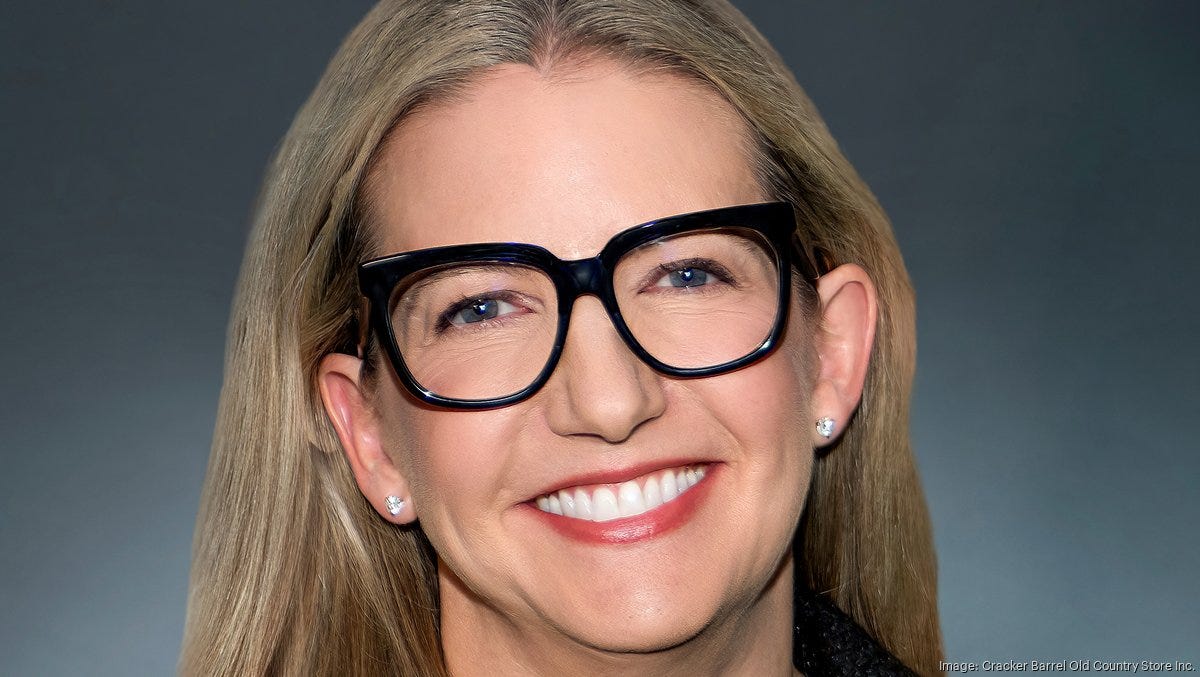
Cracker Barrel CEO Julie Felss Masino plans remodel, menu changes - Bizwomen

Masino’s vision is essentially to strip away the hokey charm and replace it with something she clearly believes will appeal to “younger, more diverse diners.” The menu is being tinkered with too—lighter options, healthier twists, a nod to “evolving tastes.”

But here’s the obvious question: did she learn nothing from Bud Light? After watching the number-one beer in America self-immolate by alienating its core base, Masino still thought bulldozing nostalgia in favor of bland “relevance” was a stroke of genius?

That’s not bold leadership—that’s corporate malpractice.

Forget about not having a case study back at Harvard Business School to remember. Bud Light walked this exact plank literally just 2 years ago when it decided to suddenly pivot into a progressive rebrand via Dylan Mulvaney.


🔥 50% OFF FOR LIFE: Using this coupon entitles you to 50% off an annual subscription to Fringe Finance for life: Get 50% off forever


The fallout was brutal: sales cratered, Modelo swooped in as the new king of American beer, and over a year later Bud Light is still limping like a horse that should have been put down. Ex-Anheuser-Busch execs admit it hasn’t recovered at all. And here’s the kicker—once you lose that loyal customer, they don’t come back. People who think salisbury steak is gourmet eating will switch to Modelo or, in Cracker Barrel’s case, literally any other highway diner, and they’ll never think twice about it.

The stock immediately plunging more than 10% should be all the impetus the board of directors needs to show Julie Felss Masino the door immediately and try and save its brand. How can anyone with a straight face defend this gamble after the smoking ruins of Bud Light and even Jaguar’s own branding fiascos showed what happens when you gut your brand’s entire identity to chase “relevance”?

This isn’t bold leadership, it’s gross incompetence. In one trading session she managed to vaporize over $100 million in shareholder value. One day. So the $700 million renovation now has costed $800 million. If wiping out nine figures in value with a single rebrand isn’t grounds for termination, what exactly is?

QTR’s Disclaimer: Please read my full legal disclaimer on my About page here. This post represents my opinions only. In addition, please understand I am an idiot and often get things wrong and lose money. I may own or transact in any names mentioned in this piece at any time without warning. Contributor posts and aggregated posts have been hand selected by me, have not been fact checked and are the opinions of their authors. They are either submitted to QTR by their author, reprinted under a Creative Commons license with my best effort to uphold what the license asks, or with the permission of the author.

This is not a recommendation to buy or sell any stocks or securities, just my opinions. I often lose money on positions I trade/invest in. I may add any name mentioned in this article and sell any name mentioned in this piece at any time, without further warning. None of this is a solicitation to buy or sell securities. I may or may not own names I write about and are watching. Sometimes I’m bullish without owning things, sometimes I’m bearish and do own things. Just assume my positions could be exactly the opposite of what you think they are just in case. If I’m long I could quickly be short and vice versa. I won’t update my positions. All positions can change immediately as soon as I publish this, with or without notice and at any point I can be long, short or neutral on any position. You are on your own. Do not make decisions based on my blog. I exist on the fringe. If you see numbers and calculations of any sort, assume they are wrong and double check them. I failed Algebra in 8th grade and topped off my high school math accolades by getting a D- in remedial Calculus my senior year, before becoming an English major in college so I could bullshit my way through things easier.

The publisher does not guarantee the accuracy or completeness of the information provided in this page. These are not the opinions of any of my employers, partners, or associates. I did my best to be honest about my disclosures but can’t guarantee I am right; I write these posts after a couple beers sometimes. I edit after my posts are published because I’m impatient and lazy, so if you see a typo, check back in a half hour. Also, I just straight up get sh*t wrong a lot. I mention it twice because it’s that important.

Tyler Durden
Fri, 08/22/2025 – 10:25

Trump ‘Will Fire Cook’ If She Doesn’t Resign After Pulte Drops New Receipts

0
Trump ‘Will Fire Cook’ If She Doesn’t Resign After Pulte Drops New Receipts

Update: President Trump just told reporters in Washington DC that he’ll fire Cook if she doesn’t resign. 

Developing…

*  *  *

Days after Federal Housing Finance Agency (FHFA) Director Bill Pulte wrote a letter to Attorney General Pam Bondi claiming Federal Reserve Governor Lisa Cook “falsified bank documents and property records to acquire more favorable loan terms” by claiming two homes as her primary residence, Pulte dropped new evidence on Friday suggesting that Cook lied again on a government form. 

“We have obtained a document Lisa Cook submitted to the U.S. Government while serving as Federal Reserve Governor. In it, on February 28, 2023, she represents to the U.S. Government that the Atlanta Property is her PERSONAL RESIDENCE,” Pulte wrote on X. “However, Lisa Cook, as a then-sitting Fed Governor and six months earlier, on September 1, 2022, appears to have listed that same property for RENT.”

Here are the ‘receipts’ spread out for your perusal: 

Recall that Cook listed the Atlanta Condo has her “Primary Residence” at the same time she was claiming a property in Michigan as her primary residence. 

Last week Pulte wrote a letter to Bondi and DOJ official Ed Martin suggesting that Cook may have committed a criminal offense. The letter alleges that Cook “falsified bank documents and property records to acquire more favorable loan terms, potentially committing mortgage fraud under the criminal statute.”

Bloomberg reports that Pulte said Cook took a mortgage on a property in Ann Arbor, Michigan, signing a mortgage agreement that stipulated she would use the property as her primary residence for at least a year.

Two weeks later, according to the letter, she took another mortgage on a Georgia property and also declared it would be her primary residence.

Pulte also called on Bondi to look into whether Cook misrepresented her circumstances by later listing the Georgia property for rental.

The letter prompted President Trump to respond, demanding “Cook must resign, now!!” 

Cook responded to the accusations; 

“I have no intention of being bullied to step down from my position because of some questions raised in a tweet,” Cook said in a statement.

“I do intend to take any questions about my financial history seriously as a member of the Federal Reserve and so I am gathering the accurate information to answer any legitimate questions and provide the facts.”

Of note, she was nominated to the Fed by President Joe Biden and took office in 2022, becoming the first Black woman to serve on the Fed’s board of governors.

She was later nominated by Biden for a full term, which expires in 2038.

Tyler Durden
Fri, 08/22/2025 – 10:10

Bonds & Bullion Bid As Fed Chair Powell Delivers ‘Dovish’ Remarks From Jackson Hole

0
Bonds & Bullion Bid As Fed Chair Powell Delivers ‘Dovish’ Remarks From Jackson Hole

Update (1000ET): Well, Powell surprised many with a notably dovish tilt:

  • *POWELL: SITUATION SUGGESTS DOWNSIDE RISKS TO EMPLOYMENT RISING

  • *POWELL: SHIFTING BALANCE OF RISKS MAY WARRANT ADJUSTING POLICY

Powell recognizes that the employment picture is significantly worse…

Here’s the key paragraph:

Putting the pieces together, what are the implications for monetary policy?

In the near term, risks to inflation are tilted to the upside, and risks to employment to the downside—a challenging situation. When our goals are in tension like this, our framework calls for us to balance both sides of our dual mandate.

Our policy rate is now 100 basis points closer to neutral than it was a year ago, and the stability of the unemployment rate and other labor market measures allows us to proceed carefully as we consider changes to our policy stance.

Nonetheless, with policy in restrictive territory, the baseline outlook and the shifting balance of risks may warrant adjusting our policy stance.

This sent stocks, gold, and bond (prices) higher…

Small Caps are leading the charge (up 3%)…

And the dollar notably lower…

And rate-cut odds spiked…

The rest of the statement is just Powell undoing FAIT policy from the 2020 Jackson Hole speech.

Full speech below:

*  *  *

The big day has finally arrived as Fed Chair Powell delivers what will be his last speech from the wilds of Wyoming.

The big question here is whether he will specifically set up a September rate cut. At his last press conference, on July 30, Powell declined to tip his hand on whether he expected to move in September.

At that July press conference, Powell highlighted that several economic reports were due before the September meeting.

“We’ll be taking that information into consideration and all the other information we get as we make our decision at the September meeting,” he said back then.

What have the reports shown?

Most memorably, that the job market looks much weaker than it did on July 30.

Major data revisions showed the average three-month payroll gain went from 150,000 before the July employment report to just 35,000.

Amid much speculation of what he will offer up to the market gods amid the summer doldrums, Goldman Sachs expects Powell to modify his statement from the July FOMC press conference that the FOMC is “well positioned” to wait for more information.

Instead, he might note that the FOMC is well positioned to address risks to both sides of its mandate but emphasize that downside risks to the labor market have grown following the July employment report, while reiterating that tariffs are likely to have only a one-time effect on the price level.

We expect the FOMC to partially reverse some of the changes it made in 2020, as it has foreshadowed in the minutes to its recent meetings.

Specifically, we expect the FOMC to return to saying that it will respond to “deviations” from maximum employment in both directions rather than just to “shortfalls” or to at least water down the shortfalls language and to return to flexible inflation targeting (rather than flexible average inflation targeting) as its main strategy while retaining the option to use a make-up strategy at the zero lower bound.

Bottom line, Goldman does not expect Powell to decisively signal a September cut, but the speech should make it clear to markets that he is likely to support one.

We suspect that most FOMC participants who have expressed mixed feelings about cutting in September will be willing to support a cut if Powell pushes for one, but that he will think it more reasonable to make that case to them closer to the meeting with more data in hand

Additionally, Academy Securities, Peter Tchir expects Powell to push back on the “labor market is weak” narrative (which Tchir continues to believe is true and why the Fed should be cutting in September).

Economists seem to be honing in on a “replacement rate” level of hiring, in the 50k to 80k range.

That seems low and if discussed, will likely agitate the President as numbers less than 100k as the level of hiring required to keep the unemployment rate stable, just don’t seem that exciting.

Even if the Fed plans to cut, they would like it to be a bit of a surprise (keeping the probability of a rate cut at the next meeting closer to 50 than 100 likely suits them best).

If Powell is able to convince markets jobs are comfortable but inflation isn’t, look for bond yields to go higher, dragging stocks down with them.

Some of this already has been priced in, so the move should be “normal” in size, rather than some outlier.

Recent news on the AI/Data Center side seems to have slowed the excitement for investing in those sectors a little this week.

The market’s reaction to Powell’s has been varied over the years…

Watch the full speech live here (due to start at 1000ET):

Meanwhile, here’s a Bingo Card to play along (via Bloomberg)


Tyler Durden
Fri, 08/22/2025 – 09:45

In The Global Trade War “The EU Clearly Has Joined The US Camp”

0
In The Global Trade War “The EU Clearly Has Joined The US Camp”

By Bas van Geffen, senior macro strategist at Rabobank

Picking Sides

Yesterday, the EU and the US finally released a joint statement on trade. The statement further decreases trade uncertainty, as both sides were still locked into talks over some of the details. In the end, the EU did make several regulatory concessions to the US. However, European legislation on e.g. digital services was less of a blocking issue than some had feared.

The joint statement confirms that 15% is the base tariff, which will also apply to European pharmaceuticals and semiconductors from September 1. As we noted before, that’s a significant increase from the current 0% rate. Having said that, this coming into effect little over a week from now also reduces any lingering risk that these two sectors would temporarily be subject to much higher Section 232 tariffs that Trump is still due to announce.

The auto industry will have to wait a little longer: the US will cut the tariff on European cars only after the EU “formally introduces the necessary legislative proposal to enact the tariff reductions” on US industrial goods and certain food and agri exports – and extends the 2020 ‘lobster deal’ that expired July 31.

The statement also keeps the door open to quota for steel and aluminium exports, to safeguard US and EU supply chains. More importantly, Washington and Brussels will coordinate actions to “ring fence” their domestic steel and aluminium markets from overcapacity. That’s a thinly veiled way of not saying China?

If you need more proof of that, the two sides have also agreed to strengthen their cooperation related to export restrictions on critical minerals and similar resources by third countries, to address non-market policies of third parties, and to cooperate on inbound investment reviews as well as duty evasion.

Add to this the European commitment to align with US technologies and the purchase of US defense equipment, and the EU clearly has joined the US camp.

Although the joint statement further reduces trade uncertainty, we still expect foreign demand for European goods to be more muted in the coming quarters. Nonetheless, the European purchasing managers’ indices were better than expected. And the positive surprise in the August survey was entirely led by European manufacturing. It is somewhat remarkable that the manufacturing sector, which should be hardest hit by tariffs and trade uncertainty, has steadily improved since the start of the year.

Frontrunning of Trump’s tariffs may have helped European exports in the first half of the year, but the flipside of that frontloading should be weaker export performance in the coming period. In fact, the August survey suggests that the improvement was entirely home-grown. European manufacturers reported an increase in new orders for the first time in 14 months – despite a fall in new export orders.

Day ahead

Today’s key event is the Fed’s annual conference in Jackson Hole. Several central bankers have travelled to Wyoming, including ECB President Lagarde, the Bank of England’s Bailey and Governor Ueda from the Bank of Japan. But the key speaker is Fed Chair Powell.

Powell has so far maintained that more data is needed before the policy rate can be lowered further. And the minutes from the last FOMC meeting revealed this week that a majority of policymakers are still waiting for more clarity on the potential inflationary impact of Trump’s tariffs.

There is still no convincing evidence that consumer prices are being affected by the higher tariffs, but since the July policy meeting, the producer price index has shown the first signs of upward price pressures. It remains unclear to what extent this will be passed on to consumers, and how persistent these price pressures will be. But, since that meeting, it has also become evident that the labor market has been significantly weaker in recent months than previously thought.

So, the Fed is caught between inflation risks and concerns about the labor market. Driven by the weak jobs report, markets are pricing a 70% chance that the Fed will lower rates in September. Several FOMC members have recently hinted at this as well. But what does Powell think? If he still insists that more data is needed, the market may revise the probability of a rate cut.

But will Powell be very outspoken today? The Fed Chair is not only torn between the two objectives of its dual mandate; the Trump administration continues to chip away at the independence of the central bank.

In addition to Trump’s verbal attacks on the Fed chair, the president is also trying to undermine Powell’s position from within the FOMC. Trump already has a some allies within the Fed. Bowman and Waller dissented in July, and he has nominated Miran, one of his confidants, to (temporarily) join the FOMC starting in September.

But Miran’s seat is the only one Trump can fill with certainty in the coming years, since Powell can technically stay on as a regular member of the FOMC after his term as chair ends. And that’s not enough for Trump to tighten its grip on the central bank.

So, Trump and his allies have now launched an attack on Lisa Cook. The Department of Justice indicated it plans to investigate her over alleged fraud. A DoJ official “encouraged” Powell to immediately remove Cook from the central bank’s board “before it is too late!” – but Powell does not have the authority to do so.

The ECB releases its estimate of Q2 negotiated wages. The Bundesbank reported a strong rebound in German wages. That should lift the eurozone average, which in turn should further reduce the prospect of additional monetary easing.

Tyler Durden
Fri, 08/22/2025 – 09:25

Obama Judge Orders Dismantling Of Alligator Alcatraz, Relocation Of Detainees

0
Obama Judge Orders Dismantling Of Alligator Alcatraz, Relocation Of Detainees

A federal judge has ordered the dismantling of major components of “Alligator Alcatraz,” the detention center for illegal immigrants recently built in the Florida Everglades. Judge Kathleen M. Williams of the Federal District Court in Miami also ruled that no new detainees may be brought to the facility, and current detainees must be relocated within 60 days.  

At its heart, the Thursday-night ruling has nothing to do with the management of illegal immigrants. The lawsuit that led to the decision was filed the Center for Biological Diversity, the Miccosukee Tribe and Friends of the Everglades, with the three organizations accusing federal agencies and Miami-Dade County of violating the National Environmental Policy Act (NEPA). Specifically, Williams sided with the plaintiffs in concluding that the building of Alligator Alcatraz proceeded without the environmental review required by NEPA. 

Seen here on July 4, the “Alligator Alcatraz” detention facility is about 40 miles west of Miami and 60 miles east of Naples. (AP Photo/Rebecca Blackwell)

“[Defendants] consulted with no stakeholders or experts and did not evaluation of the environmental risks,” wrote the 68-year-old Williams, who was appointed by President Obama in 2011. “There weren’t ‘deficiencies’ in the agency’s process. There was no process.” Williams pointed to “a myriad of risks” to the Everglades environment, including wastewater discharge and rain runoff.  

Florida’s Division of Emergency Management appealed the ruling almost immediately after it was released. Florida and the Trump administration had argued there was no environmental impact to consider, because there was already an airstrip on the site before they turned it into Alligator Alcatraz. The judge, however, said the transformation of the site was on a scale that dramatically changed the environmental implications. The new lighting, for example, reduced the Florida panther’s habitat by 2,000 acres. “The project creates irreparable harm in the form of habitat loss and increased mortality to endangered species in the area,” wrote Williams.

Judge Kathleen Williams graduated from Duke University and University of Miami School of Law

In a statement issued after the ruling, Paul Schwiep, who represented Friends of the Everglades and Center for Biological Diversity, offered his own depiction of the project:

“The state and federal government paved over 20 acres of open land, built a parking lot for 1,200 cars and 3,000 detainees, placed miles of fencing and high-intensity lighting on site and moved thousands of detainees and contractors onto land in the heart of the Big Cypress National Preserve, all in flagrant violation of environmental law.”

Williams said Florida and the federal government “offered little to no evidence” as to why the facility had to be built in the Everglades. “[It’s] apparent …that in their haste to construct the detention camp, the state did not consider alternative locations.” Florida had argued that the facility is purely a state enterprise, exempting it from NEPA’s environmental-review provisions. Williams, however, said the facility falls under NEPA because it operates with federal funding and direction” 

President Trump and Homeland Security Secretary Kristi “ICE Barbie” Noem toured Alligator Alcatraz on July 1 (Andrew Caballero-Reynolds AFP via Getty and People)

Though it’s a preliminary injunction as the case is further litigated, Williams set a 60-day deadline for Florida and the feds to remove current detainees and to start dismantling critical features of the facility, including fencing, lighting and power generators. A temporary restraining order issued on Aug 7 had already prohibited additional construction, including filling, paving and installation of new lighting and other infrastructure.  

Alligator Alcatraz is the first state-run facility that houses people detained by the federal government. Several other Republican-led states have moved toward creating their own versions, complete with similarly creative nicknames. Earlier this month, Indiana announced it had made an agreement with the Department of Homeland Security to add 1,000 beds for illegal immigrants at the Miami Correctional Facility in Bunker Hill — calling it the “Speedway Slammer.” On Tuesday, Nebraska announced plans for a “Cornhusker Clink.” 

“This ruling affirms what we argued in court — that the government can’t just build something in the middle of the Everglades and the Big Cypress preserve with no environmental review, and no public input,” said Tania Galloni, managing attorney for the Florida office of Earthjustice. Ahead of the ruling, Florida Gov. Ron DeSantis sounded pessimistic about his prospects: “It’s pretty clear we’re in front of a judge who is not going to give us a fair shake on this.”

Tyler Durden
Fri, 08/22/2025 – 09:05