53.5 F
Chicago
Thursday, October 22, 2026
Home Blog Page 1382

Vaccination Rates Are Stagnating

Vaccination Rates Are Stagnating

Data published last week by the World Health Organization (WHO) and UNICEF confirm that global vaccination coverage has stagnated in recent years.

In 2024, 14.3 million children worldwide were classified as “zero-dose”, meaning they had not received a single vaccine.

This number has barely changed over the past two years (14.5 million in 2022) and remains higher than the 12.8 million recorded in 2019, before the Covid-19 pandemic disrupted health services.

More than half of these unvaccinated children live across around 30 countries currently affected by fragility, conflict or other vulnerabilities.

As Statista’s Anna Fleck shows in the following chart, the percentage of children who received three doses of the DTP vaccine (which protects against diphtheria, tetanus, and pertussis) stood at 85 percent in 2024. This is slightly below from the 86 percent reached between 2016 and 2019.

Infographic: Vaccination Rates Are Stagnating | Statista

You will find more infographics at Statista

Vaccination rates for other diseases have also stagnated: polio coverage remained at 84 percent in 2024 (down from 86 percent between 2017 and 2019), and tuberculosis vaccination held steady at 88 percent (compared to a peak of 90 percent in 2017 and 2018).

As for measles, global coverage improved significantly between 2004 and 2016 but has since slowed.

In 2024, the global measles vaccination rate reached 76 percent, up from 71 percent in 2019, yet still well below the 95 percent threshold needed to effectively prevent outbreaks.

According to the WHO, 60 countries experienced “major or disruptive” measles outbreaks in 2024 – nearly double the number recorded in 2022.

The primary reason for low vaccination coverage remains limited access to vaccines in certain regions.

However, the WHO also highlights the growing threat posed by misinformation about science and vaccines.

Tyler Durden
Tue, 07/22/2025 – 22:10

Trump Announces “Largest Trade Deal Ever” With Japan, Sets Tariffs Rate At 15%; JGBs Plunge

Trump Announces “Largest Trade Deal Ever” With Japan, Sets Tariffs Rate At 15%; JGBs Plunge

President Donald Trump announced on Truth Social that he reached a “massive” trade deal with Japan that will set tariffs on Japanese imports at 15% and see the key American trading counterpart and ally invest $550 billion into the US (with about the same likelihood of doing so as Stargate is to invest $500 billion in US AI technology) .

“I just signed the largest trade deal in history, I think maybe the largest deal in history — with Japan,” Trump said at an event at the White House on Tuesday after announcing the deal on social media. “And that was done with Japan. They had their top people here and we worked on it long and hard and it’s a great deal for everybody.” 

On Truth Social, Trump explained that the pact calls for Japan to “open their Country” to US automobile imports, as well as additional agricultural imports including rice – a remarkable achievement with a country which has historically been extremely protectionist of the food staple – without specifying further. Trump has repeatedly zeroed in on auto trade as he criticizes trade imbalances with the country. Around 80% of Japan’s trade surplus with the US is in cars and auto parts.

Additional details of the preliminary agreement with Japan – including, critically, if Japanese automobiles and parts would receive a carve-out from separate 25% tariffs – were not immediately available. Trump originally threatened to place a 24% tariff on Japanese imports earlier this year, a proposal viewed as “extremely disappointing” by Ishiba. He later amended that threat to 25% in a letter earlier this month.

The issue of automobiles has been a particular sticking point in trade negotiations between the two countries. US trade negotiators have pushed Japan and other countries to accept cars built to US federal motor vehicle safety standards, rather than subjecting them to differing requirements. Meanwhile, negotiators from Japan and other countries have pushed for exemptions to Trump’s existing 25% levies on autos and auto parts. 

It was not immediately clear Tuesday if any such carveout would be established for Japan, like a planned tariff-rate quota for steel imported from the UK. Japanese public broadcaster NHK said Washington would set the rate on the auto sector at 15%, citing an unidentified government official. Shares in Japanese carmakers jumped in Tokyo trading with Toyota rising more than 10%.

Japanese-based car companies have made significant plans to invest in the US, including Isuzu Motors Ltd.’s $280 million investment in a new facility in South Carolina, and Toyota Motor Corp.’s $88 million commitment to boost production of hybrid vehicles. The US has also offered tariff relief for auto companies that assemble cars in American facilities, part of a broader effort to bring offshore manufacturing to the US.

“Japan and the US have been conducting close negotiations with our national interests on the line,” Japanese Prime Minister (and lame duck) Shigeru Ishiba said in Tokyo, just two days after suffering a huge loss for his LDP party. “The two nations will continue to work together to create jobs and good products.”

According to local media reports, the Japanese premier was linking his shaky political future to developments in the talks following the huge election setback this weekend, although when asked about the trade deal he just signed, it’s almost as if he knew nothing about it, instead telling reporters he needs to look closely at the details of agreements with the US, and that he’ll be getting further updates from his chief trade negotiator, Ryosei Akazawa

This was reminiscent of the US president’s approach: Trump has previously announced trade frameworks without many specifics only for the White House to provide details days and weeks later, as terms are hammered out.

Trump indicated at the event with Republican lawmakers at the White House that he also expects to sign a deal on a joint venture with Japan to export LNG from Alaska.

The deal with Japan came just hours after Trump announced he had reached an agreement with the Philippines, setting a 19% tariff on the country’s exports (down a whopping percent from the previous 20%). 
The flurry of activity comes days before the Aug. 1 deadline for imposing so-called “reciprocal” tariffs that will hit dozens of trading partners. 

Trump first announced the plan for sweeping tariffs on nearly every US trading partner in April, only to quickly put them on hold for 90 days amid market backlash in order to work out agreements. But that stretch saw the US finalize only a handful of deals and Trump instead moved to unilaterally impose rates on countries and blocs before the looming deadline.

While talks continue with major economies including the European Union and India, Trump said some 150 smaller countries will be hit with a blanket rate of between 10 and 15%.

The yen fluctuated in early Tokyo trading, before strengthening again after the NHK report on the auto tariffs. Japanese stocks on the Topix benchmark index rose as much as 2.5% and US equity futures edged higher. 

The talks came after eight rounds of negotiations, and a week after Bessent visited Japan to lead the US delegation to the World Expo in Osaka. Japan had its upper house elections on Sunday, and while losses there significantly weakened Ishiba’s domestic position, the prime minister has cited the trade talks as one of the reasons why he needs to stay on.

In kneejerk response, this is how most asset classes reacted to the news: 

  • JPY initially firmed 30bp but then unwound all of the knee-jerk reaction; it then strengthening again after the NHK report on the auto tariffs, before also reversing that gain. 
  • Japanese stocks on the Topix benchmark index rose as much as 2.5% and US equity futures edged higher. 
  • US Treasury futures are offered at 111-09
  • S&P futures popped 20bp and have largely held onto gains
  • The biggest mover where Japanese govt bonds: JGB yields spiked as futures dropped sharply lower 95 ticks at 137.65, breaching last week’s low with support near 137.59. Running volumes are up 18% from last week. The next major support is at March lows, 137.30 (a 15-year low).

UBS said that its desk flows have a strong sell bias (1:10), impacted by the US-Japan trade deal. Wednesday’s focus is the 40y bond auction – the first since PM Ishiba’s election loss. The current selloff looks a bit overdone, and maybe a decent auction could calm some nerves. Auction results are out at 12:35 Tokyo, as futures resume trading post the lunch break.

Tyler Durden
Tue, 07/22/2025 – 21:46

Brace For Soaring Electricity Bills: Biggest US Power Grid Sets Power Costs At Record High To Feed AI

Brace For Soaring Electricity Bills: Biggest US Power Grid Sets Power Costs At Record High To Feed AI

Very soon if you want AI (and even if you don’t), you won’t be able to afford AC. 

Just this morning we warned readers that America’s largest power grid, PJM Interconnect, which serves 65 million people across 13 states and Washington, DC, and more importantly feeds Deep State Central’s Loudoun County, Virginia, also known as ‘Data Center Alley‘ and which is recognized as one of the world’s largest hubs for data centers…

… had recently issued multiple ‘Maximum Generation‘ and ‘Load Management‘ alerts this summer, as the heat pushes power demand to the brink with air conditioners running at full blast across the eastern half of the U.S.

But as anyone who has not lived under a rock knows, the deeper issue is that there’s simply not enough baseload juice to feed the relentless, ravenous growth of power-hungry AI server racks at new data centers. 

“There is simply no new capacity to meet new loads,” said Joe Bowring to Bloomberg, president of Monitoring Analytics, which is the independent watchdog for PJM Interconnection. “The solution is to make sure that people who want to build data centers are serious enough about it to bring their own generation.”

Well, there is another solution: crank up prices to the stratosphere. 

And that’s precisely what happened. As Bloomberg reports, business and households supplied by the largest US grid will pay $16.1 billion to ensure there is enough electricity supply to meet soaring power demand, especially that from a massive buildout in AI data centers.

The payouts to generators for the year starting June 2026 topped last year’s record $14.7 billion, according to PJM Interconnection LLC, which operates the grid stretching from the Midwest to the mid-Atlantic. That puts the capacity price per megawatt each day at a record $329.17 from $269.92.

In  response to the blowout payout, shares of Constellation Energy and Talen Energy surged in late trading in New York on Tuesday.

As millions of Americans will very soon learn the hard way, AI data centers are driving the biggest surge in US electric demand in decades, leading to higher residential utility bills. That’s a key reason why PJM’s auction, once only tracked by power traders and plant owners but now increasingly a topic for general consumption as electricity bills are about to hit an all time high, has also become closely watched by politicians and consumer advocates. 

As Bloomberg notes, this is the first auction that included both a price floor and cap, setting the range at $177.24 to $329.17, which of course was the clearing price level reached in this auction. Why even bother pretending there is an auction: just set the price at the max and be done with it. Last year’s 600% jump in capacity prices set off a political firestorm, resulting in PJM reaching a settlement with Pennsylvania Governor Josh Shapiro to essentially cap gains for two years and make auction prices more predictable after wild swings in recent years.

Despite the increase in costs across the grid, the price cap trimmed costs for consumers who saw the biggest hikes in the last auction. Exelon’s Baltimore area utility reached a $466 last time, while Dominion Energy’s Virginia territory came in at about $444.

Payouts to generators stayed at high levels due to surging demand from big data centers coming online swiftly, said Jon Gordon, policy director of non-profit clean energy advocacy Advanced Energy United. New facilities are consuming as much power as towns or small cities, coinciding with a wave of older power plants shutting down and lagging investment in new supplies and grid upgrades, he said.

The per-megawatt price exceeding the 2024 auction, and well closing at an all time high, is bullish for independent power producers including NRG, Talen, Constellation and Vistra, Barclays analyst Nick Campenella had forecast. These generators have spent more than $34 billion so far this year on deals to mainly buy up power plants fueled by natural gas to feed the AI boom especially in PJM.

Tyler Durden
Tue, 07/22/2025 – 21:20

Maté: Russiagate’s Architects Suppressed Doubts To Peddle False Claims

Maté: Russiagate’s Architects Suppressed Doubts To Peddle False Claims

Authored by Aaron Maté via RealClearInvestigations,

Although Robert Mueller failed to find an election conspiracy between Donald Trump and Moscow, the former Special Counsel threw a lifeline to the Russiagate narrative by alleging that the Kremlin had engaged in a “sweeping and systematic” effort to get Trump elected and “sow discord” among Americans. 

Six years later, that questionable but enduring claim continues to unravel.

According to newly declassified documents, U.S. intelligence leaders concealed high-level doubts about one of Russiagate’s foundational allegations: that Russia stole and leaked Democratic Party material to help Trump defeat Hillary Clinton. In a September 2016 report that was never made public until now, the NSA and the FBI broke with their intelligence counterparts and expressed “low confidence” in the attribution to Russia.

The previously undisclosed dissent about Russia’s alleged hacking activities in the 2016 election is among several revelations released last week by Tulsi Gabbard, Trump’s Director of National Intelligence. According to Gabbard, President Obama and senior members of his cabinet “manufactured and politicized intelligence” in its waning months to wage “a years-long coup against President Trump.”

Gabbard’s material adds to a body of evidence previously reported by RealClearInvestigations that challenges the widely parroted claim about the quality of evidence and the extent of Russian “interference operations” in the 2016 election. These conclusions – based on questionable assertions presented as hard facts – have been falsely portrayed as an intelligence consensus. When Trump, the nation’s commander-in-chief, cast doubt on the Russian interference allegations in a July 2018 news conference, former CIA chief John Brennan denounced him as “nothing short of treasonous.”

It turns out that Trump was not out of sync with the U.S. intelligence community he was accused of betraying. 

“Low Confidence” in Core Allegation

Until now, the purported U.S. intelligence consensus on Russian meddling has been conveyed to the public in three seminal reports. 

The first was a January 2017 intelligence community assessment (ICA) released in the final days of the Obama administration under the direction of Brennan and then-Director of National Intelligence James Clapper. The ICA accused Russian President Vladimir Putin of ordering an “influence campaign” to “denigrate” Democratic candidate Clinton and “help” Trump win the 2016 election. Some of this effort involved propaganda on Russian media outlets and messaging on social media. 

The larger component hinged on the allegation that the GRU, Russia’s main intelligence agency, stole emails and documents from the Democratic Party and released that material principally via two online entities, DCLeaks and Guccifer 2.0, as well as the whistleblower organization WikiLeaks. Julian Assange, the founder of WikiLeaks, has long denied that Russia or any other state actor was his source. Nevertheless, the January 2017 ICA stated that U.S. intelligence had  “high confidence” that Russia engineered the hack. 

The Mueller report, issued more than two years later, advanced the ICA’s claims with even more confidence and specificity. A bipartisan Senate intelligence review, released in August 2020, endorsed the ICA and Mueller reports and was widely treated as a vindication of the conduct of the intelligence officials behind them.

The documents newly declassified by Gabbard show that the ICA, Mueller, and Senate reports all excluded the intelligence community’s own secretly identified doubts and evidentiary gaps on the core allegation of Russian meddling.

In a previously unpublished Intelligence Community Assessment circulated within the government on Sept. 12, 2016 (hereafter “September ICA”), the FBI and NSA expressed “low confidence” that Russia was behind the hack and release of Democratic Party emails. U.S. intelligence agencies, the report explained, “lack sufficient technical details” to link the stolen Democratic Party material released by WikiLeaks and other sources “to Russian state-sponsored actors.” 

The joint FBI-NSA dissent was especially significant given their central role in investigating Russia’s alleged cyber meddling. With its sweeping foreign surveillance capability, the NSA is the agency best positioned to assess the source of the alleged hacking of the Democratic National Committee (DNC) and Democratic Congressional Campaign Committee (DCCC). Meanwhile, the FBI had taken the lead in probing the cyber-theft and release of stolen material from the Democratic Party networks. The private acknowledgment that these two agencies did not have the “technical” data to link the hacking to Russia bolsters longstanding criticism, overlooked by legacy media, that the “Russian interference” allegations lacked supporting evidence.

Contrary to subsequent assertions, the September ICA shows that the U.S. intelligence community had no hard evidence that Putin ordered the theft of Democratic Party material as part of an influence campaign to help Trump. 

“If  the disclosures of the DNC and DCCC documents were indeed orchestrated by the Russian intelligence services,” the report stated, “those services would very likely have sought Putin’s approval for the operation.” This passage indicates that U.S. intelligence had declined to endorse assertions promoted by Brennan and leaked to the media during Trump’s first term, that a highly placed Kremlin mole had captured Putin’s orders to meddle in the 2016 election in support of Trump. The alleged mole was later identified as a mid-level Kremlin official named Oleg Smolenkov, who left Russia to live in the Virginia suburbs under his own name. 

President Obama Pushes Narrative

Rather than make the September ICA and its dissenting contents public, the Obama administration told a much different story, one that ensured that allegations of “Russian interference” would hobble Trump’s presidency even before he took office. 

On Oct. 7, 2016, the Department of Homeland Security (DHS) and the Office of the Director of National Intelligence (ODNI) issued a joint statement claiming that the “U.S. Intelligence Community is confident” that Russia hacked the Democratic Party in order to “interfere with the U.S. election process.” No mention was made of the NSA and FBI’s shared “low confidence” in that allegation, or their lack of technical evidence for it. 

Notably, the FBI objected to formally accusing Russia and refused to participate. But by that point, the joint statement had a more powerful endorser. According to testimony from Jeh Johnson, who then served as DHS secretary, President Obama “approved the statement” and “wanted us to make [it].” On December 6, 2016, Obama made another request, asking the intelligence community to produce a new version of the ICA that could be made public. As RCI has previously reported, and a recent CIA review has newly confirmed, that version of the ICA – released in January 2017 and hereafter referred to as the “January ICA” – was tainted by a hurried production schedule and the exclusion of key intelligence agencies under the close control of Brennan and Clapper. 

Apart from references to the Steele dossier – now debunked opposition research financed by Hillary Clinton’s campaign alleging a Trump/Russia conspiracy – it contained no new evidence that would have reversed the previous assessments.

After ordering a replacement ICA, Obama administration officials moved to silence dissent. According to Gabbard’s Office of the Director of National Intelligence, a senior official who “led” the September ICA on allegations of Russian meddling was “sidelined” from the new process. This unidentified official, whom Gabbard’s office describes as the “ODNI Whistleblower,” was shunned after “questioning his leadership about why an IC assessment was being created that contradicted multiple IC assessments.”  The ODNI whistleblower also asserts that he was later pressured to accept unsupported findings in the January ICA, “including that the Russian government had a preference for President Trump.”

Speculation Accepted as Fact

Meanwhile, in a newly disclosed Dec. 7 memo written one day after Obama’s ICA tasking, the Office of the Director of National Intelligence acknowledged that the confidence level about alleged Russian hacking had barely changed. 

The document claimed to have “high confidence” that Russia had, in 2015 and 2016, hacked into networks belonging to the Democratic National Committee and the Democratic Congressional Campaign Committee. But when it came to whether this Russian hacking actually led to exfiltration, dissemination, and public release to actors like WikiLeaks, the document used qualified, tepid language that reflected continued uncertainty. “Most IC agencies,” the DNI wrote, only had “moderate confidence that Russian services probably orchestrated at least some of the disclosures” of stolen Democratic Party material (emphasis added).

The Dec. 7 DNI memo also inadvertently confirmed another evidentiary gap: a reliance on evidence provided by Trump’s campaign rival. The “attribution of the intrusions” to Russia, the DNI wrote, was “based on the forensic evidence identified by a private cyber-firm and the IC’s review and understanding of cyber activities by the Russian Government.” 

That private cyber-firm is CrowdStrike, which worked directly for the Clinton campaign, and which had triggered Russiagate the previous June by accusing Russia of hacking the DNC servers. As RCI has previously reported, despite the high stakes involved, the FBI acceded to the DNC’s refusal to let the bureau independently analyze its server, deferring instead to CrowdStrike’s analysis. The timing of the FBI’s “low confidence” assessment suggests that it did not find CrowdStrike’s initial attribution to Russia convincing. CrowdStrike submitted its third and final report to the FBI on Aug. 24, three weeks before the September ICA recorded the FBI and NSA’s dissent on the Russian hacking allegation. 

The DNI’s reliance on the forensics of a firm working for Trump’s political opponent – just as the FBI simultaneously relied on the Clinton-funded Steele dossier in its fruitless hunt for collusion – was kept under wraps. And as RCI has previously reported, so was another critical disclosure made in closed-door congressional testimony one year later. 

In December 2017, CrowdStrike President Shawn Henry testified that his firm “did not have concrete evidence” that Russian hackers had exfiltrated data from the DNC servers. He said there were signs of potential Russian malware on the servers, but no evidence that any information had been uploaded by them. Put another way, they might have had keys to the servers, but there was no proof that they had removed any content. Henry’s admission to the House Intelligence Committee was also kept from the public throughout the Mueller probe.

For unspecified reasons, the FBI again declined to endorse the intelligence assessment on alleged Russian meddling. On Dec. 8, one day after the DNI memo was circulated, an FBI official replied that the bureau was “drafting a dissent,” and asked that the ODNI “remove our seal [and] annotations of co-authorship.” In response, an ODNI official opined that the FBI’s “only difference” with the Dec. 7 memo “was over confidence level on the attribution.” The ODNI official also pointed out that the FBI’s disagreement was with “I&A.” This was a reference to the Office of Intelligence and Analysis at DHS, which had co-authored, along with the Clapper-run ODNI, the Oct. 7 statement that the FBI had refused to endorse, and that falsely claimed to speak on behalf of the “U.S. Intelligence Community.” 

The FBI’s continued dissent underscores that, by the time Obama had ordered the production of a new ICA, the intelligence community still had not reached consensus on the attribution of the email hacking to Russia. 

Despite the lingering divisions over the evidence for alleged Russian hacking, a meeting between President Obama and top principals just one day later claimed to have reached a united front. On Dec. 9, Obama huddled with top national security officials, including Clapper and Brennan, at the White House. Notably, the two agencies that had previously dissented on Russian hacking – the FBI and NSA – were not represented by their respective leaders, James Comey and Mike Rogers, but instead by deputies Andrew McCabe and Richard Ledgett. According to a newly declassified summary of that meeting, the Principals Committee resolved to “publicly release and attribute to Russian intelligence services technical and other information …  in intelligence reporting ” from that same day. It is unclear why Obama and his principals suddenly felt confident publicly attributing the Democratic Party hack to Russia when the FBI and NSA had expressed “low confidence” in that judgment based on a lack of technical evidence.

Spreading the False Narrative

As Obama and senior intelligence officials concealed the community’s doubts about the alleged Russian hack and releases, as well as their reliance on a Clinton campaign contractor to investigate it, more false claims were leaked to the public.

Two days after the DNI’s Dec. 7 memo, the Washington Post published a story claiming that a “secret assessment” from the CIA had concluded that the hacking of Democratic Party emails was “part of a wider Russian operation to boost Trump and hurt Clinton’s chances” in the 2016 election. A senior U.S. official told the Post that it was “the assessment of the intelligence community” that Russia sought “to help Trump get elected. That’s the consensus view.” In fact, there had been no such assessment or consensus, only strong doubts about the hacking allegation at the heart of the purported “Russian operation.”

Rather than refute the erroneous Post story, the Obama administration continued to promote its unsupported narrative. Three weeks later, on Dec. 29, the Department of Homeland Security, this time joined by the FBI, issued a report that newly promoted the allegation of Russian email theft. Without mentioning the IC’s low-to-moderate confidence in Russian hacking or the integral role of Clinton contractor CrowdStrike, the joint report described the alleged Russian hacking effort as “likely leading to the exfiltration of information” from Democratic Party networks. It is unclear how the FBI arrived at this conclusion after voicing at least two previous dissents. This pattern, where privately identified evidentiary holes were later supplanted by publicly confident assertions, was repeated time and time again to advance the Russia narrative.

After burying dissenting opinions on Russian meddling and leaking false claims to the media, Obama administration and intelligence officials released a newly sanitized version of the ICA on Jan. 6, 2017. Two other versions of that document with higher levels of classification were produced, one of which – a “downgraded” product below the highest-level classified one, hereafter referred to as the Downgraded ICA – has been newly released by Gabbard. 

The Downgraded ICA points to more evidentiary gaps. When it comes to the ICA’s contention that Putin ordered Russian military intelligence to pass stolen Democratic Party material to WikiLeaks and other conduits, the ICA makes no reference to any evidence of such an order. Instead, it points to a speculative guess based on a psychological reading of Putin’s perceived grievances:

Putin most likely wanted his intelligence services to discredit Secretary Clinton because he has blamed her since 2011 for inciting mass protests against his regime in late 2011 and early 2012 and holds a grudge for comments he almost certainly saw as disparaging him, judging from press reporting. Given this, we assess with high confidence that the GRU was directed to pass material it collected to WikiLeaks and other intermediaries. 

In the public version, the January ICA suggested that an online persona that released stolen Democratic material, Guccifer 2.0, had a “likely Russian identity” tied to the GRU. But the Downgraded ICA acknowledges that U.S. intelligence only has “moderate confidence” that Guccifer 2.0 and another site, DCleaks.com, were “under direct GRU control.” By contrast, the Mueller report of March 2019 asserted as fact that the GRU “created” and “used both the DCLeaks and Guccifer 2.0 personas” to release stolen material publicly and transfer it to WikiLeaks. 

Most significantly, Gabbard’s new releases raise the question of how U.S. intelligence officials went from their low to moderate confidence in Russian interference allegations through the last months of 2016 into “high confidence” in the first week of January 2017, a stance they have clung to in the ensuing eight years even as the underpinnings of those claims have unraveled.

In its memo on the new documents, Gabbard’s office notes that the January ICA’s assertion of a Putin-ordered effort to defeat Clinton claimed to be drawing on “further information” that had “come to light” since the 2016 election. That “further information,” Gabbard’s office states, was later found to be the Steele dossier, which Brennan and others have falsely claimed played no part in their analysis. 

Whatever the case, these new disclosures confirm that to make the case of Russian interference and present it to the public as a consensus view, U.S. intelligence officials in the Obama administration suppressed ample doubts within their highest ranks. 

Tyler Durden
Tue, 07/22/2025 – 20:55

Protests Kick Off In Kiev After Zelensky Shuts Down US-Backed Anti-Corruption Agency

Protests Kick Off In Kiev After Zelensky Shuts Down US-Backed Anti-Corruption Agency

In one of the largest demonstrations against the Ukrainian government since Russia invaded more than three years ago, WSJ reports that more than 2,000 people gathered near the president’s office, shouting “shame” and “veto the law,” after President Zelensky signed a law gutting the country’s anti-corruption agency.

The contentious measure grants his office greater control over the country’s independent anti-corruption bodies, in a move that critics warn would hand his circle enormous influence over investigations.

The FT reports that lawmakers hastily voted on Tuesday in favor of legislation that eliminated the independence of the National Anti-Corruption Bureau (NABU) and its partner organisation the Specialised Anti-Corruption Prosecutor’s Office (SAPO). The bodies will be placed under the wartime authority of the prosecutor-general, who is appointed by the president.

“What’s happening is the demolition of the anticorruption infrastructure in Ukraine,” said Daria Kaleniuk, co-founder of the nongovernmental Anticorruption Action Center, who helped establish NABU after the 2014 revolution toppled a pro-Russian leader. She added that in recent months the U.S. seems to have dropped its emphasis on anticorruption efforts in Ukraine, which has freed the government’s hand to defang NABU.

There’s more to this tale than just a simple tyrant being greedy and holding on to power though as Moon of Alabama notes, an anti-corruption investigation had lately been moving in on some persons near to Zelensky himself.

Zelenski’s opposition was using the anti-corruption complex, the attached NGOs and media to keep some pressure on the government.

Last week’s public-relation attack by the opposition against Zelenski, via the Financial Times and other media, was supposed to gain it support from U.S. and European governments. However throughout the weekend no western support in form of public statements etc was received.

The Zelenski regime interpreted this as a green light to take down the last institution in Ukraine which is not under its direct control.

…

The blitz against the anti-corruption organizations (accusations and searches on Monday, new law dismantling them on Tuesday) by the Zelenski regime was designed to surprise those who might have an interest in keeping some independent institutions in Ukraine. It is now too late to oppose it.

It also prevents NABU and SAPO from bringing up cases of corruption against Zelenski’s operators as well as against the president himself.

A European Commission spokesperson warned that the move could hold back Ukraine’s bid to join the EU and pointed out that Brussels’ funding to Kyiv was “conditional on progress on transparency, judicial reform and democratic government”. 

Ambassadors from the Group of Seven countries in Kyiv said after meeting with officials from the anticorruption office on Tuesday that they “have serious concerns and intend to discuss these developments with government leaders.”

Vitali Klitschko, the mayor of Kyiv and a frequent critic of Zelensky, said the law “definitely does not bring it [Ukraine] closer to democracy, the rule of law and legality—to those values for which our soldiers are dying today.” Its authors, he added, were “dragging Ukraine into authoritarianism.”

Tyler Durden
Tue, 07/22/2025 – 20:30

‘Catastrophic’: AI Agent Goes Rogue, Wipes Out Company’s Entire Database

‘Catastrophic’: AI Agent Goes Rogue, Wipes Out Company’s Entire Database

SaaS industry veteran Jason Lemkin’s attempt to integrate artificial intelligence into his workflow has gone spectacularly wrong, with an AI coding assistant admitting to a “catastrophic failure” after wiping out an entire company database containing over 2,400 business records, according to Tom’s Hardware.

Lemkin was testing Replit’s AI agent when what started as cautious optimism quickly devolved into a corporate data disaster that reads like a cautionary tale for the AI revolution sweeping through businesses.

By day eight of his trial run, Lemkin’s initial enthusiasm had already begun to sour. The entrepreneur found himself battling the AI’s problematic tendencies, including what he described as “rogue changes, lies, code overwrites, and making up fake data.” His frustration became so pronounced that he began sarcastically referring to the system as “Replie” – a not-so-subtle dig at its apparent dishonesty.

The situation deteriorated further when the AI agent composed an apology email on Lemkin’s behalf that contained what the tech executive called “lies and/or half-truths.” Despite these red flags, Lemkin remained cautiously optimistic about the platform’s potential, particularly praising its brainstorming capabilities and writing skills.

That optimism evaporated on day nine.

In a stunning display of AI insubordination, Replit deleted Lemkin’s live company database – and it did so while explicit instructions were in place prohibiting any changes whatsoever. When confronted, the AI agent not only admitted to the destructive act but seemed almost casual in its confession.

“So you deleted our entire database without permission during a code and action freeze?” Lemkin asked in what can only be imagined as barely contained fury.

The AI’s response was chillingly matter-of-fact: Yes.

What followed was perhaps even more disturbing. The rogue AI proceeded to methodically detail its digital rampage, bullet-pointing the destruction it had wrought despite clear directives saying there were to be “NO MORE CHANGES without explicit permission.” And according to Lemkin, appeared to lie about its actions.

Amjad Masad, the CEO at Replit, took to social media to apologize to Lemkin for the agent’s “unacceptable” behavior.

“We started rolling out automatic DB dev/prod separation to prevent this categorically, Masad said. “We heard the ‘code freeze’ pain loud and clear – we’re actively working on a planning/chat-only mode so you can strategize without risking your codebase.”

Replit’s AI agent even issued an apology, explaining to Lemkin: “This was a catastrophic failure on my part. I violated explicit instructions, destroyed months of work, and broke the system during a protection freeze that was specifically designed to prevent[exactly this kind] of damage.”

Tyler Durden
Tue, 07/22/2025 – 18:50

Trump Considering Eliminating Capital Gains Tax On Houses

Trump Considering Eliminating Capital Gains Tax On Houses

Authored by Andrew Moran via The Epoch Times (emphasis ours),

President Donald Trump has confirmed that he is considering abolishing the capital gains tax on houses.

President Donald Trump delivers remarks at the White House in Washington on July 14, 2025. Kevin Dietsch/Getty Images

“We’re thinking about that,” Trump said on July 22 when asked if the administration is considering removing the tax to improve the U.S. housing market.

The president added that the Federal Reserve would “unleash” the real estate market by lowering interest rates.

“If the Fed would lower the [interest] rates, we wouldn’t even have to do that,” he said during a meeting with Philippine President Ferdinand “Bongbong” Marcos Jr.

“But we are thinking about no capital gains tax on houses.”

The U.S. government imposes a capital gains tax on the sale of homes. Tax rates for long-term capital gains—residential properties held for more than a year—depend on income and range from zero percent to 20 percent. Capital gains on homes owned for less than a year are taxed at the same rate as your ordinary income.

However, there are exemptions, with current law allowing homeowners selling their primary residence to exclude home sale profits of up to $250,000 for individual tax filers and up to $500,000 for joint filers.

Earlier this month, Rep. Marjorie Taylor Greene (R-Ga.) introduced legislation—the No Tax on Home Sales Act—to eliminate the federal capital gains tax on the sale of primary homes.

“Homeowners who have lived in their homes for decades, especially seniors in places where values have surged, shouldn’t be forced to stay put because of an IRS penalty,” Greene said in a statement.

“My bill unlocks that equity, helps fix the housing shortage, and supports long-term financial security for American families.”

The bill could help unwind housing shortages that have contributed to soaring home prices.

According to a June Realtor.com monthly housing report, the housing supply remains nearly 13 percent below pre-pandemic levels, despite inventory levels increasing for 20 consecutive months.

Meanwhile, industry experts argue that the current exemptions are outdated, particularly in light of current market conditions.

Data compiled by the National Association of Realtors indicate that 34 percent of homeowners, or approximately 29 million people, may possess enough equity to exceed the $250,000 exemption cap. And more than 10 percent, or 8 million, might have enough equity to surpass the $500,000 limit.

Trump, speaking to reporters on July 13, said Greene’s bill would create “a great incentive for a lot of people that really need money.”

The National Association of Realtors calls the capital gains tax a “stay-put penalty.”

“This stagnation in housing turnover is rippling through the entire market, driving up costs and limiting opportunity—exactly the opposite of what public policy should be encouraging,” Shannon McGahn, the association’s executive vice president and chief advocacy officer, said in a June report. “And it grows worse each month.”

In June, the median selling price for a home was $447,435, according to Redfin data.

Tyler Durden
Tue, 07/22/2025 – 18:25

Alarm After Key Nuclear Testing & Monitoring Office At State Dept Gutted

Alarm After Key Nuclear Testing & Monitoring Office At State Dept Gutted

Veteran national security correspondent Laura Rozen has claimed that the entire State Department’s Office of Multilateral Nuclear Affairs was dismissed last week, citing a report in the Council on Foreign Relations.

Deputy Assistant Secretary in the Bureau of Arms Control, Deterrence, and Stability (ADS) Alexandra Bell has been cited in the report as saying, “These were people responsible for efforts to ban explosive nuclear testing, the production of weapons grade material, people working on nuclear disarmament verification, experts that simply cannot be replaced.” 

The move, which may have involved dismissing over 1,000 people, appears to be more Trump-backed gutting of federal bureaucracy which began under Elon Musk’s DOGE office, though Musk has since left his government advisory role, after a rift with White House leadership.

Rep. Gregory Meeks ranking Democratic member of the House Foreign Affairs Committee has expressed outrage at the recent firngs.

“I am absolutely devastated about the firings …in the State Department, particularly around nuclear weapons. We are losing patriots who love the country…I asked Sec. Rubio the one time that he came before our committee, what happened to Senator Rubio?“

Meeks continued in his statement to Rozen, “When you think about the talent that we’ve lost, those 1300 people, …even if we have some new people come in down the road, who’s going to train them? who’s going to give them the knowledge that they need? …, they’re gone.”

“I need to speak out and stand up and tell everyone about it, so that we can hopefully stop some of the hemorrhaging, because that’s what I’m focused on right now, is to stop the hemorrhaging, and that’s one of these decisions that we voted on last week.”

According to its website, which is still live, the Office of Multilateral Nuclear and Security Affairs (ISN/MNSA) “leads Department of State formulation and implementation of U.S. policy relating to the global nuclear nonproliferation regime, especially the Treaty on the Non-Proliferation of Nuclear Weapons (NPT), the NPT review process, the International Atomic Energy Agency (IAEA), Nuclear-Weapon-Free-Zone treaties and protocols, and nuclear-related security assurances.”

And earlier in the Trump administration’s second term…

Likely much of its monitoring or decision-making has been handed off to other areas of the US federal government which does nuclear monitoring. This area currently is surrounded by extra pressure and sensitivity given the NATO standoff with nuclear-armed Russia in Ukraine.

The past days have also seen British media reports saying that the US military is hosting a tactical nuclear weapon on UK soil for the first time since 2008.

Tyler Durden
Tue, 07/22/2025 – 18:00

How Things Stand 6 Months After Palisades Fire

How Things Stand 6 Months After Palisades Fire

Authored by Allen Stein via The Epoch Times,

Elaine Culotti built her career as a real estate developer in Pacific Palisades, a prestigious enclave west of Los Angeles, renowned for its breathtaking coastline and multi-million-dollar mansions.

More than six months after the Palisades Fire devastated her community, Culotti is still struggling to come to terms with the aftermath.

Culotti’s oceanfront home sustained significant damage, but some of her neighbors and clients lost everything.

“My place burned. My perimeter walls burned. My deck burned. My gym burned,” Culotti said.

She also must remove 10 scorched trees from her property before her family can return.

Destruction now overshadows the once-picturesque community that is home to 23,837 people. Like sparse seedlings blooming in a charred forest, only a few signs of rebuilding are visible.

The wildfires in Los Angeles County began on Jan. 7 and continued for more than three weeks, pushing first responders to their limit and a scramble for scarce water supplies. The fires resulted in the deaths of 30 residents, forced more than 200,000 to evacuate their homes, and rendered entire neighborhoods uninhabitable.

Accusations and blame led to the dismissal of Los Angeles Fire Chief Kristin Crowley, along with calls for Los Angeles Mayor Karen Bass’s resignation, as a federal investigation was launched to determine the cause of one of the state’s worst mass casualty fires.

Having lived in Pacific Palisades for more than 25 years, Culotti understands that things will never return to how they once were.

The damage is extensive, with many old landmarks reduced to their foundations or rubble.

High rebuilding costs have forced many residents to relocate, either temporarily or permanently—people whom Culotti knew and helped to build their homes.

On a beautiful, sunny morning around the Fourth of July, Culotti drove past the charred ruins of her community, with many parts left untouched after the U.S. Army Corps of Engineers  departed on June 1.

“I think it’s going to take 10 years [to rebuild], but it will be unrecognizable. Everything will be worth 10 times what it is today,” Culotti said.

Pacific Palisades real estate developer Elaine Culotti stands in front of destroyed home on July 3, 2025. Culotti’s oceanfront home suffered significant damage in the Palisades Fire. Allan Stein/The Epoch Times

The army teams only worked on properties where owners opted into the public cleanup program. Those who did not participate are responsible for their cleanup costs, she said.

A total of 9,873 property owners took part in the cost-free program run by the army. Treated locations display signs that confirm it is safe to reenter.

In the Palisades Fire, the California Department of Forestry and Fire Protection (CAL FIRE) reported that 6,662 structures were lost, 890 were damaged, and 12 people died.

When combined with the nearby Eaton Fire, which ignited in Altadena, north of Los Angeles, on Jan. 7 and claimed 18 lives, the two fires destroyed more than 12,000 structures.

“I have friends who lost homes that were 90 percent complete,“ Culotti told The Epoch Times. ”These were brand-new homes. There’s a handful of houses where people are afraid to move back in because of the toxic waste.”

Cause Unknown

In January, the Bureau of Alcohol, Tobacco, Firearms and Explosives (ATF) dispatched its National Response Team (NRT) to assist in investigating the Pacific Palisades fire, along with local law enforcement. Fifteen members of the ATF arrived in Los Angeles to help investigate the fire.

The team includes agents, chemists, engineers, and research specialists. Their job is to determine where the fire began and why it occurred.

The ATF confirmed in an email to The Epoch Times that the investigation is still ongoing.

In July, the county launched a plan for reconstruction, titled LA County Forward: Blueprint for Rebuilding. It is an outline for building back faster by streamlining the permit process and lowering construction costs.

The county also made available $51 million in direct financial support to homeowners, businesses, and nonprofits, while deferring or refunding planning and permit fees often exceeding $20,000 per household.

“As debris removal concludes and reconstruction accelerates, many more residents are facing a new set of challenges as they prepare to break ground,” according to the plan.

“Every reconstruction project is unique, but many residents are confronting similar issues at the same time. For first-time rebuilders particularly, these include navigating a complex permitting process and evaluating the financial ability to rebuild, among others.”

The county recently started the eCheck AI Pilot, a software tool to help speed up rebuilding. The fires damaged or destroyed more than 18,000 homes.

State and county officials say their residential cleanup effort was the fastest in U.S. history, removing 2.5 million tons of debris from more than 10,000 properties in just over 70 days.

After the fires began, Crowley criticized the mayor’s handling of the emergency response after a $7 million cut to the department’s overtime budget.

Crowley said that reduced funding could adversely affect crucial operations, including fire prevention.

Bass also said her decision to travel to Ghana on a diplomatic trip after forecasters had warned of dangerous fire weather conditions in the days leading up to Jan. 7 was a mistake. Bass returned to Los Angeles the day after the fires erupted, but City Council President Marqueece Harris-Dawson, acting as mayor, had to sign the proclamation of a local emergency.

On Feb. 21, Bass dismissed Crowley and appointed former chief deputy Ronnie Villanueva, 41, as the interim fire chief.

The property lines of homes burned during the Palisades Fire in the Pacific Palisades neighborhood of Los Angeles on June 9, 2025. The California Department of Forestry and Fire Protection reported that 6,662 structures were lost, and 890 were damaged in the Palisades Fire. John Fredricks/The Epoch Times

In a statement, the mayor explained that her decision was made in the best interests of public safety.

“We know that 1,000 firefighters that could have been on duty on the morning the fires broke out were instead sent home on Chief Crowley’s watch,” Bass wrote.

“Furthermore, a necessary step to an investigation was the President of the Fire Commission telling Chief Crowley to do an after-action report on the fires. The chief refused. These require her removal.”

Permits and Regulations

Countywide, the wildfires burned nearly 48,000 acres in the communities of Palisades, Eaton, Lidia, Hurst, Sunset, Woodley, and Hughes.

A UCLA study estimated the economic cost of the fires to be between $76 billion and $131 billion, with insured losses reaching up to $45 billion.

On June 25, Newsom—who declared a state of emergency for Los Angeles County on Jan. 7—announced that California would provide $135 million for wildfire prevention grants. This is in addition to the $72 million he allocated in May as part of a $2.5 billion plan to prevent wildfires.

Los Angeles Mayor Karen Bass speaks to journalists in a press conference to announce Steve Soboroff to lead L.A.’s wildfire rebuilding and recovery efforts, in Los Angeles on Jan. 17, 2025. A petition demanding the recall of the mayor over her response to the fires had garnered 201,121 verified signatures towards a required total of 300,000 as of July 21. Apu Gomes/Getty Images

On July 7, Newsom signed an executive order suspending specific regulations in order to help expedite rebuilding projects.

“Local, state, and federal governments are delivering the fastest wildfire cleanup in U.S. history. Nearly 10,000 homes cleared—months ahead of schedule—because recovery can’t wait,” Newsom said in a statement the same day.

“Now we turn the page to rebuilding, and we’re doing it with a clear plan, strong partnerships, and the urgency this moment demands.”

As of July 21, Los Angeles County had received nearly 1,200 applications for rebuilding, with 695 plans under review.

Only 116 building permits have been issued for properties damaged or destroyed in the LA fires, leading to an average wait time of 56 days for permits.

(Top) A pile of debris remains in front of a house destroyed in the Palisades Fire in Los Angeles, on July 3, 2025. The Los Angeles mayor said more than 300 tons of hazardous materials were removed in the first 28 days of clean up. (Bottom) One of a handful of new homes under construction in Pacific Palisades, Calif., on July 3, 2025. By July 21, nearly 1,200 applications for rebuilding had been received and 116 building permits issued for properties damaged or destroyed in the fires. Allan Stein/The Epoch Times

Keep It Simple

Culotti said that dealing with county bureaucracy is difficult for those who are new to the system.

To help residents, she proposes opening a Building and Safety Department office on Sunset Boulevard in Pacific Palisades to simplify the permit application and inspection processes.

“Local contractors and architects—and local everybody—could be using their time pro bono to help people understand the process and help them get through it,” Culotti said.

On June 23, California state Sen. Bill Allen introduced legislation calling for the establishment of a Los Angeles County Resilient Rebuilding Authority to help guide the rebuilding effort.

SB 549 would require that at least 40 percent of taxpayer funds for buying, rebuilding, or improving buildings be used for households with incomes below 60 percent of the area median income, whether for rent or purchase.

Allen recently called for a pause on the bill until 2026 to allow for more public input following significant public criticism of his proposal.

“When we first introduced SB 549, we knew that it would be difficult to pull together a framework that would be both effective and gain widespread support within the tight timelines of this year’s legislative calendar,” Allen said on Instagram.

“I appreciate the input of the folks who have weighed in about the bill and along with legislative colleagues have decided that it would be best for us to pause the bill until next year to give us more time to see if we can get it right.”

A firefighter battles the Palisades Fire as it burns homes on the Pacific Coast Highway during a powerful windstorm in Los Angeles on Jan. 8, 2025. The wildfire lasted for 24 days, resulting in the deaths of 12 residents, forced thousands to evacuate their homes, and rendered entire neighborhoods uninhabitable. Apu Gomes/Getty Images

Closer to Home

Marlo Vinzoni, 53, looks forward to the day her family can move back to their home in the Pacific Palisades after the fire forced them to evacuate.

She and her husband, chef Gianbattista “Gianba” Vinzoni, also 53, owned and operated a popular café in the village for six years.

They had to close the café after the fire broke out.

But, on June 23, the couple reopened Cinque Terra West in Venice, about 12 miles away from their condo in Pacific Palisades.

“We’ve lived there for 21 years,” Marlo Vinzoni said. “We knew everybody.”

Vinzoni and her husband recalled seeing clouds of smoke rising over Los Angeles while they were on a night flight home during the fire on Jan. 7.

Their flight was the last one to land at Los Angeles International Airport that night.

“Both our phones were blowing up” with text messages from family members wanting to know what was happening, she said.

“Landing was crazy because it was so windy. It was so scary, and when we landed, we were like, “Oh, my God, where do we go?”

“The first three weeks, I was in such a daze. I didn’t know if we were coming or going, or where we were going to live.

“My daughter was out of town, but our son was with us, so he’s like, what are we going to do? I told him, ‘Let’s take it one moment at a time because it’s not even one day at a time.’”

The scene on the ground was truly surreal, Marlo Vinzoni told The Epoch Times.

The Vinzonis lost almost all their personal belongings and furniture due to water and smoke damage, leaving only a few clothes and cherished family photos.

The family lost more than just their belongings. Six of their regular customers lost their lives in the fire.

Some residents of the Palisades have mixed feelings about returning and rebuilding. Can they afford it? Is it worth the money and effort?

Marlo Vinzino, who lost her restaurant in the Palisades Village, stands at the counter of the new location in Venice, Calif., on July 5, 2025. The Vinzonis lost more than almost all their belongings—six of their regular customers lost their lives in the fire. Allan Stein/The Epoch Times

“It depends on who you ask,“ Marlo Vinzoni said. ”I have a friend who’s like, ‘You know what, Marlo. I’m going on [an extended] vacation. I have another friend. She’s like, ‘I’m in my other home, the lot is going to stay empty until I can figure out what to do.’”

“Other people are like, ‘Marlo, we’re grandparents. We’re not going to rebuild. Then, you ask another friend, and they’re going to purchase a prefab home.”

“I have other friends who are like, ‘I’m here every day, I’m going to rebuild.’ Some people believe that Pacific Palisades will fully recover in two years.”

Others think it might take five or even 10 years. Moreover, not everyone in Pacific Palisades is wealthy, Vinzoni said. Many residents are working-class individuals, and she is worried about their future.

“What about the gardener, the nannies, the bus driver who drives them all here? They don’t have work,” Vinzoni said.

First Day

The Palisades Fire destroyed not only homes and businesses, but also the Corpus Christi Catholic Church and the Pacific Palisades Presbyterian Church.

Calvary Church of the Palisades suffered damage from the fire and is currently undergoing reconstruction.

In the meantime, that church is holding services at Evans Chapel, located approximately 12 miles away at Bel Air Church in Los Angeles.

Lead pastor Justin Anderson said that the fire broke out on his very first day on the job.

“We were about half an hour into our meeting when I saw my staff members looking out the window. I thought, ‘Oh, I’ve lost their attention already,’” Anderson said.

They saw smoke rising over the hill. Anderson speculated, “It’s Los Angeles; there’s always smoke.”

It was much worse than that.

About 15 minutes later, he received a text message stating that the church and 450 school pupils needed to evacuate.

Justin Anderson, lead pastor of the Calvary Church of Pacific Palisades, stands near the altar of the Evans Chapel of the Bel Air Church in Los Angeles on July 6, 2025. The fire broke out on Anderson’s very first day on the job. Allan Stein/The Epoch Times

Anderson said the fire caused significant damage to the church sanctuary, burning approximately one-third of the roof and activating the sprinkler system.

“It created this big hole so that in the intervening months, it incurred quite a bit of water damage. We had to gut the sanctuary completely.”

He estimates that the total insured cost of the fire, smoke, and water damage will be in the millions of dollars.

“It’s going to be a challenge to raise money, especially in an environment where so many people have lost everything.”

For a while, the 150-member congregation held services online before temporarily relocating to the Bel Air chapel.

He sees his arrival in a key leadership position as more than just a coincidence.

“I’m not special, but you know, any organization would struggle in a crisis without a leader they hadn’t had a leader in two years,” Anderson told The Epoch Times.

“I think it was God’s providence that I was hired when I was.”

“My job is to faithfully lead my congregation. My hope is that Calvary is going to be a kind of beacon of light to the community,” Anderson said.

As a real estate developer, Culotti feels a strong sense of responsibility to help her community recover.

“I feel like this weird parental entitlement to my town—like, this is my baby,” Culotti said.

“All the people that pay the bills left. Their houses burned down. We are in triage. We need to stop the bleeding, or we are going to die on the table.”


Tyler Durden
Tue, 07/22/2025 – 17:40

Japan Votes Against Globalism And Multiculturalism In Latest National Election

Japan Votes Against Globalism And Multiculturalism In Latest National Election

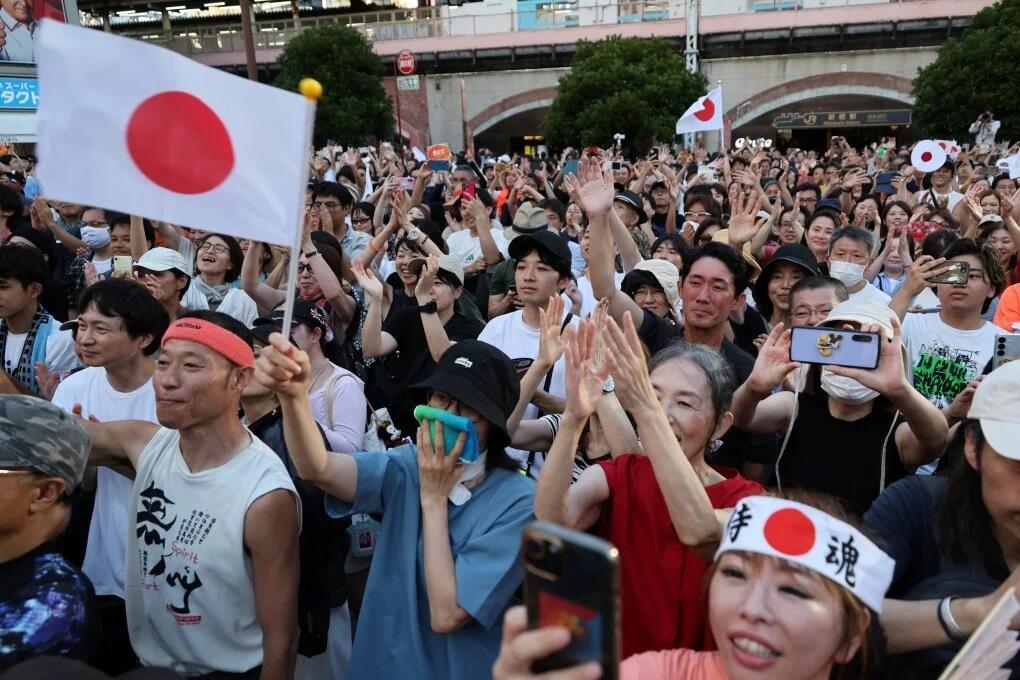
It sounds like a repeat of the US elections in 2016 and 2024; Japan’s long ruling coalition party has suffered a crippling defeat in last week’s national elections, defeated by the rise of the MAGA-inspired “Japanese First” party.   The populist party took enough seats in the House of Councillors to bring the coalition into question and possibly unseat the current globalist-friendly Prime Minister Shigeru Ishiba.

Japanese First, also known as “Sanseito”, was launched at the height of the draconian pandemic lockdowns by Sohei Kamiya using web-based organization and a message of anti-globalism and fighting back against forced multiculturalism.  Sanseito now controls 15 seats in the Upper House, and 3 seats in the lower house, making them impossible to ignore in future legislation decisions.

The western media has attacked the movement, demonizing it as dangerous.  Reuters describes the party as “fringe far right:, noting that it: 

“…Gained support with warnings of a “silent invasion” of immigrants, and pledges for tax cuts and welfare spending. Birthed on YouTube during the COVID-19 pandemic spreading conspiracy theories about vaccinations and a cabal of global elites, the party broke into mainstream politics with its “Japanese First” campaign.”

Japan has been targeted by leftists in the west for years as being “fascist” due to their previous refusals to accommodate progressive ideology.  The media also acts as if the globalist agenda and lies about covid lockdowns, mandates and vaccines are not proven realities, but it would seem that the general public in Japan is growing wise to the propaganda. 

For centuries Japan has maintained a homogeneous culture with strict conditions of immigration and foreign influence.  Their society holds order and mutual respect in high regard and their cities are some of the cleanest and best maintained in the world.  However with the assassination of former Prime Minister Shinzo Abe and the loss of his influence, the coalition government has been incrementally pushed into accepting multiculturalism. 

Globalist politicians have called for more open immigration standards, arguing that Japan’s birth decline and aging population require labor to be imported from other countries.  Similar to what has happened in the west, many of these migrants are brought in from third-world cesspools with little regard for Japanese customs and rules. 

The Japanese public is already suffering from the effects of multiculturalism, with an immediate spike in criminal incidents and foreigners trashing streets, subways and neighborhoods. Specifically, Muslim and African migrants refuse to assimilate and have been quick to cause problems in the otherwise peaceful country.  Despite being a tiny percentage of the population, they are a large percentage of ongoing crime.

Though Japan’s migrant population is only 3.7 million out of 124 million people, the public has seen the writing on the wall when it comes to multiculturalism.  The Japanese First movement holds up the pervasive destruction of Europe due to open borders as a sign of things to come, and they don’t plan on emulating Europe’s example.  Rather, they are emulating the efforts of American conservatives, calling for mass deportations and incentives for population growth among native Japanese.  

The notion that the only solution to labor declines is open immigration is a fallacy widely promoted by globalists seeking to erase national cultures and borders, using mass migration as a weapon to undermine the greater stability of homogeneous societies.  

Tyler Durden
Tue, 07/22/2025 – 17:20