54.7 F
Chicago
Friday, October 23, 2026
Home Blog Page 1407

The 28 Biggest Global Risks, According To The UN

The 28 Biggest Global Risks, According To The UN

As the world confronts overlapping crises, from accelerating climate change to the unchecked spread of misinformation, global risks are increasingly interconnected, compounding one another in ways that could overwhelm current institutions and systems.

This visualization, via Visual Capitalist’s Kayla Zhu, shows the top 28 most important global risk as outlined in the United Nations Global Risk Report 2024.

Risk importance combines the likelihood and severity of a risk, with top risks seen as most likely to occur with severe impacts if or when they manifest.

Rankings are based on a survey of 1,100 stakeholders across 136 countries which includes representatives of government, industry, civil society, and academia.

What is the Most Important Risk the World is Facing?

Below, we show the top 28 most important global risks and their importance scores, according to the United Nations.

Rank Risk Importance Score Category
1 Climate Change Inaction 37.2 Environmental
2 Large-Scale Pollution 36.0 Environmental
3 Mis- and Disinformation 35.4 Political
4 Natural Hazard Risks 35.0 Environmental
5 Rise in Inequalities 34.7 Societal
6 Biodiversity Decline 34.6 Environmental
7 Geopolitical Tensions 34.5 Political
8 Natural Resource Shortages 34.3 Environmental
9 Mass Movement of People 33.2 Societal
10 Large-Scale War 32.6 Political
11 Biorisks 32.3 Societal
12 New Pandemic 32.1 Societal
13 Rule of Law Collapse 32.0 Political
14 Cybersecurity Breakdown 31.7 Technological
15 Global Financial Crisis 31.6 Economic
16 Weapons of Mass Destruction 31.1 Political
17 AI and Frontier Tech 31.0 Technological
18 Proliferation of Non-State Actors 30.8 Societal
19 Tech-Driven Power Concentration 30.8 Technological
20 Social Cohesion Collapse 30.4 Societal
21 Widespread Debt Crisis 30.2 Economic
22 Economic Fragmentation 29.1 Economic
23 State Sovereignty Erosion 28.5 Political
24 Global Economic Stagnation 27.9 Economic
25 Supply Chain Collapse 27.8 Economic
26 Geoengineering Disasters 27.5 Technological
27 Multilateral Institution Collapse 26.3 Political
28 Space-Based Event 23.4 Environmental

Across all regions, environmental risks emerged as the highest priority, with climate change inaction and large-scale pollution both seen as highly likely and highly severe.

Climate change inaction was the most important risk overall, ranking as the most pressing issue in three of the seven regions.

In total, 84% of respondents said mis- and disinformation is already occurring, making it the most immediate risk today, according to the UN.

Mis- and disinformation also ranked as the top risk in the next two years, according to the World Economic Forum’s Global Risk Report.

While environmental concerns were top of mind for all regions, other perceptions varied by region. For example, in North Africa and Asia, concerns about cybersecurity breakdowns and artificial intelligence (AI) were among the top 10 risks, unlike in other regions.

Cybersecurity breakdowns were among the least prepared-for risks, with a preparedness score of just 3.9 out of 7. The only risk the world is less prepared for is a potential space-based event.

To learn more about risks the world is facing in the near and long term, check out this graphic that visualizes the top global risks, as ranked by the World Economic Forum.

Tyler Durden
Tue, 07/15/2025 – 22:10

A Washington–New Delhi Alliance Is a Perfect Storm Against China, For India

A Washington–New Delhi Alliance Is a Perfect Storm Against China, For India

Authored by James Gorrie via The Epoch Times,

Beijing’s Jitters: A Shifting Trade Landscape

As China’s trade with the United States continues to diminish, Beijing is anxious to stabilize trade relations with Washington—and has done so, at least for a while. But how long will any trade agreement last if the Chinese regime continues to violate it?

The harsh reality is that the Chinese Communist Party (CCP) is aware of its precarious position. On the one hand, China desperately needs to stabilize its trading relationship with the United States. On the other hand, it can’t live up to agreements because it has to cheat on trading terms, as structural weaknesses prevail in driving the economy downward. As a result, the trust level between Washington and Beijing is low.

Lack of trust isn’t the only factor against China, of course. The Trump administration’s antipathy toward the Chinese regime as a strategic rival is well understood, and that’s unlikely to change. Furthermore, direct foreign investment is dwindling, and foreign companies are exiting China as quickly as possible.

Many of them are relocating to India. The list of companies choosing India over China is significant and has been steadily growing, even before U.S. President Donald Trump won a second term in office. In 2024, dozens of major companies, including Dell, HP, Intel, Samsung, LG Electronics, Nike, Hasbro, Blizzard Entertainment, Stanley Black & Decker, and many more, have already relocated their factories to India or plan to do so in the near future.

That trend isn’t likely to change, either. According to a 2024 survey by the American Chamber of Commerce in China, 45 percent of U.S. companies in China have initiated plans to diversify their suppliers outside of China, while 38 percent are considering doing so. The writing is on the Great Wall of China: the trade gap is widening, not narrowing. Their days of leading the world in manufacturing and the strategic clout that comes with it are on their way out.

India’s Big Opportunity With the US

In the meantime, to Beijing’s great concern, India is strategically pivoting to fill that widening gap by expanding its trading relationships with the United States. The United States is equally intentional in steering trade away from China and toward India.

India’s intentions are aligned with those of the United States. In April this year, U.S. Vice President JD Vance visited India to establish a broader bilateral trade agreement between the two countries. The goal is to increase the current trade of $190 billion to $500 billion by 2030.

The growing U.S.–India relationship extends beyond trade. Prior to Vance’s visit, U.S. Director of National Intelligence Tulsi Gabbard was in India for a geopolitical conference. Perhaps even more telling, Indian Prime Minister Narendra Modi was among the first world leaders to visit with Trump after he returned to the White House. At the time, Modi mentioned a “mega partnership” with the United States and began negotiations to address Trump’s tariffs on Indian products.

Notably, Modi had already reduced tariffs on some U.S. goods before he met with Trump. That may help explain why Indian officials have described trade negotiations as “very active” and “intense,” supporting the perception of a fast-track trade deal being worked out between the United States and India.

The Strategic Ripple Effects

China may be unaware of these developments and can already see several strategic ripple effects unfolding. As noted, the United States is keen on “friend-shoring” or restructuring global supply chains out of China and into India. One additional impact may be diminishing Beijing’s ability to support Russia in its war against Ukraine.

Although a trade reset of sorts appears to be in place between Washington and Beijing, the trend of businesses leaving China en masse remains undeniable. Apple has announced that it will relocate up to 25 percent of its iPhone production from China to India by 2025, and a significant portion of its U.S. phone production will also be moved out of China.

But other ripples are occurring as well.

A closely related issue is China’s dominance of the rare earths market. Like the United States, India is dependent on China’s rare earth monopoly. One of Modi’s policy shifts is to focus on India’s potential to increase its rare earth production capacity and potentially become a key supplier to the United States. That would be a huge blow to China and a big win for both India and the United States.

Another significant issue is India’s increasing involvement in U.S. defense planning in the region. India will play a growing role in U.S. security arrangements in the Indo-Pacific region.

Beijing’s Double-Edged Response

In response to these developments, the CCP is getting creative. For example, in contrast to the trade barriers it put up after the Galwan incident involving military exchanges, Chinese state media has floated the possibility of reducing trade restrictions and encouraging engagement between China and India. That’s a direct result of India’s rising profile in the region and engagement with the United States.

Perhaps more importantly, China’s ambassador to India recently pledged to stop dumping Chinese products into Indian markets, ease trade deficits, and possibly even remove tariff and non-tariff barriers on Indian imports. This announcement comes alongside resumed diplomatic dialogue, high-level engagement, direct flights, and even the potential for enhanced access to rare earths for India.

On the flip side, in an effort to counter the friend-shoring trend, China is restricting machinery exports and equipment transfers to India in order to minimize its ability to handle incoming manufacturing demands. Beijing is also warning New Delhi that its deeper engagement with Washington—both in trade and in strategic alliances such as the Quad, as well as significant cooperation in evolving U.S.-led defense postures—could threaten its cordial relationship with China.

Another card for the CCP to play would be to increase support for Pakistan, India’s nuclear-armed regional rival. That’s a threat with a very thin veil, but unlikely to work because both Pakistan and India are nuclear-armed nations. Beijing’s support doesn’t fundamentally alter the status quo.

Will any or all of these potential countermeasures by Beijing be enough to sway New Delhi away from its tilt toward Washington? Will the Chinese regime be able to thwart India’s rise, even as its economy continues to collapse?

Not likely.

China is facing a multi-front storm, mainly of its own making through the CCP’s policies, and that storm is only getting worse. To carry the metaphor, it’s a perfect storm against China and for India.

Views expressed in this article are opinions of the author and do not necessarily reflect the views of The Epoch Times or ZeroHedge.

Tyler Durden
Tue, 07/15/2025 – 21:45

Lyme Disease Is Most Prevalent In The Northeast

Lyme Disease Is Most Prevalent In The Northeast

This year is a bad year for ticks…

Statista’s Anna Fleck reports that new research has found that ticks are becoming more widespread due to changes in the climate, land use and human-animal interactions. The biggest risk areas are in warm-temperate regions of the Northern Hemisphere, such as China, the United States and parts of Europe, with some of the areas most at risk of future tick expansion are France, Spain, Ukraine, Germany, Italy, Poland, Romania and the UK.

One of the species of ticks increasing in number across the U.S. is the lone star tick, which has been found to cause allergic reactions to red meat, also known as the alpha-gal syndrome (AGS). The Centers for Disease Control and Prevention (CDC) states that around 110,000 cases of AGS have been documented since 2010, but that the actual figure could be closer to 450,000. According to a 2023 CDC survey among healthcare providers, awareness around the tick-borne disease is still lacking, with 42 percent of respondents having not heard of AGS, and another 35 percent having reported that they were “not too confident” about their ability to diagnose or manage patients with the syndrome.

A better known disease caused by infected ticks is Lyme disease. In the U.S., this is caused mostly by blacklegged ticks, which are commonly found in forested areas in the northeastern, north-central, and mid-Atlantic states and in smaller areas within Pacific Coast states. While a vaccine against Lyme disease is currently being worked on, it is still unavailable.

Infographic: Lyme Disease Is Prevalent in the Northeast | Statista

You will find more infographics at Statista

Untreated Lyme disease can cause an array of symptoms, including extreme fatigue, a rash, a fever and arthritis. It usually takes more than 24 hours before the infection is passed from a tick that is attached to a human and so removing the tick quickly can prevent transmission of the disease.

According to data from the Centers for Disease Control and Prevention, a record high of 62,551 cases of Lyme disease were reported in 2022 (latest available data). Nationwide, this equated to an incidence rate of around 18.77 per 100,000 people.

Lyme disease is believed to be becoming more prevalent, with data published by the Environmental Protection Agency showing an increase in cases in 2022. However, it is difficult to measure the true extent of the increase due to a change in the data classification systems between 2022 and earlier, as well as the increase in awareness and testing.

As the chart above shows, Rhode Island, Vermont, Maine and West Virginia recorded the highest incidence rates of Lyme disease across the U.S. in 2022, ranging between 137.7 and 212 cases per 100,000 people.

The CDC advises preventative measures to be taken by those in high risk areas, such as long grasses in known tick regions, including wearing protective clothing and insect repellant, as well as immediate tick removal using fine-tipped tweezers, followed by cleaning the bite area. In some cases, a single dose of doxycycline might be needed to be administered.

Tyler Durden
Tue, 07/15/2025 – 21:20

The Threat From Far-Right Extremists Pales In Comparison To Jihadi Terrorist

The Threat From Far-Right Extremists Pales In Comparison To Jihadi Terrorist

Authored by Phil Gurski via The Epoch Times,

Remember Chicken Little (a.k.a. Henny Penny)? She was the one running around warning that the sky was falling and spreading panic all around. In the end, the heavens were not, in fact, plummeting, and we now use the phrase “Chicken Little” to describe those who spread myths about danger that are ill-founded.

Last week, Canadians learned of an “imminent” plot by four men in Quebec, including two members of the Armed Forces, that probably came as a bombshell (no pun intended) to those tuning in.

This “anti-authoritarian militia” had weapons, planned to seize land, had engaged in “training,” and appeared to be recruiting like-minded people online.

The self-styled “national security experts” consulted by print, radio, and television media – I did nine interviews in three days on this issue, but generally eschew the moniker “expert” –  all saw this as the end of civilization as we know it and that we in Canada had dodged a bullet (!) at the 11th hour.

Except that very little of this “analysis” was accurate.

In fact, the RCMP had seized the weaponry in the possession of this “militia” – 80 firearms, 11,000 bullets, and 16 explosive devices – in January, of 2024! A full 18 months before they made the arrests. Yes, these amateurs could very well have obtained more guns, but there is nothing in the open media to suggest they did. Furthermore, that the RCMP knew about these guys a year and a half ago means they had a good idea of who they were and what they were up to.

Many were confused as to the time lag.

Why wait so long between weapon confiscation and arrests/charges? Simple: what else could the Mounties learn about this gang?

Were there others involved? Did their “plot” ever get more plausible? Was there really a “plot” in the end?

As an RCMP spokesperson noted, there was never a threat to the public.

This demonstrates, to me, that the force had everything they needed, possibly through surveillance, federal court wiretaps, and human agent penetration.

This was actually a huge investigative success, not a potential disaster. In other words, they had the whole thing under control at all times.

In addition, the incompetence of the “militia” was made clear when Canadians learned that they were recruiting on social media (Instagram).

This weakness underscores a terribly unprofessional comsec (communications security) practice and demonstrates the very ridiculousness of their venture.

These were not the sharpest pencils in anyone’s box. It is fortunate that most extremists, in my experience, are that stupid.

Yes, far right extremism, including “anti-authoritarianism” and ‘”accelerationism” (those with the belief that the existing state of society is irreparable and that the only solution is the destruction and collapse of the “system”), appears to be on the rise in the West.

A number of Canada’s allies, including the United States and Germany, are seeing a link between these ideologues and their serving armed forces.

The main takeaway, however, is that the law enforcement and security intelligence agencies are up to speed on this threat and I am confident they are monitoring it to the best of their ability given their finite resources.

We also need to stop suggesting that our armies, navies, and air forces are rife with neo-Nazis, fascists, and their ilk.

What is not acceptable, nevertheless, is the conviction that this particular form of terrorist threat has risen to the top in the world.

Jihadis still kill and maim at scales orders of magnitude larger than any other extremist movement and will likely continue to do so for the foreseeable future.

No one seems to want to say that, maybe for fear of being labelled an Islamophobe or a “racist” (I have been called both on many occasions).

The RCMP has rightly charged these individuals with planning an act of terrorism as defined under section 83.01 of the Canadian Criminal Code—even if their chances of actually doing something were only slightly above zero. The far right has risen over the past decade, although, again, jihadis still rule the terrorist roost, and our protectors are looking at all these actors, as they should.

The average citizen, however, needs to be assured that the threat they pose is neither imminent nor existential. It would be unfortunate if a group got lucky and was able to carry out an attack despite the best efforts of our police officers and spies, although that is probably inevitable given the number of investigative priorities and finite resources.  Many more will be stopped, thankfully, due to the former’s efforts.

Pushing the panic button is neither necessary nor useful.  We should leave the running around and shouting to the birds of children’s tales, not the front pages of our media.

Views expressed in this article are opinions of the author and do not necessarily reflect the views of The Epoch Times or ZeroHedge.

Tyler Durden
Tue, 07/15/2025 – 20:55

Cal State Prof Arrested, Accused Of Assaulting ICE Agents During Cannabis Farm Raid

Cal State Prof Arrested, Accused Of Assaulting ICE Agents During Cannabis Farm Raid

Authored by Emily Sturge via Campus Reform,

A California State University Channel Islands (CSUCI) professor was arrested July 10 after allegedly assaulting law enforcement agents during a U.S. Immigration and Customs Enforcement (ICE) operation targeting illegal labor at marijuana farms. 

Jonathan Anthony Caravello, a math and philosophy lecturer, is among four U.S. citizens “being criminally processed for assaulting or resisting officers” during coordinated ICE raids at Glass House Farms cannabis grow sites in Camarillo and Carpinteria, California, according to the Department of Homeland Security (DHS).

Caravello is accused of throwing a tear gas canister at ICE agents during the protest, which occurred near the CSUCI campus.

Protesters reportedly “attempted to intercept” officers by “throwing rocks” at federal vehicles, “shattering windows and windshields,” CBS News reports.

One protester allegedly fired a pistol at officers. 

The California Faculty Association (CFA), an “anti-racism, social justice” labor union comprised of 29,000 California State University faculty members, is defending Caravello, claiming he was peacefully protesting and accusing federal agents of kidnapping him.

The CFA doubled down in a press release, calling Caravello’s arrest an “abduction.”

“We strongly condemn the abduction of California Faculty Association professor, member and activist Jonathan A. Caravello, Ph.D. and other community members terrorized and arrested by federal immigration authorities while exercising their constitutional rights to protest peacefully,” the CFA wrote. 

U.S. Attorney for the Central District of California Bill Essayli debunked the “kidnapped” allegation and said Caravello will appear in court on Monday. 

Federal law states that a violation of 18 USC 111 means “assaulting, resisting, or impeding certain officers or employees,” according to Cornell Law School Legal Information Institute.

CSUCI defended Caravello in a written statement:

“At this time, it is our understanding that Professor Caravello was peacefully participating in a protest – an act protected under the First Amendment and a right guaranteed to all Americans,” the statement reads. 

“If confirmed, we stand with elected officials and community leaders calling for his immediate release,” it continues. 

Meanwhile, the California Faculty Association is urging supporters to contribute monetary donations for bail and legal fees for Caravello.

The association is also asking individuals to write “Character Reference” letters that will “go before the judge when setting bail” and encouraging individuals to “sign up for a jail support shift so John has someone waiting when he is released.”

Screenshots of social media posts shared by @cfa_united on Instagram.

Members of the CFA held a candlelight vigil Sunday night for the individuals “abducted in the Camarillo farm raids.” 

During the cannabis farm raids, law enforcement reportedly arrested at least 361 illegal aliens from both sites and rescued at least 14 children from potential exploitation, forced labor, and human trafficking, DHS confirmed in a press release. 

The group advertised the vigil on Instagram with the hashtag “#FreeJohnCaravello.”

Screenshots of social media posts shared by @cfa_crew on Instagram.

Campus Reform reviewed Caravello’s student evaluations on the website RateMyProfessors.com.

One anonymous student warned: “If you want a professor that tries to bring his political commentary or agenda into absolutely every possible situation, then this professor is for you. Don’t bother trying to debate politics with him because any retort you bring up will immediately be shut down.”

Screenshot obtained from RateMyProfessors.com.

Campus Reform is monitoring updates to this story and has contacted Jonathan Anthony Caravello, California State University Channel Islands, and the California Faculty Association for further updates and comment. This article will be updated accordingly. 

As of July 14, spokespeople from the California State University Channel Islands and California Faculty Association told Campus Reform there are no updates or additional information to share at this time.

Tyler Durden
Tue, 07/15/2025 – 14:40

These Are The 10 Least Livable Cities In The World

These Are The 10 Least Livable Cities In The World

While some cities are celebrated for their high quality of life, others are plagued by deep-rooted challenges that make daily life difficult and dangerous in many cases.

From ongoing wars and political instability to inadequate infrastructure, this map, via Visual Capitalist’s Kayla Zhu, shows the 10 least livable cities in the world, according to The Economist Intelligence Unit’s Global Liveability Index 2025.

The index ranks cities on over 30 factors across five categories to determine their overall livability. Factors include:

  • Stability: Prevalence of crime, terror, military conflict, civil unrest/conflict

  • Healthcare: Availability and quality of private and public healthcare, general healthcare indicators

  • Culture and environment: Humidity/temperature rating, cultural and sporting availability, social or religious restrictions

  • Education: Availability and quality of private education, public education indicators

  • Infrastructure: Quality of road network, public transport, international links, availability of good housing

What is the Least Livable City in the World?

Below, we show the 10 least livable cities in the world according to The Economist, and their livability scores.

Damascus, the capital of Syria, remains the world’s least livable city in 2025.

Despite a dramatic regime change in Syria in late 2024, the effects of over a decade of civil war have left the capital with shattered infrastructure, limited access to health care and low levels of public safety.

The overall score for Damascus is nearly 10 points lower than that of the next-worst city, Tripoli, Libya.

Tripoli, Libya’s capital, continues to struggle with political instability, factional fighting, and collapsed public services. Like Damascus, it showed no improvement over previous years.

Kyiv continues to rank near the bottom amid Ukraine’s ongoing war with Russia, which has severely impacted its infrastructure and safety.

Overall, the bottom of The Economist’s livability rankings is largely filled by cities from the Middle East, Sub-Saharan Africa, and South Asia.

The average score for livability in 2025 was 76.1 out of 100, the same as 2024. However, scores in the stability category have continue to decline amid widespread geopolitical tension and civil unrest around the world.

To see which cities ranked as the most livable cities of 2025, check out this graphic on Voronoi.

Tyler Durden
Tue, 07/15/2025 – 14:20

Gold Revaluation: Trump’s Red Button Option?

Gold Revaluation: Trump’s Red Button Option?

Authored by Matthew Piepenburg via VonGreyerz.gold,

Could a gold revaluation be on Trump’s mind? Below, we consider the options facing a debt-sick America.

A Bug Racing for a Windshield

As we’ve been warning for years, the US and USD are a bug rapidly seeking a debt-hard windshield.

The trend and speed of this collision (and debt trap) are becoming increasingly more obvious with each passing day and headline.

In simplest terms, as US debt levels soar moon-bound, trust and interest in its IOUs (and the currency/dollar backing those IOUs) are sinking toward the ocean floor.

The evidence of such otherwise “dramatic” statements is literally everywhere.

Hard Questions

For example, although not at war, the US is running World War 2 debt-to-GDP ratios at the 120% level.

How did this happen? What’s the “emergency” behind this grotesque ratio?

And more importantly, how can Uncle Sam save himself?

Simple Answer

Answering the first question is fairly simple.

We arrived at this appalling turning point because the US has been getting debt drunk for decades.

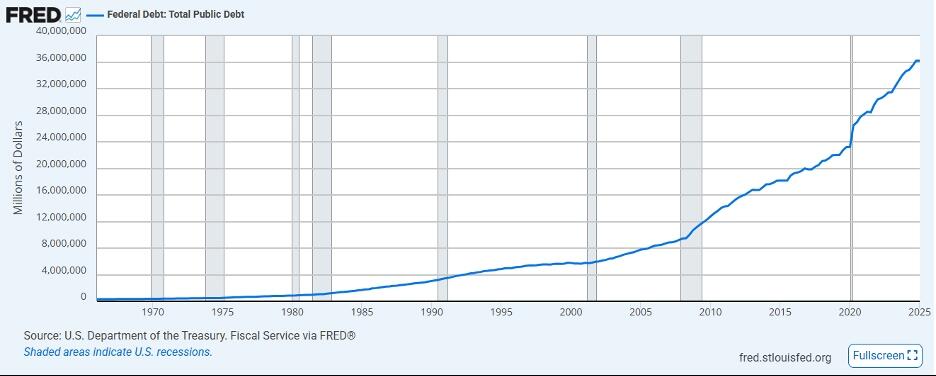
Ever since Nixon took away the gold chaperone from the USD, politicians have been buying temporary prosperity, debt-based “growth” and duped voters by taking US public debt levels from $248B in 1971 to $37T (and counting) today.

This number alone is staggering.

Trillions Matter

The difference between “billions” and “trillions” is not merely alphabetical, it’s brutal.

1 BILLION seconds ago, for example, places us in 1997. Bit 1 TRILLION seconds ago places us at 30,000 BC.

Let that sink in for a moment.

If this shocks or bothers you, well… you’re not alone.

The World Has Called the USA’s Bluff

The rest of the world is shocked too, which explains why its central banks have been quietly net-dumping USTs and net-stacking physical gold since 2014.

This further explains why freezing the FX reserves of Russia in 2022 only accelerated the distrust of a now weaponized (and once neutral) world reserve currency.

De-Dollarization…

What followed was a well-telegraphed and carefully forewarned trend of de-dollarization from the BRICS+ coalition.

Tier-1 Status…

This trend took off around the very same time that the BIS, the mother of all central banks, officially classified gold as a Tier-1 reserve asset, making an open mockery of its “sister Tier-1 asset,” the UST.

Central Bank Gold Stacking…

Gold stacking by central banks, of course, continued to skyrocket at the same time:

COMEX Panic…

If such signs of US dollar and debt woes/distrust were not obvious enough, the COMEX and LBMA exchanges out of New York and London then began scurrying like headless chickens.

Why?

Because they were trying to find enough physical gold to meet delivery demands to get the gold off of these exchanges, which, since 1974, were once just derivative schemes used to manipulate rather than deliver gold.

But the hidden facts (and implications) were far simpler. Counterparties to this legalized price-fixing scam now wanted their actual gold more than their paper contracts.

Why? 

Because they saw physical gold’s growing, inevitable and superior role in a future monetary system moving away from the debt-discredited USD and UST.

Petrodollar Signposts…

To add insult to the USD’s injury, a growing and simultaneous trend away from the petrodollar during the same period was as obvious as it was media-ignored.

But the message was clear: Faith in a USD-driven future was openly in decline.

The Denial Stage?

Defenders of the USD, of course, were quick and right to remind the world that no other nation or currency could beat or replace the mighty Dollar.

After all, it is the world’s reserve currency.

It still holds the majority position in global FX reserves and, let’s be honest, neither China, Russia, nor any other nation has the reputation or bond market to replace the dollar, right?

Right.

Reality Check: Gold’s Future in a Fiat Swamp

But, here’s the kicker.

Nations like China or Russia aren’t trying to replace the USD with their Ruble or Yuan.

They, like the rest of the world, are slowly going to replace the USD with gold.

This doesn’t mean a gold-backed world reserve currency, just a gold-based world settlement system.

China Playing Chess

Take China as an obvious example.

They have no problem de-valuing their fiat currency when measured against gold, an asset they’ve been quietly stacking and misreporting for decades in a chess game of common sense as the USA plays checkers with QE.

Nor does China have much love for USTs…

As I type this, China continues to pair gold to the oil it imports from Russia and Iran (conveniently dubbed “evil” by the weaponized US media).

In just over a decade, China’s gold-to-oil ratio was 8 barrels of oil to one ounce of gold. Today, that same ounce of gold buys China 50 barrels of oil.

Meanwhile, China has no problem seeing its Yuan price of gold rise from 7000/ounce in 2014 to 24,000/ounce today.

In short, the Yuan has collapsed against gold but not against the USD.

But China can live with this for the simple reason that it sees a gold-based new world order, and it has been stacking that gold for years.

Why?

Because the BIS, the IMF, and, of course, the BRICS+ nations see a world in which gold is superior to the debt-discredited USD as a strategic reserve asset.

Gold: Far More than an “Allocation”

Gold is no longer an allocation, hedge or subject of debate—it is the future of global trade and currency settlements. Period.

My colleague, Egon von Greyerz, saw this decades ago.

Of even date, for example, gold is now 20 % of global FX reserves. The USD percentage is falling dramatically to a 46% position, and the Euro holds a 16% slot.

But if central backs and BRICS+ nations continue to stack gold at current levels, gold may not be an official “world reserve currency” in substance or title, but it will be the new leading FX reserve asset in both title and power.

In sum, each of the foregoing themes, of which we have detailed and warned in numerous prior articles, explains the debt “emergency” facing the USD.

The Real Question: What Can the USA Do Now?

But what about the corollary question? That is: What options do the US have left to solve its debt (and hence currency) crisis?

This, too, has been on our minds for years.

More Fantasy Money?

Ultimately, there are no easy solutions or good scenarios left.

The MMT fantasy, for example, of solving a debt crisis with more debt that is paid for with mouse-clicked money has been tried in earnest since the QE guns took the Fed from a pre-08 balance sheet of $800B to a 2022 high of nearly $9T.

As reminded above, that difference between a Billion and Trillion is just plain madness.

The US, faced with solving its debt crisis (and bond market) at the expense of its paper dollar, is running out of time, options and global patience.

So, again—what can the US do today?

More War?

For Hemingway, at least, the most obvious next step is further currency debasement and war, which the past, current and even future headlines seem to confirm, from the Middle East to Eastern Europe:

But with distrust in US politics and foreign policies rising in alternative media platforms highlighting left and right scandals on everything from Russia-Gate laptops to Epstein cover-ups and AIPAC-guided uh-ohs, trust in the left and right stirrups of the DC saddle is tanking at a rapid rate.

Re-sets, DOGE Cuts & Tariff Walls?

Meanwhile, the IMF has been telegraphing a great reset since COVID, and the current Trump administration has been trying to use DOGE cuts and tariff wars to bring debt and spending levels down.

But regardless of one’s political bias, let’s be mathematical: None of these policies is enough, and none of them, as of today, are even working – as the Elon/Trump social media war intensifies in a backdrop of rising rather than falling deficit levels.

More Financial Repression?

I also expect, and have warned of, more financial repression and capital controls around the corner.

But again, not much of a solution given current and future debt levels, debased dollars (worst DXY Q3 in 40 years) and a middle class already on its knees.

The Red Button Option: Gold Revaluation?

But DC has another option, which even the Fed’s recent May 2025 Manual openly hints toward.

I call it the “red-button option” of a radical gold revaluation to effectively use a precious metal (rather than a Fed mouse-click) to achieve QE-like monetization without having to issue more unloved USTs.

One can read the Fed’s lengthy May report on their own, but the Fed-speak boils down to this:

The Fed can add gold certificates to its balance sheet, which can then become assets of the Treasury Department’s TGA account to pay down a sliver of its $37-TRILLION-dollar public debt.

But the trillion-dollar question remains: How will these $42.00 gold certificates be re-valued?

Doing the Math

In a February Forbes article, for example, there was talk of marking these certificates to market.

If that were the case, the 8131 tons of US gold (roughly 260 million ounces) at the current spot price would give Uncle Sam about $850B in instant new money to pay off some debts.

This is nice, but hardly a solution to getting the aforementioned 120% debt-to-GDP figure down to pre-08 levels at a ratio compelling enough to restore trust in—and demand for—Uncle Sam’s unwanted IOUs.

But what if the US government put in a bid for $20,000 gold?

This would create a new price floor for the precious metal while simultaneously placing newly revalued gold certificates ahead of UST’s and mortgage-backed-securities on the Fed’s balance sheet?

Sound crazy?

If you read the May Fed Report, they hint at such a balance sheet “example” but shy away from naming a new price valuation on the gold certificates.

This means we can only guess at what comes next.

Desperate Times, Desperate Measures?

But desperate times require desperate measures, and there is nothing more desperate than the USA (and balance sheet) in its current form.

An emergency gold re-valuation of $20,000, by way of just one example (perhaps lower, perhaps higher?), would create instant trillions in liquidity to address Uncle Sam’s otherwise mathematically unsustainable bar tab.

Such a measure would buy time for US IOUs and votes for a beleaguered White House.

Such considerations, once thought extreme, must now be considered with desperate seriousness in a backdrop of only desperate options.

Nixon made a radical change in 1971. Can a red-button gold revaluation in 2025 or 2026 be equally ignored?

Let’s wait and see.

Be Careful of What You Wish For

And regardless of whether the inflationary red button is pushed or not, gold wins either way, as the dollar’s purchasing power in such a debt landscape has no absolute direction left to it other than downward.

Gold, as the ultimate, most stable, stacked and historically most trusted anti-fiat asset, has no direction left than upward.

Let’s also not forget that if gold is so re-valued, then the nation with the most gold will have the most leverage in this new system.

But as I’ve suggested elsewhere, that nation is more likely to be China than the USA. It has a lot more gold than the World Gold Council reports…

If so, like all empires whose average hegemonic age hovers around 250 years, the era of the American empire is coming to an obvious turning point, no matter how you stack it.


Tyler Durden
Tue, 07/15/2025 – 14:00

Phoenix Taco Shop Owner Busted For Hiring Illegals – Time To Crack Down On Employers

Phoenix Taco Shop Owner Busted For Hiring Illegals – Time To Crack Down On Employers

Knowingly hiring illegal aliens is a major crime, and under President Trump’s Border Czar Tom Homan, the federal government is cracking down on employers who exploit cheap migrant labor. In some cases, employers have even been caught hiring illegal alien children (or maybe even trafficked by labor mules), as exposed during last week’s ICE raids on marijuana farms in Governor Newsom’s far-left progressive utopia of California.

Hiring scrutiny on employers continues nationwide, with local media outlet 12 News in the Phoenix area reporting that Homeland Security Investigations arrested Blademir Angulo, 42, after a four-month-long investigation found he had hired at least a dozen illegal aliens at his restaurant, El Taco Loko. 

Here’s more from the local media outlet:

According to court documents, Angulo not only hired the workers but also allegedly paid them in cash and allowed them to live in recreational vehicles and trailers on property he owns in Laveen, near 63rd Avenue and Baseline Road. Agents also surveilled a second property near 16th Avenue and Southern Avenue as part of the investigation.

An 18-page federal complaint filed on July 11 charges Angulo with four federal crimes: Alien in Possession of a Firearm, Harboring Illegal Aliens, Improper Entry by an Alien, and a Pattern and Practice of Knowingly Employing Unauthorized Aliens.

In an interview, Angulo admitted that he knew what he was doing was illegal, but denied ever paying money to anyone to bring his employees across the southern border. One employee had a differing account, reportedly telling investigators he owed Angulo $12,000 for smuggling him into the United States.

The case in Phoenix should serve as a major wake-up call to employers nationwide who have hired illegals and displaced American labor with cheap, unauthorized labor. Trump’s immigration officials are ramping up enforcement against such business owners, and as the administration moves to end temporary legal protections for migrants, major corporations (view here) that employed them are also going to come under increased scrutiny. 

Enforcing immigration policies has already sparked a labor renaissance for native workers.

Tyler Durden
Tue, 07/15/2025 – 13:40

New York Man Charged With Stealing Half A Million Dollars Worth Of Gold Bars

New York Man Charged With Stealing Half A Million Dollars Worth Of Gold Bars

Authored by Aldgra Fredly via The Epoch Times,

A New York man was charged for allegedly being involved in the theft of more than $500,000 worth of gold bars from an elderly resident in Lancaster County, Pennsylvania, the Ephrata Police Department said.

Zhong Ren, 44, of Brooklyn, New York, was charged on July 10 with multiple offenses, including theft by unlawful taking, criminal conspiracy of theft by deception, and impersonating a public servant.

He was arrested after an elderly resident of Ephrata, Pennsylvania, filed a police report in April about the theft of gold bars valued at $555,892, according to the police department.

Police suspected that Ren was one of the individuals who deceived the victim into using her lifetime investment savings to buy physical gold bars to protect her money from a purported theft threat, which was a fabrication by the scammers.

The scammers allegedly gained access to the victim’s computer in March and told her that someone was trying to withdraw funds from her investment accounts, the police department stated.

The victim was instructed to convert her lifetime investment money into physical gold bars and hand them over to federal employees, who would then store the gold bars in the Federal Reserve vault in Philadelphia while a supposed fraud investigation was underway.

In April, individuals posing as federal employees came to the victim’s house in Ephrata on two separate occasions to collect the gold bars, the police department said.

Police said that law enforcement authorities believe that Ren is a member of an “international criminal organization” that orchestrates such fraudulent schemes.

Ren was arraigned, and his bail was set at $550,000. He is currently being held at Lancaster County Prison. It is unclear whether Ren has been assigned legal representation at the time of writing.

The El Cerrito Police Department in California has previously issued warnings to the public about gold bar scams, saying the schemes have become increasingly prevalent nationwide.

In a June 12 Facebook post, the police department urged the public to be wary of contacts from unknown numbers or individuals claiming to represent legitimate organizations.

It stated that gold bar schemes often involve scammers impersonating government officials or tech support representatives. The perpetrators will try to convince the victims to convert their money into gold bars by claiming that their financial accounts have been compromised or are vulnerable to hacking.

“Scammers often create a sense of urgency and fear to pressure victims into acting quickly,” it stated. “No legitimate organization will ask you to convert your savings into gold and hand them over to a courier.”

The public is advised not to provide any information to the caller, to verify the legitimacy of the contact by directly reaching out to the organization the caller claims to represent, and to report the scam to the police.

Tyler Durden
Tue, 07/15/2025 – 13:20

Bessent Says “Formal Process” To Find Successor To Jerome Powell Has Begun

Bessent Says “Formal Process” To Find Successor To Jerome Powell Has Begun

U.S. Treasury Secretary Scott Bessent confirmed on Tuesday that a “formal process” is underway to find a potential successor to Federal Reserve Chairman Jerome Powell.

In an interview with Bloomberg Surveillance, Bessent remarked, “There are a lot of great candidates, and we’ll see how rapidly it progresses.”

He also noted that it would be confusing for Powell to stay on at the Federal Reserve after his term as chair concludes.

Since last month President Donald Trump has intensified his criticism of Federal Reserve Chairman Jerome Powell, repeatedly accusing him of mismanaging monetary policy and calling for aggressive interest rate cuts.

Trump has argued that Powell is acting too slowly to respond to economic conditions and said, “Maybe I should go to the Fed… Am I allowed to appoint myself at the Fed? I’d do a much better job than these people.”

He has labeled Powell with a series of insults, calling him “stupid,” “too late,” “a numbskull,” and demanding the Fed slash rates by a full percentage point to stimulate the economy.

Trump’s attacks continued into July, growing even sharper. On July 8, he declared that Powell “should resign immediately.” A few days later, he criticized Powell over cost overruns tied to a $2.5 billion renovation project at the Federal Reserve, referring to him as a “knucklehead” and “stupid guy.”

Last week, Office of Management and Budget Director Russell Vought also criticized Federal Reserve Chair Jerome Powell for a renovation project he called “too lavish,” referring to it as “Versailles on the National Mall.”

On CNBC, Vought cited “fundamental mismanagement” at the Fed.

Meanwhile, National Economic Council Director Kevin Hassett, a potential successor to Powell, added, “If there is cause to fire Powell, Trump has the authority to do so.” The criticism appeared coordinated, with other figures like Fed candidate Kevin Warsh and Vice President J.D. Vance joining in.

Trump also reiterated his demand for rates to be cut to around 1%. Members of his team suggested they might review the renovation project as a possible justification to remove Powell “for cause.”

Tyler Durden
Tue, 07/15/2025 – 13:00