Derek Chauvin Seeks To Dismiss Charges In Death Of George Floyd
Derek Chauvin’s legal team filed a new court petition Tuesday morning seeking to dismiss the charges against the former Minneapolis police officer and vacate his convictions, arguing that the case that sent him to prison for the death of George Floyd rested on a foundation that never had legal standing to begin with.
Attorney Greg Joseph submitted the 31-page filing in Hennepin County, alleging that Gov. Tim Walz, Attorney General Keith Ellison and the Hennepin County Attorney’s Office engaged in unlawful and fraudulent conduct when they brought the case against Chauvin. The central claim is procedural: a grand jury never reviewed the state’s evidence, and, under Minnesota law, Joseph argues that this omission means the state never lawfully brought the charges in the first place.
“Hennepin County District Court Judge Peter Cahill presided over a year-long due process violation by failing to convene a grand jury to consider the State’s evidence at any point between the moment he was assigned to the case, and the verdict,” the filing reads. “He lacked jurisdiction over the charges, as this Court does, because they were never lawfully brought.”
Josephtold Alpha News reporter Liz Collin the conduct amounted to a serious breach.
“What was done here is shocking,” Joseph said. “It’s inexcusable.”
The petition places much of the blame on the trial court itself. It states that Hennepin County District Court Judge Peter Cahill presided over what it calls a year-long due process violation “by failing to convene a grand jury to consider the State’s evidence at any point between the moment he was assigned to the case, and the verdict.” The filing goes further, arguing Cahill “lacked jurisdiction over the charges, as this Court does, because they were never lawfully brought.”
That argument extends up the chain of command. Joseph contends Walz’s decision to hand the prosecution to Ellison was itself an unlawful appointment, and that Ellison used authority he never had to add a second-degree murder charge to the complaint against Chauvin. Hennepin County prosecutor Amy Sweasy withdrew from the case against the officers involved and, according to court documents cited in the filing, disagreed with the decision to pile on additional charges.
Part of the reason for this is that the case unfolded amid extraordinary political pressure. Minneapolis erupted into riots for days after video of Floyd’s detainment and death went viral. Elected officials rushed to condemn Chauvin, and activists made clear that anything short of a murder conviction would be treated as a miscarriage of justice.
Joseph’s petition suggests that pressure extended into the charging decision itself, with Walz and Ellison escalating the case to a murder charge that Hennepin County’s own prosecutor did not support.
According to the petition, “Because Hennepin County’s unlawful charges against Mr. Chauvin were not severe enough for the mob, Walz referred the case to Keith Ellison, who signed and e-filed a second unfounded complaint against Derek Chauvin that included the murder charge it wanted.”
Chauvin is serving two concurrent sentences, 22.5 years on the state second-degree murder conviction and 21 years on federal civil rights charges tied to Floyd’s death. Joseph’s petition argues the entire proceeding is unreviewable on its own terms. “It is impossible to assess the trial errors in State v. Chauvin because the entire trial was a fraud; it was based on unfounded charges that were never properly before the Court.”
Joseph acknowledged the due process argument is a late addition to years of post-conviction efforts. “In a very short period of time there were very fundamental and basic violations of due process,” he told Collin. “And those aren’t necessarily things that defense attorneys normally look for.”
The filing arrives alongside a separate, ongoing push for clemency that has run through conservative media and social platforms for more than a year. Elon Muskshared a video on X last year calling on President Trump to pardon Chauvin. While Trump holds the power to pardon Chauvin’s federal civil rights convictions, the state sentence, the longer of the two, sits outside his authority.
U.S. Immigration and Customs Enforcement (ICE) has proposed an insurance plan to shield local police officers involved in immigration arrests from financial liability if they face allegations of misconduct during those arrests.
A proposal document published Aug. 14 by the Department of Homeland Security (DHS) shows the agency intends to pay for liability insurance coverage for state and local law enforcement officers who are trained to perform immigration officer functions.
The plan would allow officers to purchase up to $500,000 in professional liability insurance, which typically covers financial losses, legal defense fees, settlements, and judgments. Officers would be reimbursed up to $250 each year for insurance costs, according to the document.
The proposal also states that ICE intends to hire a contractor to provide outreach, training, and support to its 287(g) partners. The contractor would also be tasked with coordinating professional liability insurance coverage and reimbursement for law enforcement officers, according to the document.
The 287(g) program is a federal partnership that allows ICE to delegate authority to state and local law enforcement officers to perform specified immigration officer functions, including identifying and processing removable illegal immigrants who have criminal charges.
ICE is seeking industry feedback on the proposal by Aug. 20, according to the DHS’s notice.
The proposal comes as the Trump administration has intensified its immigration enforcement efforts nationwide, with ICE playing a major role.
A notice published on Aug. 10 by DHS showed that ICE also planned to provide its agents new gloves, known as CTG-5 G.L.O.V.E, or Generated Low Output Voltage Emitter, which can deliver electric shocks.
A DHS spokesperson told The Epoch Times by email on Aug. 12 that ICE aims to ensure that its officers have the tools and equipment they need to safely arrest and remove “criminal illegal aliens” from the country.
“Every decision is made with careful consideration and appropriately reviewed to ensure that any technology ICE utilizes is consistent with all applicable law enforcement policies and standards,” the spokesperson said.
“Our officers are highly trained in de-escalation tactics and regularly receive ongoing use of force training.”
The Democratic National Committee’s Resolutions Committee on Aug. 13 approved a resolution that calls for the abolition of ICE. The resolution cited the deaths of ICE detainees and allegations of poor conditions at detention facilities.
Natalie Baldassarre, the national press secretary for the Republican National Committee, criticized the resolution, saying that Democrats should prioritize the safety of Americans. Baldassarre also said the Trump administration’s enforcement efforts have mostly targeted illegal immigrants accused or convicted of crimes.
Fauci Aide Pleads Guilty To Conspiracy That Shielded EcoHealth Records, Countered Lab-Leak Narrative
Dr. David Morens, the longtime senior adviser to Dr. Anthony Fauci at the National Institute of Allergy and Infectious Diseases, pleaded guilty in Greenbelt federal court on Tuesday to conspiracy to commit offenses and to defraud the United States (18 U.S.C. § 371). The plea caps a records scandal that began with his own emails bragging about making federal documents disappear.
According to the DOJ: After the NIH terminated the bat coronavirus grant, Morens and a co-conspirator pledged to help its recipient restore the canceled funding and “counter the narrative that COVID-19 leaked from a lab.”
The 78-year-old from Chester, Maryland, took the deal in exchange for prosecutors dropping the remaining charges in a five-count April indictment. Those dropped charges included destruction, alteration, or falsification of records in federal investigations; concealment, removal, or mutilation of records; and aiding and abetting – counts that carried up to 20 years apiece at the maximum end. “By pleading guilty today, Dr. Morens has taken responsibility for what he did and will continue to do so,” his attorney, Tim Belevetz, said.
Morens faces up to five years in federal prison, three years of supervised release, and a fine of up to $250,000. U.S. District Judge Paula Xinis is overseeing the case, with sentencing set for Nov. 12 at the federal court in Maryland. A supplement to the plea agreement – the kind that typically covers cooperation – was filed under seal.
The Anatomy of the Conspiracy
According to the plea agreement and accompanying stipulation of facts, the conspiracy ran from roughly April 2020 through at least June 2023, and it began the moment the NIH pulled the plug on a grant titled “Understanding the Risk of Bat Coronavirus Emergence.”
That grant had been awarded to EcoHealth Alliance, the New York-based nonprofit that subawarded U.S. taxpayer funding to the Wuhan Institute of Virology. The NIH terminated it in 2020, in the Justice Department’s words, “based on allegations that COVID-19 emerged from the Wuhan Institute of Virology.”
What followed, per the plea, was not improvisation. Morens and his co-conspirators “agreed in writing to intentionally hide their communications from public view” by routing government business through Morens’s personal Gmail account instead of his official NIH email – in explicit anticipation that those communications would be sought under the Freedom of Information Act (FOIA).
Through that channel flowed non-public NIH information, strategy on restoring the canceled funding, edits to draft letters addressed to NIH leadership on EcoHealth’s behalf, and “back-channel” material passed to a figure the filings call Senior NIAID Official 1 – who, according to CBS’s reading of the court documents, appears to be Fauci himself. Every one of those matters, the government notes, fell squarely within Morens’s official duties and constituted federal records required to be created and maintained on government systems.
Illegal Gratuities and “Behind-the-Scenes Shenanigans”
Morens also admitted to discussing illegal gratuities with “Co-Conspirator 1,” widely understood to be associated with EcoHealth Alliance leadership. In June 2020, that co-conspirator shipped two bottles of wine to Morens’s Maryland home as thanks for his “behind-the-scenes shenanigans.”
Per the DOJ, Morens then allegedly identified an official act he could perform to “deserve” the gift: authoring a scientific commentary in a prominent medical journal advocating that COVID-19 had natural origins. The co-conspirator floated further compensation, including meals at Michelin-starred restaurants in Paris, New York, and Washington, D.C.
“Secret Back Channels”: The Email Trail
None of this scheme had to be inferred. Morens wrote it down repeatedly in emails pried loose by the House Select Subcommittee on the Coronavirus Pandemic – the congressional investigation that preceded the criminal case.
“As you know, I try to always communicate on gmail because my NIH email is FOIA’d constantly,” he told correspondents in one message, adding in another that they shouldn’t worry because he would “delete anything I don’t want to see in the New York Times.”
In February 2021, he detailed the mechanics:
“I learned from our foia lady here how to make emails disappear after i am foia’d but before the search starts, so I think we are all safe. Plus I deleted most of those earlier emails after sending them to Gmail.”
By June 2021, he was telling colleagues, “I have retained very few emails or documents on these matters,” and requesting that anything sensitive go to his Gmail. And in an April 2021 message, he explained how the protection extended upward:
“There is no worry about FOIAs. I can either send stuff to Tony [Fauci] on his private gmail, or hand it to him at work or at his house. He is too smart to let colleagues send him stuff that could cause trouble.”
The paper trail triggered a criminal referral long before the indictment: Sen. Rand Paul urged the DOJ in May 2024 to investigate Morens and the NIH FOIA office he claimed had coached him. When the grand jury indicted Morens this past April, then-Acting Attorney General Todd Blanche called the conduct “a profound abuse of trust,” stating that Morens and his co-conspirators “deliberately concealed information and falsified records in an effort to suppress alternative theories regarding the origins of COVID-19.”
Morens served in NIAID’s Office of the Director from 2006 until 2022, the year Fauci retired. As the emails surfaced in 2024, Fauci distanced himself in congressional testimony. Morens, he said, was not an adviser on institute policy or other substantive issues; he claimed to be unaware of Morens’s personal email practices; and he insisted he did not use personal email for government business himself – though he acknowledged Morens’s conduct violated agency policy.
The plea lands amid a widening accountability fight over COVID-19 origins and the ensuing cover-up. A Senate committee voted this month to hold Fauci in contempt of Congress for declining to answer questions about his conduct during and after the pandemic, referring him to a Justice Department that has yet to respond. Fauci’s lawyers maintain he was well within his rights to invoke the Fifth Amendment – and he holdsa pardon from then-President Joe Biden covering conduct from Jan. 1, 2014, through Jan. 19, 2025.
The Democratic Socialists of America’s national leadership was split 14-13 in Chicago this summer. Not over whether to endorse Rep. Alexandria Ocasio-Cortez (D-N.Y.) for president in 2028, but over whether the group’s own 120,000 members should even get to vote on the question.
The narrow margin, which blocked a nonbinding member poll, landed in the same season the DSA became, by its own count, the largest socialist organization in American history. It also exposed a fault line that the organization’s recent winning streak has mostly obscured. The DSA has not settled on what it wants to be.
Ocasio-Cortez has kept the door open for a potential run for White House. Asked on ABC’s “This Week” this month whether she would run for president or Senate in 2028, she said, “I haven’t ruled out the possibility, and I’m very humbled [by] the tremendous amount of support out there.” That leaves the DSA debating an endorsement for a candidacy she has neither confirmed nor denied.
The DSA was formed in 1982 through a merger of two earlier socialist organizations and describes its mission as replacing capitalism with democratic socialism, an economic system in which workers, not private owners, control production and resources. Its platform, called “Workers Deserve More,” calls for Medicare for All, a Green New Deal, universal rent control, and an end to mass incarceration.
Some of the DSA’s positions have drawn particular scrutiny. The group’s platform calls for abolishing Immigration and Customs Enforcement (ICE) and scaling back its deportation efforts, and its “defund the police” plank goes further, calling for eventually eliminating police and prisons altogether.
Within the Party
Frank Llewellyn, the DSA’s national director from 2001 to 2011, told The Epoch Times the organization has no interest in becoming a third party, regardless of how the endorsement debate is resolved. Llewellyn is also treasurer for Ocasio-Cortez’s congressional campaign, a role he’s held since 2018. He said he was speaking in a personal capacity, not on her behalf.
“All the success DSA has had is within the Democratic system,” Llewellyn said. “We don’t really want a third party. It’s a complicated topic, but we are committed to this path, even though there are those who would disagree.”
Llewellyn attributed the movement’s momentum to shifting economic conditions rather than any single tactic.
“The conditions are driving the success,” he said, including “where power lies, changes in the economy, and running people who have that perspective and convincing people they will do their best to make those changes.” Voters, he said, simply “see the economy is not working for them.”
He also pointed to generational turnover inside the party.
“There’s generational change going on,” Llewellyn said. “Being around a long time is no longer an advantage.“
He was careful not to predict whether the DSA will ultimately back Ocasio-Cortez.
“AOC is a formidable candidate with strong support,” Llewellyn said. “I’m sure her future political aspirations will become more defined in due time.”
Miriam Bensman, a longtime DSA member in Queens who has organized for the group since the 1980s, told The Epoch Times that staying inside the Democratic Party was a founding principle, not a recent compromise. She traced the debate back to the Socialist Party in the 1960s, before the DSA’s 1982 founding, and recalled a New York City Council candidate, Jabari Brisport, who ran on the Green Party and Socialist Party lines and lost, then won a state Senate seat two years later running as a Democrat.
“Overcoming people’s loyalty to voting as Democrats was really hard,” Bensman said. “People had to learn it for themselves.”
Bensman acknowledged that running under the Green Party banner and only gaining 2 percent of the vote wasn’t worth the time or the expense.
Bensman, who volunteered for Zohran Mamdani’s New York City mayoral campaign, a state Assembly primary, and congressional campaigns in Michigan this year, also said the DSA’s momentum reflects economic conditions. She spent much of this year knocking on doors for Assembly candidate David Orkin, who defeated an incumbent in a Queens Democratic primary, and for Rep. Claire Valdez in an overlapping congressional district.
“The inequality of wealth and income has gotten so extreme over the last almost 50 years,” she said, pointing to tax cuts dating to President Ronald Reagan’s administration, weakened unions, and rising rents. “People are rightfully angry.”
She said the DSA sometimes works alongside the Working Families Party, which backs candidates who are not DSA members, including Abdul El-Sayed, the Democratic nominee for U.S. Senate in Michigan. Bensman said she also campaigned this year for Donavan McKinney, a DSA-backed congressional candidate in Michigan.
Bensman’s support for the DSA is rooted in ideology, not just electoral tactics.
She said she is “moved by the ideals of democratic socialism,” arguing that people can’t live dignified lives amid extreme inequality and that democracy itself is compromised when government is shaped by corporate interests and concentrated wealth.
Bensman pointed to healthcare specifically, saying people “shouldn’t have to worry about not being able to eat in order to take care of their healthcare,” and compared it to services Americans already take for granted, like public schools, libraries, and toll-free roads.
“Even when we can’t get all of that,” she said, the DSA’s platform still “reshapes how we design public programs.”
This involves a belief, she said, that “government can help make life better.”
Establishment Democrats
State Sen. Michael Gianaris (D-N.Y.) told NY1’s Errol Louis that establishment Democrats should not try to block democratic socialist candidates following their recent wins.
“I keep trying to make this point to people who are anti-DSA or whatever it is. You’re not opposing these individuals who are running for office. You are opposing thousands of people who vote for them,” Gianaris said.
Llewellyn made a similar case in blunter terms, arguing that keeping the party’s current coalition intact is not the point.
“Those who can’t get on board with the DSA agenda need to leave and find another home,” Llewellyn said. “The Democratic corporate money people are at odds with DSA.”
That framing puts Llewellyn well to the left of Gianaris, who argues for coexistence rather than a clean break. Where Gianaris describes the DSA’s rise as an expansion of the Democratic coalition, Llewellyn frames it as a takeover already underway, one in which the party’s older, more moderate wing is expected to adapt or leave rather than the other way around.
The result is a party weighing two different versions of what “making room” for the DSA actually requires. A coalition broad enough to include democratic socialists, or one that eventually replaces its old guard with them.
Party Split
Not everyone views the DSA’s rise as a sign of durable strength. Ralph Rebandt, a Michigan pastor of 30 years who ran for governor there, told The Epoch Times the party’s leftward shift will cost Democrats votes in November. That kind of accommodation from elected Democrats, he said, is exactly what worries him: a party absorbing a movement it may not be able to control.
Rebandt pointed to Abdul El-Sayed’s Senate primary win in Michigan, which relied heavily on college towns, while Democratic voters in Detroit and other working-class areas favored Rep. Haley Stevens.
“There’s a huge split right now in the party,” Rebandt said. “The Democrats we’re talking to and working with in Detroit are telling us they don’t want anything to do with socialism or communism.”
Rebandt predicts El-Sayed will lose to Republican Mike Rogers in the general election. He also said he expects Generation Z voters, not older Democrats, to ultimately reject the socialist label.
“They know what socialism does. They know what socialism brings, and they don’t want that,” Rebandt said. “They want to be able to live the American dream.”
Asked whether the DSA intends to remain inside the Democratic Party or eventually break away, Rebandt predicted the opposite of a third-party strategy.
“At some point when they feel they’re large enough to take over the Democratic Party, they’re going to be the Democratic Party,” he said. “I don’t think they would do a third option.”
That prediction lines up with what Llewellyn and Bensman describe as DSA’s actual strategy. Growth through Democratic primaries, not a break from the party. Llewellyn pointed to a historical precedent he believes the DSA is emulating.
“The Republicans replaced the Whigs,” he said. “They were a third party.”
Whether that comparison holds may depend on what the DSA decides to do about Ocasio-Cortez. For now, the narrow vote in Chicago suggests the organization itself has not resolved the question, even as its membership and its influence within the Democratic Party continue to grow.
“People are afraid to argue with us because we are finding success,” Llewellyn said.
Rubio Announces Sanctions Against International Criminal Court President & Top Lawyer
Secretary of State Marco Rubio announced Tuesdaynew sanctions against International Criminal Court President Tomoko Akane and Senior Trial Lawyer Abdoulaye Seye as tensions flare between the court and the Trump administration.
“These individuals have directly engaged in efforts by the ICC to investigate, arrest, detain, or prosecute officials whose government has not consented to ICC jurisdiction,” his statement said.
The ICC, he added, has attempted to “assert authority over” over U.S. citizens and nationals of other nations that have not consented to the Rome Statute that set up the court.
The United States is not a party to the ICC.
“Our whole of government campaign to dismantle the threat posed by the ICC to national sovereignty will be sweeping and we expect more countries to join our campaign by ending their funding and participation in this politicized and unaccountable court,” Rubio said, suggesting that “additional measures” may be taken against the Hague, Netherlands-based body.
As Jack Phillips reports for The Epoch Times, the sanctions against Akane and Seye were issued under a Trump executive order last year authorizing sanctions against the court, according to Rubio.
In July, Rubio said that the Trump administration would seek to dismantle the ICC by using visa revocations, sanctions, the targeting of individuals, and diplomatic pressure on countries to withdraw from the body.
“The American people never agreed to any of this, and they never will,” Rubio said last month.
“Read the words of our Declaration of Independence. We fought a revolution against a foreign power, transporting us beyond seas to be tried for pretended offenses. Independence is our birthright. We will never let foreign bureaucrats take that away from us.”
The court, which was established in 2002 to prosecute war crimes and crimes against humanity under the Rome Statute, has been adopted by more than 120 countries. Countries that do not recognize the court’s authority include the United States, China, Russia, Israel, India, Saudi Arabia, and more.
However, the ICC has argued that the Rome Statute gives the court power to prosecute war crimes committed on the territory of member states by nationals of non-member states.
The Trump administration imposed targeted sanctions last year on several ICC officials such as prosecutors and judges, citing the ICC’s 2024 decision to issue arrest warrants for Israeli Prime Minister Benjamin Netanyahu and former Israeli Defense Minister Yoav Gallant over what the court alleged were improper actions carried out by the Israeli government during its war in Gaza.
Earlier this year, three sitting ICC judges sued Trump and his administration over the sanctions, arguing that they were unlawful.
And earlier this month, multiple human rights groups sued the administration over the sanctions, describing the actions and Trump administration order as unconstitutional.
“The plaintiffs are seeking an end to this sanctions regime, which transgresses the president’s authority and violates international and U.S. law, including the rights to freedom of expression and religion,” said lead counsel Andrew Loewenstein in a statement carried by Human Rights Watch, one of the plaintiffs in the lawsuit.
The ICC did not immediately respond to an Epoch Times request for comment.
Joslyne Baird has been looking for a job for about a year to help her family pay the bills.
She began her job search at 14 years old, applying to summer camps and grocery stores around her small Kentucky town of about 1,500 people, without success, she told The Epoch Times.
“I’m looking for babysitting jobs, mowing jobs, cleaning jobs, and so much more,” the now 15-year-old said. “Anything I’m able to do to make money for, I will do.”
Baird has not heard back from a single employer to which she submitted applications, she said.
What the Kentucky teenager is experiencing is a continuation of a trend that began in 2025: a worsening job market for American teens looking for summer work.
Experts accurately predicted last summer to be the toughest on record, and forecasted this one to be even worse, which some teenagers feel is true.
Whether it’s waiting tables, bagging groceries, or stocking shelves, a summer job is one of many rites of passage into adulthood as kids seek more responsibility, less parental oversight, and their own money to spend, but experts say these roles typically filled by teens are fading.
However, there still exists a path to making money, some teenagers told The Epoch Times, even if it means becoming your own boss.
Baird is one of 12 siblings and described herself as patient, caring, responsible, and mature – all attributes a hiring manager would look for in a teenage employee.
“I have not heard back from anybody,” Baird said. “I want a job because my family has been struggling a lot with money, and I would really like to help them.”
She has applied to many jobs over the course of about a year but to no avail.
Younger teenagers between the ages of 13 and 15 are more limited in their options due to the complexity of arranging transportation to get to work.
“Now that I’m 15, I’m hoping that people are willing to hire me since I’m older,” Baird said. “I’m very hopeful on my job search.”
Even older teenagers who are able to drive on their own described similar struggles.
Olivia Watson, 18, is going into her senior year in high school and looking for a part-time job.
She’s heard back from a few employers and participated in some interviews but has not yet landed a position.
“Most employers are looking for employees with experience, which makes it difficult for young adults like me to find work,” Watson, of Calhoun, Louisiana, said. “But also, most young adults are less motivated than others, so employers don’t take young adults seriously, especially where I’m from.”
Like Baird, Watson has applied for many jobs, including at local businesses, bakeries, retail stores, and restaurants, and she has applied for some customer service roles.
The Louisiana-based teen said she’s been searching for a job for about a month, spending ample amounts of time filling out applications and following up with employers to try to make herself stand out as a candidate.
“Even though it’s been challenging, I believe that if I keep applying, working hard, and staying positive, I’ll eventually find a job that’s a good fit for me,” Watson said.
Watson said she wants to earn her own money to save for her future, help pay her own expenses, gain experience to prepare for adulthood, and ultimately become more independent.
Asked about whether she believed expert predictions about this summer becoming the worst on record for the teenage job market, she said she and many friends, who are also looking for similar jobs, are finding this to be true.
“Some have found jobs, but many are having the same experience I am – submitting lots of applications without hearing back or waiting a long time for interviews,” Watson said. “It seems like finding a job has become much more competitive than many of us expected.”
Amid a worsening job market for teens, some are tapping into their entrepreneurial side to make money.
Tyler Brock was born and raised in rural Duplin County, North Carolina. He began working at 10 years old for a farmer up the road because he wanted gas money for his four-wheeler and to go bowling with friends.
“At that point in time, I was still doing stuff like that,” Brock said. “But when I started my company, I [had] a one-track mind, and it was ‘let’s see how hard we can work and how much we can accomplish.'”
Eight years later, Brock is the owner of Tyler’s Lawn Care, which services about 80 properties, and is a partial owner with his father in a trucking business.
Brock also recently bought a hog farm.
“I’ve always loved working, and that’s something my dad has always instilled in me – hard work and dedication,” Brock told The Epoch Times. “There’s no time to complain.”
Brock’s hog farm is capable of holding up to 2,600 hogs, and he is partnered with Smithfield Foods, a food-processing company in Virginia.
The company owns the pigs and gives them to Brock when they’re about 13 pounds. He cares for them until they’re anywhere from 45 to 270 pounds, at which point they’re ready to be taken to a processing facility.
He described all business ventures as a “dream” and a “blessing.”
“I would get up, go to school, go to football practice, or whatever sport we were in, I’d leave there, and I’d go work,” Brock said. “I can’t stand sitting still, and most of the people my age, they like to game – I don’t know how to run an Xbox controller.”
Eventually, Brock said he quit sports to pursue work.
There were times he considered giving up and struggled with work, but there also have been moments of wild success and deep fulfillment, he said.
Jay Edouard, a 19-year-old from Long Island, New York, has a similar entrepreneurial spirit.
He told The Epoch Times his first job, technically, was selling candy to classmates in middle school. Edouard wanted to make money because he felt regretful asking his parents for some while growing up. He also said he wanted to buy new Jordan sneakers.
“I thought it would be easier, better for me to make my own money, so they can’t tell me no,” Edouard said. “My dad, even my mom, they loved that at a young age I just started to make my own money or at least try.”
Once he entered high school, Edouard found work in landscaping businesses and shoveling snow. He and his friends used to enjoy the snow and play in it until they found out they could make money from it, Edouard said.
Eventually, he signed up for MyTeenGig, a website that connects teenagers to homeowners who will pay them to complete a chore around their home.
“They have all sorts of things on there,” Edouard said. “Regular yard work, or even, at one time, we had to move a hot tub.”
Comcast Turns Millions Of Routers Into Motion Sensors – The Same WiFi Signals Can ID You With 99.5% Accuracy
Dear Comcast customers: The internet gateway in your living room is now a motion sensor. It’s free of charge, and the data can go to law enforcement without further notice. What’s more, researchers have already shown that these same signals can identify exactly who is in the room.
On Tuesday, Comcast unveiled Xfinity Shield, a home security platform built entirely around the WiFi network. Its centerpiece, WiFi Motion, turns the leased gateway into a motion detector at no extra charge. According to Comcast, a typical customer has roughly 36 devices connected to their WiFi.
WiFi Motion works because a human body moving through a room disturbs the signal field between the gateway and stationary connected devices, like a printer or a game console. While the feature is opt-in and – according to Comcast’s rollout materials – does not track phones or reach through WiFi extenders, those limitations are choices Comcast made in software, not limitations of the technology itself.
Comcast says WiFi Motion works “without recording video, capturing images or identifying individuals.”
The company is not shy about identification as a product. The $15-a-month tier, Xfinity Shield Select, adds AI-powered cameras that identify people, pets, packages and vehicles. The free tier’s restraint is a line drawn one product SKU away.
The company’s own terms spell out where the data can go. According to the fine print that drew criticism when the feature first appeared last year, Comcast “may disclose information generated by your WiFi Motion to third parties without further notice” in connection with law enforcement investigations. Users pointed out at the time that the only complete opt-out is returning the Xfinity router.
The true capabilities of this technology were laid out by researchers at Germany’s Karlsruhe Institute of Technology (KIT) in findings presented last November at the ACM Conference on Computer and Communications Security in Taipei. Using nothing but the traffic from an ordinary WiFi network, their system identified people with 99.5 percent accuracy in a study of 197 participants, regardless of viewing angle or how the person walked.
The method exploits beamforming feedback information (BFI) – housekeeping signals that every connected device sends back to the router so it can aim its transmissions efficiently. Beamforming has shipped with consumer WiFi hardware since WiFi 5. Because this feedback travels unencrypted, anyone within radio range can read it and, using a trained model, convert it into a crude radio image of whoever is present.
The person being identified does not need to be carrying a device at all; it is enough that other people’s nearby phones and laptops are talking to the router. “This technology turns every router into a potential means for surveillance,” KIT’s Julian Todt warned. He described a scenario in which someone who regularly walks past a café running a WiFi network could be recognized there later – by authorities or companies – without ever knowing it happened.
One limitation provides a reality check: the system works only after it has been trained on a person’s radio signature. The 99.5 percent accuracy figure applies to re-identifying enrolled participants, not identifying a stranger cold. The attack succeeds when it can say ‘the person recorded here is the person recorded earlier’. So this limitation disappears once anyone with sufficient reach starts collecting signatures at scale.
The standards process has already moved past the warning stage. In 2025, the IEEE ratified 802.11bf, an amendment that deliberately builds sensing capabilities into WiFi – such as presence detection, fall detection, and breathing monitoring – and early implementations are already appearing in silicon. While the KIT team is urging for privacy safeguards in that new standard, the technique they demonstrated needs none of it: it runs entirely on beamforming features that have been deployed in consumer routers for over a decade.
The researchers tested mitigations. Cutting the frequency of beamforming reports barely dented accuracy even at heavily degraded sample rates, and encrypting the feedback would require rewriting the WiFi standard and breaking backward compatibility with billions of deployed devices.
Meanwhile, the visible surveillance layer is in open retreat in America. Flock Safety, the license plate reader network that became the flashpoint of this year’s anti-surveillance backlash, spent last week announcing guardrails – cutting default data retention from 30 days to seven, and instituting automatic lockouts for abnormal searches. The company’s own justification undercuts the gesture: Flock says more than 90 percent of searches are completed within a week anyway. This comes after a summer of reports of misuse, more than 50 agencies and jurisdictions walking away from contracts since January, and people in multiple states destroying the cameras outright. The ACLU called the changes a “thinly veiled PR attempt” built on “largely hollow security promises.”
A camera is at least a visible object: it sits on a pole, neighbors notice it, city councils vote on it, and when enough people get angry, it comes down. Flock needed a decade and roughly 120,000 cameras to cover American roads. The WiFi build-out was finished years ago – one living room, café, and office at a time – and there is nothing on a pole to point at.
Disengagement: Trump Vows New Strategy of Strangling Iran
The US administration has already said this many times and in many different ways. We suppose President Trump wants the world to know that talks with Iran are really really over this time, and the gloves are coming off (again):
US President Trump told top administration envoys to halt their conversations with Iran, according to CNN citing a US official
“White House officials have recently communicated to political allies that they are shifting their strategy — going from “hammer Iran ASAP” to “strangle them” over time.
While there have been no new bombs away just yet, the statement comes after earlier in the day the UAE government reported a rare instance of a pair of alleged Iranian missiles inbound in its territory. Iran subsequently denied that it was behind any attack. Earlier in the summer Kuwait and Bahrain were targets of frequent attacks, but the UAE was largely spared in the most recent salvos.
Trump is now not pursuing to revive talks at all, it appears, and this is being dubbed as a new ‘disengagement’ strategy. According to more from CNN: “And instead of claiming talks were proceeding well, and that a new deal was just around the corner — as he’s asserted repeatedly since the ceasefire signed in June fell apart — Trump announced there was no diplomacy underway whatsoever.”
So this could finally mark the end of the fake and premature ‘deal imminent’ headlines which not infrequently marked earlier phases of the war.
UAE Under Missile Alert
While initial details and the precise nature of the threat remain unclear, the UAE has said it detected a missile threat targeting the country. “UAE air defense systems detected a missile threat targeting the county,” the National Emergency Crisis and Disaster Management Authority said in a post on X. This has included Dubai residents receiving a UAE missile threat alert.
The country has not actually been targeted much by Iran throughout the war. The UAE has in follow-up said the situation is currently “safe” after the missile threat. Air-defenses detected two inbound:
UAE Defense Ministry said it detected two ballistic missiles launched from Iran, one missile fell outside territorial waters, second fell inside.
President Trump issued a new Truth Social post, within hours after posting a map depicting the Strait of Hormuz as a ‘new US territory’. He affirmed there are currently no talks or conversations happening with the Iranians – nor is there so much as anything scheduled. However, he claimed the strait is “open and operating” – with water minds having been “removed or detonated”.
A White House official tells me that Trump’s Truth Social post below is him calling off talks with Iran for the foreseeable future ⬇️ https://t.co/6dIvne1LqU
Perhaps as intended, oil reacted to the claim of an ‘open’ and supposedly mine-free Strait of Hormuz, sliding on the statement…
Iranian Attack on Outbound Tanker in Hormuz
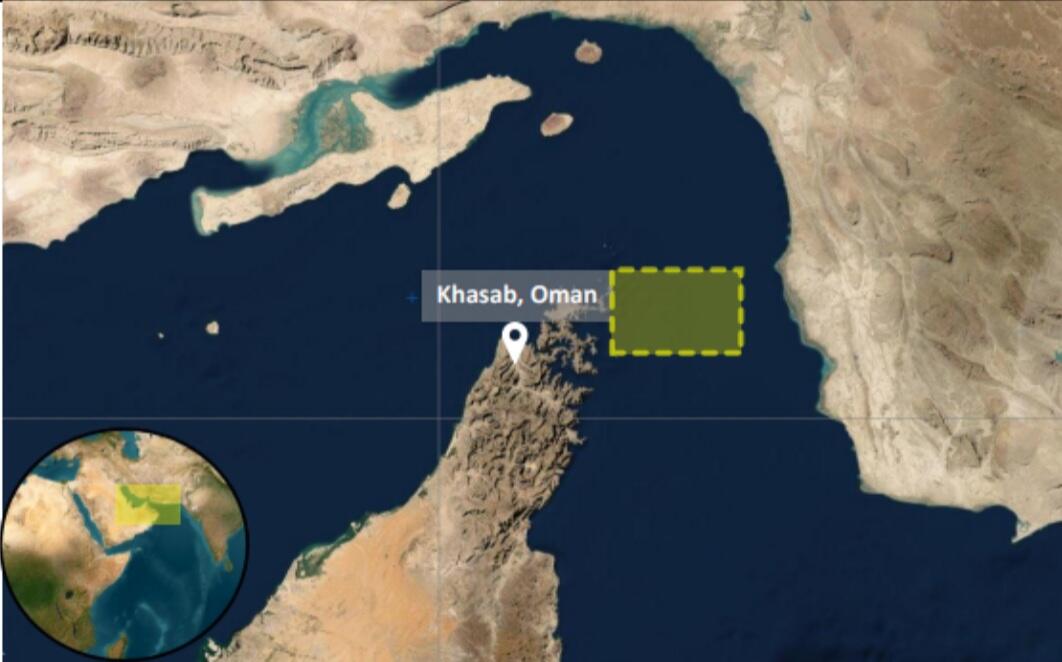
Yet another attack has occurred in the Strait of Hormuz, this time on a foreign tanker on an outbound transit route, which Iran and Oman claim to directly oversee and administer according to the terms of the Oman deal for managing the strait which is still being finalized.
UK Maritime Trade Operations says Tuesday that the unknown projectile caused engine-room damage and a crew casualty, with the remaining crew being rescued and assisted by the Omani Coast Guard.
Such attacks which mark enforcement of Iran’s protocol and claim of control over the vital energy transit waterway have been steady, though not rapid, over the last several weeks. Oil prices have been on the rise this week, also as it continues to be clear that Washington and Tehran are digging in with their competing maximum demands.
Houthis Escalate in Red Sea
Hormuz isn’t the only chokepoint still witnessing active conflict. Waters off Yemen and the Red Sea also continue to heat up, with the Iranian-allied Houthi rebels still escalating.
According to The Wall Street Journal on Tuesday, the group is “shutting down operations at a strategic seaport and pushing closer to the Bab al-Mandeb Strait, an important global shipping chokepoint.”
The report cites Yemeni authorities to describe, “The militant group’s recent missile and drone attacks forced the closure of the port of Mokha, a key logistics hub for civilian shipping and for anti-Houthi forces operating along the coast.”
“This is the most significant escalation in quite a few years, maybe since 2020,” said Adam Baron, a Yemen expert and fellow with New America, a policy institute in Washington.
Baron called the port of Mokha the key logistics hub for anti-Houthi forces on the Red Sea. The Houthis control mountainous terrain inland from the Bab al-Mandeb but not the coast along the crucial waterway, which is held by opposing forces.
No Movement on Talks until After Oman Deal Signed: Qatar
On the question of finding a path toward broader US-Iran peace, there’s still no movements on talks. Qatar is even openly saying that its direct mediation efforts won’t resume until the Oman deal is finalized – which critics have complained gives Iran de facto control of operations in the Strait of Hormuz.
“Qatar’s Foreign Ministry spokesman Majed al-Ansari says during a news conference that countries mediating between Iran and the US are waiting for Iran and Oman to announce an expected agreement on transit through the Strait of Hormuz, before pushing Washington and Tehran to resume negotiations aimed at ending their war,” Al Jazeera reports.
President Trump’s latest rhetoric and social media activity is not going to help the cause of peace, or the two sides getting back to the negotiating table. After verbalizing Monday that the US should declare the Hormuz Strait a US territory, he posted the following to Truth Social on Tuesday:
All of this comes on the heels of the 60-day diplomatic window set by the MoU inked in June has expired. Tehran said it was already effectively dead anyway, and thus “irrelevant” – blaming Washington for having violated its terms on multiple occasions.
Rough Road to November
Trump is meanwhile ultimately sticking to the following as an ultimate goal of the Iran conflict: “The number one Goal is, and always will be, that Iran cannot have, in any way, shape, or form, a Nuclear Weapon. Thank you for your attention to this matter! President DONALD J. TRUMP,” he earlier stated on Truth Social.
The path to midterm elections in November continues to be a rough one for the US administration, and the pain is likely to continue for at least the time being…
President Donald Trump’s approval rating fell to the lowest level of his presidency, with an overwhelming majority of Americans concerned the US war with Iran will last a long time, according to a Reuters/Ipsos poll https://t.co/364a3rlckMpic.twitter.com/UrDCYmf8m0
Not only has Iran not backed down, but its military is newly claiming to take an “offensive” posture and has reshuffled its command accordingly. If there are new tit-for-tat attacks, Tehran is in essence saying the next salvo will go bigger.
China is estimated to have added about 200,000 barrels per day (bpd) of crude oil to its huge inventories in July as imports rebounded from a decade-low in June and refinery runs remained depressed.
The world’s top crude oil importer, unlike other major oil consumers, started drawing down on stockpiles only in May, the third month of the Middle East crisis, as it had amassed an estimated 1.4 billion barrels of crude oil in commercial and strategic stocks at the start of the Iran war.
The trend of drawdowns in May and June appears to have reversed in July, according to calculations by Reuters columnist Clyde Russell based on officially available Chinese data.
Unlike the United States, China does not report inventories. Analysts are looking at overall supply (domestic production plus imports) and refinery processing rates to estimate how much crude is going into reserves and how much is being processed into fuels.
Using this calculation, Reuters’ Russell has estimated that China had 210,000 bpd of crude available to go to storage in July, considering total crude availability of 12.72 million bpd (8.41 million bpd of imports and 4.3 million bpd of domestic production), and refinery throughput of 12.51 million bpd.
The latest estimates show that China’s massive crude oil stockpile has mostly remained intact at about 1.2 billion barrels, five months after the worst disruption to global oil supply began with the closure of the Strait of Hormuz.
China slashed its overall crude oil imports amid the Middle East conflict as its refiners cut run rates and authorities restricted fuel exports to protect domestic supply.
The higher crude oil imports in July likely allowed stockpiling again, in a surprise to the market and possibly indicating continued weakness in domestic demand and refining volumes.
DSA Lawmaker Claims Shoplifting For “Biological Need” Shouldn’t Be Illegal
A radical Democratic Socialist lawmaker from New York is under fire after declaring that theft driven by “biological need” shouldn’t be treated as a crime, effectively green-lighting shoplifting while slamming big retailers.
Emily Gallagher, a New York State Assembly member and part of the Democratic Socialists of America’s New York State Socialists in Office caucus, sparked outrage this week with comments defending petty theft at a press conference outside Manhattan Criminal Court.
“Most of what we saw were crimes of poverty – people who are stealing things like toothpaste, people who were stealing things like, you know, soap. And that means if you’re stealing those things, you need them. And we are choosing to protect billion-dollar companies, like CVS and Walgreens, over the people who are struggling to get by,” Gallagher said, according to the New York Post.
“So I would say that the true crime is that there is such incredible wealth disparity in this city that there are people who can be thrown in jail simply for having a biological need.“
Gallagher went on to tout her soft-on-crime criminal justice “reforms” while blasting conservative media for opposing the anti-law-and-order policies that have already wreaked havoc on New York City and other Democrat-run cities across the country.
However, everyday New Yorkers aren’t buying it.
The Post quizzed several shoppers at the Food Universal supermarket in the Bronx’s Co-op City, who told the paper that Gallagher’s comments were downright ridiculous.
“It’s foolish to think one should not be punished for stealing. It is a crime,” said one shopper. “Mamdani can implement that in his [city-run grocery] stores, so if you don’t have the necessities, you can go there and get them for free,”
“People are going to feel entitled because they know they can walk in and walk out and nothing will happen,” said another shopper. “Allowing people to shoplift with no consequence is wrong. I’m a single mom and at one time I had four jobs. I would never think of stealing anything.
Anyone still dismissing the DSA as a fringe outfit with no real pull inside the Democrat Party need only look at the growing roster of newly elected socialists popping up nationwide, some already eyeing Congress. DSA-backed candidates toppled 15-term Rep. Diana DeGette in Denver and Rep. Shri Thanedar in Michigan this summer, and captured two safe blue New York House seats outright. Socialists Claire Valdez, Darializa Avila Chevalier, Melat Kiros and Donavan McKinney are now on track to join Reps. Alexandria Ocasio-Cortez and Rashida Tlaib in Washington come January. Over the weekend, House Minority Leader Hakeem Jeffries even admitted the group is part of the party’s “broad caucus.”