65.8 F
Chicago
Sunday, September 20, 2026
Home Blog Page 1456

FBI Probing Allegations Of ‘Targeted Violence’ Against Religious Groups in Seattle: Official

FBI Probing Allegations Of ‘Targeted Violence’ Against Religious Groups in Seattle: Official

Authored by Zachary Stieber via The Epoch Times,

The FBI is investigating after officials said a religious event in Seattle was disrupted by violence, a top FBI official said on May 27.

“We have asked our team to fully investigate allegations of targeted violence against religious groups at the Seattle concert,” Dan Bongino, the FBI’s deputy director, said on social media platform X. “Freedom of religion isn’t a suggestion.”

The office of Seattle Mayor Bruce Harrell did not respond to a request for comment by publication time.

Organizers said the May 24 event was held at Cal Anderson Park in support of “the sanctity of human life, the sacrality of biological gender, the importance of the nuclear family, and the right to freedom of speech and religion.”

They said the movement organizing the event stands against indoctrination of children “by a liberal, political, and sexual agenda that seeks to destroy their God-given identities.”

Counterprotesters, including the Freedom Socialist Party, said their demonstration was meant to “keep your bibles off our bodies.”

Clashes at the event resulted in 23 arrests, the Seattle Police Department said. One juvenile was released. The rest of those arrested were charged with assault and obstruction.

The White House Faith Office said in a statement on Tuesday that it condemned “the violent disruption of Seattle’s MayDay USA worship event.”

“We affirm the fundamental rights to free speech and religious freedom for all Americans, as protected by federal law. Public officials must protect the inalienable rights of all citizens, regardless of their faith or religious beliefs. We urge the City of Seattle to uphold these rights at all faith-based events, safeguarding the ability of people of faith to gather and express their beliefs without fear of harassment or violence,” the office said.

After the event, Harrell, a Democrat, called it a “far-right rally” that he said was meant “to provoke a reaction by promoting beliefs that are inherently opposed to our city’s values, in the heart of Seattle’s most prominent LGBTQ+ neighborhood.”

He said that anarchists infiltrated counterprotesters and “inspired violence,” which led to officers making arrests and asking organizers to end the event early. The request was accepted.

Organizers said in a statement to news outlets that “under Mayor Harrell’s leadership, the city of Seattle has continued its spiral into lawlessness and dysfunction while the First Amendment rights of citizens to peacefully assemble has been disregarded.”

The Seattle mayor’s office later released statements from some faith leaders that offered support for Harrell and criticized the event organizers.

Russell Johnson, the lead pastor at Pursuit NW, said on X that Harrell should apologize to Christians in the state “for his bigoted remarks after folks who were holding a peaceful worship event at Cal Anderson Park were violently assaulted for the high crime of expressing their deeply held religious beliefs in the form of a permitted worship event on city property.”

Tyler Durden
Wed, 05/28/2025 – 17:40

Yale Dean Emails Everyone Anti-Trump Essay: “I Know You Share My Concern”

Yale Dean Emails Everyone Anti-Trump Essay: “I Know You Share My Concern”

Authored by Ibrahim Garza via The College Fix,

A Yale University dean emailed the entire Divinity School a copy of his MSNBC essay criticizing President Donald Trump, according to an email recently obtained by The College Fix.

But the email is just the latest example of bias against conservatives, according to a concerned student.

“Trump’s USAID cuts are anti-Christian at the core,” Dean Gregory Sterling wrote in an opinion piece for MSNBC.

The article criticized President Trump for downsizing the United States Agency for International Development, saying it went against the teachings of Christianity.

Dean Sterling (pictured above) shared the essay with the Divinity School.

“Greetings. I am writing today to share a new commentary piece I have published at MSNBC,” the email stated.

The article represents my effort to call attention to the anti-Christian nature of efforts by our government to eliminate or drastically reduce humanitarian work domestically and abroad, and to reach the broad public with the message that Christianity is more than the picture they are probably forming from politics and media.”

The message ended with Sterling stating:

“I know that you share my concern.”

Despite multiple requests for comment, neither Dean Sterling nor Yale Divinity School have responded.

Sterling’s biography shares how under his leadership, the divinity school “tripled the number of faculty from underrepresented groups and doubled the number of staff and students from diverse backgrounds.”

A Yale Divinity School student, who wished to remain anonymous due to fear of backlash, said “taxpayers would be upset knowing that left-wing propaganda is being pushed…by administrators at so-called elite schools.”

“I wanted to believe that these schools still had immense value, but their value lies not in their curriculum nor in the administration, only in the extracurricular events you get to attend with alumni and successful people in their field,” the student, a conservative Catholic, told The Fix.

“The name ‘Yale’ carries with it a lot of prestige, and I hope that there are changes made in the free exchange of ideas to actually honor that perception.”

The student stated that this email confirmed concerns that Yale is biased against conservatives – however this experience has “strengthened” the student’s support for the Trump administration and its direct action against elite universities.

“When Dean Sterling shared his article on MSNBC, it confirmed to me that Yale Divinity School isn’t a politically neutral institution and talking openly about being a conservative isn’t an option, unless you want to get ostracized by your peers,” the student said.

“It’s deeply disappointing as a student and has strengthened my support for the Trump Administration cutting federal funding for Ivy League institutions.”

Data supports the student’s view that the university leans left.

For example, 97 percent of faculty donations in the 2024 election went to Democratic candidates, according to the Buckley Institute, a conservative Yale group. In the social sciences and humanities, Democratic professors outnumber Republicans 78 to 1, the Buckley Institute found. The total ratio is 28 to 1, according to the Buckley Institute.

The conservative group also criticized a new “Trust in Higher Education” committee formed by Yale President Maurie McInnis.

The committee seeks to address declining public confidence through “open discourse and self-reflection” however the committee has no Republican representation.

“Yale President Maurie McInnis deserves recognition for trying to address the loss of trust in higher education. At the same time, creating a committee that is 70% Democrat and has zero Republicans is a poor way of doing it,” the Buckley Institute commented in a statement to The Fix.

“American higher education has lost the faith of the public because it is seen as an out-of-touch progressive ideological echo chamber dominated by views that diverge widely from the average American,” Executive Director Lauren Noble told The Fix via an emailed statement.

She said Yale should adopt institutional neutrality and eliminate its “diversity, equity, and inclusion” programs.

“Using the university name to support a uniformly progressive political agenda has given the impression that institutions of higher education have been co-opted for the sake of politics and abandoned their educational mission,” Noble stated.

Tyler Durden
Wed, 05/28/2025 – 15:25

UBS Survey Finds Global Tesla Enthusiasm Losing Juice, But…

UBS Survey Finds Global Tesla Enthusiasm Losing Juice, But…

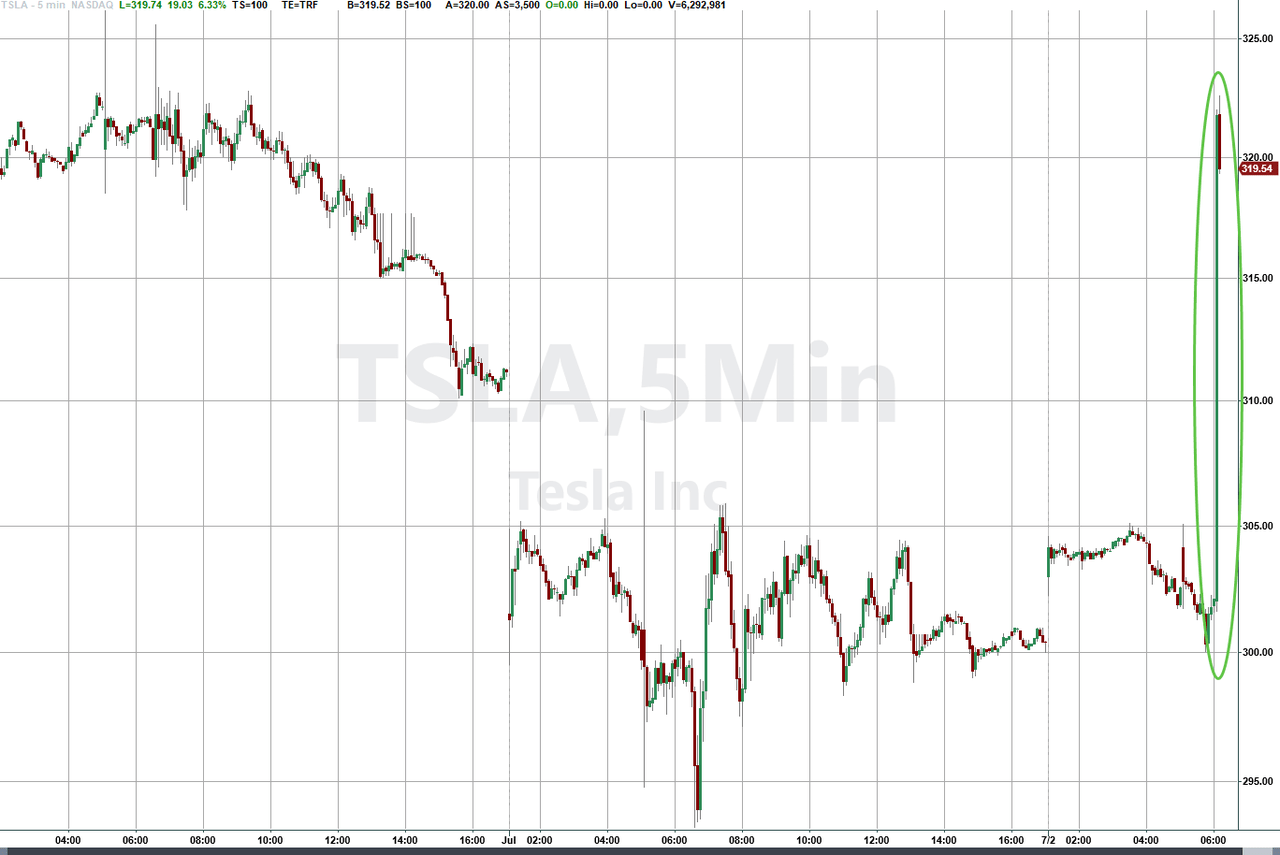
Tesla shares have rebounded sharply, rising around 60% since their March lows, driven by renewed investor enthusiasm surrounding the company’s upcoming robotaxi launch and progress on its humanoid robots. The March low coincided with remarks by unhinged leftist Minnesota Governor Tim Walz, who cheerleaded the demise of Tesla when shares cratered. 

Despite the surge in bullish investor sentiment since mid-April, fueled by anticipation of Tesla’s long-awaited robotaxi launch in Austin, Texas, in the coming days and visible progress on its Optimus humanoid robot, UBS maintains a cautious stance on the stock.

UBS analysts Joseph Spak and others published a note on Tuesday, focusing on its proprietary UBS EV Consumer Survey, in which the latest survey found declining global interest in Tesla’s EVs across all major regions (U.S., China, Europe), as well as growing pressure across its core automotive business, where fundamentals continue to deteriorate. 

Spak outlined results from each key market:

  • In the U.S., we see Tesla saturation (~48% US BEV share), a limited vehicle lineup and affordability are concerns.

  • In China, we see intense competition and Tesla is no longer seen as the technology leader.

  • In Europe, we believe there may have been brand damage from Musk’s political involvement

Overall, we remain cautious on Tesla stock,” Spak said in the note. UBS maintains a Sell rating with a 12-month price target of $190, implying significant downside from current levels. Shares were trading around $366 in premarket on Wednesday.

Spak sees through the robotaxis and humanoid robots hype, telling clients: 

“We understand that there is enthusiasm over robotaxis and humanoid robots, but the automotive business faces mounting challenges and a source of earnings/cash flow may be at risk with removal of California waiver. Musk has indicated the value of Tesla is in AV and humanoid robots. This may be true. But given the deteriorating outlook for the auto business , that means the implied valuation assigned to these ventures is already quite robust.” 

According to the survey of consumers around the world, only 36% of respondents globally would consider purchasing a Tesla—down from 39% a year ago. The share of consumers selecting Tesla as their top BEV (battery electric vehicle) choice fell even more sharply, from 22% to 18%.

Here are the highlights of the survey:

Globally, 36% of consumers would consider a Tesla, down from 39% last year. As a consumer’s top BEV choice, Tesla is down to 18%, from 22% last year. The top choice decline was fairly prominent across the 3 major regions for Tesla:

  • In the U.S. top choice went to 29% vs. 38% last year (and note vs. 2024 BEV share of 48%).

  • In China, Tesla as a top choice was down to 14% from 18% last year and now behind both BYD and Xiaomi. More broadly, China consumers prefer to buy domestic OEM brands vs TSLA, although they do favor TSLA over other foreign OEM brands.

  • In Europe, top choice went to 15% from 20% last year. In Europe, we also saw brand consideration for Audi and BMW surpass TSLA.

  • The survey also asked about autonomous/ADAS. Importance of ADAS as a feature held steady. When it comes to paying for autonomous features, only 1~12% would pay more than $7.6k upfront for autonomous features. TSLA’s FSD currently costs $8k to buy outright. Meanwhile, only ~18% would pay >$100/ month for autonomous features; FSD subscription is currently $99/month.

It’s hard to ignore the shifting sentiment in the global EV survey data, which shows consumer interest steadily moving away from Tesla and toward Chinese rival BYD.

Tesla’s favorability in the U.S. has remained stagnant at around 50% for several years. 

In China, respondents have been increasingly favoring domestic brands over Tesla. 

In Europe, respondents were also beginning to shift to domestic brands. 

The survey found that youngsters around the world are increasingly favoring Tesla. This bodes well for future demand. 

Interest in owning a vehicle that can drive autonomously differs per country. 

Contrary to UBS analyst Joseph Spak’s warning of a “deteriorating outlook” for Tesla’s automotive business, one user on X pointed to fresh sales data from China showing the Model Y ranked as the best-selling mid-size SUV for the week beginning May 19.

Tip Ranks places a 47% success rate on Spak’s calls. 

. . .

Tyler Durden
Wed, 05/28/2025 – 14:40

Crypto Czar Sacks Says US Could Possibly “Acquire More Bitcoin”

Crypto Czar Sacks Says US Could Possibly “Acquire More Bitcoin”

Authored by Stephen Katte via CoinTelegraph.com,

White House AI and crypto czar David Sacks says the US could buy more Bitcoin if the government can fund the purchase in a “budget-neutral” way without a tax or adding to the growing national debt.

Sacks told Gemini co-founders Cameron and Tyler Winklevoss during a May 27 fireside chat at the Bitcoin 2025 conference that while he “can’t promise anything,” a pathway does exist for the government to buy more Bitcoin.

However, it would require convincing Commerce Secretary Howard Lutnick or Treasury Secretary Scott Besson to OK the buy and fund it “without a new tax or adding to the debt,” Sacks said, adding that “maybe by finding the money from some other program that’s not using it — then we could potentially acquire more Bitcoin.”

David Sacks said the US could buy more Bitcoin, but he can’t make any promises. Source: YouTube

“The question is, can we get either the Treasury Department or the Commerce Department to get excited about that because if they do and they can figure out how to fund it, they actually do have presidential authorization,” Sacks said.

US can buy Bitcoin if it doesn’t sting budget 

The March 6 executive order authorizing the creation of a crypto reserve states it will hold any Bitcoin forfeited as part of criminal or civil asset forfeiture.

Sacks noted part of the executive order “allows the government to purchase more”  if it’s “done in a budget-neutral” way.

“Specifically, if either the Commerce Department or the Treasury Department can figure out how to fund it without adding to the debt, then they are allowed to create those programs,” he said.

The US holds approximately 198,012 Bitcoin, according to an April report from CoinGecko, worth over $21 billion at current prices.

Most of its holdings came from two seizures connected to the online marketplace Silk Road, one in November 2020 that netted 69,370 Bitcoin, and another in March 2022 that saw authorities seize 51,351 Bitcoin.

The US also seized 94,636 Bitcoin from Bitfinex hacker Ilya Lichtenstein on Jan. 31, 2022, after authorities hacked into his cloud storage account, which contained a file holding around 2,000 crypto wallet addresses and corresponding private keys.

In January, the US Department of Justice received the green light to sell 198,109 Bitcoin. Previously, the government sold a small portion of its holdings in March 2023, when it offloaded 9,861 Bitcoin for $215.7 million

Tyler Durden
Wed, 05/28/2025 – 14:20

FOMC Minutes Show Fearful Fed Taking “Cautious Approach” Before Plunge In Uncertainty

FOMC Minutes Show Fearful Fed Taking “Cautious Approach” Before Plunge In Uncertainty

Since the last FOMC meeting, on May 7th, the market has been mixed with stocks and crude oil rallying strongly while gold and bonds have been sold (the dollar is basically unchanged)…

Source: Bloomberg

…but bitcoin has soared over 15% since the last FOMC meeting…

Source: Bloomberg

Hard data continues to be steady and growing while ‘soft’ survey data has surged in the three weeks since the last Fed meeting…

Source: Bloomberg

Which has pushed rate-cut expectations lower overall (with cuts shifting from 2025 to 2026)…

Source: Bloomberg

As a reminder, in spite of the exact same macro background of a dramatic tightening in financial conditions (orange oval) and weakness morphing into strength for US Macro data (red and green arrow), Powell and his pals decided a 50bps rate-cut (red oval) was not necessary this time… we wonder why (black line)?

Source: Bloomberg

Finally, before we see what they said (or want us to know), we noted that “uncertainty” was a key word used by Powell (during the statement and the press conference). Overall ‘Uncertainty’ had fallen into the meeting and since then it has plunged to its lowest since February (before Liberation Day)…

Source: Bloomberg

As we detailed in the preview, these minutes of the meeting are an account of information that was available to the Fed at the time of the meeting on 7th May 2025, therefore it will not incorporate the recent de-escalation on trade with China.

So, What Did They Want Us To Know?

Here are the key headlines from the Minutes:

Participants agreed that uncertainty about the economic outlook had increased further, making it appropriate to take a cautious approach until the net economic effects of the array of changes to government policies become clearer.

Uncertainty is key:

Significant uncertainties also surrounded changes in fiscal, regulatory, and immigration policies and their economic effects.

Taken together, participants saw the uncertainty about their economic outlooks as unusually elevated.

On inflation, they are split: 

Some participants assessed that tariffs on intermediate goods could contribute to a more persistent increase in inflation. A few participants noted that supply chain disruptions caused by tariffs also could have persistent effects on inflation, reminiscent of such effects during the pandemic.

Several participants highlighted factors that might help mitigate the magnitude and persistence of potential increases in inflation, such as reductions of tariff increases from ongoing trade negotiations, less tolerance for price increases by households, a weakening of the economy, reduced housing inflation pressures from lower immigration, or a desire by some firms to increase market share rather than raise prices on items not affected by tariffs.

Growth fears: 

The labor market was expected to weaken substantially, with the unemployment rate forecast moving above the staff’s estimate of its natural rate by the end of this year and remaining above the natural rate through 2027.

…and finally, this fearmongering: 

Some participants commented on a change from the typical pattern of correlations across asset prices during the first half of April, with longer-term Treasury yields rising and the dollar depreciating despite the decline in the prices of equities and other risky assets.

These participants noted that a durable shift in such correlations or a diminution of the perceived safe-haven status of U.S. assets could have long-lasting implications for the economy.

Read the full Minutes release below: 

Tyler Durden
Wed, 05/28/2025 – 14:05

FOMC Minutes Preview: The “Wait-And-See” Meeting

FOMC Minutes Preview: The “Wait-And-See” Meeting

Three weeks after the May 7 FOMC left rates unchanged at 4.25-4.50% for a third consecutive session (as expected) with a unanimous vote, at 2pm ET today we will get the Minutes from said meeting. As a reminder, the statement noted that uncertainty around the economic outlook has increased further and added that ‘‘risks of higher unemployment and higher inflation have risen”. 

The Fed repeated its March language that economic activity continues to expand at a solid pace, though net export swings have affected the data. It maintained its view that inflation remains somewhat elevated and labor market conditions are solid, with the unemployment rate stabilizing at a low level. 

The key changes centered on increased uncertainty and the risks on both sides of the dual mandate. 

In his press conference, Chair Powell reiterated that the Fed is well-positioned to respond as needed and remains in a “wait-and-see” stance. 

On tariffs, he noted they have been larger than anticipated but have yet to show major effects in the data, though concerns remain. 

Powell said the Fed will adjust policy as the economy evolves, balancing dual mandate goals by assessing how far and how fast each side may drift from target. He declined to specify which side is at greater risk and stressed the Fed is in no rush but can act quickly if necessary. 

According to Bloomberg economists, “Jerome Powell signaled a high bar for rate cuts this year. We think these changes likely reflect significant adjustments to the staff forecast following the Trump administration’s changes to tariff policies in the intermeeting period.”

Note, the minutes of the meeting are an account of information that was available to the Fed at the time of the meeting on 7th May 2025, therefore it will not incorporate the recent de-escalation on trade with China.

Tyler Durden
Wed, 05/28/2025 – 13:50

Kremlin Issues Outline Of Putin’s Truce Demands, Warns “Peace Tomorrow Will Be Even More Painful”

Kremlin Issues Outline Of Putin’s Truce Demands, Warns “Peace Tomorrow Will Be Even More Painful”

Russian Foreign Minister Sergey Lavrov started off the week by saying the Kremlin will announce the date of the next direct talks with Ukraine in the near future following the first ‘direct’ Istanbul meeting on May 16. Lavrov has in follow-up to his initial Monday remarks stated that work on a formal peace outline is at an “advanced stage.” On Wednesday he has announced that the next talks are set for June 2 in Istanbul.

But in the meantime, Russia and Ukraine have stepped up drone and missile attacks on each other’s territories in a massive way. This has led President Trump to warn of “very bad things” to come for Moscow, and he provocatively mused whether Putin has gone “crazy” in a Truth Social post.

Trump even said Putin is “playing with fire”. Moscow has largely shrugged off the hardline rhetoric out of the White House, instead warning that emotionalism shouldn’t thwart genuine efforts toward ending the conflict.

Via Reuters

It’s been obvious to all honest observers of the war that Russia has the clear battlefield momentum and manpower to keep that momentum, amid more reports of slow but steady gains in the Donbass. Given this, Russia’s spy chief in fresh statements Wednesday has said that Moscow cannot afford to be ‘weak’ right now.

The country’s Foreign Intelligence Service (SVR), Sergey Naryshkin, said as follows:

“Russia has no right to be weak… and to abandon its own values and pursue the chimera of totalitarian liberalism and globalism.”

According to Naryshkin, “history teaches us that the security on the Eurasian continent and ultimately the whole world depends on Russia’s firm standing.”

Amid this backdrop, one senior Russian source has told Reuters in a Wednesday report that “Putin is ready to make peace but not at any price.”

Multiple Russian sources cited in the reaport said Putin wants a “written” pledge by major Western powers not to enlarge the NATO military alliance eastward. This is being taken to mean he’s asking to West to formal ruling out ever extending membership to Ukraine, Georgia and Moldova.

These written guarantees and other conditions have been spelled out in English-language Russian state media as follows:

  • Ukraine’s permanent neutrality
  • Partial sanctions relief for Russia
  • Return of frozen Russian assets
  • Protections for Ukraine’s Russian-speaking people

And then an or else was offered as part of the ultimatum. While not officially issued by the Kremlin, this appears some very intentional signaling by Putin officials. It was conveyed via the Reuters report:

The first source said that, if Putin realizes he is unable to reach a peace deal on his own terms, he will seek to show the Ukrainians and the Europeans through military strength that “peace tomorrow will be even more painful.”

But Ukraine’s President Zelensky has made clear of the Donbass and even Crimea, “this is our land” – and has repeatedly said he won’t make territorial concessions. While hawks in Europe are supporting this unbending stance, it’s as yet unclear whether Washington is brining the pressure on Kiev to at least offer Crimea. 

Meanwhile, we highlighted earlier what one prominent conservative American commentator had this to say: “Sorry, but if you want to destroy your base and watch your presidency go down in flames, start something with Russia. It’s absolutely asinine.”

This could all spiral into WW3 in the blink of an eye…

Tyler Durden
Wed, 05/28/2025 – 13:00

Goldman Downgrades Booz Allen Hamilton To ‘Sell’ Amid DOGE Contract Cancellations

Goldman Downgrades Booz Allen Hamilton To ‘Sell’ Amid DOGE Contract Cancellations

Management consulting firm Booz Allen quietly evolved into a government-wide contracting behemoth over the past few decades. By 2024, an astounding 98% of its revenue came directly from government agencies.

Now, enter the DOGE era: Goldman analysts have downgraded Booz Allen from “Neutral” to “Sell,” noting medium-term revenue growth is expected to be flat as federal civilian spending comes under pressure and priorities shift within various federal agencies. 

Highlighting top-line pressures, analysts Noah Poponak, Anthony Valentini, and Connor Dessert told clients Wednesday morning that Booz Allen shows up on the DOGE contract cancellation website more often than any other government services firm.

Federal civilian agency budgets are under pressure, as other areas of spending within the government are prioritized,” Poponak said.

He noted, “Booz Allen is on the DOGE contract cancel website more than other government services companies. We think several efforts to reduce Fed Civ spending remain underway. We now expect Booz Allen organic revenue growth closer to flat for the next several years, which could take time for the stock to digest following the strong growth run of the last few years.” 

DOGE data shows that Booz Allen has had 68 contracts canceled, with 41 of these being contracts that had not been fully paid out, and the remainder having been fully paid. The 60 contracts account for over $600 million in deals. 

Booz Allen’s canceled contracts are spread across multiple federal agencies, with the majority concentrated in the Department of Health and Human Services.

Highlights from the report:

  • Downgrade Rationale: Booz Allen is downgraded from Neutral to Sell due to concerns about limited revenue growth, margin compression, and valuation risk over the medium term.

  • Revenue Outlook: GS Analysts now expect Booz Allen’s organic revenue growth to be flat through FY28 as federal civilian agency spending is cut and DoD priorities shift. The company also appears frequently on DOGE’s contract cancellation list.

  • Margins Under Pressure: The shift toward outcome-based and fixed-price contracts increases risk for contractors. Margin compression is likely as competitive pricing intensifies in a fragmented industry.

  • Valuation Risk: While Booz Allen trades at 17x CY26E P/E and 12x EBITDA—near historical averages—those multiples are at risk if earnings stay flat. GS analysts sees 14% downside to their revised $94 price target.

  • Weak FY26 Guidance: Initial FY26 guidance calls for 0–4% revenue growth and EBITDA below consensus. FCF guidance also came in ~19% below consensus.

  • Book-to-Bill Concerns: Q1 FY26 book-to-bill ratio was just 0.71x, a sharp drop from prior quarters and an early signal of slowing growth

More broadly, Government IT outlays are set to slow this year and into next, driven by declining federal spending.

Besides Booz Allen, here are the 20 other companies with the highest percentage of revenue from the US Gov’t. 

Welcome to the era of DOGE. It won’t be pretty for the elite class in the Mid-Atlantic area. 

Tyler Durden
Wed, 05/28/2025 – 12:25

Narratives Vs. Fundamentals: Battle In The Bond Market

Narratives Vs. Fundamentals: Battle In The Bond Market

Authored by Michael Lebowitz via RealInvestmentAdvice.com,

On January 8, 2025, we answered many of your questions with an article entitled Why Are Bond Yields Rising? Since then, bond yields initially fell but have recently risen back to early January levels. Unsurprisingly, our email boxes are again filled with the same questions we got in early January.

This article presents a different perspective on the question of why bond yields are rising.  We focus on the difference between narratives and fundamentals. However, we briefly review the current situation with Treasury yields before starting.

Fundamental Bond Model

The two graphs below, updated from the January article, illustrate the strong historical correlation between ten-year bond yields and our model, which is based on inflation, inflation expectations, and economic activity. Currently, the fair value yield of the ten-year UST is 3.94%, approximately 64 basis points below the actual yield. The gap between the fair value and the bond’s yield is technically referred to as the term premium. The term ‘premium’ quantifies all non-model factors that impact yields. Today, the divergence can largely be explained by deficits and tariff-related inflation concerns, i.e., the current narratives.  

The following graph provides historical context for the relationship between yields and inflation. Yields jumped in 2021 and 2022 as inflation rose to a peak of 9%. Since then, inflation has fallen rapidly and is nearing the Fed’s 2% target. However, bond yields remain near their highs, trading in a wide range spanning 3.75% to 5.00%.

Day Traders, Narratives, and Fundamentals

Fundamentals, such as the price-to-earnings ratio for stocks or the term premium for bonds, are meaningless for day traders. Narratives explaining why markets rise or fall are equally worthless to day traders. Day traders focus on minute-by-minute imbalances between buyers and sellers. They devise trading tools to quantify how said imbalances may impact prices. Their work is incredibly technical. Most successful short-term traders do not care about market narratives and do zero fundamental analysis. The impact of these traders is most considerable on very short-term intraday prices.

Looking beyond the day traders, narratives often determine the short to medium-term price trends. These narratives, which can last days, weeks, months, or longer, are stories or themes that shape how traders and investors interpret and react to changes in the financial markets. They simplify complex topics into easily digestible explanations. Sometimes, market narratives accurately explain why markets are moving in one direction or the other. However, other times they prove false. Whether grounded in hard data or not, market narratives can perpetuate market trends by shaping shorter-term investor behaviors. Furthermore, as narratives gain popularity, they are amplified by the media and, more recently, social media platforms.

Moving out further, fundamental-based investors focus on hard data and facts. At its core, fundamental analysis enables investors to determine the intrinsic value of an asset or market, and therefore assess whether it is overvalued or undervalued. While fundamental analysis focuses on objective data, its interpretation can vary widely. Investors grounded in fundamentals are willing to look beyond the second-by-second trading of day traders and the narratives that move assets for weeks or months at a time. They are comfortable buying an asset at what they believe is a discount to its fair value.

Fundamentals vs Narratives

As active investors, we strike a balance between the short-term impact of narratives and the longer-term performance driven by fundamentals.

This is incredibly difficult in the stock market, as stocks can stay well above or below their intrinsic value for years. Thus, stock narratives tend to result in longer-lasting trends than bond market narratives.

To better appreciate this, consider the first graph below, which shows the correlation between the CAPE10 for the S&P 500 and the one-year returns following each monthly valuation. The chart encompasses 75 years of data. As we highlight, we can expect a one-year performance range of approximately plus or minus 20% at current valuations. Moreover, with an R-squared of .0277, we have no confidence in that forecast. 

The following graph shows that fundamentals are much more predictive of returns over 10-year periods. According to this model, the current expectations for the S&P 500’s annualized ten-year return range from -0.50% to +3.50%. Not only is the range of expectations tight, but we are much more confident, as evidenced by the R-squared of 0.4033.

If you are a buy-and-hold long-term investor, the paltry expected returns that stocks offer over the next ten years should provide caution. However, the first graph informs active traders that the sequence of the annual returns, which comprises the ten-year total return, is difficult to predict. Narrative and sentiment will determine that sequence.

In the bond market, narratives also considerably impact yields, but they don’t tend to last nearly as long. This is due to the interconnectedness between yields and economic activity. Higher interest rates provide less incentive to invest or consume. Thus, as we have repeatedly seen throughout history, periods of above-trend interest rates have been associated with slow or negative economic growth, and vice versa.

Feeding The Narratives

Narratives typically need a steady diet of supporting news to sustain themselves. To feed the beast, so to speak, the market exaggerates some news and downplays other news. 

The recent round of Treasury auctions is a perfect example of how the current bond bearish narrative shapes the way news is reported.

The 20-Year Doom Auction

The bearish narratives were in overdrive after the Moody’s credit downgrade and the larger-than-expected “Big Beautiful” government spending bill. But narratives always need to be fed. The bearish bond narrative ate on May 21, 2025, with a Treasury 20-year auction deemed “terrible” and “horrible” by some pundits. Some interpreted the auction as an obvious sign that the Treasury was struggling to fund itself.

Might those views be a bit of an exaggeration?

Some fear-mongers pointed out the “large” auction tail. The tail is the difference between the auction yield and the yield before the auction. A large tail can mean insufficient demand for the auctioned bonds. As the graph below shows, the recent red tail is not that abnormal. Moreover, the size of the tail is volatile in both directions. This is partly because the 20-year bond is not as widely regarded as a market benchmark as other maturities.

Also, indirect buyers were allotted 82% of the auction bonds. These are primarily central banks. So, foreign demand was strong despite the anti-dollar narrative claiming that central banks are selling US Treasuries in size?

Indeed, the auction could have been better, but the media exaggerated the outcome to feed the bearish bond narrative.

The Unseen 10-Year Auction

Two weeks before the “horrendous” 20-year auction, a very good 10-year auction was met with little fanfare.

For context, the 10-year Treasury is more closely followed than the 20-year and significantly more heavily traded. Importantly, it is a key economic rate, meaning it has a substantially greater financial impact than the 20-year yield. Lastly, bear in mind the 10-year auction was $42 billion, compared to the relatively small $16 billion 20-year auction.

Despite being much larger than the 20-year bond, the 10-year auction was met with strong demand, as seen in the graph below. Primary dealers (direct bidders), the backstop for Treasury auctions, account for the third-lowest allotment since at least 2008 at 8.9%. This signifies that demand from other sources was robust.

Second, there were bids for 2.6x as many bonds as were being auctioned. The average of the last six auctions was 2.4x. Furthermore, the ratio was at the high end of the range of the last ten-plus years.

On May 6th, despite the outstanding 10-year auction, bonds eked out a small gain. The meh 20-year auction and the bearish narratives it fed pushed prices significantly lower. Furthermore, the fear emanating from the 20-year auction sent shockwaves to the stock market, which, as circled below, fell rapidly following the announcement of the auction results.

Debunking The Deficit Narrative

We believe the hefty term premium is primarily a function of the deficit narratives spreading through the bond market.

History has shown that government spending is often unproductive. Almost all economists agree that the US government has a negative multiplier on its debt. This means that each dollar of government spending reduces long-term economic growth. Therefore, higher deficits lead to lower growth and lower inflation. While the market worries about the sheer size of bond issuance required to meet the government’s funding needs, it overlooks the potential negative impact on economic growth and inflation. One side of the story feeds the narrative, the other doesn’t.

To help quantify the economic impact of large deficits, we share the graphic below from Rising National Debt Will Cause Significant Economic Damage by the Peter G. Peterson Foundation, May 2025.

The graphic below from the report shows that by 2070, the debt-to-GDP ratio may surpass 200%. Assuming that proves correct, which is a big assumption, it would still be below Japan’s current ratio of 265%. Moreover, Japan’s economic growth has slowed to a crawl. Their GDP is the same today as it was in 2018. Further consider that its population is shrinking, and the yen is not the world’s reserve currency. Japanese 10- and 30-year yields are 1.60% and 3.10%. S&P and Moody’s rate them a notch below the US at A+ and A1, respectively.

Summary

We are active investors, which entails walking the fine line between narratives and fundamentals. Whether we agree with the prevailing narratives or not, we must comply with them, as they can significantly impact prices. However, we must also recognize and seize opportunities when we believe the narrative has stretched the price too far from its fundamentals.

 Such is the dilemma we face today with bond yields. If we are correct that the bond market is overreacting to deficits, we may see a sharp drop in yields. However, if the current narrative persists, current yield levels or even higher yields may persist.

Our deficit has been growing for decades. We believe this is a critical reason economic and productivity growth has weakened for over 40 years. We have little doubt that if this continues, it will someday become highly problematic. However, that day is not today!

Tyler Durden
Wed, 05/28/2025 – 12:00

Netanyahu Confirms Death Of Hamas Gaza Chief As Hostages Reach 600 Days In Captivity

Netanyahu Confirms Death Of Hamas Gaza Chief As Hostages Reach 600 Days In Captivity

Israeli Prime Minister Benjamin Netanyahu announced to lawmakers on Wednesday that Hamas Gaza chief Mohammed Sinwar, the younger brother of the deceased group’s leader Yahya Sinwar, has been confirmed killed.

Israel’s military has struck “dozens of targets throughout the Gaza strip” over the past 48 hours, Netanyahu remarked, and added that “We eliminated tens of thousands of terrorists, [Hamas military wing chief] Muhammed Deif, [Hezbollah chief ] Hassan Nasrallah, [Hamas’ Gaza leader who attacked Israel on Oct. 7] Yahya Sinwar, Mohammed Sinwar, and seized the Rafah and Morag crossings.”

It is unclear whether Sinwar was just recently killed, or whether Netanyahu is only now issuing belated confirmation of his death from a May 13 or other prior operation. Days after May 13, there were Israeli media reports that Sinwar’s body had been recovered. Defense Minister Israel Katz said on May 18 that, “according to all indications, Mohammed Sinwar was killed.”

“In the last two days, we’ve been executing a dramatic plan toward the complete defeat of Hamas. We’re taking control of their food distribution and money machine,” Netanyahu continued. “This is what destroys their governing capabilities. That’s what we promised.”

Following major airstrikes on a hospital in southern Gaza in mid-May, the IDF had said it was working to confirm whether Sinwar was among the dead. Israeli sources said there was a “small window of opportunity” for the strike given Hamas leaders are utilizing the vast tunnel network that exists under the hospital.

He had been targeted at the time, but may have escaped, and final confirmation was never given in the aftermath of those strikes (until today).

According to background on Sinwar from the WSJ:

Mohammed Sinwar was responsible for building up Hamas’s military wing, and was close to the U.S.-designated terrorist group’s top military commander, Mohammed Deifwho was killed by Israel last year. His brother Yahya, was the mastermind behind the Oct. 7, 2023, attack on southern Israel that launched the war. Israel killed three of Yahya Sinwar’s top deputies throughout the war, including Deif, and Hamas’s political head Ismail Haniyeh. 

If Mohammed Sinwar is dead, it would mean that the most important Hamas leaders behind the Oct. 7 attack have been taken out by Israel. After the Oct. 7 attack, Israel vowed to kill all of Hamas’s top leadership, including those abroad, and anyone who took part in or planned the attack. 

As for Wednesday’s Knesset meeting, it was heated and testy, given the opposition’s position of a “Complete failure in achieving war goals: returning the hostages and dismantling Hamas.”

Netanyahu is facing fierce criticism, including from hostage victims’ families, who have long urged negotiations with Hamas to get their loved ones back. He has opted for the ‘full war’ option, seeking the full destruction of Hamas and Islamic Jihad terrorists.

After 18 months of war, or 600 days since the Oct.7 terror attacks, 58 hostages remain in the Gaza Strip; however, Israeli leaders have warned public that the majority may be dead at this point. A US-proposed peace plan is currently under discussion by mediators, but neither side is rushing toward the negotiating table at this point, and blame-game for lack of a truce continues.

Tyler Durden
Wed, 05/28/2025 – 11:40