Whenever the Federal Reserve releases its meeting minutes, a crowd of analysts rush to dissect every comma and qualifier. But in a country that prides itself on free markets and capitalist dynamism, why do we hang on the every word of an exclusive club of central planners?
Markets shouldn’t have to interpret the tone of Jerome Powell’s press conferences or scrutinize the footnotes of bureaucratic transcripts.
But they do—because we’ve built an economy where interest rates, the price of credit, and the flow of capital are controlled not by supply and demand, but by a small committee of bankers and economists.
The problem isn’t just Powell.
The problem is that we’ve come to accept central planning at the heart of a supposedly free-market system.
What is an interest rate, if not a price? It’s simply the price of borrowing money. Every time the U.S. Treasury sells a bond, it must pay a price—an interest rate—to attract lenders. The same is true for corporations issuing debt, businesses taking out loans, or individuals financing homes and cars. Like any other price in a market economy, interest rates should respond to supply and demand.
When demand for borrowing rises, interest rates should increase to ration limited funds. When the supply of savings grows, rates should fall to reflect greater availability of capital. These aren’t exotic economic theories—they’re the same price signals that govern what we pay for groceries, smartphones, or pencils.
And yet, interest rates occupy a unique place in our economy—treated as too vital to be governed by market forces. Instead of allowing borrowers and lenders to determine rates naturally, we give this task to the Federal Reserve: a small group of economists with disproportionate influence over market movements through manipulating the supply and demand for U.S. Treasurys.
The Federal Reserve has wielded this rate-setting ability to dramatic effect over the decades—raising interest rates aggressively in response to the unchecked inflation of the 1970s, then slashing them to near zero for years following the 2008 financial crisis, and again during the COVID-19 pandemic. The central logic behind these actions is that cheap borrowing energizes economic activity because lower rates incentivize consumer spending and business investment. Indeed, many economists justify this authority as a necessity, but few highlight the significant drawbacks and long-term tradeoffs.
Nobel laureate Friedrich Hayek argued that prices are signals. Interest rates are arguably the most important prices in the economy. They guide entrepreneurs and investors in allocating capital by indicating scarcity, demand, and risk. When the Federal Reserve distorts interest rates, it clouds these signals. Businesses struggle to assess the true cost of capital, while savers earn little or nothing on their savings. Worse, artificially cheap credit can inflate bubbles in real estate, equities, or crypto assets, driven by both the low cost of borrowing and the belief that such assets will outperform traditional, interest-linked investments like Treasury bonds.
The underlying problem isn’t just that the Fed sets interest rates—it’s that it does so based on internal models and incentives, divorced from the knowledge of the millions of people who participate in the very markets the Fed affects. By setting interest rates, the Fed obscures and overrides the natural market forces that would normally inform investments and business decisions. This central planning of interest rates, no matter how sophisticated the formulas and calculations employed by the Fed, invariably leads to misallocations of capital in the economy, distorts the incentives of both businesses and consumers alike, and obscures the true sentiment of marketplace participants.
In a true free market, interest rates would be a natural occurrence emerging from the interaction of savers and borrowers—just as other prices in the economy are. If we trust markets to determine the prices of oil, steel, and semiconductors, why not money? The more we rely on a small group of exclusive Federal Reserve governors to fine-tune the economy from the top down, the more we endanger the dynamism and resilience that made the US economy the envy of the world.
Maybe the problem isn’t just who chairs the Fed. Maybe the problem is the Fed itself. Hayek taught us that prices are not mere numbers—they are carriers of knowledge and critical to functioning markets. Thomas Sowell echoes this in his critiques of central banking, arguing that when we replace the knowledge and discipline of the market with the guesswork of central planners, the results are rarely benign. We must stop mistaking power for wisdom—and start trusting the market again.
“Very Shady”: Oregon Union Tricked Lawmakers In Serious Ethical Breach According To Complaint
Oregon State lawmakers lobbed a Molotov cocktail of an ethics complaint at SEIU Local 503. The target? A blatant attempt to rig the legislative game by flooding lawmakers with 1,000 pre-printed “constituent postcards” hyping House Bill 3838 – a union power grab masquerading as a “workforce standards board” for long-term care.
The catch? At least two individuals, named in the complaint, are screaming foul after union leadership – well aware of their public opposition – added their names to the cards, urging lawmakers to pass the bill.
Filed Friday with the Oregon Government Ethics Commission, the complaint—backed by Reps. Ed Diehl (R-Stayton), Lucetta Elmer (R-McMinnville), and Republican Minority Leader Christine Drazan (R-Canby)—alleges the union knowingly misrepresented worker support for House Bill 3838.
The bill, which hands unelected bureaucrats sweeping control over care providers’ working conditions, sparked “considerable opposition” from the union’s own members.
🚨BREAKING 🚨Oregon Lawmakers File Ethics Complaint Against SEIU Local 503
Documenting that SEIU Local 503 and its representatives knowingly misrepresented workers’ support for legislation
SALEM, Ore. – In a formal complaint filed Friday with the Oregon Government Ethics…
According to the complaint, Shannon Carskadon, an adult foster home owner and SEIU member, publicly opposed HB 3838 in written testimony submitted to the House Committee on Rules.
Carskadon, represented by the union’s collective bargaining agreement with the state, also vocalized her opposition directly to Melissa Unger (SEIU Local 503’s executive director), while in-person at the Oregon State Capitol—long before SEIU Local 503 delivered the postcards to legislators.
“I was present at the capital, at the very first hearing where I met Melissa Unger with [another care provider],” Carskadon wrote. “Melissa was very surprised to see [the other care provider] there and in a face-to-face conversation with her, I expressed my concerns and opposition to the bill again, directly to her personally.”
In an email sent to Representative Ed Diehl, Carskadon said she was shocked, disgusted, and disappointed to find the union had forged her name in support of a bill she had so publicly and adamantly opposed.
Despite the considerable opposition from the union’s members, lawmakers received this:
“You have my COMPLETE support and I urge you to do the right thing! Thanks!” the postcards read.
This wasn’t just a clerical error, according to the ethics complaint—but a calculated play.
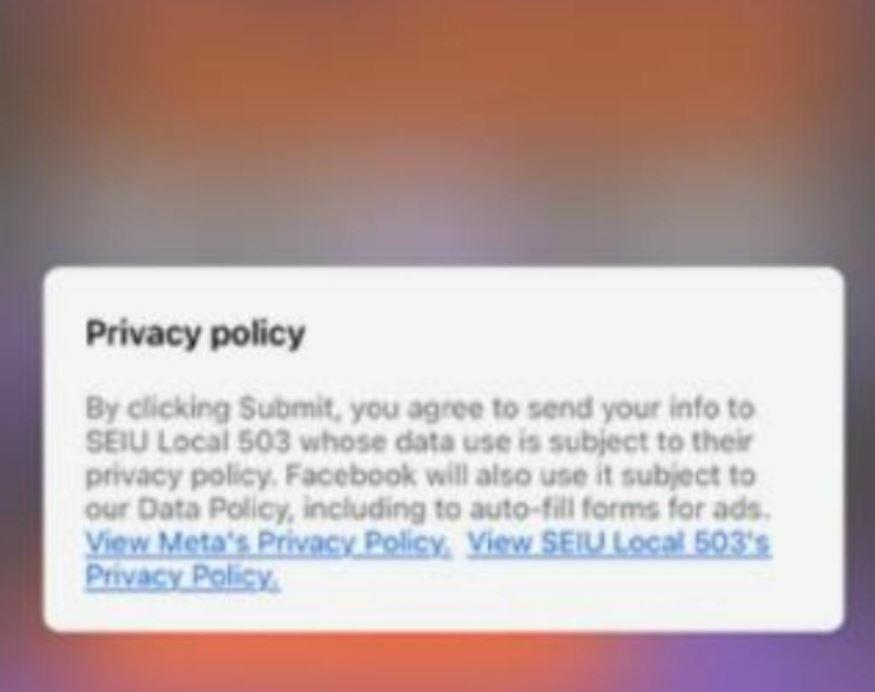
Orchestrated through ambiguous Facebook surveys, the complaint alleges the union manufactured political momentum, in violation of ORS 171.764, which bans false or misleading statements made by lobbyists.
According to Rep. Ed Diehl, lawmakers believe that union leadership may have forged support well beyond those represented by the complaint filed.
“Based on the evidence we have, I believe SEIU Local 503 knowingly and intentionally misrepresented facts,” Diehl told ZeroHedge. “It’s quite possible that none of the individuals named on the postcards ever actually authorized the statements attributed to them.”
The postcards may have been the final push needed, Diehl told ZeroHedge during a phone interview Sunday.
“These postcards clearly left an impression on many legislators and likely influenced the bill’s passage out of the Rules Committee to Ways and Means,” Diehl said. “The Commission must investigate this matter to determine the full scope of the misrepresentation and how many individuals were falsely represented.”
However, in a state run by progressive democrats willing to toss out their own to forge ahead with unpopular votes, don’t count on accountability.
🚨 BREAKING: Senate President Rob Wagner is kicking Sen. Mark Meek (D) off the Transportation Committee MID-MEETING so Democrats can ram through their $15.5 BILLION tax hike (HB 2025).
Meek recently expressed doubts about the bill—so they replaced him. Corruption at its finest! pic.twitter.com/ijWs9MN74p
— Oregon Senate Republicans (@ORSenateGOP) June 20, 2025
Oregon’s Ethics Board, similar to the majority party, has torched its credibility. With Oregon’s one-party dominance, unions have controlled the governor’s office and legislature for years.
Without campaign contribution limits until 2027, and the SEIU’S (CAPE) PAC being the single largest donor to Gov. Kotek’s election campaign, it’s anyone’s guess if loyalty will come before accountability.
Our bet: the short-term memory loss of Oregon’s voters will keep the union-Democrat machine rolling and blue, no matter who.
U.S. Attorney General Pam Bondi says the Department of Justice (DOJ) is on “high alert” following U.S. airstrikes on Iran’s nuclear program over the weekend.
Rep. Tony Gonzales (R-Texas), during a House Appropriations Committee meeting on Monday, asked Bondi about the number of Iranian nationals who may have entered the United States illegally.
“Over 1,000 have entered our country, and I can tell you we are on high alert and everyone is looking at that very closely,” Bondi said.
The attorney general suggested the FBI is on guard against possible Iranian sleeper cells located inside the United States, connecting those cells with Iranian nationals who entered the United States across the U.S.–Mexico border during the Biden administration.
“When the DOJ submitted their budget, the United States was a nation at peace, and now we’re a nation at war,” Gonzales said.
“I want us to, as much as we can, get ahead of it to give you the resources, the instruments that you need to go out and make sure that we’re preventing things from happening, not waiting until after the fact.”
Gonzales also suggested that proposals to cut funding to the DOJ, which encompasses the FBI, could undermine national security initiatives, noting a possible threat posed by Iran to the United States following U.S. airstrikes that targeted the country’s nuclear program.
“Those are the programs that we need more resources [for], more manpower,” the lawmaker said at one point.
Iran launched a barrage of missiles at a U.S. military base in Qatar on Monday. Later that day, President Donald Trump called for a cease-fire between Iran and Israel after the countries had launched airstrikes on one another for more than a week.
Bondi also said that the DOJ is committed to “doing more with less” amid budget cuts across the DOJ and the federal government, before suggesting that Congress pass the Trump administration-backed One Big Beautiful Bill Act that is currently being considered by the Senate.
“The One Big Beautiful Bill gives us a lot of additional funding at the Department of Justice to carry out our mission,” Bondi said. “That’s where it will truly help [the] Department of Justice combat all of these issues that you brought up.”
On Monday morning, Trump told reporters at the White House before departing for a NATO summit that, in his view, both sides had violated the cease-fire agreement. He had particularly strong words for Israel, a close ally, while suggesting Iran may have fired on the country by mistake.
Later, Trump wrote that the cease-fire deal was intact.
“ISRAEL is not going to attack Iran. All planes will turn around and head home, while doing a friendly “Plane Wave” to Iran. Nobody will be hurt, the Ceasefire is in effect!” Trump said in a Truth Social post.
The DOJ indicted three individuals in 2024 in connection with an assassination plot that officials say originated in Iran, involving the killing of Trump and a journalist before last year’s presidential election.
“The charges announced today expose Iran’s continued brazen attempts to target U.S. citizens, including President-elect Donald Trump, other government leaders and dissidents who criticize the regime in Tehran,” former FBI Director Christopher Wray said at the time of the indictment of the three individuals.
Goldman Makes Flurry Of Downgrades Across Consumer Sector
Goldman Sachs Managing Director Kate McShane issued a wave of notable rating changes across the consumer sector on Tuesday. The most eye-catching:
Dollar General was cut from Buy to Neutral
RH (formerly Restoration Hardware) was downgraded from Neutral to Sell
Advance Auto Parts also moved from Neutral to Sell
In contrast, Five Below was upgraded to Buy
Let’s start with Dollar General (DG). McShane downgraded the stock from Buy to Neutral following a 66% rally off the mid-January lows around $70. Her view: recent gains in margins and comps—driven by supply chain improvements, labor efficiencies, and better store restocking—are now largely priced into the stock.
She noted there’s still room for long-term margin expansion, but near-term upside in the stock appears limited given:
a highly competitive retail landscape that could pressure same-store sales, and
the continued need for investment in stores and supply chain infrastructure.
Her 12-month price for DG stands at $116, with her view of minimal upside.
Next, RH (formerly Restoration Hardware) was downgraded from Neutral to Sell. McShane cited these headwinds for the high-end, luxury home furnishings company:
A still-pressured housing market and tough year-over-year comps in the second half of 2025.
A delay in a key brand extension from 2H25 to spring 2026, limiting near-term growth.
Weakening consumer sentiment, with RH’s NPS and NPI scores now trailing peers and NPS decelerating since February.
A shift toward increased promotions—contrary to RH’s past strategy—which could pressure margins and dilute brand value.
Year-to-date, RH shares have been cut in half, with the stock trading near $179 on Tuesday afternoon—just shy of the analyst’s 12-month price target.
Moving on to Advance Auto Parts (AAP)—McShane downgraded the stock to Sell from Neutral, setting a new 12-month price target of $46, which implies an 11% downside. She sees AAP underperforming peers like O’Reilly Auto Parts and AutoZone in the near term, pointing to:
Traffic and survey data suggesting potential market share losses
A more cautious stance on margin recovery
A rich valuation at 19.5x NTM P/E, seen as unjustified without clearer signs of a turnaround
The analyst noted, “However, despite our downgrade, we continue to believe the company’s current turnaround strategy is the right approach, and we hold a favorable view of the company’s prospects longer term.”
Separate from the downgrade parade in the consumer space, McShane upgraded retailer Five Below (FIVE) to Buy and raised the price target to $135, citing improving fundamentals and brand momentum.
Here are her key points from the note:
Tariff risk from China remains, but is likely priced in, based on management’s guidance.
Valuation remains attractive, with a current P/E of 25.7x vs. historical averages.
Brand perception is improving, according to HundredX data, supporting the bullish thesis.
Earnings estimates raised, with Q2 EPS now at $0.59 (from $0.54) and FY25 EPS at $4.73 (up $0.01).
Margin expansion and merchandising improvements expected to drive continued outperformance.
McShane’s three downgrades and one upgrade have certainly turned heads across the consumer sector earlier today.
NATO Chief Butters Up Trump, While Touting Ukraine’s ‘Irreversible Path’ To NATO Membership
Before President Trump’s Air Force One even touched down in The Hague to attend this week’s major NATO summit, he was responding somewhat coldly when asked about his relationship with Ukrainian President Volodymyr Zelensky and whether they will meet.
The White House clarified that such a meeting will take place at some point on the sidelines of the summit, but pro-Kiev pundits are reacting to the following exchange with a reporter as an insult to Zelensky and to Ukraine…
“Do you think you’ll meet with Zelensky [at NATO]?”@POTUS: “Yeah, probably I’ll see him.”
“What would you say to him?”@POTUS: “I’ll say, ‘How ya doing?'”
— Rapid Response 47 (@RapidResponse47) June 24, 2025
The last time the two leaders met was in April on the sidelines of Pope Francis’ funeral, which resulted in the famous photo of the two sitting face-to-face, talking intensely, in St. Peter’s Basilica.
Trump only said to reporters Tuesday that he “would probably meet” with Zelensky, and reports now say that the sit-down could happen as soon as tomorrow afternoon.
The US has shut the door on Ukraine’s path to NATO membership, and Trump is only expected to discuss new anti-Russia sanctions as well as purchase of a fresh weapons package from the US with Zelensky.
But NATO Secretary-General Mark Rutte is still busy touting an ‘irreversible’ path of Ukraine toward NATO. He said ahead of the summit’s start:
“I can announce that now new estimates showing that our European and Canadian allies have stepped up, they will provide over €35 billion of additional security assistance to Ukraine for the year ahead,” the NATO chief said.
Rutte said there was agreement within the alliance on the need to keep up support.
“This is the reason why, I think also last year in Washington, NATO allies agreed that for Ukraine, there is an irreversible path of Ukraine to enter NATO,” Rutte told reporters. “That is still true today, and it will still be true on Thursday after this summit.”
Reporters at The Hague are busy contrasting Rutte’s warmth and embrace of Zelensky’s with Trump’s apparent coolness…
Hugs and this from NATO Sec Gen Rutte to Zelensky: “We will continue to build the bridge for Ukraine’s irreversible path to NATO membership.” https://t.co/3GQooqadT2
Rutte is clearly trying to stay on Trump’s good side, meanwhile, having issued a letter praising Trump’s ‘extraordinary’ decision to hit Iran’s nuclear sites.
The head of NATO has formally congratulated the US president in a private text message which has been revealed as follows:
The message was confirmed by the White House as authentic, after some questioned it, given how gushing it was: “You are flying into another big success in The Hague this evening,” he continued, explaining how other member states have agreed to increase their defense spending to 5 per cent of gross domestic product,” Rutte wrote.
“Donald, you have driven us to a really, really important moment for America and Europe, and the world,” he wrote. “You will achieve something NO American president in decades could get done.”
We are half a year in, and I thought I should issue an update.
Ergo, I hereby present to you “My Updated Predictions For The Last Half Of 2025:”
*June 25—A lone federal district court judge rules that President Trump must re-rename the large body of water between Florida and Mexico “The Gulf of Mexico.”
*June 26—A lone federal district court judge, installed by Barack Obama in 2015, rules that all African-Americans must be given $2 million each in reparations—and a $1,000 IHOP gift card.
*June 27—Rep. Ilhan Omar (D-MN) takes to the Congressional podium to vehemently declare that illegal aliens’ right to vote must be immediately codified and enshrined in law, while white people “and other infidels” should not be allowed to vote, in order to “save our democracy.”
*June 28—Yes, the Chicago White Sox are mathematically eliminated from playoff contention.
*July 7—Minnesota Gov. Tim Walz and Canadian Prime Minister Mark Carney jointly issue a stunning announcement: Minnesota will become Canada’s 11th province as of August 1st.
*July 24—A lone federal district court judge rules that President Trump must “immediately restore the White House to exactly as it looked at the very moment when President Biden left office on January 20th, 2025.”
*August 12—With the Canadian wildfires raging as strong as ever, four months in, President Trump, citing national security and health concerns, decides to annex Canada and put out the fires. This also reunites Minnesota with the United States. Sort of. Trump says, “I must protect the rights of American citizens to go outdoors, play golf, and breathe without being forced to inhale toxic smoke that could eventually kill them.”
*August 30—A lone federal district court judge rules that Trump must un-annex Canada and restart the Canadian wildfires.
*September 10—Elon Musk, continuing to try to patch things up with President Trump, says that he misspoke when his tweet implied that Trump visited Epstein Island. Musk says what he meant to tweet was that Trump had once visited Gilligan’s Island. “My bad,” says Musk.
*September 23—A lone federal district court judge rules that, contrary to recent Trump administration directives, the United States military must be at least 50% comprised of members of the LGBTQ Community by Jan. 1, 2027.
*September 30– Extensive new studies find that COVID-19 vaccines injured or killed far more people than originally thought…prompting the mainstream media to immediately launch a series of programs revisiting the “January 6 Insurrection.”
*October 12—Kamala Harris is found passed out on a San Francisco street, empty wine box to her side.
*October 29—Nancy Pelosi is found passed out on a San Francisco street, empty Haagen Dazs containers and vodka bottles to her side.
*November 18—It is revealed that CNN became the first cable news network ever to have a negative ratings share for any week. Lifesitenews brands the network’s Nov. 9- Nov. 15 performance “a miracle.”
*November 20—Congressional Democrats propose a bill that would require the payment of reparations to Blacks and mandate that the U.S. return the southwestern states to Mexico, the middle of the country to France, and the Eastern seaboard to England. An amendment to the bill calls for all English-speaking folks to subsequently return to England, effectively returning the erstwhile United States to the Indigenous Peoples.
*December 10—A lone federal district court judge’s ruling declares that President Trump must only wear boxers, never briefs.
*December 31—Yes, CNN’s Anderson Cooper does accidentally vomit on air after guzzling a glass filled with a mix of Wild Turkey and Clorox Bleach– and taking several prolonged bong hits to celebrate the New Year.
A sneak peek at 2026:
*January 9—Al Gore says that, unless all human activity on planet Earth immediately ceases, the planet will spontaneously combust by the end of the year.
*January 27—The U.S. observes the 10-year anniversary of Al Gore stating that, unless the Earth took “drastic measures,” it would reach the “point of no return” in 10 years.
*January 29—A lone federal district court judge invalidates the 2024 presidential election, finding that “the American people are incapable of voting in a way that furthers and supports our precious democracy.” He rules that Kamala Harris be immediately installed as president and Tim Walz as vice-president. He adds, “There are no kings in this country. I have spoken!”
Where Is Iran’s Uranium? Top Secret Leaked US Intel Says Core Nuclear Components ‘Intact’
Update(1605ET): Where is Iran’s Uranium? Truce Highlights Mystery Over Stockpile… that’s Bloomberg’s latest headline over the ‘biggest mystery’ that remains in the war. There’s also the pressing question of whether Trump’s massive airstrikes from B-2 bombers actually truly destroyed the facilities and these stockpiles.
The Iranians aren’t dumb, and likely took drastic steps to further protect, conceal, or likely move these enriched stockpiles – some 400kg according to most reports – as wave after wave of Israeli warplanes hit Iran, significantly before the US sent its bombers this past weekend. It appears core components are still intact – though Iran has long maintained it is merely for peaceful nuclear energy development.
The NY Times is currently reporting that the US operation merely set Iran’s nuclear program back by a few months.
And early emerging intelligence also points to the stockpile having not been destroyed, which contradicts the current ‘victory lap’ claims being made by President Trump and some of his top officials. In a huge development below is fresh CNN reporting based on a leaked assessment by the Defense Intelligence Agency (DIA):
The assessment, which has not been previously reported, was produced by the Defense Intelligence Agency, the Pentagon’s intelligence arm. It is based on a battle damage assessment conducted by US Central Command in the aftermath of the US strikes, one of the sources said.
The analysis of the damage to the sites and the impact of the strikes on Iran’s nuclear ambitions is ongoing, and could change as more intelligence becomes available. But the early findings are at odds with President Donald Trump’s repeated claims that the strikes “completely and totally obliterated” Iran’s nuclear enrichment facilities. Secretary of Defense Pete Hegseth also said on Sunday that Iran’s nuclear ambitions “have been obliterated.”
One unnamed defense official quoted in the report says centrifuges are largely “intact.” And more based on the apparently ‘Top Secret’ leaked DIA intel report:
“So the (DIA) assessment is that the US set them back maybe a few months, tops,” this person added.
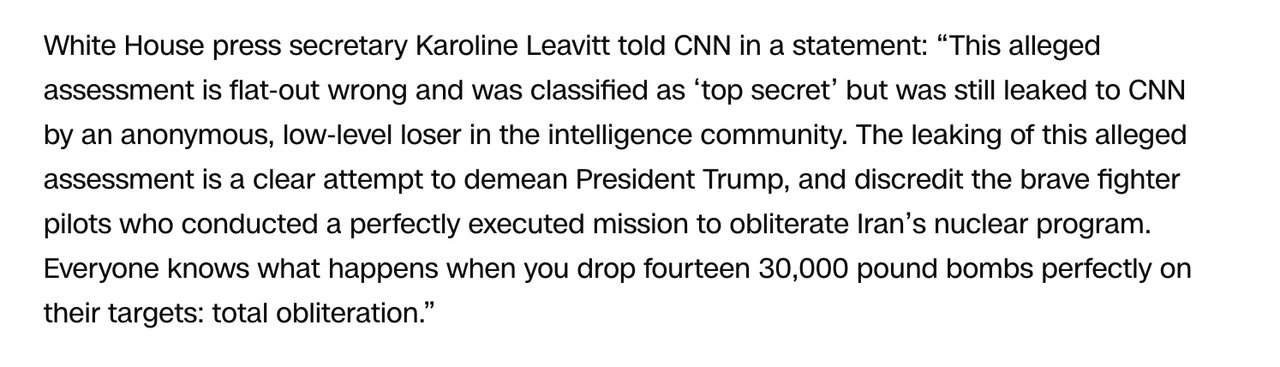
The White House acknowledged the existence of the assessment but said they disagreed with it.
CNN reports that an initial US intelligence assessment says that the US didn’t destroy Iran’s nuclear facilities and set the program back only by a few months. The White House acknowledged the assessment was real but said it disagrees with it and that it was leaked by a “loser.” pic.twitter.com/GvPAF90aVT
So this appears yet another case of the White House disagreeing with its own intelligence community (IC) – in an ongoing awkward situation which has Iraq war vibes. However, without doubt the IC is still working on an overall consensus, based likely on several different intel threads, and across agencies.
One obvious danger from the perspective of Western decision-makers (and Israel): if Iran was not intent on getting a bomb before, they likely are now – given their very existence is under threat. More of the WH reaction to the leak:
As we stated before, it is especially the Iranian hardliners which will understand the ‘two paths’ and existential question facing Iran:
1) Become a failed state like Libya after ‘giving up’ nuclear or WMD potential (precisely as Gaddafi did when offered ‘incentives’ by Bush/Cheney/Rice).
2) Or, become North Korea and you are immune from regime change wars launched by the West.
For the Iranians, the question of negotiations with the US at this point means negotiating their own demise – given they have already been relentlessly bombed. While the US may not be openly calling for regime change in Tehran, the reality is that many within Israel’s top leadership, including Netanyahu, have.
Tehran certainly knows this, and has likely already chosen path #2 – at a moment Israeli leadership is probably worried about a future nuclear dirty bomb going off in Tel Aviv. In many ways, Trump’s brazen bombing operation – which as usual saw the commander-in-chief completely bypass Congress, took things from bad to worse. We could for now with this Trump-backed ceasefire just be witnessing a ‘pause’ before a much worse storm on the horizon, whether that happens days, weeks, or months from now.
* * *
Update(1300ET): The ceasefire seems to finally be holding as of early evening local time, despite the ongoing accusations of earlier violations when it was to take effect.
“Both Israel and Iran wanted to stop the War, equally! It was my great honor to Destroy All Nuclear facilities & capability, and then, STOP THE WAR!” President Trump said on Truth Social. Were they all destroyed?
And China has belatedly weighed in, with Foreign Minister Wang Yi saying China supports Iran in achieving a “genuine ceasefire” – but following Beijing’s condemnation of the US for striking the country’s nuclear sites.
“China supports Iran in safeguarding its national sovereignty and security, and, on that basis, achieving a genuine ceasefire so that people can return to normal life,” Wang expressed to his Iranian counterpart, Abbas Araghchi, in a phone call.
But here is the clearest indicator yet that skies have cleared of Israeli warplanes and return fire over Tehran:
Iranian airspace partially reopened today, following the country’s ceasefire with Israel after 12 days of hostilities, according to aviation monitoring company FlightRadar24.
“Iranian airspace is now open to international arrivals and departures to/from Tehran with prior permission,” FlightRadar24 said on X. Iraqi airspace has also reopened, it added.
Also, Iranian media is currently airing footage of a large crowd assembled in central Tehran, in an act expressing solidarity with the country’s armed forces. IRNA, Fars, and Mehr are covering the gathering in Revolution Square. Now each side is declaring ‘victory’ to some extent, but whether the ceasefire will actually stick is anyone’s guess.
Update(1116ET): On Tuesday the head of Iran’s nuclear energy program vowed that the country will continue its nuclear program uninterrupted, despite the Trump-ordered weekend heavy bombings of three key nuclear and uranium enrichment sites.
AEOI (Atomic Energy Organization of Iran) head Mohammad Eslami said on state television that “plans for restarting [the facilities] have been prepared in advance” and that measures ensuring continued production are in place.
“Despite the evil conspiracies of its enemies,” the AEOI said in the statement, “this organization will not allow the path of development of this national industry to be stopped.”
Head of #Iran’s Atomic Energy Organization: “We’ve taken necessary measures & are assessing the damaged areas. Plans for revival [of #nuclear facilities] were pre-arranged, and our current strategy ensures no disruption to production & services. pic.twitter.com/3OzppGj6TH
“This action, contrary to international law, was unfortunately carried out in the shadow of indifference and even with the cooperation of the International Atomic Energy Agency,” the statement read.
This is not surprising, but what is surprising is just how bold and provocative a statement that Russian Foreign Minister Sergei Lavrov just made. On the question of Iran’s now ‘missing’ (or ‘unknown whereabouts’) enriched uranium stockpiles, he laid out that Iran has every incentive to hide it from IAEA inspectors.
“What guarantees are there that the IAEA will not leak this information to the US or Israel?” he posed in public statements on the American military action against Iran, while emphasizing that arms control will fail due to these American-Israeli surprise attacks which killed negotiations.
Lavrov criticized the IAEA Director for demanding to know where Iran’s enriched uranium is stored. What guarantees are there that the IAEA will not leak this information to the US or Israel?
— Arms control will not be the same after this surprise attack; everyone will lose. pic.twitter.com/wPR3GA2dj7
Indeed the Iranians too have long feared that international inspectors could be conduits of information on sensitive facilities for Israeli and US intelligence. And now these same facilities are being targeted for destruction.
* * *
Despite last night’s big news of a Trump-declared ceasefire, the reality is it was little more than an effort at a pause, and it’s increasingly looking like neither side actually signed onto. Or at least each side issued ‘confirmation’ with a lot of conditions, and there wasn’t even firm agreement on the start time.
As the US- and Qatar-brokered ceasefire deadline closed in, Israel and Iran kept exchanging lethal blows overnight, with Israel hitting various targets in Iran, killing nine people in northern Iran and reportedly assassinating yet another nuclear scientist, while Iran killed at least four Israelis in a devastating hit on an apartment tower. At eight minutes after midnight in Washington, President Trump used his Truth Social account to announce the ceasefire was in effect, and to urge continued compliance.
But as of Tuesday morning, Trump’s message is one of extreme frustration. Hisfiery statement to the press just moments before boarding Marine One included the declaration, “We basically have two countries that have been fighting so long and so hard that they don’t know what the f*ck they’re doing. You understand that.” Watch the comments below:
The warring sides have not heeded Trump’s call to immediately halt, and at the very moment the US president has been issuing desperate messages and warnings, explosions are still being observed in Israel and Iran.
Just after the president addressed the press, Israel’s Channel 12 said IDF warplanes have launched another round of strikes against Tehran. This also just as Trump issued a new Truth Social post demanding that Israel not attack Iran. “All planes will turn around and head home,” he wrote, almost as a directive, so that “Nobody will be hurt” as “the Ceasefire is in effect!”
A big question remains whether he’s bringing real leverage to bear against Israel, or if the latest ‘objections’ are more just show to provide political cover for himself for the negative fallout as war persists. But his current deeply frustrated tone is a reminder of the failures to achieve peace in Ukraine, and the past Ukraine-Russia related statements to just ‘let them fight it out’ of the last months.
Axios’ Barak Ravid offers up an explanation (per machine translation):
Israeli official: Trump called Netanyahu and asked him not to attack Iran at all. Netanyahu told Trump that he could not cancel the attack and that some kind of response was needed to Iran’s violation of the ceasefire. Ultimately, it was decided to significantly scale down the attack and cancel the attack on a large number of targets
Times of Israel has also freshly commented on the obvious miscommunication and apparent growing rift among allies concerning plans for the Iran conflict, and whether to halt the fighting of keep up the attacks:
Trump was sending out posts on his Truth Social platform promising that Israel will not strike Iran “after he knew we would attack,” an Israeli official tells the Kan public broadcast.
Israeli officials confirmed that the IAF struck an Iranian radar site north of Tehran, after Iran fired two ballistic missiles at Israel after a ceasefire had taken effect.
But it’s still possible, amid the finger-pointing, that ceasefire could take effect Tuesday, though it’s anyone’s guess precisely when.
In the overnight hours there was this large Israeli attack on Tehran even after ceasefire was announced to the world:
Tehran. After 3am. Israel is bombing all over district 6 & 7 of Tehran. Home to 600,000, the area houses the Tehran Museum of Contemporary Art, which has the largest collection of Francis Bacon paintings in the world. The area is also home to many governmental buildings. pic.twitter.com/TvT76HoPd7
— Samira Mohyeddin سمیرا (@SMohyeddin) June 24, 2025
It may in the end have little substantive to make it stick, and might prove merely a pause or temporary respite for both sides to assess damage and regroup. Here’s how we got here, via Newsquawk:
US President Trump announced that Israel and Iran agreed to a complete and total ceasefire, from 05:00BST/00:00ET, which would last for 12 hours. After which, the war would be considered officially ended.
Under the ceasefire announced by Trump, Iran would stop striking Israel in six hours (at midnight ET on Tuesday), and Israel is expected to stop striking Iran 12 hours after that (at noon ET Tuesday). Then, after another 12 hours, or at midnight ET Wednesday, the war will be considered over, a White House official confirmed to CBS News.
Strikes continued into and after the Iranian proposed time of 01:30BST/20:30ET. After the Trump deadline of 05:00BST/00:00ET, Iran is said to have fired some missiles at Israel, though they claim it was fired just before the deadline.
At 06:04BST/01:04ET Trump posted that the “ceasefire is now in effect”.
At 07:17BST/02:17ET Israeli PM Netanyahu confirmed the ceasefire is now in effect, war achieved its goals, will respond forcefully to any violations. PM’s office adds that Netanyahu will deliver a statement later today.
The ceasefire agreement seems to have broken down only 4 hours after being in effect, with the IDF suggesting it had detected and intercepted fresh ballistic missiles from Iran. In response to this latest attack, the IDF Minister instructed the military to respond “forcefully” to Iran’s violation of the ceasefire. Iran has denied firing missiles at Israel after the ceasefire.
Iran’s overnight missile strike on a residential home in Be’er Sheba resulted in some shocking scenes of people seeking to get out and survive the nightmarish ordeal:
DEVASTATION in Beersheba following MISSILE attacks from Iran
Aftermath and rescue efforts of the hit on the Beersheba residential building:
TRAGEDY IN BEERSHEVA: Three of the victims were members of the same family. The fourth person killed was in a nearby apartment.
According to the Home Front Command’s investigation, the missile struck the sixth floor, hit two apartments, and exploded directly inside the shelter.” pic.twitter.com/GoKLvz1lZq
Israel is now feeling the drive for vengeance for this and other devastating blows from the Islamic Republic, despite Trump in this rare moment expressing that he’s “really unhappy” with Israel. “Bring your pilots home, now!” – is the message not being heeded.
The illegal immigrant whom Milwaukee County Circuit Judge Hannah Dugan is accused of helping evade arrest has accepted a plea deal in which he admitted to entering the United States illegally.
Mexican national Eduardo Flores-Ruiz faces up to two years in prison and a $250,000 fine under the terms of a plea deal filed in the U.S. District Court for the Eastern District of Wisconsin on June 23.
He is also subject to one year of supervised release. The plea deal states that Flores-Ruiz has agreed to be deported after completing a federal prison sentence.
According to the plea agreement, Flores-Ruiz first entered the United States illegally on Jan. 15, 2013, near Arizona. He was arrested and deported the next day but later re-entered the country.
Flores-Ruiz was arrested in Milwaukee on March 12 over a battery incident. He was subsequently charged with misdemeanor counts of battery, domestic abuse, and causing physical harm.
On April 18, when Flores-Ruiz was slated to appear before Dugan at a Milwaukee courthouse, Dugan allegedly escorted him out through a jury door and evaded immigration agents who were waiting to arrest him.
Federal officials stated that Flores-Ruiz escaped the courthouse and was apprehended by agents outside the building after a foot chase.
Dugan was suspended by Wisconsin’s Supreme Court and charged with obstructing a proceeding and concealing an individual to prevent his arrest.
FBI Director Kash Patel said on social media platform X that evidence indicates that Dugan “intentionally misdirected” federal immigration agents away from Flores-Ruiz, which allowed the illegal immigrant to evade arrest.
In a May 14 motion to dismiss the case, Dugan’s attorneys argued that it is “no ordinary criminal case, and Dugan is no ordinary criminal defendant,” while citing her job as a circuit court judge.
“The government’s prosecution of Judge Dugan is virtually unprecedented and entirely unconstitutional—it violates the Tenth Amendment and fundamental principles of federalism and comity reflected in that amendment and in the very structure of the United States Constitution,” the attorneys stated.
Homeland Security Department Assistant Secretary Tricia McLaughlin said:
“This criminal illegal alien has a laundry list of violent criminal charges including strangulation and suffocation, battery, and domestic abuse. Ruiz illegally entered the U.S. twice.”
The Epoch Times reached out to legal representatives for Flores-Ruiz and Dugan but received no response by publication time.
Senate GOP’s ‘Big, Beautiful Bill’ On The Brink As Tax Clashes, Medicaid Cuts And Parliamentarian Delays Derail Timeline
Senate Republicans are in panic mode this week, frantically rewriting their so-called “big, beautiful bill” before a planned Thursday vote, but the trillion-dollar package is sagging under the weight of internal brawls, Medicaid landmines, and the looming judgment of the Senate parliamentarian, Politico reports.
GOP leaders insist they’re on track to start voting Thursday, but senators emerging from a tense closed-door briefing Monday night admitted that major parts of the megabill, including key tax language and Medicaid provisions, remain in flux, and the final text still hasn’t been released.
“I think we’ll eventually pass something, I just can’t tell you when,” Sen. John Kennedy (R-LA) said bluntly. “We’ve got a lot of stuff to work out, and the bill will be changed on the floor.”
The holdup centers on the so-called “Byrd bath,” the parliamentarian’s behind-closed-doors review of which pieces of the legislation qualify under budget reconciliation; the GOP’s only way to pass the bill without Democratic support. Parliamentarian Elizabeth MacDonough’s rulings could land as late as Wednesday night, just hours before the Senate’s first expected vote.
As we noted on Monday, MacDonough (D) has booted several major provisions from the Republican megabill to enact President Trump’s agenda – including language which would authorize states to conduct border security and immigration enforcement(more below).
“Part of it right now is the Byrd bath, and it’s taking a little bit longer,” admitted Senate Majority Leader John Thune (R-SD), who’s hoping for a Thursday kickoff with final passage over the weekend.
But it’s not just Senate procedure clogging the drain — it’s the substance, too.
SALT Showdown
Sen. Markwayne Mullin (R-Okla.) has been trying to broker a deal on the controversial state-and-local-tax deduction cap, or SALT. He pitched keeping the $40,000 cap that the House passed while tweaking the income threshold at which it phases out – a move aimed at soothing House SALT rebels.
Problem is, those same House Republicans already rejected that combo days ago. And after Monday night’s briefing, even GOP senators weren’t sure if Mullin had actually sealed any agreement or just tossed out “options.”
Medicaid Minefield
Then there’s Medicaid…
GOP leaders are floating a special fund for rural hospitals to ease concerns over deep Medicaid cuts in the Senate version of the bill, specifically, a plan to slash the provider taxes that many states rely on to trigger larger federal payments.
“I am absolutely happy with a rural fund; I think that would be great,” Sen. Josh Hawley (R-MO) said. “Will that solve the issue? I don’t know.”
Sen. Thom Tillis (R-NC) even handed out a printed breakdown showing how much Medicaid money states like his and Hawley’s would lose under the current proposal. Hawley also said Thune reassured senators the bill wouldn’t alter federal cost-sharing for states that expanded Medicaid under Obamacare, a key worry among more moderate Republicans.
But none of that is calming nerves in the House, where GOP leaders are warning that the Senate’s version could be a poison pill.
Speaker Mike Johnson has urged senators to make minimal tweaks to the House-passed bill. House Freedom Caucus Chair Andy Harris (R-MD) put it more bluntly: “If it should pass the Senate in its current rumored form, it probably would have trouble in the House.”
Parliamentarian Potholes
Meanwhile, Senate Republicans are reeling from MacDonough’s early rulings that tossed out several major cost-saving provisions.
A proposal to penalize states for food-aid payment errors, designed to shift costs and save billions, was deemed noncompliant with reconciliation rules. Senate Agriculture Republicans are now scrambling to salvage the plan with a rewrite.
Also in the trash heap: Sen. Mike Lee’s plan to overhaul federal rulemaking and sell off millions of acres of public lands. Lee is now offering a narrower version excluding Forest Service lands and may revive the proposal as a floor amendment.
And the tax section, the heart of the GOP bill, is still under review. Finance Committee staff met with MacDonough Monday and are expected to return Tuesday to go over the language line by line. Final rulings aren’t expected until Wednesday at the earliest.
Trump Steps In
President Donald Trump is now working the phones and the White House to get fiscal conservatives on board.
On Monday, Trump met with Sens. Lee, Rick Scott (R-FL), and Ron Johnson (R-WI) and urged them to support full repeal of Biden’s clean energy tax credits and to focus on slashing Medicaid waste, fraud and abuse. The trio delivered Trump’s message to House Freedom Caucus members in a private meeting Monday night.
But even with Trump leaning in, time is short and the to-do list is long.
Republicans had originally hoped to release the final version of the bill Monday. Now, insiders say it won’t drop until after MacDonough’s rulings land, leaving very little time for senators to read, debate, or amend the text before a floor vote.
Despite it all, Thune remains hopeful. “We’re pushing hard to get this done by Thursday,” he said.
“You’re Welcome”: Pennsylvania Boasts About Saving ‘Green’ Maryland From Near Power Grid Collapse
Pennsylvania State Sen. Kristin Phillips-Hill (R-York) wrote in a late Monday Facebook post that the state’s surplus electricity supplies were exported to Maryland during Monday’s peak demand surge, as temperatures in the region approached 100°F. She credited Pennsylvania’s stable power grid with preventing a blackout crisis in “our ‘green energy’ neighbor – Maryland.” As we’ve reported on several occasions, far-left climate Marxists running Maryland have mismanaged the grid, which now teeters on the verge of a Spain-style blackout disaster if outside energy imports are not secured.
“Just a friendly note to our “green energy” neighbor – Maryland: You’re welcome,” Sen. Phillips-Hill wrote in the post.
She said, “During this heat wave, Maryland consumers demand a lot more energy than it generates. If it was not for Pennsylvania – it would be lights out and air conditioning off,” adding, “This is another reminder that Maryland should work on supporting (and not shutting down) baseload energy generation rather than require farmers in Southern York County to give up pristine farmland to construct more transmission lines.”
Not even two weeks ago, a top official at Baltimore Gas and Electric (BGE), a local utility with 1.3 million electric customers and 700,000 natural gas customers, warned that rolling power blackouts could soon become a regular feature in the state due to a rapidly alarming mismatch between total power capacity on the grid and soaring demand.
Regular rolling blackouts could become reality for Baltimore-area residents if a lack of energy supplied to the power grid remains unaddressed, Baltimore Gas and Electric Company Vice President Electric Operations Steven Singh warned.
BGE has worked during the last two decades to lessen the number of short-term loads shed events, Singh said, but rolling blackouts — during which power is disconnected from some segments of the community when the grid remains viable — could be implemented if power demand continues to exceed supply.
“It’s a huge concern,” Singh said. “It’s a clear and present issue.”
At a recent round table at the University of Maryland … We have a supply and demand issue.”
Singh also shared larger concerns with energy shortages that may result as the energy transition away from coal-fired power plants continues, and electric vehicle ownership grows. He said one factor that impacts the region is an increase in data centers — reliant on huge, power-hungry server infrastructure.
Regular rolling blackouts could become a reality for Baltimore-area residents, Baltimore Gas and Electric Company Vice President of Electric Operations Steven Singh said.
Storms and other large-scale weather events are the main reason for outages, while blackouts are caused by a… pic.twitter.com/O0nmbpxXFQ
At the heart of the crisis is the state’s Democratic leadership, which has masqueraded as efficient managers but are, in reality, far-left climate Marxists. Disastrous “green” policies are plunging the state into yet another crisis.
Maryland needs to wake up to the reality that local elections matter. Power bills are spiraling out of control because Democrats in the state are more focused on Marxist-style reparations schemes to fleece taxpayers, overtaxing residents, having margaritas with illegal aliens, diverting public funds to migrants, pushing radical woke agendas, attempting to install condom machines in elementary schools, and advancing degrowth green policies.
Condoms for Kindergarteners — this is the priority of @mddems. Rather than supplying the grid with more power and lowering electric bills, or giving children stuck in failed schools a better option, Annapolis Democrats want to put condoms in kindergarten classrooms. Sad. pic.twitter.com/rpBog5jkgd
Far-left Governor Wes Moore—whom Democrats are eyeing as a future presidential candidate—has steered Maryland into multiple crises. Remember, activists in managerial roles often lack the experience to govern effectively, instead focusing on advancing their ideological agendas. The result is a state in rapid decline—mismanaged policies, soaring costs, and growing frustration among residents. It’s no surprise that Marylanders are packing up and leaving in search of better-run Red States.