65.2 F
Chicago
Wednesday, October 28, 2026
Home Blog Page 1501

NIRP Is Back As Swiss National Bank Cuts Rates To Zero, Introduces Stealth Negative Rates

NIRP Is Back As Swiss National Bank Cuts Rates To Zero, Introduces Stealth Negative Rates

Five years after covid sparked a once in a generation inflationary surge and forced all central banks to push their interest rates well above the zero (and in some cases negative) lower bound which defined the post-QE era, overnight the Swiss National Bank became the first to show that the world of higher rates is over and ZIRP is coming back, after the central bank cut its rate from 0.25% back to 0.00% for the first time since 2022.

But it’s not just ZIRP that is back: NIRP is also here courtesy of the Swiss, because while the SNB may have cut its interest rate to zero, the way it penalizes banks’ excess reserve holdings means lenders will face negative rates if they park too much cash at the central bank.

Ah yes, the magic of the zero lower bound is once again with us!

According to a statement by the SNB published on Thursday morning, Swiss banks can hold up to an unchanged 18 times their minimum reserve requirement in sight deposits at the SNB for free but anything over that they will be charged interest of -0.25% as the discount from the policy rate remains unchanged at 25 basis points.

The goal behind the “tiered remuneration”, according to Bloomberg, is to incentivize lending between banks so that enough liquidity is exchanged on the Swiss money market. For lenders holding more than their limit it’s cheaper to pass on excess reserves to institutions which are under their thresholds, because they have to pay them less than the central bank.

For all lenders which don’t have a minimum reserve requirement the threshold is set at a paltry 10 million francs ($12 million) in sight deposits, the SNB said.

The system, which the SNB has had in place since it lifted its key rate above zero in 2022, means that the average money-market rate — known as Saron — has usually been a few basis points below the central-bank rate.

Which means that starting Friday, negative funding costs for banks are therefore likely, as board member Petra Tschudin told reporters in Zurich. She added that she expects only “very little” sight deposits to be remunerated at the negative rate. That chimes with experience from some three years under the regime, where typically only a tiny fraction of them were hit by the lower rate.

Still, little or not so little, negative rates are back in at least one country… and soon in many more. 

While Switzerland’s main banks lobby called the SNB’s decision “understandable,” it criticized its consequences.

“It’s clear that a zero interest rate environment diminishes the incentive for responsible saving and places additional pressure on retirement provision,” the Swiss Bankers Association said in a statement. “As in previous periods of low interest rates, banks and their customers once again bear a significant share of the monetary policy burden.”

Similarly, the insurance association welcomed the SNB not going negative, but stressed that “even the return to a low interest rate environment already poses a challenge” to the sector.

SNB President Martin Schlegel acknowledged the discomfort the new rate environment creates for banks and signaled that there’s an elevated bar for further cuts.

“We would not take the decision to go negative lightly,” he said. “But I want to stress that the profitability of banks is not within the national bank’s objectives.”

Finally, while some argue that negative rates are a way for capital deficient central banks to restock their coffers after years of high rates pushed them all into technical insolvency, given the small share of deposits affected, it’s unlikely that the SNB will make a lot of money from charging lenders. Between 2015 and 2022, the central bank earned almost 12 billion francs from negative rates, though it then paid out 14.5 billion francs from when rates turned positive through the end of March of this year.

Tyler Durden
Thu, 06/19/2025 – 17:10

“No Kings”, Except For The Bureaucrats

“No Kings”, Except For The Bureaucrats

Via The Brownstone Institute,

Over the weekend, thousands of anti-Trump advocates gathered for “No Kings” protests across the country, but their aims were not directed at constitutional norms; instead, they are engaged in a protest against the President’s authority over the Executive Branch. 

The chief issue in Washington since the second Trump inauguration is whether the commander-in-chief is empowered to control the Executive Branch, which houses nearly all federal agencies. 

The Vesting Clause answers that question with absolute certainty: The executive Power shall be vested in a President of the United States of America. 

In response to the Trump administration’s efforts to abolish the government’s vast censorship apparatus, however, Democrats and judicial activists offer an anti-constitutional alternative for the country: The power to fire taxpayer-funded bureaucrats or reduce their funding shall be vested in no person.

In April, Secretary of State Rubio announced the closure and defunding of the State Department’s Counter Foreign Information Manipulation and Interference (R/FIMI), formerly known as the Global Engagement Center (GEC). 

Under Rubio’s predecessor, Antony Blinken, the GEC was instrumental in silencing dissent, as it worked to “limit the reach of, the circulation of, and render unprofitable, disfavored press outlets by funding the infrastructure, development, and marketing and promotion of censorship technology and private censorship enterprises to covertly suppress speech of a segment of the American press,” according to one lawsuit. 

But this week, California District Judge Susan Illston upended the President’s control of the executive branch and ordered Secretary Rubio to halt the abolishment of R/FIMI. According to Judge Illston, not only is the Ministry of Truth permitted to censor Americans for alleged “disinformation,” such as the Hunter Biden laptop, the lab-leak theory, or natural immunity; but the Constitution actually prohibits the president from exercising control over the State Department. 

Unsurprisingly, the “No Kings” crowd offered no pushback to the judge’s defense of a censorious cabal’s entitlement to taxpayer funding. 

This is familiar territory for Judge Illston. Previously, she issued a preliminary injunction prohibiting President Trump from “reorganizing” or “reducing” staff at 22 executive branch agencies, including the Department of Health and Human Services (annual budget, $1.8 trillion), the Social Security Administration (annual budget, $1.5 trillion), the Department of Veterans Affairs (annual budget, $350 billion), and the Treasury Department (annual budget, $1.3 trillion). 

Illston is not alone. After President Trump ordered “all executive departments and agencies to cease Federal funding for NPR and PBS,” the outlets responded that the First Amendment requires the disbursement of taxpayer funds to their operations. 

In February, five former Secretaries of the Treasury wrote in the New York Times that the nation’s payment system is “operated by a very small group” of “career civil servants” and that allowing the duly appointed members of the Executive Branch to change that bureaucratic mandate would be “unlawful and corrosive to our democracy.” 

More recently, judges have blocked the President from exercising control over the Department of Education, the border, the NIH, and the National Guard. 

Viewed as a whole, President Trump’s opponents insist that they have an unalienable right to taxpayer funding, control over the citizenry, and deployment of government resources. They fight for a monarchy without splendor, and their aim is to usurp the President’s explicit authority to control the executive branch, as the Constitution makes clear. 

So we live amidst the grave irony. Many of the people who came out to proclaim loyalty to no king only recently were pushing for business, school, and church closures without legislation, in addition to wild social protocols, travel restrictions, pharmaceutical controls, limits on gatherings, and forced masking and injections, all forced under conditions of quasi-martial law. 

This is the same crowd that is now proclaiming to be against kings. The question is: what do they favor? If the lockdown era is any indication, this is a movement not about freedom and self-government but of millions of Lilliputians – in the public and private sectors, elites with high incomes and job security – throttling, tethering, and restricting the freedom of the people and funding their armies of bureaucrats with taxes and debt. 

Tyler Durden
Thu, 06/19/2025 – 16:35

Netanyahu Threatens Assassination Of ‘Modern Hitler’ – Iran’s Ayatollah

Netanyahu Threatens Assassination Of ‘Modern Hitler’ – Iran’s Ayatollah

After on Thursday more ballistic missiles and drones struck Tel Aviv and various parts of Israel – including Soroka Medical Center in Beersheba – the Israeli Health Ministry reports that 271 people arrived at hospitals, four in serious condition, 16 in moderate condition, and many more with minor injuries – with most of this latter category being people suffering from anxiety attacks.

In total, now nearly a week into the air war between Iran and Israel, 106 people are being treated in hospitals, and another 149 are being treated in emergency rooms, Israeli media reports based on the health ministry. The popular X account War Monitor gives voice to what many are likely thinking…

Israeli leaders are ramping up their war rhetoric as President Trump is still said be mulling whether he’ll order US military entrance into the war in order to penetrate Iran’s most deep underground nuclear facilities with 30,000 pound bunker buster bombs.

Prime Minister Benjamin Netanyahu is now openly threatening to assassinate the Islamic Republic’s Supreme Leader, Ayatollah Ali Khamenei:

Touring Beersheba’s Soroka Medical Center in Beersheba after it was hit by an Iranian missile earlier today, Prime Minister Netanyahu said he would not rule out a strike on Iranian Supreme Leader Ali Khamenei. “No one is immune,” says Netanyahu. “All the options are open.” 

He adds, “It’s best not to speak about this in the press.” Defense Minister Israel Katz, by contrast, has been publicly threatening Khamenei. Netanyahu says that US involvement in the war “is a decision for President Trump.”

He also called the top Shia cleric and ruler of Iran a “modern Hitler” while touting “We’re going to see a different Middle East, a reality we haven’t seen until now.” The country’s defense minister, Israel Katz, has also said that ‘eliminating’ Khamenei is a goal of the war effort.

And addressing whether he thinks Trump will come to Israeli’s aid, Netanyahu said, “He will do what is good for America, and I will do what’s good for Israel.”

But, the Israeli leader added, “At the end of this operation, there will be no nuclear threat on Israel, and there won’t be a ballistic threat.” Thus he’s vowing to wipe out Iran’s nuclear program as well as offensive missile capability – the latter being a very tall order given the longtime size of Iran’s stockpile of missiles.

Netanyahu then said, in comments which have already received severe criticism domestically, “all of us are paying a personal price” in the war, “and that hasn’t missed my family as well — my son canceled a wedding.”

The latest from President Trump on Thursday:

Meanwhile, Iran’s supreme leader reiterated in a message posted on X that Israel calling on the United States for help is a sign of ‘weakness’. 

“The very fact that the Zionist regime’s American friends have entered the scene and are saying such things is a sign of that regime’s weakness and inability,” he said.

“I would like to tell our dear nation that if the enemy senses that you fear them, they won’t let go of you. Continue the very behavior that you have had up to this day; continue this behavior with strength,” Khamenei added.

Tyler Durden
Thu, 06/19/2025 – 16:00

How To Destroy A State: Swap Out The Wealthy For Illegal Immigrants

How To Destroy A State: Swap Out The Wealthy For Illegal Immigrants

Submitted by Ted Dabrowski and John Klingner of Wirepoints

Whether they’re doing it on purpose or out of just plain ineptitude, Illinois’ political leaders have been slowly destroying this state. More recently, they’ve moved into overdrive.

What we’re talking about is all the wealth the state is giving up by pushing out wealthier taxpayers and inviting less wealthy people in. Not to mention the flood of illegal immigrants that have been “welcomed” to Illinois, many fully dependent on the state.

Not only is Illinois a net loser of people to other states, but the people leaving Illinois make far more than the people coming into Illinois, making things even worse.

The taxpayers that left – about 156,000 of them in 2022 – made on average $124,000 in income, according to data based on the IRS’ annual taxpayer migration report. In contrast, the 111,000 taxpayers that moved into Illinois made on average only $86,000.

That’s a massive $38,000 difference per person lost – a gap that has accelerated significantly in recent years. Compare that to 2010, when the difference was about $5,500. Illinois is increasingly chasing out its wealthy.

In total, Illinois lost a net 45,000 tax filers in 2022, or a total of 87,000 Illinoisans when those tax filers’ dependents are included. The state netted a similar loss of residents – about 90,000 each year – in 2019, 2020 and 2021 (see Appendix A on number of people leaving). 

The losses of wealth as a result of that outmigration have also been staggering. In 2022 alone, the state had nearly $10 billion less to tax because of resident flight (see Appendix B on the income losses). The losses to the tax base have been piling up for years.

“Don’t worry,” Illinois leaders want residents to think. “Our population has finally begun to grow again.” 

What they’re not telling you is that it’s all because of the spike in illegal immigrants.

Illinois was attracting about 25,000 (official) international immigrants a year until the Biden administration opened up the Southern border. And just like that, the number jumped to 61,000, then 93,000, and finally to 113,000 in 2024 alone.

Illinois and Chicago’s sanctuary status are sure to have played into that immigration increase.

A Wirepoints reader recently summed up the situation well: “It can’t be good for the Illinois economy when the upper-middle class and wealthy are moving out while most of the illegal immigrants may end up staying…”

He’s right. Illinois is losing people, businesses and investment, destroying its economic vitality. The state’s dismal job creation, high unemployment rate and meager economic growth – the nation’s 4th-worst since 2019 – are all evidence of that. 

Nothing will change until Illinoisans vote in a whole new class of lawmakers. Those that finally put Illinois residents first.

* * * 

Appendix A.

Appendix B.

Tyler Durden
Thu, 06/19/2025 – 15:25

Waste Of The Day: $140 For Taxi Ride Across Parking Lot

Waste Of The Day: $140 For Taxi Ride Across Parking Lot

Authored by Jeremy Portnoy via RealClearInvestigations,

Topline: Massachusetts’ Emergency Assistance Family Shelter Program recently funded what might just be history’s most expensive car trip: $140 for a taxi ride of 223 feet. For those quick with a calculator, that’s a rate of $3,314 per mile.

It’s just one example of taxpayer funds spent on “improper and unlawful emergency procurements” while the agency was using $325 million in state funds last year to help address the state’s migrant crisis, according to a recent report from the state auditor.

Key facts: The emergency housing program was originally created to carry out Massachusetts’ “right to shelter” law from 1983, which guarantees housing for families with children or pregnant mothers. 

The program has been overwhelmed with immigrant families in the last few years. There were 3,883 families in shelters in January 2023 but 7,463 families by December 2024. 

The influx forced the state to sign emergency, no-bid contracts with companies that were charging up to $31 per meal to feed migrants on the taxpayers’ dime. One company, Spinelli Ravioli, billed the state 9.6% more than their contract allowed for 493 food deliveries, according to the new audit.

The state also hired Mercedes Cab Company to transport migrants at a price that was comparable to “executive car services,” the audit found. Inexplicably, the state paid $140 for a car ride that drove 223 feet from one side of the parking lot to the other.

Another ride cost $4,561 for 55 passengers to travel 7.6 miles roundtrip from a hotel to a doctor’s office. Auditors found a nearby bus company that could have done the trip for less than $200 per hour.

The state spent $351,690 on 2,816 trips where homeless riders cancelled or didn’t show up. It happened so often that it “appears excessive,” auditors wrote.

Extra riders in the taxi are supposed to cost $40 each, but Mercedes Cab Company twice billed $80 each. Auditors claimed that “There was no evidence that [the state] reviewed these invoices for accuracy before making payment.”

In total, Mercedes Cab Company received $4.7 million for almost 16,000 trips at a rate of $155 per trip or $10.01 per mile, auditors found.

Critical quote: Gov. Maura Healey’s administration blamed the issues on an “unprecedented surge in families due to failed immigration policies” and claimed the previous administration did not equip the shelters for success.

State auditor Diana DiZoglio disagreed in an interview with WBZ News. She claimed that Healey’s administration knew the shelters would be overwhelmed but “waited January, February, March, April, May, June, July, and then only in August decided to consider these options for food and transportation.”

Background: Ed Augustus, Massachusetts’ Secretary of Housing and Livable Communities, earned a salary of $191,485 in 2024, according to OpenTheBooks.com.

Summary: Some of the expenses in Massachusetts’ shelter program would be excessive even for a king, let alone those in emergency housing.

The #WasteOfTheDay is brought to you by the forensic auditors at OpenTheBooks.com

Tyler Durden
Thu, 06/19/2025 – 14:15

Two US Soldiers Die In Non-Combat Incidents In Middle East As Region On Edge

Two US Soldiers Die In Non-Combat Incidents In Middle East As Region On Edge

While the globe’s attention has been focused almost entirely on the near week-long Iran-Israel war, and as the White House could escalate its backing of Israel in the conflict, two US Army soldiers died this week during Middle East deployments.

Two US Army soldiers deployed to Iraq and Kuwait in support of the years-long Operation Inherent Resolve died this week in separate non-combat incidents, the Department of Defense announced Wednesday, but without disclosing specifics.

Illustrative, Iraq US troops. Source: AP

Staff Sgt. Saul Fabian Gonzalez, 26, from Pullman, Michigan, died Tuesday in Erbil, Iraq. And Sgt. 1st Class Emmett Wilfred Goodridge Jr., 40, from Roseville, Minnesota, perished Sunday at Camp Buehring, Kuwait.

Pentagon officials have only said both deaths are still under investigation and did not release further details.

Gonzalez was an Apache helicopter mechanic with D Troop, 2nd Squadron, 101st Combat Aviation Brigade, 101st Airborne Division (Air Assault), with a home base of Fort Campbell, Kentucky.

Per DOD press releases, his military honors include the Army Commendation Medal with a “C” device, the Army Achievement Medal with six oak leaf clusters, the National Defense Service Medal, and the Army Aviation Badge, and more commendations.

As for Goodridge, he was was part of the 2nd Battalion, 22nd Infantry Regiment, 1st Infantry Brigade Combat Team, 10th Mountain Division, which is based at Fort Drum, New York.

Over the past half-decade of US force deployments in Syria and Iraq, there have been a handful of American deaths, some non-combat related and with less of these the result of direct combat, often with pro-Iranian as well as nationalist militia groups.

The majority of Americans, per the latest polls, are against deeper US military involvement in the Middle East; however, there are leading US Congress members on both sides of the aisle who argue US intervention is necessary to prevent Iran from getting a nuclear weapon – which the Islamic Republic has always denied seeking.

Tyler Durden
Thu, 06/19/2025 – 13:40

General Mills Announces Removal Of Synthetic Food Dyes, Starting With Cereals

General Mills Announces Removal Of Synthetic Food Dyes, Starting With Cereals

Authored by Naveen Athrappully via The Epoch Times (emphasis ours),

General Mills, which owns a wide range of snack and baked products in the United States, announced plans to remove food colors from all its products, in a June 17 statement.

Based in Minnesota, some of the company’s popular brands include Cheerios, Nature Valley, Blue Buffalo, Häagen-Dazs, Old El Paso, Pillsbury, Betty Crocker, Totino’s, and Annie’s.

General Mills Inc.’s Cheerios and Honey Nut Cheerios are displayed on the shelf of a Whole Foods Market store in Venice, Calif. Lisa Baertlein/Reuters

In the press release, the company said it will remove synthetic dyes “from all its U.S. cereals and all K-12 school foods by summer 2026. Additionally, the company will work to remove certified colors from its full U.S. retail portfolio by the end of 2027.”

General Mills clarified that the change will only impact a small portion of its school portfolio as “nearly all” of its school offerings are made without food colors. Similarly, 85 percent of the full U.S. retail portfolio is currently made without colors.

Jeff Harmening, company chairman and CEO, said that the company’s recent reformulation changes will ensure the entire catalog of products offered will be without colors.

General Mills’s announcement followed a statement by another major corporation, Kraft Heinz, on the same day.

Heinz said on Tuesday that it will not launch any new products with artificial colors in the United States and will remove the additives from its existing product portfolio by the end of 2027.

The companies’ announcements follow a call by the Department of Health and Human Services (HHS), along with the Food and Drug Administration (FDA), to phase out all petroleum-based synthetic dyes from the nation’s food supply, as part of the broader Make America Healthy Again initiative.

“For too long, some food producers have been feeding Americans petroleum-based chemicals without their knowledge or consent,” HHS Secretary Robert F. Kennedy Jr. said in an April 22 statement.

Kennedy said that the “poisonous compounds” offered no nutritional benefits and adversely impacted children’s health and development.

The federal administration will work with companies to “get these toxic dyes out of the foods our families eat every day,” Kennedy said.

FDA commissioner Marty Makary said that the agency asked food companies to substitute artificial colors with “natural ingredients for American children as they already do in Europe and Canada,” citing an epidemic of childhood diabetes, obesity, depression, and attention-deficit/hyperactivity disorder (ADHD).

According to the statement, the FDA is fast-tracking the review of calcium phosphate, Galdieria extract blue, gardenia blue, butterfly pea flower extract, and other natural alternatives to synthetic food dyes.

Meanwhile, two synthetic colors, Citrus Red No. 2 and Orange B, which can currently be used to color hot dogs and sausages, are being phased out of the food supply.

Makary cited a randomized trial which found that artificial dyes in the diet resulted in increased hyperactivity in 3-, 8-, and 9-year-olds.

Major Brands and Food Colors

Since the HHS announcement, major brands and corporations have lined up to remove synthetic food dyes from their offerings.

WK Kellogg, for example, announced it is reformulating cereals served in schools so that they no longer include FD&C colors by the 2026–27 school year. (FD&C refers to the federal Food, Drug, and Cosmetic Act of 1938.)

“We know that students have limited choice in what they eat at school, so we will only offer them food with lower sugar, whole grains and colors from natural sources,” said the company on its Commitment to Transparency, Quality, and Safety webpage. “In addition, we have already updated our innovation program and will not be launching any new products with FD&C colors, beginning in January 2026.”

In an earnings call last month, Tyson Foods CEO Donnie King said that products containing petroleum-based synthetic dyes will be reformulated and the colors will be removed from the production process.

Tyson is one of the largest meat companies in the country, producing approximately 20 percent of the beef, pork, and chicken in the United States.

Walmart’s Sam’s Club said it would eliminate more than 40 ingredients, including artificial colors and aspartame, from its private-label brand Member’s Mark by the end of this year.

Other major brands undergoing the transformation include PepsiCo and In-N-Out Burgers.

Reuters contributed to this report.

Tyler Durden
Thu, 06/19/2025 – 13:05

Watch Live: White House High Stakes Presser As Trump Mulls Bombing Iran

Watch Live: White House High Stakes Presser As Trump Mulls Bombing Iran

Update(1250ET): The White House holding a high stakes presser, as President Donald Trump also again convenes his top national security officials in the situation room to hear intelligence officials and make key decisions on the Israel-Iran war. Of course, the biggest question that remains is: will the US directly enter the war against Iran? 

WATCH LIVE (scheduled to begin at 1300ET):

The most pressing issues at stake:

  • Last ditch diplomacy working? Reuters reports in a breaking development that Iran held direct talks with US over de-escalation and potentially restarting nuclear negotiations.
  • The Guardian reports that Trump only wants to strike Iran only if the US can destroy the Fordow enrichment facility.
  • Destruction of Fordow would at least require the 30k pound bunker buster bomb, but still may not be effective in ending Iran’s enrichment capacity.
  • Netanyahu says that while regime change in Tehran is not the current goal, the option is on the table.
  • Tactical nuke on the table?
  • Will the Iranians close the Strait of Hormuz, choking off global oil shipping?
  • Reports of US bases in the region taking protective and defensive measures
  • Israeli intelligence official says ‘imminent collapse’ of Iranian government is “far from the truth” – NBC reports
  • Iran is warning that a “third party intervention” would spark an immediate military response
  • Netanyahu has said the US has been “helping a lot” – without defining specifics

* * *

Update(1210ET): Just an hour away from a high-stakes White House press briefing, and a report in The Guardian has really upped the ante…

Donald Trump has suggested to defense officials it would make sense for the US to launch strikes against Iran only if the so-called “bunker buster” bomb was guaranteed to destroy the critical uranium enrichment facility at Fordow, according to people familiar with the deliberations.

Trump was told that dropping the GBU-57s, a 13.6-tonne (30,000lb) bomb would effectively eliminate Fordow but he does not appear to be fully convinced, the people said, and has held off authorizing strikes as he also awaits the possibility that the threat of US involvement would lead Iran to talks.

The effectiveness of GBU-57s has been a topic of deep contention at the Pentagon since the start of Trump’s term, according to two defense officials who were briefed that perhaps only a tactical nuclear weapon could be capable of destroying Fordow because of how deeply it is buried.

Tactical nukes now? 

And there’s much, much more that needs to be considered. Likely full American military entry in to the war would spiral into full regime change in Iran. What comes next? 

Iran as a society is much larger, and with an even more complex ethnic division than neighboring Iraq… and we all remember the pandora’s box and US ‘forever war’ very well. Soon after Saddam’s toppling came the rise of ISIS and hellish decade-plus long Syrian proxy war. Have the politicians already forgotten? (or more likely they don’t care…) Adding to the chaos would be the IRGC likely closing the vital Strait of Hormuz – which would send oil prices skyrocketing.

By the day’s end we are likely to find out whether Trump will stick by being negotiator in chief… or war hawk in chief… will he listen to the likes of Tulsi Gabbard and Tucker Carlson, or to Lindsey Graham and Mark Levin? Meanwhile…

* * *

As Israel’s war with Iran nears the end of its first week, each side continued to inflict destruction from above in Thursday’s opening hours. In a development certain to be exploited by proponents of US intervention, the largest hospital in southern Israel reportedly received “extensive” damage after suffering a hit from an Iranian ballistic missile. Meanwhile, defying warnings of radiation dangers from the International Atomic Energy Agency, the Israeli Air Force bombed Iran’s Arak heavy water reactor, even though Iran modified it pursuant to the 2015 nuclear deal to make it incapable of producing weapons-grade plutonium. 

After missile impact, smoke rises from Soroka Hospital, which serves the entire Negev region of southern Israel (via Haaretz)

In other important recent developments: 

  • Israeli Defense Minister Israel Katz said “the prime minister and I have instructed an escalation in the intensity of strikes against government targets in Tehran to destabilize the Ayatollah regime“
  • Russian spokesman Dmitry Peskov warned that direct US participation in Israel’s war on Iran would spark a terrible spiral of escalation” 
  • President Trump has reportedly approved a Pentagon plan for attacking Iran, but is holding off on giving the green light as he continues to seek Iran’s capitulation to foregoing any uranium enrichment — something Iran views as an intolerable infringement on its sovereignty. “I may do it, I may not do it,” he told reporters. 
  • The foreign ministers of Iran, the UK, France and Germany are set to discuss the nuclear impasse in Geneva on Friday.
  • MAGA conservatives continue to erupt in angry rejection of US involvement in the war Israel started, as evidenced by Tucker Carlson’s merciless evisceration of Iran hawk Ted Cruz in a viral interview  

In its initial retaliatory strikes on Israel, Iran had largely confined its missile barrages to the night. However, after the Islamic Revolutionary Guard Corps (IRGC) observed significant success in evading Israel’s highly-hyped Iron Dome, Iranian barrages are now increasingly coming in broad daylight, as they did on Thursday morning in a 30-missile strike that caused dozens of injuries, six of them severe: 

One of Iran’s missiles struck Soroka Hospital in the southern city of Beersheba, with health officials saying the explosion caused extensive damage along with injuries. Iran said the missile was aimed at a nearby Israeli military intelligence facility; the Times said the nearest military facility it knows of is over two kilometers away. Verified by the Times, this video captures the sound of the thunderous explosion blast and the huge mushroom cloud that rose up from the impact at the hospital: 

Israeli President Isaac Herzog emphasized that the hospital has a staff of “Jews and Arabs work[ing] side by side…caring for Israelis of all faiths and our neighbors the Palestinians.” Thanks in large part to a Wednesday evacuation of the floor that was struck, no fatalities have been reported at the hospital, and only minor injuries. Israeli officials quickly condemned the attack. “The missile fired toward Soroka Medical Center is an act of terror and crosses a red line,” Health Minister Uriel Buso told Times of Israel. Israeli critics will be quick to point out Israel’s enormously destructive campaign in Gaza has damaged or destroyed 94% of the hospitals in the territory.   

The Iranian barrage also caused major damage in the major city of Ramat Gan, an important business and educational hub just 5 kilometers east of Tel Aviv. With many modern skyscrapers, Ramat Gan has been nicknamed “the Manhattan of Israel.” Some of those shiny skyscrapers were shattered on Thursday morning, as two people were seriously injured:  

The Iranian strike devastated these buildings in Ramat Gan (Chaim Goldberg – Flash90 via Times of Israel)

On the other side of the war map, Israeli bombs and missiles rained down on Iran, with the Israeli military announcing 40 fighter jets hit dozens of facilities, including the Arak heavy water reactor, and a facility in Natanz that Israel claims Iran is using to develop a nuclear weapon. In March, the US intelligence community said it continues to conclude that, true to its decades of assurances, Iran is not pursuing a nuclear weapon.    

Ironically, Israel’s attack on Arak helps draw attention to the 2015 Joint Comprehensive Plan of Action (JCPOA) nuclear deal that Trump withdrew the United States from in 2018, sowing the seeds of the war that’s raging today. In compliance with that deal, Iran filled the heavy water reactor core with cement so it would be incapable of producing weapons-grade plutonium. Other JCPOA modifications were also in progress at the Arak facility. In announcing its Thursday strike, the IDF even referred to it as the “inactive nuclear reactor in Arak” — which only helps underscore the fact that the original nuclear deal was fully achieving its purpose, and it was only discarded in deference to Israel and its Western collaborators looking for a false pretense for war, one that’s astonishingly similar to the one used for the disastrous invasion of Iraq.   

Earlier in the day, Israel had warned Iranians to evacuate from the vicinity of the reactor, using social media posts that featured satellite imagery of the facility in a red circle. However, Israel’s warning came after reports that Iranians were enduring a near-total loss of internet access more than 12 hours at the last report. The outage was reportedly the work of the Iranian government; the New York Times said the move was likely motivated in part by fear of Israeli cyberattacks. Earlier this week, Israel’s US ambassador cryptically promised “some surprises on Thursday night and Friday that will make [Israel’s explosive-beeper] operation [in Lebanon] almost seem simple.” 

Tyler Durden
Thu, 06/19/2025 – 12:50

Kremlin Warns Against US Intervention In Iran, Tells Israeli Leaders ‘Come To Your Senses’

Kremlin Warns Against US Intervention In Iran, Tells Israeli Leaders ‘Come To Your Senses’

Moscow has warned Washington against getting involved in military actions targeting Iran, saying that such interference could lead to uncontrollable escalation and dire consequences, Russian Foreign Ministry Spokeswoman Maria Zakharova described during a Thursday press briefing at the St. Petersburg International Economic Forum (SPIEF).

“We would like to especially warn Washington against military intervention in the situation, which would be an extremely dangerous step with truly unpredictable negative consequences,” she said.

Office of the Iranian Supreme Leader via AP

“The priority today is to halt the escalation of violence, achieve a ceasefire, and restore peace. These steps are crucial for creating the necessary conditions to bring the situation back to the negotiating table. We are committed to facilitating this process in every possible way,” she continued.

Since the opening days of the crisis which began with Israel’s large warplane attack against Iran’s nuclear and military sites in the early hours of Friday, Russian President Vladimir Putin engaged in telephone discussions with both the Prime Minister of Israel and the President of Iran.

TASS also reports that Putin spoke with President Trump on the matter, urging de-escalation before another major war and quagmire engulfs the whole region once again. However, this seems to already be happening. Russia had previously to this current fighting offered to mediate the nuclear issue between Iran and Israel.

Zakharova continued to explain: “Russian Foreign Minister Sergey Lavrov has also been active, communicating with the foreign ministers of Iran, Turkey, Egypt, and Oman. The current crisis in the Middle East was a topic of discussion in Lavrov’s conversations with the Azerbaijani foreign minister, as well as during negotiations with Indonesia’s foreign minister. These dialogues are ongoing.”

That’s when she laid out more of the Kremlin’s position on the matter:

“We hope that all parties recognize that there is no viable alternative to seeking mutually acceptable negotiated solutions to the problems at hand. Our support for a resolution concerning the Iranian nuclear program will always be grounded in international law, the principle of equal and indivisible security, and a balanced consideration of mutual interests.”

She backed Iran’s “clear commitment to its obligations under the Nuclear Non-Proliferation Treaty” – at a moment the White House has been demanding that Tehran agree to zero enrichment, which so far it has rejected, calling it a violation of its national sovereignty.

‘We particularly warn Washington against military intervention that would be an extremely dangerous step with truly unpredictable negative consequences’

‘Russia calls on the Israeli leadership to come to senses and immediately stop attacks on nuclear installations’ — Zakharova

“Moscow fully endorses this position and firmly believes that a lasting resolution can only be realized through diplomacy and negotiations,” Zakharova concluded. Still, Russia is not expected to play any direct military role in defending Iran, also as it has its own war raging in Ukraine. But the two sides are defense and arms trade partners.

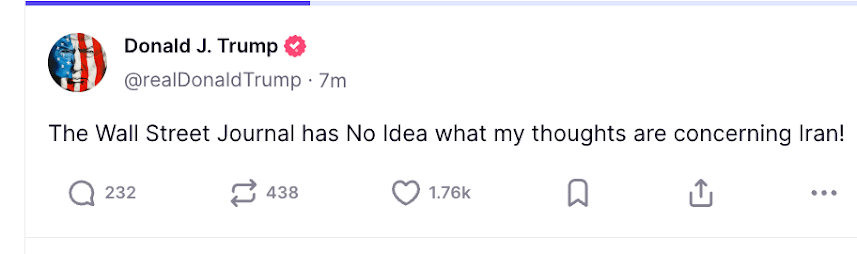
Trump has been emphasizing that “Iran cannot have a nuclear weapon” but also that no one “knows what I’m going to do.” He has also on Thursday pushed back on prior evening reports that he has made up his mind to get the US military involved. “The Wall Street Journal has No Idea what my thoughts are concerning Iran!” Trump wrote on Truth Social.

Tyler Durden
Thu, 06/19/2025 – 12:30

Interior Dept. Proposes Opening Up 82 Percent Of Alaskan Petroleum Reserve

Interior Dept. Proposes Opening Up 82 Percent Of Alaskan Petroleum Reserve

Authored by Naveen Athrappully via The Epoch Times (emphasis ours),

The Department of Interior (DOI) released a draft analysis that proposes reopening up to 82 percent of the 23-million-acre National Petroleum Reserve in Alaska (NPR-A) to oil and gas leasing and development, the agency said in a June 17 statement.

A part of the 800-mile Trans Alaska Pipeline System runs through boreal forest past Alaska Range mountains near Delta Junction, Alaska, on May 5, 2023. Mario Tama/Getty Images

NPR-A was set aside as an emergency oil supply for the U.S. Navy by President Warren Harding in 1923. In 1976, the reserve was transferred to the DOI’s Bureau of Land Management (BLM).

In 2022, the Biden administration announced the closure of almost half of the NPR-A reserve to oil and gas drilling, overturning a policy from the first Trump administration that sought to boost oil development in the region.

The latest proposal reverses the Biden-era restrictions, “consistent with the Trump administration’s commitment to Energy Dominance and regulatory reform,” the DOI said.

The proposal supports a presidential action, “Unleashing Alaska’s Extraordinary Resource Potential,” signed by President Donald Trump on Jan. 20, 2025.

The action highlighted that Alaska has an “abundant and largely untapped supply of natural resources” that could deliver energy price relief for Americans, ease trade imbalances, and create high-quality jobs.

According to the DOI, Congress designated NPR-A for oil and gas exploration in response to the 1970s energy crisis. The BLM manages the reserve under the Naval Petroleum Reserves Production Act, which mandates an “expeditious program of competitive leasing,” the agency said.

Acting Assistant Secretary for Land and Minerals Management Adam Suess said the proposed plan is about “creating more jobs for Americans, reducing our dependence on foreign oil, and tapping into the immense energy resources the National Petroleum Reserve was created to deliver.”

“Under President Trump’s leadership, we’re cutting red tape and restoring commonsense policies that ensure responsible development and good stewardship of our public lands,” he said.

Reducing Regulations

According to the DOI, the proposal builds on efforts to reverse burdensome regulations that have been imposed on the oil and gas sectors and includes rescission of a 2024 rule that restricted leasing in NPR-A.

The DOI announced the planned rescission on June 2, calling the Biden-era policy an overreach that hampered domestic energy production.

“Congress was clear: the National Petroleum Reserve in Alaska was set aside to support America’s energy security through responsible development,” Interior Secretary Doug Burgum said.

“The 2024 rule ignored that mandate, prioritizing obstruction over production and undermining our ability to harness domestic resources at a time when American energy independence has never been more critical. We’re restoring the balance and putting our energy future back on track.”

The Biden-era rule had closed roughly 11 million acres of NPR-A to oil and gas extraction and restricted construction on another 2 million acres.

Critics Decry Plan

In a June 2 statement, the Alaska Wilderness League criticized the DOI’s move to “gut protections” in NPR-A, also known as the Western Arctic Reserve.

“The Trump administration’s move to roll back protections in the most ecologically important areas of the Western Arctic threatens wildlife, local communities, and our climate—all to appease extractive industries,” Kristen Miller, executive director of the group, said.

“This is another outrageous attempt to sell off public lands to oil industry billionaires at the expense of one of the wildest places left in America. These lands are home to caribou, migratory birds, and vital subsistence resources that Indigenous communities have relied on for generations. The public fought hard for these protections, and we won’t stay silent while they’re dismantled.”

Meanwhile, the American Petroleum Institute welcomed the move to repeal the 2024 rule.

Dustin Meyer, senior vice president of policy, economics, and regulatory affairs at the group, called the 2024 regulation “misguided” in a June 2 statement.

Repealing the rule will “fully leverage Alaska’s National Petroleum Reserve as a driver of revenue, economic growth, and energy security,” he said.

Tyler Durden
Thu, 06/19/2025 – 11:55