64.1 F
Chicago
Friday, June 26, 2026
Home Blog Page 153

Minnesota Democrats Unanimously Vote To Protect Rep. Ilhan Omar… And Dead Voters

Minnesota Democrats Unanimously Vote To Protect Rep. Ilhan Omar… And Dead Voters

Authored by Eric Utter via AmericanThinker.com,

Minnesota Senate Democrats recently voted – unaminously – against removing deceased persons from the state’s voter rolls.

This tracks with the fact that almost 100% of dead people vote for Democrats, making them Democrats’ most loyal voting bloc, even surpassing that of serial killers.

(This may explain why, historically, Democrat gerrymandering seems designed to encompass as many cemeteries as possible. O.K., that is just an unfounded assertion, but it seems likely, does it not?)

The dead — and serial killers — are groups that vote heavily for Democrats? Talk about a symbiotic relationship! The latter provide the former! Genius! Kismet!

This after they also voted — unanimously — against an oversight committee effort to compel Rep. Ilhan Omar to testify after she missed a deadline to provide documents to the committee investigating the Somali fraud rampant in the North Star State.

So the multi-millionaire or poverty-stricken representative (take your pick) from Somalia escapes a subpoena, at least for now.

It is obvious that Democrats in Minnesota are as wedded to fraud as Ilhan once was to her brother. And for the same reason: they will do whatever it takes to attain and retain power, so help them Allah.

They share the same goals as well, at least for now: to fleece law-abiding taxpayers out of as much money as possible, so as to line their own pockets — and the pockets of those who help them attain and retain power.

In a sane country, at a sane moment in time, this would be considered an unethical, unacceptable, unconstitutional, illegal, and treasonous misuse of power, one that spits in the face of a representative democracy. Here today? Meh. Not good, but let’s not fly off the handle like our founders did. Tolerance and empathy, you see.

Democrats want as many illegals in the country as possible, because they vote for Democrats in droves. Why wouldn’t it be the same for dead folks? The more dead people, the more votes Democrats get. And, if the dead are erstwhile denizens of red states and rural areas, so much the better. Presto chango, a Republican has been converted into a Democrat! Remarkable!

This could explain Democrats’ love of abortion, medical assistance in dying, and violent criminals.

Our forefathers would have done whatever it took to counter this orgy of criminality.

Past mafia godfathers would be proud of it.

Today? Democrats like Tim Walz, Gavin Newsom, and J.B. Pritzker might accurately be called “fraudfathers.”


Tyler Durden
Fri, 05/08/2026 – 15:10

Ancient Settlement Older Than The Pyramids Discovered; Rewrites North American History

Ancient Settlement Older Than The Pyramids Discovered; Rewrites North American History

Authored by Steve Watson via modernity.news,

An ancient Indigenous settlement unearthed near Sturgeon Lake in Saskatchewan is challenging long-held views about early human presence in North America.

Dating to around 11,000 years ago and predating Egypt’s Great Pyramid by more than 6,000 years, according to the official timeline, the site provides evidence of long-term habitation rather than temporary camps.

Archaeologists working with Sturgeon Lake First Nation uncovered stone tools, fire pits, toolmaking materials, and remains of the extinct Bison antiquus. Charcoal layers point to controlled fire management, aligning with oral traditions. The findings suggest a sophisticated society with advanced hunting strategies, including buffalo jumps.

The site, known as Âsowanânihk (“a place to cross” in Cree), lies about five kilometres north of Prince Albert along the North Saskatchewan River. It was first spotted by avocational archaeologist Dave Rondeau through riverbank erosion exposing artifacts.

Rondeau said: “The moment I saw the layers of history peeking through the soil, I felt the weight of generations staring back at me. Now that the evidence has proven my first instincts, this site is shaking up everything we thought we knew and could change the narrative of early Indigenous civilizations in North America.”

Dr. Glenn Stuart of the University of Saskatchewan added: “This discovery challenges the outdated idea that early Indigenous peoples were solely nomadic. The evidence of long-term settlement and land stewardship suggests a deep-rooted presence. It also raises questions about the Bering Strait Theory, supporting oral histories that Indigenous communities have lived here for countless generations.”

Excavations indicate the location served as a hub for organized activity shortly after the last Ice Age. Researchers compare its importance to iconic global sites like the Great Pyramids, Stonehenge, and Göbekli Tepe.

The discovery includes evidence of bison pounds and kill sites, with hunters targeting massive Bison antiquus weighing up to 4,400 pounds. This points to coordinated community efforts and deep environmental knowledge.

Chief Christine Longjohn of Sturgeon Lake First Nation stated: “This discovery is a powerful reminder that our ancestors were here, building, thriving and shaping the land long before history books acknowledged us. For too long, our voices have been silenced, but this site speaks for us, proving that our roots run deep and unbroken. It carries the footsteps of our ancestors, their struggles, their triumphs, and their wisdom. Every stone, every artifact is a testament to their strength. We are not just reclaiming history, we are reclaiming our rightful place in it.”

The site, on Treaty 6 territory home to the Plains Cree, faces potential threats from logging and industrial activity. The Âsowanânihk Council, involving Elders, youth, educators, and archaeologists from the University of Saskatchewan and University of Calgary, is leading protection and further study efforts. Plans include a cultural interpretive centre.

Carbon dating of charcoal from a hearth places activity at about 10,700 years ago, roughly 1,000 years earlier than prior estimates for organized settlement in the region.

This find adds physical evidence to oral histories describing the area as a cultural and trade center, highlighting sophisticated land stewardship in post-glacial North America.

The discovery underscores ongoing collaboration between Indigenous communities and researchers to preserve and understand this chapter of human history. Further excavations and funding could yield more insights into early societal organization on the continent.

Your support is crucial in helping us defeat mass censorship. Please consider donating via Locals or check out our unique merch. Follow us on X @ModernityNews.

Tyler Durden
Fri, 05/08/2026 – 13:20

Vaccine Trade Returns? Moderna Working On Hantavirus Shot Sends Shares Higher

Vaccine Trade Returns? Moderna Working On Hantavirus Shot Sends Shares Higher

Moderna is out with timely news that it is working on early-stage research on vaccines targeting hantaviruses. The news comes as a Spanish woman has been hospitalized for a suspected infection, while a hantavirus cluster has ravaged a Dutch-flagged cruise ship, with five confirmed and three suspected cases of hantavirus. Three deaths have been reported so far.

Bloomberg reports that Moderna is collaborating with the U.S. Army Medical Research Institute of Infectious Diseases on hantavirus vaccine research and is also working with Korea University College of Medicine’s Vaccine Innovation Center on a potential vaccine.

“These efforts are early-stage and ongoing and reflect Moderna’s broader responsibility to develop countermeasures against emerging infectious diseases,” Moderna said.

Moderna said its work on hantavirus vaccines began before the cruise ship Hondius reported an outbreak while anchored off the coast of Cape Verde, on the west coast of Africa, last week.

Anais Legand, a technical officer at the World Health Organization (WHO), provided an update earlier today stating that all remaining passengers on the Hondius have left the ship without symptoms.

“They will be asked to take their temperature every single day for 42 days. They will be asked to check every day for other symptoms like feeling unwell or a headache,” Legand said, adding, “They will be provided with someone to contact. If they’re not feeling well, it’s up to the national authorities where people will go next.”

WHO Emergencies Communications Lead Nyka Alexander stated in a livestreamed update earlier that “the risk to the public remains low.”

Nevertheless, the news sent Moderna shares higher around noon. Shares had already been rising after the company reported that its mRNA flu vaccine outperformed in a late-stage study, likely driving early market activity. Shares are up 18%.

President Trump told an ABC News reporter on Thursday that “It’s very much, we hope, under control.” 

Polymarket:

Hantavirus pandemic in 2026?
Yes 9% · No 91%
View full market & trade on Polymarket

It is only a matter of time before other struggling biotech companies announce that they, too, are developing vaccines to prevent the next potential pandemic. This follows the Covid playbook.

Tyler Durden
Fri, 05/08/2026 – 13:05

OnlyFans Lures Outside Capital As Architect Capital And Billionaire Tag Team Deal

OnlyFans Lures Outside Capital As Architect Capital And Billionaire Tag Team Deal

Nearly seven weeks after OnlyFans owner and billionaire Leonid Radvinsky died, and after months of reports that the sex-worker streaming platform was exploring a stake sale, the Financial Times reported Friday morning that San Francisco-based Architect Capital is preparing to buy a minority stake in the company.

Australian billionaire James Packer, best known as the former head of the Packer family’s media and casino empire, is expected to be among a group of investors lined up to support Architect Capital’s deal to acquire a 15% stake in OnlyFans at a $3.1 billion valuation, according to FT’s sources.

The deal would leave control of OnlyFans with the family trust headed by Katie Chudnovsky, widow of late owner Leonid, who acquired OnlyFans in 2018 via Fenix International.

Leonid died in March at 43. He was apparently battling cancer for several years. 

Top OnlyFans creator pornstar Sophie Rain mourned the death of Leonid, saying back in March how he “built something that changed my entire life. Like, I grew up on food stamps and now I can take care of my whole family because of a platform he created. I will never forget that.” 

Radvinsky studied economics at Northwestern University and by 2018 had bought a majority stake in OnlyFans and helped transform the video content platform into an adult-content subscription business powerhouse that reshaped how sex workers monetize their bodies. 

OnlyFans was founded in 2016 and exploded in popularity during the Covid pandemic. Some of the latest data from 2024 showed the website had 4.6 million creators, 377 million fans, and $1.4 billion in revenue.

As we’ve previously noted, Americans spent an estimated $2.6 billion on OnlyFans subscriptions in 2025.

OnlyFans is bringing in outside capital without giving up control while leaving Radvinsky’s wife in charge. This may suggest the family trust is cashing out some value while simultaneously creating a pathway for broader monetization.

Tyler Durden
Fri, 05/08/2026 – 12:50

Closer Look Reveals April Jobs Report Was A Disaster, And AI Is Now Here To Take Your Job

Closer Look Reveals April Jobs Report Was A Disaster, And AI Is Now Here To Take Your Job

On the surface today’s jobs report was very strong: headline payrolls came in nearly double the expected (115K vs 65K), with unemployment flat just so Trump’s chief economist Kevin Hassett could push bullish taking points in today’s TV circuit such as this one.

  • *HASSETT: ‘RIP-ROARING’ JOBS MARKET

Unfortunately, below the surface this was the ugliest jobs report in years, and one could say even more cooked than last month’s laughable surge in jobs (which was revised from 178K to 185K).

Here’s why.

First, while the Establishment survey showed an impressive 115K jump in jobs when virtually everyone was expecting a big drop, looking at the composition reveals two things: the biggest contributor was semi-government jobs from the Education and Health services category which added 46K, and has been the biggest, and only consistent source of jobs growth this decade.

But even more remarkable was the surge in courier and messenger jobs, which soared by 38K in April, reversing the 52K drop last month. Was there a Doordash or Uber hiring binge that we missed last month? We thought they were mostly laying off their thousands of illegal alien workers… 

In other words, just two job categories accounted for almost all the job gains in April. As for the beating heart of the US economy, manufacturing jobs, they tumbled to -2,000 after surging 15,000 in March, the first negative print of 2026. Manufacturing jobs are now down 73K over the past year. Chemicals, Wood, and Machinery manufacturing are the biggest losers, but few subsectors are doing well

But what is even more concerning, is that the entire base of the monthly print was put in doubt after the BLS reported that in April, the Birth/Death adjustment “added” 391K jobs, which as we have explained repeatedly are not actual jobs but a baseline for model assumptions what the number of jobs in a given month “should” be. One would think after all the huge negative revisions to jobs under Biden as a result of flawed BIrth/Death assumptions the BLS would have learned its lesson. One would be wrong. 

But stepping away from the Establishment survey, things are even uglier in the much more accurate Household Survey. It is here that we find that contrary to the abovementioned payrolls increase, the number of employed workers actually declined by 226K in April. Worse, this wasn’t a one off: as shown below, the number of employed workers has been declining every month this year, and is now down an average of 343K jobs every month of 2026 after hitting a record high in Dec 2025!

Unfortunately, this means that we are once again witnessing the infamous divergence between the Household And Establishment surveys, as the number of employed workers has been declining and is now the lowest since December 2024 ot 162.622 million, the number of payrolls (tracked by the Establishment survey) is now at an all time high of 158.735 million, a number which is clearly not supported by the data.

This divergence is also why the unemployment rate remained at 4.3%: even though employment shrank by 226K to 162.622 million, the unemployment rate did not rise because people left the labor force.

There was more rot under the surface, as the number of full-time jobs in April plunged by 424K, while part-time jobs surged by 123K.

The drop in full-time jobs dragged the total number of full-time workers to levels last seen in December 2024. In other words both total employment and full-time jobs are back to where they were when Trump was elected.

But while all of the above is just the usual statistical gimmicks we have exposed every year for nearly two decades, there was something much more ominous in today’s report: AI is finally coming for your job… if you are a programmer that is. 

While the total number of jobs in April rose, on the abovementioned low quality Health and education and courrier (?) jobs, information jobs dropped again, sliding by 13K, having slid again… and again… and again. In fact, as shown in the next chart, Information jobs have now been negative every month since 2024!

Don’t expect that to change any time soon as the impact of AI “jobs outsourcing” is now here: as Goldman Delta One head Rich Privorotsky noted, we are seeing a flood of tech layoffs among which Cloudflare laying off 20%, Paypall firing 20%, Upwork 25%, Bill Holdings 30%, Coinbase 14%, Meta 10%, Microsoft 7%… and Google saying 75% of new code is now AI-generated (and about to layoff double digits too). This excludes the bloodbath across the crypto sector where the crypto winter coupled with AI has led to especially brutal mass layoffs.

Tech companies announced 33,361 job cuts in April, according to data from outplacement firm Challenger, Gray & Christmas Inc. So far this year, the industry has planned 85,411 cuts, up 33% from the same period in 2025.

“Technology companies continue to announce large-scale cuts and are leading all industries in layoff announcements,” said Andy Challenger, the company’s chief revenue officer. “Regardless of whether individual jobs are being replaced by AI, the money for those roles is.”

According to Layoffs.FYI, Q1 has seen the most tech related layoffs since the tech recession of 2022.

As Goldman’s Privorotsky puts it, “this phase has been the capex boom to enable what eventually becomes a far more radical labor adjustment cycle.” Which means workers are laid off to make space for capex spending and the occasional stock buyback. 

As he concludes, that may ultimately be what the market believes a future Fed reaction function will revolve around…AI-driven productivity disinflation eventually allowing a much deeper cutting cycle. In short, the Universal Basic Income that we predicted over two years ago is coming to pay for welfare for the tens of millions soon to be laid off due to AI, is now on its way.

Tyler Durden
Fri, 05/08/2026 – 12:22

“Damage Done Already” – Oil May Take Year To Normalize: Adam Parker

“Damage Done Already” – Oil May Take Year To Normalize: Adam Parker

Last night’s ZeroHedge debate featured the cautiously bullish Adam Parker, former Morgan Stanley chief equity strategist who now runs Trivariate, and bearish money manager Michael Pento, hosted by Adam Taggart of Thoughtful Money.

While Parker is largely optimistic about equities, he put forth a gloomy prediction on gas prices, based on what he is hearing as a consensus on Wall Street. Namely that prices will remain high for at least a year even if Hormuz were to open today.

His full comments below and highlights from last night’s debate. Check out the full discussion to hear how both Pento and Parker are positioned going into year-end:

Best case: More pain at the pump

Parker warned that oil markets may remain structurally elevated even if the Strait of Hormuz reopens immediately, arguing that current pricing still underestimates how long normalization could take.

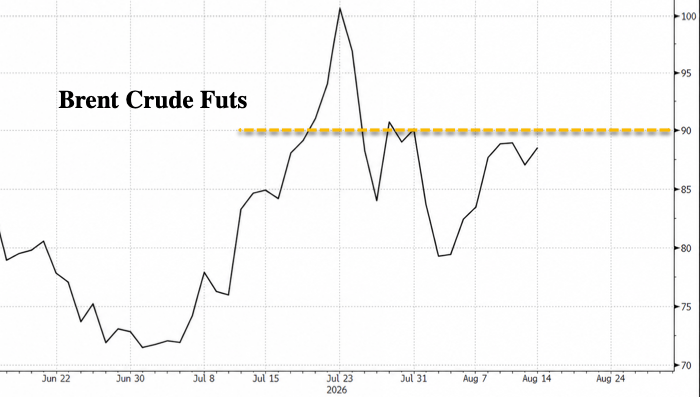
The consensus view is it takes much longer to normalize than what’s in the 12-month forward Brent,” Parker said, noting that forward oil pricing in the high-$70 range likely needs to be revised upward.

“Even if we’ve really truly reached some agreement now, it’ll take several months to get back toward where we were already, maybe a year.

Parker added that economic damage from the energy spike has likely already occurred, particularly for consumer-facing sectors.

There’s damage done already to consumer discretionary and staples earnings.

He argued the bigger debate now is whether equity markets continue looking through the near-term pressure on the assumption conditions eventually improve.

If Hormuz doesn’t open…

Renewed hot Middle East conflict and continued closure of the Strait of Hormuz would quickly mean severe inflation and a likely recession, according to Pento. In other words: stagflation.

Prolonged conflagration in the Middle East? Well, first of all, that would send CPI up even higher. And that would send interest rates up even higher,” Pento said, warning that much of recent GDP growth has been debt-funded rather than organic cash flow.

“Interest rates are going to go much higher as they follow inflation higher. That could put the kibosh on all this borrowing.

Pento argued that if oil prices hit $150 per barrel, things go South quickly.

“If oil goes to 150 and stays there or thereabouts, you’ll see stocks drop and you’ll see home prices drop. And that really torpedoes the top 20% purchasing power.”

He added that recession odds rise significantly if oil remains above $100 to $120 “for any kind of duration, a couple of months,” calling it “a big problem for the stock market.

Meanwhile trading the day-to-day is impossible because “you can get a tweet from Trump telling everybody that things are going great now and we’re about to sign a deal. And then the next thing you know, you turn around, you go to the bathroom, you come back and bombs are being lobbed at ships. It’s that stochastic.

Watch the full debate below or listen on Spotify.

Tyler Durden
Fri, 05/08/2026 – 12:20

Trump Administration Drops First Batch Of UAP/UFO Files

Trump Administration Drops First Batch Of UAP/UFO Files

On Friday, the Trump administration released the first official tranche of declassified UAP (Unidentified Anomalous Phenomena) and UFO files through the new Presidential Unsealing and Reporting System for UAP Encounters (PURSUE) – which of course was the alternative to the real incriminating Elite Presidential Shielding Taskforce Ensuring Impunity Now (EPSTEIN) files.

ack ack ack

The files are hosted at the official government site: https://www.war.gov/UFO/. This marks the start of a rolling release schedule (new materials every few weeks) covering decades of unresolved cases across multiple agencies, with a strong emphasis on unprecedented transparency.

What’s Included in Release 01 (162 Files + Supporting Materials)

The initial drop focuses on 162 FBI documents, all in PDF format. These are unresolved cases where the government states it cannot make a definitive determination on the nature of the phenomena – often due to insufficient data – and explicitly invites public and private-sector analysis.

Mainstream reporting (Fox News, New York Post, and others) highlights additional materials in the broader release:

  • Apollo 12 and Apollo 17 mission photos showing strangely shaped objects and clusters of dots in the lunar sky.

Archival imagery from the Apollo 17 mission to the Moon. The yellow box contains an enlarged area of the original photo in which three lights are visible above the lunar terrain.

  • A transcript from Apollo 17 operators describing “very bright particles or fragments” drifting by the spacecraft, “big ones on my window,” and “jagged, angular fragments that are tumbling” – likened to “the Fourth of July.”

  • FBI photos from New Year’s Eve 1999 showing two black-dot UAPs flying near U.S. aircraft.
  • References to “the latest UAP videos” and other original source documents/photos (including a colored illustration of a UFO over a field).

Specific recent military sightings mentioned across coverage and X discussions include:

  • An inverted teardrop-shaped object with a vertically linear trailing mask over the United Arab Emirates (June 2024).
  • A “strange contrast” or unexplained area in the skies over Iraq (December 2022, per CENTCOM).

  • A small circular UAP flying low near the ocean surface toward land near Greece’s coast.

The Department of War (in coordination with ODNI and other agencies) described the effort as historic and government-wide, involving the review of tens of millions of records (many still on paper). Releases will continue on a rolling basis.

President Trump announced the release on Truth Social: “Based on the tremendous interest shown, I will be directing the Secretary of War, and other relevant Departments and Agencies, to begin the process of identifying and releasing Government files related to alien and extraterrestrial life, unidentified aerial phenomena (UAP), and unidentified flying objects (UFOs), and any and all other information connected to these highly complex, but extremely interesting and important, matters. GOD BLESS AMERICA!”

“The Department of War is in lockstep with President Trump to bring unprecedented transparency regarding our government’s understanding of Unidentified Anomalous Phenomena. These files, hidden behind classifications, have long fueled justified speculation – and it’s time the American people see it for themselves. This release of declassified documents demonstrates the Trump Administration’s earnest commitment to unprecedented transparency,” reads a statement from Secretary of War, Pete Hegseth.

And of course Russia is mocking the release:

Guess Epstein wasn’t (isn’t?) an alien?

Tyler Durden
Fri, 05/08/2026 – 09:55

US Jobs Jump 115K, Smashing Estimates; Unemployment Rate Unchanged At 4.3%

US Jobs Jump 115K, Smashing Estimates; Unemployment Rate Unchanged At 4.3%

In his preview of today’s NFP report, Goldman’s Delta One head wrote that “NFP almost feels like a sideshow at this point. You can argue weak labor data gives a Warsh led Fed enough cover to cut, but with oil and input inflation still elevated there’s also an argument that a weakening labor market alongside a constrained Fed is actually the more difficult combination for risk assets.” With that in mind, moments ago the BLS reported that in April the US added a red hot 115K, above the median consensus of 65K (and near the upper end of the forecast range which peaked at 133K), down from an upward revised (for once) 185K (originally 178K). This was the first back to back gain in jobs in a year.

The change in February jobs was revised down by 23,000, from -133,000 to -156,000, and the change for March was revised up by 7,000, from +178,000 to +185,000. With these revisions, employment in February and March combined is 16,000 lower than previously reported

A look below the surface reveals a less impressive picture: while payrolls rose to a new record high, actual employment has dropped to the lowest since January 2025…

… as the monthly change in payrolls has disconnected dramatically from actual jobs, which dropped by 226K in April and are now down 4 months in a row!

Also worth noting: while it’s seasonal, in April the US saw 391K jobs added only in speadsheets thanks to a surge in Birth/Death model adjustments, the highest since October, and clearly a revision of the previous trend of revising birth death adjustments lower.

The unemployment rate was unchanged at 4.3%, in line with expectations, which is odd since all major ethnic groups saw their unemployment rate increase

… while the Labor Force Participation Rate dipped to 61.8% from 61.9%. The employment-population ratio, at 59.1 percent, changed little in April. These measures edged down over the year after accounting for annual population control adjustments. 

Wage growth came in cooler than expected, rising 0.2% MoM, below the 0.3% expected, and translating into a 3.6% annual increase, also below the 3.8% expected.

Some more details from the April report:

  • The number of people jobless less than 5 weeks increased by 358,000 to 2.5 million in April. The number of long-term unemployed (those jobless for 27 weeks or more) was essentially unchanged at 1.8 million and accounted for 25.3 percent of all unemployed people. 
  • The number of people employed part time for economic reasons increased by 445,000 to 4.9 million in April. These individuals would have preferred full-time employment but were working part time because their hours had been reduced or they were unable to find full-time jobs.
  • The number of people not in the labor force who currently want a job changed little at 6.1 million in April. These individuals were not counted as unemployed because they were not actively looking for work during the 4 weeks preceding the survey or were unavailable to take a job.
  • Among those not in the labor force who wanted a job, the number of people marginally attached to the labor force changed little at 1.8 million in April. These individuals wanted and were available for work and had looked for a job sometime in the prior 12 months but had not looked for work in the 4 weeks preceding the survey. The number of discouraged workers, a subset of the marginally attached who believed that no jobs were available for them, was also little changed in April at 475,000. 

Looking at the composition of the report, employment edged up by 115,000 in April, after showing little net change over the prior 12 months. In April, job gains occurred in health care, transportation and warehousing, and retail trade. Federal government employment continued to decline. 

  • Health care added 37,000 jobs, in line with the average monthly gain of 32,000 over the prior 12 months. Over the month, job gains occurred in nursing and residential care facilities (+15,000) and home health care services (+11,000).
  • Transportation and warehousing employment increased by 30,000 in April, reflecting a gain in couriers and messengers (+38,000). However, employment in transportation and warehousing is down by 105,000 since reaching a peak in February 2025.
  • Retail trade added 22,000 jobs in April. Employment increased in warehouse clubs, supercenters, and other general merchandise retailers (+18,000) and in building material and garden equipment and supplies dealers (+13,000). These gains were partially offset by job losses in department stores (-7,000) and in electronics and appliance retailers (-2,000). Retail trade employment had shown little net change over the prior 12 months. 
  • Social assistance continued to trend up in April (+17,000), reflecting a gain of 24,000 jobs in individual and family services.
  • Federal government employment continued to decline in April (-9,000). Since reaching a peak in October 2024, federal government employment is down by 348,000, or 11.5 percent. Federal employees on furlough during the partial government shutdown were counted as employed in the establishment survey because they worked or received (or will receive) pay for the pay period that included the 12th of the month.
  • Employment in information continued to trend down in April (-13,000). Telecommunications lost 3,000 jobs, while employment continued to trend down in motion picture and sound recording industries (-6,000) and in computing infrastructure providers, data processing, web hosting, and related services (-4,000). Information employment is down by 342,000, or 11.0 percent, since its most recent peak in November 2022.
  • Employment showed little change over the month in other major industries, including mining, quarrying, and oil and gas extraction; construction; manufacturing; wholesale trade; financial activities; professional and business services; leisure and hospitality; and other services.

Visually:

A few things stood out here: the monthly increase in courriers and messengers (i.e. DoorDash delivery(, +38K, was the highest since covid!

Government was also notable: total government jobs have now declined every month since October, and arr down 9 of the past 10 months.

But that is nothing compared to the depression in the Information sector, where jobs are now down every months since 2024!

Finally, looking at the quality composition of the jobs report, we find that in April, the US added 123K part-time jobs, while 424K full-time jobs were lost.

The drop in full-time jobs dragged the total number of full-time workers to levels last seen in December 2024!

The only silver lining: after plunging at the end of 2025 and start of 2026, and after a big drop in March, native-born workers rose by 341K in April, while foreign-born dropped by 326K.

In short, this was a much uglier jobs report than the clearly “nudged” headline indicates, although we doubt that anyone in the market will notice when all that matters if whether memory stocks today have momentum or not.

Tyler Durden
Fri, 05/08/2026 – 09:25

Ukrainian Drone Strike Paralyzes Airports Across All Southern Russia

Ukrainian Drone Strike Paralyzes Airports Across All Southern Russia

Russian cities and communities are busy preparing Victory Day WW2 memorial events all across the country ahead of Saturday, and so security is already on edge and on high alert, especially in the Moscow area, given that Ukraine’s devastating cross-border drone attacks have persisted and expanded of late.

On Friday air traffic at 13 airports across southern Russia was suspended after drones struck a building at a regional air navigation center in Rostov-on-Don, Russia’s transport ministry confirmed. This was the crucial air traffic control center for the whole region, and so its being taken offline has had significant impact.

Airspace empty over southern Russia

Regional media has listed that it halted flights to and from airports in Astrakhan, Vladikavkaz, Volgograd, Gelendzhik, Grozny, Krasnodar, Makhachkala, Magas, Mineralnye Vody, Nalchik, Sochi, Stavropol and Elista.

“The regional air traffic control center in Rostov-on-Don, which manages air traffic in southern Russia, has been temporarily adjusted due to the Ukrainian drone strike … personnel are safe, and equipment is being assessed” to determine whether operations can be restored, the ministry said on Telegram.

According to the Amsterdam-based Moscow Times, “Aeroflot, Pobeda, Nordwind and Rossiya Airlines said they were adjusting their flight schedules for Friday and would need to cancel some flights. At least 14,000 passengers were stuck due to delays and cancellations, the Association of Tour Operators of Russia said.”

“Russia’s Transportation Minister Andrey Nikitin asked major airlines to coordinate with the state-owned Russian Railways and the Unified Transportation Directorate to arrange for trains and buses to transfer passengers from canceled flights,” the report noted.

On the same day, over 260 drones were intercepted across various sectors of the country – which suggests that in total at least several hundreds were sent. Once again, some of them reached as far away as the Perm region in the Ural Mountains.

The drone waves have continued despite that Russia unilaterally announced a ceasefire corresponding with V-Day events commemorating victory over Germany in WW2. The ceasefire runs May 8-10; however, Ukraine has not acknowledged this.

Still, the Defense Ministry is acting as if it is on and it is official, having announced in a statement Friday morning that it has observed 1,365 violations by Ukraine since midnight.

The Kremlin is putting the Ukrainian capital on notice, telling foreign diplomats to evacuate in the instance that Ukraine’s military tries to disrupt Saturday celebrations in Moscow and Red Square.

Russian leaders have wared Kiev will get pummeled in an unprecedented bombing if President Zelensky orders any drone attacks on Moscow. He had actually appeared to threaten precisely these events during remarks earlier in the week.

Tyler Durden
Fri, 05/08/2026 – 09:20

OpenAI Valuation Doubts Loom As Softbank Scales Back Margin Loan

OpenAI Valuation Doubts Loom As Softbank Scales Back Margin Loan

SoftBank Group’s abrupt scaling back of a planned $10 billion margin loan backed by its roughly 13% stake in OpenAI – now targeting as little as $6 billion – reveals deepening lender unease over the AI giant’s $852 billion post-money valuation set in March 2026.

The move follows earlier $40 billion bridge financing and comes amid reports that OpenAI missed internal revenue and weekly-active-user targets earlier this year.

While the loan itself is SoftBank’s problem, the episode carries real risks for OpenAI.

The clearest danger is a loss of valuation momentum (a down-round!).

Reuters reports that lenders, including banks and private-credit funds, balked at assigning reliable collateral value to unlisted shares in a company whose secondary-market demand has already cooled.

With sellers reportedly outnumbering buyers and rival Anthropic drawing stronger interest, the episode reinforces perceptions that OpenAI’s headline valuation may be frothy.

This could make future capital raises more expensive or dilutive, especially if OpenAI needs additional funding to service its enormous compute commitments – estimated in the hundreds of billions over the next few years.

An anticipated IPO, once seen as straightforward at premium multiples, might now face haircuts or heavier scrutiny from public-market investors wary of missing-growth signals.

SoftBank’s own leverage adds indirect pressure.

The Japanese conglomerate is one of OpenAI’s largest backers and has layered significant debt atop its AI bets.

Should credit markets tighten further or OpenAI’s performance lag, SoftBank could face margin calls or be forced to sell secondary shares – flooding an already thin market and driving down perceived value.

That, in turn, might erode employee and partner confidence, complicate talent retention in a hyper-competitive sector, and chill the broader AI investment narrative that has sustained OpenAI’s sky-high spending.

While none of this is immediately existential – OpenAI retains strong revenue growth, marquee partnerships, and Sam Altman’s (circular) deal-making clout – the SoftBank loan retreat is a tangible warning: private-market exuberance can evaporate quickly when lenders demand proof that eye-popping valuations match real cash flows.

If sentiment sours further, OpenAI could find itself navigating a far narrower runway than its $852 billion price tag once implied… and as OpenAI goes, so goes the hyperscalers’ budgets as the circular financing of all this spend breaks down with any chinks in the armor of of OpenAI’s exponential growth expectations.

Tyler Durden
Fri, 05/08/2026 – 09:04