62.3 F
Chicago
Monday, September 21, 2026
Home Blog Page 1532

White House: Changing A Minor’s Gender Is “Child Abuse” And “Medical Malpractice”

White House: Changing A Minor’s Gender Is “Child Abuse” And “Medical Malpractice”

Authored by Steve Watson via Modernity.news,

White House Deputy Chief of Staff Stephen Miller announced Thursday that the Trump administration considers it “child abuse” to be change the gender of a minor and that health professionals carrying out the procedures are opening themselves up to charges of medical malpractice.

Speaking to the press, Miller stated “The Department of Justice is coordinating with state and local law enforcement to fight child abuse in our school systems.”

“It is child abuse to change a child’s gender, particularly if you do not inform the parents,” Miller further emphasised, adding “So, if a five-year-old or a six-year-old or a seven-year-old goes to school and the teacher tries to turn the boy into a girl or the girl into a boy, that is child abuse, and this administration is treating that as child abuse, and it is a gross violation of parental rights.”

“This also includes the administration’s message to our hospital systems that they cannot and will not be allowed to use taxpayer dollars to perform chemical castrations and sexual mutilations of children,” Miller noted.

He added that “Castration surgeries, castration drugs, sterilization treatments of children are barbaric. They violate all sound medical ethics. They are completely unwarranted. They harm children for life, irreversibly. It is child torture. It is child abuse. It is medical malpractice.”

“So the Department of Health and Human Services, under the leadership of Bobby Kennedy, as well as the Department of Justice and other departments of this government, are making clear to our medical providers and our hospital systems that you cannot use taxpayer dollars to perform these barbaric procedures on America’s children,” Miller urged.

He further outlined that “HHS has systematically updated all and eliminated all of the junk, fake science that was produced under the Biden administration promoting sex changes on children, promoting the idea of sterilizing children.”

“That’s been cleaned out, that’s been removed, and new guidance is being issued to doctors and hospitals advising them that they cannot perform these horrifying procedures, these irreversible procedures, on our nation’s children,” he added.

Leftists in the comments of the post are claiming en mass that there are no cases of this happening anywhere in the US, and that Miller is making it all up. Yet, there have been accounts in the news, and a deep dive suggests this is happening in places.

Miller also noted that “This administration ended the Biden administration’s policy and the Democrat Party’s policy of allowing men into women’s sports, men into women’s spaces.”

“We are using every single legal and financial tool we have, at President Trump’s direction, to make it clear that schools and universities are—and will—lose federal funds, as you’ve seen in Maine, if you allow men to invade women’s sports and women’s spaces. And this applies to our whole K-12 system,” Miller added.

*  *  *

Your support is crucial in helping us defeat mass censorship. Please consider donating via Locals or check out our unique merch. Follow us on X @ModernityNews.

Tyler Durden
Sun, 05/04/2025 – 09:20

Ukrainian Drones Have Been Targeting Historic Orthodox Churches In Russia

Ukrainian Drones Have Been Targeting Historic Orthodox Churches In Russia

Throughout over three years of the Russia-Ukraine war, there has been a sad and tragic trend of churches being struck by missiles, drones, or bombs on both sides of the conflict.

But attacks on religious sites have gone all the way back to 2014, and the start of the conflict in the Donbass, which saw pro-Kiev forces frequently shelling Russia-aligned areas, including attacks on Orthodox churches.

And of course, since then the Ukraine government has actively and openly persecuted Ukraine’s largest Orthodox church for simply maintaining spiritual communion with the Moscow Patriarchate.

Famous, historic monasteries have been shut down or seized by authorities, monks expelled, and churches have been raided by far-right nationalist militant groups. As for the other side, Russian aerial raids have often devastated whole Ukrainian neighborhoods, including destruction of local churches.

In a fresh incident, Russian government and media sources say a Ukrainian drone was sent across the border and struck an iconic, historic church in Belgorord region, which set the church on fire.

Local Belgorod governor Vyacheslav issued a statement on Telegram Saturday saying “the enemy is striking our holy sites again – an enemy drone has attacked Saint George Church in the village of Tolokonnoye.”

Emergency crews were able to extinguish the blaze, but not before the church’s domes caught on fire…

Friday into early Saturday saw Ukrainian forces launch over 40 drones and some 150 artillery shells in Russia’s southern Belgorod region. Along with neighboring Kursk, Belgorod has seen repeat incursions by Ukraine’s military over the course of the war.

While it’s impossible to confirm whether all these attacks on churches were ‘deliberate’ and targeted, Russian authorities believe this is the case, given an even more well-known church was just recently destroyed:

Last Thursday, the iconic New Jerusalem Orthodox church complex in the region burned down following a Ukrainian drone strike. Commenting on the incident at the time, Gladkov described it as a “deliberate” attack and also accused the Ukrainian military of subsequently targeting the firefighters who were trying to contain the blaze.

The New Jerusalem Church complex in the village of Sukharevo was entirely made of wood and so went up in flames quickly. That did clearly seem a targeted attack given Ukrainian drones dropped explosives directly on it.

Currently, Moscow and Kiev are still far from agreeing on a ceasefire. President Zelensky has accused his Russian counterpart Putin of playing a “game” with offers of very limited, 3-day ceasefires. Kiev instead wants to start with a month-long truce, but Russia has described this as a pretext for Ukraine forces rearming and replenishing along the front lines.

“This is more of a theatrical performance on his part. Because in two or three days, it is impossible to develop a plan for the next steps to end the war,” Zelensky has said in his latest statement.

Tyler Durden
Sun, 05/04/2025 – 08:45

Saudi Arabia Executes 100th Prisoner So Far This Year – Majority Are For Drug Offenses

Saudi Arabia Executes 100th Prisoner So Far This Year – Majority Are For Drug Offenses

Via Middle East Eye

Saudi Arabia has executed two people on terrorism-related charges, bringing the total number of executions in the kingdom this year to at least 100, according to an AFP tally.

The Ministry of Interior said the two Saudis were executed for their involvement in acts of “terrorism”, including joining a “terrorist organization” and attending training camps abroad, where they learned to make explosives.

Leaked video/screenshot shows execution in Saudi Arabia, YouTube

“After being referred to the competent court, a decision was issued confirming the charges against them and ordering their execution as punishment,” it added.

Of the 100 people executed this year, 59 were convicted of drug-related offences, including 43 foreigners, according to AFP.

“While Saudi Arabia positions itself as a positive diplomatic actor, its international partners are showing they are willing to turn a blind eye to its flagrant human rights violations,” Jeed Basyouni of the rights group Reprieve US said in a statement.

“The result? 100+ executions since January, more than half of them for non-lethal drug offenses.”

After a moratorium of approximately three years, Saudi authorities resumed executions for drug-related crimes at the end of 2022.

According to a previous AFP tally, at least 338 people were executed last year, compared to 170 in 2023 – far higher than the previous record of 196 in 2022.

Saudi human rights defenders and lawyers have accused Crown Prince Mohammed bin Salman of overseeing a crackdown on freedom of expression since he came to power.

This includes the introduction of a counterterrorism law that Human Rights Watch has criticized for its broad definition of terrorism.

US Secretary of State Marco Rubio meets with Saudi FM Prince Faisal bin Farhan at the State Department in Washington, on April 9, 2025. AFP

At least 1,115 executions have been carried out under the crown prince’s rule between June 21, 2017 and October 9, 2024.

Additionally, according to Reprieve, Saudi Arabia has repeatedly lied to the UN about its use of the death penalty.

Tyler Durden
Sun, 05/04/2025 – 08:10

Hope For The UK? Reform Party Dominates Uniparty In Sweeping Local Elections

Hope For The UK? Reform Party Dominates Uniparty In Sweeping Local Elections

In July of 2024, the Labour Party and Kier Starmer won general elections with the British public seeking to punish conservatives for not following through on their Brexit promises and stopping mass open immigration.  One of the primary reasons why the Brexit movement was a success was because it attempted to address growing concerns among UK natives that their ties to the European Union had trapped them in a prison of progressive politics including carbon taxation, declining personal freedom, economic crisis and mass immigration from the third world. 

Starmer would take his narrow win and go on to expand the very same policies that UK citizens voted against.  He helped to flood Britain with migrants, primarily from Islamic regions, and as the public took to the internet and the streets to complain, he enforced draconian censorship laws to silence them. 

It’s amazing how quickly things can change in less than a year. In 2024, the Reform Party won around 14% of the vote share.  This week in local elections they won 30% of the vote share, crushing Labour and the Conservatives and winning 677 council seats.

Labour lost 187 seats and Conservatives were stunned with a 674 seat loss. Nigel Farage has hailed Reform UK’s gains in Thursday’s elections as “unprecedented” and “the end of two-party politics”.  The party also won two mayoral races and added a fifth MP to its ranks in the Runcorn. 

UK voters are sending a clear message to the political elites that their progressive agenda will no longer be tolerated.

Local council elections are held every four years (though not all seats come up for a vote at the same time), and are designed to fill local government posts dealing with issues from housing to potholes.  The Reform Party upset in council seats is a sign that Farage is on his way to becoming Prime Minister. 

Conservatives and Labour, long considered a “Uniparty” alliance that never actually changes the system while they pretend to be opposed, has consistently referred to Reform as an “extremist” or “far-right” organization (much like MAGA in the US).  Writing in The Times, Keir Starmer argued that the lesson learned from the elections was not that the country needed “ideological zealotry”, but that the government needs to “crank up the pace on giving people the country they are crying out for…”

Labour members claim that their losses are due to the sluggish economy and cuts to social welfare policies, such as cuts in winter fuel payments to pensioners.  In other words, their solution is to buy off voters with more benefits.  They continue to pretend as if the mass immigration problem, high taxes and censorship are not factors.

Nigel Farage, though opposed to mass immigration programs, has not come out to fully endorse deportations, which is what helped give Donald Trump his landslide White House win in the US.  Some critics say Farage does not go far enough in his solutions for saving the country.  Only time will tell, but there are certainly visible cracks in the armor of the uniparty system and this may portend much needed changes in the UK and perhaps the rest of Europe in the near future. 

Tyler Durden
Sun, 05/04/2025 – 07:35

Five Benefits That The US Would Reap From Coercing Ukraine Into More Concessions To Russia

Five Benefits That The US Would Reap From Coercing Ukraine Into More Concessions To Russia

Authored by Andrew Korybko via substack,

Failure to do so risks another “forever war”, an Afghan-like debacle for the US, or World War III.

Russian Foreign Minister Sergey Lavrov’s recent reaffirmation of his country’s goals in the Ukrainian Conflict signal that the Kremlin regards the US’ reportedly finalized peace plan as unacceptable. Ukraine must withdraw from the entirety of the disputed territories, at least partially demilitarize and denazify, and Western troops mustn’t deploy there afterwards for Russia to agree to a ceasefire

Here are the five benefits that the US would reap from coercing Ukraine into these and other concessions to Russia:

1. Swiftly & Sustainably End The Ukrainian Conflict

Another “forever war” or Afghan-like debacle would be averted upon swiftly ending the conflict via these means, which would lead to a sustainable peace since Russia’s security interests would be ensured. The Trump Administration thus wouldn’t have to worry about getting dragged into another quagmire via mission creep if peace talks collapse or having its reputation tarnished by a defeat. Coercing Ukraine into the required compromises for ending the conflict would be an effective and face-saving way to move on.

2. Shock NATO Into Spending 5% Of GDP On Defense

NATO’s Western European members are expected to procrastinate on Trump’s demand that they spend 5% of GDP on defense unless they’re shocked by the proposed US-coerced Ukrainian concessions. They’d jolt them into prioritizing this without further delay due to their paranoid fear of a Russian invasion. This would in turn lead to Western Europe finally shouldering more burdens for its own security and correspondingly complementing its Central European members’ existing efforts in this regard.

3. Turn Central Europe Into The EU’s Center Of Gravity

In that scenario, the Central European countries’ role as NATO’s frontline states would be reinforced, which could lead to them becoming the EU’s center of gravity if the US helps the Polish-led “Three Seas Initiative” implement its dual military-economic integration projects. These anti-Russian countries are expected to cling even closer to the US after the Ukrainian Conflict ends, thus enabling the US to drive a wedge between Western Europe and Russia afterwards, thereby perpetuating US influence over the EU.

4. Enter Into A “No-Limits” Resource Partnership With Russia

Expanding the nascent RussianUS “New Détente” into a “no-limits” resource partnership in the post-conflict era would lead to them jointly managing the global oil and gas industries while also unlocking valuable rare earth opportunities. Potential US ownership of Russia’s Nord Stream and trans-Ukrainian gas pipelines to Europe could further perpetuate US influence over the bloc as well as deter Russia from violating the Ukrainian peace deal. The economic and strategic benefits would truly be unprecedented.

5. Accelerate The “Pivot (Back) To Asia” For Containing China

Quickly extricating the US from the financial and military commitments that the Ukrainian Conflict entails would accelerate its “Pivot (back) to Asia” for containing China and comprehensively add to the pressure being put upon the People’s Republic by Trump’s global trade war/“economic revolution”. This outcome would advance the US’ grand strategic goal of reshaping the emerging Multipolar World Order more to its liking within the realistic limits posed by the global systemic transition.

These five benefits would be lost if the US doesn’t soon coerce Ukraine into more concessions to Russia. 

The conflict could continue indefinitely in that event, during which time the US might either largely abandon Ukraine and thus cede its influence over the EU while accepting an historic defeat or punish Russia by “escalating to de-escalate” at the risk of World War III, neither of which is preferable.

The best way to end what Trump rightly described as “Biden’s war” is therefore through the proposed means.

Tyler Durden
Sun, 05/04/2025 – 07:00

Buffett To Step Down As Berkshire CEO At Year-End As Cash Hoard Hits Record $348 BIllion

Buffett To Step Down As Berkshire CEO At Year-End As Cash Hoard Hits Record $348 BIllion

It’s the end of an era at America’s largest hedge fund/private equity/insurance float-cum-rollup conglomerate, whatever you want to call it: Warren Buffett just announced during the Berkshire annual pilgrimage to Omaha that he is stepping down as CEO of Berkshire at the end of the year, and that Greg Abel, the vice chairman for non-insurance operations who has been groomed over the past decade for just this moment, will take over the conglomerate. The news was greeted with a standing ovation by the thousands of Berkshire shareholders who were present at Omaha’s Convention Center.

Buffett – whose track record cemented him, along his long-time sidesick Charlie Munger, into a celebrity billionaire renowned for his investing acumen and witticisms – built Berkshire Hathaway into a business valued at more than $1.16 trillion, generating compounded annual returns to shareholders at double the rate of the S&P (19.9% vs 10.4%), since 1965, and a staggering 5,502,482% overall gain on BRK stocks since 1964, vs “only” 39,054% for the S&P. His investing success gave him the power to move stocks and helped him strike lucrative deals with Goldman Sachs and General Electric during times of crisis.

The announcement stunned the board and even Abel, who, while long signaled as Buffett’s successor, was unaware that the news was coming as the annual meeting drew to a close.

“That’s the news hook for the day,” Buffett said. “Thanks for coming.”

Berkshire grew aggressively over the decades with Buffett as chairman and CEO, as he chose acquisitions and stocks for the company portfolio alongside trusted adviser and vice chairman, Charlie Munger, who died in 2023 at 99. As Bloomberg notes, “the conglomerate acquired a bewildering assortment of businesses, which Buffett often said mirrored the US economy as a whole. A bet on Berkshire, he said, was a bet on America.”

Buffett started managing money when he was young, a disciple of Benjamin Graham’s investing style. He moved more into the corporate world when his Buffett Partnership Ltd. bought shares of Berkshire. In 1965, he took control of the rest of the business.

Composed mostly of struggling textile operations that would eventually fade away, Berkshire became the foundation for Buffett’s modern-day giant. Piece by piece, he built and acquired operations into a varied set of industries, including insurance — which gave him cash, or “float” — to help his investing strategy. 

Now, Berkshire owns businesses ranging from railroad BNSF to auto insurer Geico, sprawling energy operations, and even retailers such as Dairy Queen and See’s Candies. Its collection of companies generated $47.4 billion of annual operating earnings in 2024. Buffett also built up the stock portfolio — populating it with giant bets on the likes of Apple Inc. and American Express — and offering Berkshire another way to participate in the gains of businesses that it didn’t fully own.

* * *

Ahead of today’s annual meeting with Berkshire’s faithful, the company reported Q1 results that showed a steep drop in operating earnings from the year-earlier period: operating earnings, which include the conglomerate’s fully owned insurance and railroad businesses, fell 14% to $9.64 billion during the first three months of the year. In the first quarter of 2024, they totaled $11.22 billion. On per share basis, operating earnings were $4.47 last quarter, down from $5.20 a year ago, and below the $4.72 consensus forecast.  

Much of the company’s decline was driven by a 48.6% plunge in insurance-underwriting profit, which came in at $1.34 billion for the first quarter, down from $2.60 billion a year prior, and was mostly due to the Southern California wildfires which led to a $1.1 billion loss in Q1.

Berkshire’s bottom line also took a hit from the dollar losing value in the first quarter. The company said it suffered an approximate $713 million loss related to foreign exchange. This time last year, it benefited from a $597 million forex gain. The dollar index fell nearly 4% in the first quarter. Against the Japanese yen, it lost 4.6%.

The company’s overall earnings plunged nearly 64% year over year, as Buffett’s portfolio of publicly traded names took a hit to start the year. As is well-known, Berkshire always advises investors to look past these quarterly changes: “The amount of investment gains (losses) in any given quarter is usually meaningless and delivers figures for net earnings per share that can be extremely misleading to investors who have little or no knowledge of accounting rules,” Berkshire’s release said.

Berkshire said Donald Trump’s tariffs and other geopolitical risks created an uncertain environment for the conglomerate, owner of BNSF railway, Brooks Running and Geico insurance. While the firm said it’s not able to predict any potential impact from tariffs at this time, it warned that tariffs may further hit profits.

“Our periodic operating results may be affected in future periods by impacts of ongoing macroeconomic and geopolitical events, as well as changes in industry or company-specific factors or events,” Berkshire said in the earnings report. “The pace of changes in these events, including international trade policies and tariffs, has accelerated in 2025. Considerable uncertainty remains as to the ultimate outcome of these events. We are currently unable to reliably predict the potential impact on our businesses, whether through changes in product costs, supply chain costs and efficiency, and customer demand for our products and services” it said.

During the annual meeting, Buffett also addressed Trump’s tariff policies at the company’s annual meeting in Omaha, saying trade “should not be a weapon.” 

“You can make some very good arguments for the fact that balanced trade is good for the world,” Buffett said in response to a question about trade barriers. “There is no question that trade can be an act of war.” He added that the US “should be looking to trade with the rest of the world.” Which, obviously is what Trump is trying to do, just on far better terms than effete US leadership had accepted gradually over the past few decades.

Continuing a familiar trend, in the first quarter, Berkshire’s cash hoard ballooned to a fresh record, rising to more than $347 billion from around $334 billion at the end of 2024, as the company now holds a record $305.5 billion in Treasury Bills, which to CNBC showed “that Buffett did not use the first-quarter drop in the stock market to deploy the money.” Which, of course, was to be expected since the stock market dropped sharply only at the start of the second quarter.

During the pandemic, Buffett was stymied on the dealmaking front due to high valuations for good businesses, leaving a swollen cash pile and few attractive opportunities to put money to work. Instead of deals, Buffett aggressively leaned into share buybacks to deploy capital, though he broke with that trend by completing a $11.6 billion acquisition of Alleghany Corp. in 2022.

Last year, he decried a lack of meaningful deals that would give the firm a shot at “eye-popping performance” as Berkshire’s cash pile hit yet another record. The few US companies capable of moving the needle at Berkshire had already been “endlessly picked over by us and by others,” he said. Since then, as the billionaire cut his stakes in Apple and Bank of America while refraining from making major deals, Berkshire’s cash pile kept piling up, reaching $347.7 billion as of March 31.

Meanwhile, Berkshire continued to be a net seller of stocks for a 10th quarter in a row, although at a far slower pace, selling just a net $1.5BN in stocks, down sharply from the $6.7BN in Q4 and from the record $75.5BN in Q2 2024.

The report comes as Berkshire enjoys a stellar year-to-date performance, while the broader market languishes. In 2025, Class A shares of Berkshire are up nearly 19%, while the S&P 500 is down 3.3% as uncertainty from tariffs pressures tech and other sectors. Not surprisingly, with the stock surging to a new all time high, for the third quarter in a row, Berkshire did not repurchase any of its  own stock.

Despite Buffett’s large following, his day-to-day management of Berkshire was simple. He long favored a decentralized management approach, allowing the heads of Berkshire’s various businesses to run the operations how they deemed fit and checking in on the operations every now and then.

Buffett considered one of his more important roles to be a capital allocator for Berkshire, figuring out where the money should go, and reportedly spent a lot of time reading in his corporate office in Omaha. That office had just 27 employees as of last year.

“Buffett’s decision to limit his activities to a few kinds and to maximize his attention to them, and to keep doing so for 50 years, was a lollapalooza,” Munger said in an annual letter. “Buffett succeeded for the same reason Roger Federer became good at tennis.”


Tyler Durden
Sat, 05/03/2025 – 22:58

Americans Value Health & Family Above Everything

Americans Value Health & Family Above Everything

Amid all the distractions offered by smartphones, social media and the constant stream of information we’re all inundated with these days, it’s sometimes hard to focus on the truly important things in life. 

But what are those things? 

While the answer to that question is highly individual, Statista’s Felix Richter reports that there are some core values that unite many people.

Infographic: Americans Value Health & Family Above Everything | Statista 

You will find more infographics at Statista

According to Statista Consumer Insights, Americans largely agree on family and health being among the most important things in life, while making money, personal growth and a career are also high on the list of thing Americans value most in life.

Tyler Durden
Sat, 05/03/2025 – 22:45

Nuclear Deterrence Requires Only Dozens Of Warheads – Not Thousands

Nuclear Deterrence Requires Only Dozens Of Warheads – Not Thousands

Via Brian McGlinchey at Stark Realities

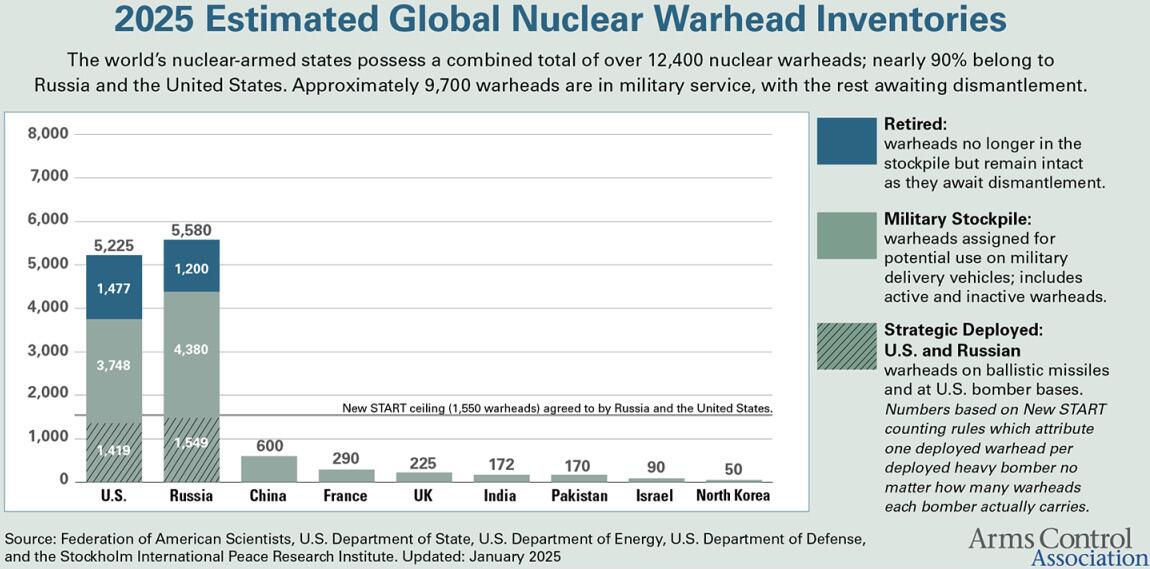
Over the next decade, the US government plans to spend nearly $1 trillion on its nuclear arsenal — with the actual cost certain to run even higher than that. The huge outlay is driven in part by the sheer size of America’s doomsday-weapon collection, which comprises an estimated 3,700 deployed or stockpiled nuclear warheads, not counting another 1,500 that are purportedly “retired” and awaiting dismantlement.

Though Americans have been conditioned to think it’s reasonable to maintain such a large arsenal, the idea that thousands of warheads are required to deter nuclear aggression rests on flawed thinking about the nature of deterrence. While defense contractors and military bureaucracies enriched by the status quo will tell you otherwise, the truth is that an adequate arsenal of nuclear warheads can be measured not in thousands, but mere dozens.

During the Cold War, two successive doctrines guided nuclear war strategy. First came Massive Retaliation, which rested on the threat of a disproportionate, devastating nuclear response to either conventional or nuclear aggression. That gave way to Mutual Assured Destruction (MAD), in which any nuclear attack was guaranteed to escalate to the point where both countries are completely destroyed.

Both doctrines shared a cornerstone premise — that effective, credible deterrence requires the capability to completely destroy the opposing country. That’s the wrong yardstick. Deterrence is achieved by the ability to impose an intolerable level of retaliatory destruction on a country that’s contemplating a nuclear first-strike — a threshold far lower than border-to-border annihilation.

For perspective, in World War II, Russia and China each suffered roughly 20 million total civilian and military deaths. The same unfathomable fatality counts that spanned several years in World War II can be achieved in mere minutes with only 20 modern nuclear warheads — 15 striking Russian cities and only five hitting the more densely-populated cities of China, according to calculations by University of Maryland professor Steve Fetter.

If the United States chose to opt against the morally-repugnant targeting of population centers with little military significance (that is, cities similar to Hiroshima and Nagasaki), a second-strike could instead vaporize the enemy’s economy, targeting power generation, refinery complexes and vital ports (though even these nuclear attacks would inflict civilian death on a huge scale, not only from the blasts but also the economic destruction). Here, Fetter calculates 100 detonations would suffice.

The fatalities and destruction associated with either of those two targeting scenarios that pursue some level of societal devastation — so-called “countervalue targeting” — are well beyond what any foreign ruler would consider tolerable, suggesting that the anticipation of even one or two second-strike warheads would be sufficient to deter an adversary from striking first.

Note, this approach to deterrence, which focuses on the power to retaliate and inflict “intolerable” destruction, does not require adversaries with high moral character. It matters little whether an opposing ruler regards his citizens with loving empathy or depraved indifference. Rulers are ultimately driven by self-interest — and no leader can expect his hold on power to survive a nuclear gamble that brings about the vaporization of cities or irreplaceable economic assets in his own country. (Indeed, there may be no “power” to hold on to.) As political scientist Kenneth Waltz wrote in a milestone 1990 paper that promoted the peacekeeping value of nuclear weapons while making the case that small arsenals are sufficient, “Rulers like to continue to rule.”

Given these realities of deterrence, the size of an adversary’s nuclear arsenal has no bearing on the appropriate size of America’s. “So long as two or more countries have second-strike forces, to compare them is pointless,” wrote Waltz. “If no state can launch a disarming attack with high confidence, force comparisons become irrelevant…beyond a certain level of capability, additional forces provide no additional coverage for one party and pose no additional threat to others.”

In contrast to countervalue targeting, “counterforce targeting” aims to inflict military defeat by destroying a large, diverse array of military targets, such as missile silos, bomber and submarine bases, command and control facilities, and conventional forces.

Counterforce-targeting is what led both America and Russia to amass far larger arsenals than that of any other nuclear-armed country. Beyond the elevated general risk associated with securing, transporting, maintaining and training with these large volumes of warheads, the mutual targeting of nuclear weapon delivery platforms pursuant to counterforce doctrine encourages first strikes — launched out fear that an opponent’s first strike would render one’s own weapons unusable.

Aside from the heightened risk of miscalculations during crises and accidental explosions during peace, America’s outsized nuclear arsenal threatens national security in a way that has nothing to do with mushroom clouds — by nudging the United States further along its path to financial catastrophe. As then-Chairman of the Joint Chiefs Mike Mullen warned in 2010, “The most significant threat to our national security is our debt.” His statement came when the national debt was only about a third of its current $36.8 trillion.

Of the trillion dollars to be spent on nuclear weapons through 2034, $460 billion will be spent on a “modernization” program that encompasses warheads, missiles and silos and submarines. Of that, the Pentagon expects to spend $120 billion to replace the current generation of land-based, Minuteman III ICBMs with Sentinel ICBMs made by Northrop Grumman. Last year, the Air Force notified Congress that the Sentinel program would cost 37% more than the previous estimate, and take two years longer to implement. If the history of Pentagon weapon procurement is any guide, we can count on more such announcements in the coming years.

Considered in the context of second-strike deterrence, the Sentinel program is particularly exasperating. Given their fixed locations in satellite-observable silos, land-based ICBMs represent the most vulnerable leg in the nuclear-arms triad, which also includes bombers and submarine-launched missiles. Put another way, it’s the leg that does the least to convince a nuclear adversary that the United States has a guaranteed second-strike capacity — which is the only strike capacity that matters. At the same time, land-based ICBMs are a magnet for enemy missiles, with one study suggesting nuclear strikes on US ICBMs could kill 300 million people across North America. 

Hiding in plain sight: Land-based ICBMs — like this one near Monarch, Montana — comprise the most vulnerable leg in the nuclear triad (via Moose Radio 94.7)

In February, President Trump expressed dismay at the ongoing development of new nukes:

“There’s no reason for us to be building brand new nuclear weapons. We already have so many. You could destroy the world 50 times over, 100 times over. And here we are building new nuclear weapons, and they’re building nuclear weapons.”

Trump’s remarks came as he expressed interest in opening new arms control negotiations with Russia and China. That’s a noble pursuit, but when a second-strike capability is all the United States needs for defense, a case can be made for blazing a unilateral path toward rational and frugal nuclear deterrence — particularly when you consider the dangerously destabilizing nature of a huge arsenal built for counterforce targeting.

“There is no compelling military or strategic rationale for linking the size of U.S. nuclear forces to those of other nuclear weapon states,” wrote Fetter. “As long as the United States has enough survivable warheads to deter and respond to nuclear attacks, it should not matter how many weapons other countries have.” That’s not to discount the risk-reducing value of a far smaller Russian arsenal.

Ballistic missile submarines — like the USS West Virginia — do the most to assure an enemy of America’s second-strike capability (US Navy)

Alas, any move toward a dramatically slimmer US nuclear warhead inventory will face fierce opposition from those who benefit from today’s emphasis on numerical superiority. The status quo is a prime example of the principle of “concentrated benefits and diffused costs.” Via both taxation and inflation, the $1 trillion cost of sustaining and upgrading the arsenal over the next 10 years will be spread across hundreds of millions of Americans, including many who haven’t been born yet. Shuffled into the $90 trillion the US government is projected to spend over that same period, the cost flies under the radar of everyday Americans, precluding major political opposition.

The financial benefits, on the other hand, accrue to a relatively small number of stakeholders, from arms manufacturers to Pentagon and Department of Energy bureaucracies. The enjoyment of concentrated benefits incentivizes these stakeholders to fiercely defend the status quo, deploying a formidable influence arsenal that includes lobbyists, campaign contributions, the promises of jobs in 50 states and hundreds of congressional districts, and financial sponsorship of national security think tanks that steer policy.

While those who are enriched by America’s excessive nuclear arsenal have the upper hand, the status quo is so dangerous and wasteful that Americans of all political leanings should unite in challenging it.

Stark Realities undermines official narratives, demolishes conventional wisdom and exposes fundamental myths across the political spectrum. Read more and subscribe for free at starkrealities.substack.com  

Views expressed in this article are opinions of the author and do not necessarily reflect the views of ZeroHedge

* * *

Tyler Durden
Sat, 05/03/2025 – 22:10

Which Countries Produce The Most Silver?

Which Countries Produce The Most Silver?

Silver is an essential metal for the electronics industry, which is helping fuel an expected rise in global demand over the coming years.

As mining of this crucial metal ramps up to meet demand, a select nation continues to dominate global silver output.

This map, created by Visual Capitalist’s Ryan Bellefontaine in partnership with Vizsla Silver Corp., uses the latest data from Metals Focus in the Silver Institute’s World Silver Survey to show the countries producing the most silver.

Mexico Leads Again

Here are the top silver-producing countries in the world as of 2023:

Country Millions of Ounces (Oz)
🇲🇽Mexico 202.2
🇨🇳China 109.3
🇵🇪Peru 107.1
🇨🇱Chile 52.0
🇧🇴Bolivia 42.6
🇵🇱Poland 42.5
🇷🇺Russia 39.8
🇦🇺Australia 34.4
🇺🇸U.S. 32.0
🇦🇷Argentina 26.0
🇮🇳India 23.8
🇰🇿Kazakhstan 16.6
🇸🇪Sweden 12.6
🇮🇩Indonesia 10.3
🇲🇦Morocco 8.8
🇺🇿Uzbekistan 7.7
🇨🇦Canada 7.1
🇵🇬Papua New Guinea 4.3
🇪🇸Spain 3.7
🇧🇷Brazil 3.3

Mexico retains its position as the world’s leading silver producer, mining 202.2 million ounces (Moz)—accounting for nearly a quarter of the world’s total supply. The country’s deep-rooted silver mining history, rich reserves, and active mining sector keep it at the forefront of global production.

China followed as the second-largest silver producer with 109.3 Moz. In third place, Peru is closely behind at 107.1 Moz

After Peru, South America is home to some of the world’s other most significant silver producers, such as Chile with 52.0 Moz and Bolivia with 42.6 Moz, which round out the top five.

A Historic Industry with a Bright Future

Mexico’s dominance in silver mining dates back centuries, with its reserves continuously tapped to meet growing global demand.

Today, projects like Vizsla Silver Corp’s Panuco project in northwest Mexico demonstrate the country’s vast potential. Panuco alone contains an estimated 201.4 million ounces of silver.

As the world looks toward a future of increased industrial and investment demand for silver, Mexico remains the undisputed leader in production, reinforcing its role as a cornerstone of the global silver supply chain.

Discover how Vizsla Silver Corp. promotes responsible mining practices to support the rising global demand for silver while building a sustainable future.

Tyler Durden
Sat, 05/03/2025 – 21:35

Biden Autopen Use Increased As Cognitive Decline Deepened, Analysis Finds

Biden Autopen Use Increased As Cognitive Decline Deepened, Analysis Finds

Authored by Steve Watson via Modernity.news,

The Oversight Project has released a disturbing new findings showing an apparent correlation between the increased use of autopen signatures and Joe Biden’s worsening mental decline.

The group previously found that two different autopens were used, pointing out that Neera Tanden was the White House Staff Secretary when Biden autopenned pardons from a golf course in the US Virgin Islands.

The organisation released further analysis finding that Biden’s pardons for family members, Anthony Fauci, General Milley, J6 Committee members, and Gerald Lundergan were all autopenned.

Now a further analysis of Executive Order signatures shows an “increased use of the autopen as President Biden’s mental and physical decline accelerated,” according to the group.

The findings show that Biden used a wet signature on every single Executive Order during his first 18 months in office.

However, this radically changed in late Spring of 2022 when around half of the orders were autopenned. By the Summer, 100 percent of the orders were being signed by autopen.

In 2023, two thirds of the orders were autopenned, and in 2024 that figure rose to three quarters, before again hitting 100 percent in the last days of his presidency in 2025.

The Oversight Project notes:

Our investigation highlights several Executive Orders that are particularly concerning due to their political weight. These orders, all signed with the autopen, address sensitive issues such as national security, public health, and military justice. Below are key examples:

  • Executive Order 14097: Combating International Drug Trafficking (April 27, 2023)
    This order authorized the activation of the Ready Reserve of the Armed Forces to address international drug trafficking, expanding emergency powers to combat a national security threat.
  • Executive Order 14098: Sanctions on Sudan (May 4, 2023)
    This order imposed sanctions on individuals destabilizing Sudan, addressing threats to U.S. national security and foreign policy.
  • Executive Order 14114: Countering Russian Aggression (December 22, 2023)
    This order expanded sanctions targeting Russia’s military-industrial base and financial institutions, amending prior orders to counter Russian aggression.
  • Executive Order 14118: Terminating the Zimbabwe Emergency (March 4, 2024)
    This order revoked a national emergency regarding Zimbabwe, acknowledging ongoing concerns about violence and corruption while lifting sanctions.
  • Executive Order 14122: Public Health Preparedness (April 12, 2024)
    Focused on COVID-19 and public health, this order transferred responsibilities to the Office of Pandemic Preparedness and Response Policy (OPPR) and revoked COVID-19-related orders.
  • Executive Order 14130: Amending the Manual for Courts-Martial (December 20, 2024)
    This order updated the Manual for Courts-Martial to align with legislative changes, including randomized selection of court-martial members.

The new findings come after President Trump called for those who operated Biden’s autopen to be jailed.

Trump has declared that all of the pardons issued by ‘Joe Biden’ in the final days of his fake Presidency should be void because he didn’t sign any of them.

*  *  *

Your support is crucial in helping us defeat mass censorship. Please consider donating via Locals or check out our unique merch. Follow us on X @ModernityNews.

Tyler Durden
Sat, 05/03/2025 – 21:00