

55.1 F
Chicago
Friday, October 30, 2026
Home Blog Page 1545

Where Are We Now?

Where Are We Now?

By Peter Tchir of Academy Securities (full pdf available here)

Just last weekend, we discussed Confusion versus Uncertainty. We have a long list of potential market moving-events, many of which might be at pivotal moments.

  • The Big Beautiful Bill. Not letting tax cuts expire is crucial. Additional targeted tax cuts would also be helpful – especially anything that would drive growth and innovation.
     

    • The new “twist” here was the apparent falling out, played out via social media, between President Trump and Elon Musk. It seems to have quieted down, which is a good thing. While we are correct to worry about the deficit, at this point in time, moving the bill along seems more important. Will Thursday’s “social media storm” be a one-time event, or do we need to think about potential ramifications for the Trump agenda without Musk’s support? I don’t think so, but it is a concern.
       
  • Tariffs.
     

    • With July 8th approaching rather quickly, and only the U.K. deal signed, it seems unlikely that many more fully done deals will be inked before the deadline. On the other hand, the market is pricing in a “worst” case of extensions on the pause. We get some deals announced with a few countries and we get a pause extension on countries where there has been some initial negotiating. That seems reasonable for the markets to assume, given everything that has gone on.
       
    • A deal with China seems to have become the top priority.
       

      • The Geneva Deal doesn’t seem to be working as either side expected.
      • The President is apparently getting directly involved with Xi, which is what the President wanted all along, though I’m not sure that is the best approach, given China has known this all along.
      • We fully expected the administration to try to isolate China. We were wrong. While it is encouraging to see how the policy is being portrayed, there is a real concern, especially amongst the Geopolitical Intelligence Group, that we might not get the international cooperation against China that many think is necessary for the plan to succeed.
      • Short-term wins versus longer-term risks. If the purpose of the deal is to buy time to prepare for more separation, then we have to structure the deal very carefully. China has the resources and global integration to also work aggressively during any “cooling off” period. Protecting IP and National Security Interests should remain an integral part of any deal. There is a real struggle on this front between short-term and longer-term needs.
      • The processing of rare earths and critical minerals. The one “card” that China seems to have immense control over is the processed/refined rare earths and critical minerals. While Greenland and Ukraine might help get access to these raw materials (though we don’t see that as the major problem), they don’t do much for us in terms of processing/refining where China continues to dominate the market. We don’t know just how big of a card this is (quite large if they are actually willing to use it broadly for an extended period), but getting these businesses up and running domestically should be the biggest priority of the admin once Budget 2025 is passed. It still would have made sense, according to the GIG, to also include close allies in this crucial supply chain, but that ship may have sailed.
         
    • Are tariffs tools to negotiate, there to generate revenue, or designed to bring manufacturing back to the U.S.? Recently Japan cited some uncertainty, from their perspective (on the U.S. side) regarding what the goal is.
       

      • It seems reasonable to expect that after the Big Beautiful Bill is passed (I’m assuming that it will be passed), we will get more clarity on the direction the admin is headed in on tariffs. The President, even working almost 24/7, can only focus on so much, so getting the budget passed is likely taking his attention away from other things (and the bizarre “feud” on Thursday certainly doesn’t help). We should also learn whether the revenue was an artifice to pull in some votes to get approval for the bill (arguing that tariff revenues will offset some costs, until growth kicks in). The “revenue” side of tariffs might be less important after the bill gets passed. On the other hand, maybe the administration doesn’t want to “upset the apple cart” and risk not getting the bill passed? So, after the bill is passed, will we go back to being more aggressive on tariffs?


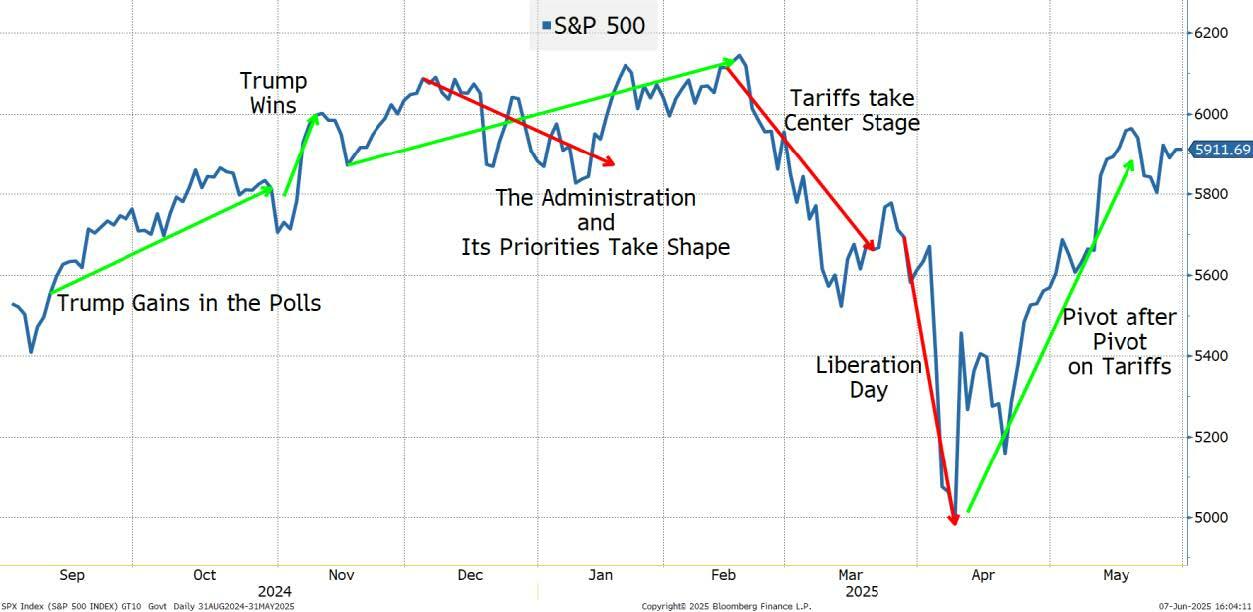
        This chart might be a bit simplistic (data centers and AI still play a huge role in the movements of the market, but it isn’t too far off).
         

  • National Production for National Security. If that has the sound of something that might have been said in a Communist country, I’m okay with it. Prioritizing what is needed and pushing the agenda as aggressively as possible is key for our success and ability to compete with China down the road. Subsidies would help, but they don’t seem to be on the agenda with the urgency many of our National Security experts think is needed. On the other hand, deregulation is also a crucial step and that is something we have argued, since day 1, that Trump has specialized in. Why he didn’t start with deregulation and fighting NIMBY (Not In My Backyard) is a question I would love to have answered (the chart above would look a LOT different if the admin had come out of the gates focused on this front rather than tariffs). Treasury Secretary Bessent talks about this as being one of the “legs of the stool” and the more we turn our attention to this, the better. While it is also designed to take jobs away from elsewhere and bring them to the U.S., it seems less aggressive than using tariffs and is far more in our own control.
     
  • When, or if, will the impact of existing tariffs, policy uncertainty, or even confusion hit the economic data and the markets? We discuss this in our NFP Reaction, and remain convinced that the market, at these levels, has become too complacent with risks on the economic front. While backing off on tariffs has been great, and has greatly reduced the risk of recession, that is still a risk as the global economy takes time to adjust to the level of uncertainty (and even confusion) that has been set in motion since Inauguration Day. I completely believe the worst is behind us on the tariff headlines, but the impact has not been felt in the real world, and while 10% (or just higher) is “manageable,” there are likely going to be costs.
     
  • Peace. While we argued peace in a short timeframe was achievable (peace in a single day seemed impossible), that has stalled, at least in Russia. We published a Drone Attack SITREP on Monday. The mix of carrots and sticks was confusing to many of the GIG members, and maybe it is surprising we are here. The geopolitical situation is different than the economic situation, but if I had to be cautious about something right now – it is the growing difference between how confidently the President predicted peace, and where we are now. It is “different” than tariffs with China, right? Maybe not?
Bottom Line

I still like rates. Friday’s move could have pushed the Fed’s second cut out to next year, while, for me, the jobs data solidified the chance of a July cut, with 3 to 4 for the year. 10s back to 4.5% is a buying opportunity, though a range of 4.2% to 4.6% seems about right. A bit of a wide range, but the volatility around so many of the topics listed above, especially the bill, still needs to be considered.

Credit boring. Crypto exciting.

Credit, which I think I understand, should do okay here. So far the calendar hasn’t slowed much, but credit has held in very well. Across the globe, anyone looking for corporate credit risk needs to come to the U.S. as the market is the only place big enough to offer diversification across industries, ratings, and maturities. Also, the companies issuing corporate debt are often global in nature, so the exposure isn’t confined to the U.S.

On Crypto, I don’t understand the rush for governments to get involved, but it seems that is the trajectory we are on. So long as corporations can add crypto to their balance sheets and see their stock valuations rise more than the amount of crypto they bought, I can understand why they would do that. However, I cannot understand that relationship, which is driving the process. I do understand anxiety around FX globally and deficits globally, but I’m still not sure how that translates into owing crypto – but certainly I am more tempted to jump back on the bandwagon than fight it here.

Equities. Maybe not “priced to perfection” but getting close. When we examine the list of risks, uncertainties, or even things to be confused about, the market seems positioned to the optimistic side. That could be proven correct, but the risk/reward has definitely shifted with the recent legs of this rally (China, chips, and deficit spending). The IPO market is wide open and that could be a big benefit not just to markets, but also for the economy as new and innovative companies are brought to the forefront of daily market headlines!

It has been great being on the road a lot (on the road again this week) and talking to so many of our clients, colleagues, and members of the Geopolitical Intelligence Group.

  • There is a decent amount of concern about small and midsize businesses, especially related to tariffs.
  • A blind faith that the consumer keeps consuming (which has been the correct call).
  • A more optimistic outlook for dealing with China from most people, than generally expressed by our Geopolitical Intelligence Group. We had a great outing with two GIG colleagues from the CIA last week, demonstrating how we are moving deeper into national security and policy.

Today, I just wanted to conclude by thanking all of those who take time out of their hectic schedules to meet with, talk to, or even just respond to Academy Securities as it helps us grow and get better!

If we go back to today’s question “Where are We Now?” the answer is at some pivotal moments for some major drivers to kick into gear, or stumble, as they near the goal line.

Tyler Durden
Sun, 06/08/2025 – 12:50

Chinese-Owned Firm Halts Construction On Battery Plant In America’s EV Heartland

Chinese-Owned Firm Halts Construction On Battery Plant In America’s EV Heartland

Chinese-owned AESC has halted construction of its $1.6 billion battery plant in America’s emerging “Battery Belt,” citing economic uncertainty tied to President Trump’s trade war and tariffs and the potential early termination of federal clean energy subsidies.

Construction of AESC’s electric-vehicle battery plant in Florence, South Carolina, began in 2023 after securing a deal with BMW to make battery cells. 

On Thursday, the company sent a letter to employees regarding the construction halt, as obtained by The Wall Street Journal. The letter laid out:

  • Tariffs on Chinese-made machinery, steel, and aluminum, which significantly raise costs.

  • A proposed tax bill in Congress that would end EV battery production subsidies early and restrict eligibility for China-linked companies.

  • Broader industry pressure as automakers slow or cancel EV rollouts.

“Our intent is to finish construction of the facility once stability and predictability have returned to the market,” Knudt Flor, AESC’s chief executive for the U.S. and Europe, wrote in the memo.

Current and former employees told WSJ that construction of the building has been completed, but all work on installing equipment and battery cell assembly lines has been halted.

Sources noted that AESC would face steep tariffs on EV battery machinery imported from China and said that recent steel and aluminum tariffs imposed by the Trump administration have further compounded the company’s cost challenges.

In recent years, Biden-era green energy policies fueled a surge in battery factory construction across parts of the Midwest and Southeast, driven by cheap land, proximity to major automotive hubs, and generous state-level incentives. This region—stretching from Tennessee and Alabama to the Carolinas, Ohio, and Michigan—has become known as America’s “Battery Belt.”

Some major projects across the belt include:

  • Ford and SK On: $11.4B battery and EV campuses in Tennessee and Kentucky

  • LG Energy Solution: Multiple joint ventures with GM, Stellantis, and Honda in Michigan, Ohio, and Indiana

  • Hyundai and SK: $5B EV battery plant in Georgia

  • Toyota: Expanding EV battery production in North Carolina

“Now many of those subsidies are being targeted by Republicans at the same time regulations and tax credits aimed at driving EV sales are also at risk,” WSJ noted, adding, “The current version of a tax bill before Congress would end EV battery production subsidies a year early and make them unavailable to companies with ties to certain countries, including China.”

Tyler Durden
Sun, 06/08/2025 – 12:15

Billions Spent On Data Centers – But Where Is The AI Adoption Rate?

Billions Spent On Data Centers – But Where Is The AI Adoption Rate?

This week, readers were given fresh insights from UBS (read: here & here), highlighting the explosive surge in data center investments. As we’ve noted before, one asset manager—backing a multi-billion-dollar AI data center project in Texas—described to us the current AI infrastructure buildout as a multi-year “sprint.”

With hundreds of billions pouring into data center development—concentrated in Texas and the Heartland due to cheap land and reliable power—investors should be asking one critical question: how fast is AI adoption scaling across corporate America?

According to Goldman Sachs’ latest AI Adoption Tracker for Q2 2025, the enterprise implementation of AI continues to expand, particularly across sectors most vulnerable to automation. At the same time, productivity gains are becoming more measurable, even as AI-related layoffs have yet to materialize. 

Analysts Jan Hatzius, Joseph Briggs, and others offered clients a clear snapshot of the current AI investment tsunami:

AI-related investment growth remains strong, particularly for semiconductor firms, where equity analysts expect revenue growth of 36% from current levels by the end of 2026. Since the release of ChatGPT, analysts have upgraded their end-2025 revenue projections for semiconductors by $200bn (0.7% of US GDP) and AI hardware enablers by $105bn (0.4%).

As for the AI adoption rate, analysts found that as of May, approximately 9.2% of U.S. firms reported using AI in the production of goods or services—up from 7.4% in 4Q24. 

The most significant quarter-over-quarter gains occurred in the education, information, finance, and professional services sectors.

“Large firms with 250+ employees continue to report the highest adoption rate (14.9%) while medium-sized firms with 100-249 employees reported the largest expected increase in adoption over the next 6 months (+4.7pp to 14.6%). Adoption rates have also accelerated among medium-sized firms with 150-249 employees,” the analysts said. 

Certain subsectors—especially in computing, web hosting, and telecom—are seeing adoption rates exceed 30%. Broadcasting and telecommunications firms anticipate the largest adoption gains through the rest of 2025.

Given the increasing AI adoption rate, the analysts noted that AI’s impact on employment metrics has been marginal:

AI’s impact on the labor market remains limited and there is no sign of a significant impact on most labor market outcomes. AI-related job openings now account for 24% of all IT job openings and 1.5% of all job postings. AI has not been mentioned in major corporate layoff announcements in recent months and the unemployment rate for AI-exposed positions has reconciled with the broader unemployment rate.

However… 

We continue to observe large impacts on labor productivity in the limited areas where generative AI has been deployed. Academic studies imply a 23% average uplift to productivity, while company anecdotes imply similar efficiency gains of around 29%.

Here’s what companies and trade organizations are saying about current and future AI adoption…

Ultimately, investors will need to see AI adoption across corporate America continue to climb in order to justify the massive infrastructure buildout.

The looming question now is: At what point does rising adoption trigger a wave of AI-driven layoffs?

Tyler Durden
Sun, 06/08/2025 – 12:15

Federal Appeals Court Upholds Limits On Florida Drag Show, Including No Minors Rule

Federal Appeals Court Upholds Limits On Florida Drag Show, Including No Minors Rule

Authored by Tom Ozimek via The Epoch Times,

A federal appeals court has ruled that the city of Naples, Florida, can lawfully require a drag performance at this weekend’s Pride Fest event to be held indoors and restricted to adult audiences.

In a split June 6 decision, the U.S. Court of Appeals for the 11th Circuit reversed a lower court’s preliminary injunction blocking local restrictions. The court found that Naples Pride, the nonprofit organizing the event, had waited too long to challenge the conditions after accepting the same terms in 2023 and 2024.

The majority concluded that the city’s decision to impose the restrictions was not based on the group’s viewpoint, but rather on public safety concerns. The judges also held that the performance venue—a city park—constitutes a “limited public forum,” where speech protections under the First Amendment are subject to greater regulation.

The court added that the performance could still go forward under the same conditions as in previous years—indoors and adults-only—and that the city had a strong argument that its rules were reasonable and viewpoint-neutral.

In dissent, Circuit Judge Nancy Abudu criticized the majority’s reasoning, arguing that the city’s restrictions were “undeniably viewpoint and content-based” and thus unconstitutional, regardless of whether the park is viewed as a traditional or limited public forum.

Earlier this month, U.S. District Judge John Steele issued a preliminary injunction barring Naples from enforcing the indoor and age-restriction requirements. That ruling came in response to a lawsuit filed in April by the ACLU of Florida on behalf of Naples Pride, alleging violations of constitutional free speech rights.

Reacting to the 11th Circuit’s reversal, the ACLU of Florida called the decision “disappointing” and vowed to continue the legal fight. Naples Pride likewise criticized the ruling, but said it would comply with the restrictions, for now.

“We respect the rule of law and will comply with the restrictions—but we won’t pretend this is justice,” Callhan Soldavini, board member and corporate counsel for Naples Pride, said in a statement. “Righting the wrongs of injustice takes time, but make no mistake: we will keep fighting.”

The case now returns to the lower court, where Naples Pride’s claims for damages will proceed.

In response to the ruling, the Naples Police Department said on June 6 that the police would be on-site during the event to ensure public safety.

“As a result, the City may continue enforcing its event ordinance while the case proceeds,” the department said in a post on social media. “We remain committed to protecting public safety, upholding constitutional rights, and ensuring the safe use of public spaces.”

Meanwhile, the same court of appeals ruled in mid-May that a Florida restaurant known for hosting drag shows could continue hosting the performances pending further litigation in a case that challenges enforcement of the state’s Protection of Children Act.

The law prohibits the admission of children into live performances that Florida considers obscene for minors. However, the court found that the restrictions in the act were too vague as they applied to the shows held at the restaurant.

Tyler Durden
Sun, 06/08/2025 – 11:40

FTC Warns Of Rising Student Loan Scams, Says Fraudsters Took Millions From Borrowers

FTC Warns Of Rising Student Loan Scams, Says Fraudsters Took Millions From Borrowers

Authored by Chase Smith via The Epoch Times (emphasis ours),

The Federal Trade Commission (FTC) is warning borrowers to steer clear of student loan debt-relief scams, after shutting down a group of companies last month that allegedly charged millions in illegal fees and left customers worse off.

Graduates attend a commencement ceremony at Harvard University in Cambridge, Mass., on May 29, 2025. Rick Friedman/AFP via Getty Images

The warning, issued June 6, comes as part of a broader push by the FTC to raise awareness about deceptive debt-relief schemes targeting Americans with student loans.

In a recent enforcement action, the agency permanently banned California-based Panda Benefit Services and its affiliates from the debt-relief industry. The FTC said the companies posed as partners of the Department of Education and promised borrowers quick loan forgiveness in exchange for upfront payments.

According to the FTC, the companies collected more than $16.7 million from consumers who were told their loans would be forgiven or significantly reduced. Instead, the scammers kept the money and never delivered on their promises.

“It’s illegal for anyone to charge fees before they help you or to pretend they’re affiliated with the Department of Education,” the FTC said in the consumer alert.

The Education Department does not work with private companies that demand payment in advance, and borrowers should be cautious of anyone claiming otherwise.

The now-banned companies, including those doing business under names like Prosperity Benefit Services and Pacific Quest Services, were first sued in 2024. At the time, the FTC alleged the operators sent deceptive mailers marked “FINAL NOTICE” and “Time Sensitive,” and made false promises of full loan forgiveness.

Borrowers were also misled into sharing personal financial details, including their Federal Student Aid ID, which scammers could use to access accounts or steal identities.

The case was one of the FTC’s first under a new federal rule that strengthens its ability to penalize those impersonating government agencies. Several judgments in the case ordered the defendants to surrender assets and banned them from telemarketing and making misrepresentations about financial services.

The FTC emphasized that no private company can do anything for borrowers that they can’t do themselves for free at StudentAid.gov. This includes applying for income-driven repayment plans, consolidating loans, or exploring forgiveness options—none of which require payment to third-party services.

Federal law also prohibits companies from pretending to be affiliated with the Department of Education. But scammers frequently misuse official-sounding names and seals to appear legitimate.

Borrowers struggling to repay federal loans can explore free options, including deferment, forbearance, and income-driven repayment plans. In some cases, they may also qualify for forgiveness based on long-term payment history or employment in public service.

The agency is urging the public to report suspected scams at ReportFraud.ftc.gov, contact their state attorney general, and find out more at ftc.gov/StudentLoans.

Tyler Durden
Sun, 06/08/2025 – 10:30

Los Angeles Braces For Another Day Of Chaos As Newsom Pits Marxist Color Revolution Against Trump Admin

Los Angeles Braces For Another Day Of Chaos As Newsom Pits Marxist Color Revolution Against Trump Admin

Los Angeles is bracing for yet another day of what appears to be coordinated rioting sparked by mass arrests of illegals by Immigration and Customs Enforcement (ICE). The unrest has involved organized elements affiliated with far-left activist cells, including Marxist-aligned nonprofits (see below).

The situation over the last two days has quickly deteriorated into looting, arson—including the burning of vehicles—and direct assaults on law enforcement personnel. Indicators suggest a high degree of premeditation and online mobilization in what appears to be an attempt by Democratic Party-aligned actors to ignite a Mexican version of the Black Lives Matter riots, echoing the chaos seen during the 2020 “Summer of Love” color revolution.

On Saturday, the Trump administration announced they were federalizing 2,000 California National Guard troops, while DHS Secretary Kristi Noem also chimed in – posting on X that protesters who use violence against officers will be prosecuted – writing “You will not stop us or slow us down.’

President Trump also blamed California Governor Gavin ‘Newscum’ and LA Mayor Karen Bass Bass – saying in a Saturday night ‘Truth’ that if they can’t do their jobs, “then the Federal Government will step in and solve the problem.”

On Sunday, Trump posted: 

Great job by the National Guard in Los Angeles after two days of violence, clashes and unrest. We have an incompetent Governor (Newscum) and Mayor (Bass) who were, as usual (just look at how they handled the fires, and now their VERY SLOW PERMITTING disaster. Federal permitting is complete!), unable to to handle the task.

These Radical Left protests, by instigators and often paid troublemakers, will NOT BE TOLERATED. Also, from now on, MASKS WILL NOT BE ALLOWED to be worn at protests. What do these people have to hide, and why??? Again, thank you to the National Guard for a job well done!

White House spox Karoline Leavitt echoed Trump’s comments, saying in a post on X: “President Trump will uphold law and order and continue to remove all dangerous illegal alien invaders from our country,” adding “The mob violence will be quelled, the criminals responsible will be brought to justice, and operations to arrest illegal aliens will continue unabated.“

Newsom, Bass, and the LAPD are downplaying the protests – framing it as fed overreach amid ‘peaceful‘ protests between Immigration and Customs Enforcement (ICE) and protesters, after ICE agents carried out multiple immigration sweeps throughout the county.

California AG Rob Bonta said “There is no emergency and the President’s order calling in the National Guard is unnecessary and counterproductive.“

Late Saturday, a Border Patrol Black Hawk helicopter could be seen unloading dozens of boxes of guns and ammo. 

Meanwhile, the Deartment of Homeland Security accused Democratic leaders in California – including Governor Gavin Newsom (D) and Mayor Karen Bass (D) of contributing to the violence.

“The violent targeting of law enforcement in Los Angeles by lawless rioters is despicable and Mayor Bass and Governor Newsom must call for it to end,” DHS spokeswoman Tricia McLaughlin said in a statement. 

SBA Administrator Kelly Loeffler called out Newsom called out Mayor Bass – saying that the SBA will relocate its regional office out of LA ‘immediately.’

And what do we have here?

The pallets of bricks have reappeared, echoing the same tactics seen during the 2020 riots.

On Saturday morning, we profiled one of the nonprofits behind the chaos — Unión del Barrio — whose manifesto is filled with explicit Marxist and communist rhetoric — appears to have become the next group Democrats are using as useful idiots. 

DataRepublican noted that several NGOs are coordinating the chaos. 

Further assessment is ongoing to determine the operational structure behind the violence and any external influence or coordination exerted by foreign adversaries. 

“As a reminder while riots rage in Los Angeles LA’s Mayor, Karen Bass, was a Fidel Castro supporter She was a member of the Venceremos Brigade and made 7 trips to Cuba during the 1970s — when it was illegal for Americans to do so Later, she traveled there with Obama in 2016,” Sequoia partner Shaun Maguire wrote on X. 

And this. 

CC Trump admin??  Maybe it’s time to codify DOGE cuts. 

Robert F. Kennedy Jr.’s former running mate, Nicole Shanahan, pointed out:

I smell CIA/deep state all over this. Sanctuary cities like LA strategically encouraged erratic and violent migrants to seek refuge and now are using them to violently attack federal law enforcement officers.

They have no respect for our laws, they use our entitlements, and they destroy our cities. This will be the fate of all sanctuary cities if we let this madness continue.

“Foreigners who live in your land will gain more and more power, while you gradually lose yours. They will have money to lend you, but you will have none to lend them. In the end they will be your rulers” (Deut 28:43-45). These words were written thousands of years ago and still hold true today.

Newsom and Bass want this altercation with Trump. They will trade a city on fire if it means they can score political points. Meanwhile, California suffers. Will we ever wake up from this nightmare?

Los Angeles was a war zone in the overnight hours. 

Los Angeles City Council Member Eunisses Hernandez (D) called to escalate the fight against ICE agents. 

A key question emerging from the unrest is the extent to which illegal aliens are participating in the riots—and whether any individuals or groups may be acting under the influence of foreign intelligence agencies intent on fomenting social unrest within the U.S.

Given the indicators observed so far—coordinated action, ideological messaging, and tactical resemblance suggest the rogue nonprofits aligned with the Democratic Party are using “color revolution” frameworks in their attempt to spark nationwide riots. This incident should be evaluated as a potential national security threat, given the likely participation of foreign nationals. 

Stay tuned for updates…

Tyler Durden
Sun, 06/08/2025 – 09:51

Will Beijing De-Dollarize Or Dump US Treasury Debt?

Will Beijing De-Dollarize Or Dump US Treasury Debt?

Authored by Milton Ezrati via The Epoch Times,

Anticipating what tactics Beijing might use against U.S. President Donald Trump amid trade negotiations, several media outlets here, in Europe, and elsewhere have begun to speculate that China will threaten to distance its economy and its trade from the dollar—de-dollarize in the popular parlance—and perhaps sell off its extensive holdings of U.S. Treasury debt.

Neither act, however, is at all likely, certainly not as an immediate bargaining chip.

It is easy to see why commentators would seize on notions like de-dollarization. Beijing for years has sought to raise the yuan’s international profile, often at the expense of the U.S. dollar. In its wide-ranging Belt and Road Initiative, for instance, it often insists that arrangements and contracts are denominated in yuan and not dollars, as is customary elsewhere.

Beijing has promoted the idea of moving away from the dollar among the so-called BRICS nations (Brazil, Russia, India, China, and South Africa). China’s Asian Infrastructure Investment Bank denominates loans and grants in yuan, not dollars. Beijing has contracted for large oil purchases in yuan, not dollars. Its extensive dealings with Russia dispense with the use of dollars. And the People’s Bank of China has aided the effort by promoting a digital yuan.

But Beijing is also well aware that China, as an export-dependent economy, must hold dollars to back its trading activities with most nations.

For all Beijing’s efforts to supplant the dollar with the yuan, the dollar nonetheless acts as a basis for 80 percent of the world’s import-export activity, even when Americans are not involved. The dollar has a presence in 90 percent of all currency transactions, compared with only 4 percent for the yuan.

China could shed the dollar and still have access to global trading and currency arrangements, but it would have to accept much less effective and efficient arrangements to do so.

In other words, de-dollarization would hurt China much more than it would hurt the United States, and both Beijing and Washington know this.

Nor is China likely to threaten the sale of its holdings of U.S. Treasury debt.

There is no denying that China’s holdings are huge. Some estimates put the figure at just under $1 trillion, second only to Japan’s holdings of about $1.13 trillion. This would seem to give Beijing leverage, but all involved know that the sale of these holdings would deny China a liquid market in which to invest its necessary holdings of U.S. dollars.

Moreover, an extensive sale would depress the price of U.S. Treasury bonds, imposing losses on Beijing’s balance sheet at a time when China’s domestic economic troubles make such a loss especially hard to bear. To be sure, such a sell-off would hurt Washington, but it would hurt Beijing even more, and both sides know it.

Beijing also knows that China’s interests would suffer from the tendency for any of these steps to weaken the dollar’s foreign exchange value and strengthen the yuan. In these circumstances, China’s central authorities would do better to weaken the yuan’s foreign exchange value, especially against the dollar. Such an action would make Chinese goods cheaper to dollar-based buyers and accordingly offset some of the adverse pricing impact of existing and threatened U.S. tariffs.

Instead, the yuan has recently gained value against the dollar. Beijing could reverse this trend if it were to talk down the currency actively by publicly eschewing de-dollarization and any talk of selling off holdings of U.S. Treasury debt.

It hardly warrants saying that matters today remain highly uncertain.

Trump’s next move is impossible to guess, as is Beijing’s.

For all the uncertainty, however, it is still possible to set aside all the talk of de-dollarization and asset sell-offs, for the very practical reasons outlined here and also because Beijing, in these ongoing negotiations, has zero interest in antagonizing Washington.

Views expressed in this article are opinions of the author and do not necessarily reflect the views of The Epoch Times or ZeroHedge.

Tyler Durden
Sun, 06/08/2025 – 09:20

Bank Connected To Left Wing Billionaire Giving Loans To Illegal Immigrants To Fight “Systemic Racism”

Bank Connected To Left Wing Billionaire Giving Loans To Illegal Immigrants To Fight “Systemic Racism”

A bank connected to leftwing billionaire Tom Steyer is giving loans to illegal immigrants using a financial loophole—claiming it’s a way to fight “systemic racism”, according to the Daily Wire.

Beneficial State Bank, based in Oakland, California, offers loans to immigrants without legal status by using Individual Taxpayer Identification Numbers (ITINs) instead of Social Security numbers.

The bank says this is part of its mission to promote fairness. “Beneficial State Bank is committed to addressing financial inequalities that disproportionately affect communities of color, a result of centuries of systemic racism,” the bank said in its 2022 impact report.

“A key initiative is lending to immigrant customers who may not have Social Security numbers but possess Individual Taxpayer Identification Numbers.” In 2022, it issued $25 million in auto loans to 707 ITIN borrowers

The Daily Wire writes that in 2023, the bank continued to push this strategy. “Because many financial institutions require social security numbers, people without them, such as recent immigrants to the United States, can face barriers to qualifying for the loan they need to purchase a car,” the report reads.

“The bank lends to customers with Individual Taxpayer Identification Numbers, providing critical access to credit and expanding financial inclusion.” About 10% of its 16,000 auto loans are made this way.

The bank started by offering loans to undocumented immigrants through furniture stores, according to the Global Alliance for Banking on Values. It also lends to people with California AB 60 driver’s licenses, which are available to those who “are unable to provide proof of legal residence in the United States.”

Beneficial State Bank did not respond to questions about this. But it’s not the only bank making ITIN loans. Prysma Lending has issued over a billion dollars in these loans and hosted talks to help immigrants avoid deportation by using a “credible fear” interview.

This ITIN loan tactic also supports developments like Colony Ridge in Texas, which has been linked to illegal immigrants, including criminals.

Leaked emails from a Texas land developer show there’s a whole lending industry targeting illegal immigrants. One developer admitted, “we will not be able to sell our developments if each of our buyers have to have [social security numbers].”

Tyler Durden
Sun, 06/08/2025 – 08:45

Why Fishermen Are Catching Fewer Lobsters In Maine

Why Fishermen Are Catching Fewer Lobsters In Maine

Authored by Allan Stein via The Epoch Times (emphasis ours),

STONINGTON, Maine—For veteran lobsterman Travis Dammier, it was the end of another trip at sea on a solo voyage to earn a living.

He was approaching home, feeling less than excited as he navigated his fishing boat, My Kassandra, through the calm waters back to the commercial port of Stonington, Maine.

Lobster fisherman Travis Dammier, 41, unloads his catch in Stonington, Maine, on May 12, 2025. As an experienced independent lobsterman, Dammier said it’s getting harder to make a living as lobster hauls shrink, costs rise, and government regulations tighten. Allan Stein/The Epoch Times

With little fanfare, the 36-foot vessel powered effortlessly toward the Greenhead Lobster Co. dock, stopping on its starboard side.

Dammier moved quickly as he secured the vessel with thick ropes.

Two dockworkers greeted him, and together they began transferring the live lobsters into large plastic containers for sale in the local market.

Dammier was pleased to return safely with his moving cargo, ready to sell in bulk, even though this landing was light at 140 pounds.

After factoring in expenses for fuel and bait, he estimated his profit at around $100 for three hours of hard labor.

He knew he needed to check more traps and make additional trips to ensure his time and effort would be worthwhile.

Dammier fondly recalled the glorious days of lobster fishing closer to shore, when daily catches could exceed 1,000 pounds and yield substantial profits.

Those years of abundance seemed they’d never end, but they eventually did.

Now, Dammier is compelled by circumstance to venture further out to sea and spend extended periods away from Stonington, about halfway up the Maine coastline.

“This time of year is brutal,” Dammier said. May is typically considered a lean month for the lobster harvest season.

New Challenges

Making a living from lobster fishing has become increasingly difficult for experienced independent lobstermen such as Dammier.

The rising costs of doing business, along with uncertain profits and declining landing volumes since the exceptional peaks of the 1990s and 2000s, all contribute to the challenges faced in this industry.

Dammier’s profound love for lobster fishing is the only constant, a passion inherited from his grandfather.

At 41, he is tall and easygoing. He wears a baseball cap and a gray hooded sweatshirt with rolled sleeves, layered underneath bright orange and yellow waterproof coveralls.

His trimmed beard gives him the appearance of a seasoned sailor; his expression is steady as he gazes out over the tranquil water.

Working alone on a lobster boat presents its unique challenges, Dammier told The Epoch Times.

Lobsterman Travis Dammier, 41, gazes out at the harbor in Stonington, Maine, on May 12, 2025. Even if he could afford to hire a deckhand, Dammier said finding qualified workers is difficult. Allan Stein/The Epoch Times

“I’ve been fishing on my own for eight years now. I’m hauling my regular hauls by myself,” he said.

He still has a scar on his right forearm from an injury he sustained when he fell overboard.

The boat ran over him, slicing his arm. He managed to pull himself back on board and survived to fish another day.

Even if he had the funds to hire an additional deckhand in these belt-tightening times, Dammier said it is difficult to find qualified workers.

“I think it’s because it is hard work,“ he said. ”These new generations just don’t have the ethic.”

He said many experienced lobstermen are leaving the business due to rising operating costs and state regulations.

He added that some of Stonington’s independent operators were “bigger dogs” in their day, but time, as well as physical wear and tear, also took a toll on them.

“I know a lot of guys who sold out over the past couple of years with all these regulations—all the doom and gloom” surrounding the future of the lobster fishing industry, Dammier said.

During the peak years of lobster fishing in Stonington, when daily catches averaged 500 to 600 pounds or more, Dammier fished closer to shore, which made his job less expensive.

“I used to fish right up in there, inside that island—right there,” he said, pointing.

It has been four years since he placed a lobster trap in those narrow shoals and put down bait north of Fog Island, northeast of Bar Harbor, about 60 miles from Stonington.

Dammier said the lobsters are no longer as abundant in these locations as they once were. He now has to travel farther and for longer, increasing costs, trips, and the risk of injury.

The lobster boat My Kassandra leaves the port harbor of Stonington, Maine, on May 12, 2025. Allan Stein/The Epoch Times

“You have to go into deeper water—go out further or first,” he said.

Along Maine’s rugged 228-mile coastline, filled with forested islands and stony inlets, lobster catches have declined for the third consecutive year, dropping from 111 million pounds in 2021, to about 87 million pounds in 2024.

Maine produces between 80 and 90 percent of the nation’s lobster supply, and Stonington is recognized as one of the leading lobster ports in the country.

With a population of 1,056, Stonington became a separate town in 1897, having previously been part of Deer Isle. It has continued to be a crucial hub of the lobster fishing industry and a tourist destination.

In 2021, the town produced 13.6 million pounds of lobster, valued at $74 million. By 2024, the amount had decreased to 11.9 million pounds, valued at $54.25 million, while lobster landings across the state totaled 86.2 million pounds, worth $528.4 million.

In 2024, the Division of Marine Resources issued 7,463 licenses for commercial and non-commercial lobster fishing in Maine’s seven coastal management zones. In addition, there were 2.5 million lobster traps in use.

What Has Changed?

Over the past century, yearly lobster catches in the state have varied greatly, falling to an all-time low of 5.3 million pounds in 1934.

Maine’s annual lobster catch hit a record high in 2016, totaling 132.6 million pounds, with a market value of $540.6 million.

Patrice McCarron, president of the Maine Lobstermen’s Association, said that a common misconception is that lobsters are moving to the colder northern waters of Canada, which contributes to the depletion of Maine’s lobster stock.

“I would say the lobsters aren’t moving anywhere. It’s more that the center of abundance where they’re most available has shifted to deeper waters,” she told The Epoch Times.

A stack of lobster traps in Stonington, Maine, on May 12, 2025. In 2024, 2.5 million traps were in use across Maine’s seven coastal zones. Allan Stein/The Epoch Times

The Gulf of Maine Research Institute, observed that ocean warming from 1984 to 2014 has caused the optimal summer temperatures for lobsters to shift northeastward.

As a result, the lobster population in southern New England fell by 78 percent, while the population in the Gulf of Maine increased by 515 percent.

The organization credited the substantial increase to successful conservation efforts.

Adult lobsters thrive in water temperatures around 50 degrees. However, temperatures above 65 degrees can stress them, negatively affecting their eight-year breeding cycle.

While there has been some warming in the Gulf of Maine, McCarron said that its ecosystem differs from southern New England’s.

“We get a lot of the Arctic melt coming into the Gulf of Maine as well. Sometimes that water sinks to the ocean bottom,” she said.

“We’ve had years of warmth, but nothing that’s outside of what a lobster would stop tolerating.”

McCarron said that a decline in lobster landings typically follows each boom, yet fishing companies become accustomed to the profitable yields.

“I think the peak was much more than we had ever really expected the resource would provide us,“ she said. “There was an expectation in the industry that at some point, the landings were going to trail off.”

Dockworkers at the Greenhead Lobster Co. prepare plastic containers to unload live lobsters from an arriving vessel, in Stonington, Maine, on May 12, 2025. Allan Stein/The Epoch Times

Soft Landings

Ron Trundy, the manager of the Stonington Lobster Co-Op, has also observed lobster catches decline from their peak highs and level out.

“Some years, it would be a little less, some more,” he said.

Trundy said that lobster fishing remains profitable, despite rising costs causing frustration among many in the industry.

He said that prices for fishing gear have increased markedly, sometimes doubling, but the fluctuating cost of lobsters does not reflect these increases.

“The investment is way higher now than even 10 years ago,” Trundy told The Epoch Times. “The expenses are very high now. The business is changing.”

Twenty years ago, the cost to build a lobster boat was around $150,000. Now, it costs between $500,000 and $600,000, Trundy said.

Before the pandemic, a wire lobster trap cost around $60. Now, lobster boat operators expect to pay as much as $150.

Read the rest here…

Tyler Durden
Sun, 06/08/2025 – 08:10

UK Makes Solar Panels Mandatory On Most New Homes

UK Makes Solar Panels Mandatory On Most New Homes

Authored by Carl Deconinck via Brussels Signal,

The “vast majority” of new homes in England will soon be fitted with solar panels as standard, UK energy secretary Ed Miliband has confirmed.

Developers warned of added costs and bureaucratic hurdles.

The announcement, part of the forthcoming Future Homes Standard set for release this autumn, aimed to slash household energy bills and nudge the UK closer to its net-zero ambitions.

Miliband, speaking to the BBC on June 6, called the plan “just common sense,” claiming solar panels could save homeowners around £530 (€629) annually, based on current energy price caps

The British Government’s proposal mandated solar panels on almost all new builds, with “rare exceptions” for homes shaded by trees or otherwise impractical for solar generation.

Unlike the previous Conservative Party government plan, which required panels to cover 40 per cent of a building’s ground area or none at all, the ruling Labour Party’s approach insisted on at least some solar coverage, even if the 40 per cent target was not met.

Miliband insisted this flexibility would ensure near-universal adoption without letting developers off the hook.

According to the Home Builders Federation, which indicated support for solar integration, “burdensome” paperwork could slow down the government’s ambitious target of 1.5 million new homes by 2029.

Neil Jefferson, head of the Home Builders Federation, told the BBC that an estimated two in five new homes had solar panels and that the industry was “getting increasingly used to incorporating solar panels within the building of new homes”.

“The government just needs to take care to make sure that it does not prescribe and mandate to much on rooftops.

“If every single home needs to be applied for on an exemption basis that will slow up the delivery of desperately-needed new homes, that administration will be burdensome,” he said.

Solar Energy UK’s CEO Chris Hewett said there was a need for more trained installers to meet demand, a point echoed by industry voices calling for investment in skills to sustain this “rooftop revolution”.

Meanwhile, the government’s own figures suggested solar power, while growing from 42 per cent since 2024 and 160 per cent over the past decade, remained a minor player, trailing gas, wind and nuclear in the UK’s energy mix.

Developers estimated solar installations could add £3,000 (€3,560) to £4,000 (€4,750) to construction costs per building.

Miliband dismissed concerns that these would be passed onto buyers, claiming house prices would not rise.

The policy dovetailed with Labour’s broader green agenda, including relaxed planning rules for heat pumps and a £13.2 billion (€15.68 billion) insulation scheme.

The Climate Change Committee insisted near-total decarbonisation of housing was essential for the 2050 net-zero target, a goal Labour inherited from the Conservatives who appeared to have turned against it.

Conservative leader Kemi Badenoch said it was “impossible” without tanking living standards, while Reform UK wanted it scrapped entirely, citing higher energy bills.

Supporters, including Liberal Democrat MP Max Wilkinson, hailed the move as a win for both wallets and the planet.

Industry figures including Octopus Energy’s Nigel Banks claimed smart tech and storage could slash energy costs by up to 90 per cent for some households.

Tyler Durden
Sun, 06/08/2025 – 07:00
