62.8 F
Chicago
Monday, September 21, 2026
Home Blog Page 1565

Stop All Federal Funding Of Universities

Stop All Federal Funding Of Universities

Authored by Connor O’Keeffe via The Mises Institute,

The Trump administration has found itself in a dispute with Harvard University. It began when the President’s team sent several Ivy League universities a list of changes they expected the schools to make.

The move is part of a new right-wing strategy which recognizes that we currently live under a vague, necessarily politicized system of civil rights law and aims to begin interpreting civil rights laws in ways more in line with the values and social aims of the right.

By threatening to withhold federal funds, the administration was able to get schools like Columbia University to agree to enact changes like banning masks, granting campus police more powers, and appointing an administrator to oversee the Middle East Studies Department with the authority to crack down on rhetoric about Israel that the administration considers antisemitic.

Harvard, however, refused to abide by the administration’s demands. As a result, Trump froze a little over $2 billion in federal funds going to the school last week and announced plans to freeze an additional $1 billion earlier this week—all while threatening to withhold all $9 billion the Ivy League school receives from the federal government each year if they refuse to agree to the President’s demands.

The showdown is largely being framed as either a battle to protect academic freedom from an authoritarian president or an overdue effort to rescue one of the nation’s oldest universities from the radical far-left administrators leading it off course.

But as politicians, pundits, and university officials battle over which characterization is accurate and, therefore, what ought to happen next, few are paying any attention to one of the more outrageous details that this dispute has brought attention to: that taxpayers are being forced to send $9 billion a year to one of the wealthiest colleges in the world.

The $9 billion figure comes from several federal programs—including education initiatives, student aid, research grants, student loan guarantees, and funding for the university’s affiliated hospitals. 

Much of this funding is composed of multi-year grants and contracts, but the annual figure does, indeed, tend to land around $9 billion.

And that’s just Harvard. Zoom out, and you’ll find that those same federal programs are forcing the over-taxed, heavily-indebted, inflation-rattled American public to send well over $100 billion to colleges and universities every single year.

Conservatives and free-market advocates are right to point out whenever the topic of student debt forgiveness is brought up that such a program is, in effect, a wealth transfer from poorer, working-class Americans without college degrees to their better-off, frequently white-collar, college-educated counterparts. But the same is true for all programs that transfer tax dollars to colleges and universities.

Beyond being blatantly unjust, the federal money pouring into higher education is the main factor behind the exploding cost of college in recent decades. In the name of making college more affordable, the federal government effectively took over the student loan market in the US and—primarily by extending government loan guarantees—expanded the level of lending far beyond what private lenders were willing to provide.

That created significantly more demand for college, which jacked up the price. Then, the artificially high prices forced even more students to turn to loans to afford school, which required more government loan guarantees, which made prices even higher, meaning more loans were needed, and on and on. All the while, the government has started and expanded direct federal spending programs on education that have only fueled the affordability death spiral.

This has been terrible for every non-wealthy student or family straining to pay for a college degree, and all the people who could not afford to go to college at all who are still forced to fund all the government subsidies causing this mess. But, it’s important to understand, this setup has been great for the universities who have gotten to enjoy filling their campuses with cartoonishly lavish buildings and resort-level accommodations, while bloating their administrations with diversity officers, sustainability directors, and other ideological positions.

It has also been great for the politicians and government bureaucrats who have gained leverage over the schools educating the next generation and the scholars and intellectuals currently researching topics relevant to those running our federal government.

In other words, federal higher education policy is best understood as one big government-run scam that’s enriching and empowering a small group of ideological administrators and bureaucrats at our expense. It is, in that way, no different from the healthcare system—through which schools like Harvard are also receiving money through their hospitals.

That is the big unspoken truth at the core of this debate about what the Trump administration is doing with Harvard. A president like Trump can exert control over the internal policies of these universities because of how unnecessarily reliant they are on government money. And widespread pushing of highly unpopular progressive dogmas in classrooms and professional scholarship can only happen at this large a scale because of how—and how much—higher ed and academia are subsidized in modern America.

There is only one genuine and permanent solution to these problems. Halt all federal funding—direct and indirect—for these “private” colleges and universities.

As long as these schools rely on politicians to fund their operations, they will always be politicized. There is no escaping that. And, on the other side, even if Trump is totally victorious and gets Harvard to capitulate on everything, there is functionally nothing stopping the next Democrat to win the presidency from reversing everything Trump did.

Education and genuine scholarship are too important to entrust to the whims of politicians and government bureaucrats. Research and scholarship that is actually valuable does not require forcing people to fund it against their will. 

And the American people cannot afford to keep sending a significant portion of their money to the well-off and well-connected. These problems are extensive, but the solution is straightforward: stop forcing us to fund these universities.

Tyler Durden
Wed, 04/23/2025 – 22:35

Boeing CEO Confirms China Halted Orders; Goldman Notes “Improved Earnings Results” For Planemaker 

Boeing CEO Confirms China Halted Orders; Goldman Notes “Improved Earnings Results” For Planemaker 

Boeing reported first-quarter results that Goldman analysts described as “improved,” but the real headline this morning isn’t the earnings—it’s CEO Kelly Ortberg’s CNBC interview, in which he revealed that China has halted aircraft deliveries.

In a televised interview with CNBC’s Squawk on the Street, CEO Ortberg stated that Chinese airlines had “in fact stopped taking delivery of aircraft due to the tariff environment.” He noted that the aviation giant would begin marketing the commercial jets to other carriers if deliveries were prolonged. 

We’re working with our customers right now, we’re not going to wait too long,” Ortberg said in the interview, adding, “We’ll give the customers an opportunity if they want to take the airplanes. That’s what we’d prefer to do. But if not, we’re going to remarket those airplanes to people who want them.”

Aircraft rejected by Chinese airlines (read: here) could be headed to Air India Ltd. Bloomberg noted that through the end of March, the airline had accepted 41 737 Max jets built initially for Chinese airlines. 

Boeing CFO Brian West told investors that Chinese customers represent about 10% of the commercial backlog. He noted that if tariff impacts expand beyond China, then additional problems could arise for the planemaker.  

The possible tariff fallout comes as the struggling planemaker prepares to lift the 737 Max and 787 models in the coming months. The CEO was adamant about not letting trade war woes “derail the recovery” of Boeing

In an earlier earnings release, Boeing confirmed that plane production would soon rise as first-quarter results showed earnings and cash consumption improvements. 

Goldman analysts, including Noah Poponak, gave clients a first look at the earnings report, commenting that the results showed improvement. 

Bottom line: BA 1Q25 results show improvement in the business. Commercial aircraft production rate plan commentary was held, defense margins are positive, services margins beat, and free cash is ahead of consensus and guidance. Yesterday the company announced the sale of portions of Digital Aviation Solutions, at a multiple higher than its own, which will help accelerate balance sheet deleveraging.

Details: Revenue of $19.50bn is in line with FactSet at $19.46bn, and up 18% yoy. Core EPS of $(0.49) compares to consensus at $(1.18) and our $(0.83), driven primarily by revenue and margin at BDS. The BCA segment operating income of $(537)mn compared to our estimated $(406)mn. BDS margin of 2.5% is above our (4.0)% estimate. The BGS margin of 18.6% is 80bps above our estimate and up 40bps yoy. 1Q25 free cash flow is $(2.3)bn, ahead of us and consensus at $(3.7)bn. The company still expects to reach a rate of 38/month on 737 and 7/month on 787 this year.

1Q25 Results:

Poponak remained “Buy” rated on Beoing shares with a 12-month $213 price target:

Our 12-month price target of $213 is derived from targeting a 4.25% free cash flow yield on 2026E free cash, discounted back one year at 12%. Key risks: (1) the pace of air traffic growth, (2) supply chain ability to ramp-up production, and (3) contract operating performance within the defense segment.

Since the Max jet crashes and Covid, Boeing shares have been trading in a tight range. 

CEO Ortberg outlined Boeing’s turnaround efforts in a press release: “Our company is moving in the right direction as we start to see improved operational performance across our businesses from our ongoing focus on safety and quality.” 

Tyler Durden
Wed, 04/23/2025 – 22:10

Behind Yesterday’s Gold Selloff: Near-Record ETF Liquidation

Behind Yesterday’s Gold Selloff: Near-Record ETF Liquidation

Amid yesterday’s equity meltup, ETFs accounted for 34% of the overall tape (vs an YTD avg 28%) as the desk skewed better to buy driven by a mix of domestic, international and sector exposures.

However, the action was not uniform, because unlike recent weeks which have seen aggressive equity ETF selling/shorting offset by a surge in ETF buying, yesterday the flows were flipped. 

As Goldman ETF specialist Chris Luccas writes, over the past few weeks, Goldman has seen demand for spot-exposure (GLD), across a wide range of clients, triggered by the broader outperformance and a conduit to manage uncertainty. However, yesterday’s price action appeared to be release valve after the S&P cemented its 3rd best session in the past 2 years.

Cutting to the chase, it was an outsized session for GLD as the fund concluded the session as the 3rd most-traded ETF (which is unusual GLD) and witnessed its 3rd largest notional trading session since its inception in 2004. Volumes were notable on the desk as Goldman skewed (much) better to sell (mostly long sales) across spot (GLD) and the miners complex (GDX, GDXJ), with supply accelerating into the latter half of the session. As shown in the chart below, within primary market flows, GLD registered a -$1.3bn outflow (its largest daily outflow since the record 2011 slam when tremendous SNB intervention set a ceiling for gold that lasted nearly a decade) and GDX faced a -$200mm redemption (its worst daily outflow in the past 12 months).

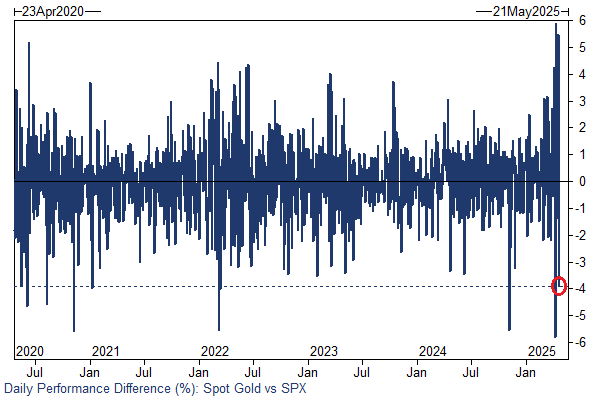
With regard to price action, spot performance versus S&P was at one of its widest measures in the past 5 years..

The ETF slam goes to show just how much easier it is to push the gold price around using paper instead of physical, but it also suggests that such bursts of selling may be limited. As Goldman notes, while gold ETF AUM is at highs, the amount of gold held by ETFs as an aggregate is below levels witnessed in 2020. Record AUM in GLD has been entirely a function of price appreciation versus subscriptions (even though inflows have been robust on the year).

Meanwhile, as regular readers are well aware, while occasional gold ETF liquidations are inevitable, the ETF sectors has a lot of catching up to do with the actual price, as shown in the next chart mapping aggregate ETF holdings vs spot price. As such, while liquidation days like yesterday (and today) are to be expected, it is inevitable that the ETF bid will eventually appear.

Finally, there was good news for gold bulls: while the overbought selloff – driven by ETF liquidations – in the last 2 days was remarkable and at 4% was one of the worst 2-day drops on record, physical demand out of China appeared like clockwork the moment China came online, and helped push gold about $40 higher in the span of minutes, and about $100 higher compared to this morning’s lows.

Expect much more of the same as China’s population increasingly allocates its net worth into the yellow metal as we discussed yesterday.

Tyler Durden
Wed, 04/23/2025 – 21:56

Waste Of The Day: NY Staircase Costs Almost $1 Million Per Step

Waste Of The Day: NY Staircase Costs Almost $1 Million Per Step

Authored by Jerremy Portnoy via RealClearInvestigations,

Topline: Every journey starts with a single step, but the cost of each step isn’t usually $935,000.

That’s how much New York State will spend to repair each of the 77 stairs leading up the grand entrance to the Capitol building in Albany after ignoring the maintenance for over a decade. The cost gradually rose from $17 million in 2014 to $72 million today.

Key facts: Inspectors closed off public access to the granite Eastern Approach staircase in 2014 after finding rusted steel supports and load-bearing bricks so loose they could be removed by hand, according to the New York Times. A study commissioned by then-Governor Andrew Cuomo estimated the repair bill at $17 million.

Cuomo never appropriated the money, except for $120,000 for urgent repairs in 2016. When Gov. Kathy Hochul finally set aside funding in 2022, the cost had risen to $41 million.

This February, New York State announced it had hired Louis C. Allegrone, Inc to repair the steps at a cost of $72 million. Only one other company submitted a bid, according to the New York Post, which also found internal documents showing the administration was at one point prepared to spend over $80 million on the stairs.

The Post was unable to learn why the cost more than quadrupled from the 2014 estimate. A spokesperson told the Post that “By law, we cannot comment further while the procurement process is ongoing.” Opinion writer Andrea Peyser noted, “I’m not aware of any statute that forbids overtaxed citizens from learning how public officials rob them blind.”

Office of General Services Commissioner Jeanette Moy later told the Albany Times Union that inflation, rising construction costs and worsening deterioration were all factors in the cost increase.

In reality, the deferred maintenance on the Eastern Approach stretches back even further than 2014. The New York Sun ran an article in 1924 claiming the staircase was nearing “complete ruin” and estimated repairs would cost $1 million, according to the New York Times.

Search all federal, state and local government salaries and vendor spending with the AI search bot, Benjamin, at OpenTheBooks.com

Background: Oddly enough, this isn’t the only luxury staircase New Yorkers have funded recently. New York City shelled out $30 million for a 28-step staircase at Times Square 42nd Street subway station in 2022.

Summary: Given New York’s penchant for spending, it’s fitting that lawmakers will be unable to walk into the Capitol building without stepping on taxpayers’ wallets.

The #WasteOfTheDay is brought to you by the forensic auditors at OpenTheBooks.com

Tyler Durden
Wed, 04/23/2025 – 20:55

Iraqis Outraged By Visit Of Syrian Leader Jolani Over al-Qaeda Past

Iraqis Outraged By Visit Of Syrian Leader Jolani Over al-Qaeda Past

Via Middle East Eye

Safaa Rashid was barely an adult in 2005 when an explosion ripped through the Iraqi capital Baghdad, killing his 21-year-old cousin, a university student who was working part-time at an electrical goods shop in the city’s center. “A suicide bomber stormed the market and detonated his explosive belt, killing my cousin and dozens of innocent people in an instant,” said Rashid, now 38 and still living in Baghdad. “He was just at the beginning of his life.”

Safaa lost two other cousins that same year in blasts that were attributed to al-Qaeda in Iraq (AQI), the armed group that would evolve into ISI, the Islamic State in Iraq (later just Islamic State), and is responsible for tens of thousands of deaths in Iraq and abroad.

Syria’s self-declared interim President Ahmed al-Sharaa (Jolani), via AFP.

One of those who joined AQI’s campaign at the time was a young Syrian named Ahmed al-Sharaa, who later would reappear in his homeland under the name Abu Mohammed al-Jolani and last year successfully overthrew President Bashar al-Assad to become Syria’s new ruler.

Although Sharaa has since disavowed his time in al-Qaeda [in terms of public rhetoric at least], his possible presence at an Arab League summit in Baghdad next month has provoked outrage from victims of AQI and its successors, as well as dozens of MPs who are trying to prevent his attendance. “Jolani is the face of terrorism,” said Rashid.

“He must be held accountable – I lost three cousins to his group’s violence…how can someone like this be welcomed as if he were an honoured guest?”

‘Premature’ meeting?

Iraqi Prime Minister Mohammed Shia al-Sudani said last week that he had formally invited Sharaa to attend the upcoming summit, which is scheduled to be held in Baghdad on May 17. The two also met in Qatar last week for the first time since the overthrow of Assad.

Although the Iraqi government had been one of the few in the region to continuously maintain relations with Sharaa’s predecessor, Iraq like many other Arab states appears to be trying to integrate post-Assad Syria diplomatically, possibly hoping to end the instability unleashed by the country’s 13-year war.

But the extension of the invitation has outraged many. Iraqi media reported that at least 50 MPs from Asaib Ahl al-Haq and Kataib Hezbollah – two Iran-backed armed political factions that provided military support to Assad against Sharaa and other Syrian opposition groups – have filed criminal complaints in Iraqi courts against the Syrian president.

Iraq’s Supreme Judicial Council has yet to take any official action and previously issued a statement saying that several complaint documents circulating on social media were fake and invalid.

Nevertheless, it has led Asaib Ahl al-Haq’s leader, Qais al-Khazali, to brand Sharaa’s invite “premature”, warning there could be a diplomatic incident between the “brotherly nations” should he be arrested. “In light of this, and in accordance with the principle of separation of powers, the decisions of the Iraqi judiciary must be adhered to and respected by all,” he wrote on X.

Abu Ali al-Askari, a senior Kataib Hezbollah figure, meanwhile described Sharaa as a “convict”.

Change of attitude

Sharaa travelled from Damascus to Baghdad in 2003 to join al-Qaeda shortly before the US-led invasion that toppled President Saddam Hussein. Though he has denied being close to the group’s leader Abu Musab al-Zarqawi, other outlets have claimed he quickly rose through the ranks to a senior position.

During the insurgency against US-led forces in Iraq, AQI was responsible for numerous sectarian atrocities across the country, triggered by the group bombing al-Askari Shrine in Samarra on 22 February 2006.

Zarqawi had earlier declared all-out war on Iraqi Shias, “wherever they are in Iraq”. Sharaa has argued his time in AQI was more about gaining fighting experience and defending Iraqis than building a caliphate or imposing al-Qaeda’s harsh variant of Islamic law.

“There was a massive Arab and Islamic response to the American intervention,” he told The Rest Is Politics podcast. He added that during his time in a range of US-run facilities, including the notorious Abu Ghraib prison, his attitude towards the conflict changed and he began to fall out with other al-Qaeda members over their support for overt sectarianism.

Iraqi Telegram accounts linked to pro-Iran groups have posted documents they say further implicate Sharaa in AQI’s actions, though they also suggested Sharaa was released from an Iraqi prison for lack of evidence.

The Islamic Dawa Party, which held the prime ministership during the bulk of the AQI and ISI insurgency, also warned against inviting Sharaa to Iraq. Though they did not mention the prime minister by name, they said that anyone invited to the Arab League conference should have a “spotless” legal record both at home and abroad.

In a statement on Sunday, they also drew comparisons with Israeli Prime Minister Benjamin Netanyahu and the outstanding arrest warrant issued against him by the International Criminal Court over the war in Gaza.

“The same should be done in Iraq towards those who have committed heinous crimes against its people, whatever the excuses, out of respect for Iraqi blood and in loyalty to the martyrs who gave their lives for the nation’s dignity and honour,” said the party.

‘A significant step’

Although many of Syria’s neighbours have tried to rebuild links with the country following Assad’s defeat, much of the international community has continued to be wary, not least after the recent outbreak of sectarian violence on the country’s west coast.

The violence in Latakia, which erupted after attacks by Assad loyalists on pro-government forces, has seen widespread killings of hundreds of members of the Alawi religious minority by armed groups. Sharaa condemned the killings and has sought to calm tensions through dialogue, but the attacks have again raised the spectre of sectarian violence and drawn parallels with the Sunni-Shia bloodshed that devastated Iraq in the mid-2000s.

Not everyone has opposed diplomatic meetings with Sharaa. A number of MPs have emphasised the need for dialogue between the two countries after decades of violence.

Khamis al-Khanjar, an MP and head of the Azem Alliance, welcomed the meeting in Qatar between Sudani and Sharaa. “This meeting represents a significant step toward enhancing Arab cooperation and promoting the principles of dialogue and joint action to address current challenges, rebuild bridges of trust and integration among our peoples, and serve the security and stability of our region,” he wrote on social media.

But with the pain of decades of bloodshed still fresh in the mind of many in Iraq, and with AQI’s descendents still wreaking havoc in parts of the country, the visit is likely to trigger further outcry.

“Inviting Sharaa to visit Baghdad just returned painful memories for victims’ families,” said Rashid. “Many of whom are still waiting for justice nearly two decades after the worst years and al-Qaeda attacks post-2003.”

Tyler Durden
Wed, 04/23/2025 – 20:05

Xiaomi To Delay First SUV Release After Fatal Accident

Xiaomi To Delay First SUV Release After Fatal Accident

Xiaomi has postponed the launch of its first electric SUV, the YU7, following a fatal accident involving its flagship EV—a setback in its high-stakes bid to challenge Tesla and BYD, according to Bloomberg.

Originally set to debut in June or July, the YU7’s release has been quietly shelved with no new date confirmed, according to sources familiar with the matter. The company also canceled plans to unveil the SUV at this week’s Shanghai auto show and pushed its investor day to June from late April.

The delay complicates Xiaomi’s $10 billion electric vehicle gamble, which Chairman Lei Jun has called his final startup venture. With just one EV on the road so far, breaking into the SUV segment was seen as a critical step in scaling its presence in China’s fiercely competitive auto market.

Xiaomi declined to comment, though a Weibo post after Bloomberg’s report insisted the original June-July timeline “remains unchanged.”

Bloomberg writes this morning that the crash has triggered a police investigation and intensified scrutiny of the company’s EV technology. Three women died in the high-speed accident.

The incident sparked widespread debate over Xiaomi’s assisted-driving features, battery safety, and overall vehicle reliability. In response, Chinese regulators have summoned over a dozen automakers to tighten rules around autonomous-driving systems.

“The problem with the way self-driving features have been sold is it’s caused people to think that they can be less attentive to the way the car is actually performing,” said Bill Russo, CEO of Automobility Ltd., at the Shanghai auto show. “You still need to monitor the car. I think that’s what we’re going to hear more of — regulators trying to step in to make sure we’re not calling it autopilot or full self-driving.”

Despite EVs being central to Xiaomi’s future—especially as its smartphone business faces headwinds—the company’s stock has slid over 20% since mid-March. This comes even after Xiaomi raised its 2025 EV delivery target to 350,000 vehicles following its fastest revenue growth since 2021.

Tyler Durden
Wed, 04/23/2025 – 19:40

It Appears That Mass Deportations Of The Elderly Are Not Being Considered

It Appears That Mass Deportations Of The Elderly Are Not Being Considered

Authored by Jonathan Turley,

With all of the coverage yesterday of the heated arguments in Mahmoud v. Taylor, one order of the Court was likely overlooked. It appears that elderly Americans will not be deported as Alien Elderly Americans. At the request of the A.A.R.P., the Court agreed to change the name of A.A.R.P. v. Trump to W.M.M. v. Trump

The case is a pending class action lawsuit seeking the protection of alleged Venezuelan gang members facing deportation under the Alien Enemies Act.

The original captioning was a pseudonym used by one of the parties. That did not go over well with the organization.

“Unsurprisingly, this litigation has already received attention from the press and social media. It will surely continue to do so. AARP is concerned that the nomenclature adopted by the caption of this case will create substantial confusion among journalists and the public. Indeed, in the 72 hours since the litigation was filed, it has already resulted in numerous misplaced inquiries to AARP. Both the ACLU and AARP are prominent advocacy organizations on federal policies, albeit in very different domains.”

While many retirees are moving to El Salvador and other countries in the area, the original captioning suggested a more involuntary relocation. 

With a court composed of AARP-qualified members (Barrett and Jackson are in their 50s but still can join), the Supreme Court decided to remove any question that this was a case about deportations under some mysterious Alien Elderly Act (AEA):

The AARP, a nonprofit entirely unrelated to this case, seek leave to intervene to request that the petitioner A.A.R.P.’s pseudonym be changed to A.R.P. and that the case caption be styled as W.M.M., et al. v. Donald J. Trump, et. al. The petitioners and the respondents do not oppose the AARP’s motion….

The Court construes the motion to intervene as an agreement by the existing parties to amend the styling of the case caption. Accordingly, the Court amends its prior order granting the motion to proceed under pseudonyms and orders that the petitioners are permitted to proceed under the pseudonyms A.R.P., W.M.M., and F.G.M. [not to be confused with FGM -EV]. In addition, the Court orders that this case will hereafter proceed under the case caption W.M.M., et al. v. Donald J. Trump, et. al.

The change should come as a relief given the claims on the left that Trump is planning to “disappear” journalists, homosexuals, and members of Congress. 

Just last week, MSNBC host Symone Sanders-Townsend declared:

“To be very clear, it’s going to be the people of color, and vulnerable communities that are next in line.”

That apparently will not include the elderly, including the justices themselves who will be allowed to remain to rule in what is now W.M.M. v. Trump. 

However, Women Moving Millions (WMM) may not want to make any long-term plans.

Tyler Durden
Wed, 04/23/2025 – 19:15

Palestinian Authority’s Abbas Calls Hamas ‘Sons Of Dogs’ & Demands Release Of Hostages In Fiery Speech

Palestinian Authority’s Abbas Calls Hamas ‘Sons Of Dogs’ & Demands Release Of Hostages In Fiery Speech

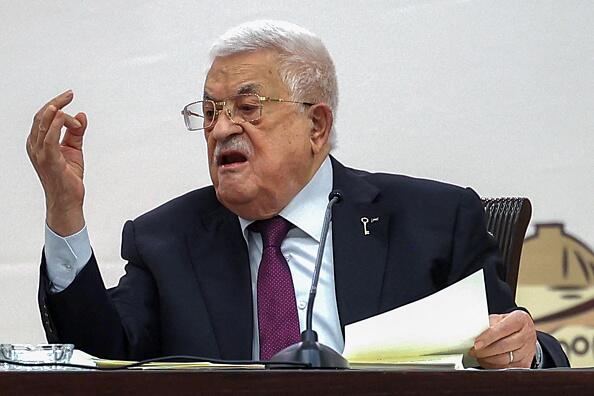
Political fractures on the Palestinian side have become more and more public as the Gaza war persists. On Wednesday Palestinian Authority (PA) President Mahmoud Abbas issued a strong declaration demanding that Hamas release all remaining Israeli captives in order to prevent Israel from using “an excuse” to continue destroying Palestinian homes and waging war in the Gaza Strip.

In the unexpected statement, Abbas went so far as to call Hamas militants “sons of dogs”. He said while chairing a Palestinian Liberation Organization (PLO) Central Council meeting in the West Bank city of Ramallah, “You sons of dogs, hand over what you have and get us out of this. Don’t give Israel an excuse. Don’t give them an excuse.”

AFP/Getty

Every day there are hundreds of deaths. Why? They don’t want to hand over the US hostage,” Abbas said, as cited in regional media. This was in reference to US-Israeli captive Adi Alexander. His family has been imploring President Trump to help gain his release. Alexander was born and raised in New Jersey.

Abbas highlighted that Israel sees itself as justified in erasing Palestinian identity so long as the hostage crisis continues. Fifty-nine hostages, living and dead, remain in the Gaza Strip. Abbas urged Hamas to hand over the hostages in order to “be done with it.

However, Prime Minister Netanyahu and his military leaders have vowed to purse the complete destruction of Hamas. So likely the US-designated terror group believes that if it frees all remaining hostages, the Israeli military will then even more relentlessly seek its total defeat. Israel has vowed to never let Hamas return to governance or power over the Strip.

The BBC commented on 89-year old Abbas’ statement:

The remarks were the strongest against the group that the president has delivered since the war began 18 months ago.

A Hamas official condemned what he called Abbas’s “derogatory language” towards “a significant proportion… of his own people”.

The aforementioned Hamas representative added, “Abbas repeatedly and suspiciously lays the blame for the crimes of the occupation and its ongoing aggression on our people.”

The West Bank leader’s provocative words received some pushback from within Abbas’ own political camp, and among other West Bank officials. “The victim cannot be held responsible for the crimes of the occupation. Today, we face the threat of a new catastrophe that may be more horrific than the 1948 Nakba,” Secretary-General of the Palestinian National Initiative, Mustafa Barghouti, told Al Araby TV.

This PA vs. Hamas back-and-forth highlights that the two groups have long been rivals and political enemies. While there are occasional statements of ‘solidarity’ issued between both, much of the history of their interaction has been marred by political fighting, which has at times in past years spilled over into gunfights in the streets.

The PA, which has always been more secular-leaning and filled with Left-wing officials, is seen as weak and ineffectual by the Sunni hardliners in Hamas. It was Fatah, which makes up the core of the PA, which led resistance to Israeli policy for decades prior to Hamas gaining full power over the Gaza Strip.

While anti-Israeli terrorism of the latter half of the 20th century was dominated by Marxist guerrillas, such as the Popular Front for the Liberation of Palestine (PFLP), recent decades have seen the rise of the Islamists.

The founder of the PFLP, which became infamous for hijacking airplanes throughout the 60s, 70s, and 80s, was George Habash – born to a Christian Palestinian family. He was even given an Orthodox Christian funeral in Amman, Jordan upon his death from natural causes in January 2008.

The founder of the PFLP George Habash was given a Christian funeral at an Orthodox Christian cathedral in Amman. This highlights that prior to the rise of Hamas, Palestinian militants tended to be secular, Left-leaning, and from diverse religious backgrounds. 

The PA (PLO/Fatah) continues to even have Christian officials in its ranks, while Hamas is purely Sunni and often threatens the remaining Palestinian Christians in Gaza.

The whole rivalry is a further reminder that Western officials and populations often approach the Palestine-Israel conflict in an overly simplistic manner. They tend to assume the Palestinians have a singular worldview and politics. Similarly, Israeli politics are also often deeply divided, revealing deeper complexities.

Tyler Durden
Wed, 04/23/2025 – 18:50

NIH Director Gives Update On New Project To Find Causes Of Autism

NIH Director Gives Update On New Project To Find Causes Of Autism

Authored by Zachary Stieber via The Epoch Times,

The director of the National Institutes of Health (NIH) said on April 22 that the new project to identify the causes of autism will likely involve patient records and outside researchers.

“We’d like to … get access to the medical records of a large portion of the American population,” Dr. Jay Bhattacharya, the NIH’s director, told reporters in Washington. 

“I think to answer a question like this—why is autism rising—you need very large samples of people.”

He also said, “Medical records, I believe, should be a very important part of this, because that’s maybe the best way to track the link between exposures and then what happens afterwards.”

The project could draw data from the Centers for Medicare and Medicaid as well as other parts of the government, such as the military, Bhattacharya said. Patient data would be deanonymized to protect privacy, according to the NIH director.

Bhattacharya had said during an NIH meeting on Monday that the NIH’s data platform would pull data from pharmacy chains, medical claims, federal partnerships, and health organizations.

Health Secretary Robert F. Kennedy Jr. told President Donald Trump earlier in April that health officials had launched a “massive testing and research effort” that would determine what caused the spike in autism. A Centers for Disease Control and Prevention report released on April 15 showed the rate of autism is up to one in 31 children in America. Autism is a developmental disability that can cause an array of symptoms, including delays in learning skills and epilepsy.

Kennedy told a recent briefing that the rise in autism is attributable to environmental factors, as opposed to genetics or better screening. He said studies would examine possible culprits such as mold and air pollution.

Bhattacharya said that the budget for the project, which will be run out of his office, is not finalized yet but will be in the order of tens of millions of dollars.

The process for picking researchers to be involved will be the normal process, with researchers offering proposals, NIH centers evaluating the proposals, and peer reviewers deciding which projects will be approved.

“I don’t know the exact details [of] what that will look like, but the goal is to use the normal way we do science at the NIH to answer a question that the NIH normally has not sought to answer,” Bhattacharya said.

Bhattacharya said at an unrelated briefing earlier on Tuesday that the reason autism is rising is a question “that is at the front of the minds of so many parents across the country worried about their kids, and yet scientific progress on this has been slow because scientists are frankly scared to ask the question.” 

He said that the NIH “is going to make it so that those questions are no longer taboo among scientists.”

Kennedy has said that vaccines may be one of the causes of autism.

Bhattacharya said during his confirmation hearing that he did not think there was a link between autism and vaccines, based on his reading of the literature, although he said he would support investigating the spike in autism.

Some autism organizations said in a joint statement on April 17 that “vaccines do not cause autism.” 

The Autistic Self Advocacy Network, one of the groups, said in a statement that “it is simply impossible that actual research into a supposed environmental cause of autism could be completed by September–real science does not move that quickly.”

Kennedy had told the president that “by September, we will know what has caused the autism epidemic,” but Bhattacharya said the project will take longer than that.

Bhattacharya said that the plan is to issue a call for proposals by September. Scientists will then respond to the call, and grants will be approved.

“I would like to have a timeline within a year, where they would start to put out the preliminary results,” he said. 

He added later: “Secretary Kennedy is enthusiastic to get the scientific process going, and I am too, so … he’s accurately communicating that we want to get moving on this as rapidly as we can.”

Tyler Durden
Wed, 04/23/2025 – 18:25

Trump To Exempt US Carmakers From Some Tariffs: Report

Trump To Exempt US Carmakers From Some Tariffs: Report

Exactly two weeks after Trump delayed tariffs on most non-China countries by 90 days, and a week after the president exempt most Chinese consumer electronics exports from US duties, the FT reports that Trump is set to spare carmakers from some of his most onerous tariffs following intense lobbying by industry executives over recent weeks.

The move would exempt car parts from the tariffs that Trump is imposing on imports from China to counter fentanyl production, as well from those levied on steel and aluminium, a move which FT sources described as a “destacking” of the duties.

The exemptions would leave in place the 25% tariff Trump imposed on all imports of foreign-made cars. A separate 25% levy on parts would also remain and is due to take effect from May 3.

Although Washington has already shielded autos from the “reciprocal” tariffs announced on major trading partners, US auto companies have in recent weeks pushed for further exemptions. The concessions would mark an initial win for the auto sector and another retreat by Trump on his most aggressive tariffs amid concerns that they would push up US car prices, disrupt supply chains and cause job losses.

Over the past week, car executives had stepped up their criticism of the tariffs with Stellantis chair John Elkann warning that “American and European car industries are being put at risk” by Trump’s trade policy. Another senior automotive executive said: “we’ve urged the administration – don’t hit us over and over with all of these other tariffs . . . because that really jeopardises the health of our sector.”

The reprieve is also the latest sign Trump is open to offering carve-outs to favored industries.

Trump announced bespoke “reciprocal” tariffs of up to 50% on almost every US trading partner on “liberation day” on April 2, before later lowering the levies to a 10% baseline for 90 days, following a surge in market volatility.

Last week, the administration said it would exempt consumer electronics such as laptops and smartphones from the reciprocal tariffs but would instead potentially hit those imports with other levies later this year.

The president also signaled last week that there would be “help” for the auto industry, and earlier offered better terms for imports of cars made in Mexico and Canada as long as companies complied with the rules of the 2020 USMCA trade agreement.

Complete vehicles and parts that comply with the terms of the USMCA will have the 25% tariff applied only to their non-US content.

According to the FT sources, current negotiations are mainly focused on making it easier to implement the levies – for example, by simplifying rules over where the car components are sourced.

The FT report briefly pushed GM and Ford stock higher, but the move has since fizzled.

Tyler Durden
Wed, 04/23/2025 – 18:00