62.8 F
Chicago
Monday, September 21, 2026
Home Blog Page 1570

Stocks Soar, Reverse All Of Yesterday’s Losses On Bessent China Comments, Short Squeeze

Stocks Soar, Reverse All Of Yesterday’s Losses On Bessent China Comments, Short Squeeze

US equity markets were already ramping higher, as yesterday’s massive short pile up reversed and transformed into a squeeze (and force out of underexposed systematic funds), when an 11:58am ET headlines from Bloomberg, suggesting…  well… the obvious, namely that the trade war with China is unsustianable in the long run according to Bessent…

  • *BESSENT SEES DE-ESCALATION WITH CHINA, SITUATION UNSUSTAINABLE

… sent the US equities to session highs, up 3%…

…and reversing all of yesterday losses…

Started with a major short-squeeze…

The broad risk on move has sent the dollar higher, hitting the yen and euro, and pushing the USDJPY well above 141 (after sliding below 140 overnight) and the EURUSD has pushed to session lows, down 0.5%, while the US 10y yield is near its richest levels of the day, down 3bp. Gold is also sliding and was below $3400 after hitting a record high $3500 just a few hours earlier.

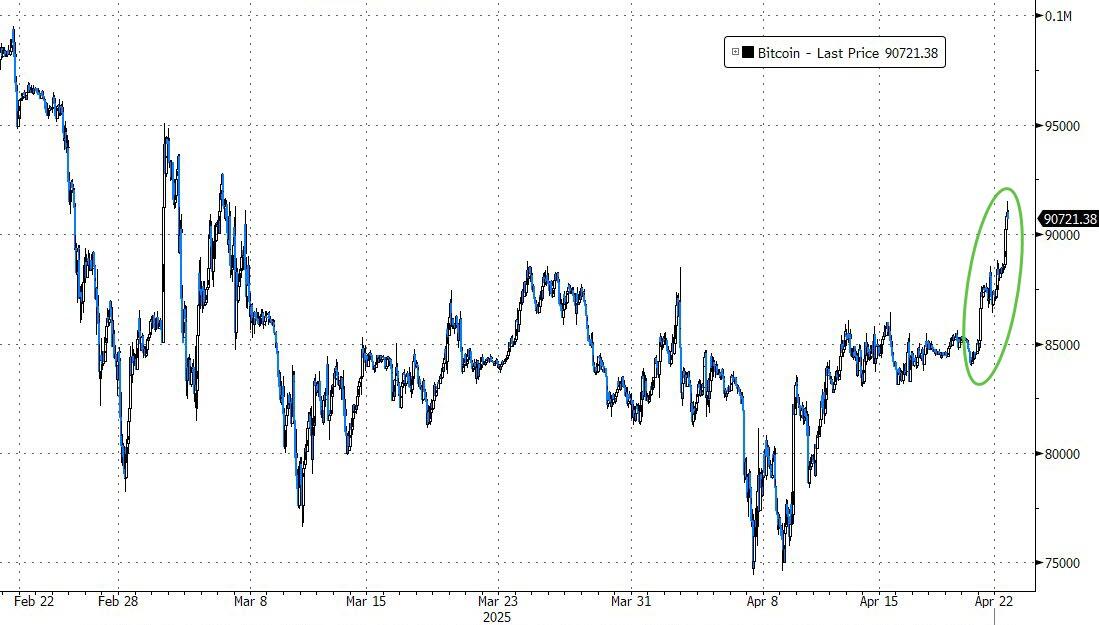
While gold is sliding, bitcoin topped $91,000…

Today’s rally is already shaping up as the biggest since Trump’s tariff pivot on April 9. According to UBS S&T, money is flowing back into High Momentum {UBQQHMTM}, up 3.5%, with groups like M&A Banks {UBXXMABK}, up 2.8%, and AI Power {UBXXVOLT}, up 3.4%, benefitting. Some more notable flows:

  • A risk-on rotation is visible in Volatility {UBPTVOL}, up +2.5%, versus Quality {UBPTQLTY}, down 1.4%. Lower quality pockets are bouncing back most forcefully with De-SPACs {UBXXDSPC} up 3.5%, and Low Quality Credit {UBXXCRED} up 3%.

  • Tariff Losers {UBXXTTL}, up 2.8% stabilise, note the basket outperformed meaningfully during Monday’s selloff in a sign of washed out positioning.

  • Defence Primes {UBXXPRME} are down 3%, though note about two-thirds of the move is driven by Northrop after disappointing earnings.

Another reason for today’s meltup is the reversal of yesterday’s meltdown, as panicked systematic funds scramble to buy. According to Goldman’s Cullen Morgan, the systematic macro rebalance has effectively been completed, with global equity length going from approximately an 8 out of 10 during the YTD/February highs to a 1 out of 10 currently, of $53bn and representing a short position from CTA/trend followers and 1-yr low lengths from risk parity style + VA vol-control products. 

As a result, Goldman now has CTAs as modeled buyers in every scenario over the next week and month.


Tyler Durden
Tue, 04/22/2025 – 12:42

Supreme Court Hears Major Parental Rights Case Over LGBT Readings

Supreme Court Hears Major Parental Rights Case Over LGBT Readings

Authored by Jonathan Turley,

Today, the Supreme Court will hear oral arguments on a major parental rights case in Mahmoud v. Taylor, a challenge to Montgomery County (Md.) requiring their children to participate in instruction that includes LGBTQ+ themes. It is a case that could produce sweeping changes across the county as parents object to the use of public schools to advance social and political agendas. These books are being required for children 3-10 years old. The parents have the stronger argument in my view. A ruling in their favor could prove one of the most important victories for parental rights in decades.

Parents objected in Maryland in 2022 when the county approved books featuring LGBTQ+ characters for inclusion in its language-arts curriculum. The county then announced that it would not allow parents to opt to have their children excused from instruction involving the storybooks.

Various parents sued, including some citing their Muslim, Catholic, and Ukrainian Orthodox beliefs. They lost in the lower courts, including the United States Court of Appeals for the Fourth Circuit.

The parents cited Wisconsin v. Yoder, where the Court declared that it was “recognized ‘beyond debate’ the First Amendment right of parents ‘to guide the religious future and education of their children.’” In that case, the court held that Amish parents did not have to send their children to school after the eighth grade because it conflicted with their religion.

They also argue that the Maryland policy is neither neutral nor generally applicable as required under Church of Lukumi Babalu Aye v. City of Hialeah. That could produce the greatest number of questions from the justices today. The parents argued that the county has long allowed notice and opt-outs for material and instruction that address family life and sexuality. However, it refused to do so here.

The parents alleged religious hostility in comments made against the challengers.  They raise the question of why such children cannot be allowed alternative reading options.

The Montgomery County Board of Education is arguing a narrower view of the free exercise clause and that public education requires a uniform curriculum, including recognition of our society’s diversity. They insist that allowing some to opt out would present an overwhelming burden on the schools.

A decision for the parents could significantly change public schools’ handling of such controversial materials. I have previously written about how administrators and teacher unions are destroying public education by elevating agendas over academics.

Teachers and boards are killing the institution of public education by treating children and parents more like captives than consumers. They are force-feeding social and political priorities, including passes for engaging in approved protests.

As public schools continue to produce abysmal scores, particularly for minority students, board and union officials have called for lowering or suspending proficiency standards or declared meritocracy to be a form of “white supremacy.” Gifted and talented programs are being eliminated in the name of “equity.”

Once parents have a choice, these teachers lose a virtual monopoly over many families. 

They are no longer a captive audience. If public unions want to maintain funding, they will have to actually improve educational results for these families.

Notably, figures like American Federation of Teachers president Randi Weingarten have opposed the elimination of the Department of Education because it might help voucher schools and other alternatives to public education.

In a podcast, Weingarten explained, “We know, for example, what Texas would do. They’ll use it for vouchers. So they won’t give [federal funding] to the kids who have it now, they’ll just give it for vouchers.”

There is reason for Weingarten and the teacher’s union being so concerned. Florida allows for school choice and has demanded greater performance from public schools. Despite attacks by Weingarten and other Democrats, Florida has been ranked as the number one state for both education and the economy.

However, public educators have continued to lower proficiency requirements and cancel gifted programs to “even the playing field.” The result has been to further hide the dismal scores and educational standards of many public school districts.

There is an irony in the position before the Supreme Court by public educators. A reversal may be a critical change in slowing the departure of families from public schools. One of the families discussed in this case sold their house to afford private schooling for their children.

By limiting such mandatory programs, some families may be less likely to seek alternatives to public schools. These families want to send their children to public schools while retaining their role in instilling religious values for their children. Montgomery County is forcing a choice that few parents will make against their family values.

As on earlier controversies over parental rights, Democrats will find that this is not partisan;  it is primal for parents.

Tyler Durden
Tue, 04/22/2025 – 12:40

Massive ‘Mystery Explosions’ Rock Ammo Depot Outside Moscow, Resulting In Mushroom Cloud

Massive ‘Mystery Explosions’ Rock Ammo Depot Outside Moscow, Resulting In Mushroom Cloud

A ‘mystery explosion’ has rocked a munitions depot in Russia’s Kirzhach district (Vladimir region) outside of Moscow on Wednesday, resulting in a state of emergency being declared for the area, and large-scale evacuations from nearby villages, as emergency crews scramble to the scene.

Widely circulating social media videos show a sizeable mushroom cloud over the area, with an early casualty assessment ongoing. “Massive explosions have been reported on Tuesday near the town of Kirzhach in Russia’s Vladimir Region, some 75 km northeast of Moscow,” reports Russian state media. One dramatic video showed the following:

“The blasts are said to have taken place at a munitions depot. Local authorities have announced a state of emergency in the district and blocked the roads leading to the area,” RT writes.

The explosions happened at around 3:30pm local time, and eyewitness reported a series of explosions – the aftermath which could be viewed from several miles away.

“A temporary accommodation center which has been established in a local school has already received about 100 people, including children and elderly citizens, a representative of the facility has told TASS,” the Russian English-language media report continues.

The facility also reportedly stores missiles for the Russian armed forces. This is not the first time a mysterious ‘accident’ has befallen the site, since the Ukraine war started. 

Below is the initial report from The Wall Street Journal’s Chief Foreign Affairs correspondent…

Immediate suspicion is likely to fall on Ukrainian intelligence services and their CIA backers, given this fits the familiar pattern of sabotage operations which have been semi-regular over the past couple years.

Russia’s Deputy Defense Minister Andrey Bulyga is being dispatched to the scene to oversee an investigation into the causes of the event, and to assess casualties and damage.

There have been a spate of mystery fires inside Russia, particularly targeting defense and energy sector buildings. To some extent, both Ukrainian and Russian intelligence services are likely waging intensified sabotage campaigns against the other at this point.

Last year, Anne Keast-Butler, head of the UK’s GCHQ, or signals intelligence operations (which is the equivalent of America’s NSA), warned in a speech that President Putin was plotting “physical attacks” against Western targets.

The GCHQ director claimed at the time that Moscow is busy “nurturing and inspiring” groups of cyber attackers, and is even “in some cases seemingly coordinating physical attacks against the West.”

In many cases Russian authorities have downplayed these incidents, often choosing to describe them as the result of industrial accidents; however these ‘accidents’ have come in unusually high numbers in recent years amid war in Ukraine…

Last year, an Ikea in Lithuania’s capital went up in flames, and authorities just last month pinned it on Russian intelligence or saboteurs after a lengthy investigation. The fire, which targeted the Swedish retailer store in Vilnius on the May 9, 2024, resulted in no casualties. Interestingly, the two prime suspects taken into custody were actually Ukrainian citizens.

Ammo has continued to shoot off into surrounding villages and neighborhoods Wednesday afternoon and evening…

“It has been established that through a series of intermediaries… the organizers of these crimes are in Russia and this is connected to military intelligence and security forces,” the Lithuanian prosecutor’s office said, describing a ‘destabilization’ campaign in Europe.

Tyler Durden
Tue, 04/22/2025 – 12:20

Robotaxis, Margins And Musk’s Moonlighting: Tesla Q1 Earnings And “Company Update” Preview

Robotaxis, Margins And Musk’s Moonlighting: Tesla Q1 Earnings And “Company Update” Preview

Tesla has set its Q1 2025 earnings call for today at 5:30PM eastern time. The event will be livestreamed, with a recording available later on Tesla’s website. The Q1 Update Letter will be released after markets close that same day. This quarter, as multiple Tesla blogs like Teslarati have pointed out, Tesla is also adding a new element: a “Company Update.”

For the first time, the term appeared in both its vehicle delivery report and on the company’s official X account. “In addition to posting first quarter results, Tesla management will hold a live company update and question and answer webcast that day,” the company stated.

Speculation is growing that Tesla may use the update to reveal more about its upcoming projects, particularly the affordable EVs teased in its Q4 2024 report: “Plans for new vehicles, including more affordable models, remain on track for start of production in the first half of 2025…”

Tesla’s Q1 2025 earnings are expected to show a 4.4% decline in profit to $0.43 per share, with revenue holding steady at $21.45 billion, according to FactSet. Analyst estimates range from $0.30 to $0.51 per share, but consensus has dropped over 40% since late 2024. Piper Sandler warned the results will “likely underwhelm,” with margins “probably trending near multiyear lows.”

At the start of April, Tesla reported 330,000 vehicle deliveries in the first quarter, missing Goldman, JPM, Morgan Stanley, and UBS’ estimates of between 351,000 and 375,000. 

Tesla shares have been halved since their record high on Dec. 17.

This morning on CNBC the question was whether or not the name was too oversold in the short term. Dan Levy, Barclays senior equity research analyst, on what he’s watching for in Tesla’s Q1 earnings told Joe Kernen: “We’re looking for the potential for Elon Musk to be a bit more reengaged with Tesla — the opportunity to reiterate the FSD driverless event in June. This outweighs some of the fundamental factors that we expect for a weaker earnings result itself.”

Levy sounded a cautious tone ahead of Tesla’s Q1 earnings report, pointing to deeper structural concerns beneath the surface. He noted that the company’s dismal start to the year has effectively set the tone for the rest of 2025. “We had such a weak first quarter… there’s going to be a weak setup for the second quarter as well. It’s just too steep a hill to climb.”

There’s five more things in particular investors will be looking for in this upcoming report and/or update, IBD noted this weekend.

Robotaxis And Affordable EVs

Investor focus is shifting to Tesla’s promised robotaxi rollout. Musk has said paid rides would begin in Austin this June, but his past claims about autonomy have repeatedly fallen short. The latest FSD update shows modest progress, but it’s still far from viable as a robotaxi platform. The Cybercab—unveiled last year as a two-seater without a steering wheel—is supposed to launch before 2027 at under $30,000.

However, Reuters recently reported that Trump’s 145% tariff on Chinese goods has halted key parts shipments, possibly delaying both the Cybercab and Semi. The Cybercab’s cost-saving “unboxed” manufacturing method also remains unproven.

We reported hours ago that aerial images of Tesla’s Texas Gigafactory hinted at cybercab production. 

Joe Tegtmeyer, a certified flight instructor, snapped high-resolution aerial images of the Tesla Giga Texas earlier today, which revealed what could be castings of the new Cybercab vehicle. “Interesting developments next to the Giga Texas Casting Machine section today … several new kinds of castings that do not look like Model Y or @cybertruck … looking for experts out there to identify these in the comments!” Tegtmeyer wrote on X. 

Tegtmeyer noted, “Also, what looks like more Giga Press parts being delivered today.” 

Tesla’s long-teased affordable EV: Reports suggest the first lower-cost option may just be a simplified Model Y, possibly arriving in 2025 or 2026. “The affordable model, which was supposed to be planned for the second half and which was supposed to be an opportunity for volume — that’s going to be delayed by at least several months,” Levy explained on CNBC, emphasizing how this setback weakens one of the few credible near-term levers for expanding market share.

Vehicle sales for Q1 fell 13% year-over-year to 336,681. Growth is expected to stagnate this year, with consensus forecasting a modest 3% increase in deliveries, though some analysts now expect fewer sales than in 2024.

Tariffs And Tesla In China

China sales rose slightly but remain low-margin, while U.S. and European demand has been hit by Musk’s controversial public profile.

Tesla has quietly removed the “Order Now” button for its Model S and Model X vehicles on its Chinese website, signaling potential disruption amid a deepening US-China trade war. The move comes as Beijing announced a new round of retaliatory tariffs early Friday, raising the effective duty on U.S. imports from 84% to 125%

Both the Model S and Model X are manufactured in California, making them directly exposed to China’s tariff escalation—in other words, those vehicles would not be economically feasible to sell in a high-rate tariff regime overseas.

“The electric-car maker was offering the option to order the two models as of the end of March, according to a screenshot of its China website archived by Wayback Machine,” Bloomberg noted. 

The sudden suspension of ordering Model S/X should not come as a surprise, considering both are made in Fremont, California and then loaded up on RORO carriers to Beijing. The good news for Tesla: Model S/X were a tiny fraction of Tesla sales in China last year, coming in just under 2,000 units, compared with 661,820 for both the Model 3 and Model Y (both made at Shanghai Gigafactory).

While Tesla’s exposure to Trump’s tariffs is limited compared to other automakers, it still relies on Chinese suppliers for battery components, including CATL and BYD. Investors will be watching for updates on how Tesla plans to respond to trade tensions and cost pressures.

Musk’s Political Involvement

Musk’s political involvement is also on watch. He has been rumored to be finishing his work with DOGE by May and people are watching for a potential full-time return to Tesla. While acknowledging the reputational fallout, Levy cautioned against overstating its permanence. “There are all the questions on brand damage and where we are in the global EV market… It remains to be seen. But Tesla is still one of the only ones in the U.S. selling EVs profitably,” he noted. In other words, despite the noise, Tesla still maintains a structural edge in an otherwise unprofitable sector.

Less than 24 hours ago Wedbush analyst Dan Ives called a “code red” at Tesla, saying Musk needed to return to Tesla full time. “Musk needs to leave the government, take a major step back on DOGE, and get back to being CEO of Tesla full-time,” Ives penned in a note to clients on Sunday. 

“Tesla is Musk and Musk is Tesla….and anyone that thinks the brand damage Musk has inflicted is not a real thing, spend some time speaking to car buyers in the US, Europe, and Asia. You will think differently after those discussions.”

Two weeks ago, Ives, whose analyst rating on the stock remains “Buy” rated, slashed his price target to $315, down from $550. He explained, “Tesla has essentially become a political symbol globally, adding, “It is time for Musk to step up, read the room, and be a leader in this time of uncertainty.”

Ives concluded, “We view this as a fork in the road time: if Musk leaves the White House there will be permanent brand damage, but Tesla will have its most important asset and strategic thinker back as full time CEO,” adding, “If Musk chooses to stay with the Trump White House, it could change the future of Tesla/brand damage will grow.” 

IBD adds that a March YouGov/Yahoo News poll found 67% of U.S. adults wouldn’t consider a Tesla, with 37% citing Musk as the reason. Wedbush analyst Dan Ives, a longtime bull, cut his Tesla price target by 40%, calling the situation a “perfect storm” and estimating Tesla has lost at least 10% of its future customer base—potentially more than 20% in Europe.

Margins Under Pressure

Levy concluded that perhaps the most pressing issue is the company’s shrinking margins. He warned that this earnings call could bring further disappointment if profitability doesn’t show signs of stabilizing.

“Margins have been under pressure… If they give any color that shows that the margins are going to remain suppressed, that’s a problem,” Levy said. With automotive gross margins expected to hover around 10% — roughly a third of what they were three years ago — the real story may not be about deliveries or product announcements, but the company’s eroding pricing power and cost structure.

Analyst Sentiment Heading Into The Call

Over the past two weeks, analysts have issued a flurry of updated price targets on Tesla, reflecting a landscape of caution and recalibrated expectations. The only question is if they are low enough to make Q1 look good. 

  • Raymond James issued a fresh “Outperform” rating for Tesla on April 22, 2025, signaling optimism despite broader market hesitations, though they did not specify a new price target. Just one day earlier, Barclays cut its target from $325 to $275 while maintaining an “Equal Weight” rating. Analyst Dan Levy pointed to weak fundamentals, margin pressure, and growing brand concerns tied to Elon Musk’s political entanglements as key factors.
  • Wedbush’s Dan Ives, typically one of Tesla’s louder bulls, slashed his target from $550 to $315 on April 6. Though he kept an “Outperform” rating, he issued a warning that Musk’s political activism could do lasting damage to Tesla’s consumer perception and investor trust. Wells Fargo echoed this sentiment on April 21, setting a $130 target with an “Underweight” rating, citing poor demand trends and the risk of product-line cannibalization from a lower-cost model.
  • JPMorgan was even more pessimistic, cutting its price target to $120 while reiterating an “Underweight” stance. The firm admitted to underestimating the degree of consumer backlash facing Tesla and now sees continued downward pressure on both margins and sentiment. Deutsche Bank, while still bullish with a $345 target and a “Buy” rating as of late March, also revised down delivery expectations due to softening demand across global markets.
  • Exane BNP Paribas joined the bearish ranks, setting a $137 target on April 16 with an “Underperform” rating, reflecting growing skepticism over Tesla’s fundamentals and positioning. UBS dropped its target to $190 with a “Reduce” rating on April 10, citing new tariffs and predicting an 11% hit to Tesla’s 2025 delivery numbers.
  • Mizuho also trimmed its target, landing at $375, as it adjusted for anticipated price increases and flagging U.S. demand driven by tariff headwinds.
  • Lastly, Cantor Fitzgerald maintained a positive outlook with a newly issued “Overweight” rating on April 2, though it did not attach a numerical target to its bullish thesis.

Tyler Durden
Tue, 04/22/2025 – 12:00

Ker-Powell! To The Liberal World Order

Ker-Powell! To The Liberal World Order

Authored by Michael Every via Rabobank,

President Trump just landed another comic-book punch on Fed Chair Powell: 

“”Pre-emptive Cuts” in Interest Rates are being called for by many…. there can almost be no inflation, but there can be a SLOWING of the economy unless Mr. Too Late, a major loser, lowers interest rates, NOW. Europe has already “lowered” seven times. Powell has always been “Too late”, except when it came to the Election period when he lowered in order to help Sleepy Joe Biden, later Kamala, get elected. How did that work out?”

To be honest, Trump is saying many of the same things that many of those covering the Fed in markets are too – just far less politely; and very inappropriately in the eyes of those same commentators… because they are allowed to criticize an independent central bank and take market positions to bend it to their will, but politicians are obviously not. 

That’s part of the Liberal World Order (LWO).

And how did that work out?

Pope Francis died on Easter Monday, his last speech after having met US Vice President Vance having stated: “How much contempt is stirred up at times towards the vulnerable, the marginalised, and migrants. I appeal to all those in positions of political responsibility in our world not to yield to the logic of fear which only leads to isolation from others, but rather to use the resources available to help the needy, to fight hunger and to encourage initiatives that promote development.” President Trump will attend the funeral in Rome, expected by April 27, then the world has another key election to focus on.

That’s as Canada’s and Australia’s white smoke looms as both sweat about the end of the LWO. In Oz, ridiculously, it’s still all about housing. Just as silly, Politico asks ‘Could Canada join the EU? Unlikely … but not impossible’ –as if ‘European’ in European Union doesn’t mean anything, and the US would just watch that happen without acting vs. it– and as Canadian PM Carney says he wants to increase federal spending by 1% of GDP for the next four years to ‘Trump-proof’ the economy if he wins. As if that is possible either.

The chief of the World Economic Forum also just stood down with immediate effect – but there won’t be any election for his successor, just a search committee. That’s orderly, and perhaps worldly, but doesn’t seem very liberal.

Trump has posted about the justice system again, claiming there wasn’t any court action to stop population flows in one direction, but there is lots to stop it going the other way. We wait to see what the Supreme Court has to say about the Alien Enemies Act of 1798, but informed speculation is a ruling may say the government can deport people if it gives seven days’ notice.

Last week, the US Trade Representative released his final port fees for Chinese-built ships journeying to the US. We will publish a report on that later today but suffice to say while many players can avoid the worst of its impact, China can’t. On US-China trade war, it’s full steam ahead.

China is openly threatening repercussions for any country that strikes a trade deal with the US with negative implications for it, which any trade deal the US signs now must logically have. In short, it’s choose or be chosen time, as I’ve warned. So, what are *you* going to do? “Rate cuts?”

Underlining the sense of desperation evident in some intellectual circles, The Atlantic claims Hitler’s Terrible Tariffs “by seeking to “liberate” Germans from a globalized world order,…sent the national economy careening backwards”. The messaging is clear.

Yet that claim has no basis in historical fact: Hitler used lots of economic statecraft tools pre-WW2, but tariffs were not his primary vector.

Foreign Affairs, however, argues ‘The Global Trading System Was Already Broken… But There’s a Better Way to Fix It Than a Reckless Tariff Regime.’ 

Its suggestion is the US finds large like-minded economies who agree to run balanced trade together and builds a new system from there, rather than everyone shouting, “Because markets!” while ignoring their own and others’ mercantilism in a system that IS broken. 

Which some think *is* the US plan if you join the dots.

On which note, US Vice-President Vance was just invited to Indian PM Modi’s home; India placed a 12% tariff on Chinese steel; and the talk is of a “roadmap” to elevate US-India relations, making a mockery of the BRICS as an anti-US wall, and perhaps moving us closer to the foundation stone of a new global architecture. Indeed, it seems a race between India, Japan, and possibly Vietnam to strike the first deal with the US… and then face the wrath of China.

Conversely, French President Macron reportedly claims Europe is ready for the burden of the global reserve currency…. which in the current broken system means a much higher euro, a much larger trade deficit, much less industry and rearmament, and much more inequality. Unless Europe thinks it can have a global reserve currency while running balanced trade or trade surpluses… which sounds like the US plan everyone is now decrying, “because markets!”

I continue to argue Europe is in NO way ready, or willing, to take on that burden, and any market ‘favouritism’ towards the Euro is a gift it won’t want to accept once it sees the euro pro quo. Meanwhile, if Europe is the global future, why is the ECB and EU Commission so worried about the issuance and use of US dollar-backed stablecoins there? Capital flight?

Gold just hit another record nominal high at $3,445 before dipping slightly. While most are getting an eerie feeling about that, and some note US Treasury yields are rising as the US dollar is falling, muttering about Trump and “the end of US exceptionalism”, very few truly grasp that the global system, not just global trade, is collapsing – or being collapsed. That extends way beyond what we are seeing so far: and how well do you think smaller economies and powers will fare as it does vs. the US? Badly. In short, shorting the dollar comes up short when one thinks about it that way.  

Will the Spring IMF, World Bank, and G20 finance ministers’ meetings this week see a Mar-a-Lago Accord or just plain discord as everyone –including central banks– realises they won’t be singing from the same hymn sheet, or with the same singers, much longer? Recall the collapse of central bank coordination, centred on gold, was a pivotal factor in the end of two previous Liberal World Orders in the early- then mid-20th century. As was geopolitics…

…as Russian President Putin signed a 20-year Strategic Partnership Agreement with Iran: after no Ukraine ceasefire or peace deal, that looks like no ‘Noxin’ (reverse Nixon) win for Trump on that front either.

Meanwhile, the Pentagon looks in chaos, with the White House saying it’s trying to reject Secretary of Defence Hegseth, who still has Trump’s backing. Don’t think this isn’t related to Iran, and who wants jaw-jaw vs war-war –and not necessarily the way you might think– as Israel rehearses for a strike on Iran and Hezbollah, the latter still refusing to disarm as Lebanon’s government and the UN wishes, and instead attempting to entrench itself deeper.

So, yes, a lot going on: even more than President Trump saying something rude about Powell. More like a US Ker-Powell! to the entire Liberal World Order.

Week ahead

Today has the ECB survey of professional forecasters, to delight… professional forecasters of the ECB, Eurozone consumer confidence, and the ECB’s Lagarde on CNBC. There is also the Philly and Richmond Fed services surveys and the Fed’s Jefferson and Harker speaking.

Wednesday: has global services and manufacturing PMIs, UK public sector borrowing, and the ECB’s wage tracker, then the Fed’s Beige Book and US new home sales and building permits.

Thursday: it’s the German IFO survey, US durable goods, initial claims, and existing home sales.

Friday: sees UK and Canadian retail sales, and US Michigan consumer confidence.

Tyler Durden
Tue, 04/22/2025 – 09:40

IMF Slashes Global GDP Forecasts, Warns Of Trade War Fallout For China, US

IMF Slashes Global GDP Forecasts, Warns Of Trade War Fallout For China, US

The International Monetary Fund slashed its growth forecast for 2025 and 2026, and said the latest escalation in the trade war risks saddling China and the US with losses that would only get worse after this year.

In its latest World Economic Outlook report published this morning, the IMF cut its 2025 global GDP forecast to 2.8%, and trimmed its 2026 GDP view to 3.0%. In January, the IMF predicted the world economy would expand 3.3% both this year and in 2026. The US saw the biggest growth cut, its GDP now expected to grow 1.8% and 1.7%, revised lower by 0.9% and 0.4%, respectively. The EU GDP was also trimmed but far less, to 0.8% and 1.2% in 2025 and 2026, down from 1.0% and 1.4% (expect a full-blown deflationary collapse in the old continent in a few months once China starts dumping all of its trinkets it can no longer sell in the US). 

As for China, the IMF now expect GDP to grow by just 4.0% in 2025 and 2026. The forecasts represent cuts of 0.6% and 0.5%, respectively, from the IMF’s previous predictions published in January, before Donald Trump reclaimed the presidency.

The China downgrades were made under a reference forecast based on information available as of April 4, only taking into account trade measures such as Trump’s initial 34% “reciprocal” tariffs on top of a fentanyl-related 20% tax, as well as China’s retaliation. Since then, Trump hiked new levies to a combined 145% on most Chinese goods, prompting Beijing to hit back with duties of 125% on the US.

In short, the question now is who falls into recession first and waves the trade war White Flag.

If the measures announced on April 5-14 were considered and assumed to be permanent, “the losses in China and the United States would become larger in 2026 and beyond,” the IMF said.

For China, the US tariffs imposed as of April 4 “offset the stronger carryover from 2024” — after a better-than-expected performance in the fourth quarter — and “fiscal expansion in the budget,” the IMF said, although despite repeated jawboning and declarations of imminent fiscal stimulus, Beijing has yet to roll out even one notable program that will boost the country’s GDP.

“After enduring a prolonged and unprecedented series of shocks, the global economy appeared to have stabilized, with steady yet underwhelming growth rates. However, the landscape has changed as governments around the world reorder policy priorities and uncertainties have climbed to new highs. Forecasts for global growth have been revised markedly down compared with the January 2025 World Economic Outlook (WEO) Update, reflecting effective tariff rates to levels not seen in a century and a highly unpredictable environment. Global headline inflation is expected to decline at a slightly slower pace than what was expected in January”, the IMF wrote in its semiannual report.

Appealing to a continuation of the globalist status quo, the IMF also said that “at this critical juncture, countries should work constructively to promote a stable and predictable trade environment and to facilitate international cooperation, while addressing policy gaps and structural imbalances at home. This will help secure both internal and external economic stability.”

Good luck with that.

According to Bloomberg, the outlook now “is rife with uncertainty after Trump’s chaotic decision making resulted in an escalating cycle of retaliation with China” as effective tariff rates between the two countries are far above the 60% level many economists say will decimate bilateral trade. Sure enough, the IMF slashed it global trade volume forecast from 2.4% in 2024 to 1.9% and 2.0% in 2025 and 2026, a haircut of 0.3% and 0.4% respectively.

Tyler Durden
Tue, 04/22/2025 – 09:20

Will The EU Join The Economic War Against China?

Will The EU Join The Economic War Against China?

Authored by Conor Gallagher via NakedCapitalism.com,

As the US goes down the trade war route with China, it’s looking for others to join the party. There are numerous reasons to believe the entire project will go down in flames like the effort to isolate Russia.

What of its Project Ukraine partner in crime, the EU? Is it game for another ride at the imperial rodeo? On April 16 the Wall Street Journal reported some of the more unsurprising recent news: that the U.S. plans to use global tariff negotiations to isolate China. The Irish Times on the same day had the scoop that any Washington-Brussels deal over tariffs will likely involve an agreement for the bloc to fully join the US in the economic war against China, which the EU is open to, although it has some qualms about other aspects of the Trump team’s proposed terms:

They suggest that the overall US strategy is to decouple from China, and that any country who wishes to have a trade deal with the US will also have to distance itself from Beijing…

At present neither US beef nor chicken can gain entry to the EU market because of strict EU rules – something which has repeatedly been complained of by the Trump administration. But senior Irish and EU sources dismissed any chance that the EU would change its standards on, for example, hormone-treated beef and chlorine-washed chicken.

The EU is also standing firm —for now— on Washington’s demands it abandon its efforts to regulate American tech behemoths operating in Europe. There are not, however, strong objections to the demands on China.

The EU was already heading down this path anyway with its recent “de-risking” campaign. In 2023, Italy abandoned its lackluster participation in Beijing’s Belt and Road Initiative. Germany faces an internal battle over its China policy, but incoming Chancellor Friedrich Merz is among those with a more hawkish tone. Still, it’s more likely that he and his coalition will continue the untenable balance of political hostility toward Beijing while maintaining the economic relationship. That arrangement favors some of Germany’s biggest companies, which continue to make significant amounts of money in China. Meanwhile, the US, European Atlanticists, and workers will push for a tougher policy. In the end, it could be decided by market developments in China. Should Germany’s Big Three auto companies continue on the path to irrelevance in the Chinese market and be overtaken by Chinese companies elsewhere, that would drive Berlin to embrace a more confrontational policy.

At the EU level, Ursula von der Leyen and many others are fully aboard the derisking train.

EU member states added new instruments to Ursula’s toolbox during her first five-year term, such as the Foreign Subsidies Regulation, International Procurement Instrument, an Anti-Coercion Instrument, the Corporate Sustainability Due Diligence Directive, the EU Critical Raw Materials Act, and the NZIA (Net-Zero Industry Act), which aims for the EU to process 40 percent of the strategic raw materials it uses by 2030. Taken together, they mean Ursula can do serious damage to trade with China if she convinces herself —or Washington does— it’s the best course of action.

The EU is making noise about cozying up to China as a counterweight to the Trump’s hardball negotiation tactics, but we’ve seen this before, and it’s best to wait and see. The EU bigwigs are not going to Beijing until late July, and both Washington and Brussels aim to iron out a deal before then ahead of the end of Trump’s 90-day tariffs pause. That reprieve was announced on April 9, which means a deadline of July 8.

Say the EU more fully commits to this path of “de-risking” from China. What will it mean for the bloc? And what knock on effect will it have on the US, which has increasingly been the recipient of transshipped Chinese goods through the EU?

In an August paper from the Peterson Institute for International Economics Mary E. Lovely and Jing Yan lay this out in detail. Aptly titled, “While the US and China decouple, the EU and China deepen trade dependencies,” the following chart tells a big chunk of the story:

What does this mean? Here’s the Conversable Economist to decipher:

In short, these patterns seem to suggest that imports not coming from China to the US economy are, in a substantial way, ending up in the EU economy instead. This pattern suggest that if the goal of US trade policy is to reduce China’s footprint in the global economy, it is unlikely to do so.

Well, unless Washington can get Brussels to once again shoot itself in the foot. What is the EU importing from China? Gone are the days when it mostly consisted of textiles, shoes, and furniture. They are now pharmaceutical ingredients, chemicals, critical raw materials, and machinery.

Disrupting that trade would be another death blow to European industry. As a recent report for the European Commission notes:

Member States with more industry-oriented economies typically exhibit higher exposure to Chinese imports. This is the case for Member States such as the Czech Republic’s (33% of total Czech extra-EU imports originate in China), Romania, Poland, Slovenia, Slovakia and Germany, underlining the important role of China as source of inputs for EU industry.

There would likely be product shortages as China is the main source of the EU’s “strategic product dependencies.” It is the primary source of 64 such products out of a total of 204 identified by the EU.

The report for the European Commission notes:

For some specific products, the EU’s import concentration on China is at very high levels of 90% and more (e.g. certain pharmaceuticals,chemicals, raw materials). Together, the wide scope in the nature and type of dependencies (“where to start?”) and deep levels of reliance on China in specific cases (“how to diversify?”) underline the complexity of de-risking import dependencies from China.

Indeed, the EU is completely reliant on China for magnesium, which is used in aerospace, automotive, electronics, and other industries for components like aircraft parts, car frames, mobile phone housings. Problem is that over 94% of the world’s magnesium export production now comes from Chinese producers. Russia makes up a big chunk of the rest. Oops.

And before Beijing threw in the towel on its zero-Covid policy, it was leading to shortages in the EU of medicines, ranging from children’s fever reducers to eye drops and antibiotics. About 80 percent of active pharmaceutical ingredients used in Europe and about 40 percent of finished medicines sold in Europe come from China or India. The EU joining the economic war against China could see a return to those days of shortages:

[China] is a major producer of older unbranded medicines that are routinely used in hospitals. Antibiotics, for example, have become increasingly outsourced to Asia, with China dominating. The country has cornered the market for the key ingredients that go into making penicillin. China also is a key exporter in other categories such as blood pressure drugs or painkillers.

Naturally, the EU plan to fix this involved “reviving investment and boosting access to affordable drugs,” as well as requiring companies to hold bigger stocks of medicines deemed essential, but did nothing to fix the underlying problem, and that pretty well sums up the story across various industries. The problem is that neoliberal motivations planted the seeds of China’s dominance today (and good for Beijing for handling those gifts responsibly).  Now Western officials say they want the jobs and industry back, and in a sense they do. China has moved too far up the value chain and is no longer under their thumb. But that does not mean industrial manufacturing that left will be making a return to Detroit and Dusseldorf, Toledo and Turin.

That’s because it is not possible to simultaneously embrace neoliberalism while pursuing an industrial policy, and that’s not the goal anyways. Instead, the very same forces that shipped Western industry East are exploiting anger over those lost jobs and living standards and directing it toward China for “stealing.” And all the big money thinks it can get supply chains up and running via “friend shoring” that excludes China and runs seamlessly from other polluted slave labor centers to their garden doors.

Why would the EU be up for another economic shootout at the US’ side?

Aside from the oft-cited reasons of its misleadership class, racial motivations, and power delusions, the US does remain the most important economic partner for the bloc — just not for essential items:

At an aggregate level, the US is still the EU’s main economic partner as of today (Figure 4).8 Only for imports of goods, China stands out as more important for the EU in relative terms than the US. In other dimensions (goods exports, services imports and exports as well as inward and outward FDI), the EU-US relation is significantly more intense. A similar picture exists from the perspective of the US, with the EU as a more important economic partner across all dimensions considered.

Prior to her humiliating 2023 trip to Beijing, von der Leyen elaborated on her “de-risking” strategy in a speech on EU-China relations at the Mercator Institute for China Studies and the European Policy Centre. Here’s a key excerpt:

The starting point for this is having a clear-eyed picture on what the risks are. That means recognising how China’s economic and security ambitions have shifted. But it also means taking a critical look at our own resilience and dependencies, in particular within our industrial and defence base. This can only be based on stress-testing our relationship to see where the greatest threats lie concerning our resilience, long-term prosperity and security. This will allow us to develop our economic de-risking strategy across four pillars. The first one is: making our own economy and industry more competitive and resilient.

About that stress-testing. It’s strange that the trans-Atlantic relationship is never put to the same test as with Moscow and Beijing.

A Risky Bluff

At first glance it would appear that like in the case of Project Ukraine the EU would be due to suffer much more than the US in a coordinated economic war against Beijing due to Europe’s heavier reliance on China.

That might not be the case however. That’s because while the US might simply be masking its reliance on Beijing. The Mercator Institute for China Studies:

EU dependencies have since 2016 further concentrated on China, while US have diversified away – likely in part a consequence of the Trump Administration’s hawkish approach to China after entering office in 2016 and the start of trade measures in 2018. The US has seen its trade dependencies on Vietnam and Mexico increase, but they, in turn, have become more dependent on imports from China. This raises the question in how an increase in indirect dependencies could undercut the benefits of any decrease in direct dependencies.

And if Washington hopes for its economic war to succeed, it needs —and is actively pursuing as the above-mentioned WSJ article shows— other countries to join it against Beijing.

That’s when potential shortages could really start to bite (depending on China’s response). Here’s another chart from the Peterson Institute for International Economics:

And again from the Conversable Economist:

Indeed, given that imports often pass through the production process in several countries on their way to a final product, it’s plausible that some Chinese exports are going to Mexico and the EU, being incorporated into other products, and then ending up as US imports.

Let’s use the example of pharmaceuticals. US imports from the EU have exploded in recent years:

And we now have Trump threatening the EU with tariffs — including on pharmaceuticals — in order to get Brussels to engage in economic war against Beijing. If the EU acquiesces — or if it doesn’t and Trump follows through with his threats — Americans could end up paying even more exceptional prices for drugs. Here’s why:

Data from 2021 show that approximately 95 percent of vitamin B1 and its derivatives imported into the EU came from China. Over 96 percent of the heterocyclic compounds with an unfused pyrazole ring, APIs used in many antibiotics, are also imported by the EU from China. An even higher dependency can be found for chloramphenicol and its derivatives, reaching over 98 percent. Chloramphenicol is a key substance for a wide-spectrum antibiotic used for severe infections that cannot be treated with other antibiotics.

Moreover, even when the active ingredients or the final drugs are manufactured in Western countries or in India, production often depends on imports of raw materials from China. For example, India imports about 70 percent of APIs from China, including those necessary for the production of antibiotics, paracetamol and drugs for diabetes and cardiovascular diseases. In fact, compared to India, China is able to produce APIs 20-30 percent cheaper, depending on the product, thanks to the availability of cheap raw materials. In addition to the production of the APIs, China is also a key supplier of excipients, meaning substances that improve, for example, the absorption, taste or physical properties of the drug.

Roberta Pizzocaro, president of Olon, a Milan-based company that makes around 300 different pharmaceutical ingredients that go into finished drugs, tells Politico the following:

Many pharmaceutical ingredients are now only produced in Asia and some exclusively in China, said Pizzocaro. She said that her company could last “some time” on existing stocks, but it wouldn’t be long before shortages started to bite.

Perhaps it isn’t wise for nations to be so reliant on one country for so much of the pharmaceutical supply chain? The fact the EU does not have fallback options would seem to rule out launching a trade war, but to believe common sense will carry the day would require ignoring all the self destruction the leadership class repeatedly inflicts on its own citizens.

Tyler Durden
Tue, 04/22/2025 – 09:00

Stealth Bomber Costs Sink Northrop Grumman Shares Most In Years

Stealth Bomber Costs Sink Northrop Grumman Shares Most In Years

Northrop Grumman shares plunged in premarket trading—much like the U.S. MQ-9 drones downed by Iran-backed Houthis—after the aerospace and defense contractor posted dismal first-quarter results and slashed its 2025 earnings forecast.

Northrop posted a profit of $481 million, or $3.32 per share, for the first quarter, down from $944 million, or $6.32 per share, in the same quarter one year ago. The staggering 47% per share profit drop was primarily due to loss provisions tied to the first production batch of B-21 stealth bombers

Northrop explained more in an earnings release:

During the first quarter of 2025, we recognized a pre-tax loss of $477 million ($397 million after-tax or $2.74 per diluted share) across the five low-rate initial production (LRIP) options on the B-21 program at Aeronautics Systems. The loss largely relates to higher manufacturing costs primarily resulting from a process change made by the company to enable an accelerated production ramp, as well as increases in the projected cost and quantity of general procurement materials.

Sales for the quarter slid about 7% to $9.47 billion, missing the Bloomberg consensus projection of $9.93 billion. 

Here’s a snapshot of Northrop’s weaker-than-expected results across most divisions, with a significant miss on EPS, free cash flow, and aeronautics margins… 

EPS: $3.32 vs. $6.32 last year; missed estimate of $6.28

Revenue: $9.47B, down 6.6% y/y; missed estimate of $9.93B

Free Cash Flow: -$1.82B; well below estimate of -$599.3M

CapEx: $256M, down 5.2% y/y; missed estimate of $310.7M

Backlog: $92.8B

Segment Performance:

  • Sales: $2.81B, down 5.2% y/y; missed $3.12B estimate

  • Operating Loss: -$183M vs. $297M profit y/y; estimate was +$300.1M

Defense Systems:

  • Sales: $1.81B, up 28% y/y; slightly missed $1.86B estimate

  • Operating Income: $179M, +1.1% y/y; in line with $180.4M estimate

Mission Systems:

  • Sales: $2.81B, up 5.6% y/y; beat $2.77B estimate

  • Operating Income: $361M, down 4.5% y/y; missed $398M estimate

Space Systems:

  • Sales: $2.57B, down 30% y/y; missed $2.71B estimate

  • Operating Income: $283M, down 15% y/y; missed $293.5M estimate

Management also attributed the sales miss to a “previously disclosed wind-down of work on certain Space Systems programs,” adding, “These decreases were partially offset by higher sales at Mission Systems and Defense Systems.” 

For the full year, Northrop reduced its outlook for operating income from a previous forecast but kept revenue guidance: 

  • Adjusted EPS forecast: Cut to $24.95–$25.35 from $27.85–$28.25; below Bloomberg consensus of $28.12

  • Revenue forecast: Maintained at $42.00–$42.50 billion; in line with estimate of $42.32 billion

In premarket trading, Northrop shares plunged as much as 10%. If losses extend into the cash session, it would mark the stock’s worst day since the early days of the Covid. Should losses exceed -10.15%, it would be the steepest single-day drop since October 10, 2008, when shares fell 13.45%.

Goldman’s Noah Poponak, Anthony Valentini, and Connor Dessert provided clients with their first take on the earnings report:

Bottom Line: NOC 1Q25 results are below consensus. The company recorded a $(477)mn pre-tax loss in Aeronautics for the five LRIP options on the B-21 program. Total company segment EBIT excluding that charge is still below consensus. The company reiterated 2025 revenue guidance, and reiterated free cash, while reducing segment EBIT and EPS.

Details: 1Q25 fully adjusted EPS of $6.06 compares to FactSet consensus at $6.26 and our $6.53. Reported EPS is $3.32. Fully adjusted segment EBIT of $1.05bn is 3% below consensus. Revenue of $9.5bn is 5% below consensus with a slight beat in MS, but all other segments missed by MSD%+. The adjusted segment operating margin of 11.0% is 10bps below our estimate and 20bps below consensus. All segments beat on margin except Mission Systems, which missed by 160bps. NOC updated its 2025 guidance, including revenue of $42.0-$42.5bn (reiterated, vs. consensus at $42.3bn), segment operating income of $4.20-$4.35bn ($4.65-$4.80bn prior, vs. consensus at $4.82bn), EPS of $24.95-$25.35 ($27.85-$28.25 prior, vs. consensus at $28.11), and free cash flow of $2.85-$3.25bn (reiterated, vs. consensus at $3.10bn).

Our $527 12-month price target is based on a target relative (S&P 500) CY25E P/E of 1.1X. Key risks include (1) Geopolitics, (2) DoD spending priorities, (3) capital deployment, and (4) margins.

Despite the earnings miss and guidance cut, CEO Kathy Warden stated in a press release, “Global demand for our products remains strong, which is reflected in our record first quarter backlog, and we are making significant progress on our key programs.” 

*  *  *

Top products last week at ZeroHedge Store:

– ZeroHedge Waxed Canvas Hat

ZeroHedge Shirt

IQ Biologix Astaxanthin (extremely potent anti-inflammatory)

ZeroHedge Multitool

Anza SWAT Micarta Blued (made in the USA)

Tyler Durden
Tue, 04/22/2025 – 08:40

Futures Rebound On Trade Deal Optimism, Gold Hits Another Record

Futures Rebound On Trade Deal Optimism, Gold Hits Another Record

US equity futures are higher, attempting to pare back some of the sharp losses from Monday’s prior session and extending yesterday’s late day buying where the S&P found support at the 5,100 level; according to JPM, there is some optimism around a trade deal with either Japan or India and a deal is a likely milestone for stocks to finally bottom. As of 8:00am ET, S&P and Nasdaq futures are are up 0.8%, off session highs of 1.3%, with Mag 7 and Semis all higher with TSLA earnings after the close. This week 25% of the S&P reports with implied vols among the highest since peak-COVID. Chinese tech names are reportedly considering US listings despite “market ructions”, via Bloomberg citing sources; Walnut Coding, CloudSky, Zaihui & Zhonghe said to be considering IPOs in the US. The yield curve is twisting flatter and USD seeing a bid following 4 days of losses. The commodity space is mostly higher led by Energy but gold remains the top story as it set a new ATH rising above $3500 before easing back. The macro data focus is on regional Fed activity indicators (Philly non-mfg and Richmond Fed at 8:30am/10:00am ET), but the more impactful data is tomorrow’s Flash PMI prints. We also get a slew of Fed speakers (see below) alongside numerous heavyweight earnings including Tesla.

In premarket trading, Magnificent 7 stocks are rising (Tesla +0.7%, Alphabet +0.7%, Nvidia +0.92%, Amazon +0.99%, Apple +0.82%, Microsoft +0.7%, Meta +0.6%). Solar stocks gain after the US set new duties as high as 3,521% on solar imports from four Southeast Asian countries (First Solar +5.8%, Sunnova Energy +1.2%, SolarEdge Technologies +3%, Array Technologies +1.9%, Enphase Energy +2.3%). 3M (MMM) climbs 3% after the company stood by its full-year financial guidance while acknowledging new risks from the unfolding trade war. Here are some other notable premarket movers:

  • Appian (APPN) rises 2% after hiring Srdjan Tanjga as CFO. Tanjga is leaving MongoDB to take the job.
  • Calix (CALX) soars 14% after the computer services company reported quarterly results that beat expectations and provided an outlook that is above the analyst consensus estimate.
  • CoreWeave (CRWV) rises 2% as Jefferies and Barclays initiate the software company at overweight, citing AI compute reliability and first mover advantage.
  • Danaher (DHR) climbs 3% after the life-sciences firm reported quarterly profit that beat estimates.
  • Halliburton (HAL) falls 4% after the energy and engineering services company reported adjusted earnings per share and revenue for the first quarter that fell year over year.
  • Kimberly-Clark (KMB) slips 2% after the consumer-products company reported quarterly organic sales that disappointed and said the company faces about $300 million in incremental costs in 2025 due to tariffs.
  • Northrop Grumman (NOC) falls 8% after the defense contractor cut its adjusted earnings per share guidance for the full year.
  • StoneCo (STNE) rises 3% as Citi upgrades the the fintech to buy on its progress toward becoming a small bank from a payment firm.
  • Synchrony Financial (SYF) rises 3% after the financial services firm reaffirmed its net revenue forecast for the full year.
  • Verizon Communications Inc. (VZ) declines 3% after posting a larger-than-expected decline in mobile-phone subscribers in the first quarter, the result of heavy competition and less spending by government agencies.
  • Zions Bancorp (ZION) falls 3.8% after first-quarter earnings missed the average analyst estimate. Analysts note that current economic uncertainty is weighing on the company’s outlook.

While S&P futures have managed a rebound contracts added 0.9%, the conversation on Wall Street still focuses on the implications of any White House effort to replace Powell. Concerns that Trump may be preparing to fire Powell have added to unease for traders already grappling with the turmoil unleashed by the president’s tariff onslaught. Trump’s policies and his broadsides against the Fed have forced a reappraisal of the dollar and Treasuries as havens in times of stress, although the collapse in the dollar has been as large as when the Fed launched QE, so if Powell will not ease, Trump will get his hit to the dollar using other means.

“With increasing rhetoric from the administration admonishing the Fed to cut rates and the markets entertaining intensifying discussions about the possibility of replacing the Fed chair, we don’t expect a rush back into the market from abroad,” John Velis, a strategist at Bank of New York Mellon, said of US bonds. “The haven status of such assets is increasingly in question.” 

Attention later Tuesday will shift to Tesla, which reports first-quarter earnings after the market close; its stock has dropped about 44% this year as the massive post-eleciton rally has fully unwound. Elon Musk’s role in the federal government has contributed to a global sales slump.

In Europe, the Stoxx 600 index dropped as traders returned from the Easter break. Novo Nordisk A/S slumped almost 10% on concern it faces tougher competition from Eli Lilly & Co.’s experimental weight loss pill. Here are the biggest movers Tuesday:

  • Precious metals and mining stocks advance as concerns over the US economy and President Donald Trump’s criticism of the Federal Reserve sent gold to a record above $3,500 an ounce
  • L’Oreal shares gain as much as 2.6% after the cosmetics maker’s like for like sales growth exceeded expectations. Analysts pointed to a strong performance in the beauty company’s Chinese market
  • Pernod Ricard shares rise as much as 3% after being upgraded by Barclays, with analysts arguing risk is skewing to the upside, particularly in the company’s key Chinese growth market
  • OVH Groupe shares rise as much as 11%, hitting their highest in over two years, after being upgraded by analysts at Stifel, who argue the cloud computing company is facing no clear headwinds
  • Biotage gains as much as 58% after private equity firm KKRa made a take-private offer for Swedish life sciences group for 11.6 billion kronor ($1.2 billion), a 60% premium versus last week’s close
  • Novo Nordisk shares fall as much as 9.8% in their first day of trading since Wednesday after the release of strong data from a rival obesity pill developed by US peer Eli Lilly
  • Orsted falls as much as 9.6% after being downgraded to underperform at Bank of America. The broker cites a surge in US regulatory uncertainty facing the Danish wind energy firm’s offshore projects
  • Equinor shares fall as much as 3.1% after RBC downgraded shares to underperform from sector perform, and the Norwegian energy group halted the construction of its US offshore wind farm Empire Wind
  • DCC shares drop as much as 1.5%, giving up initial gains, after agreeing to sell its healthcare division to funds advised by Investindustrial Advisors at an enterprise value of £1.05 billion
  • Aryzta drops as much as 4.9% on Tuesday, snapping a run of six straight daily gains that had last week driven the stock to its highest since Oct. 2018, after reporting first-quarter results

Earlier in the session, Asian stocks were steady as traders await outcomes of US tariff negotiations with key trading partners, while fresh concerns about the independence of the Federal Reserve also kept a lid on sentiment. The MSCI Asia Pacific Index swung in a narrow range. Taiwan’s benchmark fell more than 1% while Indonesia and Singapore led gainers. Key gauges in Hong Kong climbed, while Australia’s was little changed as trading resumed  following a four-day weekend. Asian stocks overall have held up well relative to big losses in New York, with market watchers increasingly discussing the waning dominance of the US exceptionalism trade. 

In currencies, the Bloomberg Dollar Spot Index is little changed. The yen is the best performing G-10 currency, rising 0.3% against the greenback although couldn’t sustain an earlier break past 140. “Market volatility though is driving some haven flow into the yen,” said Shoki Omori, chief desk strategist at Mizuho Securities Co. in Tokyo. “Reports the BOJ sees little need to change their stance on rate hikes are also aiding sentiment in the currency, while denting the dollar.” 

In rates, treasuries are mixed with underperformance seen in shorter-dated maturities, pushing US two-year yields up 3 bps to 3.79% while long-dated tenors have plied narrow ranges, flattening 2s10s curve by nearly 4bp, 5s30s by more than 2bp. German yields fall across the curve with two-year borrowing costs touching the lowest since 2022. The gilt curve steepens with 2s10s widening nearly 5bps. The Treasury auction cycle begins with $69 billion 2-year at 1pm New York time and includes $70 billion 5-year and $44 billion 7-year sales Wednesday and Thursday. WI 2-year yield near 3.78% is about 11bp richer than March auction, which stopped through by 0.3bp. 

In commodities, oil prices advanced, with WTI climbing 1.4% to $64 a barrel. Bitcoin rises 1.3% and above $88,000. Spot gold earlier hit $3,500 for the first time before paring gains to around $3,460. 

Looking at today’s calendar, we get the April Philadelphia Fed non-manufacturing activity (8:30am) and Richmond Fed manufacturing index (10am). Fed speaker slate includes Jefferson (9am), Harker (9:30am), Kashkari (1:40pm), Barkin (2:30pm) and Kugler (6pm)

Market Snapshot

  • S&P 500 mini +1%
  • Nasdaq 100 mini +1%
  • Russell 2000 mini +1%
  • Stoxx Europe 600 -0.3%
  • DAX -0.2%
  • CAC 40 -0.4%
  • 10-year Treasury yield +1 basis point at 4.42%
  • VIX -1.7 points at 32.17
  • Bloomberg Dollar Index little changed at 1216.69
  • euro -0.1% at $1.1498
  • WTI crude +1.5% at $64.05/barrel
  • Top Overnight News
  • The Trump administration intends to press India to give online retailers such as Amazon and Walmart full access to its $125bn ecommerce market, as part of a trade deal being negotiated under the threat of increased tariffs. FT
  • Talks between the US and Thailand over the Trump administration’s tariff plans were postponed after Washington asked the Southeast Asian nation to address “issues” related to trade, officials said. BBG
  • WSJ’s Timiraos writes “Trump Is Laying the Groundwork to Blame Powell for Any Downturn” and is signalling he will blame the Fed for any economic weakness resulting from his trade war if it doesn’t cut rates soon.
  • US Securities and Exchange Commission announced Paul Atkins was sworn in as chairman
  • Senior House Republican, Frank Lucas, defends Powell and Fed independence amid Trump attacks. Axios
  • Chinese trade held up in April despite Trump’s tariffs, data showed, as Trump spared many electronics and paused levies against most countries. BBG
  • China’s curbs on shipments of critical metals to the US are already having a visible effect, with exports of the minerals plunging and shipments of several critical items halting entirely in March, customs data shows. SCMP
  • A Japanese delegation will deliver a letter from PM Shigeru Ishiba to Xi Jinping this week, as Tokyo strives to avoid China-US crossfire. BBG
  • When Japanese Finance Minister Katsunobu Kato meets his U.S. counterpart Scott Bessent in Washington this week, the yen is shaping up to be a major topic of discussion, though sources say Tokyo will push back against any request to boost its currency. RTRS
  • The BOE’s Megan Greene said US tariffs may be more of an disinflationary risk to the UK than inflationary. BBG
  • India’s Prime Minister Narendra Modi and U.S. Vice President JD Vance on Monday hailed the “significant” progress made in trade talks between the two sides during Vance’s visit to India. CNBC

Tariffs/Trade

  • US Commerce Department finalized dumping duties ranging from 6.1% to 271.28% on solar cells imported from Cambodia, Malaysia, Thailand and Vietnam.
  • US Trade Representative’s statement confirmed that USTR Greer and India’s Ministry of Commerce and Industry have finalised terms of reference to lay down a roadmap for negotiations on reciprocal trade and stated that India’s constructive engagement so far has been welcomed.
  • South Korea’s Acting President Han said he expects South Korea-US trade talks this week to pave the way towards a mutually beneficial solution.
  • Reuters reports that “Japan sees little scope for grand deal on yen in talks with US” at this week’s Washington meeting of Finance Ministers. Sources report that Japan will push back against any request to boost its currency. Japan reportedly sees little scope for direct action i.e. FX intervention or an immediate BoJ hike, via Reuters citing sources. The meeting is likely to focus, from a Japanese perspective, on getting further insight into Washington’s intentions.

A more detailed look at global markets courtesy of Newquawk

APAC stocks traded mixed with most indices rangebound despite the sell-off on Wall St where stocks and the dollar were pressured after President Trump renewed his criticism against Fed Chair Powell. ASX 200 was little changed as strength in mining stocks and gold producers were offset by losses in tech, energy and healthcare, while price action was also hampered by the absence of any key data. Nikkei 225 struggled for direction and swung between gains and losses in relatively contained parameters amid a choppy currency and slightly higher Japanese yields. Hang Seng and Shanghai Comp conformed to the mixed picture with the Hong Kong benchmark marginally pressured on return from the Easter weekend, while the mainland was kept afloat amid earnings and positive EV-related updates.

Top Asian News

  • Japanese Finance Minister Kato said finance authorities are to ask banks to help support financing at small companies affected by US tariffs, while he is arranging to hold a meeting with US Treasury Secretary Bessent and plans to discuss forex issues.
  • Japan Keidanren Business Federation Chief Tokura says wants FX to stabilise as much as possible; rapid FX fluctuations are not desirable for the economy, in response to a question on USD/JPY moving below 140.00.

European bourses (STOXX 600 -0.6%) opened mostly and modestly lower and have traded sideways throughout the morning thus far. Sentiment in Europe today is fairly gloomy, playing catch-up to the hefty losses seen in the US on Monday (reminder: Europe was shut on account of Easter Monday). European sectors hold a negative bias, in-fitting with the risk tone. Real Estate takes the top spot, benefiting from the  relatively lower yield environment (in Europe). Insurance follows closely behind, with both Helvetia and Baloise jumping around 4% after the pair announced a merger of equals to form a leading European insurance group. Healthcare has been weighed on today by significant pressure in Novo Nordisk (-8%), hit as traders digest the latest obesity-pill updates from rival Eli Lilly.

Top European News

  • BoE’s Greene says market pricing for BoE rate cuts has been moving around a lot but not all of it is to do with the UK. Aware of rise in inflation expectations, but risks are to both sides. US tariffs represent more of a disinflationary risk than an inflationary one for the UK. Wage growth remains “pretty high”, the labour force survey has been volatile and has its own collection issues.
  • ECB Survey of Professional Forecasters; 2025 and 2026 inflation forecasts raised, growth lowered.
  • German government lowers growth forecasts to 0.0% for 2025 and ~1% for 2026 (Including the US base tariff of ten percent as well as on steel, aluminium and cars), according to Handelsblatt’s Olk.

FX

  • DXY is flat with the USD showing a differing performance vs. peers (stronger vs. EUR and CHF, weaker vs. JPY). Monday was a notable down day for the USD after another outburst from US President Trump, attempting to strong arm Fed Chair Powell into lowering rates and speculation over whether he will attempt to remove him before his term expires next year. Today’s calendar is lacking in US data but heavy in speakers with Fed’s Jefferson, Harker, Kashkari, Kugler & Barkin all due on deck.
  • EUR/USD is a touch lower but holding above 1.15 after early USD buying knocked the pair from its overnight peak at 1.1547. This comes after the pair hit a multi-year high on Monday at 1.1574. On the trade front, there has been little in the way of updates since last week’s reporting that the EU expects tariffs to remain given a lack of progress in trade discussions. As it stands, despite today’s reprieve for the USD, the EUR still remains a liquid alternative to the USD should investors continue to shun US assets.
  • JPY is top of the G10 leaderboard as the currency continues to benefit from its safe-haven appeal with USD/JPY briefly slipping below the 140 mark earlier in the session for the first time since September 2024. JPY is also underpinned by hopes over upcoming talks between the US and Japanese administrations. That being said, a Reuters sources piece noted that Japan will push back against any request to boost its currency. This prompted a slight pick up in USD/JPY after failing to sustain a move below 140. From a policy perspective in Japan, source reporting suggests that the BoJ is likely to keep its rate-hike signal intact at its meeting next week despite Trump tariff risks.
  • GBP is flat vs. the USD with UK-specific newsflow on the light side. In an interview on Bloomberg TV, MPC member Greene remarked that the main issue from the trade war is whether the main impact will be on demand or the supply side; whether the main factors will be on demand or the supply side. Greene added that wage growth remains “pretty high”, however, the labour force survey has been volatile and has its own collection issues. BoE’s Breeden is due later in the day.
  • Antipodeans are both now steady vs. the USD after initially kicking the session off on the front foot. Upside was trimmed alongside a pick up in the USD in quiet newsflow. Overnight, AUD/USD hit a fresh YTD peak at 0.6439 before returning back to within Monday’s 0.6369-0.6437 range.
  • PBoC set USD/CNY mid-point at 7.2074 vs exp. 7.2925 (Prev. 7.2055).

Fixed Income

  • USTs are still digesting the remarks from Trump on Fed Chair Powell and interest rates. Commentary which sparked marked steepening on Monday as short-end yields were weighed on by the prospect of cuts while the long-end picked up on the prospect of this sparking more inflation down the line. As it stands, the curve is unwinding that action a little and is slightly flatter today but still in close proximity to the steepest points seen on Monday i.e. 2s10s around 63bps vs Monday’s 55-66bps range. USTs are softer on the session, at the low-end of a 110-18 to 110-27+ band. A 2-year auction is due later, with focus also on a slew of Fed speakers.
  • Modest two-way action in Bunds today, with catalysts light thus far. No reaction to the latest ECB SPF that featured an increase to the inflation and cut to the growth views of respondents; a point which may well be reflected in the IMF forecasts this afternoon. Holding at the top-end of a 131.46-83 band on return from the long weekend and while Bunds are outperforming USTs, it is only modest with the German benchmark essentially unchanged. Ahead, a 2027 Schatz auction with appearances from ECB’s Lagarde and Knot also scheduled.
  • Gilts opened lower by just under 30 ticks before paring essentially all of the move to print a 92.40 high, just five ticks shy of Friday’s close. However, this proved short lived with the benchmark coming under gradual but notable pressure and entered the appearance from BoE’s Greene at a 92.02 base. Greene highlighted two-way risks to inflation being present though some modest pressure in Gilts, to a 91.96 trough, came as she highlighted wage growth remains “pretty high” and she is keeping an eye on the rise in inflation expectations.

Crude

  • Crude futures extend on the rebound from the prior day’s trough despite the European rebound in the Dollar and overall quiet news flow thus far. Desks pin the recent losses in the complex to US tariff uncertainty, risk aversion from Trump pressuring the Fed Chair, and telegraphed progress regarding US-Iran nuclear talks. WTI resides in a USD 62.72-63.43/bbl range with its Brent counterpart in a USD 66.54-67.25/bbl parameter.
  • Spot gold extended on its rally and printed a fresh record high at USD 3,500/oz at the time of writing, with gains in the yellow metal facilitated by the recent fall in the Dollar coupled with ongoing uncertainty on the US tariff policy and geopolitics. Add to that, the issue of US central bank independence after US President Trump upped the pressure on Fed Chair Powell to ease monetary policy. Spot gold currently resides in a USD 3,3412.34-3,500.20/oz range.
  • Mostly firmer trade across base metals amid the recent fall in the Dollar and resilience in the red metal’s largest buyer. 3M LME copper resides in a USD 9,254.03-9,333.05/t.

Geopolitics

  • Kremlin spokesman Peskov said Russian President Putin’s comments on Monday that it was possible to discuss the issue of not striking the civilian targets, including bilaterally, he had negotiations and discussions with the Ukrainian side in mind.
  • Iranian Foreign Minister will visit China on April 23rd, according to the Chinese Foreign Ministry.

US Event Calendar

  • 10:00 am: Apr Richmond Fed Manufact. Index, est. -6.5, prior -4

Central Bankers

  • 9:00 am: Fed’s Jefferson Speaks at Economic Mobility Summit
  • 9:30 am: Fed’s Harker Speaks at Economic Mobility Summit
  • 1:40 pm: Fed’s Kashkari Speaks in Moderated Discussion
  • 2:30 pm: Fed’s Barkin Speaks in Fireside Chat
  • 6:00 pm: Fed’s Kugler Speaks on Monetary Policy Transmission

DB’s Jim Reid concludes the overnight wrap

Welcome back to all those in Europe that enjoyed the long Easter weekend. While most European markets were closed on Monday, the main market theme has been renewed pressure across US assets, with the S&P 500 falling -2.36%, 30yr Treasury yields rising +10.4bps to 4.90% and the dollar falling to a new 3-year low, while gold extended its YTD gain to over +30%.

The broad sell-off was triggered by rising concerns over Fed independence as President Trump became increasingly critical of Fed Chair Powell. The White House rhetoric had initially escalated after Powell’s hawkish-leaning speech that exacerbated the market sell-off last Wednesday. But while markets digested President Trump’s initial post that “Powell’s termination cannot come fast enough” last Thursday relatively well, ongoing criticism saw renewed pressure on US assets on Monday. In a post yesterday President Trump suggested it was time for “preemptive cuts”, claiming that “there is virtually No Inflation” and that the economy risks slowing unless Powell, whom President Trump referred to as “Mr. Too Late”, lowers interest rates. This post followed the National Economic Council Director Kevin Hassett saying on Friday that the Trump team was studying whether he could remove Powell.

While potential risks to Fed independence had already generated headlines in recent weeks, yesterday’s market moves were the clearest sign yet of investor anxiety over the topic. Powell, whose term as Chair expires in May 2026, reiterated last week that the Fed’s independence “is a matter of law,” and that “we’re not removable except for cause.” Other Fed officials have also warned against curtailing the central bank’s independence, including Chicago Fed President Goolsbee yesterday. Note that while the Fed Chair has significant influence over the FOMC, monetary policy actions are taken by a majority vote so removing Powell could lead to increased pushback from other members against pressure on the Fed to deliver easier policy. And with the latest rise in yields being driven mostly by real rates rather than breakevens, the market reaction is arguably more about broader investor concerns that less credible US policy-making may erode the exorbitant privilege that has allowed the US to run high twin deficits than it is about the specific risk of political influence over the Fed’s rates policy.

Tariffs also stayed in the headlines, with President Trump commenting yesterday that “Tariffs are going well, everybody wants to negotiate”, but with there being little definitive progress. Some positive headlines came out of US Vice President Vance’s visit to India, with the White House touting “significant progress in the negotiations”. Over in Japan, Prime Minister Ishiba said “If Japan concedes everything, we won’t be able to secure our national interest” ahead of an expected second round of talks with the US. Mexico’s President Sheinbaum said there was no agreement yet with the US, with talks ongoing ahead of a May 3 deadline for tariffs on auto parts. And earlier on Monday, China’s Ministry of Commerce warned other countries in talks with the US against “reaching a deal at the expense of China’s interests”, with no signs so far of a substantial engagement between the US and China.

This backdrop saw the S&P 500 (-2.36%) post a broad-based decline on Monday with all 24 of its industry groups lower on the day and the equal-weighted version of the index down by -2.04%. Cyclical stocks underperformed, with the Mag-7 down -3.23% led by a -5.75% decline for Tesla ahead of its earnings release this evening. And a -2.55% decline for the NASDAQ saw it move back into bear market territory, with the index down -21% from its recent peak. The VIX volatility index rose +4.17pts to 33.82 and other risk assets also struggled, with US HY credit spreads +14bps wider at 412bps.
In a pattern of bonds being an increasingly poor hedge for equities, long-term Treasuries saw a renewed sell-off. 10yr yields moved +8.6bps higher to 4.41% and 30yr yields rose +10.4bps to 4.90%, their highest since January. This rise was driven by real yields, with the 10yr real yield up +9.4bps to 2.18%. By contrast, 2yr yields fell -3.5bps to 3.765% as the amount of Fed rate cuts priced by December rose +6.1bps to 93bps. These moves translated into a sharp steepening of the yield curve, with the 2s10s and 2s30s slopes reaching their steepest levels since January 2022, shortly before the Fed started its post-Covid hiking cycle.

In FX, the dollar index (-0.96%) yesterday closed at its lowest level in over three years. The dollar index is now down -5.69% since the start of April and on course for its weakest month since 2009. The dollar lost ground against all G10 currencies on Monday, with the euro rising to 1.1515, its highest level since November 2021, while the Swiss franc (+1.08%) was the strongest performing G10 currency. The flight to perceived safe havens also saw gold (+2.92%) post its 22nd all-time high since the start of the year, extending its YTD advance to +30.46%. Overnight, gold prices edged up another +0.81% higher to $3,452/oz.

In the energy space, the risk-off mood, concerns about the US-China trade war and constructive weekend headlines on indirect US-Iran talks put new downward pressure on oil prices. Brent crude fell -2.50% to $66.26/bbl, reversing about half of its +4.94% rise last week.

Asian equity markets are struggling to gain traction this morning after yesterday’s meltdown on Wall Street. In Japan, the Nikkei (-0.35%) is slightly lower after falling by -1.30% on Monday. In China, the Hang Seng (-0.03%) and the CSI (+0.03%) are little changed, while the Shanghai Composite (+0.31%) and Korea’s KOSPI (+0.15%) are seeing minor gains reversing initial losses. Outside of Asia, US equity futures are seeing a modest recovery, with those on the S&P 500 and the NASDAQ around +0.35% higher. 10yr Treasury yields (+0.5bps) are marginally higher following yesterday’s sell-off, with the dollar (-0.15%) again moving lower overnight. In Europe, STOXX 50 futures are trading -0.47% lower this morning after Monday’s holiday, which follows rebounds of +3.09% for the STOXX 50 and +4.03% for the STOXX 600 last week.

Over in Asia, our strategists published an insightful report yesterday laying out the case for a stronger RMB. They see the risk-reward weighted to a move lower in USD/CNH over the summer months, with the cost-benefit analysis for China’s policy not favouring a weaponization of the RMB.

Looking forward to the rest of this week, the data highlight will be the April flash PMIs on Wednesday, with the impact of US tariffs in focus. European manufacturing PMIs have been recovering in recent months but remain in contractionary territory, while in the US the index was only slightly above 50 (50.2) last month. Investors will also be watching the PMIs for evidence of supply disruptions and price pressures from tariffs, with US manufacturing PMI price indices having risen to 2-year highs in March.

Other notable economic indicators out this week include March durable goods orders and housing market data in the US. Our US economists see durable goods orders (Thursday) growth at +1.0% MoM (+1.0% in February), pointing to a strong start to the year for capex prior to the major tariff announcements. The Fed will also release its Beige Book on Wednesday. In Europe, other sentiment releases include the Ifo survey in Germany (Thursday) as well as consumer confidence indicators in the UK (Friday), Eurozone (Tuesday) and France (Thursday).

Elsewhere, global policy-makers are gathering in Washington for the IMF/World Bank spring meetings. As part of that, the IMF will be releasing its latest economic forecasts later today, and G20 finance ministers and central bank governors will also be meeting on Wednesday and Thursday. And there will be plenty of Fedspeak, including Jefferson, Harker, Kashkari, Barkin and Kugler today.

We will also be entering the peak of the earnings season. Two of the Mag-7 will be reporting with Tesla after market close today and Alphabet on Thursday, while other tech reports include Intel, IBM and ServiceNow. Results from consumer groups including P&G and PepsiCo may get extra attention given the recent softening in US consumer sentiment, while in Europe names to watch include SAP and Dassault Systemes. See the full weekly calendar below.


Tyler Durden
Tue, 04/22/2025 – 08:28

Deficient Handbag Security: DHS Sec’y Noem’s Purse With $3K, Badge Stolen At DC Eatery

Deficient Handbag Security: DHS Sec’y Noem’s Purse With $3K, Badge Stolen At DC Eatery

An Easter dinner out with family turned into a big embarrassment for Kristi Noem and the Secret Service, as a thief stole the Department of Homeland Security chief’s handbag and the big stack of cash and various other sensitive items it contained. At Monday’s Easter Egg Roll at the White House, Noem confirmed the theft but told NBC News, “I don’t think I can comment on it yet. It’s not resolved yet.”

Scene of the crime: Noem failed to secure her handbag at the Capital Burger at 1005 7th St NW in Washington 

The crime unfolded Sunday night as Noem was eating with her extended family at Darden Restaurants-owned Capital Burger on Seventh Street NW in Washington DC. When it was over, Noem was without her large “Gucci B” shoulder bag (some of which retail for $4,400), a $600 Louis Vitton Clemence Purse, and valuable contents that included roughly $3,000 in cash, her DHS badge, passport, driver’s license, credit cards, blank checks, medicine and apartment keys. “Her entire family was in town including her children and grandchildren,” DHS told the New York Times via email. “She was using the cash withdrawal to treat her family to dinner, activities and Easter gifts.”

A law enforcement source told the Post that a review of security camera footage captured a white man in an N-95 mask, dark pants, a “fur-type” collar and ball cap pulling off the crime. Around 7:55pm, he entered Capital Burger and headed up a few stairs to the area where Noem was dining. After sitting near her, he maneuvered his chair close to hers and surreptitiously used his foot to nudge her handbag toward him. A few minutes later, he picked it up, tucked it inside his jacket, walked out the door and down the street. Noem had just finished settling the tab when she felt something brush against her leg; at that moment, she thought it was a grandchild, sources told the New York Post

Two Secret Service agents were reportedly seated at the bar, between the front door and where Noem was seated up a few stairs (2022 photo via Phu H. on Yelp)

In addition to embarrassing the woman responsible for securing the homeland, the theft is the latest in a long-running series of failures of the Secret Service, which is itself a DHS agency. While her detail is considerably smaller than that of the president or vice president, Noem is least nominally under round-the-clock Secret Service “protection.” At least two agents in street clothes were sitting at the Capital Burger’s bar, somewhere between the front doors and Noem’s table, a witness told NBC News, adding that the eatery wasn’t particularly crowded when the incident occurred.  

Former Secret Service agent Don Mihalek said protective details are often asked to keep a lower profile at personal events versus official ones. “They tend to give those people a lot more room, especially in a social setting,” he told the Washington Post. “They’re not going to stand over her while she’s having Easter dinner with the family.” However true that may be, when you consider how close he was able to seat himself, Noem is clearly fortunate this guy was apparently just a thief and not an armed, violent leftist outraged over Noem’s role in turning the tide against illegal immigration.   

The Secret Service is now investigating the theft — and presumably itself too. Given the nature of the victim, the agency isn’t assuming this was necessarily a garden-variety purse-grab: Investigators want to know if the thief knew the significance of his victim.

Speaking of her high profile, Noem has a reputation as the Trump cabinet’s foremost publicity-seeker, stringing together a dense portfolio of photo ops depicting her donning a wide variety of tight-fitting uniforms and outfits — so much so that she’s earned the nicknames “Cosplay Kristi” and “ICE Barbie.” However, making headlines by failing to secure her own overpriced handbag, $3,000 in cash and DHS access badge isn’t exactly the kind of buzz she’s looking for.  

Tyler Durden
Tue, 04/22/2025 – 05:45