Mississippi Supreme Court Shuts Down Teen’s Bid For Masculine Name Amid Gender Transition
The Mississippi Supreme Court ruled this week that a 16-year-old biological female undergoing gender transition procedures cannot legally change her name to a more masculine one.
In an 8–1 decision issued April 17, the state’s highest court sided with a lower court judge who previously denied the teen’s request, concluding that Mississippi law gives judges discretion over name changes for minors and that such changes must clearly serve the best interests of the child.
The minor, identified in court documents as S.M.-B., first petitioned for a name change through her mother in July 2023. The request, which was uncontested and had the support of the teen’s father as well, was part of her gender transition, her attorney told the Hinds County Chancery Court during a Nov. 6 hearing.
“She identified as a male, and would like to be known as a male … through school, through college, preparing for college and so forth,” the attorney stated during the hearing, according to the Supreme Court’s opinion.
But Judge Tametrice Hodges denied the request later that month, ruling the teen should “mature” further before the court considers such a change. She dismissed the petition without prejudice, meaning it could be refiled later.
On appeal, attorneys with the American Civil Liberties Union, representing the teen, argued that the lower court lacked discretion to deny the petition because it was uncontested. “Most [chancery court judges] grant uncontested minor name changes as a matter of course,” the ACLU said in a brief urging the state high court to take up the case. “The Mississippi Supreme Court must make clear the legal standard for this issue.”
But Justice James Maxwell, writing for the majority, rejected the ACLU’s argument.
“The petitioner’s primary appellate argument is that the [judge] had no discretion to deny the name-change petition because it was uncontested and both parents agreed,” Maxwell wrote. “But Mississippi law says otherwise.”
He cited existing precedent, noting that the right to change one’s name typically applies to “any person of mature years” – not minors. Under Mississippi law, minors are defined as individuals under the age of 21.
The court also emphasized that a name change for a minor may only be granted when it is “clearly in the best interest of the child” – and that trial judges have the discretion to make that determination.
Only one justice, Leslie King, dissented. He slammed the lower court for what he called a “deficient” record, writing that the trial court apparently conducted a bench conference off the record, took no evidence, and ended the hearing without allowing testimony from the minor or her parents.
“It is clear that further development of the facts in this case are necessary,” King wrote. “I find that the record is deficient and that the deficiency renders this Court unable to properly determine whether the chancery court dismissed the petition for correct or incorrect reasons.”
The mother had told the court that her daughter’s given name made her transition “more difficult.” Both parents supported the petition.
The case adds to the growing legal battles in the U.S. over how states handle gender identity issues involving minors. Mississippi’s ruling underscores that, in the Magnolia State, youth undergoing transition face strict judicial scrutiny — even when their families are on board.
Former State Department Official Warns Of Deep State’s ‘Undeclared Second Cold War’ On Populism
Mike Benz, the former State Department official who would later shed light on the Government-Big Tech censorship complex, has now accused the U.S. intelligence community of attempting to wage what he describes is an “undeclared second Cold War” against populism at home and abroad.
“They said communism was a threat to democracy because it usurps the will of the people, it imposes government controls over everything from the media to the means of production, to wealth and economic redistribution,” Benz recently told podcast host Benny Johnson.
The Undeclared Second Cold War: The intelligence community took the same global apparatus set up to stop left-wing communism and repurposed it to wage a global war on right-wing populism. That is a part of US history now that has to be declassified. pic.twitter.com/vgc63Sb5OV
“But they said populism was a threat to democracy because it, quote, weakens democratic institutions. Democratic institutions mean basically anyone that the foreign policy establishment supports, whether that’s in media, they call the news media democratic institution, they don’t call the Benny Johnson show an institution, they’ll call the New York Times an institution, they’ll call universities an institution, they’ll call Harvard an institution, they won’t call something like Liberty University an institution.”
Benz is calling for the wholesale declassification of the intelligence communities efforts to suppress populism, along with congressional investigations and hearings.
“The point is, is any act of the people that undermines elements of their control is categorized as a threat to democracy and subjected to the same apparatus that we constructed during the war on communism. And I believe this story can really only be fully told through declassifications and hearings that are similar to the church committee hearing,” Benz said. “And that framework for understanding nationalism and populism, as opposed to socialism and communism in the 1960s and 70s, has to run through every element of control by the IC that was weaponized at home.”
Since departing the State Department, Benz has led efforts to expose government, especially intelligence community, involvement in censoring free speech on social media. A key focus was the Global Engagement Center (GEC), originally established in 2007 as the Counterterrorism Communication Center to combat propaganda from groups like Al-Qaeda. Rebranded as the GEC in 2016 under President Obama, it shifted to countering foreign disinformation. Despite its foreign focus, the GEC faced accusations in legal cases for participating in the Election Integrity Partnership (EIP), which flagged election-related disinformation on social media, the Epoch Times reports.
Last week, Secretary of State Marco Rubio announced the closure of the Global Engagement Center (GEC), criticizing its role in suppressing Americans’ free speech.
“Over the past half-decade, bodies like GEC, crafted by our own governing ruling class, nearly destroyed America’s long free speech history,” Rubio wrote in an op-ed for The Federalist. “The enemies of speech had new lingo to justify their authoritarian impulse. It was ‘disinformation,’ allegedly pushed by nefarious foreign governments, that was the No. 1 threat to ‘our democracy.’ To protect ‘our democracy,’ this ‘disinformation’ had to be identified and stamped out.”
Rubio highlighted a 2020 GEC report that labeled public speculation about the origins of the COVID-19 virus—such as claims it was an “engineered bioweapon” or linked to “research conducted at the Wuhan institute”—as part of a “Russian disinformation apparatus.” He noted that the GEC not only flagged specific claims as foreign propaganda but also targeted individual users.
On the first day of his second term, President Donald Trump signed an executive order banning government censorship to safeguard free speech.
“No longer will our government label the speech of our own citizens as misinformation or disinformation, which are the favorite words of censors and those who wish to stop the free exchange of ideas and, frankly, progress,” Trump told the World Economic Forum. “We have saved free speech in America, and we’ve saved it strongly with another historic executive order.”
Chinese Plastics Factories Face Mass Closure As US Ethane Disappears
Previously we explained that the US-China trade war has been unique in that the US was hit fast and hard, mostly through capital markets and financial linkages, which travel instantaneously with acute consequences (the recent dump of US treasuries by China and subsequent purchases of the yuan and perhaps gold took effect in milliseconds, and prompted a cottage industry of narratives how the US dollar is losing its reserve currency status). At the same time, the impact to the Chinese economy takes a while to propagate, as supply chains take weeks if not months to normalize to a new status quo; the period is even longer when the frontrunning of tariffs meant China would overproduce in the days leading up to the outbreak of the trade war, and keep economic output artificially inflated, as demonstrated by the paradoxically strong Q1 GDP numbers out of Beijing. Yet once the slowdown hits, as it inevitably will, the consequences for China – which unlike the US has no social safety net – will be far more dire. It also means that the trade war with China will apex only once Beijing suffers max pain, at which point Xi will be far more amenable to talks with Trump. The only question is when will said max pain moment hit.
We don’t know yet, although we are keeping a close eye on alternative Chinese economic indicators (one can’t trust official Chinese data in normal times, and one certainly can’t trust any local “data” at a time when gepolitical leverage is measured in growth basis points, even if they are completely fabricated) for the tipping point.
Until then, however, there are growing signs that the first wave of pain has already landed, and as Bloomberg reports, Chinese plastics factories that depend on a gas they mainly import from the US are contending with the prospect of widespread shutdowns as the world’s two largest economies bunker down for a prolonged trade war.
The world’s dominant plastics manufacturer gets almost all its ethane, a petrochemical feedstock that is also a component of natural gas, from the US. But eye-watering tariffs on American goods mean plants that cannot process substitute raw materials will bleed money; their only alternative is to mothball production for the near (or not so near) future.
“The situation is dire for China’s ethane crackers as they have no alternative to US supply,” said Manish Sejwal, an analyst at Rystad Energy AS, using an industry term for such facilities. “Unless they are granted tariff exemptions, they may have to stop production or close shop.”
Needless to say, that would be catastrophic for China’s plastics industy.
Most so-called crackers in China use naphtha as a feedstock, with processors that solely use ethane as raw material for petrochemicals making up is less than 10% of the total at about 4 million tons, according to Rystad. China is by far the biggest buyer of American supply, according to the US Energy Department.
But with 125% tariffs in place, factories would have lost $184 for every ton of US ethane they processed in the week ending April 11, according to Rystad data. That compares with more than $100 they would have made in profits if there were no tariffs.
According to Bloomberg, the extra costs are another blow for China’s plastics sector, which is already dealing with a glut as the growth in production capacity exceeds demand. The tussle is also threatening other feedstocks, including natural gas liquids and propane, and has led to sharp drops in US prices, hardly the inflationary shock so many have predicted.
Across China, domestic ethane production won’t be able to plug the gap, with the nation producing around 120,000 tons in 2024, according to industry consultancy JLC International.
Furthermore, the ethane market “is marked by long-term contracts, with little to no opportunity to resell cargoes on the spot market,” Rystad said April 10, making it tough for the Chinese to obtain alternative supplies from non-US sources.
While China has so far avoid widespread closures of production across sectors, it appears likely that the plastics industry in general, and the ethane and propane supply chains in particular, will be among those hit first and hardest. So for those seeking to time the moment of max pain, and greatest malleability of Beijing, keep an eye on Chinese plastic prices and/or labor strikes in the region.
The lower the former goes, the higher the latter will move, and the faster the trade war will come to an end. And come to an end it will, because as even Goldman forecast in its latest China forecast (available to pro subs here), the country’s GDP is about to fall off a cliff: the bank now expects China’s Q2 GDP growth to crater to just 0.8% QoQ from 4.9% in Q1. And that’s just the start, if China is unable to unleash a stimulus similar in size to what it did during covid.
The scale doesn’t lie—but it doesn’t tell the whole story.
You might be eating better, exercising more, and still seeing the same number each morning. It’s frustrating, discouraging, and, as it turns out, possibly misleading.
For decades, weight has been treated as a primary marker of health. But a number on the scale says little about inflammation, cardiovascular risk, or metabolic dysfunction—factors that often shift before any visible weight loss appears.
That’s why more people are turning to at-home biomarker testing—health tracking that looks beneath the surface, revealing internal changes long before they’re visible in the mirror or on the scale.
Colin Godby, an engineer and father of two, tested his blood out of curiosity, not concern. What he found was unexpected—and alarming.
The at-home test revealed that Godby had hereditary hemochromatosis, a genetic condition that causes iron to accumulate in the body. Left untreated, it can lead to liver disease, heart problems, and other complications. It was a diagnosis standard labs hadn’t caught—and likely wouldn’t have.
“I’d been chalking up fatigue and joint pain to getting older,” he said. “But this gave me answers. Real ones.”
What stood out to Godby wasn’t just the result—it was the realization that he might never have discovered the issue through routine care. He hadn’t planned to see a doctor, and even if he had, a ferritin test likely wouldn’t have been part of a standard workup.
“I realized how blind I was to the nuance of my health,” said Godby. “And how likely it would be for many other people to also have potential issues they might not know about.”
From COVID-19 Swabs to Full Panels
During the pandemic, millions swabbed their noses at home and waited for COVID-19 test results—an experience that introduced many to the idea of testing health at home.
“COVID normalized the idea that you could test yourself and act on the results,” said Jordan Moradian, a product and growth manager at SiPhox Health, a direct-to-consumer testing company, in an interview with The Epoch Times.
Even before the pandemic, health tracking was gaining traction among wellness enthusiasts. COVID-19 accelerated the trend, Moradian said, fueled by renewed interest in immunity, more time at home, and popular science voices like Andrew Huberman.
Today, companies like SiPhox, Everlywell, LetsGetChecked, and QuestHealth offer clinical-grade diagnostics at home. Tests typically use finger-prick or saliva samples to measure everything from blood sugar and inflammation to hormones and cholesterol—and deliver results in days.
The global home testing market, valued at more than $10.5 billion in 2024, is projected to nearly double by 2030, according to Grand View Research. The growth reflects a shift toward preventive, patient-led care—emphasizing early detection, frequent monitoring, and personal agency.
Beyond the Doctor’s Office
At-home blood testing gives people more control over their health, often filling gaps left by conventional care.
Most annual checkups include only basic labs—typically a lipid panel and perhaps a comprehensive metabolic panel. However, these often exclude markers of inflammation, insulin resistance, hormone balance, or cardiovascular risk. As a result, early signs of chronic disease may go unnoticed.
“Many people turn to at-home biomarker tracking to test markers their physicians may not typically order,” Moradian said.
In places where diagnostics are limited, these tools offer a fuller health picture before a clinical visit.
The appeal is not just access, but speed. Instead of waiting months for a follow-up panel, users can adjust their lifestyle and retest within weeks, getting near real-time feedback on what’s working.
Moradian identified three groups driving demand: people recovering from health scares who want early warnings; younger, data-driven users testing diets or supplements; and those in “medical deserts” with limited access to care.
Some of the most revealing data come from what routine checkups miss, he said. Many users discover elevated ApoB—a key heart disease marker—even with normal cholesterol. Others uncover hormonal imbalances, such as low testosterone, rarely screened for in standard exams.
For many, this internal data becomes more than diagnostic—it becomes personal. The numbers link daily choices to real biological change.
Motivation in the Metrics
The bathroom scale is slow to move and quick to frustrate. Blood work, by contrast, offers internal proof that change is happening—even before it’s visible. A drop in blood sugar, a dip in inflammation, or a hormone shift can be more motivating than what’s seen in the mirror.
“Improvements in biomarkers almost always come before visible weight changes,” said Dr. Robert Lufkin, a physician and author of “Lies I Taught in Medical School,” in an email interview with The Epoch Times. “Tracking blood sugar or inflammation offers real-time feedback—often before any physical changes show up.”
Moradian sees the same pattern. “Biomarker tracking offers a holistic view of one’s health,” he said. “When someone pursues weight loss, they can also see parallel improvements in blood pressure or kidney function—changes that would otherwise go unnoticed if they focused solely on the scale.”
“This ‘whole-picture’ perspective is hugely motivating,” he added. “Seeing multiple indicators trend positively reinforces that lifestyle changes are working even before outward, easily visible progress appears.”
In a culture obsessed with appearance, internal markers offer a deeper kind of progress:—one rooted in biology, not vanity.
How Accurate Are At-Home Tests?
As at-home blood testing grows, many wonder if the results are as reliable as those from a doctor’s office. Companies like SiPhox say yes—if the right standards are met.
“A common misconception is that at-home testing isn’t as accurate or reliable as clinical testing,” Moradian said. “In reality, reputable at-home tests employ rigorously validated methodologies and must meet strict regulatory standards.”
SiPhox processes tests through Clinical Laboratory Improvement Amendments and College of American Pathologists-accredited labs, which are federally certified for accuracy and oversight. The company reports a 95 percent to 99 percent match with standard venous draws, benchmarked quarterly against labs like LabCorp and Quest Diagnostics.
However, not all tests meet these standards. Experts urge consumers to look past marketing and ask key questions: Is the lab certified? Are the tests validated? Do clinicians review results?
The Association for Diagnostics & Laboratory Medicine (ADLM) supports at-home testing only through certified labs that provide clear explanations and follow-up options.
“Consumer-directed laboratory testing can provide valuable information,” said Anthony Killeen, the group’s president, in a press release. However, he emphasized that it must be used appropriately and with support from qualified professionals.
ADLM has also warned about quality gaps, calling for tighter regulation of misleading or poorly validated tests. As the industry grows, the group’s message is clear: Convenience must not come at the cost of accuracy.
The Limits of At-Home Testing
At-home blood testing offers fast, easy access to health data and the promise of early detection. However, experts warn that more data doesn’t always lead to better outcomes.
One risk is over-testing. Like daily weigh-ins, frequent checks of glucose or inflammation can fuel anxiety over normal fluctuations.
“Frequent testing without proper context can lead to anxiety, overanalysis, and obsession with small, normal fluctuations,” said Lufkin. “Not every spike or dip is meaningful—bodies are dynamic.”
Another challenge is interpretation. Without a doctor’s guidance, users may make diet or supplement decisions based on a single number.
“Self-monitoring is intended to complement professional medical advice, not replace it,” said Moradian. “We encourage users to share their biomarker data with their health care providers, fostering collaborative decision-making.”
A 2020 review in Archives of Pathology & Laboratory Medicine echoed this concern, noting that consumers “may not know the risks or what significance a result has.” In some cases, false positives led to unnecessary procedures, added costs, and anxiety.
Privacy is another issue. A 2023 study published in JAMA Internal Medicine found that fewer than half of direct-to-consumer companies followed HIPAA guidelines. Only four allowed users to delete their data, while over half admitted they could share it for research or with third parties.
Cost is another barrier. While tests may appear cheaper than lab visits, a full panel can cost $75 to $300, and few are covered by insurance. For frequent users, the price adds up quickly.
Your Body, Your Baseline
At-home testing shifts the focus from population averages to personal baselines—moving health tracking from what works for most to what works for you.
This idea underpins “N=1 medicine,” a growing movement in which individuals act as their own experiments. Instead of relying on annual checkups or generic advice, users collect data, track trends, and make changes based on what works for them.
But where to begin?
Lufkin recommends starting with a foundational lab panel that includes fasting insulin, fasting glucose, HbA1c (a longer-term marker of blood glucose levels), triglycerides and HDL (to calculate the ratio), CRP (a marker of inflammation), LDL-C, and vitamin D.
“These give a snapshot of your metabolic and inflammatory status—far more informative than weight or BMI,” he said.
Once you have your baseline, Lufkin advises a gradual, focused approach:
Pick one change, such as cutting added sugar, walking after meals, or improving sleep.
Track how you feel—energy, mood, cravings, and digestion often shift before lab numbers do.
Retest every three to six months to monitor trends and confirm your direction.
“Even small improvements confirm that your efforts are working—long before the mirror shows it,” he said.
Ultimately, at-home testing isn’t about micromanaging every fluctuation. “You don’t need to be perfect—just curious,” Lufkin said. “Let data guide your next best step. That’s real empowerment.”
What American Hardline Retailers Are Saying about Tariff Fallout
Goldman analysts met with management and investor relations teams from specialty hardline retailers (BBY, BJ, DG, DKS, FL, OLLI, RH, TGT, ULTA, WMT, WOOF) to assess tariff exposure, consumer behavior, and macroeconomic challenges amid 145% tariffs on Chinese goods and the average US tariff rate at its highest since the 1930s.
Here are the conversations Kate McShane, Mark Jordan, and other analysts had with IR and management teams from retailers:
Best Buy
Tariff exposure and impacts. Given President Trump’s recent exclusion of electronics from tariffs, management noted that their exposure is likely even lower than the 20% remaining China tariff. BBY is still trying to figure out their tariff situation by talking to vendors, but noted that most of their COGS that originate from Mexico are under exclusion as well (leaving them at low exposure for Mexico). Management also emphasized that the tariff exposure to comp headwind correlation is not linear, as vendors have multiple sites of manufacturing and it is largely dependent on the trade offs vendors make. When comparing tariffs to 2018/2019, they noted that last time, tariffs came through on large appliances, and most of the product categories did not get hit much since they were also exempted. At the moment, management does not believe they have taken prices up (they anticipate tariffs impacting 2Q-4Q), and as of last earnings call, have not brought in any inventory early for tariffs.
Navigating consumer elasticity and macroenvironment. Management stated that their guidance takes into account their potential estimate for consumer elasticity, as they accounted for factors such as product levels, vendor price increases, potential declines in purchased units, etc. They are also involved in weekly planning given the macro-environment, and are preparing themselves and their vendors to be ready in case of any quick tariff changes. In the case of a recession, management noted that there are still many levers they could move to preserve profitability, such as changing labor demand and reducing various SG&A expenses.
BJ’s Wholesale Club
BJ could benefit as a limited SKU retailer when it comes to tariffs. General merchandise comprises less than 15% of BJ’s overall business. Management explained that BJ’s limited SKU count and reliance on a treasure hunt experience gives the company more flexibility than some others. For example, BJ could forgo certain SKUs and offset that with other SKUs, making calculated choices depending on the situation.
BJ expects to see SG&A deleverage this year but automation helps offset. On the 4Q earnings call, BJ guided to SG&A deleverage, driven by an acceleration in new club openings, particularly with continued outsized growth in depreciation as the company owns more of the clubs its opens. BJ plans to be disciplined from an overall cost perspective. Management also noted that the use of automation, such as autonomous robots in inventory, can help minimize footsteps and labor hours, allowing for more labor hours to go towards customer-facing tasks.
Dollar General
Improved execution leading to trade-in. In their last earnings call, DG noted that the trade-down between higher income consumers has been accelerating between 4Q and 1Q. Management noted that the reason they didn’t see this trade-down earlier is likely due to some consumers taking a little longer to feel pressure, but also because of improved company execution. DG believes they are in a better spot today to receive trade-down needs than they were 6-9 months ago, which will allow them to create better impacts on their trade-in customers. Specifically, management noted that they are better positioned in their in-stock levels, SKU reduction strategies, and are investing more in their back-to-basics, which is translating to the top line.
No significant changes on SNAP. Management stated that they are watching SNAP carefully and believes that the low income consumer is still under pressure, but has not confirmed any significant changes related to SNAP. They noted that in the past they have seen significant impacts when there are full-scale cuts on SNAP, but it is not as impacted when it is only work requirement changes. They also stated that if there were certain foods removed from SNAP, they would likely see more of a gradual impact than immediate, given that the consumer will not stop buying the foods they regularly eat immediately. Currently, SNAP accounts for ~MSD of DG’s sales.
DICK’S Sporting Goods
DKS’s position in a difficult macro backdrop. Per management, DKS is uniquely positioned in the marketplace, especially during challenging times, as its offering enables people to go outside and manage stress in an accessible way. Additionally, people are not willing to forgo things they consider essential, such as cleats that fit their kids or running shoes, which they often view as more necessary than discretionary. In terms of Game Changer, management highlighted that it has become an indispensable piece of the youth sports ecosystem and remains confident in the business in a tougher macroeconomic environment.
The company could benefit from elevated inventory. Exiting 4Q, DKS’s inventory was up 18%, more for other reasons (e.g., its Southern store strategy, strategic investments) versus getting ahead of tariffs. As a result, there could be some unintended benefits from the higher inventory. The inventory consists of some seasonal and some core product, and it was a focused investment into certain brands categories that have been fueling top line growth to keep the momentum going.
Foot Locker
FL’s tariff exposure. FL’s private label is a LSD percent of sales, with about half of that being sourced through China and the balance through other Southeast Asian countries. FL’s partners also have exposure to China, while noting their exposure to that region has come down over the past several years, particularly following 2018/19 tariffs. Per management, the company is working through this with their partners through a lens of mutual profitability. FL noted that their outlook for the year still suggests that they will continue to make progress against their Lace Up plan.
FL noted its inventory was in a good place coming out of 4Q. FL’s inventory levels were up 1% coming out of 4Q, and the company saw improved inventory turns last year. Per management, FL wants to leave some flexibility to lean into any traffic-driving promotions, rather than needing to clear inventory. In terms of inventory management, FL plans to continue to be agile and respond to the overall macro environment.
Ollie’s Bargain Outlet
Supply chain opportunity and flexibility in the current environment. Management addressed investor concerns that supply chain opportunities could be limited in the near term if tariffs persist, by noting that OLLI has already factored that into their strategies, and is continuing to aggressively buy product. In the case that supply chain products are limited, management is not worried given that there is still a lot of merchandise from distressed stores and bankruptcies. While they have not currently seen mass cancellations of orders yet, they highlighted that once more imports arrive from China, companies will have to start canceling orders, likely allowing OLLI to benefit from this excess merchandise. Management also noted that they are currently buying more domestic product and are not buying certain product categories from China (the only category at risk is seasonal items); however, they are not worried about their product mix, as their consumers are trained for a treasure hunt environment. Given OLLI does not have a set planogram merchandise model, consumers are not expecting them to have the same products every time, which allows OLLI’s buyers to flexibly chase different products.
Restoration Hardware
RH plans to work through its elevated inventory which will help with FCF. RH has $200-300mn in excess inventory, with the company noting it bought heavily in advance into its new collections which were trending well. RH plans to work through the inventory this year, without providing a timeline on when this will be done. The company is not buying as much unless it is new collections (i.e., new items in its sourcebooks) or for customers’ custom orders.
While the macro remains challenging, RH seeks to benefit from newness. RH sees an impact on its customer base when mortgage rates go above 7%. In terms of correlation with the stock market, wealthy customers might wait and not purchase in a certain month, and in general, the company sees a correlation between mortgage rates and existing home sales. Per management, RH set out to gain market share with newness, noting that from 2019-22, the company did not offer newness. RH noted it is currently benefiting from the transformation through market share gains, given its compelling offering, scale, and pricing.
Levers RH could pull in a difficult environment. RH noted it could potentially monetize assets through sale leasebacks, which it has done in the past. The company added that its marketing spend is over $100mn, which it could cut back on, along with salaries, corporate headcount, or ongoing projects/investments. RH pointed to its 4/6/20 press release (linked here) as an example of what it has done historically.
Target
Prices will likely increase, while elasticity is hard to predict. In terms of direct exposure to China, private label is 30% of sales, and 30% of their private label comes from China. Direct imports are more in home and apparel, while indirect is more of electronics and toys. TGT noted that unit demand is going to be tough, and elasticity is hard to predict as it changes over time depending on the macro backdrop. Per management, the expectation is that everyone will have to take price. That said, TGT highlighted that it maintains a strong balance sheet and feels good about its ability to manage this.
TGT plans to remain agile on its inventory position. TGT noted it has not brought in product early to any great degree in the current environment as there is not limitless storage, while adding it has a mindset to remain ready and agile. We would note that TGT ended the year with ~7% y/y inventory growth, which management noted in March was a function of strategic decisions versus sitting on unproductive inventory. Given TGT’s guests over-index to interest in newness and on-trend product, the company was trying to get a jump start on the year and pulled forward some receipts (e.g., spring sets for hardlines and apparel).
Ulta
Ulta Beauty at Target shop-in-shop openings will pause in 2025. At a recent conference, ULTA mentioned it would not be opening additional Ulta Beauty at Target locations this year and would instead be focusing on the existing 610 stores. Per ULTA, this decision will allow the company to incorporate learnings and strengthen existing stores before continuing the expansion.
ULTA’s tariff exposure. In FY24, only ~1% of ULTA’s receipts were direct imports, noting this is mostly related to the Ulta Beauty Collection and gifts with purchases. ULTA is talking with its manufacturers and suppliers on how to mitigate tariff impacts. The Ulta Beauty Collection has exposure to China but also Canada and Europe. Prestige brands are more exposed to North America and Europe, while mass has more exposure to China/Asia. On the indirect side, it is more difficult as ULTA works with 600 brands, which includes smaller brands without broad global supply chains.
Ulta hires new Chief Merchandise Officer. On 4/17, Ulta announced they hired Lauren Brindley as their new Chief Merchandising Officer to replace retiring CMO, Monica Arnaudo. When speaking with the company, they highlighted Ms. Brindley’s more than 20 years of experience in beauty, from both the retail and brand perspective and her experience and relationships across the beauty spectrum, from mass to luxury. Ms. Brindley also led the development of the Boots No 7 brand and has strong brand building experience. Additionally, having served as a CEO of Revolution Beauty, she brings an enterprise view to the merchandising and digital role.
Walmart
Discretionary categories are underperforming. WMT has not pulled forward inventory in anticipation of tariffs due to the uncertain backdrop. The company plans to lean heavily into value, noting the more discretionary side of general merchandise is underperforming. That said, seasonal events remain productive for WMT, and the company plans to focus on grocery for upcoming events, while for back-to-school, it will lean into consumables.
WMT is benefiting from automation. 60% of WMT’s fulfillment volume today is moving through automation, and ~55% of stores are receiving automated freight. The automation cycle is scheduled to roll out through 2029, with cost savings already there today but not sizable enough yet to call out. As a result of automation, inventory efficiency has increased over time.
Sam’s Club is well-positioned for omnichannel growth. WMT is positioning Sam’s Club as an omnichannel club, noting that the market still feels underpenetrated. The Sam’s Club and Walmart US e-commerce supply chains are merging, and e-commerce fulfillment will be done through the Walmart system. As a result, per management, the cost is much lower and the network already exists. While clubs are usually for a stock up versus a top up trip, prepared meals is one of the fastest growing areas for Sam’s Club.
Petco
Commentary on tariffs and pricing: Management noted that owned brands represent 5% of COGS with exposure in China, Mexico, and Canada, with China being the largest. The company also noted that price hike and 10+ mitigation strategies have been under consideration with the aim to mitigate potential impacts on national brands.
Competition: The company had no specific update on peer activity. Management has been focused on defining Petco’s position in the market and identifying differential points. The company is focused on understanding the core customer with an emphasis on internal brand definition, analyzing broader industry dynamics, and going back to retail basics.
The key takeaway is clear: investors and consumers should favor retailers with supply chains outside of China, while penalizing those that are heavily reliant on Chinese imports.
Harvard has refused to accept the orders of a Trump administration commission concerning its chronic problems with anti-Semitism, campus violence, and racial tribalism, bias, and segregation.
Yet, unlike some conservative campuses that distrust an overbearing Washington, Harvard and most elite schools like it want it both ways. They do as they please on their own turf and yet still demand that the taxpayers send them multibillion-dollar checks in addition to their multibillion-dollar private incomes.
Aside from the issues of autonomy and free expression, there are lots of campus practices that higher education would prefer were not widely known to the public.
But soon they will be, and thus will become sources of public anger. Perhaps envision elite private colleges as mossy rocks, which seem outwardly picturesque—until you turn them over and see what crawls beneath.
So, if there are protracted standoffs, our elite campuses will be hard-pressed to defend the indefensible. This effort will be difficult because public confidence in higher education has already plummeted to historic lows in the most recent polls.
In Amerispeak public surveys, those expressing very little confidence or none at all in higher education have soared to about 30 percent of respondents, while those polling only “some” confidence rose to 40%.
Polls show that less than a third of Americans have quite a lot of confidence in our college campuses.
No wonder: Over the past half-century, tuition has generally risen at twice the rate of inflation. In part, that price-gouging became standard because federal aid to our most prestigious schools has skyrocketed, hand-in-glove with the federalized student loan program. It has become a $1.7 trillion entity in which the combined rate of both those students who defaulted on their guaranteed loans or are currently late on payments is nearing 12-13 percent. In sum, colleges counted on an ensured stream of tuition money and so raised their prices inordinately, given federal guarantees.
Note that small private Hillsdale College, which takes no federal money and is the guarantor of its own generous student aid, charges about $45,000-50,000 for combined tuition, room, and board—about half the going rate in the Ivy League and similar elite campuses.
Half the youth of the country who choose to go straight to work and not attend college might object to such use of their tax dollars. They would assume that universities with multibillion-dollar endowments and huge annual incomes have plenty of resources to guarantee their own student loans. That way, campuses would have a financial interest in seeing their own students graduate in four years, get jobs, and pay back their alma mater promptly and fully. Instead, as long as universities are paid upfront, they seem to care little that their graduates leave heavily in debt and occasionally default on their loans.
There is almost no intellectual diversity on campus. Some recent studies have found Democrat/liberal professors outnumber their Republican/conservative counterparts by a 10-1 margin, especially in the social sciences and humanities. There are plenty of conservative PhDs on the market, but higher education has used insidious methods such as diversity oaths and covert political bias to find ways not to hire or retain them.
Colleges no longer believe in their ancient mission to teach students the ancient, disinterested, and inductive method of pursuing knowledge. Nor do they care much that their graduates leave college without a broad classical education in history, literature, language, philosophy, science, and math. Instead, they are missionaries who believe their duty is to indoctrinate youth in progressive ideology, found mostly in studies courses and deductive classes, as part of a greater project to fundamentally alter the nature of the United States.
The Supreme Court in a recent case ruled against Harvard and the University of North Carolina, stating that their use of racial and gender bias is illegal under the 14th Amendment and thus affirmative action and associated racial essentialism are forbidden.
Yet, many of our campuses simply rebrand their offices of “diversity/equity/inclusion” —the campus euphemism for using race and gender bias in applications, hiring, retention, and promotion—with newer Orwellian names like the “Office of Belonging” or “Community Outreach.” Universities are higher education’s version of sanctuary cities that likewise cavalierly believe they can largely ignore federal laws with impunity.
For example, it’s illegal to segregate university events or facilities by race. But universities sidestep the law by offering race-based graduation ceremonies as “auxiliary” or “additional” events and commemorations. Racially segregated dorms are deemed “theme” houses open to all but de facto widely known as racially exclusive. If the so-called “white” minority at Stanford—some 22 percent of the student body—opted for an “extra” white graduation ceremony, theoretically open to all students, the university would—and should—shut it down promptly.
In business and private entities, “overhead deductions” or “surcharges” usually run from 10 to 20 percent. But elite private universities charge the federal government for their faculty research grants, often between 40 and 60 percent. Apparently, they operate on the principle that their supposedly prestigious brands deserve private exemption from gouging the government.
Over the past few decades, foreign governments, without audit, have poured some $60 billion into America’s purportedly most prestigious universities. Communist China and illiberal Qatar alone gave $500 million last year. And they expect and receive something for their ideologically driven investments.
The Department of Education during the first Trump administration fined many campuses millions of dollars for not reporting these often quid pro quo gifts. If one wonders why hundreds of thousands of foreign students from dictatorial and often anti-American nations like China and Middle Eastern autocracies prove instrumental in growing anti-American and anti-Israel protests, then follow the money that funds professorships and programs sympathetic to these agendas.
The Bill of Rights and its later amendments apply to everyone everywhere in the United States. But these laws are especially operative on those entities that take federal government money and, by doing so, forfeit some of their operational autonomy.
Yet disruptions of invited lecturers who are conservative, pro-Israeli, pro-life, or who question biological males competing in female sports are commonplace on campus.
Usually, when an invited conservative federal judge, a Republican officeholder, a traditionalist activist, or a professor deemed not conservative is shouted down, or the lecture hall is swarmed with disruptive and sometimes violent student protestors, campus administrators issue pro forma stern statements about “not tolerating violations of free speech.”
And then, they do nothing.
Most campus officials either empathize with the spirit or the ideology of the disrupters. Or they are far more afraid of their own radical professors and students than they are of the federal government cutting off their funding for refusing to guarantee First Amendment protections. Harvard arguing for federal funds on the principle of protecting the First Amendment is adding insult to the serial injury it has done to free speech.
More cynically, most campus administrators assume that if conservative pro-life students ever swarmed a pro-abortion lecturer, or Jewish students ransacked a Middle East Studies classroom or chased and then trapped foreign students in a library, then they would likely be summarily expelled. Most naturally assume that universities’ selective timidity and laxity are ideologically and politically driven.
There is no guarantee of due process on campus, as understood under the Bill of Rights. Students or faculty who are accused of particular hot-button “crimes,” such as sexual harassment or “hate speech,” are often denied the right to know their accusers or to have an open hearing with legal counsel before a disinterested panel of judges.
The wronged have little redress of grievance except to use the public court system to intervene to force the university to follow the law.
The best-kept secret of our marquee universities is a radical fall-off in standards as once defined by their own, once much ballyhooed, tough requirements. Our best universities customarily now ensure that 70-80 percent of students in their classes receive A’s.
Prestigious campuses, like Harvard and Stanford, have recently introduced remedial math classes. Privately, the supposedly most demanding campuses know that their prior non-meritocratic admissions have resulted in thousands of students who enter college without the high-school preparation necessary to meet their own past traditional university requirements.
Conservative, Jewish, and religious families now doubt whether their offspring would be treated equitably or would receive a first-rate education commensurate with the four-year total $400,000 cost, or are even now safe.
When pressed, universities usually point to their professional and graduate schools in medicine, engineering, math, science, and business as integral to American prosperity. True, they are. But to the degree they are, it is likely because they have either resisted university orthodoxy or were never as politicized as the social sciences and humanities, or are already being weaponized, albeit more slowly.
If universities were smart, they would accept federal conditions to follow the law and protect the safety and interests of their own students.
That way, they would restore their academic rigor and reputations, regain public support, and enhance meritocracy, the key to their former excellence. But even if their officials are either too partisan or timid to change, they could always publicly report to their radical faculties and students that they were “forced” to comply with conditions that they might privately accept were certainly in their own interests.
Otherwise, at the present rate, employers, parents, and the public will make the necessary adjustments, and the brands once deemed the gold standard and prestigious will become mere dross.
“It’s Time For A Change”: Canadian Youth Fed Up, Turn To Conservative Poilievre As Liberal Boomers Go Full Carney
It was a rainy March evening in British Columbia, but that didn’t stop 29-year-old Giancarlo Zorrilla from attending his first political rally. Like many young Canadians, Zorrilla is fed up – and he’s placing his hopes in Conservative leader Pierre Poilievre, while the Liberal Party is seeking a fourth term after globalist Justin Trudeau was forced to take the L.
“It’s time for a change,” Zorrilla told Bloomberg, heading into a Poilievre campaign stop near Vancouver. Though Prime Minister Justin Trudeau is out of the picture, Zorrilla isn’t buying the Liberals’ rebrand. “Still the same rock band,” he quipped.
That frustration is bubbling over across Canada’s younger voters. Once wooed by promises of legalized pot and eco-friendly reforms, Millennials and Gen Z are now reeling from runaway housing prices and a cost-of-living crisis that’s left dreams of home ownership and early retirement in the dust.
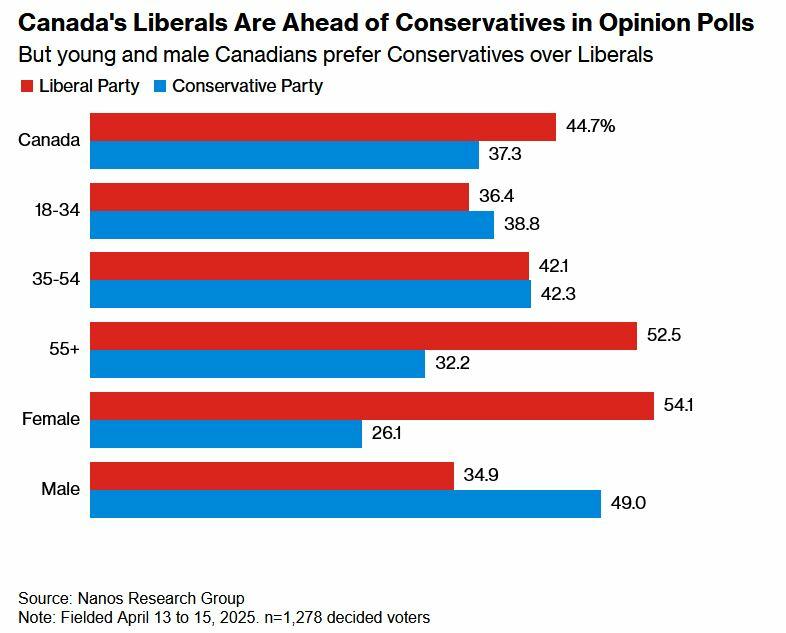
While Poilievre has found resonance among the youth – roughly 39% of 18-to-34-year-olds back the Conservatives vs. 36% for the Liberals, per Nanos Research, not enough to catapult him ahead but still significant. With less than two weeks before election day, Prime Minister Mark Carney’s Liberals are holding a narrow lead overall, thanks in part to strong support from Canadian boomers.
Carney, 60, is virtually a stranger to the TikTok generation. His political playbook caters more to Baby Boomers than Zoomers, like the ad where he and “Austin Powers” star Mike Myers wax nostalgic about Mr. Dressup and The Tragically Hip. Good luck finding a Gen Z’er who knows who Howie Meeker is.
Yet it’s that very throwback charm that’s roped in voters like Tracy Nice, a 64-year-old lifelong Conservative who flipped blue over Carney’s steady hand and Canada’s souring relationship with the U.S.
“Carney just seems like a very smart, calm, thoughtful man who I trust,” Nice said. “And obviously the Bank of Canada and the Bank of England trusted him.”
Poilievre, meanwhile, has taken a different approach. He’s leaned into the social media era, ditching stuffy suits for tight tees, donning aviators, and even puffing hookah with a shawarma shop owner on YouTube while chatting about cryptocurrency. His message? Axe taxes, cut red tape, and let Canadians save – all wrapped in a swagger that channels online populism.
As Mark Jeftovic of Bombthrower.com notes, Canadian boomers are generally dicks:
The Liberal base has had it easy for a decade. With a compliant, sycophantic press and a loyal army of boomers—presumably the only ones still answering calls from pollsters on their wall-mounted rotary-dial landlines during CBC commercial breaks—they greet any resistance to the prospect of four more years of controlled demolition of the Canadian economy with smugness and derision.
There are endless cases caught on video of deranged elderly liberals gyrating in spasmodic fashion chanting “elbows up” at each other and the rest of us and they seem to think it’s some kind of “gotcha moment” to fly off the handle or flip us the bird…
Mating call of the white-haired Canadian boomer looking to fuck over their grandchildren. pic.twitter.com/XtAOBtLS40
— Caryma Sa’d – Lawyer + Political Satirist (@CarymaRules) April 19, 2025
Now, the “liberal boomer” image has gone viral and the guy who probably thought he was “0wning the opposition, lol” is a meme now – it has captured the essence of the Liberal Party’s campaign platform:
Thus, it’s no mystery why young men are flocking to the Conservatives – though the gender gap is hard to ignore. Twice as many women support Carney’s Liberals, while nearly half of male voters back Poilievre. Liberals were quick to pounce on the Tory leader’s use of the phrase “biological clock” during a speech on housing affordability, accusing him of tone-deafness on gender issues.
“Poilievre’s style is coded masculine,” said Laura Stephenson, a political science professor at Western University. “And the Conservative Party in general… has often been favored by men over women.”
Still, the youth surge behind Poilievre marks a generational reversal. Traditionally, young Canadians leaned left, while older voters skewed conservative. Now, with sky-high rents and stalled economic growth, the Liberal record is falling flat — even as the party racks up wins on progressive policies like pharmacare and dental care.
“We have legalized marijuana, we have pharmacare, we have dental care,” said Stephenson. “What many [young voters] still struggle with, though, is paying rent, or buying a home.”
And that, for Poilievre, may be his most potent talking point yet. Whether it’s enough to close the gap before voters hit the polls, that’s the billion-dollar question.
Vatican Countdown: Here Are The Candidates For New Pope
Update (1628ET):
Pope Francis’ death earlier this morning triggered centuries-old traditions and rules within the Roman Catholic Church, including mourning and the selection of a new leader.
Here are the key steps in selecting the new pope:
Vacancy of the Papal See:
The process begins when the papacy becomes vacant, typically due to the death of the reigning pope or, more rarely, resignation (e.g., Pope Benedict XVI in 2013).
The Camerlengo, a cardinal appointed to manage the Church’s temporal affairs during the vacancy, verifies the pope’s death (historically by tapping the forehead and calling his baptismal name) and assumes interim administrative duties.
Preparation for the Conclave:
The College of Cardinals gathers in Rome for General Congregations, daily meetings to handle Church business and prepare for the conclave. These meetings include all cardinals, but only those under 80 years old can vote.
The conclave must begin 15–20 days after the vacancy, allowing time for cardinals to travel, though this can be adjusted slightly.
The Sistine Chapel is prepared as the voting venue, secured to ensure secrecy, with electronic jamming devices to prevent leaks.
The Conclave:
Eligible Voters: Only cardinals under 80 years old at the start of the vacancy can participate (maximum 120 electors, though the number varies; currently ~130 eligible cardinals exist, per Vatican estimates).
Seclusion: Cardinals are sequestered in the Domus Sanctae Marthae (a Vatican residence) and the Sistine Chapel, swearing oaths of secrecy. No external communication is allowed.
Voting Process:
Voting occurs in the Sistine Chapel, with two rounds in the morning and two in the afternoon each day.
Cardinals write a name on a ballot, fold it, and place it in a chalice, saying, “I call as my witness Christ the Lord who will be my judge.”
A two-thirds majority (e.g., 80 of 120 votes) is required to elect a pope.
If no candidate achieves this, the ballots are burned with a chemical to produce black smoke (indicating no decision). If a candidate secures two-thirds, the ballots are burned to produce white smoke, signaling a new pope.
Scrutiny and Counting:
Three scrutineers (elected cardinals) count votes, with infirmarii collecting ballots from any sick cardinals. Ballots are burned after each session.
Deadlock Provisions:
After ~13 days (33–34 ballots) without a two-thirds majority, cardinals may vote to reduce the requirement to a simple majority or hold a runoff between the top two candidates (per Universi Dominici Gregis).
Acceptance and Announcement:
If elected, the candidate is asked by the Dean of the College of Cardinals: “Do you accept your canonical election as Supreme Pontiff?” and, if yes, “By what name will you be called?”
The new pope chooses a papal name (e.g., John Paul, Francis) and is vested in papal garments.
The Cardinal Protodeacon announces “Habemus Papam” (“We have a pope”) from the balcony of St. Peter’s Basilica, introducing the new pope’s name and title.
The pope imparts the Urbi et Orbi blessing to the crowd in St. Peter’s Square.
Who are the contenders to be the next pope (list courtesy of The Guardian):
Pietro Parolin, 70, Italy
Seen as a moderate “continuity candidate”, Parolin was close to Francis. He has been the Vatican’s secretary of state since 2013, playing a key role in diplomatic affairs, including delicate negotiations with China and governments in the Middle East. He is regarded as a reliable and trusted papal representative by secular diplomats. In 2018, he was the driving force behind a controversial agreement with the Chinese government on the appointment of bishops, criticised by some as a sellout to the communist regime. Parolin’s critics see him as a modernist and a pragmatist who places ideology and diplomatic solutions above hard truths of the faith. To his supporters, he is a courageous idealist and avid proponent of peace.
Luis Antonio Tagle, 67, the Philippines
Tagle, a former archbishop of Manila, would be the first Asian pope, the region with the fastest-growing Catholic population. At one time he was considered to be Francis’s preferred successor and a strong contender to continue the late pope’s progressive agenda, but recently appears to have fallen out of favour. He has suggested that the Catholic church’s stance on gay and divorced couples is too harsh, but has opposed abortion rights in the Philippines.
Peter Turkson, 76, Ghana
Turkson would be the first black pope in centuries. He has been vocal on issues such the climate crisis, poverty and economic justice while affirming the church’s traditional positions on the priesthood, marriage between a man and a woman, and homosexuality. However, his views on the latter have loosened and he has argued that laws in many African countries are too harsh. He has spoken out on corruption and human rights.
Péter Erdő, 72, Hungary
A leading conservative candidate, Erdő has been a strong advocate for traditional Catholic teachings and doctrine. He would represent a big shift away from Francis’s approach. He is widely regarded as a great intellect and a man of culture. Erdő was a favourite of the late cardinal George Pell who believed he would restore the rule of law in the post-Francis Vatican. In 2015, Erdő appeared to align himself with Hungary’s nationalist prime minister, Viktor Orbán, when he opposed Francis’s call for churches to take in migrants.
Matteo Zuppi, 69, Italy
Appointed a cardinal by Francis in 2019, Zuppi is considered to be on the progressive wing of the church, and would be expected to continue Francis’s legacy, sharing the late pope’s concern for the poor and marginalised. He is (relatively) liberal on same-sex relationships. Two years ago, Francis made him the Vatican peace envoy for Ukraine, in which capacity he visited Moscow to “encourage gestures of humanity”. While there he met Patriarch Kirill, the leader of the Russian Orthodox church and Vladimir Putin’s ally. He has also met Volodymyr Zelenskyy, Ukraine’s president.
José Tolentino Calaça de Mendonça, 59, Portugal
Tolentino is one of the youngest potential successors to Francis, which could count against him – ambitious cardinals may not want to wait another 20 or 30 years before another shot at the top job. He has attracted controversy for sympathising with tolerant views on same-sex relationships and allying himself with a feminist Benedictine sister who favours women’s ordination and is pro-choice. He was close to Francis on most issues, and argues that the church must engage with modern culture.
Mario Grech, 68, Malta
Grech was seen as a traditionalist but began to embrace more progressive views after Francis was elected in 2013. His supporters argue that his changing opinions show his capacity for growth and change. He has criticised European political leaders who sought to limit the activities of NGO ships and has expressed support for female deacons.
Pierbattista Pizzaballa, 60, Italy
Since 2020, Pizzaballa has been the Latin patriarch of Jerusalem, a crucial role in advocating for the Christian minority in the Holy Land. After Hamas’s attack on Israel on 7 October 2023, Pizzaballa offered himself as a hostage in exchange for children who were being held by Hamas in Gaza. He visited Gaza in May 2024 after months of negotiations. He would be expected to continue some aspects of Francis’s leadership of the church, but has made few public statements on controversial issues.
Robert Sarah, 79, Guinea
Sarah is a traditional, Orthodox cardinal who at one time sought to present himself as a “parallel authority” to Francis, according to a Vatican observer. In 2020, he co-authored a book with the then retired Pope Benedict defending clerical celibacy that was seen as a challenge to Francis’s authority. He has denounced “gender ideology” as a threat to society, and has spoken out against Islamic fundamentalism. Like Turkson, he could make history as the first black pope in centuries.
Could American Cardinal Raymond Burke be in the running?
American Cardinal Raymond Burke, one of the top contenders to become the next Pope:
“Limiting the number of Muslims allowed to immigrate to traditionally Christian nations would be a prudent decision on the part of politicians. It’s to be patriotic and responsible.
The latest from Polymarket shows that Pietro Parolin is in the lead with 37% and Luis Antonio Tagle is in second place with 26%.
Everyone will soon become an expert at Pope selection. Let the games begin.
* * *
Vatican News reports that Pope Francis died at the age of 88 at 7:35 a.m. local time (1:35 a.m. EST). Earlier this year, he experienced a severe health crisis that resulted in over a month of hospitalization due to double pneumonia.
Cardinal Kevin Farrell, Camerlengo of the Apostolic Chamber, announced the death of the 266th pope via this statement:
“Dearest brothers and sisters, with deep sorrow I must announce the death of our Holy Father Francis. At 7:35 this morning, the Bishop of Rome, Francis, returned to the house of the Father. His entire life was dedicated to the service of the Lord and of His Church. He taught us to live the values of the Gospel with fidelity, courage, and universal love, especially in favor of the poorest and most marginalized. With immense gratitude for his example as a true disciple of the Lord Jesus, we commend the soul of Pope Francis to the infinite merciful love of the One and Triune God.”
Vatican News provided more color on the Pope’s deteriorating health leading up to his death on Easter Monday:
The Pope was admitted to the Agostino Gemelli Polyclinic Hospital on Friday, February 14, 2025, after suffering from a bout of bronchitis for several days.
Pope Francis’ clinical situation gradually worsened, and his doctors diagnosed bilateral pneumonia on Tuesday, February 18.
After 38 days in hospital, the late Pope returned to his Vatican residence at the Casa Santa Marta to continue his recovery.
To his 1.3 billion followers, Francis signaled a more inclusive stance toward LGBTQ+ Catholics and advocated for open borders in the United States.
The Pope is Appalled there are Discussions About Closing the US Border – He Says we Need to Open the Doors to Illegal Aliens
“The solution is migration. To open the doors to migration…. For an immigration policy to be good, it must have four things:
Francis was the first pope from Latin America, the first Jesuit to become the head of the Catholic Church, and the first to take the name Francis, inspired by St. Francis of Assisi, who gave up his vast amounts of wealth to live in poverty.
Throughout his tenure (March 13, 2013 to April 21, 2025), Francis also spoke about multiple recurring themes, including compassion, humility, and advocacy. He told followers, “My people are poor, and I am one of them.”
On Sunday, U.S. Vice President JD Vance met with Francis to exchange Easter greetings.
“I know you have not been feeling great, but it’s good to see you in better health,” Vance told the Pope, adding, “Thank you for seeing me.”
The White House on Monday morning issued condolences on X:
The death of Francis sets in motion a chain of centuries-old procedures to secure a new pope. Cardinal Kevin Farrell, the Vatican camerlengo, will act as the head of the Vatican in the meantime.
The question is whether the cardinals who choose Francis’ successor will read the latest cultural shifts across the West and pick a more traditional pope or continue down the path of progressive inclusiveness.
Aerial Images Of Tesla’s Giga Texas Hint At Cybercab Prototype Production
Monday’s spotlight was on Wedbush analyst Dan Ives, who issued another warning to clients about a “code red” situation unfolding at Tesla if CEO Elon Musk continued devoting time to DOGE-related efforts in Washington. Tesla shares fell 7% by late afternoon. However, one bright spot emerged on X around midday: aerial images show that Cybercab prototype builds may have already begun.
Joe Tegtmeyer, a certified flight instructor, snapped high-resolution aerial images of the Tesla Giga Texas earlier today, which revealed what could be castings of the new Cybercab vehicle.
“Interesting developments next to the Giga Texas Casting Machine section today … several new kinds of castings that do not look like Model Y or @cybertruck … looking for experts out there to identify these in the comments!” Tegtmeyer wrote on X.
Interesting developments next to the Giga Texas Casting Machine section today … several new kinds of castings that do not look like Model Y or @cybertruck … looking for experts out there to identify these in the comments!
Tegtmeyer noted, “Also, what looks like more Giga Press parts being delivered today.”
Tesla investor Sawyer Merritt quoted Tegtmeyer’s post on X, explaining:
“These do appear to be to rear Cybercab castings. The Cybertruck casting racks are marked with CTTX, which means Cybertruck Texas. On these new images from Joe today we can see RTTX, which likely means Robotaxi Texas.”
“Tesla has been installing Cybercab production equipment for months. Two months ago in a public interview Lars Moravy said that the first Cybercab prototype builds were slated to start this summer, with general mass production to start in early 2026.”
Despite the negative news surrounding Tesla to begin the week, new aerial images appear to show a new casting that doesn’t resemble those used for the Cybertruck or Model Y—potentially indicating parts for the Cybercab. Perhaps an analyst—maybe even Dan Ives—will inquire about these images during Tuesday’s earnings call.
But what unfolded was something far more surprising: a candid, wide-ranging conversation that revealed just how much common ground these two actually share—especially when it comes to calling out the modern left.
It kicked off with a sharp joke from Kirk, who warned Maher that the “purple-hair jihadis” would be coming for him next.
“They want to kill me just as bad. Oh, they really do!” Maher responded. He explained, “They hate their own apostates more. I’m supposed to get on the short bus to crazy town with them—and I won’t.”
From there, Maher began to draw a clear line between classic liberal values and what he called the “woke” ideology taking over the Democratic Party.
“I am one of them! They’re not one of me,” he said. “Liberal and woke are two completely different things—woke is very often the opposite.”
Maher explained, “Liberalism is, let’s live in a colorblind society. That’s the goal. Woke’s goal is, ‘We see race everywhere.’ Liberal is, ‘There’s a two-state solution.’ Woke is ‘river to the sea.’”
Then came a line that cut to the core of his frustration: “You got off the F-train, you fell asleep, and you got off at 20 stops too far. Don’t blame me for that.”
What started as a typical podcast on Club Random quickly turned into something way more revealing. @charliekirk11 and Bill Maher weren’t clashing on everything—they were connecting over one uncomfortable truth: the woke cult is tearing the country apart.
The conversation pivoted to an issue even some liberals are struggling to defend: women’s sports. Kirk praised Maher for speaking out.
“You deserve credit for being a liberal that acknowledges male-female distinctions,” he said.
“Oh, of course! Of all the low-lying fruit the Democrats just hand the Republicans to win elections, that’s the one,” Maher responded.
Kirk grinned and asked, “Are they really gonna let us win every national election on this no-men-in-women’s-sports thing?”
Maher answered bluntly: “It’s so ridiculous.”
He cited the stat that 890 trophies had already gone to biological males competing in women’s events—and even pointed out that California’s own Gavin Newsom had backed away from the debate.
“You lost Gavin Newsom on this,” he said. “Take that as a hint.”
The conversation then shifted—this time to an issue even many liberals have started to question——sports.
“You deserve credit for being a liberal that acknowledges male-female distinctions,” Kirk said.
Then came the part no one saw coming. Maher opened up about a recent dinner he had with President Trump—and pushed back on the idea that engaging with him was somehow off-limits.
“I voted for Obama, I voted for Clinton,” Maher said. “But the idea that I could talk to them as freely as I felt this conversation was going, is emblematic to me of why the Democrats lose the elections. Because they just don’t feel that this is like a real person.”
He got even more honest: “And I know it’s so weird to say that about Donald Trump, who I’ve said a jillion times is, you know, a whiny little b*tch, I could go through my greatest hits of insults. But this was about getting past that and maybe seeing that if we met in person, we don’t hate each other as much. And we don’t!”
“I’m sorry, I’m not going to pretend that’s a bad thing,” Maher added.
Then came the part no one saw coming.
Maher acknowledged his dinner with President Trump—and made it clear he wasn’t going to pretend it was a bad thing.
That’s when he dropped the line about Trump that will have Democrats in shambles:
That’s when Kirk delivered a line that stopped the conversation cold.
“You had more moral courage than pastors I know who went along with the woke crazy train,” he said. “You deserve credit for that—because it came at a high cost.”
Maher nodded in agreement. For a moment, the two ideological opposites sounded completely in sync. Maher didn’t sugarcoat his assessment of what’s dragging his party down.
“Until we get rid of that sh*t, they’re never going to win another election,” he said.
Kirk replied, “They’re not going to take political advice from me.”
Maher responded, “No, but they might from me. Not the 10%—but that’s 10%. They’re very loud, but that’s it.”
Then came a quote that’s never felt more relevant: “As FDR once said, ‘I welcome their hatred.’”
That’s when Kirk hit Maher with a line that stopped the conversation cold—and sparked one of the most powerful moments of their exchange.
“You had more moral courage than pastors I know who went along with the woke crazy train. You deserve credit for that—because it came at a… pic.twitter.com/aOCJdzq6Xg
Two men with very different worldviews just exposed what many Americans already sense: the far left isn’t leading the Democrats forward. It’s dragging them down. And unless the party finds the courage to cut that anchor loose, it’s going to sink with it.