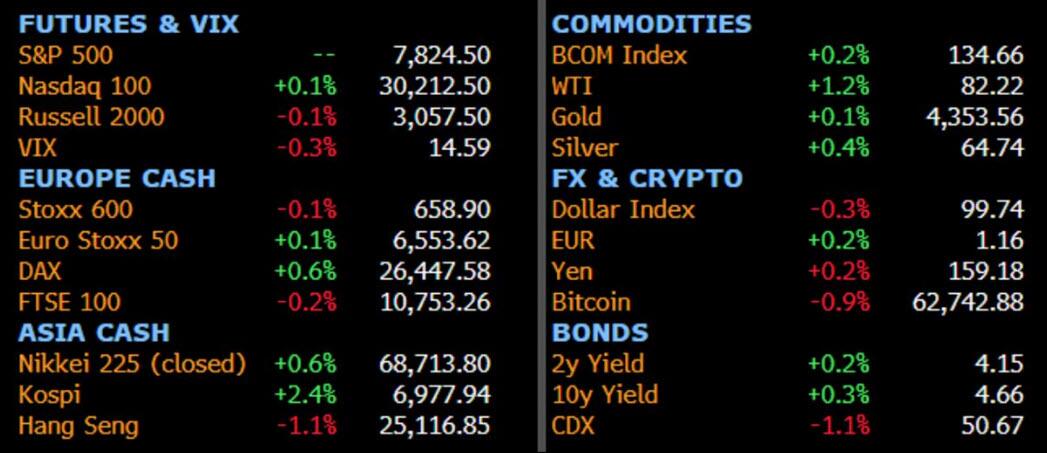
Futures are fractionally higher, as they have been much of this supercharged week which pushed stocks to new all tim ehighs, amid quiet news flow this morning. As of 8:00am ET, S&P futures are up 0.1% after the index closed at a record on Thursday. Nasdaq 100 futures advanced 0.2%, with the tech benchmark set for a 1.2% gain in the week. Momentum darling Sandisk rallied almost 6% in premarket trading after surging double digits yesterday and is now up 60% from its lows less than two weeks ago; Mag 7 stocks mostly unchanged with MSFT and META showing some modest declines as investors continued to focus on OpenAI’s plans for a Wall Street debut. Bond yields are 1-2bp higher, led by 30y. A Reuters article reported that BOJ is eyeing September rate hike and faster pace of tightening, affirming the recent hawkish bias: OIS now sees 81% probability of a September hike (vs. ~65% last Friday). Commodities are modestly higher: oil moved 0.6% higher; gold added 0.1% this morning. US economic data calendar include July retail sales (8:30am), August preliminary University of Michigan sentiment and June business inventories (10am). No Fed speakers scheduled for the session

In premarket trading, Mag 7 stocks are mixed (Tesla +0.5%, Microsoft -0.3%, Nvidia +0.2%, Alphabet 0.0%, Apple 0.0%, Amazon -0.1%, Meta -0.1%)
- Dronemakers including AeroVironment (AVAV) are higher after the Trump administration said it is applying a 100% tariff on imports of unmanned aircraft systems and their components. AeroVironment shares are up 3%.
- Aehr Test Systems (AEHR) rises 8% after Jefferies started coverage on the semiconductor manufacturing company with a buy rating, citing the firm’s growth profile.
- Applied Materials (AMAT) falls 5% after the semiconductor capital equipment company’s estimate-topping forecast met with tepid investor reaction following the stock’s frenetic rally this year.
- ARS Pharmaceuticals (SPRY) sinks 14% after the company pushed back the timeline for the biotech to reach cash-flow breakeven to the end of 2027. The firm’s management previously expected to reach that mark by the middle of 2027.
- Capricor (CAPR) surges 100% after the drug developer said it plans to amend its biologics license application for its drug to treat a rare muscle disease and that the FDA has indicated it is willing to review this amendment. The news spurred an upgrade at Cantor.
- Gemini Space Station (GEMI) falls 6% after the crypto exchange founded by the Winklevoss twins reported a wider-than-expected adjusted Ebitda loss for the second quarter amid crypto trading declines.
- Globant (GLOB) falls 11% after the IT-services company cut its full-year forecast. It also gave a third-quarter forecast that was weaker than the analyst consensus estimate.
- Nubank (NU) gains 10% after the Brazilian fintech reported second-quarter net income that beat the average analyst estimate and saw its 15 to 90-day non-performing loan ratio improve.
- Reddit (RDDT) jumps 10% as the social media company is set to join the S&P 500 prior to the opening of trading on Aug. 18.
- Sandisk (SNDK) rises 6%, set to extend Thursday’s 14% rally, as JPMorgan assigns an overweight rating following the firm’s investor day.
- York Space (YSS) is down 17% after the space and defense company cut the revenue outlook for the full year.
Tech shares again lifted the S&P 500 to fresh highs this month as investors piled into beaten-down semiconductor and other AI-related stocks, with second-quarter earnings exceeding already lofty expectations. After a benign consumer inflation print and producer price data this week, US retail sales numbers on Friday could provide more clues on the direction of Fed policy ahead of next month’s meeting, although according to real-time BofA card spending data, expect a big miss when the data is released at 8:30am.

And speaking of Bank of America, its CIO Michael Hartnett said the “door wide open for bulls to rip risk higher.” He cites soaring earnings, a $10 trillion wealth surge in 2026 and over $1 trillion of AI capex expected in 2027. But most notably he says AI is now so big it is the market, and policymakers simply can not allow stocks to fall as it will spark an economic crash.
Elsewhere, the chip bubble is baaaaack: South Korea’s Kospi Index – a bellwether for retail and momentum euhoria in chip names – added over 2% Friday, bringing its weekly gain to 11% and snapping a seven-week losing streak. Samsung Electronics and SK Hynix both advanced more than 15% over the past five days.
“A huge amount of hyperscaler money is flowing into hardware,” said Hitoshi Asaoka, chief strategist at Asset Management One. “That is translating into extremely strong sales and profit growth for hardware companies. Investors are returning to the idea of, ‘let’s look at the earnings themselves again.’”
Meanwhile, the threat of lofty energy prices reigniting inflation remains. Brent crude jumped almost 2% on Friday, before reversing the move to trade around $87 a barrel. Treasury Secretary Scott Bessent promised unprecedented “economic isolation” for Iran and a “one-two punch” that includes the continued blockade of the country’s ports.
European shares hover near record highs with continued support from the artificial intelligence trade and after the region’s equity funds notched their largest inflows in six months. The Stoxx 600 is little changed as software and IT stocks rally, boosted by a report that Silver Lake is in talks to acquire Workday. HelloFresh falls to a record low after a downgrade at Barclays. Here are the biggest movers:
- European software and IT stocks post broad-based gains on Friday, with sentiment boosted by a Reuters report that Silver Lake is in talks to acquire Workday. SAP, Dassault Systemes and Nemetschek are among gainers.
- Maersk shares gain as much as 6.5% after an upgrade to hold from sell. The shipping company appears to have scope for a further guidance upgrade, and “ample room” for share buybacks over 2027-28.
- Aviva shares rise slightly, briefly reaching their highest level since May 2018, after the insurer’s first-half operating profit exceeded estimates. Analysts note the beat was supported by reserve releases, tempering the market reaction.
- Autostore shares extend a post-earnings rally after the stock was raised to buy from hold at Deutsche Bank, which cites multiple consecutive quarters of improving momentum, stronger customer engagement and a growing backlog at the warehouse automation firm.
- DFDS shares rise as much as 21%, the steepest gain since 2008, after the shipping and logistics firm raised its revenue growth outlook for the year.
- Talanx shares rise as much as 5.9%, the most in over a year, after the insurer’s second-quarter net income came in comfortably ahead of estimates and supported a lift to its guidance for the full year.
- Napatech shares rally as much as 25%, the most in over three months, after the Danish company that provides Programmable Network Interface Cards used in data centers said it has secured a follow-on production order related to a major AI-infrastructure design win secured in 2025.
- Cohort shares gain as much as 7.4%, the most since early July, after the electronic and surveillance technology solutions company announces that its German unit ELAC was awarded a contract to supply integrated sonar systems for the Polish Orka submarine program in collaboration with Saab.
- VZ Holding shares jump as much as 10% after the provider of investment advisory services beat expectations in the first half.
- HelloFresh shares fall to a record low as Barclays downgrades to underweight and assigns a Street-low price target, saying questions remain about the meal kit provider’s top line.
- EnergieKontor shares plummet as much as 18% and hit their lowest level since 2020 after the wind-energy producercut its earnings goal after markets closed yesterday, just hours after reaffirming its guidance.
- GB Group shares fall as much as 27%, their steepest drop since 2009, after the identity verification and fraud prevention company lowered its full-year revenue guidance.
Asian stocks rose, poised for their best week in two months, as the AI tech rally regains momentum on fading concerns over Federal Reserve rate hikes. The MSCI Asia Pacific Index advanced as much as 0.7% Friday, extending its weekly gain to about 3%. South Korea’s tech-heavy Kospi gained for a fifth-straight session, its longest streak since mid-June, while Japanese equities also advanced. Indonesian stocks gained after an address to the nation by President Prabowo Subianto before its budget. After last month’s volatile selloff, the AI trade is getting back on track following the latest corporate results. Stocks in South Korea and Taiwan are set for their biggest weekly foreign inflow in months, a sign that global investors are returning after a historic selloff. “Once traders start searching for yield again, they tend to gravitate back toward that AI and tech picture,” Tim Waterer, chief market analyst at KCM Trade, told Bloomberg TV. “I think that the US earnings season went some way into dispelling some of the fears that were building up about valuations and sustainability of operating margins.” Elsewhere, Hang Seng had its biggest weekly decline in seven weeks. Vietnam fell most in Asia on financial concerns.
In FX, the Bloomberg Dollar Spot Index falls 0.2% and is on course for its largest decline since last week’s payrolls miss. The Norwegian krone is leading gains against the greenback, rising 0.5%, also helped by higher oil prices. The kiwi is also at top of the leaderboard after underperforming on Thursday. USD/JPY edges down toward 159. European stocks are little changed while futures are pointing to a fairly flat open on Wall Street.
In rates, long-end Treasuries hold losses in early US session, with yields higher by around 1-2bp and extending this week’s curve-steepening move amid similar price action in European bond markets. The US sold 30-year bonds at the highest yield in a quarter century on Thursday, underscoring the premium investors are demanding to finance the nation’s deficits. US 10-year yield near 4.65% is less than 1bp higher on the day with bunds and gilts in the sector lagging by 2.5bp and 2bp; WTI crude futures are up about 0.5%, off session highs. With front-end and belly yields edging lower, US 2s10s spread widens nearly 2bp to 52bp, widest since May 21 and near 200-DMA which has broadly held since March; 5s30s spread is more than 2bp wider near 92bp, last seen May 14. UK and German 10-year borrowing costs rise 3 bps each. IG credit new-issue slate empty so far. Three companies sold a combined $5.85 billion on Thursday, paying about 11bp in new issue concessions on deals that were 2.6 times oversubscribed. Start of next week has the potential to be relatively active.
In commodities, WTI crude oil futures advance as talks around reopening the Strait of Hormuz continue to show limited progress. Brent crude futures rise 0.7% to around $87.60 a barrel and that’s hampered bonds.
US economic data calendar include July retail sales (8:30am), August preliminary University of Michigan sentiment and June business inventories (10am). No Fed speakers scheduled for the session
Market Snapshot

Top Overnight News
- The United States on Thursday said that it could maintain a naval blockade of Iran indefinitely and would ratchet up economic pressure on Tehran as ceasefire talks have floundered, global oil supply is dropping and regional tensions are rising. RTRS
- The US is pressing NATO allies to demonstrate support for Donald Trump’s policies, as it reviews potential troop cuts in Europe. BBG
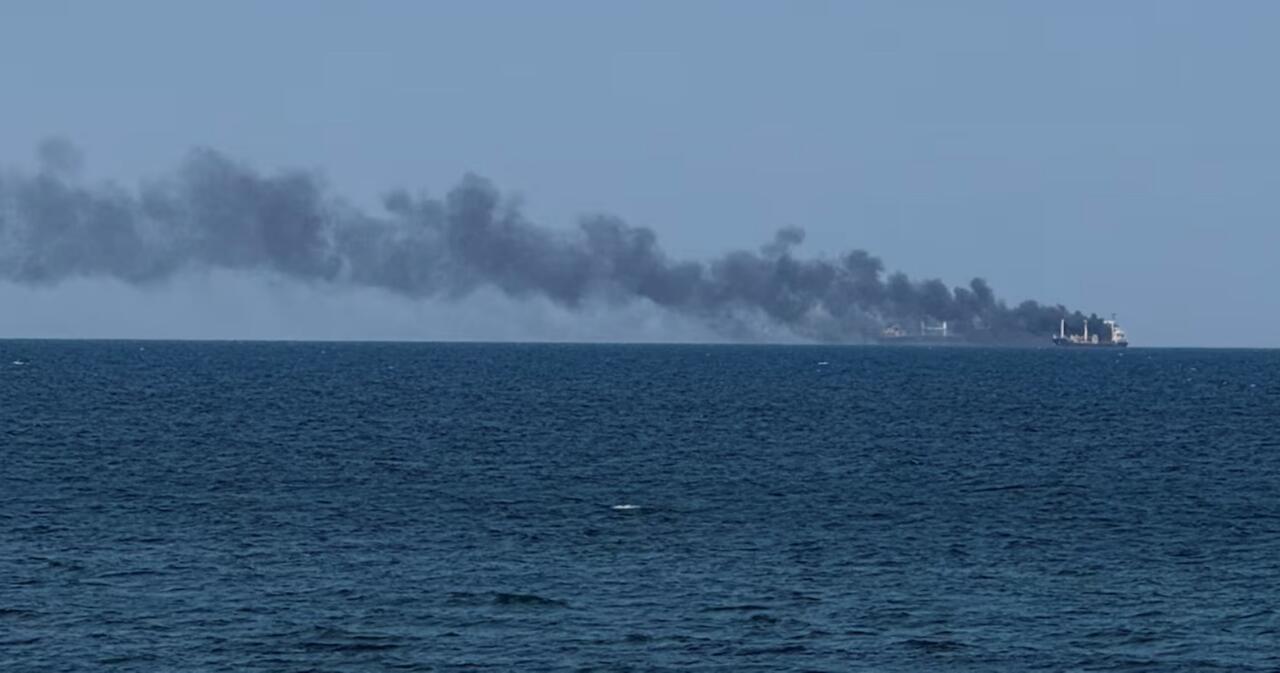
- Ukraine has sent Russia an offer suggesting they both halt attacks on civilian targets in the Black Sea, a source said, after mounting strikes on vessels and ports there raised fears over global food supplies. RTRS
- China’s auto factories are building so many cars for export that the global shipping industry can’t keep up. Specialized car carriers, essentially floating parking garages, are booked out years ahead to export cars from Chinese factories. Rates to charter ships are up 65% this year on the surging demand to move vehicles out of China. WSJ
- Tariffs latest: The US is imposing a 100% duty on some imported drones and their components, a move that may significantly affect China. Australia said the US agreed to “consider full exemption or, at the very least, no increase” to the tariffs. BBG
- The BoJ is set to raise interest rates as soon as September and is considering hiking more aggressively thereafter from the current pace of roughly twice a year, said three sources familiar with its thinking. RTRS
- Japan’s efforts to prop up the yen are creating fresh opportunities as investors return to carry trades — borrowing the low-yielding currency to buy higher-returning assets. BBG
- Leading US AI labs such as OpenAI and Anthropic are releasing cheaper models as they fight to retain cost-conscious customers who are switching to cut-price alternatives from Chinese rivals. The price war comes as rising AI bills push companies to curb usage and seek cheaper models, helping Chinese developers including Moonshot and DeepSeek make inroads with users from Silicon Valley to Europe. FT
- OpenAI is on track to generate annualized revenue of more than $40 billion based on its current performance, people familiar said. The ChatGPT maker’s revenue has accelerated in recent months. BBG
- Fitch affirmed the US at AA+, outlook stable, while it stated that the US rating is supported by a large economy, high per capita income, dynamic business environment and exceptional financing flexibility. However, it also commented that labour demand has weakened and job creation has dropped significantly in 2026, while it expects inflation to move towards the target by year-end 2028.
- US White House deputy national security adviser Andy Baker will leave the administration in coming weeks: Axios
A more detailed look at global markets courtesy of Newsquawk
APAC stocks traded mixed as the region only partially sustained the positive handover from Wall Street, where the S&P 500 hit a fresh record high, and the Nasdaq outperformed on tech strength, as softer PPI data further added to the case for the Fed to refrain from hiking rates in September. Nonetheless, the positive momentum began to wane overnight with little fresh major catalysts and after US President Trump signed a proclamation imposing tariffs on drones and components. ASX 200 was pressured as the strength in tech was overshadowed by losses in the heavy industries, including miners, materials, resources and industrials, while participants also digested earnings releases. Nikkei 225 gained and briefly reclaimed the 69,000 level before paring some of the advances, while participants continue to second-guess whether the BoJ will speed up the pace of rate increases. KOSPI outperformed on tech momentum, but is off earlier highs with resistance at the 7,000 level. Hang Seng and Shanghai Comp were subdued amid a slew of earnings releases including from SMIC and JD.com, with the latter pressured despite beating on the top and bottom lines, while sentiment was also not helped by trade-related frictions with the US to impose tariffs of up to 100% on drones, which seems to be aimed at China and DJI, which holds around an 80% share of the global drone market.
Top Asian News
- PBoC keeps 7-day reverse repo operation volume at zero, while it injects CNY 349bln via overnight reverse repos.
- Taiwan raises 2026 GDP forecast to +11.05% (prev. +9.64%).
- Hong Kong revises 2026 GDP forecast to 3.5-4.5% (prev. 2.5-3.5%).
European bourses are broadly softer across the board, outside of the DAX 40 given the gains in SAP (see more below). Over in Asia, memory chip names (Kioxia +3.8%, SK Hynix +3.3%) climbed in Asia-Pac trade after Sandisk gave a positive outlook at its investor day. Sandisk said it expects revenue growth in the mid-to-high teens between 2028-30 and also plans to return 100% of excess cash to shareholders. Sectors are mixed. Tech is the sector outperformer, followed by Media and Insurance. To the downside is Utilities, while Basic Resources and Health Care also underperform.
Top European News
- Reform UK leader Farage won the Clacton by-election with 22,293 votes.
FX
- DXY gradually weakened throughout the morning to a 99.70 base, despite higher energy prices (Brent +1.5%), which are typically constructive for the USD. Weakness in the Buck likely comes as participants digest the July series of data, which contained dovish components. CPI/PPI were in-line and soft, respectively, while the payrolls figure will likely give food for Fed doves. Today, USD is set to digest US Retail Sales and the UoM survey.
- USD/JPY -0.2% and continues choppy action, this time after another BoJ source said the Bank was set to raise interest rates as soon as September; this saw the pair slip 17 pips to a 159.15 base, a level which is being tested at the time of writing. Currently, markets assign a c. 80% probability of such action in September. More pertinently, Bloomberg sources on Thursday said the Takaichi government is said to support faster BoJ rate hikes. The piece also said the bank could raise rates in either September or October; the timing of the latest source potentially the reason why this JPY strength has stuck.
- Kiwi is rebounding vs the USD after losses following Thursday’s soft inflation expectations survey; action which has entirely faded with the pair ~0.2% higher than pre-data. NZD/USD +0.4%, once again above all significant DMAs.
- NOK is the G10 outperformer, strength which is likely a function of oil prices despite the Norges Bank hold on Thursday raising questions over the removal of the tightening bias from the statement in September. Brent Oct’26 is firmer by 1.5%, after rising throughout the EU morning without a clear catalyst. NOK/SEK sees continues support above 1.00, while USD/NOK broke out of recent ranges
Fixed Income
- USTs continue to fall further from Thursday’s peak of 109-03+, after failing to hold above the current range highs of 109-01. The 30-year auction was soft, showing a 0.4bp tail, below-average bid-to-cover and above-average dealer allocation, all pointing to weaker demand despite the considerably higher outright yield on offer. Following the auction, analysts at TD Securities said this is problematic for the Treasury as it must fund the government at more expensive levels. Looking ahead, US Retail sales is on the docket.
- Gilts opened lower and trades at the lower end of its 86.90-87.26 range, given the steady climb in energy prices. On the political front, Reform leader Farage won the Clacton by-election as expected. Following the count, More in Common’s Tryl told Politico that despite that impressive raw vote total by Farage, the vote share was at the lower end of expectations, which shows that his opponents are highly motivated to turn out. Focus now turns to the outcome of the Parliamentary investigation into Farage over recent donations.
- Bunds continue to trade counter to energy prices, currently trading at the bottom end of its 124.72-125.01 range. A light docket ahead in Europe, given the summer period.
- Australia sells AUD 1bln November 2032 bonds, b/c 3.75, avg. yield 4.6868%.
Commodities
- Crude futures have been grinding higher throughout the European morning despite the lack of a clear driver. Overnight, US Treasury Secretary Bessent said they will implement unprecedented measures on Iran and are conducting a maximum pressure campaign against Iran. Meanwhile, this morning, Iranian Foreign Ministry spokesman Baghaei said a possible agreement with Oman on a new shipping route through the Strait of Hormuz will not, by itself, mean the strategic waterway will reopen. Furthermore, UKMTO says a tanker was struck by a drone while transiting outbound through the Strait of Hormuz, possibly following comments by ADNOC stating that two of its vessels attacked while transiting the Strait of Hormuz on Thursday.
- There have also been a couple of headlines regarding Russia/Ukraine/NATO: NATO HQ confirmed allied jets were scrambled after a drone entered Latvian airspace. Russia’s Foreign Minister Lavrov said an immediate ceasefire in Ukraine is not possible.
- WTI Sept and Brent Oct futures have been edging higher since European players entered the market. Brent trades towards the top end of a USD 86.20-88.60/bbl range at the time of writing whilst WTI sits towards the upper end of a USD 80.71-82.99/bbl range. Dutch TTF is firmer by almost 2% intraday and north of EUR 61.50/MWh.
- Metals are flat/mixed amid a lack of drivers and in what is seemingly a summer lull. Spot gold resides towards the middle of a USD 4,322-4,363/oz range after dipping under yesterday’s 4,343/oz low. Spot silver ekes mild gains and resides towards the top end of a USD 63.51-64.73/oz range after briefly falling under yesterday’s USD 64.22/oz low. 3M LME copper remains above USD 14k/t in a USD 14,045.20- 14,125.28/t range.
- US VP Vance said goal one is to keep oil and gasoline affordable for the US.
- China’s State Planner said domestic gasoline and diesel retail price caps will be cut by CNY 230/T and CNY 220/T, respectively; effective on August 14.
- Ukrainian official said if a ceasefire is implemented in the Black Sea region, Ukraine could restore grain exports through its seaports within one month.
Trade/Tariffs
- US President Trump signed a proclamation imposing tariffs on drones and components, which imposes 100% tariffs on certain-sized drones and a 25% tariff on smaller-sized drones. 10% tariffs will be imposed on drones from the UK and 15% tariffs on drones from the EU, Japan, Liechtenstein, South Korea, Switzerland and Taiwan. Tariffs will take effect 21 days after signing, while for components of drones that are not particularly sensitive, the tariffs will take effect 180 days after signing.
- Australian PM Albanese said he spoke with US President Trump and reviewed advancements under the AUKUS defence agreement, while he added that the AUKUS initiative continues full steam ahead. Albanese said he raised the issue of tariffs with Trump and urged him to consider full exemption, while he added that Trump would consider Australia’s request.
- Brazil began analysing the reciprocity process on US tariffs, while it was notifying the US about the process and requesting that diplomatic consultations be held.
Central Banks
- Fed’s Goolsbee (2027 voter) said they have been getting a little bit better readings on inflation, which he hopes will continue and noted that a lot of inflation drivers were from tariffs, oil and things they hope to be one-time increases. Furthermore, he stated that if they can get some of that into the rearview mirror, they can get inflation heading back to 2%, and that the US economy is steady.
- The BoJ is reportedly set to raise interest rates as soon as September and also considering accelerating subsequent hikes, according to reports.
- RBA’s Harper will depart from the monetary policy board, and Melinda Cilento has been named as a part-time member of the RBA board.
Geopolitics: Iran
- US VP Vance said the US has a lot of tools at its disposal for Iran.
- US Treasury Secretary Bessent said they will implement unprecedented measures on Iran and are conducting a maximum pressure campaign against Iran, targeting its bank accounts and digital currencies worldwide, while the pressure campaign caused the collapse of the Iranian banking sector. Bessent added that measures against Iran will be a combination of economic isolation and blockade in the Strait of Hormuz, and he expects more announcements on Iran next week. Furthermore, he said they will take actions unprecedented in the history of economic isolation of a country and will prevent anything from entering or leaving Iranian ports.
- Iranian Foreign Ministry spokesman Baghaei said a possible agreement with Oman on a new shipping route through the Strait of Hormuz will not, by itself, mean the strategic waterway will reopen, Press TV reported.
- UAE’s ADNOC said two of its vessels attacked while transiting the Strait of Hormuz on Thursday. Following this, UKMTO said a tanker was struck by a drone while transiting outbound through the Strait of Hormuz.
- US CENTCOM commander and Saudi Crown Prince MBS discuss mutual defence cooperation and efforts to de-escalate regional tensions, according to Saudi State News Agency.
- US President Trump’s son-in-law Jared Kushner is to visit Israel next week for consultations on the situation in Gaza, according to Axios
- Airstrikes hit separatist militant group in Erbil, Iraq, according to Tehran Times.
Geopolitics: Ukraine
- Russia’s Foreign Minister Lavrov said an immediate ceasefire in Ukraine is not possible, IFX reported.
- Drones hit area around Russian Baltic seaport of Ust-Luga, according to the regional governor.
- Latvia issued an air threat alert in areas bordering Russia and Belarus, while NATO fighter jets shot down a drone over northeastern Latvia. It was also reported that Finland restricted aviation and maritime traffic in eastern Gulf of Finland.
Geopolitics: Other
- North Korea condemned US-South Korean military drills and said the military exercises are more provocative than last year, while it added that US-Japan-South Korea military cooperation is turning into a nuclear alliance. Furthermore, North Korea vowed to respond to a new level of threat with a new level of deterrent and will continue to expand nuclear deterrence, according to KCNA.
- Japanese Regional Coast Guard said four Chinese ships intruded into Japanese territorial waters, Kyodo reported.
US Event Calendar
- 8:30 am: United States Jul Retail Sales Advance MoM, est. 0.1%, prior 0.2%
- 8:30 am: United States Jul Retail Sales Ex Auto MoM, est. 0.2%, prior -0.2%
- 10:00 am: United States Aug P U. of Mich. Sentiment, est. 55, prior 55.2
DB’s Jim Reid concludes the overnight wrap
Right. I’m about to go off on holiday to find somewhere cooler after what was the 5th hottest day ever in the UK yesterday. I say 5th hottest but that is recorded history. Apparently the Early Eocene Epoch some 55 million years ago was the last time these sorts of temperatures were the norm in the UK. Admittedly the country was nearer the Mediterranean then! For the next couple of weeks you’ll mostly find me bathing in an Alpine lake or shouting at my children. Henry and Peter will be holding the fort while I’m gone. See you on the other side.
Before I disappear in search of snow and ice, markets have generally been enjoying the heat. Over the last 24 hours, investors have continued to dial back the chances of a Fed rate hike, sending the S&P 500 (+0.65%) to fresh highs. The biggest catalyst was a downside surprise in the US PPI inflation print, while lower oil prices gave the doves an extra tailwind, with Brent crude (-2.15%) finally snapping a six-day winning streak. As a result, pricing for a September Fed hike fell to just 35% by the close, down from above 50% on the morning of Wednesday’s CPI release, whilst the 10yr Treasury yield (-5.1bps) also moved sharply lower as markets embraced the more dovish outlook.
That PPI release set the tone for the day, as it cemented the view after Wednesday’s CPI that the Fed didn’t need to rush into rate hikes. The data showed monthly headline PPI unchanged in July (vs. +0.2% expected), which meant the year-on-year reading fell back to +4.7% (vs. +4.9% expected). So the release supported the view that the energy shock was fading, and the Fed wouldn’t need to react next month. As ever, there was also some focus on the categories that feed into PCE inflation, which is the Fed’s preferred measure. But those were generally mixed and offset each other, with strength in portfolio management (+6.5%) offset by weakness in other categories like airfares (-3.4%). In net terms, the PPI details added a one basis point to our US economists’ estimate for July core PCE inflation.
The downside PPI surprise led to an immediate reaction in pricing for the next Fed meeting. For instance, the probability of a September hike had been at 40% right before the release, but was down to 35% by the close. Indeed, the last time a hike by September was considered that remote was back in June, before Warsh’s first press conference was unexpectedly hawkish. That said, there was a reluctance to go much lower on market pricing given we’ve still got the August jobs report and CPI report before the next FOMC meeting. And looking further out, futures are now pricing in a 92% chance of a hike by the December meeting, also the first time since June that this has been less than fully priced.
We did hear from a few Fed speakers as well, but there weren’t really any surprises from a market point of view. Cleveland Fed President Hammack said that “I think we need to act now”, but she’d already dissented for a rate hike in July, so that wasn’t a surprise. Meanwhile, Richmond Fed President Barkin (a non-voter this year) was more dovish, pointing out that much of today’s high inflation “has come from shocks, which should pass”.
This backdrop of softer inflation and more dovish rates pricing led to a big rally for US Treasuries yesterday. In fact, the 10yr Treasury yield (-5.1bps) fell to 4.64%, whilst the rate-sensitive 2yr yield (-5.9bps) fell to 4.14%, its lowest level in almost a month. And the 30yr yield declined by -4.5bps, though we did see the highest yield at a US Treasury auction since 2001 as $25bn of 30yr bonds were issued at 5.216%. In Asia this morning US yields are back up a basis point across the curve.
The dovish momentum received further help yesterday from lower oil prices, which finally ended their run of gains over the last week. It wasn’t a huge fall, but Brent crude was down -2.15% by the close to $87.07/bbl, ending a run of 6 consecutive daily gains. Brent did rise from its intraday low of $85.85/bbl after the Houthi-run Saba news agency reported that the Houthis were targeting the Aramco refinery in the Jizan region. And earlier on in the session, Iran’s state-run IRIB cited a joint military command spokesman, who said that no ship could safely transit the Strait of Hormuz without approval. But overall, in the absence of material news, some of recent run up in geopolitical risk premium was taken out of oil markets, not least given the sizeable recent shipping via Hormuz by shuttle transfers and ships operating without transponders. Brent is flat this morning.
Beyond the crude oil moves, it’s worth noting the continued tightness in refined product markets. Crack spreads in the US and Europe remain close to the highs reached in late July. So while crude oil prices are down by over 25% from their spring peak, the decline in refined product prices has been more modest. For perspective, while Brent crude is now +20% above pre-Iran war levels, US wholesale gasoline prices are about +50% higher and European diesel prices are about +60% higher. Just ahead of filling our car before the 14-hour drive to the Alps!
Whilst the PPI reading and lower oil prices were the main market drivers yesterday, we also had the US weekly initial jobless claims. They were a bit higher than expected, rising to 209k in the week ending August 8 (vs. 202k expected), so again that cemented the view that the Fed could stay on hold at the next meeting. And in turn, all this dovish newsflow benefited US equities, with the S&P 500 (+0.65%) at another record. This was aided by a recovery for the Magnificent 7 (+1.20%) as well as tech stocks more broadly as the NASDAQ (+0.81%) and the Philly semiconductor index (+0.46%) also advanced. But it was a positive day more broadly with the equal-weighted S&P 500 (+0.74%) outperforming and hitting a new high as well.
Earlier in Europe, markets hadn’t been quite as resilient, with the STOXX 600 (-0.04%) edging lower for a second consecutive session. In part, that reflected Europe’s smaller exposure to tech, and also that ECB pricing didn’t move as much as Fed pricing did. Indeed, investors continue to price a September rate hike as a 90% chance for the ECB. So yields saw a comparatively smaller fall in Europe than the US, with those on 10yr bunds (-2.9bps), OATs (-3.5bps) and BTPs (-4.8bps) ending the day lower. UK gilts were a particular underperformer, with the 10yr yield only down -1.9bps after the monthly GDP print surprised on the upside in June, unexpectedly rising by +0.3% (vs. -0.1% expected).
In Asia this morning, the KOSPI (+1.99%) continues its recent comeback, extending its rally to a fifth straight session, with the Nikkei (+0.56%) also firm. In contrast, Hong Kong’s Hang Seng (-0.93%) and Australia’s S&P/ASX 200 (-1.01%) are under pressure, while mainland Chinese benchmarks are seeing modest declines, with the CSI 300 (-0.12%) and Shanghai Composite (-0.21%) edging lower. S&P 500 futures are flat with the Nasdaq equivalent -0.15%. European futures are back up a quarter to half a percent as I type.
Looking at the day ahead, data releases include US retail sales for July, and the University of Michigan’s preliminary consumer sentiment index for August. Meanwhile in the Euro Area, there’s also the second estimate of Q2 GDP.