“Every western society is confronted by an internal cultural conflict between those who wish to distance society from its civilizational legacy and those who wish to renew it.”
– Frank Furedi on Substack
Whatever else you think is happening in our world, contraction is the reality-based order-of-the-day, and everything else is downstream of that. The world has to get by with less. Nothing is going to fix this for everybody, though any number of schemes for redistributing what’s left will preoccupy the political mojo.
Right now, it’s tariffs, which are an attempt to restore industry ceded to the formerly left-behind people elsewhere in the world — taking back what we used to do. You are correct to wonder if this is even possible. The wish is surely understandable, if a bit fuzzy and over-simplified: to be again a nation of people occupied purposefully in the service of a bright future. Redemption stories are deeply appealing.
Many of us are aware that the hour for this is late. We’ve already lived through our decades of pumping cheap oil out of American ground, extracting the ores, fashioning the metal into I-beams and rails, raising the skyscrapers, laying the asphalt ribbons of highway, and strewing the landscape with split-level houses and strip-malls. Let’s not try a re-run of that.
What have we got to work with?
An overly-complex matrix of systems and subsidiary systems operating on the verge of failure at excessive scale. For example, our cities and their asteroid belts of suburbs. The rot is already well-advanced in many of them from their centers outward, and we can see the process underway of strip-mining the remaining assets on-the-ground. Detroit, Cleveland, Baltimore. . . all occupy important geographically strategic sites. All are populated by dwindling societies of the cope-less, floundering their way out of existence. The geographies will abide without them. Others will come along and make something of these places’ virtues.
Agri-business is a method for strip-mining the value from what remains of our fruited plains. Everything about it is on an arc of failure, mortgaged to a futureless giantism. It seemed like a good idea at the time, and now that time has passed. The remaining soil itself can probably be rescued with heroic ant-like peasant labor over generations, which is to say a long and rather desperate project with no quick resolution. Even if Robert F. Kennedy, Jr., hadn’t come along to read America the riot act on food, anyone can see that the age of Froot Loops is drawing to a close.
Town and country, what human society at its best was composed of, has got to be rearranged. This is something that MAGA is not talking about. MAGA looks like it is seeking a reenactment of the years 1950 to 1964. That isn’t going to happen. What then? The tech broz propose something that looks like an A-I printed robotic future. They are drunk on their own Stanford University brand Kool-Aid, hallucinating a future that is little more than math dressed in spandex.
It is nearly impossible to grok the size of their vast fortunes, their billions. Thousands upon thousands of millions. From what? From marshaling squadrons of lawyers to draw up ownership documents for this and that venture enabling idiots with nose-rings to lecture each other about sexual etiquette on cell-phone screens? Warning: don’t become infatuated with singularities, journeys beyond biology and the ecology of planet earth. That’s a story for saps, cargo-cultists, the mentally ill.
Speaking of all that money, one thing you can surely depend on is a violent unwinding of global finance. The vast bottom of humanity already has plenty of nothing, and their abundance will abide. The hedge fund broz and related broz in the shared hallucinations of capital can make some provision for wealth preservation if they have half-a-brain. It’s the great wad in the middle that has the worst problem: they get wiped out and then they discover they have no Plan B. That’s when the fun really kicks off in America (and other sovereign lands, of course.)
Things are breaking ‘out there.’ The financial world’s feedstock is promises. In a trusting world, promises are a splendid technology. Promises allow you to borrow hamburgers from next Tuesday to have a hamburger today. . . .and all else that follows from that. In a not-so-trusting world, promises go up in a vapor with the morning dew.
The folks in charge will attempt to manage the manifest contraction that is upon us by doing everything possible to pretend that it isn’t happening and to deflect from any signals that happen to get through the muzak they broadcast about blue skies and staying on the sunny side. If you are serious — even serious about the comedy sure to arise out of this — you will be prepared for all kinds of trouble: shortages, hunger, civil strife, cold, darkness, the absence of TikTok.
Your number-one job is to stay sane.
Now, go forth and revel in today’s fine spring weather, mindful of the many more fine days to come as history spools out.
By Benjamin Picton, senior macro strategist at Rabobank
Art of the Deal
Stocks had looked poised for a face-tearing rally today as another Trump pivot on China tariffs over the weekend threatened to blast out shorts. Trump announced that tariffs on computers and electronics would be set at 20% – rather than the full-freight-rate of 145% – placating big tech CEO’s and US consumers. However, late on Sunday President Trump walked back the concession by announcing via Truth Social that electronics are “just moving to a different tariff ‘bucket’” and that the whole electronics supply chain will be subject to “national security tariff investigations”. So, it looks like the reprieve is only temporary.
Is this more Art of the Deal? Is it the Madman Theory in action? Or is it just wild caprice? Theories vary widely from “it’s all part of the plan” to “there is no plan, and this guy has no idea what he is doing.” Much of this is in the eye of the beholder, as is the state of the underlying US economy. On Friday the University of Michigan consumer sentiment index fell to 50.8 and the ‘expectations’ sub-index slipped below 50. 1-year ahead inflation expectations rose from 5% to 6.7%, but Democrats and Independents seem to think that inflation will be in the double digits, whereas Republicans are more sanguine.
As the rest of us try to second-guess what is really going on in the White House, Trump surrogates Scott Bessent and Howard Lutnick are now playing ‘good cop, bad cop’ with world leaders. Lutnick has been going fire and brimstone to accuse others of cheating on trade and assure us that tariffs are coming, and then Bessent presents as the cool voice of reason willing to cut deals with nations that are willing to play ball with US economic and foreign policy goals.
Bessent has previously said that he expected the cost of tariffs to be “eaten” by the exporting countries, partially through lower prices and partially through a stronger Dollar. The stronger Dollar part of that equation appears to have gone out the window for now as the DXY index teeters on the 100 level, but isn’t overvaluation of the Dollar due to its reserve currency status one of the main bugbears of Trump, Lutnick and Navarro? Perhaps they’re trying to have their cake and eat it too by weakening the Dollar enough to improve US trade competitiveness, but not so much as to threaten its status as the reserve currency. Bessent recently told Tucker Carlson that the Trump Administration still has a strong Dollar policy “over the long term.”
Despite the falling Dollar, increasing fears of global recession and oodles of fresh supply from OPEC+ have seen crude oil prices decline materially, but gold and the Euro have been major beneficiaries as mobile international capital looks for a safe place to hide. EURUSD closed at 1.1355 on Friday and Gold made a new high close of $3,238/oz. Both are down a little in early trade this morning as the pivot to risk-on cuts haven demand.
A rising Euro will add to the woes of European industry as it faces tariff and defence spending pressure from the USA, the loss of Russian energy supplies and China’s switch from customer to competitor. Nevertheless, 10-year Bund yields have fallen almost 17bps over the course of April while the 10-year US Treasury yield has soared by 29bps over the same timeframe.
Despite Europe’s Byzantine political system and ongoing competitiveness problems, it appears that some traders at least are interpreting sclerosis as stability and marking Europe up for the fiscal headroom enjoyed by the likes of Germany and the Netherlands. Even perennial laggard Italy is suddenly looking better, with S&P last week upgrading its credit rating to BBB+ citing improvement in public finances.
Meanwhile, as noted in this Daily last week, Europe is exploring the replacement of tariffs on Chinese EVs with minimum prices, and Spanish Prime Minister Sanchez has recently been in Beijing for talks with China to expand economic ties. This seems a curious move given that China has declared a “partnership without limits” with Russia – who are currently waging a war of aggression on the EU’s Eastern flank – and Chinese autos present an existential threat to European industry that is lagging in the innovation race and struggling for cost competitiveness.
US Treasury Secretary Scott Bessent had earlier warned Europe against cozying up to China by saying that it would be “cutting your own throat” to do so, but at least some European officials seem to think they can leverage the Americans by re-risking the China relationship to demonstrate that Europe “has options”. European policy makers have delayed the imposition of retaliatory tariffs on US steel for 90 days to give negotiations with the Trump Administration the best chance of succeeding, but if Europe continues to pursue closer trade integration with China right up to the 90-day deadline it seems likely that the USA will take a hard line.
To illustrate one risk: After the US Supreme Court last week issued an administrative order allowing the White House to proceed with firing two Democratic appointees to independent labor boards, there has been speculation that the Court could soon make a determination that would allow for President Trump to dismiss Fed Chair Jerome Powell. If those powers were granted, and a Trump-loyalist installed as Fed Chair, European policy makers would have to be concerned about the potential withdrawal of Dollar swaplines being used for negotiating leverage.
While Europe attempts to walk both sides of the street on the US/China conflict, the UK seems to be taking a leaf out of the MAGA playbook with respect to domestic industry. Prime Minister Starmer convened an extraordinary session of parliament over the weekend to pass emergency legislation to prevent the closure of the Scunthorpe steelworks – Britain’s last remaining integrated steel mill. British Steel’s Chinese owners, Jingye, had reportedly refused earlier offers of government support to keep the plant running. Some commentators have insinuated that Jingye might have allowed the plant to fail on purpose, while UK Business Secretary Jonathon Reynolds suggested that “it might not be sabotage, it might be neglect.” A vote on full nationalization of the works is expected within weeks, but for now British Steel is scrambling to secure supplies of the raw materials needed to continue British steelmaking.
While financial markets will undoubtedly remain focused on tariffs and yields this week, developments in the Middle East may have the potential to blow the price action off course. US Middle East envoy Steve Witkoff recently held talks in Oman regarding Iran’s nuclear program with the Iranian Foreign Minister, while US Energy Secretary Chris Wright held talks in Riyadh regarding US cooperation on the development of a civilian nuclear industry in Saudi Arabia. A second round of discussions between the US and Iran has been scheduled for Saturday.
President Trump has previously said that failure to reach a deal on Iran’s nuclear program could lead to strikes on Iranian nuclear sites in partnership with Israel, so those talks on Saturday will be a big deal. The United States recently moved at least six B-2 stealth bombers (almost 1/3rd of the active fleet) to the Indian Ocean base of Diego Garcia, within striking distance of Iranian nuclear and oil facilities. This could also be interpreted as a message to China, who has just placed export controls on rare earth minerals and who relies on Iranian oil for its energy needs: “If you hit our supply chains we can hit yours too”.
The situation is precarious, but could a compromise be hammered out that is acceptable to Iran, Israel and Saudi Arabia, while also giving China pause for thought on trade war escalation? That would really be the Art of the Deal.
Tariff Shock Delayed For Dollar Tree & Home Depot By Several Months
Although President Trump rolled back reciprocal tariffs (excluding China) last week and a temporary exemption for smartphones, computers, chips, and other consumer electronics over the weekend, the uncertainty sparked by the trade war has left corporate America, including major retailers, on edge.
Goldman analysts Kate McShane, Mark Jordan, and others shared key insights with clients on Monday from conversations with the management teams of retail giants Dollar Tree and Home Depot. Both retailers import a significant volume of products from Asia, including China.
McShane noted that one key takeaway from conversations with Dollar Tree executives is that Trump’s tariff “bazooka” won’t impact store shelves for several months. Once the tariffs take effect, margins could become volatile; however, they expect products to remain competitively priced with peers, including Dollar General and Walmart.
Tariff commentary
DLTR noted that there is a 3-4 month delay between when tariffs land in the port and when the goods show up in stores thus giving them some run way before showing up in their P&L. Management added that margins could be volatile in the near-term, but between cost and price actions the company expects to remain able to provide compelling products at good value relative to the rest of the industry. DLTR added that they are hearing anecdotes of ships anchored offshore waiting to see if anything changes in the coming days.
In addition to trade war commentary impacting operations, Dollar Tree provided color on U.S. consumers amid these uncertain times:
Trade-in trends
The company has spoken to a belt tightening with their middle and lower income customers that has been consistent for several quarters now. Management noted that they are seeing very strong trends in the upper income cohort. DLTR believes that their robust holiday offering contributed to the strength in Q4 and noted that the strength has continued into Q1. Across seasonal merchandise, 3.0 stores saw a 10% comp lift, including a 30% lift in Thanksgiving and 15% lift in Christmas. Additionally, management noted that they have a very easy Easter comp this year.
The analysts’ second conversation was with Home Depot executives, who provided insights on the impact of tariffs, the cost environment, consumer behavior, and the housing market.
Tariff impact on cost environment.
The company noted that the vast majority of their imports are around seasonal goods and that all of their Spring merchandise has landed. Their next imports will be for the holidays in the 2H of the year. Management added that they have an experienced cost finance team and merchants in place that know the potential impacts down to a SKU level, and once they have a better idea of the extent of the tariffs they will take the appropriate mitigation actions. HD will likely take similar action to what they did in 2018. Then, they sized the impact at $2bn and was able to mitigate 2/3rds of that with no price action. They first evaluate if they can source a component part somewhere else, and if not, they then see if there is a substitute for that part. If there is no substitute, they try to find another way to mitigate before turning to price. In 2018, in home improvement industry, including HD, did experience some price increases.
Thoughts on housing in the context of a recession.
When discussing whether the company believes purchasing activity could pick up in an economic slow down, with potentially lower rates, management noted that it is hard to call. Adding that uncertainty in the economy could delay purchases; however, potential buyers have already been on the sidelines for likely an extended period of time. HD noted that historically as mortgage rates approach 6-6.5% they have seen activity pick up.
The key takeaway is that both retailers are in a lag period before tariffs begin impacting supply chains. As noted on Sunday, container freight bookings from China to the U.S. have already plunged — an early signal of disruptions ahead.
In November last year, I discussed the importance of yield spreads, historically the market’s “early warning system.”To wit:“
“Yield spreads are critical to understanding market sentiment and predicting potential stock market downturns. A credit spread refers to the difference in yield between two bonds of similar maturity but different credit quality. This comparison often involves Treasury bonds (considered risk-free) and corporate bonds (which carry default risk). By observing these spreads, investors can gauge risk appetite in financial markets. Such helps investors identify stress points that often precede stock market corrections.”
In other words, the yield spreads reflect the perceived “risk” in the financial markets. The spread between risky corporate bonds and safer Treasury bonds remains narrow when the economy performs well. This is becauseinvestors are confident in corporate profitability and willing to accept lower yields despite higher risks. Conversely, during economic uncertainty or stress, investors demand higher yields for holding corporate debt, causing spreads to widen. This widening often signals investors are growing concerned about future corporate defaults, which could indicate broader economic trouble.
The two charts above show the importance of yield spreads, which tend to rise before financial turmoil in the stock market. When yield spreads began to widen, those increases often preceded liquidity events, reduced corporate earnings, economic contractions, and stock market downturns. In other words, the increase in yield spreads reflected increased investor risk aversion. Eventually, that risk aversion spilled over into the financial markets as investors realized the fundamental shift in the financial markets.
As we discussed in this past weekend’s #BullBearReport, yield spreads reflect the recognition of a shift in three primary areas:
Corporate Financial Health: Credit spreads reflect investor views on corporate solvency. A rising spread suggests a growing concern over companies’ ability to service their debt. Particularly if the economy slows or interest rates rise.
Risk Sentiment Shift: Credit markets tend to be more sensitive to economic shocks than equity markets. When credit spreads widen, it typically indicates that the fixed-income market is pricing in higher risks. This is often a leading indicator of equity market stress.
Liquidity Events: As investors become more risk-averse, they shift capital from corporate bonds to safer assets like Treasuries. The flight to safety reduces liquidity in the corporate bond market. Less liquidity potentially leads to tighter credit conditions that affect businesses’ ability to invest and grow, weighing on stock prices.
The recent market disruption caused by Trump’s trade war has undoubtedly widened spreads between “risk-free” treasury yields and corporate bonds. This is because those tariffs directly impact corporate financial health (reduced profitability), a shift in “risk sentiment” (valuations), and liquidity (potential increase in default risk). Regarding the last point, the lack of market liquidity is at levels not seen since the economic shutdown in 2020.
While yield spreads have widened, they remain well below the long-term averages. However, if recession risks increase due to tariffs, sentiment, or illiquidity, those yield spreads will widen further. The illiquidity issue is currently the most significant risk to the markets, as the sharp spike in yields this past week is warning of a more significant event brewing in the bond market. As we noted in our Daily Market Commentary this past week:
“On Monday, Treasury bonds had a sharp decline far beyond what the economic or tariff data suggested would be the case. We suspect that on Monday, there was forced liquidation through either margin calls or demand redemption of an institutional fund. The outsized selling and volume on a single day for bonds is highly unusual. The media excuses of “tariffs” or “economic concerns” are issues the bond market has known about for quite some time.”
That type of sharp liquidation has historically been the issue of some liquidity events in the bond market. In this case, it appears to be the heavily leveraged arbitrage trade used by hedge funds called the “basis trade.” That trade is a little complicated but critically important to understand. The link below is a brief explanation.
However, the increase in yield spreads and the disruption in the bond and equity markets certainly raise the risk profile for investors in the near term.
Economic Policy Uncertainty
Wepreviously addressed the market’s selloff, primarily due to the Trump administration’s “tariff on, tariff off” policies.
“That catalyst turned out to be President Trump’s “on again, off again” tariff announcements, which created turmoil in earnings expectations. The flux in tariff policies makes it difficult for markets to predict future earnings and corporate profitability. With the “E” in forward valuation measures in flux, markets struggle to price in expected outcomes.”
As shown, those policies are creating a sharp increase in policy uncertainty. We suspect this isn’t going to change in the near term. However, it is notable that these periods are historically short-term, and such spikes are generally near market lows. In other words, the current policy uncertainty will pass, and markets can return to focusing on earnings and valuations. Until then, market rallies will likely be an opportunity to reduce risk.
Regarding earnings and valuations, Wall Street only expects a one-quarter impact from tariffs. As shown, earnings for Q1 are currently expected to come in at $217/share, down from $226.54 one year ago. But, interestingly, Q2 earnings are expected to rise to $223.86, roughly where Q1 estimates started a year ago.
However, in Q3, earnings are expected to drop sharply to just $179/share. If realized, that 20% drop in earnings will be pretty significant. This is particularly problematic for the equity market when assigning forward valuation multiples. For example, assuming the market trades at an 18x multiple of $179 in earnings would pin the market’s fair value at 3,222. Such would be a nearly 40% decline from Friday’s close.
Following that sharp drop in earnings, analysts at S&P Global expect Q4 earnings to rebound sharply to their previous estimates. That assumption suggests they believe the tariffs to be temporary, and the Trump administration will negotiate “no tariff” deals with our trading partners. While such could be the case, I am not so optimistic.
However, whatever outcome occurs will likely lead to reduced estimates heading into 2026, closer to the long-term linear growth trend. That is what the rise in yield spreads suggests as the economy slows and inflation falls. That is barring the expansion of the current bond market crisis into a more significant credit-related event that begins to impact the major banks.
This uncertainty, in both policy and markets, is why we are cutting risk for now.
We Cut Risk For Now
As discussed in last week’s post, “Hope In The Fear,” the weekly “sell signal” was triggered.
“The chart below is a long-term weekly analysis of the relative strength (RSI) and momentum (MACD) indicators. I have denoted when the indicators are trading in bullish and bearish trends. The primary signal is the crossover of the weekly moving averages, as noted by the vertical lines. While the MACD and RSI indicators provided early warning signals, the moving average crossover confirmed a market correction or consolidation. These indicators will not necessarily cause a risk reduction precisely at the top. However, they generally provide sufficient indications to reduce risk ahead of more significant market corrections and consolidations.“
“Conversely, they also offered signals when investors should increase market equity risk. These signals were instrumental in avoiding the 2008 market crash and the 2022 correction. Currently, the RSI is crossing below 50, which may suggest a continued correction process with the MACD beginning to revert. However, the moving average crossover has not yet confirmed the RSI and MACD messages.”
Currently, both the market and the increase in yield spreads warn investors of elevated market risk that could induce further market declines and increased volatility. While such does not preclude a significant counter-trend rally in the short term, the longer-term risks seem to be growing.
As investors, we could undoubtedly ignore the warning signs, and this could be a short-term corrective event like we saw during the 2020 pandemic or the Fed’s “taper tantrum” in 2018. The market correction was brief in those instances, and the bull market resumed. However, it is worth noting that during those periods when the “sell signals” were short, the Federal Reserve intervened by cutting rates, increasing monetary accommodation, or both. Currently, as shown in the Fed Liquidity Index, that is not the case.
For these reasons, we began cutting risk on this week’s rally. With the market still technically oversold, we will not be surprised to see a continuation of the rally this week. Such would be similar to the reflexive rally we saw immediately following the weekly “sell signal” in 2022. Today, like then, sellers emerged as market concerns remained elevated. I suspect that will be the case this time as market participants continue to reprice markets for slower economic growth and policy changes. Markets rarely bottom without retracing toward the previous lows or setting new lows. Given the technical damage to the market, we suspect we will see a pullback before this correction process is over.
From a more bullish point of view, the valuation reversion will eventually become complete. However, that is likely not in the coming weeks or even the next couple of months.
If the markets rally substantially from current levels, our risk reduction actions will drag on portfolio performance. I am okay with that until I am more confident that the corrective process is behind us and that the benefits of increased equity exposure outweigh the risks to invested capital. Given the warning signs from yield spreads, the weekly “sell signal,” and slowing economic growth and inflation, market risk seems tilted against investors temporarily.
For now, we will continue to use rallies to rebalance risk, manage asset allocations, and hold increased cash levels.
UAW Boss Sides With Trump On Tariffs, Stuns MSNBC Panel
Anti-Trumper—perhaps now reformed—UAW union boss Shawn Fain stunned far-left MSNBC hosts Alicia Menendez, Symone Sanders-Townsend, and Michael Steele over the weekend by echoing MAGA talking points and defending President Trump’s tariffs.
“We know that tariffs will influence these companies to do the right thing and reinvest in this country,” Fain said, who oversees 400,000 union members across America’s auto industry.
Fain continued: “We believe Stellantis and these companies will bring work back because of these tariffs … look what these auto manufacturers have done without them…”
He praised former presidential candidate Ross Perot, who famously warned about the consequences of NAFTA in the early 1990s, calling him a “prophet.”
Fain emphasized that Perot was right: “Since NAFTA’s inception in 1993, we’ve lost 90,000 manufacturing facilities in this country. Millions of jobs.”
Fain waived Perot’s 1993 book “Save Your Job, Save Our Country: Why Nafta Must Be Stopped–Now! Unknown Binding”…
Responding to Fain, Symone Sanders-Townsend had a mental glitch (404 error) when trying to understand the union’s alliance with MAGA on auto tariffs. She said, “I’m really struggling to understand how UAW has aligned with Trump on this.” The other leftist hosts also experienced 404 mental errors, causing a flare-up of Trump derangement syndrome.
Fain then countered the MSBC hosts: “So first off, NAFTA is still causing us to lose jobs in this country – our broken trade system is still causing us to lose jobs in this country, and no one from either party has been willing even to address the issue for 30 plus years…We support tariffs as a tool, a tool in the toolbox, not the be-all and end-all. We’ve got to fix the broken trade system.”
UAW President Shawn Fain on the need for tariffs:
“We know that tariffs will influence these companies to do the right thing and reinvest in this country.”
“Since NAFTA’s inception in 1993, we’ve lost 90,000 manufacturing facilities in this country. Millions of jobs.” pic.twitter.com/kdJ5HqRyNF
UAW President Shawn Fain joins the MSNBC panel to speak out on behalf of President Trump’s tariffs and their application in real-world terms: “Tariffs are a motivator to make these companies do the right thing.”
It seems that unions are increasingly supportive of Trump — yet, for some inexplicable reason, they continue backing a rudderless and imploding Democratic Party more focused on illegal aliens, anti-Trump/Musk color revolutions, gender politics, and policies that undermine national security.
Apple Overtakes Rivals To Lead Global Smartphone Market In Q1 Milestone
The most unexpected highlight from Counterpoint Research’s Market Pulse Early Look is Apple’s rise to the number one position in global smartphone shipments in Q1 2025, capturing about 19% of market share and outperforming Chinese rivals. This rebound in fortunes for CEO Tim Cook is particularly notable given the underwhelming iPhone 16 launch last fall and the company’s weak Q4 performance.
Counterpoint found that the launch of Apple’s entry-level model, the iPhone 16e, propelled sales and allowed the company to seize the number one spot for shipments in the first quarter, with a 19% share.
“OEM dynamics continue to remain interesting. Helped by the iPhone 16e launch in a non-traditional quarter and continued growth and expansion in its non-core markets, Apple took the #1 spot in Q1 2025, despite the challenges faced in its biggest markets,” the report stated, adding, “While sales in the US, Europe and China were either flat or declining, Apple recorded double-digit growth in Japan, India, Middle East and Africa, and Southeast Asia.”
Samsung followed Apple with an 18% market share, Xiaomi held 14%, while Vivo and Oppo were tied at 8%. All other brands collectively accounted for 33%.
Last quarter, the global smartphone market expanded by 3% YoY. Declines in developed markets were partially offset by “growth in China owing to government subsidies and continuing recovery in key emerging markets across Latin America, Asia-Pacific and Middle East & Africa,” according to the report.
“The market got off to a mixed start in 2025, where Q1 saw continued improvement in economic conditions, particularly in emerging markets. But mature markets like North America, Europe and China showed signs of fatigue after a recovery in 2024,” Counterpoint Senior Research Analyst Ankit Malhotra said.
Malhotra said, “Sales in January were particularly strong, with a subsidy-led demand boost in China. The momentum continued with major launches like Samsung’s S25 and iPhone 16e, but it turned quickly as economic uncertainties and trade war risks started mounting, especially towards the end of the quarter. We continue to analyze changes in policies and are currently projecting the market to decline YoY in 2025, despite growth in Q1.”
Counterpoint warned that the global smartphone market will likely slow this year amid mounting macroeconomic headwinds and tariffs that will pressure consumer demand across most markets.
Kremlin spokesman Dmitry Peskov said that Putin will have the final say on whether Russia extends its 30-day moratorium on strikes against Ukraine’s energy infrastructure that’ll expire on Friday. He also noted that “the moratorium has essentially not been observed by the Ukrainian side”, which is true, but the US hasn’t pressured Ukraine to comply with its part of the agreement. Here are three respective arguments for and against Russia extending its “energy ceasefire” with Ukraine:
———-
1. Maintain Positive Diplomatic Dynamics With The US
Talks with the US are generally going well so Russia might want to maintain these positive diplomatic dynamics with a view towards making tangible progress on normalizing ties and ending their proxy war. To that end, Putin could once again opt for patience and restraint since the threats posed by Ukraine’s continued violation of their “energy ceasefire” remain manageable, thus enabling Russia to possibly obtain more of its goals through diplomacy than if it reverted to relying solely on military means.
2. Dispel The Neocons’ Claims About Russia’s Intentions
Warmongering forces within the American Establishment and among their media allies have claimed that Russia is untrustworthy, and this perception could be lent false credence if Putin declines to extend the “energy ceasefire”, thus potentially adding unbearable pressure upon Trump to end their talks. The neocon faction might then command more influence over the administration with all that entails for a dangerous escalation with Russia if they then convince Trump to double down on support for Ukraine.
3. Incentivize The US To Finally Apply Pressure On Ukraine
Part of the Russian-US talks concern strategic resource cooperation, which understandably takes a long time to negotiate due to the nitty-gritty details, so maintaining positive diplomatic dynamics in spite of Ukraine’s continued violation of the “energy ceasefire” could raise the odds of a major deal. Should one be clinched, then the US might then be much more incentivized to finally apply pressure on Ukraine, both with regard to respecting this moratorium and conceding to more of Russia’s demands for peace.
—–
1. Show That Putin Won’t Be “Led By The Nose” Again
On the other hand, deciding against extending the “energy ceasefire” that Ukraine never abided by would show Trump that Putin won’t be “led by the nose” again, which refers to how the Russian leader characterized former German Chancellor Merkel’s manipulation of him through the Minsk Accords. Putin could calculate that this would uphold his personal reputation, make Trump respect him more as a leader, and therefore raise the odds of the US pressuring Ukraine to comply with any future deals.
2. “Escalate To De-Escalate” On Better Terms For Russia
By resuming attacks against Ukraine’s energy infrastructure, perhaps dramatically so through the use of more hypersonic medium-range Oreshniks, Russia could “escalate to de-escalate” with the intent of achieving better terms for itself through whatever subsequent deals the US might broker with Ukraine. This strategy would amount to giving the US a dose of its own medicine that Biden applied to Russia, but there’s no guarantee that it’ll have the intended effect with the much more differently wired Trump.
3. Decisively Exploit Perceived American Weaknesses
Be that as it may, Putin’s calculation could be that the US has become so weak over the past few months due to Trump’s eagerness to “Pivot (back) to Asia”, the resultant rift that this created with Europe, and his global trade war that Russia would be foolish not to exploit this by pulling out all the stops in Ukraine. This thinking takes for granted that the US couldn’t or wouldn’t rally the West to “escalate to de-escalate” in kind but would meekly withdraw from the conflict instead, which can’t be known for sure.
———-
Both scenarios entail considerable risks, with another extension possibly leading to Trump manipulating Putin just like Merkel did while rejecting an extension could result in a serious Russian-US escalation, though their respective benefits could potentially be the diplomatic or military resolution of this conflict. Putin is very cautious and averse to escalations, however, so he might be inclined to extend Russia’s de facto unilateral compliance with this lopsided “energy ceasefire” unless “hardliners” dissuade him.
… has become a politicized farce (one overseen by rabid marxist professors with TDS such as Justin Wolfers, who at $600K per year, is rather generously overpaid for a communist). Moments ago the latest NY Fed Consumer Expectations Survey confirmed as much, when it not only reported that 5Y inflation expectations declined to 2.9% from 3.0%, the lowest since January…
… but that 3Y inflation expectations were unchanged and 1Y inflation expectations rose to 3.6% from 3.1%.
Not surprisingly, two-year yields promptly fell to session lows after the inflation data hit the tape, because the NY Fed survey now openly contradicts UMich as one-year inflation expectations – which rose to 3.6% in March, the highest since September 2023 – remained far, far lower than the Democrat-skewed 6.7% preliminary print for the April UMich report.
But even more importantly, expectations on a longer, five-year horizon have slid to 2.9% in the New York Fed survey. That makes the UMich survey, or rather the folks it polls, look literally retarded and will promptly reverse any ludicrous jitters that inflation expectations are getting unanchored on Main Street.
Some more highlights from the inflation panel:
Median inflation uncertainty (the uncertainty expressed regarding future inflation outcomes) decreased at one- and five-year-ahead horizons and was unchanged at the three-year-ahead horizon.
Median home price growth expectations decreased by 0.3 percentage point to 3.0% in March. This series has been moving in a narrow range between 3.0% and 3.3% since August 2023.
Median year-ahead expected price growth increased by 0.1 percentage point for food to 5.2% (its highest level since May 2024), 0.7 percentage point for the cost of medical care to 7.9%, and 0.5 percentage point for rent to 7.2%. Median year-ahead price expectations fell by 0.5 percentage point for gas to 3.2% and 0.2 percentage point for the cost of college education to 6.7%.
While the NY Fed data greatly reduced stagflationary concerns, it did underscore the threat of looming economic slowdown and an outright recession, to wit: unemployment, job loss, and earnings growth expectations deteriorated, while household income growth expectations declined. Households were also more pessimistic about their year-ahead financial situations and credit access. Finally, stock price expectations declined and reached the lowest level since June 2022.
First, looking at the labor market:
Median one-year-ahead earnings growth expectations fell by 0.2 percentage point to 2.8% in March, equaling its 12-month trailing average. Needless to say, it’s tough to have rising inflation when earnings are collapsing, but good luck explaining that to Democrats.
And this is where alarm bells for the Fed should be going off because while stagflation is clearly off the table, recession is becoming the biggest threat: consider that mean unemployment expectations, or the probability that US jobless rate will be higher 1 year from now, rose 4.6% percentage points m/m to 44.0%; this was the highest reading since April 2020.
There’s more: the perceived probability of losing one’s job in the next 12 months increased by 1.6 percentage points to 15.7%, the highest level since March 2024. The increase was largest for respondents with annual household incomes below $50,000. The mean probability of leaving one’s job voluntarily in the next 12 months increased by 0.4 percentage point to 18.0%, remaining far below the 12-month trailing average of 19.7%.
Turning from the labor market to household finances, things go from bad to worse:
Perceptions about households’ current financial situations compared to a year ago deteriorated slightly, with a larger share of households reporting a worse financial situation compared to a year ago. Year-ahead expectations about households’ financial situations also deteriorated in March. The share of households expecting a worse financial situation in one year from now rose to 30.0%, the highest level since October 2023.
The median expected growth in household income decreased by 0.3 percentage point to 2.8% in March, falling below its 12-month trailing average of 3.0%. The decline was most pronounced for respondents with at most a high school degree and for those with annual household incomes under $50,000.
Median household spending growth expectations declined by 0.1% point to 4.9%.
Perceptions of credit access compared to a year ago showed a larger share of households reporting it is harder to get credit. Expectations for future credit availability also deteriorated, with a larger share of respondents expecting it will be harder to obtain credit in the year ahead.
The average perceived probability of missing a minimum debt payment over the next three months decreased by 1.0 percentage point to 13.6%, remaining slightly above the 12-month trailing average of 13.4%.
The median expectation regarding a year-ahead change in taxes at current income level decreased by 0.2 percentage point to 3.2%.
The mean perceived probability that the average interest rate on saving accounts will be higher in 12 months increased by 0.7 percentage point to 26.1%.
The mean perceived probability that U.S. stock prices will be higher 12 months from now dropped by 3.2 percentage points to 33.8%, the lowest level since June 2022.
Last but not least, the latest confirmation that DOGE is working:
Median year-ahead expected growth in government debt decreased by 0.4 percentage point to 4.6%, the lowest reading of the series since its start in June 2013.
“I’m Not Going To Do It”: El Salvador Refuses To Return Alleged MS-13 “Terrorist” To US
Update (1235ET): El Salvador’s President Nayib Bukele will not return an El Salvadorian citizen mistakenly deported from the United States, suggesting that to return the man would be to smuggle a terrorist into the United States.
“Well, I’m supposed to have suggested that I smuggle a terrorist into the United States, right?” Bukele said when pressed on returning the man to the US. “Return him to the United States. I smuggle him into the United States. I’m not going to do it.”
🚨 #BREAKING: President Bukele says he will REFUSE to send MS-13 gang members back to the United States from El Salvador
BUKELE: “How can I smuggle a terrorist into the United States? Of course I’m not going to do it. The question is preposterous!”
Kilmar Abrego Garcia, an El Salvadoran national, was mistakenly deported by the Trump administration, after which the US Supreme Court ruled that the administration must facilitate his return.
White House Deputy Chief of Staff Stephen Miller also chimed in, saying: “So it’s very arrogant, even for American media to suggest that we would even tell El Salvador how to handle their own citizens. As a starting point, as two immigration courts found that he was a member of MS-13,” adding “When President Trump declared MS-13 to be a foreign terrorist organization, that meant that he was no longer eligible under federal law… for any form of immigration relief in the United States.”
“So he had a deportation order that was valid, which meant that, under our law, he’s not even allowed to be present in the United States and had to be returned because of the foreign terrorist designation,” Miller added. “This issue was then by a district court judge completely inverted, and a district court judge tried to tell the administration that they had to kidnap a citizen of El Salvador and flying back here. That issue was raised to the Supreme Court, and the Supreme Court said the district court order was unlawful and its main components were reversed.”
President Donald Trump is opening the doors of the White House to Nayib Bukele, the president of El Salvador, on April 14 to talk about the use of Bukele’s Terrorism Confinement Center to house illegal immigrants deported from the United States.
“Our nations are working closely together to eradicate terrorist organizations, and build a future of prosperity,” Trump wrote April 12 on his Truth Social platform.
White House press secretary Karoline Leavitt told reporters during a press briefing April 11 that the Central American nation’s leader is visiting “to talk about the cooperation that is at an all-time high, and we very much appreciate President Bukele and El Salvador’s cooperation and the repatriation of El Salvadorian gang members who the previous administration allowed to infiltrate our country.”
Officials point to an agreement between the two nations to incarcerate Tren de Aragua and MS-13 gang members in El Salvador’s Terrorism Confinement Center as a positive move based on mutually beneficial collaboration.
The high-profile meeting comes on the heels of a unanimous April 10 Supreme Court decision regarding a Maryland court filing that orders the federal government to facilitate the return of Kilmar Abrego Garcia, a 29-year-old Salvadoran illegal immigrant and alleged gang member, who was deported to El Salvador despite a previous court ruling preventing his deportation to that country after determining it would impact his safety.
Attorneys for the federal government blamed an “administrative error” for Abrego Garcia’s deportation, according to the court ruling.
Leavitt told reporters that interpreting the language of the decision is important to understand the role the government is expected to play in assisting Abrego Garcia.
“The Supreme Court made their ruling last night very clear that it’s the administration’s responsibility to facilitate the return, not to effectuate the return,” Leavitt said.
She deferred inquiry to the Department of Justice’s newly filed brief challenging the matter in a lower court.
The deportee’s future remains unclear, with Trump suggesting El Salvador will decide his fate.
“President Bukele has graciously accepted into his nation’s custody some of the most violent alien enemies of the world and, in particular, the United States,” Trump wrote.
“These barbarians are now in the sole custody of El Salvador, a proud and sovereign nation, and their future is up to President [Bukele] and his government. They will never threaten or menace our citizens again!”
Abrego Garcia’s attorney said the government’s tactic of quickly deporting suspected illegal immigrants puts the judicial system’s reputation for fairness in question.
“The government can deport whomever they want, wherever they want, and call it a mistake later,” Simon Sandoval-Moshenberg, the man’s attorney, told reporters after the Supreme Court found in his client’s favor.
Abrego Garcia was arrested on March 12 by Immigration and Customs Enforcement agents in Baltimore.
His wife, U.S. citizen Jennifer Vasquez Sura, later identified him in a photo of shackled deportees seen entering the terrorism center and subsequently challenged the deportation in federal court.
U.S. District Judge Paula Xinis on April 4 ordered the federal government to return Abrego Garcia, calling the deportation “wholly lawless” in her ruling.
Abrego Garcia remains in Salvadoran custody, where he has resided for just over a month.
Prior court filings say Abrego Garcia fled gang threats in his home country as a teenager. He has no criminal record in the United States and denies the federal immigration authorities’ allegations that he is affiliated with the notorious MS-13 transnational gang.
Here’s Stephen Miller to clarify a few things…
🚨 BOOM! Top Trump advisor Stephen Miller just went BERSERK for 3 minutes straight on Fox over the media narrative that Trump must bring home Kilmar Abrego Garcia from El Salvador.
Miller perfectly debunked this ENTIRE claim that Garcia’s deportation was an “error.” This entire… pic.twitter.com/TfGa1VjvpS
Man Arrested For Setting PA Governor’s Mansion Ablaze, Forcing Shapiro And Family To Flee
Police have arrested a man they accuse of using incendiary devices to set the Pennsylvania governor’s mansion ablaze in the wee hours of Sunday morning, causing major damage to the luxury residence and forcing Gov Josh Shapiro and his family to evacuate. The alleged arsonist’s social media posts reportedly show a history of animus against President Biden and those who voted for him.
Trump on the arson and attempted murder of PA Governor Shapiro.
“The attacker was not a fan of Trump, he wasn’t a fan of anybody, was just a whack job.”
Authorities say Cody A. Balmer, a 38-year-old resident of the capital city of Harrisburg, managed to leap the perimeter fence, break into the mansion and then use homemade incendiary devices to start multiple fires before fleeing the scene. While police were alerted to a breach before the fires were started, they failed to locate the arsonist before he did his work, and also failed to find him before he scaled the same fence and escaped. More than a dozen hours later, Balmer was arrested at an unspecified Harrisburg location.
Channeling a “l’etat, c’est moi” vibe, Gov. Josh Shapiro told reporters, “Last night, we experienced an attack, not just on our family, but on the entire Commonwealth of Pennsylvania. I want you all to know that your prayers lift us up, and in this moment of darkness, we are choosing to see light.”
Shapiro was jarred from his sleep at 2 am by a state trooper who banged his door to alert the 51-year-old, first-term governor to the emergency, and then rush him and his family out of the structure. Last year, Shapiro escaped a different kind of harm when he wasn’t chosen as Kamala Harris’s running mate.
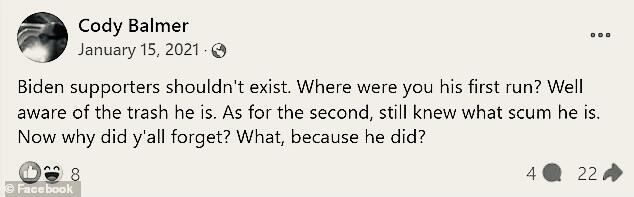
A Daily Mail exploration of Balmer’s social media profiles uncovered a photo of him pointing a handgun at the camera, various posts expressing disdain for President Biden and his supporters, and a potential allusion to political violence.
“Biden supporters shouldn’t exist,” he posted to Facebook in January 2021. “Where were you his first run? Well aware of the trash he is. As for the second,still knew what scum he is. Now why did y’all forget? What, because he did?”
Five days later, he posted, “RIP Joe Biden… Whoops that’s in may, #notmypresidenteither”
In another post, he said “Knowing is half the battle… the other half is extreme violence.” From the Daily Mail report, it’s unclear what “knowing” Balmer was referring to.
State Police Lt. Col. George Bivens gave Balmer high marks for his deliberate execution of the raid: “He clearly had a plan. He was very methodical in his approach, and moved through it without a lot of hurry.”
Balmer will face various charges that are expected to include attempted murder, aggravated arson, terrorism and aggravated assault against an enumerated person. (Yes, that last charge represents the state valuing the lives of government employees more than it values yours.) The lack of any indication of conspiracy charges suggests police initially believe Balmer acted alone.
Police say they have not yet determined a motive for the fiery but mostly peaceful attack, and it’s uncertain if the timing — at the beginning of the Jewish Passover holiday — relates to the fact that Shapiro is a Jew. Contemplating that possibility, Shapiro struck a defiant tone:
“If he was trying to terrorize our family, our friends, the Jewish community, who joined us for a Passover Seder in that room last night, hear me on this: we celebrated our faith last night, proudly and in a few hours, we will celebrate our second Seder of Passover.”
Shapiro also denounced political violence, whatever its target:
“This kind of violence is becoming far too common in our society, and I don’t give a damn if it’s coming from one particular side or the other. Directed at one particular party or another, one particular person or another. It is not OK. And it has to stop, we have to be better than this.”
However, in September, Shapiro enthused over a different kind of political violence, as he hosted Ukrainian President Volodymyr Zelensky at the enormous General Dynamics facility in Scranton that manufactures 155mm artillery shells that the United States has supplied Ukraine in mass quantities.
Shapiro faced a social media backlash when he signed the shells destined for the bloody Western proxy war against Russia.
There’s Gov Josh Shapiro with Zelensky signing artillery shells at a weapons plant in Scranton, PA
For those unfamiliar, Shapiro is the guy who said Palestinians are too “battle-minded” to make peace pic.twitter.com/QjyTTVVV0v