60.9 F
Chicago
Monday, September 21, 2026
Home Blog Page 1599

Not So Fast: Lutnick Says Semiconductor Tariffs Coming “In Month Or Two”, Exemption Is Only “Temporary”

Not So Fast: Lutnick Says Semiconductor Tariffs Coming “In Month Or Two”, Exemption Is Only “Temporary”

Update (1059 ET): 

U.S. Commerce Secretary Howard Lutnick told ABC’s This Week host Jonathan Karl that smartphones, computers, chips, and other consumer electronics may soon be subject to separate tariffs in a month or so, suggesting that the exemptions announced Friday evening are only temporary.

“All those products are going to come under semiconductors, and they’re going to have a special focus type of tariff to make sure that those products get re-shored. We need to have semiconductors, we need to have chips, and we need to have flat panels — we need to have these things made in America. We can’t be reliant on Southeast Asia for all of the things that operate for us,” Lutnick told Karl.

When Karl asked to clarify whether tariffs on Apple iPhones and other smartphone devices might “come back on in a month or so,” Lutnick replied, “Correct. That’s right: We need our medicines, semiconductors, and electronics to be built in America.”

Lutnick’s comments came after Customs and Border Protection posted updated guidance late Friday night on product exclusions from President Trump’s reciprocal tariffs, imposed under Executive Order 14257 and its amendments (EO 14259). The exclusions cover a wide range of electronic devices, including smartphones, laptops, and related components.

Lutnick also said that Trump would implement “a tariff model to encourage” the semiconductor and pharmaceutical industries to re-shore supply chains back to the Heartland.

We can’t be beholden and rely upon foreign countries for fundamental things that we need,” Lutnick said, adding, “So this is not like a permanent sort of exemption. He’s just clarifying that these are not available to be negotiated away by countries. These are things that are national security that we need to be made in America.” 


*  *  *


Update (Sunday): 

China responded to new trade guidance issued by U.S. Customs and Border Protection on Friday evening. The guidance excludes some of the highest-value goods—such as computers, chips, and smartphones—from reciprocal tariffs.

AFP News quoted a Chinese Commerce Ministry spokesperson, calling the updated guidance a “small step” toward correcting President Trump’s “wrong practice” of imposing 145% tariffs on Chinese goods. Beijing has hit back with 125% levies on U.S. goods in the deepening trade war that erupted last week.

“China is now evaluating the impact,” the ministry spokesperson said.


*  *  *


Saturday Update (1255 ET): As Trump adviser Stephen Miller points out, the products are still “subject to the tariff under the original IEEPA on China of 20 percent.”

The White House further clarified that the exemption (from the higher tariffs only) will be retroactive to April 5th, and all duties received since then will be refunded.

Any duties that were collected at or after 12:01 a.m. eastern daylight time on April 5, 2025, pursuant to Executive Order 14257 and the Subsequent Orders, on imports that are excepted under Executive Order 14257 and the Subsequent Orders because they are “semiconductors,” as explained in this memorandum, shall be refunded in accordance with U.S. Customs and Border Protection’s standard procedures for such refunds.


*  *  *

U.S. Customs and Border Protection (CBP) issued an updated guidance late Friday night on product exclusions from President Trump’s reciprocal tariffs, imposed under Executive Order 14257 and its amendments (EO 14259). The exclusions cover a wide range of electronic devices, including smartphones, laptops, and related components.

First, President Trump paused reciprocal tariffs for non-retaliating countries (e.g., China) for 90 days last week. Now, updated guidance from CBP reveals that some of the highest-value trade—particularly a wide range of electronics—is excluded from the reciprocal tariffs.

Among the 20 tariff codes listed for exemption, three stand out in particular:

  • 8471 – Automatic data processing machines and units thereof (e.g., laptops, desktops, servers).

  • 8517.13.00Smartphones and other telecommunication apparatus for cellular networks.

  • 8542 – Electronic integrated circuits (e.g., microprocessors, memory chips).

Here’s the complete list:

  • 8471 – Automatic data processing machines and units thereof (e.g., laptops, desktops, servers).

  • 8473.30 – Parts and accessories for automatic data processing machines (e.g., computer parts).

  • 8486 – Machines and apparatus for the manufacture of semiconductor devices or electronic integrated circuits.

  • 8517.13.00 – Smartphones and other telecommunication apparatus for cellular networks.

  • 8517.62.00 – Machines for the reception, conversion, and transmission/regeneration of voice, images, or other data (e.g., modems, routers).

  • 8523.51.00 – Solid-state non-volatile storage devices (e.g., flash memory, SSDs).

  • 8524 – Media for the recording of sound or other phenomena, not elsewhere specified (can include CDs, DVDs, etc.).

  • 8528.52.00 – Monitors capable of directly connecting to an automatic data processing machine (e.g., computer monitors).

  • 8541.10.00 – Diodes, other than photosensitive or light-emitting diodes (LEDs).

  • 8541.21.00 – Transistors with a dissipation rate of <1 W.

  • 8541.29.00 – Other transistors.

  • 8541.30.00 – Thyristors, diacs, and triacs (semiconductor switching devices).

  • 8541.49.10 – Light-emitting diodes (LEDs) – chips mounted in discrete packages.

  • 8541.49.70 – Other LEDs, not listed elsewhere.

  • 8541.49.80 – Infrared LEDs.

  • 8541.49.95 – Other light-emitting semiconductor devices.

  • 8541.51.00 – Silicon-based photovoltaic devices (solar cells), whether or not assembled in modules or panels.

  • 8541.59.00 – Other photovoltaic devices.

  • 8541.90.00 – Parts of the goods of heading 8541 (e.g., parts for diodes, transistors, LEDs).

  • 8542 – Electronic integrated circuits (e.g., microprocessors, memory chips).

To close out the week, the U.S.–China trade war escalated in a highly predictable tit-for-tat fashion. The U.S. now imposes a 145% effective tariff rate on Chinese goods, while Beijing has retaliated with a 125% rate on American products.

Meanwhile, Wall Street analysts have already trimmed sales estimates for U.S. companies with Chinese exposure, including Apple and Tesla, as economic storm clouds gather over global trade.

Notably, most of the products now exempt from reciprocal tariffs are those the U.S. lacks the capacity to produce at scale—highlighting the need for significant reshoring, investment, and supply chain restructuring. 

Many of these products are also consumer essentials—items Americans couldn’t live without, such as smartphones and computers—making them politically sensitive. The Trump administration likely chose not to risk upsetting consumers ahead of the Midterms. 

In markets, this news will be fuel to stage a further recovery…
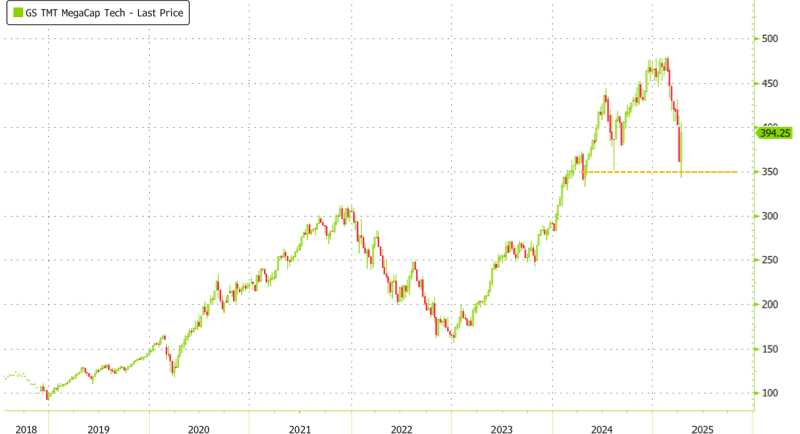
Nasdaq Breadth…

As Wedbush’s Dan Ives notes, Big Tech and investors ‘got the dream news’.  .  . 


Tyler Durden
Sun, 04/13/2025 – 10:59

Audit: Cuomo Spent $453M On 247,343 Medical Devices For COVID… State Used Only 3

Audit: Cuomo Spent $453M On 247,343 Medical Devices For COVID… State Used Only 3

Former New York Gov. Andrew Cuomo’s handling of the Covid crisis wasn’t just a health catastrophe, but a financial one too, according to a damning new audit report released Friday. The state government poured $453 million into building an enormous stockpile of medical equipment — and only used 0.000012% of it

According to state comptroller Tom DiNapoli, New York bought a staggering 247,343 medical devices, but only wound up using a laughable three pieces of equipment out of the vast horde. Worse, the waste was only compounded by the state’s utter neglect of its fiduciary duties to taxpayers. Rather than finding buyers for the once-valuable assets, bureaucrats have been content to let the equipment age and decay in warehouses. As if the erosion of the stockpiles weren’t bad enough, New York is also wasting money on storage costs. 

“New York state bought hundreds of millions of dollars’ worth of medical equipment at the onset of the COVID-19 pandemic, including ventilators and x-ray machines, that now sits unused in storage facilities across the state, missing recommended maintenance and costing taxpayers storage expenses,” said Napoli’s office. Of the equipment that requires ongoing maintenance, auditors found that 90% of it is past due, with no process or contract in place to handle that need. Failure to keep up with maintenance risks voiding manufacturer warranties, and also rendering the equipment unusable in an emergency. 

Then-Gov Cuomo with comedian Chris Rock and actress Rosie Perez at a 2020 event where Cuomo promoted masks as “amazingly” effective at slowing the spread of Covid. They weren’t(Spencer Platt/Getty Images via NPR)

 “It was completely understandable that we did a lot of panic buying in the moment. But then to throw all this stuff in a warehouse and neglect and ignore it — it’s compounding the mistake,” Bill Hammond of the Empire Center think tank told Politico. Four years ago, the Department of Health created a “Medical Stockpile Steering Committee” to determine how much of the equipment should be retained. The group said 51,140, but there was no plan for the other 200,000 devices. The DOH couldn’t produce any documentation about how the committee reached its conclusions.  

Heading into the pandemic, the state had 4,800 pieces of equipment on standby, but now has a quarter million items five years after Covid-19 entered the country. The inventory includes CPAP/BiPAP machines, ventilators, oxygen tanks, pulse oximeters, oxygen concentrators and infusion pumps In addition to the money wasted on the equipment itself, Cuomo’s administration also paid McKinsey & Company consultants more than $5 million to advise them how much stuff to buy.

In the understatement of the year, Cuomo spokesman Rich Azzopardi told the New York Post that McKinsey overestimated the need. “You can Monday-morning quarterback now, but then we were looking to save lives and doing nothing wasn’t an option.” Alas, Cuomo’s record on “saving lives” is arguably worse than the emerging picture of his financial mismanagement of the pandemic. His administration was widely condemned for ordering nursing homes to accept Covid-positive patients who were discharging from hospitals, then accused of deliberately understating the number of long-term-care-resident deaths that followed.  

The faultfinding report comes just weeks after 67-year-old Cuomo announced his candidacy for New York City mayor, by many of our political leaders.” He resigned his governorship in August 2021 after at least 11 women filed various complaints of unwelcome sexual advances against him — from kisses to groping to comments. The state legislature had been closing in on impeaching him. When he announced his bid for the mayor’s office last month, Cuomo blamed the city’s problems on “the lack of intelligent action. Friday’s report will do little to assure voters that he packs the requisite IQ.  

Tyler Durden
Sun, 04/13/2025 – 09:55

Mother Arrested, Held In Police Cell In UK, For Confiscating Her Own Daughters’ iPads

Mother Arrested, Held In Police Cell In UK, For Confiscating Her Own Daughters’ iPads

Authored by Steve Watson via Modernity.news,

A mother was arrested and jailed for seven hours after she confiscated iPads from her own children because she wanted them to concentrate on their homework.

Yes, really.

It’s the latest insane story of police overreach from the backwards UK, where stabbings are just an everyday occurrence and robberies are not even investigated, but people saying mean words about the ‘wrong’ things are thrown in prison.

Now responsible parenting is the target.

The LBC report notes:

History teacher Vanessa Brown, 50, spent seven-and-a-half hours in a custody cell on March 26 this year, following a claim she had stolen two iPads which were traced to her mother’s house in Cobham, Surrey.

Yet it transpired that the two devices belonged to her daughters, and Ms Brown had merely confiscated them to encourage them to focus on their schoolwork, a fact Surrey Police has now acknowledged.

“I find it quite traumatic even talking about this now,” Ms Brown recalled.

“At no point did they [the officers] think to themselves, ‘Oh, this is a little bit of an overreaction for a moment, confiscating temporarily her iPads and popping over to her mum’s to have a coffee’. It was just a complete overreaction.

It isn’t made exactly clear who reported the iPads stolen, but it seems to have been the ex-partner of the woman.

In any case, why on Earth did police waste their time on this? Isn’t there enough actual crime to deal with?

The police also prevented the woman from speaking to her own children following the accusation. They also pulled one of the children out of school for questioning.

Neil O’Brien, a Tory MP and shadow education minister, commented on the incident, noting “This is beyond absurd. People are having phones snatched all the time and police won’t follow up even when they know where they are, yet a law abiding person can end up in a cell for hours on end for taking away their own kids’ iPads.”

Richard Tice, the deputy Reform UK leader, said that the “world has gone mad,”adding that “Police need to catch real criminals not mums looking after their children!”

Greg Smith, the shadow business minister, added his criticism, remarking “Absolutely mad. A parent chooses when their child gets screen time and anything that challenges that is absolutely bonkers.”

Harry Miller, a former police officer who works with the free speech campaign group Fair Cop, urged that police in the UK are becoming “Stasi like”.

“They have become agents of a state orthodoxy rather than upholders of the law. It shows a complete lack of awareness of what theft is – a parent confiscating an iPad doesn’t even come close to meeting that definition,” he urged.

“I think they should do more than apologise and remove themselves from office, because operating like that is a form of kidnap,” Miller continued.

“They repeatedly overreach and they seem to have taken it upon themselves to become social engineers. That is not the role of the police,” he further asserted.

Don’t worry, because soon enough, British authorities will have the ability to predict which responsible mothers are going to confiscate tablets from their kids before they do it.

Then they’ll be dealt with accordingly.

The incident comes on the heels of another shocking story of parents being arrested for criticising their children’s school in a WhatsApp group.

JD Vance was right, the UK now operates within a full on dystopian apparatus:

*  *  *

Your support is crucial in helping us defeat mass censorship. Please consider donating via Locals or check out our unique merch. Follow us on X @ModernityNews.

Tyler Durden
Sun, 04/13/2025 – 09:20

Space Force Commander Fired After Undermining JD Vance Visit To Greenland

Space Force Commander Fired After Undermining JD Vance Visit To Greenland

During the height of the Cold War the United States built multiple military outposts and bases in Greenland as part of the Distance Early Warning (DEW) Line to defend against a sneak attack by Soviet forces.  The presence of these forces (including a secret underground ice base) was not only to act as early detection, but also as area denial.

For decades the US has been pouring money and resources into Greenland, even though it was officially an “autonomous” territory of Denmark.  For example, Greenland received yearly subsidies from USAID (until it was shut down) of up to $12 million.  Greenland officials talked avidly of strengthening economic ties with the US in 2021 after stopping a Chinese attempt to secure mining rights in the region (the CCP uses resource agreements in weaker countries to gain leverage over their governments).    

In the uncertain period after WWII, the American presence was considered practical and was welcomed.  It would be unheard of for base commanders in the region to openly question or undermine Presidential efforts to secure Greenland.  It would also be especially bizarre for a US commander to express loyalty to Denmark or Greenland over America.  However, in 2025 we’re living in the age of military DEI and the now defunct Biden era has left some nasty activist surprises behind.

Vice President JD Vance has been busy in the country to pursue Donald Trump’s interest in bringing back a greater US presence in Greenland or perhaps securing control of the territory outright.  This included a tour of the last remaining US base in the region, Pituffik Space Base.

The commander of the base, Colonel Susan Meyers, responded to the visit with an email message to personnel expressing opposition to Vance’s statements during his tour in which he argued that Denmark had left Greenland in an economic doldrums.  She also reportedly insinuated concerns that Vance’s visit might have an adverse effect on personnel and their relationships with Greenlanders and Danes that work at the base.

“I spent the weekend thinking about Friday’s visit — the actions taken, the words spoken, and how it must have affected each of you. I do not presume to understand current politics, but what I do know is the concerns of the U.S. administration discussed by Vice-President Vance on Friday are not reflective of Pituffik Space Base…I commit that, for as long as I am lucky enough to lead this base, all of our flags will fly proudly — together…”

Meyers, who has been commander of Pituffik Space Base since July of 2024, has subsequently been fired from her post. Pentagon spokesman Sean Parnell retweeted Military.com’s story on the email and added a screenshot of the announcement of Meyers’ removal.

“Actions to undermine the chain of command or to subvert President Trump’s agenda will not be tolerated at the Department of Defense,” Parnell wrote on X.

Military leaders are expected to remain non-partisan in their engagements with personnel and foreign interests, but the statements by Meyers reflect the commonly invasive nature of progressive activism.  The need to push equity and inclusion rhetoric spread like a virus within the armed forces during the Biden Administration due to DEI programs.  It is incumbent upon military personnel to place US interests above all others, not clutch pearls in the name of “equity”.  Any disagreements on policy are supposed to be handled internally to prevent fomenting divisions.

Numerous DEI hires within the military have led to embarrassing breaches of protocol, from drag queen TikToks to promote recruitment for the Navy, to Critical Race Theory classes and marketing for up and coming officers, and feminist based promotions for unqualified women into specialized combat units like the Army Rangers.  This kind of recruitment is poison to an organization that relies on merit as a foundation for its survival.    

Pituffik Space Base is home to the 821st Space Base Group and is responsible for space base support. The base hosts the 12th Space Warning Squadron (12 SWS), which operates a Ballistic Missile Early Warning System (BMEWS) designed to detect and track ICBMs launched against North America. The base is also host to Detachment 1 of the 23rd Space Operations Squadron, part of the Space Delta 6’s global satellite control network. The airfield’s runway handles more than 3,000 US and international flights per year. The base is also home to the northernmost deep water port in the world.

Greenland officials have expressed interest in working more closely with the US but also say they want to keep their autonomy (have their cake and eat it too). Greenland’s economic development is essentially non-existent and with a tiny population of 56,000 people that’s unlikely to change.  Denmark has left the nation to flounder economically.  A larger American presence could jump-start resource projects including energy and mineral exploration. 

It’s difficult to determine what Trump’s true strategy will be for a larger US presence in Greenland, but he has stated that “nothing is off the table”.  One thing is certain – Military leaders announcing political proclamations out of turn will not make it any easier for Trump to secure a deal.   

Tyler Durden
Sun, 04/13/2025 – 08:45

More ‘Trump-Proofing’ The War: Europe Pledges $23BN In New Military Support For Ukraine

More ‘Trump-Proofing’ The War: Europe Pledges $23BN In New Military Support For Ukraine

Authored by Kyle Anzalone via AntiWar.com,

The Ukraine Defense Contact Group (UDCG) pledged to send 21 billion euros ($23.7 billion) in future military aid for Kiev. Under the Joe Biden administration, Washington led the UDCG and was the largest contributor to the Western proxy war in Ukraine.

Following a meeting of the UDCG on Friday, the bloc announced the new military aid for Kiev. The majority of the aid was pledged by Berlin and London. Germany agreed to send Ukraine €11 billion over the next four years. The UK plans to send £4.5 billion this year.

Getty Images

The UDCG was formed and led by the US to facilitate Western support for the proxy war in Ukraine. After Trump returned to the White House, the US stepped back as the group’s leader. London and Berlin are now co-heads of the organization. Secretary of Defense Pete Hegseth attended Friday’s summit remotely.

Discussing Berlin’s pledge, Defense Minister Boris Pistorius argued, “Given Russia’s ongoing aggression against Ukraine, we must concede (that) peace in Ukraine appears to be out of reach in the immediate future.” He added, “We will ensure that Ukraine continues to benefit from our joint military support.”

President Trump is making a major push to bring the war to an end with a diplomatic settlement. US and Russian officials met in Turkey on Thursday, with both sides describing the talks as positive. On Friday, Trump’s Middle East envoy, Steve Witkoff, traveled to St. Petersburg to meet with President Valdimir Putin.

UK Defence Secretary John Healey accused Putin of misleading the US about Russia’s interest in ending the war. “Putin said he wanted peace, but his forces continue to fire on Ukraine,” he said.

Ukrainian Defense Minister Rustem Umerov, who attended Friday’s summit, explained that Europe was now “taking the lead in security assistance for which we are thankful to the UK and Europe.” He noted that Washington has continued to send Kiev military aid.

Pistorius said Berlin’s pledge to send billions in weapons to Kiev over the next four years is because “Russia needs to understand that Ukraine is able to go on fighting, and we will support it.”

According to the Ukrainian Defense Ministry, the German pledge includes 4 IRIS-T air-defence systems with 300 guided missiles, 300 reconnaissance drones, 120 MANPADS, 25 Marder infantry fighting vehicles, 15 Leopard 1A5 main battle tanks, 14 artillery systems, 100 ground surveillance radars, 30 PATRIOT guided missiles, and 100,000 rounds of artillery ammunition.

Berlin’s pledge notably does not include Patriot launch systems, just interceptors. Ukrainian President Zelesnky has recently made several appeals to allies for more air defense systems. Pistorius said Germany was unable to send a Patriot system to Ukraine as Berlin is waiting for deliveries of the platform for its defenses.

“Air defence is a problem all over the world – we are doing as much as we can as fast as we can,” said PistoriusMost of Britain’s military aid will come as radar systems and air defenses. “In our calculations, 70% to 80% of battlefield casualties are now caused and inflicted by drones,” Healey explained.

Tyler Durden
Sun, 04/13/2025 – 08:10

China Calls US Tariff Exemptions A “Small Step” Toward Fixing “Wrong Practice”

China Calls US Tariff Exemptions A “Small Step” Toward Fixing “Wrong Practice”

Update (Sunday): 

China responded to new trade guidance issued by U.S. Customs and Border Protection on Friday evening. The guidance excludes some of the highest-value goods—such as computers, chips, and smartphones—from reciprocal tariffs.

AFP News quoted a Chinese Commerce Ministry spokesperson, calling the updated guidance a “small step” toward correcting President Trump’s “wrong practice” of imposing 145% tariffs on Chinese goods. Beijing has hit back with 125% levies on U.S. goods in the deepening trade war that erupted last week.

“China is now evaluating the impact,” the ministry spokesperson said.


*  *  *


Update (1255 ET): As Trump adviser Stephen Miller points out, the products are still “subject to the tariff under the original IEEPA on China of 20 percent.”

The White House further clarified that the exemption (from the higher tariffs only) will be retroactive to April 5th, and all duties received since then will be refunded.

Any duties that were collected at or after 12:01 a.m. eastern daylight time on April 5, 2025, pursuant to Executive Order 14257 and the Subsequent Orders, on imports that are excepted under Executive Order 14257 and the Subsequent Orders because they are “semiconductors,” as explained in this memorandum, shall be refunded in accordance with U.S. Customs and Border Protection’s standard procedures for such refunds.


*  *  *

U.S. Customs and Border Protection (CBP) issued an updated guidance late Friday night on product exclusions from President Trump’s reciprocal tariffs, imposed under Executive Order 14257 and its amendments (EO 14259). The exclusions cover a wide range of electronic devices, including smartphones, laptops, and related components.

First, President Trump paused reciprocal tariffs for non-retaliating countries (e.g., China) for 90 days last week. Now, updated guidance from CBP reveals that some of the highest-value trade—particularly a wide range of electronics—is excluded from the reciprocal tariffs.

Among the 20 tariff codes listed for exemption, three stand out in particular:

  • 8471 – Automatic data processing machines and units thereof (e.g., laptops, desktops, servers).

  • 8517.13.00Smartphones and other telecommunication apparatus for cellular networks.

  • 8542 – Electronic integrated circuits (e.g., microprocessors, memory chips).

Here’s the complete list:

  • 8471 – Automatic data processing machines and units thereof (e.g., laptops, desktops, servers).

  • 8473.30 – Parts and accessories for automatic data processing machines (e.g., computer parts).

  • 8486 – Machines and apparatus for the manufacture of semiconductor devices or electronic integrated circuits.

  • 8517.13.00 – Smartphones and other telecommunication apparatus for cellular networks.

  • 8517.62.00 – Machines for the reception, conversion, and transmission/regeneration of voice, images, or other data (e.g., modems, routers).

  • 8523.51.00 – Solid-state non-volatile storage devices (e.g., flash memory, SSDs).

  • 8524 – Media for the recording of sound or other phenomena, not elsewhere specified (can include CDs, DVDs, etc.).

  • 8528.52.00 – Monitors capable of directly connecting to an automatic data processing machine (e.g., computer monitors).

  • 8541.10.00 – Diodes, other than photosensitive or light-emitting diodes (LEDs).

  • 8541.21.00 – Transistors with a dissipation rate of <1 W.

  • 8541.29.00 – Other transistors.

  • 8541.30.00 – Thyristors, diacs, and triacs (semiconductor switching devices).

  • 8541.49.10 – Light-emitting diodes (LEDs) – chips mounted in discrete packages.

  • 8541.49.70 – Other LEDs, not listed elsewhere.

  • 8541.49.80 – Infrared LEDs.

  • 8541.49.95 – Other light-emitting semiconductor devices.

  • 8541.51.00 – Silicon-based photovoltaic devices (solar cells), whether or not assembled in modules or panels.

  • 8541.59.00 – Other photovoltaic devices.

  • 8541.90.00 – Parts of the goods of heading 8541 (e.g., parts for diodes, transistors, LEDs).

  • 8542 – Electronic integrated circuits (e.g., microprocessors, memory chips).

To close out the week, the U.S.–China trade war escalated in a highly predictable tit-for-tat fashion. The U.S. now imposes a 145% effective tariff rate on Chinese goods, while Beijing has retaliated with a 125% rate on American products.

Meanwhile, Wall Street analysts have already trimmed sales estimates for U.S. companies with Chinese exposure, including Apple and Tesla, as economic storm clouds gather over global trade.

Notably, most of the products now exempt from reciprocal tariffs are those the U.S. lacks the capacity to produce at scale—highlighting the need for significant reshoring, investment, and supply chain restructuring. 

Many of these products are also consumer essentials—items Americans couldn’t live without, such as smartphones and computers—making them politically sensitive. The Trump administration likely chose not to risk upsetting consumers ahead of the Midterms. 

In markets, this news will be fuel to stage a further recovery…

Nasdaq Breadth…

As Wedbush’s Dan Ives notes, Big Tech and investors ‘got the dream news’.  .  . 


Tyler Durden
Sun, 04/13/2025 – 08:05

Whites Need Not Apply… British Police Force Blocks Applications In Favor Of ‘Diversity’ Candidates

Whites Need Not Apply… British Police Force Blocks Applications In Favor Of ‘Diversity’ Candidates

Authored by Thomas Brooke via Remix News,

White applicants from a British or Eastern European background are at a disadvantage when applying for entry-level police constable roles at one of the U.K.’s largest police forces, according to reports by The Telegraph newspaper.

It has emerged that West Yorkshire Police permits Black, Asian, and Minority Ethnic (BAME) candidates to submit job applications all year round, but White people must wait for specific recruitment drives, sparking accusations of positive discrimination.

The police force claims the move is designed to boost diversity numbers and make the police more reflective of the area’s multicultural society.

An internal whistleblower told the U.K. newspaper that Black and Asian applicants are labeled as “gold” category candidates and are encouraged to apply at any time. White candidates from Britain, Ireland, and Eastern Europe, meanwhile, are “bronze” applicants.

Rather than focusing on how qualified an applicant is, the branding effectively sees candidates prioritized initially purely on the color of their skin.

According to documents reviewed by The Telegraph, the whistleblower expressed concerns to senior management over the application process, stating:

“The process restricts progression opportunities for White British candidates, while individuals from other backgrounds are swiftly advanced through recruitment stages.”

“We are currently accepting applications for the two police constable entry programmes (uniform and detective) from people from our under-represented groups… If you are not from one of these groups, please keep checking this page for future recruitment opportunities,” reads the recruitment page of the West Yorkshire Police website.

The force, Britain’s fourth-largest, insisted that “enabling people from an ethnic minority background to apply early does not give them an advantage in the application process” and that all applications are held until recruitment is opened for everyone.”

It claimed the current system simply allows the force to “attract talent from a pool of applicants who reflect the diverse communities we serve.”

West Yorkshire, a county in the north of England, has become an increasingly diverse area of Britain with a large Asian population, particularly from India and Pakistan.

According to the 2021 Census, 23.4 percent of the population in West Yorkshire identified as belonging to non-White ethnic groups. This had more than doubled from the 11.4 percent registered two decades previously at the 2001 Census.

Some 15.9 percent identify as Asian and 3.1 percent as Black.

In certain areas, particularly cities, this percentage increases considerably. In Bradford, for example, 61.1 percent of residents are White, with 31.1 percent identifying as Asian, Asian British, or Asian Welsh — over three times the national average.

A West Yorkshire Police spokesperson told the newspaper, “The most recent census found that 23 percent of people in West Yorkshire identified as being from an ethnic minority background. Our current police officer representation from ethnic minority backgrounds is around 9 percent. To address this under-representation, we use Positive Action under the Equality Act 2010.

“Positive Action allows people from under-represented groups who express an interest in joining the force to complete an application, which is then held on file until a recruitment window is opened.

“No interviews are held until the window is officially opened to all candidates.”

The whistleblower, however, suggested that while broadly accurate, ethnic minority candidates are regularly “shortlisted, sifted, assessed and invited to an interview before White candidates can even apply.”

Read more here…

Tyler Durden
Sun, 04/13/2025 – 07:00

Restoring American Industrial Might To Counter China

Restoring American Industrial Might To Counter China

Authored by Pat Fallon via RealClearDefense,

U.S. intelligence predicts a Chinese invasion of Taiwan by 2027, just two short years away. The fall of Taiwan would ensure China corners the world’s market for semiconductor chips—used in everything from cars to smartphones to satellites. A victory here for the Chinese Communist Party (CCP) would also no doubt embolden the authoritarian regime’s expansionist ambitions elsewhere. 

The CCP has made it abundantly clear that its goal is to challenge U.S. global dominance and undermine the West politically, economically, and militarily. It’s no secret that China’s military expansion is proceeding at an alarming rate, even after you account for Beijing’s propaganda campaigns. Without a robust navy, the U.S. will be unable to project power in the Indo-Pacific and maintain the capability to deter CCP belligerence. In fact, while the U.S. Navy currently holds a technological advantage in terms of the ships and weapons systems at its disposal, China’s navy currently holds a four-to-one advantage in terms of ships deployed to the region. The United States would likely struggle to replace the loss of even a portion of its fleet should it become involved in a hot conflict with China in the near future. 

The CCP has made up significant ground thanks to the weak leadership and inaction seen under the Biden Administration. At the same time, the focus of U.S. defense policy on counterinsurgency and post-Cold War consolidation has contributed to an atrophied defense industrial base. China has capitalized on this golden opportunity to modernize its military in significant ways, namely shipbuilding. 

As of 2024, China controls over half of the world’s commercial shipbuilding market, while the United States’ share is about 0.1 percent. China’s gains and the United States’ shortcomings present a major threat to our national security and that of our allies and partners. Today, the People’s Liberation Army Navy (PLAN) is the largest in the world in terms of the number of ships, and it’s expected to have a fleet of 425 ships by 2030. In comparison, the U.S. Navy is projected to have around 300 battle-ready ships

The most critical aspect of China’s naval expansion is its focus on quantity, speed, and versatility. While the U.S. Navy has traditionally focused on deploying fewer but more technologically advanced ships, China has adopted a strategy of sheer volume, rapidly expanding the capabilities of its fleet. Additionally, China’s aggressive pursuit of advanced naval systems, such as anti-ship missiles and nuclear-powered submarines, positions them as a major threat to U.S. naval dominance. As the PLAN grows in size and technological assets, it creates significant challenges for the U.S. and its allies in maintaining military strength and preventing conflicts in the Indo-Pacific. 

Because unlike the U.S., which has two coasts to defend, China’s shipbuilding efforts are mainly centered around a single state-owned institution: China State Shipbuilding Corporation (CSSC). By employing the concept of  “military-civil fusion,” about 75% of CSSC’s commercial production is sold to outside buyers, enabling them to funnel extensive funds as well as new technologies back into China’s drive to modernize. Some of these outside buyers in recent years include our own allies—Japan, South Korea, France, Greece, and Denmark. Even more worrisome, Taiwan has purchased a large quantity from these high-risk shipyards, despite the CCP’s constant threats of aggression towards the island. We must emphasize the shared risks posed to our allies and partners by their continued, even indirect, support for CSSC, which poses a considerable risk to U.S. national security and underscores the need for increased domestic production here at home.

Restoring the United States’ shipbuilding industry must be viewed as a national security priority. 

This is a daunting task, but the U.S. defense establishment cannot sit idle and cede this industry to our greatest adversary. While it may not be feasible to completely surpass Chinese production levels in the near future, the U.S. can still ensure that we have immediate access to the resources our navy needs by increasing funding for stockpiles of various crucial munitions, including long-range anti-ship missiles, torpedoes, and standard missiles. 

The overall dilapidated state and overcentralization on the East Coast of U.S. shipyards has proven to be a consistent problem. If we want to be able to quickly build and repair ships and relevant assets at both scale and a rapid pace, the U.S. must diversify our shipyards to focus on getting the right systems into the hands of the warfighter. Too much of our defense budget is being poured into ineffective programs and overcomplicated contracts that don’t keep pace with evolving threats. Eliminating unnecessary bureaucratic red tape is necessary here to unshackle our domestic defense industrial base. Incentivizing private companies to contribute to our defenses and infrastructure would help to streamline this process and allow for faster development and deployment of new technologies that can give us an edge over China in key areas.

If the U.S. is serious about deterring CCP aggression in the Indo-Pacific, we must give our navy the tools and resources to do so. This means embarking on a concerted effort to restore our domestic defense industrial base so as to prevent the projected 2027 scenario from happening in the first place.

Congressman Pat Fallon represents Texas’s 4th Congressional District. An Air Force veteran, he is a member of the House Armed Services, Intelligence, and Oversight and Accountability committees. 

Tyler Durden
Sat, 04/12/2025 – 23:20

How Reliant Are Foreign Automakers On US Buyers?

How Reliant Are Foreign Automakers On US Buyers?

With global automakers facing uncertainty from U.S. auto tariffs, the importance of American car buyers has never been clearer. For many automakers, the U.S. is a key market responsible for over one quarter of revenue.

In this graphic, Visual Capitalist’s Marcus Lu, visualizes how reliant foreign automakers are on U.S. buyers, based on analysis from the Wall Street Journal.

The data we used to create this graphic is listed in the table below.

Please note that April-December 2024 data was used for Toyota, Honda, and Nissan. North American data was used for VW, Audi, Porsche, and Hyundai.

Based on this dataset, Honda has the highest reliance on U.S. buyers. In 2023, the Japanese automaker saw its U.S. sales surge by 33%.

Honda has committed over $1 billion to retool its Ohio manufacturing plants to be able to produce gasoline, hybrid, and EV models all on the same production line.

Additionally, in partnership with LG Energy Solution, Honda is investing $4.4 billion in a new battery production facility in Ohio.

A Background on U.S. Auto Tariffs

According to S&P Global Mobility, almost half of new vehicles sold in the U.S. in 2024 were assembled outside of the country.

The top five countries ranked by their value of U.S. vehicle imports are:

  • Mexico ($78.5B)

  • Japan ($39.7B)

  • South Korea ($36.6B)

  • Canada ($31.2B)

  • Germany ($24.8B)

Trump’s auto tariffs are intended to coerce automakers into moving their production to the U.S., though this is difficult in practice due to the complexity and globalization of modern supply chains.

Automakers often rely on a vast network of international suppliers for parts and materials, and relocating entire production lines can take years and require massive capital investment.

One automotive executive, speaking anonymously with CNN, stated that it takes at least three years for brand new automotive capacity to be constructed. By that time, a new administration could be in power, and the rules could change again.

If you’re enjoying our content, check out The Best Selling Vehicle in Every State in 2024 on Voronoi, the new app from Visual Capitalist.

Tyler Durden
Sat, 04/12/2025 – 22:45

Critical Mineral Cooperation With Pakistan Carries With It Five Strategic Risks For The US

Critical Mineral Cooperation With Pakistan Carries With It Five Strategic Risks For The US

Authored by Andrew Korybko via substack,

The US sent one of its top diplomats for South Asia to attend the Pakistan Minerals Investment Forum in Islamabad last week, during which time he conveyed the Trump Administration’s interest in critical mineral cooperation with Pakistan and met with senior political and military officials to discuss this. 

These resources are integral to the “Fourth Industrial Revolution” and that’s why the US is negotiating such partnerships across the world with countries as varied as Ukraine, the Congo, and now Pakistan.

Each of these three entail strategic risks, but it’s only the last one that will be discussed in this analysis. To begin with, the bulk of Pakistan’s mineral resources are located in its Khyber Pakhtunkhwa and Balochistan provinces, which are respectively suffering terrorist insurgencies waged by the Tehrik-i-Taliban Pakistan (TTP) and Balochistan Liberation Army (BLA). The former is fighting to impose a radical Islamic dictatorship, the latter wants independence, and both are designated by the US as terrorists.

Accordingly, the first strategic risk that critical mineral cooperation with Pakistan entails is that these groups target American companies and nationals in these two regions

This is a plausible scenario since the BLA in particular is infamous for targeting Chinese workers, who they accuse of extracting their region’s wealth. As for the TTP, it’s waging war against the partially US-armed Pakistani state. Both groups are therefore expected to consider American companies and nationals to be legitimate targets.

The second strategic risk builds upon the first and relates to the US being convinced by Pakistan that the aforesaid threats to its mining companies could be mitigated through preferential arms deals. 

The Trump Administration would do well to think twice about that though since Pakistan’s much more significant arms relationship with China hasn’t made its workers any safer and perceived American favoritism of Pakistan by India could complicate their ties upon which a lot of the US’ “Pivot (back) to Asia” depends.

Segueing into the third strategic risk, Pakistan might be offering the US critical mineral cooperation at this time not only to cause trouble in Indo-US ties, but also to relieve reported pressure upon its ruling military establishment by the America First faction. 

They believe that civilian-led democratic rule would facilitate the main anti-Chinese goal of the US’ “Pivot (back) to Asia” as explained here so the ruling military establishment that stands to lose from this might be trying to buy them off with a mineral deal.

The fourth strategic risk is that Pakistan doesn’t comply with whatever strings the US might attach to a mineral deal in exchange for relieving pressure upon its military rulers. For instance, they might agree to distance Pakistan in some way from China, logistically facilitate mineral exports from Afghanistan if the US clinches a similar such deal there, and/or allow CIA drone bases for spying on and threatening Iran. It’s possible that these would just be false promises to secure a deal and enrich corrupt military officials.

And finally, the last strategic risk is that the US gets embroiled in another “War on Terror” if “mission creep” leads to it fighting the TTP and BLA with Pakistan in order to secure its mineral investments. 

The “sunk-cost fallacy” could also play a role in these calculations too. 

Coupled with potential complications in Indo-US ties and the derailing of the US’ “Pivot (back) to Asia”, the strategic costs of critical mineral cooperation with Pakistan could far outweigh the expected benefits, thus making it a poisoned chalice.

Tyler Durden
Sat, 04/12/2025 – 22:10