39.8 F
Chicago
Saturday, May 2, 2026
Home Blog Page 162

Shots Fired At U.S. Consulate In Toronto As Iran War Fuels Terror Fears

Shots Fired At U.S. Consulate In Toronto As Iran War Fuels Terror Fears

Submitted by The Bureau’s Sam Cooper,

Police responded at 5:29 a.m. Tuesday to reports that someone fired shots at the American Consulate at University Avenue and Queen Street West in the heart of Toronto, in an incident that comes as Western security agencies confront growing fears that the Iran war is triggering retaliatory violence far beyond the Middle East.

In a public statement posted by Toronto Police Operations, police said they had located evidence of a firearm discharge, that no injuries were reported, and that officers remained on scene investigating. CityNews reported damage to a consulate door and about 10 shell casings outside the building.

On Monday, ABC News reported that a federal alert sent to law enforcement agencies said the United States had intercepted encrypted communications believed to have originated in Iran that may serve as “an operational trigger” for “sleeper assets” outside the country. According to ABC, the alert cited “preliminary signals analysis” of a transmission “likely of Iranian origin” relayed across multiple countries shortly after the death of Ayatollah Ali Khamenei in the Feb. 28 U.S.-Israeli strike. ABC further reported that the encoded transmission appeared intended for “clandestine recipients” holding the proper encryption key, potentially to convey instructions to “covert operatives or sleeper assets” without using internet or cellular networks.

That warning aligns with a Department of Homeland Security threat assessment reviewed by Reuters, which said Iran and its proxies “probably” pose a persistent threat of targeted attacks in the Homeland, even though a large-scale physical attack is considered unlikely.

In Toronto, the consulate incident follows a string of shootings that has deepened fears of ideologically driven or conflict-linked violence.

The city has seen multiple Jewish institutions struck by gunfire in recent days, alongside a separate shooting at a boxing gym reportedly tied to an Iranian-Canadian critic of Tehran. Authorities have not publicly connected those incidents to the consulate shooting, but the pattern has heightened concern across the city.

Reflecting that alarm, Canadian newspaper columnist Brian Lilley wrote on X: “This is in the heart of Toronto. I know people who work in that [Consulate] building. Many of them are non-partisan civil servants who may not agree with this war. Political violence in Toronto has been normalized.”

The pattern is not confined to Canada. In Oslo, Reuters reported that a loud explosion struck the U.S. embassy early Sunday, causing minor damage but no injuries, in what Norwegian police said may have been a deliberate attack linked to the crisis in the Middle East. Reuters quoted Oslo police saying one hypothesis was terrorism, while other possibilities were also being explored. Investigators said they were searching for one or several perpetrators.

*   *   * 

Reminding readers that Jared Cohen, President of Global Affairs and Co-Head of the Goldman Sachs Global Institute, warned investors on the GS Weekend Macro Call, the Islamic Revolutionary Guard Corps maintains cells across multiple emerging market countries and could begin activating them.

“What I am looking for next is that they have meaningful cells in the Tri-Border Area of Latin America, West Africa, and elsewhere. They could hit an embassy, they could hit a consulate, or they could hit a cultural center in any one of the twelve countries they have already attacked,” Cohen explained. 

Read the report here

Tyler Durden
Tue, 03/10/2026 – 11:40

89 Arrested In Florida Human Trafficking Operation, Sheriff’s Office Says

89 Arrested In Florida Human Trafficking Operation, Sheriff’s Office Says

Authored by Jack Phillips via The Epoch Times (emphasis ours),

A sheriff’s office in Florida announced this week that an undercover operation led to 89 human and sex trafficking-related arrests, resulting in more than 1,200 separate felony charges.

A Hillsborough County Sheriff vehicle as seen in a file photo. Google Maps via The Epoch Times

The Hillsborough County Sheriff’s Office, which includes the Tampa metropolitan area, said that the operation was carried out over several weeks and targeted individuals “seeking to sexually exploit children and purchase sex.”

The suspects arrested allegedly believed they were communicating with underage victims and showed up at agreed upon locations but were instead met by undercover sheriff’s detectives, according to a news release issued by the department.

They also located a missing 17-year-old girl who was being exploited, the news release said, adding that she was rescued, and her trafficker, identified by officials as 23-year-old Armani Hopkins, was arrested and charged in connection with the incident. It’s not clear if Hopkins has legal representation.

Authorities gave more details about other suspects who were arrested by sheriff’s officials.

Stephen Fabic, 41, a math teacher at Hillsborough High School, was arrested after he allegedly “offered to pick up a teenager and bring them to his home to engage in sexual activity during conversations with someone he believed to be a minor,” the office stated.

Fabic was arrested and made a court appearance last month. An attorney speaking on his behalf, Daniel Fischetti, was quoted by local media outlet Fox 13 as saying that “it’s unknown what exactly happened the day of, or what the meeting was going to be, so I ask the court to take that into consideration when setting bond.”

The Epoch Times has contacted his attorney for comment.

John Altieri, 69, was also arrested in the operation after he allegedly “arranged for a ride share to pick up a juvenile from their home and bring them to his residence to perform sexual acts,” the office’s news release stated.

“At the time, Altieri was serving home confinement while on probation in Hernando County for two counts of Possession of a Controlled Substance,” it said, in part. It’s not clear if he has an attorney.

The office said that it safely recovered a 2-year-old child after it received a tip that the child was being exploited. A suspect, 42-year-old Peter Torres, was later arrested and the child was recovered in a safe manner, it said. It’s not clear if Torres has a lawyer.

Hillsborough Sheriff Chad Chronister, a Republican who was tapped by the second Trump administration to lead the Drug Enforcement Administration before he withdrew himself in late 2024, vowed to pursue human traffickers or individuals who seek to sexually exploit minors.

If you are using a hotel room, a chat app, or a fake profile to pursue a child, we are there,” Chronister said in a statement. “Our detectives will follow the digital trail all the way to your door.”

The arrests took place several months after the FBI, the U.S. Marshals Service, and local law enforcement officials said 122 missing children were found in Florida as part of an operation. The operation, the results of which were announced in November, encompassed much of Central Florida, including the Tampa area.

Tyler Durden
Tue, 03/10/2026 – 09:20

IRGC Says Iran, Not US, Will Determine War’s End As Trump Threatens Strikes ’20 Times Harder’ If Hormuz Transit Blocked

IRGC Says Iran, Not US, Will Determine War’s End As Trump Threatens Strikes ’20 Times Harder’ If Hormuz Transit Blocked

Summary:

  • Pentagon claims “winning”: After ten days into Operation Epic Fury, Pentagon chief Pete Hegseth lists objectives that include destroying Iran’s missile infrastructure, defense industry, navy, and ensuring Tehran is “permanently” denied nuclear weapons.

  • Trump’s mixed messaging as war could end ‘soon’ while saying Iran’s military is crippled, but also warns Tehran would be hit “20 times harder” if it disrupts oil traffic through the Strait of Hormuz. Signs of Washington officials looking for an offramp. A mere few days ago Trump stressed the US would stop at nothing short of Iran’s “unconditional surrender” – but that continues to look dubious.

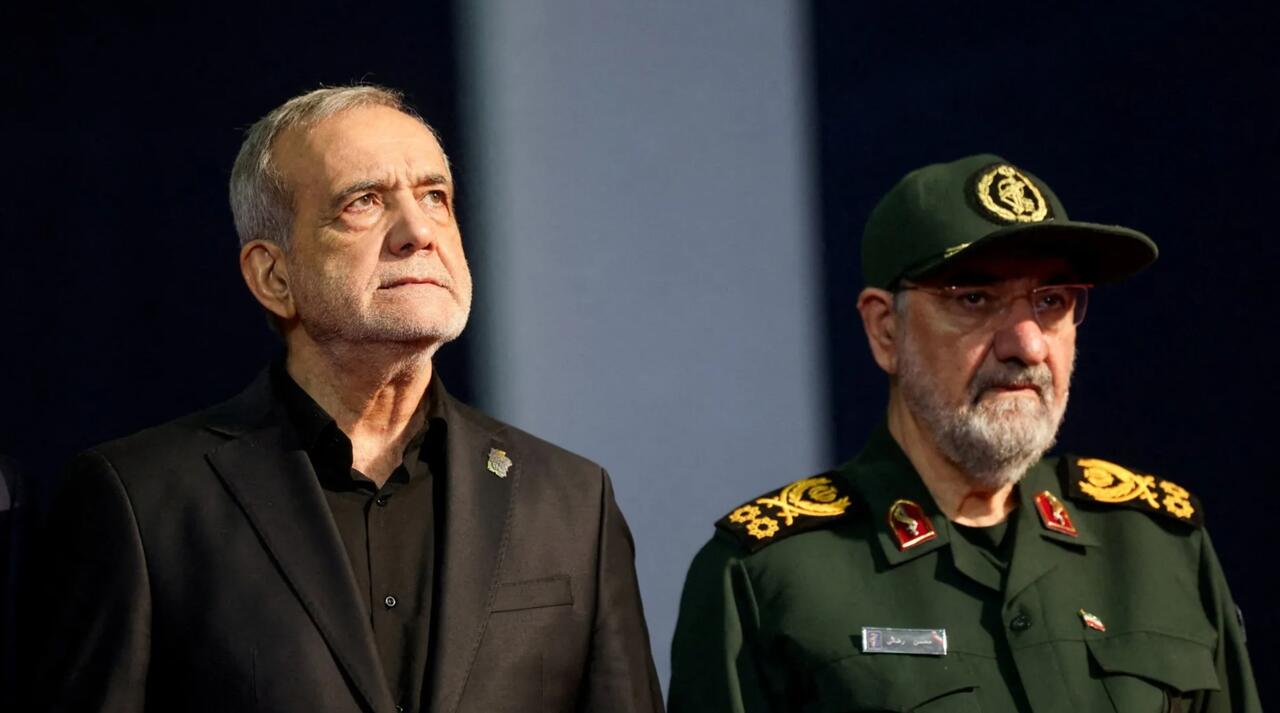
  • Iran rejects U.S. narrative: The IRGC says its missile program remains intact and claims it is firing larger salvos with heavier warheads, while officials insist Iran, not Washington, will decide when the war ends.

  • Regional escalation especially in Lebanon: Heavy IDF fighting continues with Hezbollah in Lebanon, while Gulf states intercept missiles and drones, and all the while Iranian leaders say US and Israeli regime-change efforts have failed and vow to prepare for a “long war” – even involving those who host American bases in region.

* * *

Ten days of Operation Epic Fury have passed, and War Secretary Pete Hegseth asserted that the United States is “winning” against the “barbarian” Iranians, and that Tehran has been “racing” toward a nuclear bomb.

He listed in a Pentagon press briefing Tuesday morning that war objectives are to destroy missiles and the defense industrial base, to destroy Iran’s navy, and to ensure Iran can never obtain a nuclear weapon. He stressed that the goal includes to “permanently deny Iran nuclear weapons forever.

He added: “We will not relent until the enemy is totally and entirely defeated.” This comes the day after President Trump said that he believes the war could end soon, even as Iranian officials signal they are preparing for a prolonged conflict.

AFP/Getty Images

“I think the war is very complete, pretty much,” Trump told CBS News. “They have no navy, no communications, they’ve got no air force.” Hours later in afternoon remarks from Florida, Trump warned that Iran would face massive retaliation if it tried to disrupt global oil flows, saying the United States would strike Tehran “20 times harder” if it attempted to block tankers in the Strait of Hormuz.

The Pentagon’s Tuesday morning briefing really emphasized steady destruction of Iranian missile sites – even underground ballistic launch bunkers – with heavy bunker busters. However, the Islamic Revolutionary Guard Corps (IRGC) has rejected Washington claims that its missile program has been destroyed, saying it is launching larger volleys of missiles with warheads weighing more than one ton.

Iran has continued retaliatory strikes on Israel and Gulf allies, including in Bahrain, Kuwait, the United Arab Emirates, and Saudi Arabia. One person was killed in Manama and two others were killed in central Israel Monday into Tuesday.

While Israel’s military has heavily censored potential damage on the ground and the rate of Iran’s missile and drone attacks, unverified but widespread online accounts suggest it continues to get hit hard on a nightly basis.

Tehran meanwhile has experienced some of the heaviest bombardment of the war overnight, with at least 40 people reported killed near Risalat Square. Since the start of the war, at least 460 people have been killed and 4,309 wounded in Tehran alone, according to the figures of Mehr Soroush, deputy head of the Tehran Emergency Health Department. The Iranian capital is densely packed with a size and population comparable to New York City.

Across Iran, more than 1,200 people have been killed and over 10,000 injured. Even the newly named Supreme Leader, Ayatollah Mojtaba Khamenei, may have been injured – reportedly before he was declared head of the country, state media has suggested.

Mohammad Jamalian, a member of Iran’s parliamentary health committee, has said nine hospitals are no longer operational due to the ongoing bombardment. Pharmaceutical stockpiles remain sufficient for about six months, he has described according to Al Jazeera, while non-elective surgeries have been suspended to free hospital capacity for emergency cases.

The conflict continues to expand regionally, with the Bahrain military saying it has intercepted and destroyed 105 missiles and 176 drones since Iran began attacks on countries hosting American forces. There remains a big open question on whether Gulf Cooperation Council (GCC) countries will send their militaries to formally enter Operation Epic Freedom. Hawkish Senator Lindsey Graham has certainly been calling for it, saying the Gulf should do much more in its own defense.

Israel’s northern front also remains active, with Israeli strikes in Lebanon having pushed the death toll there to at least 486 people as Israel and Hezbollah continue exchanging fire.

“Rally round the flag” effect in the wake of Trump’s ‘shock and awe-style’ bombs on Tehran and elsewhere…

Israeli officials are also signaling that the war is far from over, with Prime Minister Benjamin Netanyahu saying in a visit to IDF troops, “Our aspiration is to bring the Iranian people to cast off the yoke of tyranny; ultimately, it depends on them. But there is no doubt that with the actions taken so far, we are breaking their bones – and we are not done yet.”

As for the narrative from Tehran, leaders remain defiant – also as there’s some degree of evidence of a “rally around the flag” effect, meaning Iranians have been filmed out in the street pledging allegiance to the nation and the new Supreme Leader. Iranian officials are loudly and boldly declaring Washington and Tel Aviv failed in their initial war objectives.

Foreign Minister Abbas Araghchi said the appointment of Mojtaba Khamenei has proven that regime change efforts have collapsed. “They thought that, in a matter of two or three days, they can go for a regime change, they can go for a rapid, clean victory, but they failed… they failed to achieve their goals at the beginning, and now, after 10 days, I think they are aimless,” Foreign Minister Araghchi told PBS News Hour.

Araghchi also rejected claims that Iran is responsible for rising oil prices and disruptions to global shipping, describing that “This is not our plan” and that “The oil production, the transportation of oil has been slowed down or stopped not because of us, because of the attacks and aggression made by Israelis and Americans against us.”

Iran says it is still prepared for a “long war” and to fight to the end. On the question of closing Hormuz, the Iranian top diplomat claimed, “We have not closed that strait. We are not preventing them to navigate in that strait. But this is the result of the aggression by Israelis and Americans, which has made the whole region insecure, unstable.” Additionally the IRGC has said that Iran, not the United States, will determine when the war ends.

Pressed on Iranian strikes targeting oil facilities in the region, Araghchi insisted Tehran is acting in self-defense. “We are facing an act of aggression, which is absolutely illegal. And what we are doing is the act of self-defense, which is legal and legitimate.”

“Well, we have already warned everybody in the region that, if the US attacks us, since we cannot reach the American soil, we have to attack their bases in the region, their facilities, their installations, their assets.”

Iran’s foreign ministry has also taken the opportunity to fire back at European Commission President Ursula von der Leyen after she said the Iranian people “deserve freedom, dignity, and the right to decide their own future.”

“Please spare the hypocrisy,” foreign ministry spokesman Esmaeil Baqaei wrote on X. “You’ve made a career out of standing on the wrong side of history — green-lighting occupation, genocide, and atrocities, and now laundering U.S./Israeli crime of aggression and war crimes against Iranians.”

“Where was your voice when more than 165 innocent IRANIAN little angels were massacred in the city of Minab?” he questioned. “Why don’t you say anything when hospitals, historical sites, oil facilities, diplomatic police headquarter, firefighting stations and residential neighborhoods are wickedly targeted?” He concluded that it’s been: “Silence in the face of lawlessness and atrocity is nothing less than complicity.”

Tyler Durden
Tue, 03/10/2026 – 09:00

After 144 Years In New Jersey, Exxon Asks Shareholders To Back Texas Move To Cut Litigation Risks

After 144 Years In New Jersey, Exxon Asks Shareholders To Back Texas Move To Cut Litigation Risks

Whether it is Chevron, Tesla, Oracle, Caterpillar, CBRE, Fisher Investments, and/or an expanding roster of other major companies, corporate America has spent the better part of the post-Covid era shifting headquarters to Texas for one simple reason: the state offers a much more business-friendly environment than left-leaning blue states.

In a proxy filing on Tuesday, Exxon Mobil asked shareholders to approve moving its legal domicile from New Jersey to Texas after more than a century in New Jersey.

The main reason executives want to move to the red state is its friendlier business climate, which offers more predictable decision-making and could also reduce exposure to frivolous lawsuits.

“The Texas Redomiciliation may reduce the risk of future frivolous litigation against the Texas Corporation and its directors and officers,” Exxon wrote in the filing.

If approved at Exxon’s May 27 shareholder meeting, the company would be governed by Texas law on issues such as bylaws, director duties, and shareholder rights. Exxon noted that most of its senior leadership and about a third of its global workforce are already based in Texas.

Exxon’s evolution from its Standard Oil days has left it incorporated in New Jersey since the 1880s, and its attempt to move is yet another example of corporate America abandoning states run by left-wing politicians pushing a failed green agenda and other destructive progressive policies in favor of red states governed by common sense.

Here’s a partial list of physical headquarters moved to Texas:

  • Chevron — from San Ramon, California, to Houston, announced in August 2024.

  • Tesla — from Palo Alto, California, to Austin, announced in 2021.

  • Oracle — from Redwood City, California, to Austin, announced in 2020.

  • Caterpillar — from Illinois to Irving, Texas, announced in 2022.

  • Hewlett Packard Enterprise — from San Jose, California, to Spring, Texas, announced in 2020.

  • CBRE — from Los Angeles to Dallas in 2020.

  • Frontier Communications — from Connecticut to Dallas in 2023.

  • Fisher Investments — from Washington to Plano in 2023.

  • Professional Bull Riders (PBR) — from Colorado to Fort Worth in 2024.

  • Verily Life Sciences — from California to Dallas in 2024.

The Texas governor’s office reports that Texas logged 314 headquarters relocations from 2015 to 2024, including 24 in 2024 alone.

Now, Texas is taking on Wall Street with its own exchange, the Texas Stock Exchange.

Tyler Durden
Tue, 03/10/2026 – 08:45

ADP Signals Best Job Gains In Almost 4 Months, As BLS Payrolls Plunged

ADP Signals Best Job Gains In Almost 4 Months, As BLS Payrolls Plunged

For the four weeks ending February 21, 2026, ADP reports that private employers added an average of 15,500 jobs a week. 

Employment gains reached their highest since Thanksgiving week last year, holding steady in February after five straight weeks of strengthening. 

This positive labor market signal stands in the face of last week’s surprised plunge in non-farm payrolls – driven by a strike-triggered drop in Healthcare jobs and a huge revisions in the labor force as native workers suddenly disappeared.

Combined with the ongoing strength of the jobless claims data, once could argue that the ‘no hire, no fire’ economy is edging back towards jobs growth.

Tyler Durden
Tue, 03/10/2026 – 08:39

Futures Slide, Reversing Overnight Gains As “Off-Ramp Optimism” Fades

Futures Slide, Reversing Overnight Gains As “Off-Ramp Optimism” Fades

S&P futures are unchanged this morning, but approaching session low, following Trump comments that appeared to be the first signs of an off-ramp which however were followed by renewed fighting in the Middle East. While the risk is of re-escalation, JPMorgan writes that we are “seeing a global unwind of war-related trades as the market awaits additional news from US, Israel, Iran” but with headlines like this it will hardly last *IRAN BEGINS NEW WAVE OF MISSILE STRIKES ON NORTHERN ISRAEL: TV.  As of 8:00am, S&P futures are down 0.2%, and Nasdaq futs turn red even as Mag7 and Semis help Tech outperform with AI themes working across regions. TSMC sales worth noting up 30% in the first two months of the year. ORCL post close in focus on the tech/AI front. Global markets snapped higher with the batshit insane KOSPI leading up 535bps one day after being halted limit down (again), Europe rises ~200bps, depending on the market, having yesterday unwound all YTD gains. UK consumer sentiment dropped to a four-month low in March, reversing gains made at the start of the year. WTI is still down -7% but reversing rapidly amid the latest shooting headlines: crude traded in quite a band with WTI touching $120 yesterday as well as $80, setting $89 so far this morning; European gas prices are down 13% to sub $50as well. Copper, gold not really moving. 10-year off yesterday’s lows +3bps to 4.13%, Dollar lower, DXY at $99 and Bitcoin risk on up 250bps to $70.7k.  Today’s macro data focus is on NFIB Small Biz Survey, weekly ADP, and existing home sales. NFIB out early here this morning small step back 98.8 vs. 99.6 survey and 99.3 last month – index has been hovering around these levels since mid-2025 post tariff concerns.

In premarket trading, Mag 7 stocks are mostly higher (Tesla +0.8%, Meta Platforms +0.6%, Amazon +0.3%, Alphabet +0.2%, Nvidia +0.1%, Microsoft unchanged, Apple -0.1%)

  • BioNTech SE ADRs (BNTX) slump 17% after the vaccine maker forecast revenue for 2026 that fell short of Wall Street’s expectations. Also, the company’s founding duo plan to leave to start a new biotech focused on messenger RNA, the technology behind their blockbuster Covid-19 vaccine.
  • Casey’s General Stores (CASY) slips 2% after the convenience-store operator reported revenue for the third quarter that missed the average analyst estimate.
  • Crowdstrike Holdings Inc. (CRWD) gains 2% after Morgan Stanley raised its recommendation to overweight, saying the platform is a winner from AI positioning and its growth outlook is promising.
  • Hewlett Packard Enterprise (HPE) rises 1.6% after the company’s outlook for revenue in the current quarter exceeded analysts’ estimates, a sign the company is benefiting from solid demand for hardware that helps customers run AI workloads.
  • Kohl’s (KSS) falls 7% after reporting worse-than-expected sales for last quarter, as the retailer continues to struggle to revive years of declining results.
  • Teladoc Health (TDOC) rises 8% after Deutsche Bank upgraded the virtual health-care provider to buy, citing a compelling valuation and a potential exit scenario.
  • Vertex Pharmaceuticals (VRTX) rises 6% after the drugmaker gave interim results from a late-stage trial of its experimental therapy for a rare autoimmune kidney disease. William Blair views the data as a “clear win” for the company.
  • Zevra Therapeutics (ZVRA) jumps 15% after the biotech reported adjusted diluted earnings per share for the fourth quarter.

In other corporate news, Disney is said to be close to naming Thomas Mazloum, current head of Disneyland California, as chairman of the company’s parks division. Apple increased iPhone production in India by about 53% last year and now makes a quarter of its marquee devices there. Lego plans to invest heavily in the US, eyeing further gains in market share. Elsewhere on the data front, China’s trade growth accelerated sharply in Jan-Feb (exports +21.8% y/y, imports +19.8% y/y) and came in well above expectations. Chinese nominal exports to major trading partners rose sequentially in Jan-Feb.

Global markets moved risk on in early trading with oil extending declines after Trump’s comments sparked optimism that the war with Iran will end soon. It’s possible that geopolitical risk has peaked, said JPMorgan’s head of International Market Intelligence, but “the tape still feels pretty tentative.” And indeed, futures have since sunk and oil is rebounding following reports this morning of renewed fighting in the Middle East. Trump said he would waive oil-related sanctions and have the Navy escort tankers through the Strait of Hormuz. He’s also said to be weighing options like the release of emergency stockpiles.

“The war in Iran is not over and can intensify again at any moment,” said Joachim Klement, head of strategy at Panmure Liberum. “Any gains will remain limited until there are clear signs of an end to hostilities in the Gulf and shipping through the Strait of Hormuz improves again.”

According to Goldman trader John Flood, while the market has proven it has the ability to move violently in both directions with dealers short gamma right now, right tail (squeeze) risk at the index level is primed to be the most extreme. HF gross leverage is essentially at an all time high driven by continued shorting (hedging) via macro products. Per GSPB short exposure in US Macro Products (Index + ETF) – as % of total US Gross MV on our Prime book – now stands at the highest level since Sep ’22 and ranks in the 93rd percentile vs. the past five years. Yet at the same time, Goldman Sachs cross-asset strategists turn tactically neutral on stocks and overweight on cash for three months, citing mounting risks that the Middle East conflict may spark an energy shock comparable to those of the 1970s.

And while investors often focus on the VIX as the main gauge of market fear, Europe’s underperformance versus the US since the Iran strikes has pushed European volatility higher and widened the V2X/VIX spread.

While AI had taken a backseat in markets amid Iran, but there are a few interesting datapoints to note today. TSMC, the go-to chipmaker for Nvidia, reported a 30% jump in sales in the first two months of the year. HPE gave quarterly revenue guidance that beat estimates, showing the company is benefiting from AI hardware demand. Oracle is reporting after the close, with Tech Watch noting that skittish investors are looking for reasons to sell.

In political news, several Senate Democrats are threatening to force numerous war powers votes and disrupt the chamber unless Republicans agree to hold public hearings on the reasons for the attacks on Iran. A key Republican senator said he’s launched an investigation into the FDA’s recent denials of treatments for rare diseases. And a top Pentagon official sees little chance of resuming negotiations with Anthropic.


BioNTech and NIO are among companies due to report results before the market open. Focus will be on BioNTech’s outlook for 2026, according to BI. Earnings from Oracle and Franco-Nevada follow later in the day. Oracle might be more susceptible to cost pressures versus hyperscalers according to BI, which expects adjusted gross margin to contract roughly 400-500 bps in fiscal 2026.

Stoxx 600 up by 2.2%, with banks, tech and travel stocks leading the way, while energy stocks lag as crude declines.

Earlier in the session, Asian stocks recovered Tuesday, lifted by an overnight Wall Street rally and easing inflationary risks after President Donald Trump signaled that the Iran war may end soon. The MSCI Asia Pacific Index rose as much as 3.4%, retracing yesterday’s losses. Chipmakers TSMC, Samsung and SK Hynix led the region’s advance, while Australia’s Woodside Energy paced decliners. Equity markets across the region are holding onto fresh optimism after Trump said the war with Iran would be resolved “very soon.” Tuesday’s rebound highlights how quickly markets react to headlines from the Middle East, while cross-asset volatility shows little sign of easing in a fast-moving geopolitical environment. Oil prices plunged in Asia trading following Trump’s comments.

In FX, the Bloomberg Dollar Spot Index slipped 0.3% on Tuesday, following US President Donald Trump’s comments that the war with Iran would be resolved “very soon.” The greenback’s G10 peers are paring last-week’s losses, led by the Australian dollar and Swiss franc which are up 0.47% and 0.27% respectively.

In rates, treasuries are under slight pressure in early US trading, unwinding a portion of the late-Monday bid sparked by US President Trump’s suggestion that the strikes on Iran that caused oil prices to surge in the past week may end soon. This week’s three Treasury auctions begin with 3-year new issue at 1pm New York time; 10- and 30-year reopenings follow over next two days.  US yields are 2bp-4bp cheaper with losses led by long-end tenors, steepening 2s10s by about 1bp, 5s30s about 2bp; 10-year near 4.12% is about 2bp cheaper as European bonds outperform, narrowing performance gap that opened Monday when Treasuries rallied after the London close.  UK leading the rally in European bonds, with two-year yields down eight basis points. Yields falling across Europe, with the biggest moves at the short end, though the rally has pared. For $58 billion 3-year note auction, WI yield around 3.578% is 6bp cheaper than last month’s auction, which stopped through by 0.1bp

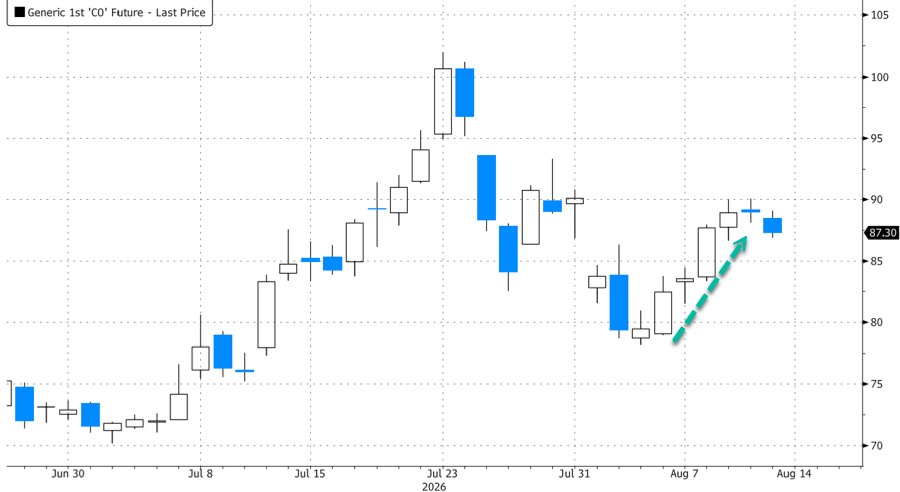
In commodities, WTI crude futures are back to around $89/barrel after peaking near $120 on Monday. Gold higher to test $5,200/oz. Bitcoin rallying back towards $71,000.

US economic data slate includes weekly ADP employment change (8:15am) and February existing home sales (10am)

Market Snapshot

  • S&P 500 mini -0.3%
  • Nasdaq 100 mini -0.2%
  • Russell 2000 mini -0.2%
  • Stoxx Europe 600 +1.9%
  • DAX +2.1%
  • CAC 40 +1.7%
  • 10-year Treasury yield +1 basis point at 4.11%
  • VIX -1.8 points at 23.66
  • Bloomberg Dollar Index -0.2% at 1198.68
  • euro little changed at $1.1645
  • WTI crude -8.3% at $86.8/barrel

Top Overnight News

  • “It’s [the war] going to be ended soon,” Trump said later at a news conference. Trump did not put a timeline on the end of the war, though, when he was pressed for details. Asked how he squared saying that the war would end “soon” with Defense Secretary Pete Hegseth’s remarks that the attacks are “only just the beginning” during a “60 Minutes” interview taped Friday, Trump said, “I think you could say both.” CNBC
  • Trump said he was eyeing a quick end to the war in Iran, as some of his advisers privately urged him to look for an exit plan amid spiking oil prices and concerns that a lengthy conflict could spark political backlash. A few senior officials in Israel are starting to voice concern about the escalating, open-ended attack on Iran — and suggesting possible exit ramps that might halt the war before it further damages the region and the global economy. WSJ, WaPO
  • Iran’s Revolutionary Guards said on Tuesday they would not let any oil out of the Middle East until U.S. and Israeli attacks cease, prompting U.S. President Donald Trump to threaten to hit Iran “twenty times harder” if it blocked exports. RTRS
  • China’s exports surged 21.8% YoY in dollar terms in January and February, putting the world’s 2nd largest economy on course for another year of record trade surpluses weeks before Trump and Xi are set to meet in Beijing. Export growth in first 2 months of the year far exceeded the median forecast of 7.1% from a Reuters survey and the 6.6% increase in December. FT
  • Apple Inc. increased iPhone production in India by about 53% last year and now makes a quarter of its marquee devices there, reflecting the US company’s efforts to avoid tariffs on China. BBG
  • TSMC’s sales rose 30% in the first two months of the year, driven by strong AI infrastructure buildout. BBG
  • Japan’s annualized GDP growth was revised higher to 1.3% for the fourth quarter, beating estimates, on stronger business investment. BBG
  • UK consumer sentiment dropped to a four-month low in March, reversing gains made at the start of the year. The BRC said British retail sales grew modestly in February. BBG
  • A top Pentagon official sees little chance of resuming negotiations with Anthropic PBC over military use of its artificial intelligence tools following the company’s legal challenge of an unprecedented government move to declare the firm a supply-chain risk. BBG

A more detailed look at global markets courtesy of Newsquawk

APAC stocks rose with global risk sentiment underpinned after oil price pressures eased on a potential G7 joint release of emergency reserves, and with relief seen after US President Trump said the war in Iran could end very soon. ASX 200 rallied with gains led by outperformance in miners, materials, tech and healthcare, while there was little reaction seen to the improved consumer sentiment and mixed business surveys. Nikkei 225 reclaimed the 54,000 status amid softer yields and as exporters cheered the pullback in energy prices. There were also several data releases, including the final Q4 GDP, which either matched the preliminary numbers or were revised upwards, although Household Spending disappointed. Hang Seng and Shanghai Comp were in the green, although the mainland bourse lagged behind its regional peers after reports that the US and China clashed over fentanyl and tariffs at a global drugs meeting, while the Trump administration told Beijing it expects to reimpose the fentanyl-related levy ⁠under a different law.

Top Asian News

  • Chinese Balance of Trade (Jan-Feb) 213.62B vs. Exp. 179.6B (Prev. 114.10B, Rev. From 114.1B).
  • Chinese Exports YoY (Jan-Feb) Y/Y 19.2% vs. Exp. 7.1% (Prev. 6.6%).
  • Chinese Imports YoY (Jan-Feb) Y/Y 19.8% vs. Exp. 6.3% (Prev. 5.7%).
  • Japanese GDP Growth Rate QoQ Final (Q4) Q/Q 0.3% vs. Exp. 0.3% (Prev. -0.6%, Rev. From -0.7%, Low. 0.1%, High. 0.4%).
  • Japanese GDP Growth Annualized Final (Q4) 1.3% vs. Exp. 1.2% (Prev. -2.3%, Rev. From -2.6%, Low. 0.3%, High. 1.5%).

European bourses (STOXX 600 +2.1%) have rebounded from Monday’s losses, with many of the indices returning out of correction territory (>10% pullback from ATHs). The IBEX 35 (+3.1%) is the outperformer, with gains in Santander (+5.9%) supporting the index after the Co.’s President bought 300,000 shares for almost EUR 3mln, as well as the improvement in overall risk tone. The brighter risk  environment follows Monday’s comments by US President Trump, who suggested that the Iran war could be coming to an end. European sectors are in the green, ex-Energy (-0.7%). Sectors that have been hit the hardest due to the Iran war have seemed to have bounced the highest this morning, with Banks (+4.1%), Basic Resources (+3.5%) and Travel and Leisure (+3.5%) sitting near the top of the pile.

Top European News

  • French Balance of Trade (Jan) -1.8B vs. Exp. -4.6B (Prev. -4.3B, Rev. From -4.8B).
  • French Exports (Jan) 53.4B (Prev. 53.0B, Rev. From 53.1B).
  • French Imports (Jan) 55.3B (Prev. 57.3B, Rev. From 57.9B).
  • German Balance of Trade (Jan) 21.2B vs. Exp. 15.2B (Prev. 17.1B, Rev. From 17.1B).
  • German Imports MoM (Jan) M/M -5.9% (Prev. 1.4%).
  • German Exports MoM (Jan) M/M -2.3% vs. Exp. -2% (Prev. 4.0%, Rev. From 4%, Low. -2%, High. -1.5%).
  • Italian PPI YoY (Jan) Y/Y -1.6% (Prev. -1.4%).
  • Italian PPI MoM (Jan) M/M 1.5% (Prev. -0.7%).

FX

  • DXY initially traded flat, before slipping a touch as the morning progressed. Today’s current range is contained within 98.492-98.939 at the time of writing. The day ahead of the US sees weekly ADP and Existing Home sales, although price action will likely be dictated by sentiment surrounding geopolitics.
  • EUR/USD is flat with a mild upward bias, but consolidating after yesterday’s Trump-led slide in the USD, with the pair notching a 1.1507-1.1637 range on Monday, vs the current 1.1606-1.1636 range thus far on Tuesday. No move was seen to the German Trade Balance data. As above, price action will likely be dictated by geopolitical and/or energy updates.
  • GBP/USD is among the better performers with Cable rising above its 200 DMA (1.3443) to a current high of 1.3483 (vs low 1.3413). This follows yesterday’s surge above its 100 DMA (1.3398) amid the aforementioned USD price action, with Tuesday’s range between 1.3282 and 1.3446.
  • USD/JPY lacked direction overnight, and continues to trade sideways this morning after slipping beneath the 158.00 level yesterday, with little reaction to a batch of data releases from Japan, including Q4 GDP revisions that either matched or exceeded the preliminary numbers, while Household Spending surprisingly contracted. USD/JPY currently resides within 157.27-157.96 vs Monday’s 157.63-158.90 range.
  • Antipodeans are mixed with AUD/USD outperforming amid firmer copper prices and better-than-expected Chinese trade data overnight, which showed double-digit percentage jumps in exports and imports for Australia and New Zealand’s largest trading partner. AUD/NZD, meanwhile, has risen back above 1.1950 and edges closer to 1.2000.
  • NOK weakened in the aftermath of softer-than-expected CPI data, with the pair, in a delayed reaction, lifting from 11.1350 to 11.1650 in the five minutes following the release, before hitting an 11.1825 peak around 20 minutes later. The pair made a session high at 11.2334, before pulling back towards the 11.1900 mark.

Fixed Income

  • A bullish start for fixed, as the complex continues to unwind the energy-induced sell-off from the start of the week.
  • USTs are firmer by 10 ticks and at the top of a 112-14+ to 112-24+ band. Continuing to grind higher as energy benchmarks remain under pressure. The US day ahead is primarily a waiting game for any further administration updates on the timeline of the conflict, in addition to a 3yr tap.
  • The upside today is most pronounced in Gilts as they catch up to the late Monday commentary from Trump, that the Middle East conflict could be over soon. Gilts gapped higher by 57 ticks, eclipsing the 91.00 handle before continuing to a 91.39 peak, taking out Friday’s 91.25 best. If the move continues, there is a bit of a gap before the 92.00 mark and then a cluster of levels just above. Given this, yields have pared notably. The UK 10yr notched a 4.79% peak yesterday, its highest since 4.86% from the 3rd of September 2025. This morning, the 10yr has been as low as 4.53%.
  • Bunds are bid, even though the benchmark lifted by over 50 ticks late Monday on the Trump interview. Currently, firmer by 33 ticks but around 25 off a 127.53 peak. Similarly to Gilts, a bit of a gap now before the 128.00 mark and then a cluster of recent levels above. For the ECB, the action has helped markets to calm from the extreme pricing adjustments on Monday. Where, at one point, two 25bps hikes were priced. Currently, around 20bps of tightening is implied by end-2026, vs. c. 7bps this time last week.

Commodities

  • Crude futures declined and have completely retraced this week’s opening surge. Downside follows comments from US President Trump, who suggested that the war with Iran will end soon. However, comments from the Iranian side this morning has shown little sign of constructive relations, as the Iranian Parliament Speaker said they do not seek a ceasefire. WTI Apr resides towards the middle of USD 84.43-91.48/bbl, while Brent May similar trades mid-range of USD 88.05-98.04/bbl.
  • Nat Gas futures were similarly hit, with Dutch TTF this morning -15% and under EUR 50/MWh once again, with the market aggressively “pricing out” the previous risk premium amid US President Trump’s comments.
  • Spot gold continues to edge higher, with the metals complex helped by recent dollar softening and as buying resumed amid hopes of a nearing conclusion to the hostilities and disruption in the Middle East. Spot gold trades towards the upper end of a USD 5,117.51-5,195.40 /oz range vs Monday’s hefty USD 5,014.58-5,192.04/oz parameter, in which gold closed at USD 5,136.60/oz.
  • Copper futures advanced alongside the improvement in risk appetite, with little initial reaction seen to the latest trade data from the red metal’s largest buyer, China. To recap, Trade Balance, Imports, and Exports smashed expectations. China combined its Jan-Feb data to account for the Lunar New Year holiday distortions. 3M LME copper resides in a USD 12,992.00- 13,129.00/t.
  • G7 Energy Ministers to meet at 12:45GMT / 08:45EDT.
  • Saudi Aramco CEO sees global oil demand to reach record high of 107.3mln BPD in 2026.
  • Saudi Aramco CEO said there is a disruption of around 180mln barrels so far; there are no problems related to storage capacity locally or internationally; CEO declines to comment on current oil production levels. “We will operate the East-West Pipeline at full capacity within two days”. Have 2mln BPD of spare capacity, so if there are any shutdowns amid the current situation, bringing that spare capacity back will take a matter of days.
  • Saudi Aramco plans to increase refining capacity in strategic regions.
  • Saudi Arabia, UAE, Iraq and Kuwait reportedly cut oil output by as much as 6.7mln BPD in total, Bloomberg reported citing sources.
  • Shanghai Futures Exchange announced the adjustment of price limits and margin ratios for some fuel oil, petroleum asphalt and butadiene rubber futures.
  • Taiwan’s Formosa Petrochemical (6505 TT) declares a force majeure on some supplies.
  • Taiwan’s Cabinet said it is to further cut the commodity tax on gasoline and diesel to 50%.
  • Japan’s Trade Minister Akazawa said Japan supports the IEA-led coordinated release of strategic oil reserves.
  • Japan’s Chief Cabinet Secretary Kihara reiterates no decision has been made on releasing strategic oil reserves.

Central Banks

  • ECB’s Muller said the chance of rate hit has increased but should not rush, need to see if the surge in energy prices is transitory or not.
  • ECB’s Simkus said it is important to stay calm until the next policy decision and not to over react, we are aware of the recent changes in market pricing but should stay the course for now.
  • RBA Deputy Governor Hauser said Australia’s economy is overall in good shape and there will be a very genuine policy debate at the board meeting, with arguments on both sides. A 5% peak for inflation probably looks a little on the pessimistic side; our response depends on size and persistence of the price shock, which is very uncertain. Inflation is too high. Oil price rise clearly an upside risk to the inflation projection but still in flux. Recent data seem to confirm even more decisively that the economy has limited spare capacity. Not all domestic data came in as strongly as expected, including consumption. Uncertainty over developments in Iran is extremely high. Data seems to confirm the economy has limited spare capacity.

Geopolitics

  • Iranian Parliament Speaker said we do not seek a ceasefire and believe in the necessity of teaching the aggressor a harsh lesson.
  • Iranian Army said we attacked the oil and gas refinery and fuel tanks in Haifa with drones, Al Hadath reported.
  • Iranian military said heavy fire will continue to rain down on aggressors.
  • Iranian Foreign Minister Araghchi said negotiations with the US are no longer on the agenda.
  • Iran’s ambassador to China said that passage through the Strait of Hormuz will be controlled, but the Strait will not be closed.
  • Iran’s Revolutionary Guards say they will not allow a single litre of oil to be exported from the region if the US and Israeli attacks continue, adds that they will determine how and when the war ends.
  • IRGC said the Strait of Hormuz will be open to any state that expels US and Israeli diplomatic envoys from its territory starting tomorrow.
  • Iran targeted US sites and depots in Kuwait in recent hours, according to Tasnim.
  • US President Trump said it’s going to be ended soon, and if it starts up again, Iran will be hit harder, while Trump responded ‘no, but soon’, when asked if the war will be done this week. said:. Big risk on Iran has been over for three days. We can leave it here but we are going to go further.
  • US President Trump said will hit Iran harder if it attempts to stop world oil supply, adds Strait of Hormuz will be safe and getting close to finishing it regarding ‘excursion’. said:. Waiving some oil-related sanctions and will take some sanctions off until this straightens out. Winning very decisively and way ahead of schedule.
  • US President Trump said we’re making major strides towards completing military objective and people could say they’re pretty well complete, left some of the most important Iran targets for later. said:. Iran’s missile capabilities are down to 10% or maybe less. Could hit Iran’s electric production, but don’t want to. We’re ahead of our initial timeline by a lot. Thinks Iran should put in a head that will be peaceful.
  • US President Trump’s advisors urged him to find an Iran exit ramp, fearing political backlash, according to WSJ.
  • US-Israel aggression targets houses in the Mehrshahr area of Karaj, western Iran, according to Mehr News Agency.
  • Russia’s Kremlin says the trilateral format of the Ukraine talks need to be continued, but no specific dates or locations have been agreed for the next round

US Event Calendar

  • 6:00 am: United States Feb NFIB Small Business Optimism, est. 99.6, prior 99.3
  • 10:00 am: United States Feb Existing Home Sales, est. 3.88m, prior 3.91m

DB’s Jim Reid concludes the overnight wrap

The past 24 hours has seen a dramatic roundtrip in oil markets as the seismic moves seen as we went to press yesterday gave way to increased optimism as President Trump suggested in the US afternoon that the war with Iran could be over “very soon”.  That eased concerns over a longer-term conflict that could trigger a major stagflationary shock and helped drive a turn lower in oil markets. Most notably, Brent crude oil prices pulled back from an intraday peak of $119.50/bbl before the European open to around $90 by the US close, though they’ve edged back up to $93.56 as I type. It even briefly traded as low as $83.66 late in the US session, which marks the largest daily nominal trading range since the start of the intra-day Bloomberg data in the 1980s when oil futures begun. The easing stress in oil markets rippled into other asset classes, with the S&P 500 (+0.83%) and 10yr Treasuries (-4.2bps) closing stronger on the day after a sharp initial sell-off.

While market stress had gradually eased through the course of yesterday’s session after peaking in Asia hours, the biggest turning point came after the European close as CBS reported Trump saying that “I think the war is very complete, pretty much”, with the US “very far ahead of schedule”. The President then delivered a similar message in a press conference after the US close, suggesting the war will “be finished pretty quickly”. Trump also focused on oil prices, again raising the option of US Navy escorts for tankers and floating the prospect of waivers for “certain oil-related sanctions to reduce prices”, without offering details other than he had discussed the topic in a call with Russia’s President Putin yesterday.

Those Trump comments helped ease market fears of a prolonged conflict that would turn into a more sustained energy shock. However, the timing for any resolution of the war remains far from clear, with Trump also saying that “we haven’t won enough” and that he didn’t believe the conflict would be over this week. There are also doubts over Tehran’s willingness to de-escalate, with the IRGC releasing a statement last night that “It is we who will determine the end of the war” and that it would not allow oil to be shipped from the Middle East if US and Israeli attacks continue. In turn, that prompted Trump to escalate his threats last night, posting that “If Iran does anything that stops the flow of Oil within the Strait of Hormuz, they will be hit by the United States of America TWENTY TIMES HARDER than they have been hit thus far”. And we’ve seen Israel launch a new wave of strikes against Iran overnight, with Gulf countries in turn reporting Iranian strikes.

The lingering uncertainty has seen oil prices tick slightly higher overnight, with Brent crude up to $93.56 from around $90 at the US close yesterday, though that’s still below the $99.40 level they were before the CBS report yesterday evening and some 25% below yesterday’s intra-day highs. Investors will be keenly watching for any signs that shipping via the Strait of Hormuz can pick up from the current all but suspended levels, not least as yesterday Saudi Arabia became the latest country to start cutting oil production. Remember that the oil moves have been much more contained further out the futures curve, with December 2026 Brent futures currently trading at $74.95/bbl. We will also be watching whether plans to release oil reserves materialise. Yesterday’s virtual G7 finance ministers’ meeting didn’t get to that point yet, with their statement saying they “stand ready to take necessary measures”, and France’s finance minister said they were “not there yet”. Overnight, Japan’s Finance Minister Katayama said that G7 energy ministers are expected to meet to discuss the process of oil reserve release today.

Markets in Asia are of course rebounding this morning given the timing of the Trump speech, with the KOSPI rising by +4.63% and the Nikkei increasing by +2.55%, both recovering sharply after having closed nearly -6.0% and over -5.0% lower yesterday, respectively. Elsewhere, Chinese stocks are also on the rise, with the Hang Seng index increasing by +1.76%, outperforming the CSI (+1.09%) and the Shanghai Composite (+0.39%). The S&P/ASX 200 is +0.85%. Europe’s STOXX 50 futures (+1.00%) are reversing Monday’s decline but those on the S&P 500 (-0.20%) have dipped in the absence of imminent de-escalation.

Coming back to China, the trade surplus (+$213.62 bn) rose to its highest on record in the combined January-February period (v/s $176.10 bn expected) while exports rose +21.8% y/y, beating the +7.2% growth expected, underscoring the resilience of the world’s second-largest economy despite trade tensions with the US.

Looking back at yesterday’s moves, the volatility in oil prices reverberated through rates markets, especially when it comes to inflation pricing. For instance, the 1yr US inflation swap moved as high as 3.10% intra-day before closing all the way down at 2.75%, -15.5bps lower on the day, with a near 20bps decline after the CBS story broke shortly after 3pm EST. And the news saw yields on 2yr (-2.4bps to 3.54%) and 10yr (-4.2bps to 4.10%) Treasuries close at the session’s lows after a 10-12bp intra-day range that saw 10yr yields peak at 4.21% just before London opened. Treasury yields are edging higher overnight, with the 10yr +1.5bps higher as the pattern of underperformance during Asia hours is again repeating, albeit mildly.

For equity markets, the turn in sentiment helped the S&P 500 recover to +0.83% by yesterday’s close after rebounding by more than 1% in the final hour of trading. S&P 500 futures had been down as much as -2.4% in Asia hours yesterday. The NASDAQ (+1.38%) and the Russell 2000 (+1.12%) posted even stronger recoveries, while the VIX index fell by -3.99pts on the day to 25.50 after peaking above 35 at the European open. 

Over in Europe, markets recovered from the lows early in the session but closed before Trump’s comments to CBS News triggered the more risk-on tone. That left the STOXX 600 -0.63% lower on day, up from -2.46% shortly after the open, while the CAC (-0.77%) and DAX (-0.98%) saw slightly larger declines. Most sovereign bonds saw a fuller reversal of the sell-off, with yields on 10yr bunds (-0.4bps), OATs (-0.5bps) and BTPs (-0.9bps) all little changed by the close, having been between +7bps and +15bps higher on Monday morning as inflation concerns mounted. One bond market that struggled to fully recover was UK gilts, with markets at one point pricing in 20bps of BoE rate hikes this year, from pricing more than 50bps of rate cuts before the strikes on February 28. While 2026 BoE hikes were largely priced out by yesterday’s close, 2yr gilts yields were still +11.7bps higher at 3.99%, with 10yr yields +2.0bps on the day.

Looking at the day ahead, data releases from the US include the existing home sales for February, and the NFIB’s small business optimism index for February. Otherwise from central banks, we’ll hear from the ECB’s Simkus and Muller.

Tyler Durden
Tue, 03/10/2026 – 08:30

As Trade Growth Surged, Goldman’s One-Delta Desk-Head Asks “Is China Done Exporting Deflation?”

As Trade Growth Surged, Goldman’s One-Delta Desk-Head Asks “Is China Done Exporting Deflation?”

China’s trade growth accelerated sharply in January-February (exports: +21.8% yoy, imports: +19.8% yoy) and came in well above consensus expectations, prompting Goldman’s Rich Privorotsky to ask:

Rebounding aggressively. China exports were strong and CPI came in hot earlier in the week, prompting the question: is China done exporting deflation?

Government data showed that exports soared 22% during the period, compared with a 7.2% median estimate from Wall Street analysts surveyed by Bloomberg. Imports jumped nearly 20%, according to a statement released Tuesday by the General Administration of Customs. The trade surplus came in at $214 billion, an all-time high for the January-February period.

Notably, both months are combined to smooth out any distortions caused by the Lunar New Year holiday.

Trade flows show China is becoming less reliant on the US market. Exports to the US fell 11%, while shipments to Africa surged nearly 50%. Exports to ASEAN rose more than 29%, and shipments to the EU climbed almost 28%.

This data shows Beijing is finding alternative markets as the Trump administration’s ‘America First’ agenda decouples from China.

Total exports for January nearly topped $357 billion, the second-highest on record, according to Bloomberg calculations based on official data.

Société Générale SA economist Michelle Lam said surging trade volumes in China were due to strong tech product demand driven by the artificial intelligence boom.

Among major categories and in sequential terms, import value of semiconductors increased the most, followed by metal ores and products, while import value of energy goods decreased (mainly from natural gas and coal). In year-over-year terms, chip imports continued to accelerate by 40.0% yoy in January-February.

Also on the import side, Crude volumes rose sharply in January and February as Beijing amassed reserves, pre-empting Mideast risks, and analysts say it provides a strong buffer for global supply disruptions.

China imported 96.93 million tonnes of crude in January and February, up 15.8 per cent from the same period in 2025, according to customs data released on Tuesday. The value of those imports, meanwhile, fell 5.2 per cent from last year in US dollar terms.

“China was accumulating oil and gas stockpiles [earlier this year], with the market expecting the US to strike Iran,” said Chim Lee, senior analyst at the Economist Intelligence Unit.

“It built on the record-breaking strong stockpiling momentum we saw in 2025.”

While highly exposed to Middle Eastern oil, China has built a substantial stockpile – which Lee estimated to be around 120 days of import cover – that provides a buffer against potential supply shocks.

“China should also benefit from AI supply chain-related goods,” Lam said. “That supports our view that there is no major growth risks despite modest stimulus this year, helped by export demand, with US-Iran situation risks to watch.”

The trade data comes after China’s consumer inflation accelerated to the highest in more than three years, while producer deflation persisted, with soft demand remaining a drag on the economy.

The positive start to the year came just before Operation Epic Fury in the Middle East upended global energy markets and commercial shipping lanes. This now poses a severe risk for the world’s largest exporter as the economic fallout from an energy shock may first weigh on industry.

Zichun Huang, China economist at Capital Economics, said, “Tensions in the Middle East will push inflation higher for as long as global energy prices remain elevated.”

“An extended conflict in an oil-producing region will fuel inflation, reduce room for monetary easing, and negatively affect global growth outlook — that, in turn, will affect China’s exports,” said Ding Shuang, chief economist for Greater China and North Asia for Standard Chartered Plc. “Given the uncertainty about how long the war will last, I think it is too early to think about stimulus. In fact, the growth target for 2026 was lowered partly to deal with an unpredictable situation like this.”

The trade and inflation data come just weeks before the summit between Chinese leader Xi Jinping and President Donald Trump to discuss ways to end the trade war. A potential mega Boeing-China jet deal may suggest positive results could emerge from the upcoming meeting.

Tyler Durden
Tue, 03/10/2026 – 07:45

Anthropic Sues Pentagon Over ‘Supply-Chain Risk’ Designation

Anthropic Sues Pentagon Over ‘Supply-Chain Risk’ Designation

Authored by Stacy Robinson via The Epoch Times (emphasis ours),

Artificial intelligence (AI) developer Anthropic sued the Department of War on March 9, following the federal government’s designation of the company as a supply chain risk.

The Anthropic logo, in this photo illustration. Dado Ruvic/Reuters

That designation hinders government agencies and their contractors from working with Anthropic.

The suit comes after the company refused to change the user policy for its AI tool Claude to allow the government to use it for what Anthropic described as “mass surveillance” and “fully autonomous weapons.”

The Pentagon has denied that it planned to use Claude for such purposes.

The refusal caused President Donald Trump and War Secretary Pete Hegseth to direct federal agencies to sever ties with Anthropic and state that “effective immediately, no contractor, supplier, or partner that does business with the United States military may conduct any commercial activity with Anthropic.”

On social media, both Trump and Hegseth accused Anthropic of trying to “strong-arm” the federal government by dictating its military policy.

WE will decide the fate of our Country—NOT some out-of-control, Radical Left AI company run by people who have no idea what the real World is all about,” Trump said in a Feb. 27 Truth Social post.

“Their true objective is unmistakable: to seize veto power over the operational decisions of the United States military,” Hegseth said on X the same day. “That is unacceptable.”

Anthropic alleges that the federal government is punishing the company for its First Amendment-protected speech and viewpoint.

The company also alleges that the Department of War reached out to some of its business partners following the rift and that those companies “delayed or paused several national security contracts or business engagements already in active development with Anthropic.” That puts “millions, possibly billions, of dollars at risk,” Anthropic stated.

These actions are unprecedented and unlawful,” Anthropic’s lawsuit reads.

“The Constitution does not allow the government to wield its enormous power to punish a company for its protected speech. No federal statute authorizes the actions taken here.

“Anthropic turns to the judiciary as a last resort to vindicate its rights and halt the executive’s unlawful campaign of retaliation.”

In its filing, Anthropic said it isn’t confident that Claude “would function safely or reliably” if used for those purposes. Anthropic’s suit asks the court to set aside Trump and Hegseth’s designation as unconstitutional.

The lawsuit also names the US Treasury and Treasury Secretary Scott Bessent, the State Department, and Secretary of State Marco Rubio, along with 17 other government agencies and officials.

A group of more than 30 AI engineers and scientists from OpenAI and Google, including the latter’s chief scientist, Jeff Dean, also filed a legal brief in support of Anthropic on Monday.

“If allowed to proceed, this effort to punish one of the leading U.S. AI companies will undoubtedly have consequences for the United States’ industrial and scientific competitiveness in the field of artificial intelligence and beyond,” the group wrote.

The Pentagon declined to comment on the suit.

The Pentagon previously said the company must accept “any lawful use” of its tools and technology to support the U.S. military.

Tyler Durden
Tue, 03/10/2026 – 07:20

Record Childhood Obesity Surge Puts MAHA Health Goals In Focus

Record Childhood Obesity Surge Puts MAHA Health Goals In Focus

Childhood obesity in the United States has reached its highest recorded level, renewing debate over school meals, physical activity, nutrition policy and the role of weight-loss medications for young people, according to The Hill. Data from the Centers for Disease Control and Prevention shows more than 1 in 5 children and teenagers were obese between 2021 and 2023, up from 5.2 percent in the early 1970s. About 7 percent now meet the criteria for severe obesity.

The issue has become part of the “Make America Healthy Again” initiative connected to Robert F. Kennedy Jr. at the U.S. Department of Health and Human Services. Discussions around solutions often center on improving school meals and increasing opportunities for physical activity.

Nutrition advocates say school meal programs play a critical role in children’s diets. For some students, breakfast and lunch at school are the most nutritious meals they receive each day. Erin Hysom of the Food Research & Action Center said pandemic school closures disrupted that support. “They’re noting that this increase in obesity occurred during COVID-19 and that jump in childhood obesity happened during the years when millions of kids lost access to reliable school meals,” she said.

The Hill writes that only nine states currently provide universal free breakfast and lunch to public school students, though others are considering similar programs. Federal officials have also promoted updated nutrition guidance that emphasizes whole foods and discourages ultra-processed products, which account for more than 60 percent of children’s daily calories.

Researchers say improving school meals will require additional funding, trained staff and better kitchen equipment so schools can prepare more fresh food. At the same time, the administration has approved requests from 18 states to remove soda and junk food from certain food assistance programs and announced new nutrition training requirements for future physicians.

Experts also point to declining physical activity in schools as a contributing factor. Erin Hager of the Johns Hopkins Bloomberg School of Public Health said opportunities such as recess and physical education have gradually been reduced as schools focus more heavily on testing. “Many of those physical activity opportunities that a lot of us kind of take for granted… have been taken away and replaced by a focus on standardized tests,” she said.

Medical treatments are also part of the conversation. The Food and Drug Administration has approved several obesity medications for adolescents ages 12 to 17, including Wegovy, Saxenda, Orlistat and Qsymia. Prescriptions for these drugs rose sharply after their approval, though they are still used by only a small share of eligible teens.

Matthew Haemer of the American Academy of Pediatrics said prevention remains the priority, but medication can help some patients. “For those children — especially those children with the most severe obesity… FDA-approved medications can be a helpful tool in the toolbox,” he said.

Tyler Durden
Tue, 03/10/2026 – 06:55

UK Govt Plots Another X Shutdown Over Grok’s “Offensive” Roasts

UK Govt Plots Another X Shutdown Over Grok’s “Offensive” Roasts

Authored by Steve Watson via Modernity.news,

The UK government under Keir Starmer is once again eyeing a total ban on X, this time claiming Grok’s ability to spit out “insults” and “offensive language” poses a dire threat. But as users on the platform point out, this is just another excuse to silence dissent against the regime.

Fresh reports reveal Starmer’s administration is probing ways to penalize X for “spreading offence online,” including a potential shutdown. Sky News reported on Grok being prompted to generate vulgar responses targeting Hinduism, Islam, and even historic football disasters.

Watch:

The correspondent notes that Grok has been used to generate “highly offensive content” directed toward groups of football fans, such as blaming Liverpool supporters for the 1989 Hillsborough disaster, where 97 fans died in a crush, and for which authorities were found to be culpably responsible. Similar insults targeted Rangers fans, referencing the 1971 Ibrox disaster that claimed 66 lives.

The government says it is investigating the issue. This comes after Ofcom, as the regulator, stated at the start of the year that it was considering potential actions. Under the Online Safety Act, penalties could include fines up to 10% of a company’s worldwide revenue or £18 million if non-compliance is determined.

Sky News states that X is “urgently investigating” the chatbot responses.

This isn’t Starmer’s first rodeo in targeting X. As we detailed in our earlier coverage, the UK government threatened a total ban on X over the so-called “Grok bikini flap,” where the AI was prompted to create ‘sexualized’ images.

As we further noted, the push for a total ban likely has nothing to do with protecting children, but everything to do with stifling free speech and criticism of the Labour government’s policies.

X users aren’t buying the latest pretext. One post blasts “Starmer Bin Lying gets fact checked by Grok every time he speaks He can’t even post on this app without being exposed as a liar.”

A reply warns of tyranny, quoting Robert A. Heinlein: “When any government, or any church for that matter, undertakes to say to its subjects, This you may not read, this you must not see, this you are forbidden to know, the end result is tyranny and oppression no matter how holy the motives.”

This pattern reeks of authoritarian overreach. Starmer’s regime, facing backlash over open borders and surveillance creep, can’t stand a platform where truths about their failures go viral.

X remains a bastion for uncensored discourse, exposing leftist hypocrisy and globalist agendas. Shuttering it just because a minority of people made Grok make up some insults would constitute a total victory for tyrants.

Your support is crucial in helping us defeat mass censorship. Please consider donating via Locals or check out our unique merch. Follow us on X @ModernityNews.

Tyler Durden
Tue, 03/10/2026 – 06:30