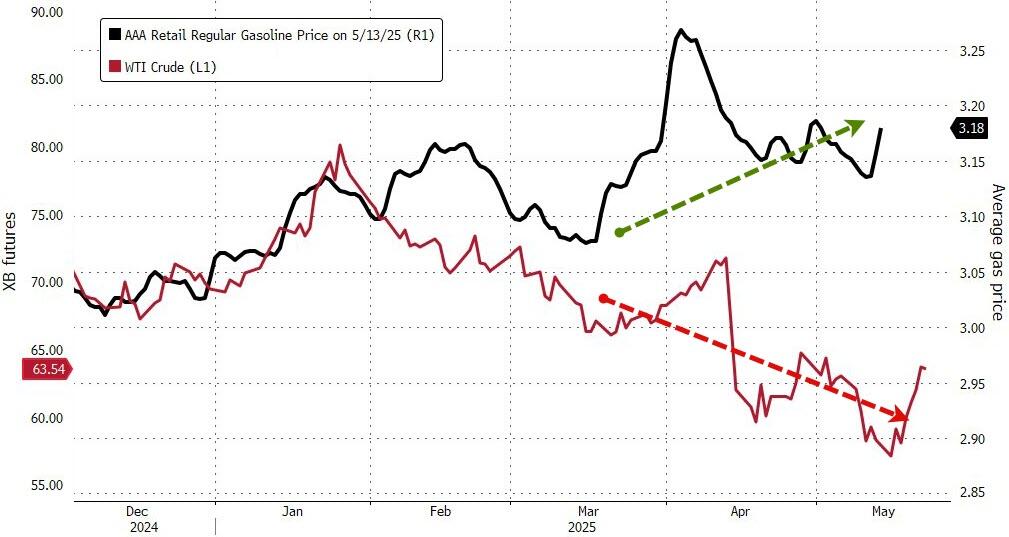
WTI Rebounds From Overnight Dip But ‘Drill, Baby, Drill’ Remains Elusive
Oil prices are marginally lower this morning after four straight sessions of gains driven by tariff optimism, following a bigger than expected build in crude stocks reported by API overnight.
The rise in stocks comes as OPEC+ readies to add another 411,000 barrel per day tranche of supply to the market as it unwinds 2.2-million barrels per day of voluntary production cuts. The new supply is likely to check prices as Saudi Arabia looks to regain market share and respond to a U.S. call for lower prices, even as U.S. President Donald Trump began the first presidential trip of his current term with a visit to Riyadh on Tuesday.
“While OPEC officials maintain that the US played no role in the decision to accelerate the phase -in of the voluntary barrels, the oil price environment has provided a beneficial backdrop to the Presidential visit from the Washington standpoint, Helima Croft, Head of Global Commodity Strategy and MENA Research at RBC Capital Markets, said in a note.
All eyes now on the official data for confirmation of builds…
API
Crude +4.29mm
Cushing -850k
Gasoline -1.37mm
Distillates -3.68mm
DOE
Crude +3.45mm
Cushing -1.07mm
Gasoline -1.02mm
Distillates -3.16mm
The official data echoe API’s report with a sizable crude build but draws at the Cushing Hub and in products…
Source: Bloomberg
In a week when the Trump administration proposes a major bill to refill the SPR, total crude stocks rose around 4mm barrels (including 528k barrels to the SPR)…
Source: Bloomberg
US crude production rose very modestly last week but along with the rig count is basically unchanged since President Trump’s election…
Source: Bloomberg
OPEC released its May Monthly Oil Market Report on Wednesday, sticking with its forecast for 2025 demand growth of 1.3-million barrels per day, higher last week’s estimate from the Energy Information Administration for demand growth of one-million bpd this year.
The International Energy Agency will release its monthly outlook on Thursday.
The cartel also lowered its estimate from production growth for countries outside of OPEC+ by 100,000 bpd to 0.8-million bpd.
WTI is rallying back from overnight weakness…
Finally, the question many are asking is when will see prices at the pump lower as Refineries are expected to keep ramping up ahead of the summer, allowing nationwide crude processing rates to remain at the highest seasonal level since 2019.
…and along with those lower prices, lower inflation.
Florida officials announced that 1,800 state Highway Patrol troopers are the first in the nation to receive federal credentials under an Immigration and Customs Enforcement (ICE) agreement allowing them to arrest illegal immigrants on their own.
Florida Gov. Ron DeSantis said at a press conference on May 12 that the state’s ongoing partnership with ICE included what is known as 287(g) agreements, where state and local law enforcement partner with ICE to help arrest and deport illegal immigrants.
The Florida Highway Patrol entered into a 287(g) task force model that gives them the power to arrest foreign nationals who are in the country illegally and place detainers on them during routine policing, such as traffic stops.
In essence, it allows local law enforcement to operate as an extension of ICE under federal supervision.
DeSantis encouraged other states to support President Donald Trump’s efforts to deport illegal immigrants, noting the success of Operation Tidal Wave. The recent joint federal-state operation arrested more than 1,100 illegal immigrants.
Some of those arrested included members of gangs such as MS-13 and Tren de Aragua, both designated as terrorist organizations by the Trump administration.
Additionally, DeSantis said Florida also swore in 100 troopers as special deputy U.S. marshals, which will allow them to execute federal search warrants and remove dangerous illegal immigrants.
Dave Kerner, director of the Florida Department of Highway Safety and Motor Vehicles, said during the press conference that the Florida troopers are the first fully credentialed law enforcement to be fully operational under the 287(g) task force model.
“What that means is, if you see a state trooper, he or she has federal authorities to detain, investigate, apprehend, and deport,” Kerner said. “We have troopers in all 67 counties of this great state that have that authority.”
Kerner told The Epoch Times that troopers serving as U.S. marshals will be able to go into homes to serve warrants, which isn’t part of the 287(g) agreements.
He said that the programs offer flexibility to state and local jurisdictions, allowing them to determine their level of involvement once they sign up for the agreements.
“It is, by and large, a voluntary effort,” he said. “You can decide how much you want to participate.”
DeSantis added that there’s a plan on the table that, if approved by the federal government, would allow military judge advocates to act as immigration judges and provide makeshift detention space and transportation for illegal immigrants.
The governor noted that the state’s experience with disaster response, such as during hurricanes, helped the state come up with the plan. He said there are 70,000 to 80,000 illegal immigrants in the state, with final deportation orders issued by a judge.
Getting rid of criminal illegal immigrants helps cut down on crime and save lives, DeSantis said.
“You’re really making a difference in your community,” he said.
Some 11 million illegal immigrants were apprehended at U.S. borders over the past four years, according to Customs and Border Protection data.
Trump campaigned on border security and illegal immigrant deportations. Upon returning to the White House, he has moved to keep that promise through a whole-of-government approach that has included designating several Mexican cartels and other transnational criminal groups as terrorist organizations. As a result, some members of the MS-13 and Tren de Aragua gangs have been deported to El Salvador’s Terrorism Confinement Center, known as CECOT.
As of May 8, ICE statistics show there are 531 agreements with state and local agencies throughout the country. Another 105 applications are pending.
Although dozens of states have agreements under the 287(g) program, Florida is the first to have its law enforcement officers credentialed.
Law enforcement nationwide has been encouraged to sign up for 287(g) agreements by the Trump administration because there are not enough federal officers to find and process millions of illegal immigrants.
Besides the task force model, the federal government created the jail enforcement model and the warrant service officer model.
The jail enforcement model allows local officers to identify and process removable noncitizens already booked into local jails. The warrant service officer model allows officers to serve and execute administrative warrants on illegal immigrants already in custody.
Florida had 266 agreements that included all 67 sheriff’s offices in the state, according to the Florida Sheriffs Association. Texas had the second-highest number of agreements at 77.
As home prices continue to climb and mortgage rates remain elevated, buying a home in the U.S. has become increasingly out of reach for the average household.
In 2025, buyers now need six-figure salaries to afford a median-priced home in all but 15 states.
This visualization, via Visual Capitalist’s Bruno Venditti, using data from Realtor.com, maps the annual income required to purchase a typical three-bedroom home in every state, based on a 10% down payment, a 6.65% interest rate on a 30-year fixed mortgage, and a 30% income-to-housing cost threshold (which includes taxes and insurance).
The Growing Gap Between Income and Home Prices
A recent study found that nearly 50% of U.S. households cannot afford a home priced at $250,000. This is particularly concerning when the median price of a new single-family home nationwide has reached $495,750, according to the National Association of Home Builders.
In many states, the income needed to comfortably afford a median-priced home far exceeds what a typical family earns.
Where Buying a Home Requires the Highest Salaries
Here are the top five most expensive states for homebuyers in 2025:
Hawaii tops the list, where buying a median three-bedroom home requires an annual income of $229,000—the highest in the country. Despite its small population, Montana has climbed into the top five least affordable states, driven by a widening gap between soaring home prices and relatively modest local incomes.
In contrast, in West Virginia a buyer would need a salary of just $71,000 to afford a median-priced home—well below the state’s median household income of $90,000. Other states with lower thresholds include Mississippi, Ohio, and Indiana.
What’s the cost of a median price in every U.S. state? Find out in this map on Voronoi.
Standing with both hands extended for a £50 million squeeze of the public teat, United Kingdom scientists claim the sun you celebrate in song contributes to “runaway climate change.”
And these white-robed high priests of perfidious Albion’s climate cult have a novel idea to control the weather and forestall the impending apocalypse: dimming the sun.
Per Simon Kent’s article in Breitbart News, this is not the only harebrained scheme these literal dimwits at Aria (the Advanced Research and Invention Agency) promise for someone else’s money.
According to the Daily Telegraph, a host of possible options for climate control are being considered by scientists with government approval alongside £50 million in taxpayer funds:
Scientists are considering outdoor field trials, which could include injecting aerosols into the atmosphere or brightening clouds to reflect sunshine, as a way to prevent runaway climate change.
Clearly, the old-school itinerant cloud seeders preying upon the angst of drought-riddled farmers and their small towns have nothing on Aria and its siren song of salvation, for they have the entire UK government on board to foot the bill for what should have been named “Operation Daedalus.”
But though the dimwits will be confronting the sun, they assure us that, unlike the heedless youth in Greek mythology who flew too close to the sun, these climate cultists vow to not go down in flames.
According to Professor Mark Symes, there will be “small controlled outdoor experiments on particular approaches.” The professor then went on to preemptively calm any member of the public who had been traumatized by Mary Shelley’s Frankenstein and had qualms with a lab-coated, modern Prometheus playing God:
“Everything we do is going to be safe by design. We’re absolutely committed to responsible research, including responsible outdoor research… We have strong requirements around the length of time experiments can run for and their reversibility, and we won’t be funding the release of any toxic substances to the environment.”
(Author’s Note: The professor is not funding anything. The British public is.)
See?
The only thing going up in flames is someone else’s money. Besides, what could go wrong when prospectively using “stratospheric aerosol injection” that “would see scientists launching sulfate particles into the Earth’s lower stratosphere at altitudes up 12 miles high?” Unforeseen consequences, you say? Please. Next, you’ll claim that COVID resulted from a lab leak.
Nevertheless, one cannot help but wonder how dimming the sun in that renowned fun-in-the-sun island known as England will prevent climate change. Given the UK’s increasing war on free speech, it is best not to ask or to have “Let the Sunshine In” on your iPod.
Oh, wait. It isn’t just us recalcitrant climate deniers worried about the unforeseen consequences of trying to change the weather?
The Telegraph notes geoengineering projects that seek to artificially alter the climate have proven controversial, with critics arguing they could bring damaging knock-on effects. This has been noted previously when scientists looked to “dimming the sun” as a way to shield the Earth’s surface.
There is a rich irony in environmental radicals who only eat organic foods, blithely supporting using artificial means to unnaturally diminish sunlight. I guess it is the climate cult’s version of “We have to destroy a village to save it”—perhaps with dimwits crooning, “I’m blocking out sunshine” to the tune of Katrina and the Waves 1980s hit?
Regardless, the climate cult—starting with the dimwits—refuses to admit how all the diplomas and degrees in the world cannot render anyone infallible. And therein is another more bitter irony: what if a climate apocalypse is manmade—by dimwits like these messing up nature by trying to stop it?
Anyway, “it’s getting near dawn, when lights close their tired eyes,” and mine are glazing over at the climate cult’s toxic imbecility on display. Suffice to say, however the dimwits give us their “dawn surprise,” we can but hope they don’t usher in the next Ice Age—or worse.
Wait! We cannot succumb to our worst fears. That’s what the climate cultists do. No, Annie is right, “The sun will come up tomorrow.” After all, the British public just bet their bottom £50 million on it, right?
Visualizing The Size Of Each Country’s Shadow Economy
The global shadow economy generates trillions in revenue each year, driven by criminal activity and other unreported transactions.
In low income countries, shadow activity makes up a larger slice of GDP, standing at an estimated 42.4% share. In comparison, this drops to 5.9% of GDP in rich countries, with the UAE seeing the smallest share overall.
To start, the shadow economy includes unreported or untaxed activity, making it difficult for authorities to monitor.
This includes illegal enterprises, drug trafficking, street vendors, or cash transactions made off the books. While measuring the informal economy is hard to quantify, it has shrunk from 17.7% of world GDP in 2000 to 11.8% in 2023.
Breaking Down the Shadow Economy by Country
Here are countries with the largest shadow economies as a share of GDP:
Rank
Country
Shadow Economy
% of GDP in 2023
Shadow Economy Value
GDP 2023
1
🇸🇱 Sierra Leone
64.5
$4.1B
$6.4B
2
🇳🇪 Niger
56.3
$9.5B
$16.8B
3
🇳🇵 Nepal
51.0
$20.9B
$40.9B
4
🇪🇹 Ethiopia
50.2
$80.2B
$159.8B
5
🇧🇮 Burundi
49.2
$2.1B
$4.2B
6
🇲🇱 Mali
46.8
$9.5B
$20.2B
7
🇹🇿 Tanzania
44.7
$35.4B
$79.1B
8
🇧🇫 Burkina Faso
43.8
$8.9B
$20.3B
9
🇨🇩 DRC
42.1
$28.2B
$66.9B
10
🇲🇿 Mozambique
39.8
$8.4B
$21.0B
11
🇰🇪 Kenya
38.4
$41.8B
$108.8B
12
🇲🇲 Myanmar
37.9
$24.4B
$64.5B
13
🇿🇲 Zambia
35.6
$10.0B
$28.2B
14
🇵🇰 Pakistan
35.0
$118.1B
$337.5B
15
🇸🇩 Sudan
34.9
$13.3B
$38.1B
16
🇨🇲 Cameroon
33.3
$16.4B
$49.3B
17
🇹🇯 Tajikistan
33.2
$4.0B
$11.9B
18
🇧🇯 Benin
32.9
$6.5B
$19.7B
19
🇨🇬 Congo
32.6
$4.6B
$14.2B
20
🇧🇴 Bolivia
32.1
$14.6B
$45.5B
21
🇵🇬 Papua New Guinea
31.4
$9.6B
$30.7B
22
🇺🇬 Uganda
31.1
$15.2B
$48.8B
23
🇱🇸 Lesotho
30.9
$0.6B
$2.1B
24
🇲🇼 Malawi
30.9
$3.9B
$12.7B
25
🇳🇮 Nicaragua
30.7
$5.5B
$17.8B
26
🇦🇴 Angola
30.2
$25.6B
$84.8B
27
🇳🇬 Nigeria
30.0
$109.1B
$363.8B
28
🇧🇩 Bangladesh
29.0
$126.8B
$437.4B
29
🇨🇮 Cote d’Ivoire
28.8
$22.7B
$78.9B
30
🇹🇬 Togo
28.1
$2.6B
$9.2B
31
🇦🇱 Albania
27.8
$6.5B
$23.5B
32
🇵🇪 Peru
27.1
$72.5B
$267.6B
33
🇲🇦 Morocco
27.0
$39.0B
$144.4B
34
🇬🇭 Ghana
26.8
$20.5B
$76.4B
35
🇭🇳 Honduras
26.7
$9.2B
$34.4B
36
🇪🇨 Ecuador
26.5
$31.5B
$118.8B
37
🇰🇭 Cambodia
26.4
$11.2B
$42.3B
38
🇿🇦 South Africa
26.3
$100.1B
$380.7B
39
🇮🇳 India
26.1
$931.1B
$3,567.6B
40
🇻🇳 Vietnam
25.1
$107.9B
$429.7B
41
🇮🇶 Iraq
24.8
$62.2B
$250.8B
42
🇺🇿 Uzbekistan
24.4
$24.8B
$101.6B
43
🇬🇹 Guatemala
24.3
$25.4B
$104.5B
44
🇩🇿 Algeria
24.2
$59.9B
$247.6B
45
🇹🇭 Thailand
24.0
$123.6B
$515.0B
46
🇮🇩 Indonesia
23.8
$326.3B
$1,371.2B
47
🇬🇦 Gabon
23.1
$4.5B
$19.4B
48
🇮🇷 Iran
22.5
$91.0B
$404.6B
49
🇬🇪 Georgia
22.1
$6.8B
$30.8B
50
🇪🇬 Egypt
21.2
$84.0B
$396.0B
51
🇹🇳 Tunisia
21.2
$10.3B
$48.5B
52
🇨🇴 Colombia
20.9
$76.0B
$363.5B
53
🇵🇾 Paraguay
20.9
$9.0B
$43.0B
54
🇵🇭 Philippines
20.7
$90.5B
$437.1B
55
🇧🇷 Brazil
20.6
$447.8B
$2,173.7B
56
🇨🇳 China
20.3
$3,612.3B
$17,794.8B
57
🇱🇰 SriLanka
20.1
$17.0B
$84.4B
58
🇸🇻 El Salvador
19.9
$6.8B
$34.0B
59
🇹🇲 Turkmenistan
19.7
$11.9B
$60.6B
60
🇱🇧 Lebanon
19.6
N/A
N/A
61
🇺🇦 Ukraine
19.3
$34.5B
$178.8B
62
🇦🇲 Armenia
18.9
$4.6B
$24.1B
63
🇧🇦 Bosnia and Herzegovina
18.6
$5.1B
$27.5B
64
🇧🇾 Belarus
18.3
$13.2B
$71.9B
65
🇯🇴 Jordan
18.3
$9.3B
$51.0B
66
🇲🇽 Mexico
17.9
$320.2B
$1,789.1B
67
🇦🇷 Argentina
17.8
$115.0B
$646.1B
68
🇦🇿 Azerbaijan
17.7
$12.8B
$72.4B
69
🇷🇸 Serbia
17.2
$14.0B
$81.3B
70
🇧🇼 Botswana
17.0
$3.3B
$19.4B
71
🇲🇰 North Macedonia
16.9
$2.7B
$15.8B
72
🇱🇾 Libya
16.3
$7.4B
$45.1B
73
🇩🇴 Dominican Republic
16.2
$19.7B
$121.4B
74
🇹🇷 Türkiye
16.1
$180.0B
$1,118.3B
75
🇨🇷 Costa Rica
13.8
$11.9B
$86.5B
76
🇲🇪 Montenegro
13.6
$1.0B
$7.5B
77
🇺🇾 Uruguay
13.5
$10.4B
$77.2B
78
🇷🇴 Romania
13.1
$46.0B
$350.8B
79
🇷🇺 Russia
13.1
$264.8B
$2,021.4B
80
🇲🇾 Malaysia
12.3
$49.2B
$399.7B
81
🇵🇦 Panama
12.1
$10.1B
$83.3B
82
🇬🇷 Greece
12.0
$29.2B
$243.5B
83
🇨🇱 Chile
11.9
$39.9B
$335.5B
84
🇬🇾 Guyana
11.8
$2.0B
$17.2B
85
🇰🇿 Kazakhstan
11.2
$29.4B
$262.6B
86
🇲🇺 Mauritius
10.6
$1.5B
$14.6B
87
🇧🇬 Bulgaria
10.5
$10.8B
$102.4B
88
🇵🇷 Puerto Rico
10.3
$12.1B
$117.9B
89
🇵🇱 Poland
9.7
$78.5B
$809.2B
90
🇭🇷 Croatia
9.3
$7.8B
$84.4B
91
🇱🇻 Latvia
9.3
$3.9B
$42.2B
92
🇵🇹 Portugal
9.3
$26.9B
$289.1B
93
🇭🇺 Hungary
9.2
$19.5B
$212.4B
94
🇸🇰 Slovak Republic
8.9
$11.8B
$132.9B
95
🇳🇿 New Zealand
8.2
$20.7B
$252.2B
96
🇸🇮 Slovenia
8.0
$5.5B
$69.1B
97
🇮🇹 Italy
7.8
$179.5B
$2,300.9B
98
🇮🇸 Iceland
7.6
$2.4B
$31.3B
99
🇰🇷 Korea
7.6
$130.2B
$1,712.8B
100
🇲🇹 Malta
7.5
$1.7B
$22.3B
101
🇪🇸 Spain
7.5
$121.5B
$1,620.1B
102
🇪🇪 Estonia
7.4
$3.1B
$41.3B
103
🇱🇹 Lithuania
7.4
$5.9B
$79.8B
104
🇩🇪 Germany
6.8
$307.7B
$4,525.7B
105
🇫🇷 France
6.7
$204.5B
$3,051.8B
106
🇯🇵 Japan
6.7
$281.7B
$4,204.5B
107
🇸🇪 Sweden
6.7
$39.2B
$585.0B
108
🇦🇹 Austria
6.6
$33.8B
$511.7B
109
🇧🇪 Belgium
6.6
$42.6B
$644.8B
110
🇫🇮 Finland
6.6
$19.5B
$295.5B
111
🇨🇿 Czechia
6.5
$22.3B
$343.2B
112
🇳🇴 Norway
6.4
$31.1B
$485.3B
113
🇴🇲 Oman
6.4
$7.0B
$108.8B
114
🇳🇱 Netherlands
6.3
$72.7B
$1,154.4B
115
🇱🇺 Luxembourg
6.1
$5.2B
$85.8B
116
🇩🇰 Denmark
5.9
$24.0B
$407.1B
117
🇦🇺 Australia
5.7
$98.5B
$1,728.1B
118
🇮🇱 Israel
5.5
$28.2B
$513.6B
119
🇧🇸 Bahamas
5.4
$0.8B
$14.3B
120
🇨🇾 Cyprus
5.3
$1.8B
$33.9B
121
🇬🇧 UK
5.3
$179.2B
$3,380.9B
122
🇸🇦 Saudi Arabia
5.2
$55.5B
$1,067.6B
123
🇮🇪 Ireland
5.1
$28.1B
$551.4B
124
🇨🇭 Switzerland
5.1
$45.1B
$884.9B
125
🇺🇸 United States
5.0
$1,386.0B
$27,720.7B
126
🇨🇦 Canada
4.5
$96.4B
$2,142.5B
127
🇰🇼 Kuwait
4.0
$6.5B
$163.7B
128
🇸🇬 Singapore
3.4
$17.0B
$501.4B
129
🇧🇭 Bahrain
2.5
$1.2B
$46.1B
130
🇶🇦 Qatar
2.2
$4.7B
$213.0B
131
🏳️ UAE
2.1
$10.8B
$514.1B
As we can see, Sierra Leone ranks first overall, with its shadow economy equaling 64.5% of GDP.
Like many other sub-Saharan African countries, the informal economy employs millions of workers, including subsistence farmers, street vendors, and small business owners. Underscoring this trend are limited opportunities in the formal sector along with bureaucratic red tape.
In particular, the DRC stands out in both the scale of its informal economy and prevalence of organized crime.
Meanwhile, Nepal ranks third overall, with shadow activity accounting for 51% of GDP. Notably, the agriculture sector employs a substantial share of informal workers. In fact, 85% of Nepal’s labor force participates in the informal economy, making it a vital source of livelihood for many.
In contrast, America’s underground economy comprises just 5% of GDP, yet its sheer size—valued at $1.4 trillion—makes it one of the world’s largest.
To learn more about this topic from a violent crime perspective, check out this graphic on violent crime rates by U.S. state.
“The nice areas are sketchy, the bad areas are sketchy, but you just have to not do stupid shit,” he added.
Presumably, by “stupid shit,” Sheeran means things like not attaching your mobile phone to your body in case it gets swiped.
The crime has reached an “industrial level” in the English capital, with criminals stealing 70,137 devices last year alone, an average of 192 a day.
Compare that to as recently as 2020, when 20,000 phones were reported stolen.
In the supposedly “nice” areas Sheeran references, wealthier people have stopped wearing expensive watches and jewelry due to the risk of having it snatched by criminals on mopeds.
So-called “follow home” robberies, where thieves track victims from luxury shopping districts before striking, are also commonplace in London.
Figures released earlier this year also show that knife crime continues to be a major problem, rising 18 per cent since 2022.
Meanwhile, take a look at how Manchester has been turned into a dystopian hellscape, mirroring virtually every other major British city, as well as many of the smaller ones.
* * *
Your support is crucial in helping us defeat mass censorship. Please consider donating via Locals or check out our unique merch. Follow us on X @ModernityNews.
Asians work from home the least in a global comparison, while college-educated workers from English-speaking countries and Africa do so more frequently.
These are the results from a new survey by the Ifo Institute and Stanford University.
Statista’s Katharina Buchholz reports that while all Asians respondents only worked an average of approximately 1.1 days a week from home, this was around 1.2 days in Europe, 1.25 in Latin America, 1.4 days in Africa and 1.6 days in English-speaking countries.
Women tend to work from home more than men – except for in Europe – tied to mothers expressing a high desire to work remotely in the survey.
The countries which saw the most work from home days were Canada, the United Kingdom and Finland, while the least were observed in South Korea, China, Greece and Japan.
In general, people expressed a higher desire to work from home than they actually did, led by mothers who on average said they would like to be present remotely 2.66 days a week, followed by childless men at 2.62 days and fathers at 2.57 days.
In 2024, the people in the survey actually worked from home only 1.27 days a week.
Clashes between heavily armed militias erupted across the Libyan capital late on Monday night, killing at least six people and plunging Tripoli into renewed violence and fear. The fighting, which continued into the early hours of Tuesday, was triggered by the killing of Abdelghani al-Kikli, a powerful militia commander known as “Gheniwa,” who led the Stability Support Authority (SSA), one of Tripoli’s most influential armed factions.
Heavy gunfire and explosions were reported in several neighbourhoods, particularly Abu Salim, a densely populated southern district. Residents told Reuters they heard intense gun battles. “Six bodies have been retrieved from the sites of clashes around Abu Salim,” Libya’s Emergency Medicine and Support Center confirmed.
The health ministry also said that emergency crews helped evacuate families trapped by the violence and called on hospitals and medical centers “to raise their level of preparedness and ensure maximum readiness to deal with any emergency”.
In the wake of the clashes, the interior ministry of the Tripoli-based Government of National Unity (GNU) issued an emergency alert urging residents to stay indoors.
Schools and universities suspended classes, exams and all administrative activities. The education ministry cited the “deteriorating security situation,” while the University of Tripoli announced a full closure “until further notice”.
Death of a warlord
Al-Kikli was allegedly ambushed on Monday evening in a facility run by the 444 Brigade, a rival militia led by Mahmoud Hamza, an influential commander allied with GNU Prime Minister Abdul Hamid Dbeibah.
While the exact circumstances of his killing remain murky, a nephew of al-Kikli said in a Facebook post that he had been lured under the pretence of negotiations, an invitation that turned out to be a calculated hit. “For many years, Abdelghani ‘Ghnewa’ al-Kikli was arguably one of the most resilient, most successful armed group leaders in Tripoli when it came to extending militia influence beyond hard security,” Jalel Harchaoui, an analyst focusing on Libyan security and political economy, said in a post on X.
“His primary strength lay not in military might – though his territorial holdings did expand – but in his ability to outmaneuver Prime Minister Dbeibah. Today, however, that winning streak looks [like] it has come to an end.”
Al-Kikli had long been a controversial figure in Libya’s volatile security landscape. Amnesty International previously accused him of war crimes and human rights violations, including torture, arbitrary detention and extrajudicial killings.
The SSA had become one of the most powerful militias in western Libya, with deep entrenchment in state institutions. As Harchaoui noted, al-Kikli had successfully “installed loyalists in key positions across the banking, telecom and administrative oversight sectors, and even within top diplomatic functions”.
A fractured state, again on edge
By early Tuesday morning, authorities said the situation was under control. The GNU said its forces carried out a “military operation” to restore security and reassert state authority in Abu Salim.
“What was accomplished today shows that official institutions are capable of protecting the homeland and preserving the dignity of its citizens,” Dbeibah wrote on X, praising the operation as “a decisive step” against “irregular” armed factions.
The United Nations Support Mission in Libya (UNSMIL) expressed grave concern over the fighting, calling for an immediate ceasefire and the protection of civilians. “UNSMIL is alarmed by the unfolding security situation in Tripoli, with intense fighting with heavy weaponry in densely populated civilian areas,” it said on X. “Attacks on civilians and civilian objects may amount to war crimes.”
The UNSMIL warned that unless armed groups were held accountable, violence would remain a constant threat to Libyans caught in the crossfire.
The North African country has been divided between rival governments in the west and east since the 2011 Nato-backed uprising that overthrew and killed longtime ruler Muammar Gaddafi. The internationally recognized GNU governs from Tripoli in the west, while a rival administration under Prime Minister Osama Hammad operates from Benghazi in the east with backing from General Khalifa Haftar’s forces.
Despite a 2020 ceasefire and several diplomatic efforts to unify the country, Libya remains fractured, with heavily armed factions vying for power, influence and control of lucrative oil and gas resources.
The latest clashes are the deadliest since August 2023, when rival factions in Tripoli battled for control, leaving 55 people dead.
LIBYA | 🇱🇾 Remember in 2011 how the US, their Allies and NATO planned to “bring democracy” in Libya but had to assassinate Gaddafi first? Well, this was Libya last night. Terrorists are fighting with the Army. It’s horrific. Military vehicles were burnt; people broke into grocery… pic.twitter.com/y9YiiwTH17
Anas El Gomati, founder and director of the Tripoli-based Sadeq Institute, said on X that al-Kikli’s “elimination leaves Dbeibah as the dominant power broker in western Libya, having systematically neutralised or co-opted potential rivals.
“The timing is particularly significant, coming as US-led negotiations explore the possibility of a unified military council between rival eastern and western factions,” Gomati added. Harchaoui warned that “what is about to follow won’t be smooth sailing.“
“Tripoli faces a territorial reshuffle as Dbeibah’s camp moves to seize SSA-held areas,” he said, adding that clashes may flare, but the real impact is institutional, with both the Central Bank and Libyan Foreign Bank set to be affected by the collapse of al-Kikli’s network.
The U.S. Supreme Court’s chief justice on Monday told an event that criticism of the court should be relegated to its decisions and not the nine justices themselves.
While speaking at Washington’s Georgetown University, Chief Justice John Roberts said that the Supreme Court “has obviously made mistakes throughout its history, and those should be criticized, so long as it is in terms of the decision.”
Roberts said that criticism of the highest court should not be based on “ad hominem” arguments or attacks “against the justices” themselves, referring to the logical fallacy where an argument is dismissed based on the character or background of the individual making that claim.
“I just think that doesn’t do any good. The harshest critics are usually colleagues, if it’s the sort of thing where there are dissents. So it’s something we’re used to,” he continued. “And again, it’s a good thing. We’re not immune from any criticism. And there are many, many instances in our history where it’s been effective over time in leading to a better result.”
The comment from Roberts marks the third time in nearly as many months in response to criticism about the Supreme Court.
In a rare written statement in March, Roberts appeared to respond to President Donald Trump’s public suggestion to impeach a federal judge who had blocked his administration’s deportations of accused Venezuelan gang members under the Alien Enemies Act.
“For more than two centuries, it has been established that impeachment is not an appropriate response to disagreement concerning a judicial decision,” Roberts said in a statement provided to The Epoch Times at the time. “The normal appellate review process exists for that purpose.”
Following U.S. District Judge James Boasberg’s initial ruling against the administration’s use of the 1798 law to deport accused gang members, Trump wrote that the judge wasn’t elected as president.
A senior adviser to Trump, tech billionaire Elon Musk, also commented on the judge’s stymying the administration’s agenda. In a post on Feb. 25, Musk wrote that the only way to allow the agenda to move forward is to “impeach judges,” responding to an article that said El Salvador’s president did the same starting in 2021.
Trump hasn’t been critical of the Supreme Court and has indicated that he will follow orders from any court. Since the start of his administration, numerous lawsuits have been filed against his administration, particularly in relation to his immigration enforcement, spending cuts, and efforts to downsize and reshape the federal government.
And last week, Roberts said during an event in Buffalo, New York, that the judiciary needs to maintain its independence in order to check executive or congressional power.
The judicial branch’s independence is “the only real political-science innovation in our Constitution,” Roberts said. Elaborating, he said that “in our Constitution … the judiciary is a co-equal branch of government, separate from the others, with the authority to interpret the Constitution as law and strike down … acts of Congress or acts of the president.”
“And that innovation doesn’t work if … the judiciary is not independent. Its job is to … check the excesses of Congress or of the executive, and that does require a degree of independence,” he said.
In his recent remarks and written statement, Roberts did not mention Trump, nor did he mention any other elected official.
How China Is Reusing Its Dying EV Batteries And Solar Panels
China is ramping up efforts to build a circular economy around its booming clean energy sector, as retired batteries and solar panels pile up and global trade tensions make critical minerals harder to source, according to the South China Morning Post.
“There is huge potential in the business of new-energy waste, because new energy is where China and the world are going,” said Ma Long, sales manager at a Henan Hairui Intelligent Technology subsidiary. His company already generates 70% of its business from battery and solar panel recycling equipment.
China’s rapid adoption of electric vehicles (EVs) and solar power is driving this trend. After a decade of EV growth, the country is now facing a “large-scale retirement of car batteries,” with retired batteries expected to exceed 4 million tonnes annually by 2028 and generate over 280 billion yuan (US$38.5 billion) in industry output, according to state estimates. Retired photovoltaic modules are also set to surge in the next five years.
“The recycling of minerals is largely for the sake of resource security,” said Du Huanzheng, a circular economy expert at Tongji University. He noted that China’s recycling push, once focused on pollution control, is now also about boosting economic growth and cutting reliance on imported minerals amid rising tensions with the U.S. and its allies.
A Beijing-based professor of environmental economics warned that China is “facing more difficulty in buying from allies of the US, such as Australia and Canada,” while other suppliers like Congo and Chile could be pressured by U.S. trade policy. “Business with other [mineral] suppliers may also be affected,” he added.
In response, China has created the state-owned China Resources Recycling Group to build a nationwide recycling network for products from electronics to retired wind and solar equipment.
The SCMP article says that big players like CATL and BYD are leading the way in battery recycling, but smaller companies are rushing in. Yu Zhongkai, senior manager at Tianli Technology, said a quarter of his company’s business now comes from battery-recycling equipment. “But we’re still experimenting, because there are no industry-wide standards yet, and the market is still unclear,” he admitted.
China’s recycling industry remains in its infancy, though its complete industrial chain and massive market give it an edge over global competitors. Du cautioned that despite investor enthusiasm, “large-scale recycling has yet to come, and a mature recycling system has yet to be formed.”
The government is tightening regulations, with 156 companies on a white list to standardize battery recycling and prevent safety and environmental risks. In February, the State Council passed an action plan to improve car battery recycling, following a December directive mandating stronger quality assurance and product traceability.
Guangdong Brunp Recycling Technology, a CATL subsidiary, claims it can recover over 99% of key metals from retired batteries. “It ensures that the batteries go where they came from, and it improves the resilience of the new-energy industry’s supply chain,” said CEO Li Changdong.
However, challenges remain. Many retired batteries end up in illegal workshops, and rural households are starting to discard old solar panels directly into trash bins, warned environmental activist Chen Liwen.
For now, legal recyclers face overcapacity as waste collection lags behind, but Ma expects the situation to improve as regulations tighten and battery retirements surge.
“So, overall, this is a big track to follow in the next few decades,” he said.