Another Near-Disaster At DC Airport: Delta Jet Narrowly Misses USAF T-38
Just one day after the Federal Aviation Administration’s leader told a Senate hearing that his organization has to “do better” in identifying safety threats like the conditions that precipitated January’s deadly midair collision at Reagan National Airport, a Delta passenger jet had a near-miss with a US Air Force jet near that very same airport.
The news was all the more disturbing given the January disaster that killed 67 people also involved a military aircraft — a US Army Black Hawk helicopter on a night training run. In Friday’s near-miss, the pilots of a Delta Airbus A319 that had just taken off for Minneapolis – Saint Paul received a warning about a USAF T-38 that had come from Langley Air Force Base in Hampton, Virginia. The aircraft was one of four of its type that were heading for a flyover at Arlington National Cemetery. (“Is this trip near Reagan National really necessary?” )
This CNN graphic shows the proximity of the departing Delta jet (left) and the USAF T-38
With the T-38 closing in at more than 350 miles per hour and an altitude of 800 feet, the Delta pilots received a warning or “resolution advisory” from their onboard Traffic Alert and Collision Avoidance System. Air traffic controllers issued instructions to both aircraft to help them avoid a collision.
Afterward, the Delta pilot asked the tower to confirm the dangerousness of the situation. “On that departure … was there an actual aircraft about 500 ft below us as we came off of DCA?” the pilot was heard asking via LiveATC.net audio reviewed by CNN. “Delta 2983, affirmative,” replied the Departure air traffic controller. Were it not for the evasive action, Friday could have brought an even worse disaster than the January collision: The Delta plane was carrying 131 passengers, two pilots and three flight attendants.
🚨 Close Call at Washington (DCA): Delta A319 & USAF T-38 Jet 🚨
A tense moment unfolded at Ronald Reagan Washington National Airport (DCA) on Friday (28) when a Delta Air Lines Airbus A319 (Reg. N342NB) taking off came into close proximity with a US Air Force T-38 jet… https://t.co/5CI7F2dnGOpic.twitter.com/nL78sNLkO7
The FAA issued a statement describing the incident:
“Delta Air Lines Flight 2983 was cleared for takeoff at Ronald Reagan Washington National Airport around 3:15 p.m. local time on Friday, March 28, while four U.S. Air Force T-38 Talons were inbound to Arlington National Cemetery for a flyover. The Delta aircraft received an onboard alert that another aircraft was nearby. Air traffic controllers issued corrective instructions to both aircraft. The FAA will investigate.”
Thursday’s Senate hearing provided scant reassurance about the safety of Reagan National, or DCA. For example, despite an FAA directive ordering all aircraft operating in the vicinity to broadcast their locations or “ADS-B out data,” Brig. Gen. Matthew Braman, head of Army aviation, said Army choppers are still flying in the area with those systems turned off — if the aircraft were deemed to be flying “sensitive” missions. Sen. Ted Cruz said that was “shocking and deeply unacceptable.”
The father of an American Airlines pilot killed in the collision expressed his own dismay at the Army’s response to the January accident. “I was frustrated with the lack of accountability. The Army still doesn’t want to say that they did anything wrong,”said TimLilley, who had previously served as an Army Black Hawk pilot himself.
National Transportation Safety Board (NTSB) Chairwoman Jennifer Homendy said January’s crash should have been avoided, given the plainly hazardous conditions that had long been observed around DCA — with 85 close calls in the three years leading up to the catastrophe.
Following Friday’s incident, Minnesota Sen. Amy Klobuchar reacted with disbelief that military aircraft were still coming close to civilian airliners.”Unbelievably dangerous and thank God people are safe,” she posted on X. “My first call to Department of Defense tomorrow: Why are your planes flying 500 feet below passenger jets full of Minnesotans headed from DCA to my state?”
A prominent Wall Street law firm has struck a deal with the White House to provide $100 million in pro bono legal services.
Skadden, Arps, Slate, Meagher & Flom LLP will dedicate the services to causes supported by both the firm and the Trump administration, including assisting veterans and other public servants, ensuring fairness in the U.S. justice system, and combating anti-Semitism.
The firm also committed to funding at least five law graduates under a fellowship dedicated to supporting the causes each year and employing merit-based hiring practices, vowing not to deny representation to members of politically disenfranchised groups.
This deal comes as President Donald Trump has, in recent weeks, issued executive orders targeting multiple major legal firms, directing government agencies to revoke their security clearances and terminate contracts. While Trump has not issued one against Skadden, the deal seems to be a way to prevent that from happening.
“This was essentially a settlement,” President Donald Trump said in announcing the deal at a White House event.
“We appreciate Skadden’s coming to the table. As you know, other law firms have likewise settled the case. And … what’s gone on is a shame.”
A White House statement explained that Skadden had approached Trump about its “strong commitment to ending the weaponization of the justice system and the legal profession.”
Jeremy London, the firm’s executive partner, said the two parties worked “constructively” to reach an agreement.
“The firm looks forward to continuing our productive relationship with President Trump and his administration. We firmly believe that this outcome is in the best interests of our clients, our people, and our firm,” London said.
News of the agreement came just hours after two other law firms, WilmerHale and Jenner & Block, sued the president for ordering the retraction of their security clearances and the termination of their government contracts.
In WilmerHale’s case, Trump cited the firm’s employment of former special counsel Robert Mueller and his aides as one of the top reasons for the move.
Mueller “wielded the power of the Federal Government to lead one of the most partisan investigations in American history,” Trump wrote in the executive order, referring to Mueller’s investigation of claims Trump colluded with Russia to influence the 2016 presidential election. Those claims proved to be unfounded.
Jenner, on the other hand, hired Andrew Weissmann, Mueller’s top prosecutor.
In separate legal actions filed in the District of Columbia, the two firms accused the administration of punishing its political opposition and asked the court to find Trump’s orders unconstitutional.
Paul Weiss, another Wall Street law firm, brokered a deal with the White House last week to provide $40 million in free legal services for mutually supported causes. In return, the administration revoked an order similar to those targeting Jenner and WilmerHale.
Maryland Democrats Pass “Sleep Tax” – Is A Thinking Tax Next?
Maryland lawmakers are scrambling to address a staggering $3.3 billion budget shortfall.
To close the gap, far-left Governor Wes Moore and activist Democrats have proposed a wave of tax hikes that would hit Marylanders’ wallets the hardest amid a deepening affordability crisis.
QUESTION:
Maryland lawmakers spent too much money. The state has a $3.5 BILLION deficit.
To close the gap, Annapolis is looking to raise your taxes/fees. Here’s a list of the proposed increases. Which affect you most? Or… have you already ordered the U-Haul truck?
With power bills already skyrocketing to record highs for many folks due to backfiring and disastrous green energy policies, these same progressive lawmakers are creating even more nightmares for taxpayers—this time by proposing a tax that effectively targets sleep.
A small but vocal group of conservative Republicans in the Maryland House of Delegates were stunned on Friday when far-left Democrats pushed through HB 858—a bill that establishes a mattress stewardship program under the guise of promoting safe disposal and recycling. This is another tax on Marylanders as the state sinks into financial turmoil and elevated credit downgrade risks. The new 6% tax on mattresses is on top of the existing 6% sales tax.
Del. Mark N. Fisher (R-Calvert), one of the leaders of the Maryland House Freedom Caucus, blasted the “Sleep Tax” and asked if there would be a “snoring surcharge.”
Democrats just passed the ‘Sleep Tax’. Marylanders already pay a 6% sales tax when you buy a mattress. Now, @mddems want you to pay a surcharge. Is that a ‘snoring surcharge’? pic.twitter.com/Pt0atYzupZ
— Libertarian Party of Maryland (@LPMaryland) March 28, 2025
Also, Moody’s Ratings recently warned that Maryland—a state heavily dependent on the federal government—faces heightened recession risk in the era of DOGE-related cuts. The warning comes amid a twin crisis: a ballooning state deficit and a power bill crisis.
If far-left Gov. Moore and Democrats are willing to tax Marylanders’ sleep, these woke activists could easily push another bill to tax thinking.
Maryland Dems…
Maryland Dems Lose All Sense Of Reality: Focus On Condoms For Kids, Reparations As Crises Pile Up https://t.co/WnoOnJxnbi
It’s time for common sense to re-enter Maryland politics after decades of Democrats torpedoing the state to the brink of financial crisis. Perhaps the Maryland House Freedom Caucus will be those heroes needed to rescue the imploding state.
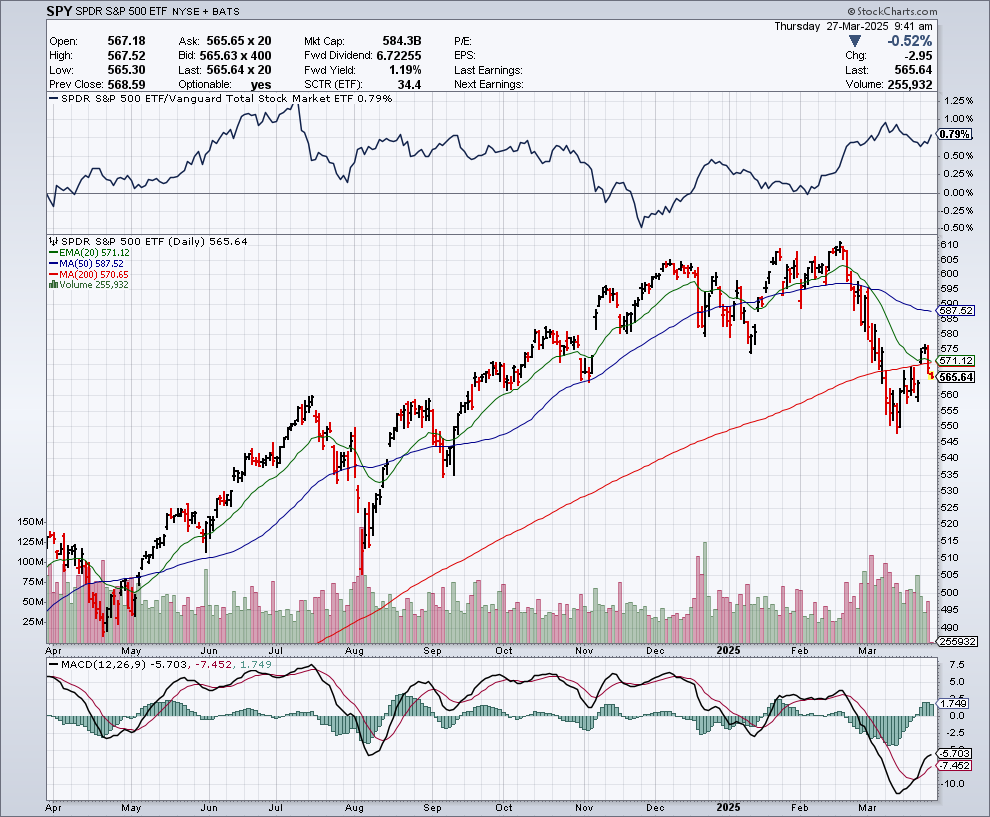
While the 25 Stocks I’m Watching for 2025 list (part 1 here and part 2 here) continue to perform well relative to the S&P, I can’t say the same about the overall market.
The looming question yesterday was whether the market snapback early in the week was a path to the S&P taking back its trend and continuing to move higher, or just a “bear market rally”. It shouldn’t be a surprise that I believe it was the latter.
There’s an old expression that “nothing good ever happens below the 200-day moving average.” As you can see, that’s where the S&P 500 continues to be (under the red line).
Then there was the question of auto tariffs yesterday, and whether or not Trump was going to immediately flip-flop on them—or whether he was even serious about them to begin with. While he does have a history of changing his mind quickly with regard to tariffs, it appears that, at least for the time being, these auto tariffs are here to stay.
The tariffs are sizable enough, and in a consequential enough industry, that they will create significant trade uncertainty between the U.S. and many of its major trading partners—introducing the stock market to more of the one thing it doesn’t like: uncertainty.
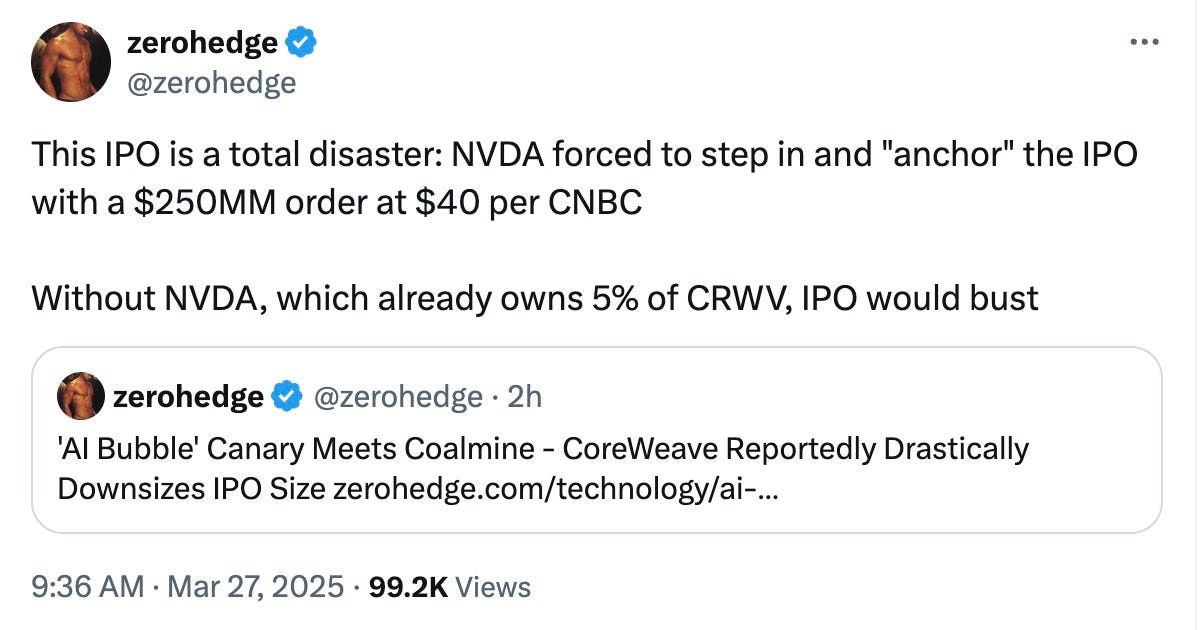
Finally, the big headline this morning is the news that CoreWeave, a purported player in the same atmosphere as Nvidia, was being forced to downsize its plans for an initial public offering.
Semafor reported that CoreWeave is set to scale back its IPO, cutting both the share price and fundraising target. The cloud firm is now aiming for a valuation closer to its $23 billion private-market figure from last year, down from the $30 billion it originally sought. It may also raise less than the $3 billion it had planned.
Shares are expected to price Thursday night and begin trading Friday, though shifting sentiment during today’s session could influence final decisions.
My longer-term readers know that about a year and a half ago, I started asking questions about where the black swans in the market could be. Where are the bodies buried that the rest of the market doesn’t necessarily know about yet? One of the places I ventured a guess was potentially between Nvidia and CoreWeave.
I wrote about the two following critical analysis that began circulating in lesser-trafficked analyst circles about the circuitous relationship between Nvidia and CoreWeave. As a reminder, here’s one video discussing the relationship I linked to with another writeup by The Mad King (paywalled now) — both of which made their rounds in mid-2023.
That circuitous relationship seems to, again, be what’s holding up CoreWeave:
“CoreWeave has been compared to WeWork because its tremendous revenue growth has come at the expense of unsustainable capex and cash burn, which in turn require tremendous constant outside investment (or debt): CoreWeave burned nearly $6 billion of cash in 2024 and $1.1 billion the previous year, because of the massive capex to build out its AI infrastructure,” Zero Hedge wrote Thursday morning, in their must-read analysis of the situation.
“Not surprisingly, CoreWeave – which also counts Microsoft as its largest customer – has been frequently rumored to be a core spoke in revenue roundtripping schemes involving Microsoft, Nvidia and OpenAI,” they continued.
And over the course of time since my 2023 article, other players in the same industry—namely Super Micro—have also had skeptical eyes cast upon them.
And just yesterday, legendary short-seller Jim Chanos raised critical questions about one of Nvidia’s acquisition of Lepton AI.
“Don’t know if this deal happens, and it’s not particularly big, but trying to buyout your resellers is usually a huge red flag. It’s often a way to bury inventory costs and/or avoid receivables provisioning,” Chanos wrote on X.
He continued: “Just to be clear, these kinds of deals w/customers and distributors do not necessarily have to be material in size to be material in impact, since near the end-of-cycles managements know that missing guidance by even a few pennies can be disastrous…”
For those unfamiliar with Jim Chanos’s pedigree, not only was he first to blow the whistle on Enron, he teaches a course called “A History of Financial Market Fraud: A Forensic Approach” at Yale. His short-sale of Enron shares was dubbed by Barron’s as “the market call of the decade, if not the past fifty years.”
Does the CoreWeave IPO necessarily denote that there’s fraud or wrongdoing under the surface? No. But at the very least, what it does show is that the market’s appetite for the AI story—and perhaps for risk-on type investments in general—isn’t what it was a year ago. When companies start pricing IPOs under expectations, it is an indicator that the bid many thought to exist in the market—whether it’s for a specific industry, specific style of stock, or specific name in general—isn’t there.
🔥 50% OFF FOR LIFE: Using this coupon entitles you to 50% off an annual subscription to Fringe Finance for life: Get 50% off forever
To me, this CoreWeave news this morning, combined with concerns that Mr. Chanos raised yesterday—on top of what we already knew—sure seems to suggest to me that the AI story may at least be temporarily losing steam. Lest we also forget just yesterday it was announced that Microsoft was pulling back from more data center leases “due to an oversupply relative to its current demand forecast”.
Not only did he raise critical questions about customer concentration and debt load just hours before the IPO was significantly downsized, I also watched him a couple of weeks ago argue the bear case against multiple analysts who pushed the same AI narrative we’ve heard for the last year, and made bombastic claims like stocks that are trading at 40x earnings are “cheap” because they’re down a couple percent off their highs.
I’ve often said that crypto is the tip of the risk-taking spear, and to watch that asset class as the canary in the coal mine for the rest of the market. As it relates to equities, however, AI is the tip of the narrative spear that still lures people into buying technology equities. If that narrative starts to crumble, I don’t think it is too much of a stretch to suggest there could be a domino effect in the rest of the equity market.
I don’t want anything to do with these AI names until I get significantly more clarity on the space and the overall market is far less volatile.
QTR’s Disclaimer:Please read my full legal disclaimer on my About page here. This post represents my opinions only.In addition, please understand I am an idiot and often get things wrong and lose money. I may own or transact in any names mentioned in this piece at any time without warning. Contributor posts and aggregated posts have been hand selected by me, have not been fact checked and are the opinions of their authors. They are either submitted to QTR by their author, reprinted under a Creative Commons license with my best effort to uphold what the license asks, or with the permission of the author.
This is not a recommendation to buy or sell any stocks or securities, just my opinions. I often lose money on positions I trade/invest in. I may add any name mentioned in this article and sell any name mentioned in this piece at any time, without further warning. None of this is a solicitation to buy or sell securities. I may or may not own names I write about and are watching. Sometimes I’m bullish without owning things, sometimes I’m bearish and do own things. Just assume my positions could be exactly the opposite of what you think they are just in case. If I’m long I could quickly be short and vice versa. I won’t update my positions. All positions can change immediately as soon as I publish this, with or without notice and at any point I can be long, short or neutral on any position. You are on your own. Do not make decisions based on my blog. I exist on the fringe. Assume any and all numbers in this piece are wrong and make sure you check them yourself. The publisher does not guarantee the accuracy or completeness of the information provided in this page. These are not the opinions of any of my employers, partners, or associates. I did my best to be honest about my disclosures but can’t guarantee I am right; I write these posts after a couple beers sometimes. I edit after my posts are published because I’m impatient and lazy, so if you see a typo, check back in a half hour. Also, I just straight up get shit wrong a lot. I mention it twice because it’s that important.
Trump Signs Exec Order Restoring Improperly Removed Statues And Public Monuments
President Trump signed an executive order Thursday aimed at overhauling the Smithsonian to combat what he calls “divisive, race-centered” narratives pushed under the Biden administration, according to RedState.com.
Titled “Restoring Truth and Sanity to American History,” the order criticizes the museum system’s recent direction: “Once widely respected… the Smithsonian Institution has, in recent years, come under the influence of a divisive, race-centered ideology,” it states, arguing such views frame American and Western values as “inherently harmful and oppressive.”
The order tasks Vice President JD Vance, a member of the Smithsonian’s Board of Regents, with leading efforts to “remove improper ideology” across the institution.
President Trump’s latest executive order targets the Smithsonian, aiming to restore what he calls a truthful, uplifting view of American history and culture. The directive criticizes recent shifts toward “divisive, race-centered ideology” and tasks Vice President JD Vance with rooting out “improper ideology” across its museums and research centers.
https://t.co/BQy31t6E8Z
President Trump has signed an executive order aimed at restoring accurate representations of American history in educational institutions. https://t.co/BQy31t6E8Z
— Executive Order & Presidential Action News (@47_Tracker) March 27, 2025
The RedState.com report quotes the order: “It is the policy of my Administration to restore Federal sites… to solemn and uplifting public monuments that remind Americans of our extraordinary heritage,” the order states, insisting museums should educate, not “indoctrinate.”
The order also instructs Interior Secretary Doug Burgum to review and “restore” public monuments removed over the past five years. A White House fact sheet says many were taken down to “perpetuate a false revision of history” or unfairly disparage historical figures.
Critics quickly lashed out. Rep. Jasmine Crockett (D-TX) wrote on X: “You cannot erase our past.” But as Trump allies note, this comes from a party that demanded the removal of statues of figures like George Washington and Jefferson.
Trump’s move follows earlier efforts to reclaim institutions from what he calls far-left ideologues—turning places like the Smithsonian and the Kennedy Center into cultural battlegrounds.
Past controversies at the Smithsonian include omitting Justice Clarence Thomas from its African American history museum in 2016—later correcting it only under pressure—and celebrating transgender activists like Sylvia Rivera in its American Women’s History Museum. It even preserved a suit worn by Rep. Andy Kim (D-NJ) during Capitol cleanup after January 6, a move critics call symbolic pandering.
The order sets a deadline of July 4, 2026—America’s 250th birthday—for completing all reforms. “President Trump aims to ensure that the Smithsonian… sparks children’s imagination, celebrates American history and ingenuity… and makes America proud,” the White House said.
xAI & X Merger Defuses Musk’s Tesla Share Liquidation Risk
Elon Musk secured a multibillion-dollar margin loan using Tesla stock as collateral to finance his acquisition of Twitter (now rebranded as X). In recent months, Tesla’s share price has been cut in half due to a confluence of factors—slowing EV demand amid high interest rates, shifting electric vehicle policies under the Trump administration, market volatility driven by trade tensions, and pressure from a coordinated NGO-driven color revolution known as “Tesla Takedown,” aimed at crashing the stock to trigger loan repayment obligations tied to Musk’s pledged equity.
In short, volatility in Tesla shares left Musk heavily exposed to potential loan repayment thresholds being triggered – which was set to occur at or below $114 according to reports – until now.
On Friday evening, Musk announced the merger of X with his AI startup, xAI, in an all-stock transaction that strengthens his financial position, protects Tesla shareholders, and renders the Tesla Takedown color revolution largely ineffective in achieving its intended goal.
Musk outlined xAI’s acquisition of X:
xAI has acquired X in an all-stock transaction. The combination values xAI at $80 billion and X at $33 billion ($45B less $12B debt).
Since its founding two years ago, xAI has rapidly become one of the leading AI labs in the world, building models and data centers at unprecedented speed and scale.
X is the digital town square where more than 600M active users go to find the real-time source of ground truth and, in the last two years, has been transformed into one of the most efficient companies in the world, positioning it to deliver scalable future growth.
xAI and X’s futures are intertwined. Today, we officially take the step to combine the data, models, compute, distribution and talent. This combination will unlock immense potential by blending xAI’s advanced AI capability and expertise with X’s massive reach. The combined company will deliver smarter, more meaningful experiences to billions of people while staying true to our core mission of seeking truth and advancing knowledge. This will allow us to build a platform that doesn’t just reflect the world but actively accelerates human progress.
I would like to recognize the hardcore dedication of everyone at xAI and X that has brought us to this point. This is just the beginning.
@xAI has acquired @X in an all-stock transaction. The combination values xAI at $80 billion and X at $33 billion ($45B less $12B debt).
Since its founding two years ago, xAI has rapidly become one of the leading AI labs in the world, building models and data centers at…
The transaction is structured as a stock swap, with X investors receiving xAI shares in return. Both companies share overlapping investors, including Fidelity Management, Saudi Arabia’s Kingdom Holding Co, Andreessen Horowitz, Sequoia Capital, and Vy Capital.
Musk, also the CEO of Tesla and SpaceX, purchased Twitter in a $44 billion deal in 2022. X CEO Linda Yaccarino wrote on X last night: “The future could not be brighter.”
Musk’s X post announcing the acquisition stated that the deal was about “blending” the AI startup and social media platform to create “a platform that doesn’t just reflect the world but actively accelerates human progress.” However, the move also eliminates the risk of Musk undergoing a forced liquidation of the $12.5 billion margin loan backed by his Tesla shares.
As we previously described at the beginning of the note, Tesla shares were halved for a number of reasons:
“This will drive Tesla into a death spiral,” Micah Lee, The Intercept’s former Director of Information Security, explained on a recent Tesla Takedown teleconference with other far-left revolutionaries.
🚨EXCLUSIVE🚨
Micah Lee, @theintercept’s former Director of Information Security, participated in the Tesla Takedown call to action tonight.
Musk’s indebtedness from leveraging Tesla shares to fund the X deal is no longer a concern for Tesla shareholders. This strategic move also renders the Tesla Takedown color revolution funded by rogue Democrats less likely to force a liquidation.
A new study ranks the best states for house flipping, using data on sale prices, remodeling costs, sales volume, and time on market. By standardizing these metrics into a single House Flipping Score, the study identifies where flipping is most profitable—higher scores mean better conditions for flippers.
Vermont tops the list of best states for house flipping with a score of 99, thanks to fast sales (32 days on market) and high transaction volume. Maine follows with a score of 95, offering the lowest remodeling costs ($27,486) among top states and similarly quick sales, the study from Badeloft shows.
New Hampshire ranks third (score: 93), combining low renovation costs with high average sale prices ($462,492). Delaware takes fourth (score: 86) with moderate remodeling expenses and solid sales volume.
Rhode Island (score: 85) has the second-fastest market (under 28 days) and low renovation expenses. Hawaii places sixth (score: 83), driven by the highest sale prices nationwide ($829,941).
Connecticut (score: 79) has the shortest time on market—just 27 days—and solid resale value. Virginia (score: 76) offers decent profits with moderate remodeling costs. North Carolina (score: 74) boasts the most active housing market among top states.
Massachusetts rounds out the top ten (score: 71) with high property values ($605,614) and a market time of 36 days.
Virginia is ranked eighth for house flipping potential, achieving a score of 76. Home improvement projects here generally require an investment of $39,215, with investors able to sell properties for an average of $382,930.
Finally, North Carolina is positioned ninth on the list of best states for house flipping, achieving a score of 74. The state features the most active housing market among the top-ranking states, with 6,649 houses sold per 100,000 residents.
A Badeloft study spokesperson said: “House flipping proves to be a profitable endeavor in many states, particularly those where the cost of remodeling is relatively low, and the potential for high sale prices is strong. It’s important to consider that prioritizing premium quality renovations is essential to maximizing the property’s value and securing a profitable return.”
“Carefully selected and stylish furnishings that complement these renovations can further enhance the home’s appeal, making it even more marketable and increasing its overall value”.
President Trump’s supporters have denounced the federal judges seeking to stall or stop this administration’s government overhaul. But there is at least one person who, despite a show of outrage and condemnation, is neither surprised nor intimidated: Trump himself.
The politically appointed judges have ordered, among other actions, that federal agencies reinstate thousands of fired probationary employees; that billions of taxpayer dollars be paid to questionable USAID projects and contractors; and that foreign-born criminals deported to their native countries be returned and granted due process. Regardless of the legal merits, the American people recognize these orders as obstructions to what Trump said he would do if elected, and what voters elected him to do. Yet the judges’ resistance is expected—they’re bound up in and rewarded by the system Trump seeks to reform.
Two-thirds of Americans believe the “system” is broken, but for years progressive politicians and their mouthpieces posited that the system couldn’t be fixed. Intellectuals on the Left, including New York Times columnist David Brooks, said America’s flaws were “systemic” in nature: systemic racism, systemic sexism, and systemic injustice. They whined and preached but offered no solutions for the millions of Americans of all races and both genders struggling and failing to unlock their potential to succeed.
When Trump announced his candidacy for president in 2015, he too claimed the system was broken, but not because we are racist or sexist by nature, but because the system itself is old, soft, and corrupt, with leaders grown unresponsive to the people they are supposed to serve. That core belief guided his first term and remains unchanged at the start of his second.
For decades, politicians failed to respond to real problems because their agendas, even their identities, were phony, crafted by consultants and pollsters who aimed not for the truth, but for whichever lies or provocations were most efficacious in winning the next election. But one need not resort to craven and conspiratorial explanations of this sort, which hint that elected officials deliberately ignore the public will. The truth is simpler. They have to ignore voters, if only because they have no idea how to fix the problems we face.
In one sense, the elites’ ineptitude is understandable: we have a highly complex society that has undergone a recent, rapid, destabilization brought on by technological advance. But to admit that they simply don’t know how to address any contemporary issue would be to concede that it is only their mere status as “elites” that qualifies them to rule. Thus, to conceal their befuddlement, they explain their inaction by a vague demand that we address the “root causes” of every issue – which further justifies them in doing nothing.
The bad faith inherent to the “root causes” strategy was nowhere more obvious than at the border. For years, establishment voices told us that border security measures would fail without addressing the “root causes” of the problem: central American poverty and climate change. These appeals allowed the political class to avoid doing what they didn’t want to do (securing the border) and to manufacture a duty to do the things they did want to do (diverting American revenue to foreign aid “relief programs” and enacting more restrictive environmental policies). Aside from those interventions, they assured us, there was nothing we could do about the illegal immigration crisis.
But as it often happens, Trump called their bluff. Somehow, he managed to end the flood of illegal crossings within weeks of taking office. And contrary to the best wisdom of the “experts,” it didn’t require a grand congressional bargain like the betrayal that Sen. Lankford (R-OK) offered as a solution. Nor did it require a new climate deal. We didn’t have to make Honduras great again to stop the caravans. No – as it turned out, the answer was staring us in the face. The solution was one that could be intuited by any American voter: just secure the border. Only a class as feckless and clueless as our politicians couldn’t grasp this. But Trump understood it. And Americans see that.
Barring any real action to improve the lot of regular Americans, the lost and divided Democrats cast about for a “message” and a “messenger” to improve their chances in the next election. They believe a magic word or slogan (“nazis,” “oligarchs,” “authoritarians,” and “autocrats” all have been tried and failed), rather than concrete beliefs and plans, will “meetthismoment” and win over American voters. But voters know the Democratic Party lacks anything affirmative or real.
Politicians will never make America great again, Trump said at his campaign kick-off in 2015. “They’re controlled fully by the lobbyists, by the donors, and by the special interests. “[And] it’s destroying our country.” Unlike Bush, Obama, and Biden, Trump spoke to what people felt in the Rust Belt and the Bible Belt and the Farm Belt. He looked into the vast interior of the country and understood what many Americans knew all too well: that working hard and playing by the rules no longer guaranteed their children would be better off than they had been.
Speaking about politicians in 2015, Trump said: “I hear their speeches. They don’t talk jobs. [They] have no competence. [They] don’t know what’s happening.” His message of “America First” was clear and authentic, and it implied real action and solid outcomes: protect jobs, livelihoods, and futures of Americans. The hapless politicians had nothing to counter.
“The Resistance” to the first Trump administration was advanced by the machinations of bureaucrats in the vast regulatory state. But with the president rapidly dismantling that apparatus, a new strategy was needed. For the Resistance 2.0, it seems the establishment will depend on the courts to thwart the democratically-expressed will of the people. But there is a higher court in this land, where American voters serve as judge, jury, and executor.
Earlier this month at the Department of Justice, Trump warned of the “violent, vicious lawyers” who persecute the president and bully the American public to get their way. Expect these lawyers to “play the ref,” Trump said, weaving in a story about former Indiana University basketball coach Bobby Knight, who once threw a chair across the court and screamed like a madman at the referees for a call to be overturned. The referee wasn’t going to change the first call, Trump said of Knight’s rationale for throwing the tantrum. “But he’s going to change for the next play. And sure as hell, he did.” Trump understands that activist lawyers and progressive pundits will put heat on the judiciary, and that, on occasion, they’ll get their way.
For 10 years, Trump has confronted the political class, calling out their incompetence and dishonesty, and the voters continue to reward him. Federal judges, egged on by the politically-motivated legal establishment, may try to frustrate the president in his pursuit of long-held promises to build a better country. But Trump is building his case outside the courts – and he’s betting on a sympathetic hearing with the American people, who will note the overt evidence of bias, corruption, and incompetence, whether it occurs in the media, executive branch, or the judiciary. Judges will rule on procedure and technicalities, but the people will evaluate the legitimacy of our institutions and credibility of our leaders.
In 2028, the jury will render its verdict.
John J. Waters is a lawyer. He served as a deputy assistant secretary of Homeland Security from 2020-21. Follow him at @JohnJWaters1 on X.
Adam Ellwanger is a professor at University of Houston – Downtown, where he teaches rhetoric and writing. Follow him at @1HereticalTruth on X.
Scott Jennings To CNN Panel: Democrats Morphed Into Angry Mob Cheering Violence & Chaos
Following sleazy Democratic Congresswoman Jasmine Crockett’s disheartening remarks about the Texas Governor’s wheelchair-bound condition, GOP analyst Scott Jennings offered some words of advice to the far-left-leaning panel during Tuesday’s edition of CNN NewsNight:
I don’t know how Democrats appointed Jasmine Crockett as the unquestioned leader of your party, but thank God.
And I think what she should do is go on TV twice as much – maybe three times as much – because everytime she appears – makes these mistakes – says something radical – it only further divides her party from the other 80% of America who can’t stand this – but the problem is – there’s an audience for this.
I heard Jimmy Kimmel’s audience cheering on Tesla vandalism; I hear that The Daily Show’s audience on a tax on Elon Musk; I hear the Human Right’s audience cheering on an attack on a man in a wheelchair.
And I realize this is what the left has become: an angry mob of people who are cheering on attacks on a guy in a wheelchair and vandalism against people who bought people … it’s pathetic.
On X, Jennings wrote that Crockett “will learn no lessons from the “Hot Wheels” episode because the Left’s angry mobs eat this stuff up,” adding, “Trust me: the unquestioned head of the Democratic Party thinks is a winning vector.”
Jasmine Crockett will learn no lessons from the “Hot Wheels” episode because the Left’s angry mobs eat this stuff up. Trust me: the unquestioned head of the Democratic Party thinks is a winning vector. pic.twitter.com/egtZIbPyDV
Jennings is entirely correct: The far-left has chosen the path of hate and violence, while the latest polling data from NBC News and CNN shows the party has hit its lowest approval ratings on record: 27% and 29%, respectively.
Has there ever been such a level of coordinated violence against a peaceful company?
I understand not wanting to buy a product, but this is extreme arson and destruction! https://t.co/AIL8WPt0uv
Democrats believe communist revolutionary tactics of firebombing Tesla showrooms and cars are socially acceptable in the era of Trump’s law and order to win back votes – yet the imploding party is oblivious and tone deaf that the Overton Window shifted last year – and BLM-style color revolutions are no longer socially acceptable.
Consuming more of this Ultra-Processed World is not a path to “the good life,” it’s a path to the destruction and derangement of an Ultra-Processed Life.
The digital realm, finance, and junk food have something in common: they’re all ultra-processed, synthetic versions of Nature that have been designed to be compellingly addictive, to the detriment of our health and quality of life.
In focusing on the digital realm, money (i.e. finance, “growth,” consuming more as the measure of all that is good) and eating more of what tastes good, we now have an Ultra-Processed Life. All three– the digital realm, money in all its manifestations and junk food–are all consumed: they all taste good, i.e. generate endorphin hits, and so they draw us into their synthetic Ultra-Processed World.
We’re so busy consuming that we don’t realize they’re consuming us: in focusing on producing and consuming more goods and services as the sole measure of “the good life,” it’s never enough: if we pile up $1 million, we focus on piling up $2 million. If we pile up $2 million, we focus on accumulating $3 million. And so on, in every manifestation of money and consumption.
The digital realm consumes our lives one minute and one hour at a time, for every minute spent focusing on a screen is a minute taken from the real world, which is the only true measure of the quality of our life.
Ultra-processed food is edible, but it isn’t nutritious. It tastes good, but it harms us in complex ways we don’t fully understand.
This is the core dynamic of the synthetic “products and services” that dominate modern life: the harm they unleash is hidden beneath a constant flow of endorphin hits, distractions, addictive media and unfilled hunger for all that is lacking in our synthetic Ultra-Processed World: a sense of security, a sense of control, a sense of being grounded, and the absence of a hunger to find synthetic comforts in a world stripped of natural comforts.
In effect, we’re hungry ghosts in this Ultra-Processed World, unable to satisfy our authentic needs in a synthetic world of artifice and inauthenticity. The more we consume, the hungrier we become for what is unavailable in an Ultra-Processed Life.
We’re told there’s no upper limit on “growth” of GDP, wealth, abundance, finance or consumption, but this is a form of insanity, for none of this “growth” addresses what’s lacking and what’s broken in our lives, the derangements generated by consuming (and being consumed by) highly profitable synthetic versions of the real world.
Insanity is often described as doing the same thing and expecting a different result. So our financial system inflates yet another credit-asset bubble and we expect that this bubble won’t pop, laying waste to everyone who believed that doing the same thing would magically generate a different result.
But there is another form of insanity that’s easily confused with denial: we are blind to the artificial nature of this Ultra-Processed World and blind to its causal mechanisms: there is only one possible output of this synthetic version of Nature, and that output is a complex tangle of derangements that we seek to resolve by dulling the pain of living a deranged life.
We’re not in denial; we literally don’t see our Ultra-Processed World for what it is: a manufactured mirror world of commoditized derangements and distortions that have consumed us so completely that we’ve lost the ability to see what’s been lost.
Ultra-processed snacks offer the perfect metaphor. We can’t stop consuming more, yet the more we consume the greater the damage to our health. The worse we feel, the more we eat to distract ourselves, to get that comforting endorphin hit. It’s a feedback loop that ends in the destruction of our health and life.
Once we’ve been consumed by money, the digital realm and ultra-processed foods, we’ve lost the taste for the real world. A fresh raw carrot is sweet, but once we’re consuming a diet of sugary cold cereals and other equivalents of candy, we no longer taste the natural sweetness of a carrot; it’s been lost in the rush of synthetic extremes of salt, sugar and fat that make ultra-processed foods so addictive. To recover the taste of real food, we first have to completely abandon ultra-processed foods– Go Cold Turkey.
The idea that we can consume junk food and maintain the taste for real food in some sort of balance is delusional, for the reasons stated above: junk food destroys our taste for real food and its artificially generated addictive qualities will overwhelm our plan to “eat healthy” half the time.
Just as there is no “balance” between ultra-processed food and real food, there is no balance between the synthetic Ultra-Processed World and the real world. We choose one or the other, either by default or by design.
Credit–borrowing money created out of thin air–is the financial equivalent of ultra-processed food. The machinery that spews out the addictive glop is complicated: in the “food” factory, real ingredients are processed into addictive snacks. In finance, reverse repos, swaps, derivatives, mortgages, etc. generate a highly addictive financial product: credit.
Just as with ultra-processed food, the more credit we consume, the more it consumes us.I owe, I owe, so off to work I go.
The derangements of synthetic food, digital realms and finance have yet to fully play out. Consuming more of this Ultra-Processed World is not a path to “the good life,” it’s a path to the destruction and derangement of an Ultra-Processed Life.