Venezuela & Israel Restore Consular Ties After 17 Years Of No Diplomatic Relations
Venezuela and Israel have agreed to restore consular relations, in a major historic shift, following the US orchestrated overthrow of longtime leader Nicolas Maduro back in January.
Interim President Delcy Rodriguez, who was Maduro’s VP, is at the head of a state system that is still fundamentally the same – which can be summed up as Chavismo Socialism – except the government now serves to do Washington’s bidding from opening up oil access to foreign policy realignment.
This external realignment has been seen most on the world stage on issues where Caracas was once among the most outspoken Global South countries condemning ‘Western hegemony’.
Venezuela’s minister of foreign relations, Felix Plasencia Gonzalez, announced on X on Tuesday: “The Governments of the Bolivarian Republic of Venezuela and the State of Israel report that they have agreed to continue bilateral technical cooperation derived from the emergency and recovery efforts following the double earthquake, as well as to establish a coordination mechanism for the provision of consular services to their respective citizens residing in both countries.”
Caracas had severed ties 17 years ago in light of Israeli bombardment of Gaza at the time. Venezuela had also very openly aligned itself with America’s longtime foe Iran, in addition to Russia and China.
The former Maduro government had even pursued military cooperation with these countries, and hosted some of their military deployments over the years.
For its part, the Israeli government announced on X on its Spanish-language account that “both governments recognize the importance of the bond between the State of Israel and the Jewish community residing in Venezuela, which constitutes an important historical bridge of friendship between the two countries.”
And a group called the Confederation of Jewish Associations of Venezuela announced that “After 17 years without consular relations, Venezuela and Israel are advancing in a confidence-building process that began with the various Israeli and Jewish organizations that came to Venezuela on the occasion of the double earthquake that struck the country on June 24, and which on that occasion provided great technical and humanitarian aid in the face of the tragedy and devastation.”
Consulates are expected to open up in each country, to facilitate travel and help deepen relations to between the countries, now that relations are moving toward normalization again.
Venezuela and Israel have agreed to start offering consular services for each other’s citizens.
There is still no talk of sending diplomats or opening permanent missions, however. pic.twitter.com/zuOQS5UEz5
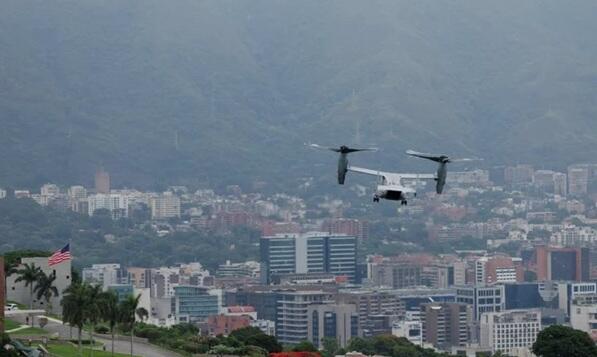
Since the Spring, American consular activity has been up and running, along with presumably the Caracas CIA station, also as even the Pentagon has held military drills in and around the Venezuelan capital.
Dozens of migrants who entered the Spanish territory of Ceuta during last month’s massive border surge have reportedly reached mainland Spain, contradicting the socialist government’s insistence that none had left the North African enclave.
Sky News reported Tuesday, citing Spanish police sources, that about 75 migrants who entered Ceuta in late July had reached Andalucía in southern Spain.
“Spanish sources in Andalucía said that around 75 migrants out of the estimated 72,000 who entered Ceuta illegally in a mass rush to the border at the end of July had reached the mainland,”Sky News reported.
The report directly conflicts with assurances from the government of socialist Prime Minister Pedro Sánchez.
“Nobody has left the city towards the peninsula, nor can they do so,” Foreign Minister José Manuel Albares said Tuesday during a visit to Ceuta.
Tens of thousands of mostly male North African migrants entered Ceuta on July 30, overwhelming the territory’s law enforcement, migrant processing facilities and other public services. Estimates have placed the number of arrivals between 60,000 and 80,000, approaching Ceuta’s normal population of about 80,000.
The surge followed a Spanish judicial ruling preventing authorities from immediately returning migrants who reach Spanish territory by land and requiring a longer legal process before removal.
Ceuta President and Mayor Juan Jesús Vivas has sharply criticized Madrid’s response and disputed the government’s portrayal of the crisis as under control.
“Ceuta has suffered and continues to suffer an invasion,” Vivas said Tuesday.
“We calculate that 10,000 immigrants are still in Ceuta and this creates an unsustainable situation.”
“The reaction of the government has not been on par with the demands of what occurred,” he added.
“A violation of the territorial integrity of Spain has occurred.”
The numbers provided by Madrid and local officials have also raised questions about the whereabouts of thousands of migrants. El País reported that the Sánchez government says 70,000 people entered Ceuta and 7,000 have been deported. El Mundo reported Monday that local officials estimate about 11,000 remain in Ceuta out of roughly 80,000 who entered.
Police sources told Sky News the crossings to mainland Spain represented a “worrying reactivation” of the migration route across the Strait of Gibraltar.
Albares nevertheless maintained Tuesday that the government would ultimately remove those who entered illegally.
“Up to the last person who entered irregularly into Spain will return to Morocco,” he said.
El País noted that Albares did not provide a specific timetable or mechanism for carrying out those removals.
The reports that migrants have reached mainland Spain add to mounting questions over Madrid’s handling of the crisis and whether the Sánchez government has accurately accounted for those who entered Ceuta.
Putin Threatens Seizures Of European Ships Over EU’s “Piracy & Banditry”
Russian President Vladimir Putin on Wednesday addressed the persisting issue of European governments and navies seizing what they deem Russian ‘shadow fleet’ vessels off Europe’s coast.
The past year alone has seen several examples, sometimes involving French or Swedish commandos descending onto a tanker’s deck from helicopters and arresting crew members. The seized vessels are then taken to nearby European ports.
The latest European Union sanctions package passed last month stipulates that EU members can sell the oil or any seized cargo obtained from these ‘shadow fleet’ vessels.
Putin has reiterated Kremlin outrage at this scheme, condemning it as “piracy and banditry”. This after Sweden has lately declared its intent to hand seized Russian grain over to Ukraine.
The Russian leader’s patience has reached its limit, apparently, as he is now putting European governments that their own ships become at risk of seizure in return.
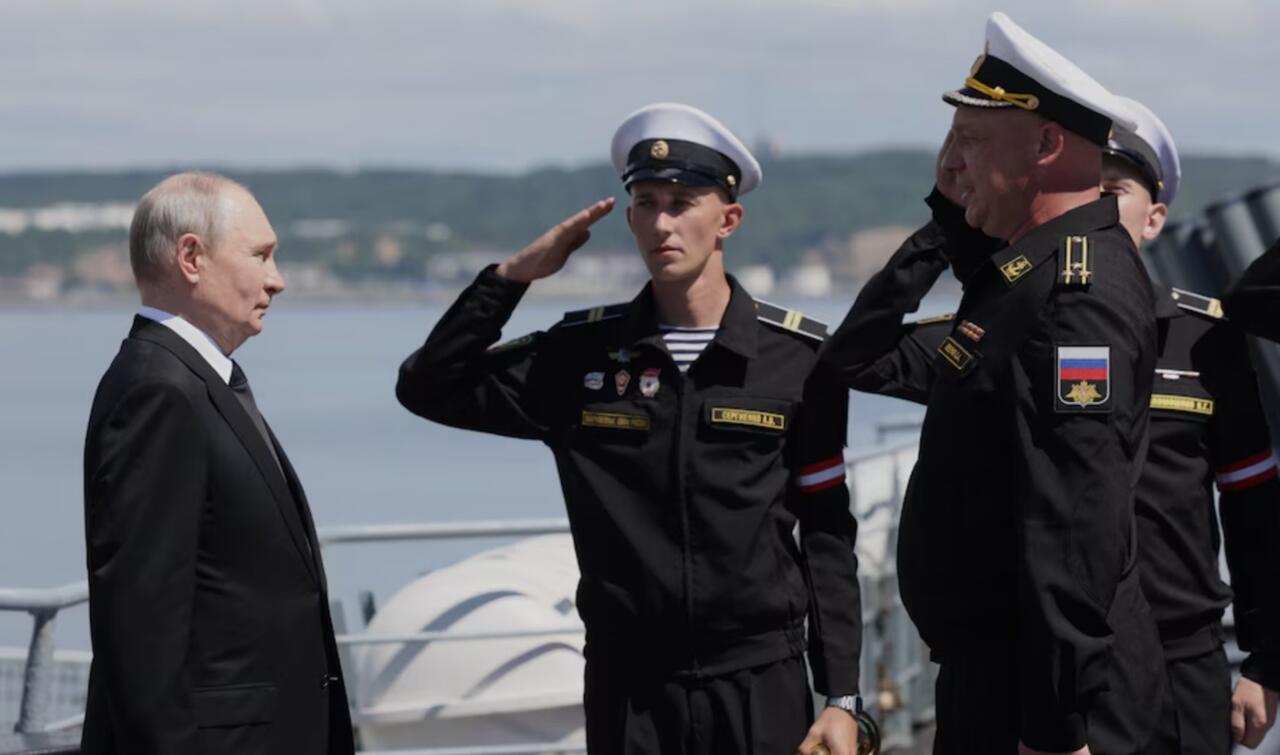
“We will be forced to respond in kind,” Putin said while overseeing naval drills in Russia’s Far East, aboard the Russian cruiser Varyag off the island of Sakhalin.
Russian forces will act “wherever we ourselves deem necessary and appropriate — anywhere,” he added.
According to some of his fuller remarks as translated and presented in Reuters:
“We can see that the authorities of certain countries, in violation of international maritime law, are attempting to restrict the movement of our economic operators’ vessels…, and have recently gone so far as to consider the possibility of seizing our vessels and selling off the property they have plundered from us,” said Putin.
“Naturally, this is nothing less than piracy and robbery. And if this begins to be put into practice, we shall be forced to respond in kind. And not necessarily in those waters where raids on our ships and vessels are planned, but wherever we ourselves deem it necessary and appropriate.”
So while Russia would not likely act in European waters, such a scenario would be more likely to go down in places like the Black Sea or Baltic region, or perhaps the faraway Indian Ocean.
Russian President Vladimir Putin threatens to seize ships belonging to European countries in retaliation for plans to intercept and seize Russian vessels suspected of being part of Moscow’s “shadow fleet.” pic.twitter.com/k6Dig6bvni
Putin also took the opportunity to address broader tensions with NATO and spillover from the Ukraine conflict, but also as it specifically impacts the Pacific and Arctic regions…
“We can see that, unfortunately, the potential for conflict is growing here; NATO is making inroads here; new military-political blocs are being formed; and new weapons systems are being deployed here, or are planned for deployment, which also pose a threat to our country,” the president said.
Yesterday saw the regular schtick where the Middle East situation remains worrying, but markets reacted to more positive narratives. After four crew and two rescuers were killed in a Houthi Red Sea attack on a ship and the US struck another in the Gulf of Oman’ trying to break its Iran blockade; Iran said Hormuz will stay closed unless the US meets its over-reach conditions; Trump doubled down on economic warfare vs Tehran because he thinks it’s “bleeding badly” -with the other option still being to “hit them really hard”; yet the Wall Street Journal reported ‘Iran Is Defying US Pressure by Becoming a ‘Survival Economy’; Pakistan claimed a US-Iran deal is close, and US Energy Secretary Wright said far more oil is flowing through Hormuz than others estimate, suggesting the US doesn’t really need to act.
This routine will likely continue through to the US midterms – and then we will see what happens. The old presidential adage is that one should speak softly and carry a big stick. Speaking loudly and leaning on a big schtick is not going to work for ever. On which, recent reports that the US is ‘out of munitions’ are true for precision varieties, not more traditional types that need to be used in greater proximity. If the US isn’t ultimately prepared to take those kinds of risks in a war against Iran, it will carry a geopolitical message that will not speak softly at all.
What the US (and allies) are running low on is Patriot missile defences. Yet just after the Pentagon gave US military industries 21 days to submit plans for “significantly faster” weapons production, Boeing has unveiled a cheap radar seeker built from off-the-shelf parts. They say necessity is the mother of invention; just not of higher margins, perhaps. (Then again, as I have repeatedly stressed, wars are won with bullets, not profits.) Yet much broader structural shifts in economics, not just economies, is evident on the ground and the Establishment intellectual level.
The sine qua non free trade academic Paul Krugman just admitted two hundred years of positive-sum free-trade thinking has been a ”sunny view… based on the assumption that we care about economic prosperity, not national power” – which is not true. War is raging and economies, currencies, and commodities have been weaponised. He admits we now need to look at ‘geoeconomics’ instead, which is the history of zero-sum economic statecraft and neo-mercantilism.
Foreign Affairs (‘The Right Way to Balance Trade: What Comes After the Neoliberal Order’) attacks Trump’s tariffs but argues for a West+ bloc common tariff against China and any trans-shipment, with low intra-bloc trade restrictions for those who also don’t run large trade surpluses, and industrial policies. Regular readers might recall this is what we have previously argued was the logical US grand macro strategy – and that attacks on Canada and Europe, etc., could be attempts to force them into accepting the common external tariff over the heads of vested interests vociferously against them. (If so, would a carrot not be better than a stick? Perhaps: but this wasn’t a normative call, just a descriptive one.)
Some also point out that even as Europe warms up for a potential trade war with China, it does not grasp the scale of the change in the world economy is lives in.
In particular, the Chinese industries the EU will likely take aim at are now mature, so require few direct subsidies that the EU will be looking for; the Leninist Chinese model helps supersize future industries so they can then stand on their own two feet. What policy framework, and working with whom, will Europe ultimately put in place within a ‘rules-based approach’ to try to retain its mature industries and to ensure that it develops new ones? (The same question also applies to the US, of course.)
As a signal, Vietnam — a GDP growth star via a low valued-added, FDI-based, export-driven economic model– is pivoting: it now wants to grow its own Korean-style ‘chaebol’ conglomerates to boost productivity and growth longer term on its terms. Is it wrong to do so when it could instead be focusing on quarterly earnings reports and outsourcing everything that it can?
Football provides an analogy to what the above may mean for us all in time: the world’s Beautiful Game –which recall isn’t actually big in India, China, or the US, the three most populous and first-, second-, and fifth-largest economies– might split.
Trump backs FIFA President Infantino, under furious attack over a World Cup sale plan dreamed up during a hydration break. UEFA, with some other federations, are developing a new rival framework for running world game. Might we end up with World Cups with different rules, sponsors, and participants?
If so, note what was a medieval mob game took a long time to grow into the rules-based one played first by English gents before then becoming a globalized money-making behemoth; and that there were early splits between those who wanted to play only with feet and those who wanted to also handle the ball – which ultimately became other sports.
In short, the West needs to relearn the Beautiful Great Game. But are its universities teaching geoeconomics or neo-mercantilism to allow the next generation of leaders to think up, and the bureaucrats to implement, such policies? Are its economists really capable of adapting to that reality rather than giving the same old advice under a new label? Are its analysts capable of projecting the dots of what it all implies?
Notably, the ECB’s annual conference in September will be held under the title ‘Geoeconomics and the International Trading System’, but the participants are still economists rather than the likes of Edward Luttwak, who coined the phrase geoeconomics in 1990 to describe how the “logic of conflict” merges with the “grammar of commerce.”
Today, of course, we can put that all aside to focus on US CPI, as if it isn’t intimately tied up with the above backdrop. Here is an ugly game all of its own – and one where the ‘rules’ change all the time.
First Morgan Stanley, Now BofA To “Mobilize And Deploy” $250 Billion Into America’s Infrastructure Supercycle
Bank of America unveiled a massive 18-month initiative to mobilize and deploy $250 billion across critical US infrastructure, targeting the computing, energy, and industrial systems needed to support artificial intelligence and accelerate the transition toward physical AI.
The announcement comes just days after Morgan Stanley launched its US Innovation Infrastructure Initiative, which aims to facilitate $1.5 trillion in capital raising and financing over the next decade. The back-to-back commitments signal that Wall Street is positioning for a multiyear capital-spending supercycle spanning data centers, power generation, grid modernization, semiconductors, advanced manufacturing and robotics.
*MORGAN STANLEY TO FACILITATE UP TO $1.5T OVER 10 YRS
this explains why they went so bullish on credit in the past 3 months https://t.co/nnhdOyD5x5
“Without hard infrastructure, it’s difficult to preserve our competitiveness and leadership for the next generation,” Karen Fang, global head of infrastructure and sustainable finance and co-head of global capital solutions, said in an interview with Bloomberg. “Old infrastructure has to be modernized.”
BofA’s financing will span three broad categories:
Digital infrastructure, including data centers, computing equipment, chips, telecommunications and semiconductors
Energy and power, including conventional and renewable generation, storage and distribution systems
Core infrastructure, including transportation, electricity transmission, grid modernization, water systems, critical minerals and mining
Surging demand for computing power, energy, manufacturing capacity and more resilient supply chains is driving a new investment cycle across the US. BofA said the initiative could support tens of thousands of jobs in construction, manufacturing, technology and long-term operations.
Morgan Stanley mapped out the AI infrastructure supply chain:
Nancy Lazar, Piper Sandler’s chief global economist and head of the firm’s economics research team, recently outlined how data center construction, reshoring, infrastructure upgrading and the reenergizing of America’s industrial base are creating an all-American blue-collar comeback as goods-producing jobs begin to reverse their multidecade downturn and shift higher.
Lazar noted:
Bullish on Goods-Producing Jobs vs. Hotel & Restaurant Jobs.
When China joined the WTO in 2001,U.S. goods-producing jobs began a decade of decline, while leisure & hospitality and education & health jobs continued to rise…
…so today, goods-producing jobs are less than half those of low-paying service jobs; their share was over 50% in the mid-1980s.
That employment mix shift gave us the bifurcated consumer, as lower-paying jobs gained share.Goods-producing jobs pay more than overall service-producing jobs, and lots more than leisure & hospitality or education & health care jobs.
Good news: That mix is now shifting the other way, as the long-running (not just tech) capex cycle raises productivity and margins, encouraging companies to add headcount.
Look at relative earnings growth by sector below.
Let’s come back to our “Powering Up America” and nuclear-power investment themes (began Decemeber 2020) over the last several years. They were right on the money, and both remain intact ahead of the multiyear capital-spending supercycle that BofA and Morgan Stanley are about to unleash.
The infrastructure required to power the AI economy, strengthen energy security, and support the AI revolution will be central to writing the next chapter ofAmerica’ss growth story into the 2030s.
Turkish officials suspect that an Israeli intelligence report about an Iranian plot to assassinate President Trump at the NATO summit in Ankara last month was a ruse designed to derail diplomacy between the US and Iran, Middle East Eye reported on Tuesday.
The Washington Postfirst reported on Monday that the US thought there was a credible enough threat against Trump that he secretly swapped planes when he departed Turkey. The president flew into Ankara on a new version of Air Force One donated by Qatar, but made a public show of departing on the older Air Force One, saying he was doing so for “old time’s sake.“
According to the Post report, after boarding the older Air Force One, Trump was then moved to a third plane, an Air Force C-32A, via a catering truck.
Some White House staffers and reporters on the older Air Force One thought President Trump was also onboard as they flew to the UK, making them unwitting decoys.
Missing from the Post report was where the intelligence about a plot against Trump came from. According to Middle East Eye and also a report from The Wall Street Journal, it came from Israel, which aligns with reports from the time.
Sources told MEE that the Israeli intelligence report warned that Iranian covert forces could target Air Force One at the airport in Ankara using shoulder-fired rockets, known as MANPADS, from just one kilometer away.
Due to the alleged threat, the Secret Service moved the departure point from Ankara Airport to Esenboga Airport and wanted to switch from the new Air Force One to the old one.
“Of course, we took the report very seriously and tried to assist our American counterparts as much as possible,” a source, described as a person familiar with the matter, told MEE. “Yet it was very clear to us that there was no way this report was true.”
The report said Turkish officials believe that the government of Israeli Prime Minister Benjamin Netanyahu devised the plot to make it appear that Israel was protecting Trump, further derail diplomacy between the US and Iran, and also strain relations between Trump and Turkish President Recep Tayyip Erdogan, whom the US president repeatedly praised during the summit.
Israel has strongly opposed the idea of the US selling F-35 fighter jets to Turkey, something Trump has said he’s strongly considering.
US President Donald Trump says the decision to make a plane switch in Turkiye after the NATO summit was made by the Secret Service.
The Washington Post revealed Trump boarded Air Force One, but used a catering truck to move to another aircraft due to an alleged Iranian threat. pic.twitter.com/dg1jz2DdBI
Another source, described as an Ankara insider, told MEE that it was ironic that the Secret Service’s decision to move Trump has been leaked just one month after it happened. “I guess they need heroes for an attack that never happened and, most likely, was never planned,” the insider said.
Cambridge University has now decided that even Little Red Riding Hood is too dangerous for young minds.
Clare College issued an official content warning ahead of a free online humanities webinar for state sixth-form pupils, flagging “adult content including themes of violence, with reference to fairytales.”
The session, part of a course designed to prepare GCSE and A-level students for university study, encouraged participants to “read beneath the surface” of bedtime stories. Official course notes still felt the need to caution: “Content warning: Please note this session will involve discussion of some adult content including themes of violence, with reference to fairytales.”
Cambridge University slaps Little Red Riding Hood with trigger warning over ‘themes of violence’ https://t.co/6TUushF83Y
In Charles Perrault’s original 1697 version, the wolf eats both grandmother and the girl. The later Brothers Grimm retelling keeps the violence but allows a huntsman to save them. Modern adaptations have dialled the darkness up further.
None of this is news to anyone who has ever heard the story. Yet Cambridge treated it as a potential trauma event for teenagers.
Lord Toby Young of the Free Speech Union cut through the nonsense: “Putting trigger warnings on fairytales is infantilising, even for Cambridge.”
Professor Dennis Hayes, director of Academics For Academic Freedom, has long warned where this leads. “Once you get a few trigger warnings, lecturers will stop presenting anything that is controversial. Gradually, there is no critical discussion.”
Commentator Adam Brooks captured the wider reaction in a short video that has been circulating widely. He called the move “ridiculous,” asked what is wrong with a culture that raises perpetual victims, and accused left-wing universities of brainwashing students while staff appear “away with the fairies.”
What was once a children’s warning about talking to strangers has been reclassified as adult material requiring institutional protection.
The message to the next generation is clear: the world is too frightening to confront without official guidance, and the stories that once toughened character must now be handled with kid gloves.
This is just the latest chapter in a long campaign to wrap classic culture in the same cotton wool as modern culture.
In a dark twist of irony, a 75th-anniversary edition of Orwell’s 1984 arrived with its own trigger warnings and lectures about the book’s “problematic” hero.
Shakespeare’s plays have been systematically infested with the same notices.
The Royal Shakespeare Company even warned audiences that The Merry Wives of Windsor contains “body-shaming.”
Universities that once prided themselves on forming adults now specialise in manufacturing fragility.
The wolf is no longer the danger. The real threat is an education system determined to keep students forever inside the cottage, doors locked, lights on, and every traditional tale carefully labelled for their own safety.
Your support is crucial in helping us defeat mass censorship. Please consider donating via Locals or check out our unique merch. Follow us on X @ModernityNews.
Iran Rejects US Pressure, Enters ‘Survival Economy’ As Mediators Cite ‘Absolutely No Progress’
It has become beyond obvious that there is no broader peace process and that things are in a stalemated situation amid what’s broadly seen as a Washington retreat from military confrontation, leaving Iran to press its own vision of management over the Strait of Hormuz with Oman.
While President Trump has settled into a waiting game which once again bets on sanctions and economic warfare to eventually force Tehran to bend, Iranian military leaders are declaring that “victory is on our side”.
The Wall Street Journal has noted that the Islamic Republic has entered a ‘survival economy’ with the country’s rulers “taking time-tested steps to keep their chronically battered economy functioning just enough to resist a drawn-out campaign.”
There’s no doubt that infrastructure along with various key industries and the Iranian currency has been severely tested and battered, but the WSJ outlines strategies of this survival mode as follows:
Tehran is rationing scarce goods, limiting access to foreign currency, slashing investment and shifting more of the burden onto households while preserving strategic imports and the essential machinery of the state, analysts say. The result will be a deepening economic malaise that leads to rising poverty and dysfunction, but also more room for Iran’s leaders to stall talks with the U.S.
That leaves Trump’s strategy resting on a risky assumption that Iran will crack before Washington does. Mediators have warned their U.S. counterparts that Iran has been living under sanctions for years and betting that Tehran will compromise because of economic pressure won’t likely yield results. Instead, Iran will likely continue to escalate attacks to raise the price for Washington and its allies.
Such a ‘risky assumption’ was on display from even the very start of Operation Epic Fury nearly six months ago and nothing has fundamentally changed in terms of the Iranian system ‘cracking’. Within merely the first two weeks of war back in early March, we highlighted some of Washington’s persisting false assumptions in: Escalation Trap: Misreading Iran’s Internal Power Dynamics.
Meanwhile, Gulf and regional mediators are still clinging to hope that some form of ceasefire can limp along and be put back in full force, also with efforts to get the US and Iran talking again. As a Wednesday, per Bloomberg:
Pakistan said the 60-day deadline for a US-Iran MoU may be extended, but the larger peace process has stalled. Earlier, Donald Trump said the US “totally” controls the Strait of Hormuz. Oil wavered.
Neither of these things are true – at this point the MoU is dead with Iran weeks ago having already pulled out while declaring in null. Also, if the US military ‘totally’ controlled the strait then there would be no crisis that must be ‘resolved’ and global oil would be transiting at full tilt again.
🇮🇷 “Certainly, victory is on our side.”
In an interview with PBS, senior IRGC adviser Mohammad Reza Naqdi said Iran has thwarted Washington’s objectives, learned how to fight the U.S. military and may prolong the war until the next American presidency to impose sustained costs… pic.twitter.com/K5cXNPRgQL
The latest from Reuters further observes that “The US and Yemen’s Iran-aligned Houthis reported separate attacks on shipping as prospects for ending the Iran war appeared to dim, with Tehran saying the Strait of Hormuz would remain closed unless Washington accepts its conditions.”
Mohsen Rezaee, the newly appointed head of Iran’s Supreme National Security Council, has informed China’s ambassador to Tehran, Cong Peiwu: “As long as America does not change its behaviour and does not accept Iran’s conditions, the Strait of Hormuz will not be opened.“
But so far on Wednesday there’s been an uneasy quiet, so at least the bombs have fallen silent. But on Wednesday Reuters while citing mediators has painted a grim picture: “There has been absolutely no progress on this issue,” the [Pakistani government] source added…
“There is no talk of an extension because, from Iran’s perspective, there is no period that began and therefore nothing to extend. The United States violated the interim agreement 48 hours after it was reached and withdrew from it a few days later,” the source told Reuters.
In the agreement, the 60-day period refers to an extendable timeframe within which Iran and the U.S. were expected to reach a final deal limiting Tehran’s nuclear program and lifting U.S. sanctions.
“One of the issues that is being discussed via mediators is the U.S. returning to the interim agreement and defining a timeframe for implementing the commitments. There has been absolutely no progress on this issue,” the source added.”https://t.co/pqc9L848BC
US President Trump said they totally control the Strait of Hormuz, while he said regarding the flight change during the return trip from Turkey in early July that he was following what the Secret Service said and the plane he flew on was at greater risk. Furthermore, Trump said that he doesn’t trust Iran.
Pakistan’s Foreign Ministry said it continues to activate direct and indirect diplomatic channels between the US and Iran and that they are working to bring both sides to the negotiating table in Islamabad. The Ministry added that they remain optimistic and not discouraged by escalations. Furthermore, the Ministry added that with the 60-day MoU deadline approaching, the deadline can be extended.
Pakistani Interior Minister is said to have given an important message to Iran.
Iranian Army official said Iran intends to maintain control and oversight of the Strait of Hormuz as a key source of its geopolitical power, Mehr News reported.
Iran’s IRGC said that if a threat against Iran occurs again, “hundreds of thousands of miles of energy transmission lines, thousands of power plants, all US and non-US systems, and even global infrastructure connected to the Internet are at risk,” Sepah reported.
Japanese PM Takaichi held a phone call with the Iranian President, on de-escalation of tensions in the Middle East and the security of maritime transit, Kyodo reported, citing sources.
Yemeni Deputy Foreign Minister said there has been no direct or indirect negotiations with the Houthis, Al ArabyTV reported.
Israel conducted airstrikes in southern Lebanon, according to IRIB.
Swedish Prime Minister Ulf Kristersson has called the Spanish government’s amnesty for illegal immigrants a “very bad idea,” warning that it could spark another migrant crisis akin to the one that beset the continent in 2015.
The center-right politician, who is running for reelection next month, told the Financial Times in an interview published on Aug. 11 that the Spanish amnesty for more than a million illegal immigrants had caused a “pretty big outcry” at the last summit of EU leaders.
Spanish Prime Minister Pedro Sánchez’s government granted a royal decree on April 14, launching the regularization of people living illegally in the country.
The proposal was first presented on Jan. 27 to allow about 500,000 illegal immigrants already living and working in Spain to obtain legal status through an accelerated process. According to figures from the Spanish government, almost 1.2 million applications for regularization were received.
The move was controversial, but the migrant surge in Ceuta, a Spanish exclave on the North African side of the Mediterranean at the end of July, compounded concerns.
Kristersson said a knock-on effect from Madrid’s move could pose a serious threat to the European Union’s free movement zone, known as the Schengen Area.
“It symbolizes that we still have to be very, very careful not to act in a way that could even come close to what happened in 2015,” Kristersson said. “I think Spain got the message … but it shows the vulnerability.”
He said he had told Sánchez that he disapproved of the move.
“Having [the amnesty] also creates a possibility for you to use European territory. That is specifically damaging for us because we know from experience that many people coming to Europe prefer to go north. Exactly that happened in 2015,” Kristersson said.
“It is not the time to get relaxed on this … there is a huge majority in Sweden saying they cannot go back to an uncontrolled situation. … Doing things that could jeopardize a stable situation would be a very bad idea.”
In 2015, 1.3 million people, mostly fleeing war in Syria and Iraq, sought refuge in Europe, causing the EU’s asylum system to collapse; reception centers were overwhelmed in Greece and Italy, with countries further north erecting barriers to stop illegal immigrants from entering.
The unprecedented influx into Ceuta began on July 30, when an estimated 50,000 to 60,000 people entered the exclave from Morocco by land and sea. Many swam around a border breakwater after social media posts claimed that Spain had opened its border.
More than 80 people died on both sides of the border, according to figures released by Spanish and Moroccan authorities. Some drowned while attempting to swim to Ceuta, while others were crushed or trampled during chaotic efforts to climb a breakwater and border fence.
In the wake of that incident, multiple leaders around Europe issued sharp criticism of Sánchez’s government, with Italy temporarily suspending its Schengen Area agreement with Spain.
The one-month suspension of border-free travel between Italy and Spain was announced on July 31 by Italian Prime Minister Giorgia Meloni and Deputy Prime Ministers Antonio Tajani and Matteo Salvini, who described the move as necessary for security.
France, which shares a land border with the Spanish mainland, also announced an intensification of controls along the border.
Italy’s move was supported by a number of EU member states, including Finland, Denmark, and the Czech Republic, with the governments of all three saying that Brussels should consider closing the Schengen Area to Spain.
On Aug. 4, EU interior ministers called for stronger borders, faster returns, and expanded efforts to dismantle migrant-smuggling networks as a result of the Ceuta surge.
Kristersson faces an election on Sept. 13, having led the Scandinavian nation since 2022 as head of a coalition comprising his Moderate Party, the Christian Democrats, and the Liberals with additional support from the Sweden Democrats.
Swedish polling company Novus’s poll of 5,726 eligible voters, conducted 6-9 July, gave the Social Democrats 32 percent, the Sweden Democrats 20 percent, and Moderates 17 percent.
Sweden tightened its previously liberal immigration and citizenship policies earlier this year because of the vast numbers of immigrants it has taken in over the past two decades.
In November, Stockholm launched an inquiry to investigate “parallel social structures” that had emerged in the country.
Swedish Minister for Education and Integration Simona Mohamsson said in a statement at the time that these structures, consisting of “clans and family-based networks,” undermine “the rule of law, threaten democracy, and hamper integration.”
“It is unacceptable that people in Sweden live under social control, are subjected to honour-based violence and oppression or are prevented from fully participating in society,” she said. “With this inquiry, we are taking an important step towards addressing these problems.”
The inquiry’s report is due to be presented on Aug. 20.
In June, the Swedish parliament passed a law allowing authorities to revoke residence permits from immigrants for “not behaving properly,” the latest in a series of moves breaking away from the country’s once-liberal immigration system.
Residency permits can now be revoked for conduct including unpaid debts, undeclared work, organizing begging, and more, even where the behavior falls short of a criminal conviction.
World’s Largest Alumina Refinery Outside China Abruptly Halves Output On NatGas Disruption
Norwegian aluminum producer Norsk Hydro’s Alunorte plant in Brazil, one of the world’s largest alumina refineries, reduced output by 50% following disruptions to natural gas availability.
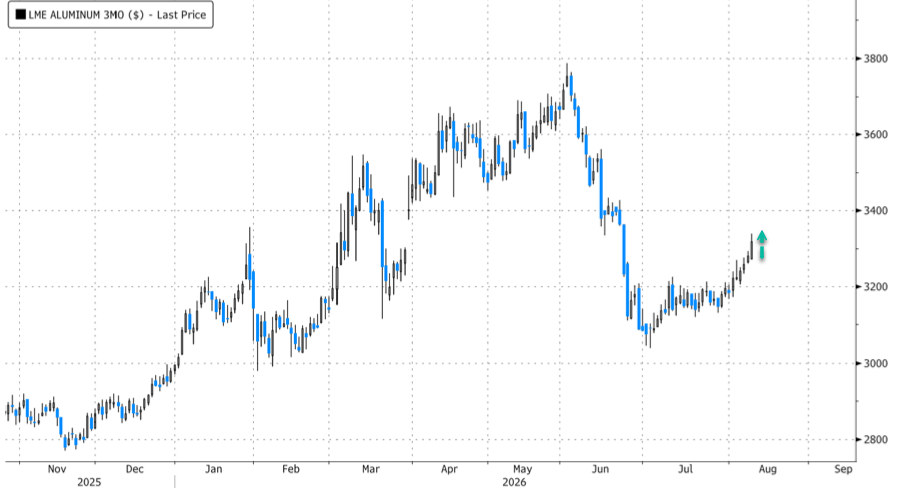
Bloomberg reports that disruptions to NatGas availability at Alunorte forced a 50% reduction in output and sent aluminum prices in London to a seven-week high. Hydro said production would return to full capacity once gas supplies normalize.
Aluminum rose nearly 2% in London and traded at $3,373 a metric ton. Alumina futures gained 1% in Shanghai.
NatGas is critical to Alunorte because alumina refining requires high-temperature heat and steam. The gas powers the Bayer process, which refines bauxite:
Digestion: Bauxite is mixed with caustic soda and heated under pressure to dissolve the aluminum-bearing minerals.
Evaporation and steam generation: Large boilers provide steam throughout the refinery.
Calcination: Aluminum hydroxide is heated to around 1,832F to remove water and produce smelter-grade alumina.
The disruption means that Alunorte cannot maintain enough steam and furnace heat to operate its production lines, forcing the refinery to reduce throughput. For context, Alunorte is the world’s largest single-site alumina refinery and the largest outside China. It is located in Barcarena, Pará, and has an annual capacity of 6.3 million metric tons.
Inventories in London Metal Exchange warehouses have fallen to 250,000 tons, the lowest level since November 1990. Norsk Hydro recently warned that the annual global aluminum deficit could top 900,000 tons if trade through the Strait of Hormuz remained disrupted.
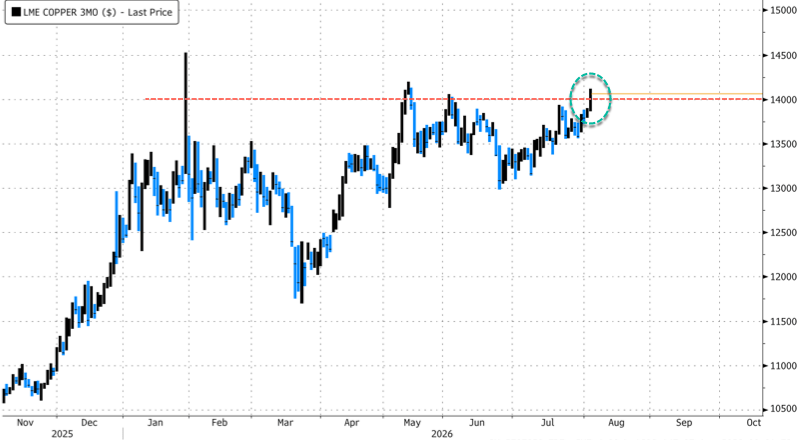
Also in the industrial metals space, copper futures in London are trading above $14,000 per ton as metal inflows into the US continue ahead of President Trump’s expected tariff, effectively tightening global supplies.
Surging prices for both industrial metals will only make electrification and decarbonization even more expensive.
“Copper and aluminum are important beneficiaries of electrification and decarbonization,” said UniCredit SpA strategist Thomas Strobel. “While copper’s investment case is driven by structural supply constraints, aluminum benefits from lightweighting, grid expansion and recycling. Together, they offer complementary exposure to some of the strongest long-term trends in the global economy.“