Almost two decades ago, Canada recognized that it needed to greatly bolster its defence capabilities in the Arctic.
“Canada has a choice when it comes to defending our sovereignty over the Arctic,” Prime Minister Stephen Harper announced in 2007 when at Canada’s Pacific fleet in Esquimalt, B.C.
“We either use it or lose it. And make no mistake, this government intends to use it.”
To put Canada’s claim to the Arctic on solid footing, the government announced the construction of a deepwater port in the Far North to house an armed fleet of Polar Class 5 Arctic Offshore Patrol Ships, capable of operating in ice up to one meter thick. By engaging in full operations on the East and West coasts throughout the year, Canada would be able to assert a credible claim.
“In defending our nation’s sovereignty, nothing is as fundamental as protecting Canada’s territorial integrity; our borders, our airspace and our waters,”Harper stressed.
Harper’s grand plans—they included other deep-sea ports and year-round roads to link Arctic ports with the Canadian south—never came to fruition. Canada still has no deepwater Arctic port. Rather than an Arctic flotilla engaging in full operations on both coasts, the most Canada often musters to signify its sovereignty in the High Arctic are abbreviated summertime visits. By that measure, Viking Cruises, which typically operates three or four Arctic cruises per year, has a comparable claim to the Arctic.
Harper was astute in recognizing the forces that would be descending on Canada’s Arctic. Foremost of those at the time was Russia, which has had by far the largest presence in the Arctic, and in 2007 planted a flag on the sea bed at the North Pole in preparation to claiming 460,000 square miles of underwater territory. But the United States, which hasn’t recognized Canada’s sovereignty over the Northwest Passage, has also been a rival.
Today, the claimants to the Arctic are ever more active. With United States Geological Survey research estimating that the north may contain 22 percent of the world’s undiscovered resources and with global warming expected to make Arctic resources exploitable, claims to the Arctic are mounting.
Russia is displaying its dominance with three dozen icebreakers, including four nuclear-powered icebreakers and a nuclear-powered cargo ship, giving it by far the world’s largest Arctic fleet. China has also emerged as a formidable entrant into the Arctic by asserting an entitlement to Arctic resources through a claim of being “a near-Arctic state.” China already has three icebreakers plying Arctic waters, with more on the way, including a nuclear-powered icebreaker expected this year. To surpass the rival fleets of both Russia and China, U.S. President Trump declared that he intends to build “40 big icebreakers.”
Canada, in comparison, has but two aging icebreakers near the end of their service life and has only recently ordered two new icebreakers, to be completed by 2030. If past experience is a predictor of future performance, however, those icebreakers won’t materialize—most of Canada’s Arctic initiatives lie moribund due to lack of funding.
Canada’s abject Arctic record was documented in a 2022 report by the Auditor General. The report stated that “long-standing issues include incomplete surveillance, insufficient data about vessel traffic in Canada’s Arctic waters, poor means of sharing information on maritime traffic, and outdated equipment. The renewal of vessels, aircraft, satellites, and infrastructure that support monitoring maritime traffic and responding to safety and security incidents has fallen behind to the point where some will likely cease to operate before they can be replaced.”
The Inuit have also become formidable players. Their Inuit Circumpolar Council, which represents some 180,000 Inuit in Alaska, Canada, Greenland, and Russia, formally aspires to sovereignty. Once it determines that the time is ripe to declare sovereignty, potentially with backing by China and the U.N., Canada would have no ability to militarily prevent them from obtaining a foothold in its Arctic territory. Not that Trump would permit Canada’s north to fall into the hands of a group allied with China. To prevent it, Trump might decide to seize Canada’s northern territories, as he intends to seize neighbouring Greenland.
The Circumpolar Inuit Declaration on Sovereignty in the Arctic correctly notes that “Sovereignty is a contested concept, however, and does not have a fixed meaning.” Canada’s strongest claim to sovereignty among the many different legal opinions as to what constitutes sovereignty is generally thought to rest on the United Nations Convention of the Law of Seas (UNCLOS), to which Canada is a party.
UNCLOS provides Canada with little solace, however. The United States is not a party to UNCLOS; Russia, which is a party, states it is considering leaving UNCLOS, and China, also a party, flagrantly disregards UNCLOS rulings with which it disagrees. Ultimately, the only law throughout history that determined sovereignty has been “might makes right.” On that criterion, Canada falls woefully, hopelessly short.
With Russia, China, the United States, and the Inuit all circling to establish or strengthen claims to sovereignty over Arctic resources, a future conflict appears inevitable. Canada must immediately step up its efforts in the region. As Harper said in 2008: “To protect the North, we must control the North.”
Views expressed in this article are opinions of the author and do not necessarily reflect the views of The Epoch Times or ZeroHedge.
“Something Exceptional Happening”: Copper Bull Forecasts New Record Highs On Most-Profitable Trade Ever
In an exclusive interview, Kostas Bintas, Trafigura Group’s former co-head of metals and now with Mercuria Energy Group Ltd., told Bloomberg that President Trump’s tariff threat on copper could push prices to record highs and unleash unprecedented opportunities for trading profits.
Bintas explained that massive copper inflows into the US are sending supplies lower elsewhere—most notably in top consumer China. As a result, the global market is showing signs of tightening, pushing Shanghai copper futures into their widest backwardation in over a year. Adding to the pressure, Mercuria forecasts that global demand will outstrip supply by 320,000 tons this year, and inventories ex-US will be significantly depleted.
“We think there is something exceptional happening in the copper market,” Bintas said, adding, “Is it unreasonable to expect a copper price of $12,000 or $13,000? I’m struggling to put a number on it because this has never happened before.”
The shift of inventory to the US means the Chinese copper market will be left with low stocks…
“China has been successful historically in rejecting high prices,” the trader said, warning, “This is the first time in recent history that another market is taking tons away from the Chinese market. That’s why it’s uncharted territory.”
Bintas runs a 40-person metals team at Mercuria and has been one of the most bullish voices in the space and called for a multiyear bull market after Covid on rising demand from all things electrification – i.e., ‘Powering Up America‘ theme and Next AI Trade.
Former Goldman metals strategist Nick Snowdon, also at Mercuria and head of metals research at the commodity trading firm, forecasted about a year ago that average copper prices would average $15,000 a ton for 2025.
Last week, Goldman’s Eoin Dinsmore, Lavinia Forcellese, and others provided clients with several key factors as to why they are “tactically cautious, structurally constructive” on copper:
We believe two key factors are driving the recent LME copper price strength:
Section 232 has lifted both the COMEX and the LME price. As the COMEX US price has increased to incorporate greater certainty on US copper tariffs, it has resulted in tighter London LME spreads and additional speculative length on the LME. While we hold to our 2025 market deficit forecast of 180kt, we think stockpiling in the US will make the world ex-US appear tighter, which may pull forward the rally we forecast for H2.
China sentiment has turned notably more positive. This is due to the government’s commitment to boost consumption, AI optimism, and lower than feared US tariffs on China. Positive China sentiment has been further bolstered by reports that China’s State Reserve Bureau (SRB) plans to add to its copper stockpiles in 2025. We see SRB copper purchases as defensive to address potential shortages rather than opportunistic (i.e. very price sensitive), and SRB buying would help offset any price-related demand pull-back in China. While our China economists see upside risk to their 2025 4.5% growth forecast, they argue that policymakers may ease off the gas after a decent Q1 real GDP print.
However, trade policy uncertainty leaves us tactically cautious. We see two-sided risks from the upcoming US trade policy update on April 2nd. While the delay to European retaliation is slightly positive, our economists expect additional product specific tariffs to be announced. Any focus on China or a hawkish line on reciprocal tariffs will be negative for copper prices. We are not anticipating a S232 copper update, as the deadline for public comments only ends on April 1st[1]. We think the front month COMEX-LME premium should drop if the trade update fails to signal a speedier than typical S232 tariff implementation.
We remain structurally bullish. Should the April 2nd policy announcements spare the market of negative sentiment surprises, we think the net LME tightening impact from the ongoing S232 copper investigation poses a net upside risk to our Q2-Q3 2025 $9,550/t-$9,883/t price forecast. For now, we also maintain our bullish $10,200/t Q4 2025 forecast, on the back of strong electrification demand, China stimulus offsetting the drag from tariffs, and slower mine supply growth.
US inflows of copper only suggest that Chinese buyers will face aggressive competition for the metal in global markets.
As awareness grows of the Chinese Communist Party’s (CCP) influence in the United States, a former congresswoman from California is shedding light on the regime’s reach in the state, across the country, and around the world.
Michelle Steel, who served in Congress from 2021 to 2025 and sat on several committees dealing with China-related issues, raised concerns about the CCP’s influence on the U.S. higher education system in a recent interview with EpochTV’s “California Insider.”
“Universities were the worst one. We have a prominent university in California called UC Berkeley … and they received $220 million from China,” Steel said.
Under the Higher Education Act of 1965, universities must report to the Department of Education every six months any foreign gifts or contracts—either individually or combined—valued at $250,000 or more in a calendar year.
Steel alleged the university never reported the money.
The allegations surfaced in 2023 when Education and Workforce Committee chairwoman Rep. Virginia Foxx (R-N.C.) and then Select Committee on China chairman Rep. Mike Gallagher (R-Wis.) stated in a letter to University of California–Berkeley officials that the university failed to report investments from the Chinese municipal government—$220 million of which was intended to fund a campus in Shenzhen, China—for the Tsinghua-Berkeley Shenzhen Institute, a joint research initiative.
Tsinghua University, one of China’s top institutions, is governed by the country’s Ministry of Education.
In exchange for the money it received, the university allegedly provided exclusive tours of advanced semiconductor research facilities to Chinese delegations, including senior Chinese regime officials, according to another letter to the National Science Foundation from House Science, Space, and Technology Committee chairman Rep. Frank Lucas (R-Okla.) and Research and Technology Subcommittee chairman Rep. Mike Collins (R-Ga.).
“Allowing adversarial nations to access research facilities at the leading edge of semiconductor design is unacceptable, especially when that access is given by a U.S. research institution that receives over $700 million annually in funds from the Federal government,” the pair said in the letter.
The Epoch Times reached out to UC Berkeley for comment.
After the allegation drew public attention in 2023, the university responded by stating that while the funds were initially proposed for a Tsinghua Berkeley Shenzhen Institute campus, the campus was never built and the investment did not take place, campus spokesperson Dan Mogulof told student-run newspaper The Daily Californian in an email that year.
Mogulof said the funds were used to construct a new campus for the Tsinghua Shenzhen International Graduate School, which he clarified is owned by Tsinghua University.
However, in a report by the Daily Beast, the university acknowledged it failed to disclose a $19 million contract in 2016 with Tsinghua University.
In 2022, the CHIPS and Science Act lowered the reporting threshold to $50,000, requiring any foreign financial support at or above that amount to be reported to the director of the National Science Foundation.
Stricter rules also apply when sensitive countries are involved, Steel said.
“[Even] when you have coffee with those countries of concern. We’re talking about China, Russia, North Korea, Iran, and any of these countries, then you have to report,” she said.
In addition to the risk of intellectual property theft, Steel said large foreign grants can also lead to university administrations being influenced or controlled by foreign governments.
“We saw so many universities, instead of the monies going down to the classrooms … administrations [were] getting bigger and bigger,” she said. “Universities are not corporations that have to make profits. They have to reinvest that to the students.”
Steel also expressed concern that university students could be receiving propaganda from foreign regimes instead of a proper education.
“Instead of teaching our kids how to think and how to be independent, some of the universities are brainwashing our kids, and they are getting [so much] money.”
Port Security
Steel said she is also concerned about CCP infiltration at major U.S. ports.
“In California, we have [the] two biggest ports in the U.S., [Los Angeles] and Long Beach, and 80 percent of those cranes we bought from China,” she said.
The popularity of Chinese-made cargo cranes is largely due to their lower cost, typically about three-fourths the price of those made in other countries, Steel said. Each crane can cost up to $15 million, while other models also cost millions.
Currently, the Port of Los Angeles uses 84 container cranes, and the Port of Long Beach uses 73 cranes.
In March 2024, the House Homeland Security Committee reported that cellular modems were found on cranes purchased from Shanghai Zhenhua Heavy Industries, a China-based manufacturer that produces nearly all Chinese-made cranes used at U.S. ports.
The modems, which are not included in equipment contracts, do not appear to support normal operations and could potentially be accessed remotely, the committee said.
Such cellular modems were also discovered in another port’s server room that houses those cranes’ firewalls and networking equipment.
Steel, who co-authored the report, said the modems installed in the cranes can track ship traffic and the types of goods being transported, potentially enabling espionage that could undercut trade competitors and disrupt supply chains.
“We heard that they always ask that those cranes to be in remote areas or inside because they put chips on it and … they’re collecting all these data,” she said. “It’s a national security issue.”
Steel said China has also provided South Korea and Japan access to its state-backed LOGINK software, a digital logistics platform that enables real-time cargo tracking, giving it visibility into global supply chains and potential leverage in economic or geopolitical conflicts.
“We are not using their maritime tracking system, but our allies are using it. So, you really have to watch it very closely,” she said. “You really have to advise other countries to stop using Chinese maritime tracking systems.”
Steel said the cranes could also be used to spy on U.S. Navy activities.
“It’s not just like a private shipping company is coming in. We’re talking about our naval ships going in and out, too,” she said. “That’s very, very dangerous.”
Before leaving Congress, Steel sponsored the Secure Our Ports Act, which would prohibit foreign adversaries from owning or operating critical infrastructure in the United States.
The legislation was reintroduced in January by Rep. Ken Calvert (R-Calif.). It would ban state-owned enterprises of foreign adversaries such as China, Russia, North Korea, or Iran—or any foreign entity partially owned by those governments—from owning, leasing, or operating port facilities in the United States.
Steel said the CCP’s influence also extends beyond the United States, describing China’s strategy as offering infrastructure development—such as dams, airports, ports, and railways—to poorer countries, eventually gaining control over key systems, especially when those nations are unable to repay their debts.
Fentanyl Crisis
Steel pointed to fentanyl as another major issue she believes China is fueling.
Overdose deaths involving synthetic opioids such as fentanyl began rising sharply in California around 2013, driven by the spread of illicitly manufactured fentanyl, which soon surpassed prescription opioids and heroin as the leading cause of overdose deaths.
In 2023, fentanyl was involved in more than 90 percent of the state’s 7,847 drug overdose deaths, according to the California Department of Public Health.
“A lot of fentanyl precursors [are] coming in,” Steel said. “When they use it inside of China, you have a death sentence. But [when it’s] taken outside of China, making money, they’re very loose.”
Steel said that while Congress was aware of China’s role in the fentanyl crisis, it wasn’t until the COVID-19 pandemic that the full scale of the problem became clear.
When the Chinese communist regime drastically reduced pharmaceutical exports during the pandemic, the sharp drop in fentanyl entering the United States revealed how much of it had originated from China, she said.
Agencies such as the Drug Enforcement Administration have also reported on the global flow of fentanyl and its precursors from China. The Department of Justice has issued indictments against Chinese networks accused of selling precursor chemicals to Mexican cartels, which then processed them into fentanyl for distribution in the United States.
Cartels, at the same time, have found some creative ways to smuggle fentanyl across the border, Steel said.
“They use the remote surfboards, and then they can just control it from Mexico’s side,“ she said. ”Then somebody [picks] it up from our side, so they don’t even have to go through the border.”
Although the flow of fentanyl has become more varied since it first entered the country, Steel said that at its core, China remains behind the supply chain.
Human Rights
Steel also criticized human rights abuses in China, saying innocent people—such as Falun Gong practitioners and Uyghurs—are being jailed and persecuted for their beliefs.
“Before they put them [in jail], they scan your body. And then one day, you wake up, if you’re lucky. If you are not, then who knows? You [might] get killed [or you might find] one of your organs is missing,” she said.
She recalled attending hearings on the CCP where some witnesses testified while covering their faces, fearing their families in China could be targeted or imprisoned.
“It’s just awful, stories that you hear [from] these people [who] came to the hearings. And they are crying, and some people wearing masks,” she said.
In some cases, she said, even the witnesses—legal American citizens—could be targeted by Chinese secret police operating inside the United States.
Shen Yun Performing Arts, whose artists practice Falun Gong, has been targeted by the CCP in similar ways. Since March 2024, the company has received dozens of emailed threats of violence during its global tour. Over the years, Chinese officials have repeatedly tried to cancel Shen Yun’s performances in various cities through blackmail and economic pressure.
Recently, Steel encountered one such incident herself.
“I just got a letter from South Korea, and they are supposed to have performances in Daegu. Daegu just canceled it because the Chinese Embassy was actually pressuring them,” she said.
Speaking on the CCP’s aggressive tactics against the performing arts company, Steel said it’s because its performances reveal a side of China that the regime does not want the world to see.
“You are trying to hide something. [That] means that you are not doing the right thing. That’s the bottom line for me,” she said.
Why Get Involved?
Steel’s efforts to uncover the CCP’s influence did not come without risk.
She recalled a conversation she had with then-Speaker Kevin McCarthy when he appointed her to the Select Committee on the Chinese Communist Party.
“Michelle, I want you to be careful. Somebody is looking at your cellphone. When you open your cellphone … you have to have those screens, that nobody from the sideways can read,” she said McCarthy told her. “And then you have to have double firewalls for your cellphone to make sure that nobody can hack them, because you know CCP is going to come after you.”
However, the risks did not deter her.
“I knew what I was getting into because both my parents fled from North Korea, from communism. I always stand up for the democracy of the country.”
She said becoming a politician was not how she originally envisioned standing up for democracy.
“I never thought that I’m going to be a politician, because I had a very shy personality, and I couldn’t speak in front of two people.”
Her mindset shifted after her mother’s shop was penalized for underpaying sales tax during a transitional period. The state tax agency accused them of tax fraud and imposed a penalty.
That experience prompted her to run for the California State Board of Equalization in 2006, and she served for eight years before being elected to the Orange County Board of Supervisors in 2015.
“I had compassion for small business taxpayers,” she said, saying that some such businesses are harassed and abused.
Running as a political “nobody,” Steel said her key to success was hard work, something she learned at a young age after moving to Japan, and later to the United States, where she constantly had to overcome language barriers and keep up with her peers.
“I slept about two to three hours. I was all over [during the election],” she said.
That work ethic carried Steel through her years in Congress, where Southern California’s coastal erosion was one of the first issues she tackled.
“My first term I was elected, we really need some more [sand] for my district, because I represented Seal Beach, Huntington Beach, Newport Beach, and Laguna Beach,” she said.
Steel said she had meetings with every Congress member who had the power to approve sand restoration projects for her district.
“So, one time on the floor, one of the congressmen [said], ‘Oh, my Sand Lady is passing,’” she recalled.
Steel’s work has also earned praise from her colleagues. In a recent letter, Ways and Means Committee chairman Jason Smith (R-Mo.) and Rules Committee chairwoman Foxx recommended her to President Donald Trump for the role of U.S. ambassador to South Korea.
In the letter obtained by The Epoch Times, the lawmakers cited Steel’s shared vision with Trump, her experience in tax and trade policy, and her fluency in Korean, Japanese, and English.
Living in America is like being in a dream factory, Steel said, where anything is possible if you work for it. It’s the freedom people have here that she values most.
“I’m just so grateful that I am an American, that … somebody who has an accent can come this far and then served at the state, served at the county, and served in Congress,” she said.
Robert Lighthizer: “We’re In A Cold War, A Second Cold War Now”
“A lot of us who were sort of united in this Cold War, particularly in the early years, it kind of brought the country together. We realized we were in a Cold War. Indeed, I think we’re in a Cold War, a second Cold War now,” former US Trade Representative Robert Lighthizer told Tucker Carlson on a podcast last week while discussing topics ranging from the current failing trade system to trade deficits and more.
The ‘Trump Effect‘ has created an urgent need for EU countries to boost defense spending in a world where rising geopolitical tensions in Eastern Europe, the Middle East, and Asia drive global superpowers to modernize their armed forces.
In the Americas, Trump has been bolstering efforts to increase hemispheric defense, whether stronger economic integration between the US and Canada or a hardened defense perimeter stretching from the Arctic to the Panama Canal.
Let’s visualize Trump’s hemispheric defense that ultimately will deter China …
Lighthizer’s view of a second Cold War taking shape is correct.
Proxy conflicts between global superpowers, an accelerating arms and AI race, economic sanctions, trade wars, and cyber warfare are some of the classic hallmarks of a new Cold War unfolding for the last decade.
Regarding global military expenditures, Goldman analyst Germaine Khong told clients that the figure topped $2.6 trillion in 2024, accounting for 2.4% of GDP – up from 2.2% in 2021-22, with much of the increase coming from European and Asian countries.
Khong cited the Geopolitical Risk (GPR) index, a measure of adverse geopolitical events and associated risks based on a count of newspaper headlines covering geopolitical tensions, which finds heightened perceived risk and tension amid conflicts in Eastern Europe and the Middle East, as well as a worsening Sino-U.S. trade war.
Since the Russian invasion of Ukraine in early 2022, Aerospace & Defense-focused funds have been ripping higher and have received inflows totaling $12 billion, with AUM quadrupling to $24 billion, according to Khong, citing fund flow data from EPFR.
In a separate note, Goldman analyst Sven Jari Stehn and others expect EU defense spending to jump from 1.9% of GDP in 2024 to 2.8% in 2027.
We expect defence spending to increase significantly across the currency union, from 1.9% of GDP in 2024 to 2.8% by 2027 (Exhibit 1, left). We then look for defence spending to eventually reach 3% according to our analysis of Europe’s military needs. In Germany, defence spending already increased from 1.5% before 2022 to 2.1% in 2024 and will from now on be largely exempted from the constitutional debt brake (Exhibit 1, right). In France, a multi-annual budget law already enshrines defence spending of 2% until 2030, and political leaders broadly concur on further increases. In Italy and Spain, the increase in defence will start from a lower level—at 1.4% and 1.2%, respectively—and will likely proceed somewhat slower than we had previously anticipated, given recent communication by leading party leaders and the Italian and Spanish Prime Ministers.
Surging global defense spending is one of the hallmarks of the second Cold War. The ongoing arms race, strategic deterrence and posturing by superpowers, proxy wars, and shifting industrial and trade policies are all signs of a world fracturing into what appears to be a bipolar era. To combat this in the Americas, Trump will bolster hemispheric defense.
The top law firms in New York City gave Donald Trump the high hat for years, despite his wealth, fame, and standing. But Big Law is finally putting politics aside and getting back to business.
Last month, Sullivan & Cromwell agreed to handle President Trump’s appeal in the egregious criminal case brought by posing partisan prosecutor Alvin Bragg. Last week, Paul Weiss agreed to provide $40 million of legal work on “mutually agreeable matters” in support of the Trump administration’s policy initiatives, and agreed to boot DEI too, in exchange for Trump’s agreement to terminate his Executive Order “Addressing Risks from Paul Weiss.”
Some decry Paul Weiss’ agreement as craven – and one young associate at another firm threatened to quit unless her law firm fights with Trump to her satisfaction. She’s missing the point, as have most of Trump’s other critics in the legal profession.
Until relatively recently, Big Law is all about business – and avoiding political risks. Leading partners at the mega-firms are practical people who behave rationally, not ideologically. And that’s how it’s supposed to work.
So, when Democratic Party lawyers tried to overwhelm Trump with egregious and extra-legallawfare, Americans rallied around him and helped him retake the presidency. Even then, Big Law refused to represent him because the risk-adjusted return of helping Donald Trump was less than shunning him. Nothing personal, just business – or so they thought.
It’s true that most lawyers, including those who pursue careers in the elite law firms, are Democrats. Two of the three law firms singled out by President Trump are among the most unbalanced of the largest 100 firms. And while Paul Weiss was closer to average, its partners donated more money to Democratic Party campaign committees in a recent cycle than any other large law firm – and one of its partners prepped Kamala Harris for her debate with Trump.
It’s also true that big law firms perceive left-wing activist groups as an outsize risk to their ability to recruit top talent, mostly from elite institutions that are also left. To mitigate that risk, firms have for many years catered to the groups’ requests for financial, policy, and legal support.
That’s why Big Law tilted further and further to the left over the last 15 years. With groups agitating from the left and with big clients who previously leaned right, such as BlackRock and members of the Business Roundtable, riding shotgun for activists, Big Law went with the flow.
These law firms contributed money to Democrats while also synchronizing their pro bono and corporate advisory work with the left’s economic activism – leveraging public sector pension investments, boycott threats, and “naming and shaming” publicity campaigns – along with legal, regulatory, and bureaucratic activism in support of “Environmental, Social and Governance” and “Diversity, Equity and Inclusion” initiatives.
Together, the groups and the law firms harnessed much of private finance and industry to the Democrats’ agenda, putting political commissars in C-suites of American businesses under the rubric of DEI and ESG, in a stunningly successful end run around democratic legislative processes.
As Big Law attorneys midwifed this revolution, conservative activists and attorneys took note. Some opposed the status quo in private practice; others were shunned by big law after serving in the first Trump administration. Compounding the affront, some firms actually embraced those who participated in the anti-Trump lawfare, betting that Trump was finished and his lawyers would fade away.
They lost that bet and, with a volley of Executive Orders, Trump sent shock waves through the legal ecosystem, increasing the cost of participating in progressive activism and taking a big step toward purging the politicization of American business.
With that background, it’s clear that Paul Weiss’ agreement is a savvy business move that’s “sleeves off a vest.” According to the New York Times, Paul Weiss’ chairman pointed out in his firmwide email that the agreement “reaffirmed” long standing principles of the firm – and rebalances their firm politically going forward.
Paul Weiss agreed: The justice system should be fair and nonpartisan; not to hire lawyers or choose clients based on their partisan affiliation; to take on a wide range of pro bono matters that represent the full spectrum of political viewpoints; to affirm their commitment to merit-based hiring promotion and retention; to terminate its DEI programs; and to take on “mutually agreed” pro bono projects in support of the administration’s initiatives.
This is a win-win resolution for Paul Weiss and President Trump.
Perhaps the hardest pill for some lawyers to swallow is the termination of DEI, but the problem with DEI is not diversity or inclusion – the problem is the equity in between.
A firm culture premised on equity is inherently more fractious and unstable than one built around equality of opportunity and equal treatment. As currently conceived, “equity” is a transactional concept rooted in anger that’s conceptually unbounded. There is no limiting principle inherent to the concept of “equity.” When do you know you have achieved it? What’s the standard if it isn’t equality? This makes equity arbitrary and unbounded – it’s why when San Francisco had a commission on equity for descendants of slaves they came up with $5 million per person – a number plucked from thin air – which even if paid would lead to demands for even more.
On the other hand, equality is relational, not transactional, bounded by reciprocity and rooted in respect for, not anger at, other people, including those who have different viewpoints or backgrounds.
Diversity is a fact, inclusivity remains a virtue, and equality is a better organizational ethic than equity.
So, while there are still issues to be resolved regarding the executive orders directed at other law firms, the Paul Weiss agreement is a smart roadmap for Big Law generally, but also in dealings with the Trump administration more specifically: Focus on business and keep the politics in balance.
Richard Porter is the former National Committeeman to the RNC from Illinois.
Trump Admin Ends Taxpayer-Funded Housing For Illegal Immigrants
The Trump administration on Monday announced that it would be ending taxpayer-funded housing for illegal immigrants.
Housing and Urban Development (HUD) Secretary Scott Turner and Homeland Security Secretary Kristi Noem revealed a joint partnership to curtail what they describe as an “exploitation” of the country’s housing programs.
“We’re here signing a partnership to ensure that the wasteful misappropriations that have been going to assist the illegal aliens in our country will no longer go to assist them but instead to assist the American people,” Turner said in a video statement on X.
Housing and Urban Development Secretary Scott Turner walks towards the West Wing following a TV interview at the White House on Feb. 19, 2025. Manuel Balce Ceneta/AP Photo
American citizens have taken a back seat to illegal immigrants for too long, according to Turner, who said that American tax dollars should be used to benefit only U.S. citizens, especially when it comes to an issue as pressing as the nation’s housing crisis.
As part of the new memorandum, HUD will provide a full-time staff member to assist in operations at the Incident Command Center (ICC) to facilitate data-sharing and ensure taxpayer-funded housing programs are not used to benefit or harbor illegal immigrants.
Noem accused the Biden administration of failing to prioritize Americans.
“This memorandum is going to be a partnership that we will form to make sure that these housing programs are going to only people who deserve it, people who are in this country who need assistance, who want a better life for their family,” Noem said in the video.
The HUD and DHS partnership comes after Trump signed an executive order in February to direct federal agencies and departments to identify all federally-funded programs that provide financial benefits to illegal immigrants and to take corrective action.
The order seeks to “ensure taxpayer resources are not used to incentivize or support illegal immigration,” according to a fact sheet on the order.
HUD cited data from the Center for Immigration Studies that showed about 59 percent of illegal immigrant households use one or more welfare programs, creating roughly $42 billion in costs. The increase has a direct impact on housing, according to the agency. By increasing demand for housing, immigration drives up costs in areas where immigrants settle, according to the data.
The department pointed to various other issues surrounding taxpayer-funded housing programs for illegal immigrants.
“Across the country there are about 9 million residents of public and subsidized housing without proper information sharing to determine eligibility status,” the department said.
US Official Alleges 23andMe Sold Americans’ DNA Data To Pharma Companies Owned By Foreign Adversaries
On Monday, 23andMe shares crashed after the genetic testing startup filed for bankruptcy in the U.S. Bankruptcy Court for the Eastern District of Missouri. While the fate of millions of Americans’ DNA data is now subject to a court-supervised sale, a new report suggests much of it may have already been sold—potentially to pharmaceutical firms, including some tied to foreign adversaries.
James O’Keefe of O’Keefe Media Group published a video on Monday featuring an undercover journalist speaking with Nathaniel Johnson, a policy advisor at the U.S. Department of the Treasury, who warned her, “Do not give your information to those people [23andMe]… they sell it to other people.”
The journalist asked Johnson: “Do they sell it [DNA data of customers] to Russia?”
He responded, “They sell it to everybody.”
Johnson explained: “There’s a clause in their contract, that basically says, like, we can give your information to our shareholders. So that they can do stuff. And all of their shareholders are, like pharmaceutical companies. But some of those pharmaceutical companies are based in other countries, and those pharmaceutical companies in other countries are like the property of, like the Ministry of Defense of Russia. Or, like, owned, by China.”
We have a U.S. Treasury Policy Advisor on tape telling us 23andMe has been sharing consumer data with “pharmaceutical companies,” including the “Ministry of Defense of Russia.”
While Johnson did not provide specifics about the shareholders or foreign entities that potentially purchased 23andMe’s vast trove of its American DNA database, a basic public forensics analysis dive into 23andMe reveals some familiar names among the top shareholders of the now-defunct unicorn startup: BlackRock, Vanguard, and Sequoia Capital.
What’s concerning is that BlackRock and Vanguard, some of the world’s largest investment companies, are large shareholders of 23andMe and have, according to public records data, high exposure to state-owned enterprises overseas.
Customers of 23andMe must only now be realizing…
If what Johnson said is even remotely true, then the genetic pool of millions of 23andMe customers potentially being sold to private companies—domestically or abroad—should be considered a national security threat.
That’s because as explained several years ago by Rep. Jason Crow (D-Colo.), a member of the House Committee on Armed Services and House Permanent Select Committee on Intelligence: “That’s what this is, where you can actually take someone’s DNA, you know, their medical profile, and you can target a biological weapon that will kill that person or take them off the battlefield or make them inoperable.”
“Render unto Caesar what is Caesar’s, and unto God what is God’s…”
When Jesus was alive, the religious leader of Rome was, in fact, both Caesar and the voice of God, for Emperor Augustus had taken the position of Pontifex Maximus, the chief high priest, for himself.
A separation between church and state would occur in the late 4th century when Saint Ambrose, the Bishop of Milan, would cleave the two.
In 390 AD, in Thessalonica, a Macedonian city in the Roman Empire, the citizens murdered a Roman garrison commander for arresting the most popular Macedonian charioteer just before a major race. A seething Emperor Theodosius ordered his soldiers to slaughter the entire population. When the smoke cleared, 7,000 men, women, and children died in the Massacre of Thessalonica.
Ambrose, the most powerful man in Christianity at the time, banned the emperor from Mass. Theodosius I, an extremely devout man, would spend the next six months seeking Ambrose’s forgiveness and doing penance. Eventually, Ambrose decided the Emperor had shown sufficient contrition and allowed him back into the Church, but not before forcing him to make Christianity the official religion of the Empire and outlawing every other faith.
That was one of the first and most powerful checks on a monarch’s power in the history of Western civilization. Another would come in 1215 when English King John was forced by a group of rebellious barons to sign the Magna Carta, which provided protections for the church and guaranteed the barons a variety of liberties and rights.
Fast forward 562 years and another step towards a truly limited government would occur in Philadelphia in 1787. In an unprecedented advance for Western civilization and, frankly, humanity, the Founding Fathers wrote the Constitution of the United States. With a keen understanding of man’s nature, this document was sufficiently robust and prescient that it would last for centuries.
In a direct reaction to the English system, they wrote a constitution in which, while the primary power lay in the legislature, the power of all three branches was checked by the other two and ultimately by the citizens and the Bill of Rights.
To give some perspective on where the locus of power lay in the new constitution, compare the articles that define the powers of the three branches: Article I, the Legislature, has 2,268 words. Article II, the Executive, has 1,025 words, while Article III, the Judiciary, has a mere 377.
The Founding Fathers went to great lengths to divide the powers and put in place checks and balances so that mob rule and demagogues would not take hold of the government and bring about tyranny.
The judicial Power of the United States, shall be vested in one supreme Court, and in such inferior Courts as the Congress may from time to time ordain and establish.
Alexander Hamilton assured all and sundry that the judiciary would be the weakest branch, writing in Federalist 81:
It may in the last place be observed that the supposed danger of judiciary encroachments on the legislative authority, which has been upon many occasions reiterated, is in reality a phantom.
He stated that a judicial usurpation of the legislature could not happen:
This may be inferred with certainty, from the general nature of the judicial power, from the objects to which it relates, from the manner in which it is exercised, from its comparative weakness, and from its total incapacity to support its usurpations by force.
This, combined with Congress’s ability to impeach judges for judiciary encroachments, said Hamilton, would be sufficient to keep judicial usurpation from occurring. Hamilton was responding to the writings of Judge Robert Yates, who warned of a rapacious judiciary in Anti-Federalist No. 78.
Hamilton was wrong, and Yates was right.
Within a very short time, Hamilton’s error and Yates’ prescience became clear. Marbury v. Madison established Judicial Review in 1803, taking for the Court the ability to invalidate a law it deemed in conflict with the Constitution. Although the court would use that power only twice over America’s first 70 years, it would do so 50 times over the subsequent 75 years and over 125 times in the last 90 years. That trajectory not only reflects the extraordinary growth in the areas of American life into which the leviathan of government has inserted itself, but it also reflects a far more activist judiciary.
And how can we tell? Look at nationwide injunctions. Judges issued six nationwide injunctions against George Bush over eight years—one per every sixteen months he was in office. Barack Obama was the subject of 12 or one every eight months. In his first term, judges issued 64 nationwide injunctions, or one every 22 days. The courts retreated, with Joe Biden getting 14 or one every three months. Now, in his second term, Trump has received 12 in only six weeks; that is, one every four days. Meanwhile, in the single four-year period of his first term, he faced more of these injunctions than every president in the previous 60 years combined!
But the thing is, injunctions are found nowhere in the Constitution. Nonetheless, with almost 700 federal judges, activists can easily find fellow travelers who are more than willing to do their bidding. It’s no coincidence that the judges who have issued many of the injunctions against Trump’s executive actions have ties to hardcore leftists:
Using injunctions, a radical leftist cabal is attempting to thwart President Trump from doing the job he was elected to do, which is to enforce and execute the laws of the United States. He should not allow them to do so. Unfortunately, impeachment is not the answer because there is zero chance of getting a conviction, with half the Senate applauding the judge’s actions.
The first thing Trump should do is ignore the order. This will force SCOTUS and/or Congress to act.
The second thing he should do is strongly encourage Congress to act, regardless of what SCOTUS does. (Or doesn’t do given the Manchurians Roberts and ACB.) Congress has the ultimate constitutional power to define the courts’ jurisdiction, whether granting or restricting it. They should eliminate or restrict federal judges’ ability to issue injunctions in general or, at a minimum, prohibit nationwide injunctions.
The Founders created a system of checks and balances that has served America well for most of her history. But that system only works when the three branches remain true to their nature.
You can argue that Congress has given too much of its power to the regulatory state, but that’s a case of one branch willingly, if foolishly, ceding power to another. In the case of the Judicial Branch, we’re seeing something different. Activist judges across the country are asserting that they basically have the power to micromanage how the Executive Branch carries out its constitutional duties. They don’t, but that doesn’t matter if the Executive Branch allows it to become reality. And the reality is, they’re using Chief Justice Roberts’ treacherous “normalappellate review process” framework to run out the clock on President Trump’s term. And Trump knows it.
In 1832, in reaction to Worcester v. Georgia, President Jackson is said to have announced: “John Marshall has made his decision; now let him enforce it!” Donald Trump should state unequivocally that he will not allow activists masquerading as jurists to hijack the proper functions of the Executive Branch. Americans, like Jesus, Ambrose, and Jackson did, understand there are separate realms of governing, and for good or bad elected presidents execute the laws, not judges.
Trump Tackles Election Integrity With Sweeping Executive Order; Will Punish States That Don’t Comply
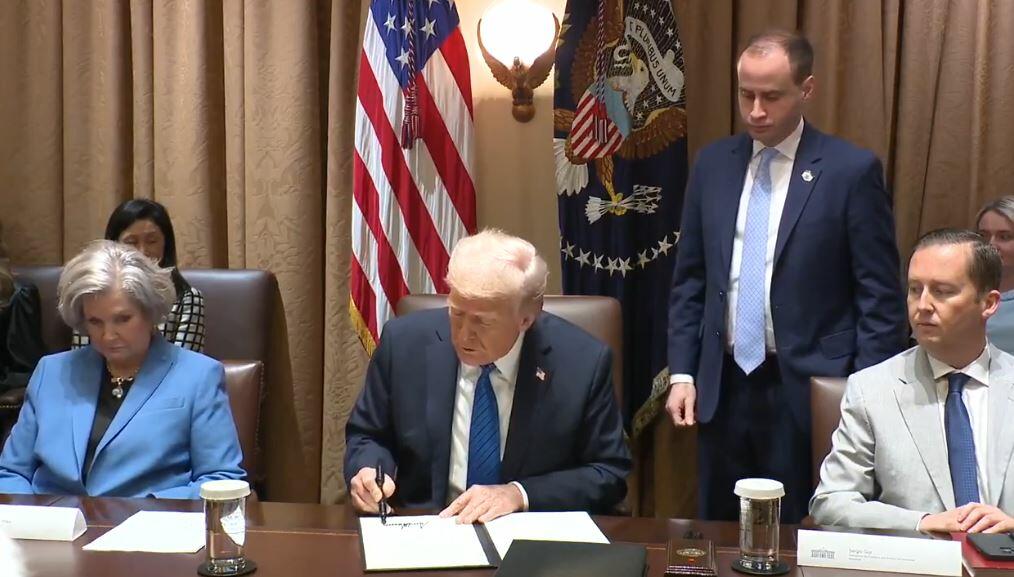
On Tuesday, President Trump signed a sweeping executive order aimed at election security.
The order will cut federal funding for states that refuse to take steps to secure their elections, tasks the Department of Homeland Security with ensuring that illegal immigrants are not voting, adds a citizenship question on the federal voting form for the first time.
It also orders the Justice Department to vigorously pursue election crimes – particularly in states that are out of compliance with federal law on election security, and seeks to ensure compliance with national election day rules.
The order also calls for the prosecution of foreign interference in US elections (like paying a British spook to produce a fabricated hoax against a candidate – which nothing is ever done about, even now?).
Watch:
🚨 POTUS signs an executive order on election integrity that includes the following provisions:
– Requires documentary, government-issued proof of U.S. citizenship on its voter registration forms.
– Conditions federal election-related funds on states complying with the integrity… pic.twitter.com/6A5zVdOAYn
Trump Eyes Two-Stage Tariffs On April 2 To ‘Strengthen Legal Framework’: Report
As April 2nd approaches – the day President Donald Trump is set to roll out a global tariff regime, the Financial Times reports that Trump is now considering ‘a two-step approach,’ which would split tariffs into two stages; targeted emergency tariffs now to raise money for planned tax cuts, and more after his administration has completed probes into trading partners to provide a more robust legal framework to deploy “reciprocal” tariffs (we charge them the same percentage they’re charging us).
Basically while Trump and Lutnick want to go full bore now, US trade representative Jamieson Greer (a lawyer who worked for Trump’s first trade chief Robert Lighthizer), insisted they pump the brakes in order to legally justify sweeping tariffs.
The dual-track strategy is poised for a high-profile unveiling on April 2, a date Trump has branded “Liberation Day,” spurring a flurry of diplomatic activity as allies seek exemptions.
Among proposals his team has been discussing is a plan to launch so-called Section 301 investigations into trading partners, while simultaneously using rarely invoked emergency powers to apply immediate tariffs in the interim. -FT
Speaking Monday, Trump vowed “substantial” tariffs on U.S. trading partners, though he also suggested the possibility of selective leniency.“They’ve charged us so much that I’m embarrassed to charge them what they’ve charged us,” Trump said – hours after announcing new tariffs on buyers of Venezuelan oil, including China. “But it’ll be substantial.”
According to the Financial Times, officials close to the matter say the administration is eyeing an immediate deployment of tariffs using emergency authorities such as the International Emergency Economic Powers Act (IEEPA), or Section 338 of the Tariff Act of 1930 – a provision that permits duties of up to 50% on foreign goods on trading partners.
One more obscure route, now considered a long shot, involves Section 122 of the 1974 Act, which permits temporary tariffs of up to 15% for 150 days – a stopgap measure that may not deliver the revenue or optics the former president is seeking.
Lawyers and people familiar with the plans also told FT that Trump could immediately slap tariffs on vehicle imports on April 2, reviving a national security study into the global auto industry from his first term.
On Monday, Trump said tariffs on cars could be announced “over the next few days.”
The debate within the Trump team has at times split along functional lines.
The two main points of contact have also differed in their approaches, say people familiar with the discussions. While commerce secretary Howard Lutnick has served as the administration’s chief negotiator, he has lambasted trading partners over their trade surpluses and tax policies, before demanding “a deal”.
US trade representative Jamieson Greer, a lawyer who previously worked for Trump’s first-term trade chief Bob Lighthizer, has increasingly asserted himself as the legal planner, seeking to create a durable blueprint for the president’s drive to reorder global trade. -FT
Greer has notably advocated for launching investigations into trading partners before applying tariffs, according to people familiar with his thinking. This would rely on tested trade law, but could delay tariffs by up to six months.
White House spokesperson Kush Desai said the final details of the reciprocal tariff plan remain under wraps, but emphasized internal alignment on the broader goal: “Although the final reciprocal tariff plan for April 2 has yet to be unveiled by President Trump, every member of the Trump administration is aligned on finally leveling the playing field for American industries and workers.”
Foreign governments are responding with urgency. The U.K. is weighing revisions to its digital services tax targeting U.S. tech firms, while the European Union has dispatched Trade Commissioner Maroš Šefčovič for emergency talks with Lutnick and Greer.
Any plan unveiled on April 2 is expected to be a refinement of Trump’s original campaign promise to apply universal tariffs to all U.S. imports – a proposal that has morphed over time but remains rooted in economic nationalism.
* * *
You can support ZeroHedge with the purchase of a high-quality, sharp,ZeroHedge Multitool.