Civil War Breaks Out Among Democrats After Schumer Folds On GOP Funding Bill
Congressional Democrats are in full revolt after Minority Leader Chuck Schumer (D-NY) folded like a wet paper napkin and agreed to vote ‘yes’ on the House-passed government funding measure that effectively ends the shutdown fight as long as six more Democrats join Schumer and Sen. John Fetterman (D-PA) who’s a ‘yes’ as well.
As it stands, the Senate will vote this afternoon to overcome a filibuster of the House’s continuing resolution, which funds federal agencies through Sept. 30 at current 2024 levels, but also includes approximately $13 billion in cuts to nondefense programs, and $6 billion in additional military spending. It’s unclear what time the vote will occur, as both sides are working to secure an agreement to allow senators to finish before the midnight shutdown deadline and head home for a weeklong recess.
Schumer claims he has no choice, saying that a shutdown would be a “gift” to the Trump administration, and “the best distraction he could ask for from his awful agenda.”
“It is deeply partisan. It doesn’t address far too many of this country’s needs. But I believe allowing Donald Trump to take even much more power via a government shutdown is a far worse option,” he said Thursday on the Senate floor.
On Thursday night, Schumer went on MSNBC to pretend he was outraged, but just had to pass the bill (and call Republicans ‘bastards.’)
“It’s much, much better not to be in the middle of a shutdown, which should divert people from the number one issue we have against these bastards, sorry, these people, which is not only all these cuts, but they’re ruining democracy,” he said.
President Trump congratulated Schumer, posting to Truth Social:
Congratulations to Chuck Schumer for doing the right thing — Took “guts” and courage! The big Tax Cuts, L.A. fire fix, Debt Ceiling Bill, and so much more, is coming. We should all work together on that very dangerous situation. A non pass would be a Country destroyer, approval will lead us to new heights. Again, really good and smart move by Senator Schumer. This could lead to something big for the USA, a whole new direction and beginning! DJT
Democrats In Disarray
House Democrats huddled at their annual strategy retreat in Northern Virginia on Thursday, where they bombarded their Senate colleagues with calls and texts urging them to nuke the GOP bill.
That said, Democrats didn’t have the cards…
Let’s be blunt here: Democrats picked a fight they couldn’t win and caved without getting anything in return. –Punchbowl
House Democrats also oppose the spending cuts contained in the GOP bill, warning that they will erode critical public services (grifts), and that fact that the GOP bill excludes specific language to limit what Elon Musk and DOGE can do as the Trump administration continues to slash federal agencies and programs unchecked by Congress, The Hill reports.
But Schumer rejected their demands.
Rep. Alexandria Ocasio-Cortez (a performance artist herself) led the charge against Senate Democrats, after House Democrats united against the GOP bill in the lower chamber.
“There is a deep sense of outrage and betrayal,” said AOC. “And this is not just about progressive Democrats, This is across the board — the entire party.”
“Just to see Senate Democrats even consider acquiescing Elon Musk — I think it is a huge slap in the face,” she continued.
“It’s an awful decision,” said Rep. Joseph Morelle (D-NY). “People are angry. We were almost to a person in unison [on the House vote]. … And a significant percentage of their caucus is voting to allow the Republicans to do whatever they want to do.”
“Right now, they are openly saying that they will take this money that is in this bill and then they will just appropriate it for whatever they want,” said Rep. Pramila Jayapal (D-WA).
“People have to know what Democrats stand up for, and they’ve got to see us fighting for them,” she added. “And if we’re just the same, and we’re just going to enable Republicans to do what they’re doing, I think that’s obviously why people are frustrated.”
Rep. Greg Casar (D-TX) – head of the Congressional Progressive Caucus, said that the GOP bill is specifically designed to let Trump and Musk keep ‘plundering.’
“First and foremost, Senate Republicans should back down from screwing over their own constituents,” he said. “And then second, Senate Democrats should do the same thing House Democrats did, which is fight for our constituents and block this bill.”
“Democrats were elected to fight for working people, not put up a fake fight.“
Speaking of fake fights…
It’s all an act…
Rep. Thomas Massie says it’s all an act… a “fake fight” in the House that “will become obvious when the Senate Democrats vote for this stinker.”
The low down on this CR. It’s a fake fight here in the House that will become obvious when the Senate Democrats vote for this stinker. pic.twitter.com/MPD9quy2aN
There’s a reason Republicans put Democrats in this position – because they know Democrats would eventually cave. And they did.
During this whole fight, Democratsnever managed to put Speaker Mike Johnson, Senate Majority Leader John Thune and Trump in a tough spot. There are plenty of policies House Democrats could’ve asked for in the CR — more money for certain programs, for instance — that would’ve placed Republicans in a bind. But they never made the case publicly for anything like that.
Senate Democrats, meanwhile, essentially tried to have it both ways. They spent the last few days — which included three long and contentious lunch meetings — warning each other in private about the grave dangers of forcing a government shutdown. But in front of TV cameras, they were trashing the House GOP CR and insisting they wouldn’t vote for the funding measure. This won them praise from progressives, activist groups and House Democrats.
Schumer, who didn’t take a public position until last night, fired a warning shot on Wednesday when he said Republicans didn’t have enough Democratic votes to pass the CR, basically threatening a filibuster. In the meantime, Senate Democrats pushed for a short-term CR intended to buy time for a bipartisan funding deal that was never going anywhere.
This set up the Democratic base for disappointment for seemingly no reason.
U.S. immigration detention facilities have reached capacity at about 47,600 beds, a top-level U.S. Immigration and Customs Enforcement (ICE) official said on March 12 in a call with reporters.
The federal government is now seeking more bed space for detained illegal immigrants, added the official, who requested anonymity as a condition of the call.
ICE is now expanding its capacity with support from the Department of Defense, the U.S. Marshals Service, and the Federal Bureau of Prisons.
Currently, ICE has funding to support an average bed space of more than 41,500 detainees, the official said, adding that ICE is working with lawmakers to obtain more funding to increase capacity.
Throughout the 2024 campaign and after taking office, President Donald Trump vowed that there would be a mass deportation of illegal immigrants. Trump said that such a move is needed after the high volume of illegal immigration under the previous administration.
Trump issued executive orders targeting illegal immigration and bolstering security along the U.S.–Mexico border. He has directed ICE agents to step up enforcement actions across major U.S. cities, with top officials including border czar Tom Homan saying they are targeting illegal immigrants with criminal histories or who are a threat to public safety.
Orders and directives that the administration has carried out include declaring a national emergency along the southern U.S. border, halting some refugee admissions, ending the previous “catch and release” policy, requiring people who are seeking asylum in the United States to remain in Mexico while waiting for court hearings, limiting the temporary protected status of people from certain countries, declining to recognize birthright citizenship, and other measures.
The number of encounters with illegal immigrants at the southern border has dropped significantly since Trump took office in January, according to recent data.
Multiple lawsuits have been filed to challenge Trump’s order ending birthright citizenship, and several judges have blocked the order. On March 11, the First Circuit Court of Appeals upheld a federal district court’s block of the order and denied a motion from the Department of Justice’s legal team to immediately overturn the district court’s ruling.
Another directive that has been challenged in court is Trump’s decision to send some illegal immigrants to the U.S. naval base at Guantanamo Bay in Cuba. Earlier this month, the American Civil Liberties Union filed a suit to block transfers to the base, which had been used to house terrorism suspects following the Sept. 11, 2001, attacks.
Some of the illegal immigrants who were sent to the base have already been deported from Guantanamo Bay to Venezuela, officials have said.
Homan said on March 4 that more funding is needed to continue the crackdown on illegal immigration, including for more beds and deportation flights.
“We need more beds, we need more enforcement assets, we need more air flights. This operation is going to cost money,” Homan told reporters at the White House. “We’re hitting on all cylinders, but we need more money to do more.”
The Epoch Times contacted the Department of Homeland Security, which oversees ICE, for comment but did not receive a response by publication time.
Hamas To Free American Hostage After Direct Trump Admin Intervention
Hamas on Friday announced it is preparing the release of hostage Edan Alexander, who is an American citizen serving in the Israeli military, along with the bodies of four other dual nationals previously slain.
Alexander was manning a military post near the Gaza Strip on October 7 when the base was overrun by Hamas gunmen pouring in from Gaza. The US-designated terror group further announced it “affirms its complete readiness to initiate negotiations and reach a comprehensive agreement on the issues of the second phase while calling for the occupation (Israel) to fully implement its obligations.” The group says it wants to salvage the fragile truce which has been holding.
Hamas stopped short of issuing the names of the four deceased that it plans to release. Alexander’s background is that he is a 21-year-old from Tenafly, New Jersey who volunteered to join the Israel Defense Forces (IDF) after high school.
US Middle East Envoy Steve Witkoff has this week said that securing his release is a top priority for the White House. Newsweek and other describe this is a big diplomatic win for President Trump:
US President Donald Trump had urged the release of the American hostage along with the remaining Israeli hostages, sending an ultimatum to Hamas last week. Trump has since met with several hostages released by Hamas during a first phase of a U.S.-brokered ceasefire between Israel and the militant group.
Alexander’s release would be a boost for Trump’s strong push to get hostages released, which has included contacts with Hamas that had surprised the Israeli government. he was the last surviving American hostage.
That the White House appears to have bypassed its Israeli ally on this is a huge blow to the Netanyahu government.
As for the Israeli prime minister, one regional report says he is currently gauging public opinion on the possibility of renewing the war in Gaza:
The Israeli public is largely tired of the war on Gaza and “convinced that Netanyahu is incapable of managing it”, Israeli analyst Ori Goldberg says.
The prime minister is gauging public opinion and “waiting to see which shoe will drop”, Goldberg told Al Jazeera.
“The shoe that calls for the continuation of the war, which demands a great deal from Israelis, or the shoe that is ultimately calling for [a discontinuation] of the war and the understanding that Israel must take home all the hostages and it has no choice.
“So far, Netanyahu has been able to read the public very well, but I’m not sure that’s the case any more,” he added.
Life in the Strip itself is still fraught with extreme dangers given how destroyed the enclave is. Humanitarian workers are reporting that civilians are getting badly hurt upon returning to their dilapidated homes. Walls or structures have crashed down on them.
“The buildings are so damaged they’re collapsing on them. Just two days ago, we had a young man – a wall fell on him, broke his spine, and tore his left kidney off his aorta,” Dr Feroze Sidhwa, a trauma surgeon with MedGlobals, told Al Jazeera. “So we had to remove his left kidney or he would have bled to death.”
The doctor further described that high prices at markets and and lack of humanitarian aid mean “people are turning on each other sometimes and disputes are becoming violent.”
Futures, Yields, Gold All Jump After Schumer Caves To Keep Government Open
US equity futures and global stocks rose as the threat of a US government shutdown receded, removing at least one element of uncertainty confronting investors. Meanwhile, gold hit a record above $3,000 an ounce as the precious metal already anticipates the stimulus flood that is coming over the horizon.As of 8:00am S&P futures are higher by 0.9% as a stopgap funding bill is set to pass in Congress after top Senate Democrat Chuck Schumer caved and opted not to block the measure. That helped lift the mood after the benchmark index extended its three-week rout beyond a 10% correction on Thursday. Nasdaq 100 futures advanced 1.2% with Nvidia leading premarket gains among the Mag7. In Europe, the Stoxx 50 advances 1.3% with outperforming sectors including consumer staples and materials; Asian stocks were also higher. Bond yields are 1-3bp higher this morning; the USD fell as the EUR surged after politicians agreed to a deal to drown Germany in debt to fund “military spending.” Commodities are higher led by Oil (WTO +1.0%) and Iron (+1.5%). Since yesterday’s close, there has been some positive developments on macro policies: meeting between Lutnick and Ontario’s Ford was viewed as positive; the US government managed to avoid the shutdown. Internationally, China will hold a press briefing next Monday to outline some additional measures boost consumer; Japan announced the largest pay hike in over three decades (+5.36% average pay gain and +3.84% base pay vs. 3.8% JPMe vs. 3.7% last year), a positive catalyst for consumption growth, yet not enough to push the yen higher. Today’s calendar includes March preliminary University of Michigan sentiment at 10am where consensus expects a 63.0 print.
In premarket trading, Nvidia is leading gains among the Magnificent Seven stocks as the group attempts to stage a rebound after the S&P 500 tumbled into its first 10% correction in almost two years. Alphabet +0.9%, Amazon +1.2%, Apple +0.5, Microsoft +0.7%, Meta +1.5%, Nvidia +2% and Tesla +1.7%. Applied Optoelectronics surges 55% after the maker of fiber-optic networking products entered a warrant agreement with Amazon. Ulta Beauty jumped 6% after reporting earnings per share for the fourth quarter that beat the average analyst estimate. Here are some other notable premarket movers:
Crown Castle rises 5% after agreeing to sell separate parts of its fiber business to an EQT AB fund and Zayo Group Holdings Inc. for a combined value of $8.5 billion.
DocuSign jumps 9% after the e-signature software company posted quarterly results that beat expectations and gave a billings outlook that’s seen as positive.
Gogo rises 13% after the in-flight broadband company forecast revenue for 2025 that beat the average analyst estimate.
Peloton Interactive gains 6% as Canaccord upgrades its rating and says the company is set to reap the benefits of being the “clear leader” in the connected fitness market.
Radius Recycling soars 110% after Toyota Tsusho’s US unit, Toyota Tsusho America, agreed to buy all shares in cash for $30 a share.
Rubrik surges 18% after the data security software company gave an outlook that is stronger than expected.
Semtech rises 12% after the semiconductor device company gave an outlook that’s seen as better than feared.
Xponential Fitness drops 31% after the franchiser of boutique fitness brands gave disappointing full-year forecasts.
Spot gold briefly rose above $3,000/oz for the first time while broader risk sentiment improved after Senate Democratic leader Chuck Schumer dropped his threat to block a Republican spending bill, thus lowering the chances of a US government shutdown on Saturday.
“It looks like the budget bill is still going through despite some opposition from Democrats and this has lifted sentiment in the US and probably there is also some spillover effect to Europe,” Julius Baer & Co. economist Sophie Altermatt said. “This might be just some reprieve, given we had so many uncertainties with erratic policy moves in the US,” she added.
Avoiding a government shutdown would remove a concern for traders, already fretting over threats to the world economy from President Donald Trump’s tariff war. Two months into Trump’s presidency, $5 trillion has been erased from US stocks. Those risks are spurring demand for haven assets, with investors the most bullish on Treasuries relative to stocks for at least three years, according to Bloomberg Markets Live Pulse survey. It’s also pushed gold to successive record highs, with the yellow metal now up more than 14% year-to-date.
“Gold is in a secular bull market,” said Peter Kinsella, head of foreign exchange strategy at Union Bancaire Privee UBp SA, who expects prices to reach $3,300 an ounce by year end. “For sure, that’s down to uncertainty caused by US trade policies but central bank demand is also a big factor.”
Some strategists reckon relief could be on the horizon for risk assets after the recent selloff. While the S&P 500 has plunged 10% off its February peak into correction territory, Bank of America’s Michael Hartnett said there’s unlikely to be a slide into a new bear market: “Fresh declines in stock prices will provoke flip in trade and monetary policy,” Hartnett wrote in a note, recommending buying the S&P 500 at 5,300 points, a 4% drop from current levels.
In Europe, German conservative leader Friedrich Merz reached a tentative agreement with the Green party on a debt-funded spending package for defense and infrastructure. The deal needs to be approved by party lawmakers and would release defense spending from debt restrictions and set up a €500 billion fund for infrastructure investment.
The Stoxx 600 climbs 0.4% as miners gained on expectations of economic support measures from China, even as benchmark indexes headed for a second straight week of declines. Carlsberg jumps on an upgrade from RBC, while Kering sinks after appointing a new artistic director to its key Gucci brand. Here are the biggest movers Friday:
Carlsberg gains as much as 4.1% after it and its peer Heineken were upgraded to outperform at RBC, noting the companies have been “prudent” in setting expectations in what is in an unusually “opaque” outlook
Adecco gains 3.6% and Hays gains 7% after BNP Paribas Exane upgraded Adecco to outperform, and double upgrades Hays to outperform, as staffing agencies are moved to the top of broker’s sub-sector preferences
Sectra gains as much as 12%, the most since December 2023, after the Swedish healthcare and cybersecurity firm reported 3Q earnings which beat expectations on most metrics, including revenues and profit
European sectors with heavy China exposure are getting a boost on Friday as the Chinese benchmark stock index rallied the most in two months on expectations of economic support from Beijing
Brunello Cucinelli shares rise as much as 3.7% as a broadly in-line set of earnings from the Italian luxury goods maker demonstrated its resilience against a tough backdrop for the broader sector
Kering falls as much as 10%, the biggest one-day drop in a year, after the luxury goods maker caught investors off-guard with its surprise appointment of Demna Gvasalia as Gucci’s new artistic director
Universal Music Group slumps as much as 11% after shareholder Pershing Square offloaded shares in the music company at a discount to yesterday’s close. Shares have fallen below the offer price
BMW falls as much as 4.5% after the German automotive firm reported disappointing guidance and missed expectations in its 4Q report, with analysts flagging the firm’s margin outlook as a particular disappointment
Swiss Life shares fall as much as 6.2%, the most in a year. The financial services company reported results that matched expectations, but were deemed insufficient by analysts
Bodycote slumps as much as 18%, the most in five years, after the heat-treatment specialist delivered its FY results, with analysts cite automotive and industrial weakness for likely mid-single-digit cuts
GN Store Nord shares are among the worst performers in the Stoxx 600 Health Care Index on Friday morning, after Bernstein re-initiated coverage of the stock with an underperform rating
El.En shares dropped as much as 8.5% in Milan trading, the most since May 16, after the Italian medical devices company reported FY earnings, indicating a “complex” outlook for 2025
Earlier in the session, Asian equities also advanced, propelled by a rally in Chinese shares as investor optimism for more policy support rose ahead of a press briefing on government efforts to boost consumption. The MSCI Asia Pacific Index rose as much as 0.9%, with Tencent and Alibaba among the biggest boosts. China’s onshore CSI 300 Index and Hong Kong’s Hang Seng China Enterprises Index each jumped more than 2%. China optimism rose on the announcement that officials from the finance ministry, commerce ministry, central bank and other government bodies are scheduled to hold a briefing on consumption Monday. The news provided traders further assurance that Beijing is determined to fix one of the weakest links in the economy. Word of the press conference “fanned expectations” for policy support, said Shen Meng, a director at Beijing-based investment bank Chanson & Co. “But if it falls short of providing details on increasing income, such optimism may weaken to some extent.” Stocks in Japan and Australia also rose, and US futures rebounded following the S&P 500’s drop into a technical correction Thursday. Rising prospects for a stopgap funding bill to avoid a US government shutdown provided some reassurance for markets amid continued concerns over economic growth and tariffs.
In FX, the Bloomberg Dollar Spot Index drops; The Japanese yen is the weakest of the G-10 currencies, falling 0.7% against the dollar even as Japan’s largest labor union group said its workers secured the highest pay deal in more than three decades. The pound falls 0.2%, extending its drop after data showed the UK economy unexpectedly shrank at the start of 2025. The Euro jumped above 1.09 after German conservative leader Friedrich Merz reached a tentative agreement with the Green party on a debt-funded spending package for defense and infrastructure. The deal needs to be approved by party lawmakers and would release defense spending from debt restrictions and set up a €500 billion fund for infrastructure investment.
In rates, treasury futures trend lower into the early US session. Treasury yields are cheaper by 1bp to 3bp across the curve with 10-year trading around 4.18%, cheaper by 3bp on the day with bunds lagging by 4bp in the sector and 10-year French bonds lagging 2bp. Bunds slid to lows of the day and French 30-year yields rose to the highest since 2011, after a report that German parties have reached an agreement with the Greens on a debt package. Advance in US stock futures adds to cheapening pressure on Treasury yields with University of Michigan sentiment data the focus for the US session.
In commodities, WTI rises 1% to ~$67 a barrel. The upbeat mood is evident elsewhere as Bitcoin climbs rises 3% toward $83,000. Gold traded briefly at a record price just above $3000 before modestly fading gains.
Looking at today’s calendar, the US economic data calendar includes March preliminary University of Michigan sentiment at 10am. Fed officials are in external communications blackout ahead of March 19 policy announcement.
Market Snapshot
S&P 500 futures up 0.9% to 5,576
STOXX Europe 600 up 0.4% to 542.64
MXAP up 0.5% to 185.46
MXAPJ up 0.9% to 581.19
Nikkei up 0.7% to 37,053.10
Topix up 0.6% to 2,715.85
Hang Seng Index up 2.1% to 23,959.98
Shanghai Composite up 1.8% to 3,419.56
Sensex down 0.3% to 73,828.91
Australia S&P/ASX 200 up 0.5% to 7,789.68
Kospi down 0.3% to 2,566.36
German 10Y yield little changed at 2.88%
Euro little changed at $1.0854
Brent Futures up 0.9% to $70.51/bbl
Brent Futures up 0.9% to $70.51/bbl
Gold spot up 0.0% to $2,990.02
US Dollar Index little changed at 103.93
Top Overnight News
US equity futures are rallying after Senate Democratic leader Chuck Schumer dropped his threat to block a key spending bill, cutting the risk of a disruptive March 15 shutdown. BBG
US Senate Minority Leader Schumer said he will vote to keep the government open and not shut it down. It was separately reported that multiple US Democratic Senators and aides indicated sufficient Democratic support for cloture on the House-passed continuing resolution in Friday morning’s vote: Punchbowl.
US President Trump is to sign executive orders on Friday at 12:00EDT/16:00GMT.
US Vice President Vance said can never predict the future but thinks the economy is strong when asked if he could rule out a recession, according to a Fox News interview,
US Treasury Secretary Bessent said they hopefully won’t get a recursive ‘Biden-flation’ and said they are very vigilant and it could happen again. Bessent added that before they can bring down inflation, they also want to help affordability and as they bring down inflation, they want to bring the absolute price level down through deregulation and bringing down interest rates for house payments and car payments.
Merz Said to Reach Tentative Deal With Greens on German Debt: BBG
Ontario Premier Doug Ford lauded his Thursday meeting with Commerce Secretary Howard Lutnick as “positive” and “productive” after their public rift over tariffs on imported goods. “We shared a tremendous amount of views back and forth, and I’m feeling very positive,” Ford told reporters outside the U.S. Department of Commerce building. The Hill
Chinese stocks jumped on Friday after Beijing promised new measures to help consumers, defying a Wall Street sell off and pushing the country’s main stock index into positive territory for the year. Chinese authorities announced late on Thursday that they would hold a press conference on “boosting consumption” on Monday. FT
China is increasingly concerned not just about US tariffs, but also the risk that Washington will direct other countries (like Mexico, Brazil, etc.) to ramp duties on Chinese imports as well. NYT
China may slash pay by 50% for fund managers who underperform their benchmarks, people familiar said, as part of a broader overhaul of the country’s mutual fund industry. BBG
Ukrainian drones attacked Moscow for the second day in a week, as US special envoy Steve Witkoff left the country, Russian news services reported. The attacks also triggered a massive fuel tank fire at one of Russia’s biggest oil refineries. BBG
The UK economy unexpectedly shrank 0.1% in January, hit by declines in manufacturing and construction. The pound slipped. BBG
Investors are the most bullish on Treasuries relative to stocks in at least three years, according to a MLIV survey. As tariff policies threaten US exceptionalism, some 77% see bonds giving a better volatility-adjusted return over the next month. BBG
Tariffs/Trade
Canada’s Finance Minister LeBlanc said they agreed to continue discussions in the meeting with US Commerce Secretary Lutnick, while they have been clear that they will not reopen USMCA provisions on dairy and didn’t discuss that with Lutnick.
Canada’s Industry Minister Champagne said there was a mutual understanding that there is an impact on both sides of the border from tariffs and they talked about issues around economic security and national security with US Commerce Secretary Lutnick. Furthermore, they talked about Canadian aluminium steel and how they can help the US
Ontario’s Premier Ford said they had a productive meeting with US Commerce Secretary Lutnick and will have another meeting next week, while he feels temperatures are decreasing and said it was the best meeting they had since tariff talks began.
ECB President Lagarde said US President Trump’s policy decisions cause concern and warned trade conflict will damage the worldwide economy, according to an interview with BBC.
A more detailed look at global markets courtesy of Newsquawk
APAC stocks were mostly positive as risk sentiment gradually improved following the negative lead from Wall St where the S&P 500 slipped into a technical correction amid tariff concerns after President Trump threatened 200% tariffs on EU wine and champagne. ASX 200 gained as strength in mining, materials, resources and utilities atoned for the losses seen in the energy, financials and tech industries. Nikkei 225 staggered at the open with pressure from recent currency strength but then recovered soon after as the yen steadily pared its recent gains. Hang Seng and Shanghai Comp advanced with the Hang Seng resuming the outperformance which has helped the index notch gains of around 22% so far this year, while the PBoC reiterated support pledges and stated that it will lower rates and the RRR at a ‘proper time’, keep liquidity ample and guide social financing costs lower.
Top Asian News
China’s financial regulator said financial institutions should boost financial support for consumption and will provide loan renewal support to eligible personal consumption loan borrowers.
DeepSeek is focusing on research over revenue and customers from sectors such as healthcare and finance bought API access to DeepSeek’s R1 and V3 models. Furthermore, DeepSeek’s founder declined to entertain interest from China’s tech giants and venture and state-backed funds to invest in the group for the time being, while it may find limited access to NVIDIA’s (NVDA) new generation of more advanced chips a potential bottleneck in the long run and could consider future partnerships that can help solve this issue, according to FT citing sources.
Rengo, Japan’s largest labour union, says first-round data shows average wage hike of 5.46% in FY25 (demand of 6.09%); initial wage hike exceeds 5% for the second straight year.
Chinese regulators have issued a requirement for the labelling of AI generated content.
China Feb YTD Aggregate Financing (CNY) 9.29tln (exp. 9.757tln); M2 Money Supply 7% (exp. 7%); New Yuan Loans 6.14tln (exp. 6.38tln)
European bourses are mostly firmer, in what has been a choppy session thus far; initial weakness at the cash open has been entirely pared with indices generally towards the top end of the day’s ranges. European sectors hold a slight positive bias; Basis Resources tops the pile, buoyed by strength in the metals complex, amid the risk sentiment and strong Chinese price action overnight. Media is found at the foot of the pile. Consumer Products is also higher today, benefiting from the strength in Chinese trade overnight; though Kering (-13%) slips after appointing Demna as Gucci’s artistic director, a move JP Morgan brands as “controversial”.
Top European News
Germany’s CDU/CSU to hold special parliamentary faction meeting this afternoon, according to Reuters sources
Goldman Sachs cuts its UK 2025 GDP growth forecast to 0.9%, down from 1.0% previously.
DIW institute says the German economy is expected to stagnate in 2025, down from the previously expected growth of 0.2%; economy expected to grow by 1.1% in 2026, down from the previously expected 1.2%
BoE/Ipsos Inflation Attitudes Survey – February 2025. Median expectations of the rate of inflation over the coming year were 3.4%, up from 3% in November 2024.
UK PM Starmer reportedly suffered a cabinet uprising over planned welfare and public spending cuts, but insisted tough choices are needed and said he will not bend fiscal rules to allow more borrowing, according to FT.
EU Diplomatic Service proposes that member nations deliver military aid to Ukraine in 2025 worth at least EUR 20bln and potentially up to EUR 40bln, via Reuters citing a paper; aid to be provided in line with nations economic “weight”.
ECB’s Villeroy says will be inflation to 2% this year in Europe; EU has the resources to retaliate against the US admin tariffs on wine and liquor.
EU Envoys agree to remove three individuals from the sanctions list, agree to renew sanctions on more than 2400 individuals and entities.
FX
USD is flat after trading firmer for most of the European morning; now currently towards the lower end of a 103.79-104.09 range. Trade updates on Thursday included President Trump noting he will not change his mind on the April 2nd tariffs. As for US Government shutdown developments, things seem to be improving with US Senate Minority Leader Schumer suggesting he will vote to keep the government open and not shut it down. Focus ahead will be on the US UoM survey and then Trump executive orders thereafter.
EUR is firmer and trading towards the upper end of a 1.0831-1.0875 range. There has been little by way of trade updates, after Trump threatened the EU with 200% tariffs on alcoholic products on Thursday, if the EU do not remove their countermeasures on the US. Focus today will be on any potential updates on German spending plans, after the debate in the prior session – Reuters reported that Germany’s CDU/CSU is to hold a special parliamentary faction meeting this afternoon – a report which may be attributed to the modest upside in the Single-Currency; elsewhere, focus will be on a Fitch credit review on France.
JPY is the clear underperformer today, with early morning losses facilitated by the risk-on mood; have peer CHF is also a touch softer. Further pressure was seen after Japan’s largest labour union, Rengo, said the first-round data shows an average wage hike of 5.46% in FY25 (demand of 6.09%). There spurred some further pressure in the JPY, with USD/JPY lifting from 148.65 to briefly top 149.00.
GBP is subdued in reaction to the regions softer than expected GDP figures, which saw the UK unexpectedly contract in January; the downside was primarily driven by a slowdown in manufacturing. However, such an outturn was not entirely unexpected given the jump seen in December’s release. Money market pricing incrementally moved dovishly, and is ultimately unlikely to have too much of an impact for the BoE as it remains focussed on inflation and other price points. Cable saw some modest downside on the release, and currently trades towards the lower end of a 1.2918-59 range.
Antipodeans are the best performing G10 currencies today, benefiting from the positive risk tone, which was lifted by remarks by a China’s financial regulator who said financial institutions should boost financial support for consumption and will provide loan renewal support to eligible personal consumption loan borrowers.
Fixed Income
USTs hold a slight downward bias, in-fitting peers; currently sitting in a 110-24 to 110-31 range. Some of the bearish action stems from the positive risk tone, as well as a weaker-than-average 30yr auction on Thursday. Trade updates on Thursday included President Trump noting he will not change his mind on the April 2nd tariffs. As for US Government shutdown developments, things seem to be improving with US Senate Minority Leader Schumer suggesting he will vote to keep the government open and not shut it down. Focus ahead will be on the US UoM survey and then Trump executive orders thereafter.
Bunds are on the backfoot by around 12 ticks, and currently just off the day’s trough at 127.15. As above, pressure stems from the risk tone and as markets digest the latest Trump threats on the EU (200% tariffs on alcohol, should the EU not remove their countermeasures). For Germany, Wholesale Prices jumped Y/Y whilst German inflation figures were revised a touch lower. And on German spending, updates have been light thus far CDU/CSU is to hold special parliamentary faction meeting this afternoon, according to Reuters sources, Scheduled EU-specific events are light for the remainder of the day, but focus will be on Fitch’s credit review on France.
Gilts are flat but still outperforming today, with gains facilitated by the softer-than-expected UK GDP figures, which saw the UK surprisingly contract in January. A softer print than the market had been looking for, driven primarily by a slowdown in manufacturing. However, such an outturn was not entirely unexpected given the jump seen in December’s release. Gilts are flat, but have held a downward bias in-fitting with peers; currently in a 91.67-92.03 range.
JGBs are modestly higher as Japanese paper reacted to the latest Rengo update, with initial data pointing towards 5.46% avg. wage hike vs demands of 6.09%. Initial hawkish reaction as it highlights the continued wage pressures in the region, but this proved short-lived as it was less than initial demands.
Commodities
Crude is on a firmer footing with WTI and Brent currently higher by around USD 0.74/bbl and USD 0.70/bbl respectively. Upside today stems from a paring of the prior day’s losses and in tandem with the pick up in sentiment. On Russia/Ukraine, Russian President Putin supported the idea of a ceasefire but stressed that the ceasefire must lead to a final settlement of the conflict and solve the root causes of the conflict. More recently, Russia’s Kremlin said it held late night talks with US Envoy Witkoff; Russia and the US will determine a timing of Russian President Putin/Trump call once Witkoff has briefed Trump. Brent’May currently in a USD 70.00-70.75/bbl range.
Spot gold is on a firmer footing, and has made a fresh ATH just above the USD 3k mark. ANZ sets its short-term price target of USD 3,050/oz.
Base metals are entirely in the green, with the complex boosted by the risk tone and support measure commentary from China overnight.
Russian Deputy Prime Minister Novak says global oil demand will rise during driving season and OPEC+ takes this into account; resumption of gas exports to Europe via Nord Stream pipelines is irrelevant for now. No talks about possible resumption of Russian oil exports to Germany via the Druzhba pipeline.
Qatar lowered the May term price for Al-Shaheen crude oil to USD 1.29/bbl above Dubai quotes.
Russian President Putin and Saudi Arabia’s Crown Prince MBS discussed cooperation in OPEC+, as well as US-Russia ties and the Ukraine conflict.
US President Trump’s administration unlocked a USD 4.7bln loan for TotalEnergies (TTE FP)
Geopolitics: Middle East
Israel’s Channel 12 quoted an Israeli source stating if there is no progress in negotiations within the next two days, the team will return to Israel, according to Al Jazeera.
US and Israel look to Africa for resettling Palestinians uprooted from Gaza, according to AP.
UN Security Council agreed to the Russia and US-drafted statement condemning widespread violence in Syria’s Latakia and Tartus, while the statement called for Syria’s interim authorities to protect all Syrians, regardless of ethnicity or religion and to hold the perpetrators of the mass killings accountable.
Geopolitics: Ukraine
Russia’s Kremlin says it held late night talks with US Envoy Witkoff, conveyed signals to US President Trump via Witkoff, Russia and the US will determine a timing of Russian President Putin/Trump call once Witkoff has briefed Trump. There are grounds for cautious optimism. Both sides understand there is a need for such a call. Putin got information from US Envoy on US thinking on Ukraine. Putin is in solidarity with Trump’s position but there is a lot of work to do
Ukraine Foreign Minister says the nation has begun forming a team to develop ways to control a possible ceasefire.
EU Foreign Policy chief Kallas said she is quite optimistic G7 can reach accord on a joint communique and if they cannot agree on G7 communique, it shows division between member countries. Kallas also said it is most likely that Russia will say yes to the US proposal for a ceasefire with Ukraine but with conditions and the US is telling G7 members they understand the Russians may want to extend the process by blurring the picture. Furthermore, she said the red line is Ukraine giving away territory and that territorial integrity is an important element, as well as noted that without the EU, any deal cannot be implemented because there are elements for which Europe has the card.
Saudi Crown Prince MBS and Russian President Putin spoke on the phone and the Saudi Crown Prince affirmed the kingdom’s commitment to exerting all efforts to facilitate dialogue and achieve a political solution to the Ukraine crisis.
Geopolitics: Other
Senior officials from China, Iran and Russia hold talks in Beijing over Iran’s nuclear issues, according to CCTV.
US Pentagon has been tasked with providing military options to ensure US access to the Panama Canal, according to CNN.
US President Trump said they are going to have to make a deal on Greenland and thinks the annexation will happen, while he added the US is going to order 48 icebreakers.
US Event Calendar
10:00: March U. of Mich. Sentiment, est. 63.0, prior 64.7
March U. of Mich. Current Conditions, est. 64.4, prior 65.7
March U. of Mich. Expectations, est. 63.0, prior 64.0
March U. of Mich. 1 Yr Inflation, est. 4.3%, prior 4.3%
March U. of Mich. 5-10 Yr Inflation, est. 3.4%, prior 3.5%
DB’s Jim Reid concludes the overnight wrap
After my promise of an exciting special announcement, yesterday we announced the launch of the Deutsche Bank Research Institute (DBRI), a new offering designed to provide valuable insights for corporates, investors and policymakers navigating today’s complex and rapidly evolving global landscape. The Institute will connect the world to Europe and Europe to the world, across geopolitics, macroeconomics, technology, and the evolving corporate landscape. Going forward, we will be delivering more in-depth analysis through engaging and accessible formats, including videos, podcasts, webinars, events and reports, which will be available on our new public Institute website.
The inaugural paper for DBRI is called “What Germany’s economy needs now”, which lays out how the country’s economic prosperity has been under severe pressure from geopolitical and technological changes, which have exposed Germany’s structural weaknesses. It outlines a series of necessary reforms which will demand a historic effort from the next government. The challenges beyond the fiscal injections are enormous but the good news is that Germany has its future prosperity and security in its own hands. You can read the English version here and the German version here. Stand by for more papers over the coming weeks and months from our new Deutsche Bank Research Institute.
The market sell-off resumed in earnest yesterday, with the S&P 500 (-1.39%) down to another 6-month low and into technical correction territory, with the index down -10.13% from its peak as recently as February 19. This is the first correction since October 2023, and Bloomberg reported that this was the seventh-fastest correction in data back to 1929, taking just 16 sessions for it to happen. Other asset classes also continued to struggle, with US HY spreads (+22bps) reaching their widest level since August, at 335bps. And as investors poured into perceived safe havens, gold prices (+1.85%) hit a record high of $2,989.
Once again, the main driver was a fresh volley of tariff threats from President Trump, who made several posts criticising the EU yesterday. In terms of the latest, President Trump said that if the EU continued with its 50% tariff on American whisky, then the US would respond with a 200% tariff on EU wines, champagnes and alcoholic products. That immediately caused issues for several European beverage companies, with Pernod Ricard (-3.97%) posting the worst performance in France’s CAC 40 yesterday, and Remy Cointreau (which produces cognac) fell -4.67%. More broadly though, President Trump’s comments reignited fears that the EU could soon face a much more serious trade escalation, particularly with reciprocal tariffs set for April 2. Indeed, earlier in his post on the 200% tariff, he described the EU as “one of the most hostile and abusive taxing and tariffing authorities in the World, which was formed for the sole purpose of taking advantage of the United States”. Bear in mind that President Trump has said he considers VAT to be like a tariff, so that could cause considerable issues for EU member states.
Matters weren’t helped yesterday by the potential threat of a US government shutdown, with funding set to run out at midnight tonight. However, after the US close, the Democratic Senate Minority Leader Chuck Schumer said that he would vote to advance the Republican bill rather than see a shutdown. So that’s helped futures to recover a decent amount of ground this morning, with those on the S&P 500 up +0.76%. The Republicans do have a majority in both chambers of Congress, but in the Senate they only have a 53-47 margin, and require 60 votes to prevent a filibuster happening, so they had to get at least some Democratic support to pass their funding bill.
Nevertheless, that news came too late to prevent US markets taking a fresh hit yesterday, with the S&P 500 (-1.39%) now down -10.13% from its record high, and surpassing the 10% threshold that makes it a technical correction. Moreover, the decline for this week alone now stands at -4.31%, which if realised would be the worst weekly performance since the week of SVB’s collapse two years ago. As in recent days, the Magnificent 7 (-2.49%) led the declines, moving back into bear market territory having shed -20.25% since its December peak. And even though tech led the losses, it was still a broad-based decline, with the equal weighted S&P 500 (-1.00%) struggling as 78% of its constituents lost ground on the day.
Whilst investors were concerned about tariffs and the latest shutdown threat, there was little respite from the latest PPI inflation data either. To be fair, it was softer than expected, with monthly headline PPI flat (vs. +0.3% expected), taking the year-on-year rate down to +3.2% (vs. +3.3% expected). But the problem was that the components that feed into PCE inflation (the Fed’s target measure) were relatively stronger, which added to concern that the Fed would struggle to meaningfully cut rates this year. The 10y Treasury yield traded as much as +3.8bps higher on the day following the release, but the bond sell-off turned into a rally as risk sentiment soured, with 10yr yields down -4.3bps to 4.27% by the close. At the front end, 2yr yields were -3.1bps lower to 3.96%.
Over in Europe, there were fresh developments over Ukraine as discussions around a ceasefire continued. Russian President Putin said on the ceasefire proposal that “The idea itself is correct and we certainly support it, but there are issues that we need to discuss”, in particular mentioning that Ukraine could use the ceasefire to mobilise and re-arm. So that fit with expectations that Russia would softly push back against the idea of a ceasefire without preconditions. Later on, Ukrainian President Zelenskiy criticised President Putin’s comments as “very manipulative”. President Putin was also due to meet US envoy Steve Witkoff last night but we have not yet heard any comments from that meeting.
Elsewhere in Europe, the other big story for markets has been the start of the debate in the German Bundestag on changing the constitutional debt brake. The debate is being conducted with the old pre-election Bundestag, where the combination of the CDU/CSU, the SPD and the Greens still have a two-thirds majority. It still isn’t clear whether the Greens will offer support to the proposals, although talks are still ongoing. Nevertheless, the debate did include frustration between Merz and the Greens, with Merz saying “What more do you want than what we have proposed to you?”
Meanwhile, Katharina Dröge, co-leader of the Green caucus in the Bundestag, said that “If you now wonder why the talks between us and you are going the way they are, then we can tell you: Because we don’t trust in your word”.
With all that going on, European assets echoed the global risk-off move yesterday. That saw the STOXX 600 (-0.15%) post a modest decline, although there were bigger losses for France’s CAC 40 (-0.64%) and the German DAX (-0.48%). In the meantime, the move into perceived safe havens meant German bunds outperformed their counterparts, with 10yr yields down -2.3bps, in contrast to those on 10yr OATs (+0.5bps) and BTPs (+1.3bps) which rose slightly.
Overnight in Asia, markets are performing well as it looked like the US would avoid a government shutdown. Moreover, Chinese markets got a fresh boost after it was announced that several government bodies would host a press conference on Monday about boosting consumption. So those developments helped support the major indices across the region, with gains for the Nikkei (+0.89%), the Hang Seng (+1.89%), the CSI 300 (+2.24%) and the Shanghai Comp (+1.56%). The main exception to that has been South Korea’s KOSPI, which has fallen -0.28%. Meanwhile in Japan, the country’s 30yr government bond yield (+3.0bps) moved up to its highest level since 208, at 2.61%.
Lastly, there wasn’t much other data yesterday, although the US weekly initial jobless claims were better than expected over the week ending March 8, falling to 220k (vs. 225k expected). Moreover, the continuing claims for the week ending March 1 fell to 1.870m (vs. 1.888m expected).
To the day ahead, and US data releases include the University of Michigan’s preliminary consumer sentiment index for March, along with UK GDP for January. Central bank speakers include the ECB’s Escriva and Cipollone.
Bund Yields Spike As Germany’s Merz Reaches Debt Deal With Greens, Claims (Unironically) “Fiscal Discipline Important”
German conservative leader Friedrich Merz has reportedly reached a tentative agreement with the Green party on the giant debt-funded spending package for defense and infrastructure.
“These were demanding discussions,” Merz, who aims to succeed Chancellor Olaf Scholz in the coming weeks, told reporters in Berlin after meeting with lawmakers, adding (unironically) that:
“fiscal discipline remains important.”
As a reminder, Merz’s Christian Democratic-led bloc and the SPD are rushing to secure a supermajority in parliament to approve sweeping constitutional amendments that would release defense spending from debt restrictions and set up a €500 billion ($542 billion) fund for infrastructure investment.
The agreement on Friday spelled out that the infrastructure funding would be earmarked for new projects – and that €100 billion will be channeled to the government’s existing climate and transformation fund, according to news organization RND, which appears to have been the bargain that Merz offered to get the Greens on board.
Handelsblatt reported earlier that an agreement had been reached.
The deal needs to be approved by party lawmakers.
The result of all this is a stronger euro (for now)…
“Game on again for the euro,” said Brad Bechtel, head of FX at Jefferies, adding that peace talks for Ukraine are adding to the currency’s momentum. “The market is cautiously optimistic that we are progressing in the right direction.”
…but bund yields are also spiking to recent highs…
Merz said late Thursday that he’s “very optimistic” that the landmark debt-spending package will be approved after a parliamentary debate on Thursday laid bare a deep rift with the Greens.
“What more do you want than what we have proposed to you?” Merz asked, prompting jeers from the party.
“The headlines are providing some comfort that the Greens are on board with the proposals,” said Evelyne Gomez-Liechti, a strategist at Mizuho International Plc, adding that markets had been pricing some chance of the agreement not passing through.
As Goldman Sachs Alberto Bacis notes, the narrative prevailing over the last 10 days is the following:
Germany has pivoted towards a fiscal expansionary stance > they have plenty of room > defense and infrastructure spending will generate a massive growth turnaround for Germany and rest of the block, bringing the following externalities:
1/ ECB must remain restrictive
2/ Inflation will fly
3/ Sky is the limit for investments
Bank of America’s sentiment survey published earlier Friday showed investors turned underweight on core euro-area fixed income for the first time since 2023.
“Core Europe duration longs collapsed as future economic growth and bond supply get priced in,” BofA strategist Ralf Preusser and colleagues wrote in a note earlier.
Finally, we note that while the agreement in Germany for a potentially huge debt package is predictably pushing German and other European bond yields higher.
Bloomberg’s Simon White notes that the asset swap’s fall has been modest this year, indicating there is no significant marking down of German credit risk.
The asset swap-spread is a gauge of credit risk for government bonds. The spread for Germany has been falling as sovereign yields rise, but the move this year has been relatively contained, and is only marginally negative.
That’s in stark contrast to France, where the asset swap-spread has fallen by much more, suggesting considerable more reluctance for bond holders to own French debt given that country’s budget troubles.
Germany, the market is saying, is still good for it.
Reuters reports that the German debt deal will exempt defense spending from the debt brake above 1% of GDP.
In other words, “defense against Russia” is just a pretext to flood the economy with a new debt-funded fiscal stimulus, just like COVID.
President Donald Trump specialized in shattering conventional wisdom and challenging the status quo on his road to the White House in 2016. To this day, our president believes Americans are getting ripped off by unfair trade practices where country after country has gotten comfortable taking advantage of the United States due to our unparalleled generosity and wealth. So, he’s focused like a laser beam on fair trade and leveling the playing field so our manufacturing workers can compete with foreign competitors and prosper. President Trump has declared that by implementing targeted tariffs on foreign countries that hurt American workers, “our country will be extremely liquid and rich again.”
Having served as President Trump’s deputy campaign manager in 2016 and as an advisor to his campaigns in 2020 and 2024, I was delighted to see him reelected in 2024 with a huge mandate to fight for our manufacturing sector and usher in a “Golden Age” in America. Make no mistake, our 45th and 47th president is determined to finish the revolution on American trade policy that he began by fixing the mistakes of the Biden-Harris years and strengthening Section 232 tariffs on aluminum and steel.
As part of the shock-and-awe action of his first one hundred days in office, President Trump signed new proclamations to bolster the fair-trade policy introduced during his historic first term in office. By elevating tariffs to 25% on aluminum and restoring the 25% levy on steel, the Trump administration is making clear that they have the backs of thousands of American aluminum and steel workers and are resolute in their mission to create a multitude of new manufacturing jobs.
While the globalists in the economic establishment and mainstream media react to targeted tariffs with their customary Trump-deranged hysteria, American manufacturers reacted with both joy and relief because President Trump is making good on another campaign promise. It must be repeated again and again – because the fake news media refuses to tell the truth – that this president supports robust trade, but it must be trade that is fair and reciprocal. This is the linchpin of the policy.
Under the “America Last” mindset of Joe Biden and Kamala Harris, foreign countries were free to exploit loopholes in Section 232 to flood the domestic aluminum and steel industry with cheap products. Canada, Mexico, Australia, and Argentina locked arms with D.C. swamp creatures to secure exclusions and exemptions, to the detriment of American workers. Australia’s aluminum exports into the U.S. have increased sharply and at the same time China and Russia have used loopholes to move aluminum through Mexico and Canada to flood our market. As a result of foreign countries cheating, Alcoa announced the permanent closing of its smelter in Washington State. Other closures have included a Century Aluminum plant in Kentucky, which idled production in 2022, and Magnitude 7 Metals in Missouri, which was forced to close in 2024.
Many globalists claim that the aluminum tariffs will raise costs for consumers. This is the same stale argument we heard in the first Trump administration; it wasn’t true then and it isn’t true now. The tariffs didn’t impact the amount of steel or aluminum consumed, didn’t weaken the economy, and didn’t cause massive job losses. Conversely, capacity utilization for aluminum increased during President Trump’s first term and now major investments in the steel industry have been announced. While some globalist companies attack President Trump’s targeted tariffs, some are telling their investors that “if all countries are getting a tariff, the impact for us is zero.” And while some globalist leaders who own aluminum smelters in Canada attack President Trump’s 25% tariff, the reality is that he was elected to bring back good-paying manufacturing jobs to American plants, and this is a commitment he plans to keep. As President Trump has said time and time again, America is done subsidizing Canada and the rest of the world.
Aluminum and steel manufacturing are critical to America’s defense industrial base. Continued dependence on foreign suppliers leaves us vulnerable and jeopardizes our national security interests. President Trump is putting America first, which means a do-it-all, do-it-now policy supporting domestic manufacturing, no more loopholes, no more exemptions, and no more of the failed Biden agenda. America’s “Golden Age” will only be achieved if we have a strong and stable industrial base. President Trump’s aluminum and steel tariffs will help save America and make our country great again.
David Bossie is the president of Citizens United and served as a senior adviser to the Trump 2024 and 2020 campaigns. Bossie served as deputy campaign manager for Donald J. Trump for President in 2016 and deputy executive director for the Trump Transition Team.
The Marine Corps Informs Senate That Ukraine War Is Impacting Readiness
The United States Marine Corps has warned that the constant support it has provided to Ukraine’s military over the last three years of war has significantly drained its own supplies and could impact war readiness. This was the testimony of the second highest-ranked Marine, Gen. Christopher Mahoney (assistant commandant of the Marines), to a Senate subcommittee on Wednesday.
“The Marine Corps has provided over $2 billion [replacement cost about $5 billion] in equipment and munitions to the Armed Forces of Ukraine via PDA presidential drawdown authority],” Mahoney said in his opening statement.
“Replacement and reimbursement for these inventory losses are needed to rebuild the depth of magazine needed to gain and maintain lost proficiency,” the General added.
He emphasized that “significant challenges” remain the meet production demands needed to replenish Marine Corps arms and equipment handed over to Ukraine:
“Though some funds have been reimbursed through PDA replenishment funds, the defense industrial base (DIB) faces significant challenges in meeting production demands for replenishment.”
Mahoney continued, “New procurement lead times delay replenishment, as existing programmed deliveries take priority. To mitigate impacts, the Marine Corps has adjusted training allocations and inventory management.”
“However, continued high demand support may require the service to accept further risks to either training readiness or strategic readiness,” the number-two top Marine general added.
While he emphasized that the US Marine Corps stands read to defend the nation, it remains that the American military is facing “four disparate-threat state actors: China, Russia, Iran, and North Korea.” He described the four as “colluding into a single, complex, and adaptive global threat system.”
“We remain the world’s most elite fighting force with the most proficient combined arms teams and best small unit leaders,” he said. “The extraordinary quality of our Marines remains our principal advantage.”
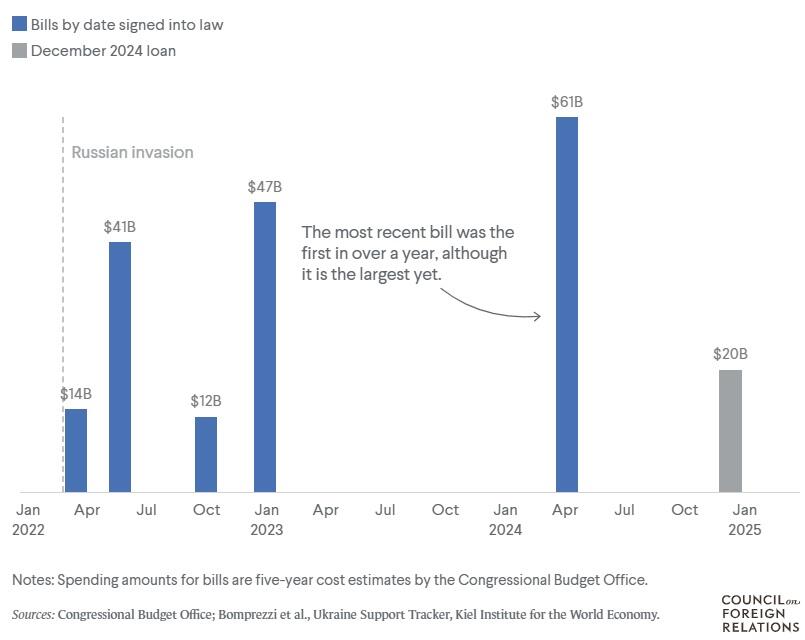
How much aid has the US actually sent Ukraine over the course of the war with Russia? The Council on Foreign relations has some new figures:
The U.S. Congress has voted through five bills that have provided Ukraine with aid since the war began, doing so most recently in April 2024. The total budget authority under these bills—the “headline” figure often cited by news media—is $175 billion. The historic sums have helped a broad set of Ukrainian people and institutions, including refugees, law enforcement, and independent radio broadcasters, though most of the aid has been military-related.
Gen. Mahony as expected also highlighted that the Marines have adapted to the new challenges presented by the last several years of conflict in multiple places.
“We are innovating and adapting from lessons learned from the modern battlefields of Ukraine, Gaza, Lebanon, Red Sea, and our own exercises,” he told the Senators.
President Trump over the last weeks has also expressed deep concern that a blank check mentality towards Ukraine under the Biden administration served to weaken US military readiness, and the American economy more broadly. After a brief halt in arms shipments to Kiev starting last week and into the weekend, the US weapons pipeline has been declared back on after the Jeddah talks.
A glamorous woman in an unglamorous job, Amaryllis Fox Kennedy sits in a cavernous office that is entirely empty other than the leftover computers and keyboards still scattered about from when the last administration vacated the premises, leaving old copies of federal budgets bound in blue, red, and grey, stretching back decades and stacked nearly from floor to ceiling.
It is not exotic like a dusty cafe in Karachi. It isn’t as chic as an art gallery in Shanghai. All the same, Amaryllis Fox Kennedy, or AFK as aides now abbreviate her name, is happy with her new post.
“I like to be in the plumbing,” says the daughter-in-law of Health and Human Services Secretary Robert F. Kennedy Jr. Once the youngest female CIA officer at 22 and whose memoir of a life spent undercover was optioned to Hollywood, she adds, this place “is where you can have the most impact.” She is speaking from the Office of Management and Budget across the alleywayfrom the White House where, during her first interview since joining the new administration, the ventilation system can be heard kicking on and off.
The onetime spy is now the associate director for Intelligence and International Affairs at OMB, a first-of-its-kind position and an assignment that is as influential as her path to it is ironic.
President Trump had considered Fox Kennedy for CIA deputy director.Arkansas Sen. Tom Cotton, chairman of the powerful Senate Intelligence Committee, intervened. Lawmakers worried that if given that role, AFK might shatter America’s premier espionage agency. Their fears were not entirely unfounded. Since leaving the agency in 2010, she has become a prominent CIA skeptic. She has made the declassification of the JFK assassination files a personal mission. She managed the campaign of Robert F. Kennedy Jr. last year as he promised to renew the work of his late uncle, President John F. Kennedy, who once vowed to “splinter the CIA into a thousand pieces and scatter it to the winds.”
Any attempts to assuage concerns failed. Her call, and a subsequent call from the White House to set up a meeting with Cotton, went unanswered. She was torpedoed behind the congressional curtain.
Rather than working inside just one three-letter agency to reform it, the director of the Office of Management and Budget asked, why not bring the entire espionage apparatus to the president’s heel? Fox Kennedy accepted. Passed over for a job at CIA, she now oversees the entire CIA budget as well as the budgets for the 17 other agencies that collectively make up the intelligence community.
This makes her the tip of the fiduciary spear, so to speak, in the ongoing White House war against what they see as a “woke and weaponized” government security establishment. The budgets, like the ones collecting dust next to her desk, and other bureaucratic authorities known only to the nerdiest of wonks, Fox Kennedy insists, are the very best tools “to put the Leviathan on the chain.”
All of this delights Vought, who calls her addition to OMB “a huge deal,” a step toward policing the shadowy corners of the federal government he described as “nearly untouchable.” No clandestine budget or compartmentalized program will be beyond her purview. Instead, AFK will be free to follow the money. “The federal government has been weaponized against the American people, including our president, in ways most Americans have yet to realize,” the budget chief told RCP before likening the enterprise to “our own Church Committee within OMB to end the weaponization for good.”
But what would you say you do here exactly? “My job is to arm Tulsi and John,” AFK replies, referring to Tulsi Gabbard, director of National Intelligence, and John Ratcliffe, director of the CIA, like old friends, “and all the amazing men and women in the intelligence community with everything they need to do their job – to do it safely and efficiently, protect this country, and execute the president’s agenda.” She continues with standard boilerplate about ensuring that “not a penny of taxpayer dollars is wasted.”
A wonk would talk about the efficiency of government systems, while a spook would say something about an attempt at omniscience. She talks that way, too, to be sure, but AFK is unusual in that she attempts to humanize budgetary questions of national security. Every taxpayer dollar that comes through the door, says the mother of three, is a dollar that will not go to “a family’s vacation” or “someone’s kid’s ballet lessons.” Misuse of those funds, she has concluded, is nothing short of “a sin.”
While she can sound a little like Marianne Williamson, the gadfly guru and perennial presidential candidate, years spent undercover while living as an art dealer abroad and recruiting arms dealers as assets has given AFK a hard edge. She reserves a special derision for those in intelligence who see themselves as separate from, and unaccountable to, civilian control.
“Even when I was there,” she recalls of past colleagues at the CIA, “they would talk about both Democrats and Republicans, whoever was in the White House, as the temps. ‘Oh, we don’t want to bother the “temps” with that – they’re going to be gone in four years.’” As a result of that attitude, there were entire departments and “parallel command structures,” AFK reported, “that ‘the temps’ have never been allowed in.” Now, as a political appointee and a temp herself, her mandate is to break down those doors.
“You can’t fund anything like the lawfare and weaponization President Trump encountered in his first term without a firehouse of money,” she said, adding that there was initially “a learning curve in the first administration around how to put the Leviathan on the chain and keep it there.” As a result, AFK continued, “the Leviathan made damn good use of that time. It had a head start.”
Not that long ago, liberals lambasted the security state while conservatives rushed to its defense. But those roles have been entirely reversed during the Trump era. From the surveillance of the first Trump campaign and the Steele dossier to the dismissal of the Hunter Biden laptop as “Russian misinformation” and the subsequent social-media censorship, it is a story that has played out for the better part of a decade. “You realize the exact same offensive playbook that we used against people who were killing Americans, and were our greatest adversaries,” she said, “we are using it against the elected representatives of the people in this country, or against any American protected by the Constitution.”
This sentiment makes Fox Kennedy at home in MAGA world and a pariah to Democrats. She comes most recently from the “Make America Healthy Again” wing of the GOP, a coalition where anything big (Big Ag, Big Pharma, and Big Tech, for instance) is viewed with skepticism. She still sticks out. Republican hawks are not known for looking to Sufi mystics for inspiration or talking about the need to root out terrorism by first acknowledging the humanity of the terrorist, as AFK has done. She possesses an undeniably different outlook on the world and a particular set of skills.
The CIA assigned her a “nonofficial cover,” sending her abroad with a false identity but without any diplomatic protections. She learned beforehand, like all agents do, to lose a tail, break out of handcuffs, and in the worst-case scenario, to shoot her way out of a bad situation. That kind of training isn’t likely to come in handy at the White House. A career in analysis and human intelligence will.
She first came to the attention of the CIA while in graduate school after developing a predictive algorithm to pinpoint where terrorist cells were most likely to develop (the ratio between hookah bars and madrassas was key). The career that followed took her from the Middle East to Asia, including a stint in Shanghai where she posed as an art dealer and, per her memoir, discovered that her housekeeper was keeping tabs on her family for Beijing. While AFK has become increasingly critical of the CIA, particularly with the counterterrorism measures deployed after 9/11, she still loves the agency.
“The intelligence community, when the cancer of political weaponization and censorship and domestic propaganda is removed, I’d fund it all day long,” AFK insists, calling it “the most cost-effective, efficient, humane way to avoid war – 10 times out of 10.” The former agent says she just wants reform, specifically a return to an apolitical mission, which AFK insists yields better results anyway.
She argues that human intelligence capabilities have been diminished in recent years as the intel agencies pursue priorities contrary to their core mission. “The majority of useful information that comes out of the intelligence community, for policymakers,” she said, came from other sources and methods. Recipients of the presidential daily brief, or PDB, a summary of intelligence and analysis presented in the Oval Office each morning, AFK reported being told is “basically” the same kind of information that can be read “in the Wall Street Journal, the Economist, and the New York Times.”
A senior administration official, granted anonymity to speak candidly, did not dispute that characterization, telling RCP that both Democrats and Republicans have complained that in recent years the PDB intel has grown “stale.”
Reform isn’t welcome in the intelligence community, especially when those three-letter agencies are predisposed to doubt the intentions of the reformer. Senate Minority Leader Chuck Schumer said as much when he seemed to warn Trump before his first inauguration not to pick a fight with spooks. “Let me tell you, you take on the intelligence community,” the Democratic leader told Rachel Maddow of MSNBC in 2017, “they have six ways from Sunday at getting back at you.”
One question is whether the Trump administration’s approach to the IC, generally, and AFK’s appointment, specifically, indicate a willingness to exact payback.
“I think her intentions, at least from my point of view, are probably not all that wonderful,” said Loch Johnson, a professor at the University of Georgia whom the New York Times once dubbed “the dean of American Intelligence Scholars.” He sees an administration motivated not by good government, but by an appetite for “revenge more than anything else.”
Legally and constitutionally speaking, Johnson told RCP, there is no doubt AFK “has a right to go out to the CIA and look at their budgets up and down.” Comparisons to the Church Committee, though, the Senate select committee that famously called the intelligence agencies to the carpet in the 1970s, may be premature.
“The Church Committee was bipartisan, fact-driven and with strict adherence to the law,” said Johnson, who served as the top aide to the late chairman of the committee, Idaho Sen. Frank Church. “So no, I don’t think this is like it.” What Johnson thinks is all but certain is a clash.
“You’re going to have Fox and others making public charges against these agencies, and that’s when they better have their facts right because the CIA and FBI – I don’t think this is inappropriate – have their own professional contacts on Capitol Hill,” Johnson concluded. “They will seek recourse.”
The White House has already started its long march through the federal bureaucracy. Elon Musk shuttered USAID. Ratcliffe thinned the CIA herd of recently hired officers, though AFK predicts that only a “very small portion” of federal employees in the intel agencies, those who “allowed their trade craft to be turned inward against Americans,” will end up “on the chopping block.”
When Trump clashed with Volodymyr Zelensky, warning the Ukrainian president he was gambling with another world war by demanding a U.S. security guarantee, AFK was on her feet across the street from the White House in the Eisenhower Office Building, cheering. “He was like Aslan,” she said, referring to the lion and protagonist of C.S. Lewis’ Narnia books.
Even in an administration defined by skepticism of foreign intervention, AFK stands out. She has been vociferous in her condemnation of what she sees as a proxy war with Russia. The sentiment most in fashion during the previous administration, that the U.S. stood with Ukraine, she wrote on social media last year, was “simply a jingle.” While that country burned, she argued, “the war hawks and the bankers” prospered.
If and when that conflict ends, conservatives will clamor for an audit of the billions in financial and military aid sent overseas. David Sachs, Trump’s crypto czar, expressed such an appetite recently, telling Fox News that Ukrainian oligarchs had been “feasting” on that assistance and alleged that American weapons meant for the frontlines had been resold on the black market. A fledgling democracy, Ukraine struggled with endemic corruption even before the war, and while allegations of widespread black-market sales are yet to be substantiated, the Zelensky administration uncovered massive fraud to the tune of $40 million in weapons procurement. AFK was not surprised.
“It’s like shipping a pallet of money,” she said of weapons sent overseas, “and walking away from it and then coming back two years later being like, but do you have proof that it’s not there?”
The administration will soon resume weapons shipments to and intelligence sharing with Ukraine after Zelensky agreed to a 30-day ceasefire with Russia on Tuesday. Anything approaching an audit will likely have to wait. AFK, meanwhile, focuses her attention stateside.
Hollywood had considered adapting her life into a screenplay. Apple was reportedly developing a TV series based on her memoir. Brie Larson was set for the starring role, with Fox Kennedy as an executive producer. The project has stalled since AFK entered politics, and her newest chapter, overseeing a sprawling intelligence apparatus from a quiet corner of the Office of Management and Budget, is not exactly glamorous. No one can argue that it isn’t influential.
These Are The U.S. Cities With The Highest Value Homes
A study by Badeloft USA examined high-value home density across cities using real estate data. After analyzing land area, average home price, and the number of properties exceeding that price, the study concluded that Miami leads in housing density, with the most above-average-priced homes per square mile.
Miami tops the list with 105 above-average-priced homes per square mile, the highest density of premium real estate. With just 36 square miles of land, its limited space drives this concentration, making it a prime destination for luxury living. The city’s average home price stands at $584K.
New York City ranks second, with 38 luxury homes per square mile. While its density is lower than Miami’s, it leads in total premium properties, boasting 11,000 across 300 square miles. With an average home price of $763K, NYC remains a global real estate hub.
Las Vegas follows in third place with 26 high-value homes per square mile. Spanning 142 square miles, it has 3,701 premium properties, nearly double the density of Chicago, signaling its rising influence in the luxury market.Philadelphia ranks fourth, with 23 premium homes per square mile. It hosts 3,214 above-average-priced properties across 134 square miles. Despite having the lowest average home price in the top cities at $218K, its density reflects strong real estate growth.
Washington, D.C., takes fifth place with 17 premium homes per square mile. With 1,225 high-value properties spread over 68 square miles and an average home price of $589K, it maintains a strong luxury market.
Boston lands sixth with 14 premium homes per square mile. Though it has just 698 above-average-priced properties, its compact 48-square-mile size boosts density. With an average home price of $745K, Boston remains a high-end market.
San Antonio ranks seventh, also with 14 luxury homes per square mile. Despite nearly 7,000 premium properties, its vast 500-square-mile area lowers overall density.
Detroit follows in eighth place with 13 luxury homes per square mile. It has 1,803 high-value properties, but its $74K average home price—the lowest on the list—underscores its affordability despite growing premium real estate.
Chicago comes in ninth, with 12 premium homes per square mile. With 2,759 above-average-priced properties across 227 square miles, its density is comparable to Honolulu, offering ample opportunities for buyers and investors.
Honolulu rounds out the top ten, also with 12 high-value homes per square mile. Despite its ranking, it boasts the most expensive average home price at $773K, with just 826 above-average-priced homes, distinguishing it from other cities.
A spokesperson from Badeloft USA commented: “High-value home density sheds light on how urban geography, land distribution, and market pressures shape housing trends. Cities with smaller land areas often experience concentrated demand for premium properties, while larger regions show more varied growth patterns.”
They continued: “These findings highlight the intricate balance between affordability, housing accessibility, and economic forces driving real estate markets. Buyers and investors should carefully consider these factors when evaluating opportunities in different markets.”
The former head of the Israeli Military Intelligence Directorate has voiced his support for the “power struggle” in Syria, adding that the “chaos” benefits Israel. “The chaos in Syria is beneficial. Let them fight each other. But Israel should remain silent on this matter and not make any public statements. It should act calmly,” Tamir Hayman said in an interview with the Israeli Army Radio.
Hayman, who now serves as the director of the Institute for National Security Studies, welcomed the conflict between the different factions in Syria, but added that Israel must stay quiet. “We wish victory to all forces, but we must do one thing, do this silently, and not talk about it.”
He said while in the short term there appears to be power struggle in Syria, the new government is trying to extend its control.
“Everyone is fighting each other. An agreement with the Kurds on the first day, a massacre against the Alawites on the second day, and a threat to the Druze on the third day… All this chaos in addition to an Israeli attack on the south… All this chaos is somewhat good for Israel,” he explained.
The former military commander was referencing the violence that began on last Thursday when gunmen allegedly loyal to Assad launched attacks on security forces in the coastal region, home to members of the Alawi community, to which Assad and most of his loyalists belong.
Clashes spiraled into revenge attacks on civilians, leaving hundreds dead and thousands displaced. The killings have stoked an atmosphere of sectarianism and intimidation, and posed a massive challenge for the credibility of Syria’s nascent government.
Civilians belonging to the Alawi community were particularly targeted. Tensions in the area had been high ever since Assad’s ouster, with Alawis saying they have been victims of occasional reprisal attacks.
While the new Syrian administration’s defense ministry said it had completed its operations against “regime remnants”, residents of the coastal cities say violence has not ended, despite being reduced.
Further destabilization and attacks
Meanwhile, Israel carried out an air strike on the Syrian capital Damascus on Thursday, as its defence minister threatened Syria’s interim President Ahmed al-Sharaa, adding to the chaos in Syria.
Israel’s military said it was targeting what it described as a command center belonging to Palestinian Islamic Jihad, which it said was used to direct “terrorist activities” against Israel.
Middle East Eye could not independently verify the claim. The strike took place in a residential area at the edge of Damascus, Syrian state media reported. The target of the strike was a Palestinian person, two Syrian security sources told Reuters. It was not immediately clear if anyone was wounded in the attack.
Elsewhere on Thursday, Israeli forces advanced into the countryside in Syria’s al-Quneitra region with tanks and military vehicles, detonating former military sites, according to the Syrian Observatory for Human Rights.
Last month, Israel carried out a series of air strikes on what it said were military bases in Syria, following Prime Minister Benjamin Netanyahu’s speech demanding a “complete demilitarisation” of Syria’s south. At least two were killed in the attacks.
During the speech, Netanyahu made specific reference to Syria’s Druze community, who live predominantly in the Sweida region. “We will not tolerate any threat to the Druze community in southern Syria,” he said.
Al-Qaeda affiliated terrorists in Syria led by Jolani are going from door to door and massacring Alawite families in the most cruel, sadistic ways. What we see on social media must only be a glimpse of the savagery that Jolani’s jihadists are committing. Entire families have been… https://t.co/FAQYKiKphf
On Thursday, Israel’s foreign ministry confirmed it had sent humanitarian aid to Druze communities in Syria over the past few weeks. Analysts have suggested that Israel’s overtures to the Druze community are part of attempts to divide Syria.
Israel has carried out heavy air strikes against Syrian military infrastructure since December, leaving the new administration – already battered from 14 years of civil war – with little capacity to respond militarily.