55.6 F
Chicago
Saturday, September 26, 2026
Home Blog Page 1710

Massie Donations Pour In – Jewish Group Vows To Help Trump Oust Him

Massie Donations Pour In – Jewish Group Vows To Help Trump Oust Him

President Trump’s social-media tirade against hard-line deficit-hawk Thomas Massie has had a big effect — but not exactly the one Trump wanted. Since Trump’s late-night tantrum in which he called for the Republican congressman to be ousted via a primary challenge, the Kentucky congressman has raked in more than $200,000 in donations. That huge and growing windfall comes as the Republican Jewish Coalition promised to help make Trump’s dream of a Congress without Massie come true. 

Massie provoked Trump’s wrath on Sunday, when he vowed to vote against a continuing resolution (CR) that would fund the government through Sept 30 — but without spending cuts. “Why would I vote to continue the waste fraud and abuse DOGE has found?” wrote Massie on X. “We were told the CR in December would get us to March when we would fight. Here we are in March, punting again!” 

On Monday evening, a sputtering Trump used his Truth Social account to lash out at the libertarian-minded Massie:

“HE SHOULD BE PRIMARIED, and I will lead the charge against him. He’s just another GRANDSTANDER, who’s too much trouble and not worth the fight. He reminds me of Liz Cheney before her historic, record breaking fall (loss!). The people of Kentucky won’t stand for it, just watch. DO I HAVE ANY TAKERS??” 

Eventually, the CR passed 217-213; thanks to Minority Leader Chuck Schumer, it’s currently dead in the Senate. However, the follow-on effects of Trump’s political attack on Massie have continued — mostly in ways that add up to a big net-positive for Massie.

“I’ve received an amazing outpouring of support since I was attacked for voting No on the Biden-$-level CR. In fact, we just hit $205,000 from 2500 grassroots donors!” Massie wrote using his campaign’s X account late Thursday afternoon, urging like-minded people to help keep the trend going. Earlier he’d noted that the influx pushed the balance of his campaign coffer over $1 million for the first time.

The sudden, non-election-year surge in contributions came alongside a social media reaction that saw a variety of conservatives and libertarians chiding the president for targeting Massie over his resolute opposition to profligate government spending, as the national debt marches toward the $37 trillion milestone. 

Glenn Greenwald zeroed in on Trump’s bizarre likening of Massie to Liz Cheney:  

Of the many absurd aspects of Trump’s attack on Thomas Massie, the comparison of Massie to Liz Cheney has to be the most laughable. It’s honestly difficult to think of two people less similar to one another than Thomas Massie and Liz Cheney.

Of course, that’s not to say Trump’s call to oust Massie has been uniformly ridiculed. Indeed, the America-first Republican is once again in the crosshairs of a group that works to advance the interests of Israel, as the Republican Jewish Coalition (RJC) quickly promised to take a leading role in making Trump’s wish of ending Massie’s congressional career a reality. “RJC will be a leading force alongside President Trump in support of a viable candidate to defeat Massie,” RJC spokesman Sam Markstein told Jewish Insider.

Massie has made himself a top target of pro-Israel political organizations by repeatedly voting against aid to Israel — as he does where other countries are concerned. He has also voted against legislation that’s touted as opposing antisemitism but which, in practice, would curtail criticism of the State of Israel.  

This is the second recent round of Republican Jewish Coalition saber-rattling at Massie. Last month, amid Massie’s public consideration of a run for Mitch McConnell’s Senate seat in 2026, the group promised to do whatever it takes to keep him from ascending to the upper chamber. “If Tom Massie chooses to enter the race for US Senate in Kentucky, the RJC campaign budget to ensure he is defeated will be unlimited,” warned Republican Jewish Coalition CEO Matt Brooks.

Massie has yet to announce his decision, but on Wednesday he made it clear that contributions to his campaign fund would be available for either defending his current seat, or working to join Rand Paul in representing Kentucky in the Senate: 

Meanwhile, the whole dust-up has inspired plenty of social media content: 

Tyler Durden
Thu, 03/13/2025 – 11:05

DOGE Impact Remains Muted As National Jobless Claims Tumble

DOGE Impact Remains Muted As National Jobless Claims Tumble

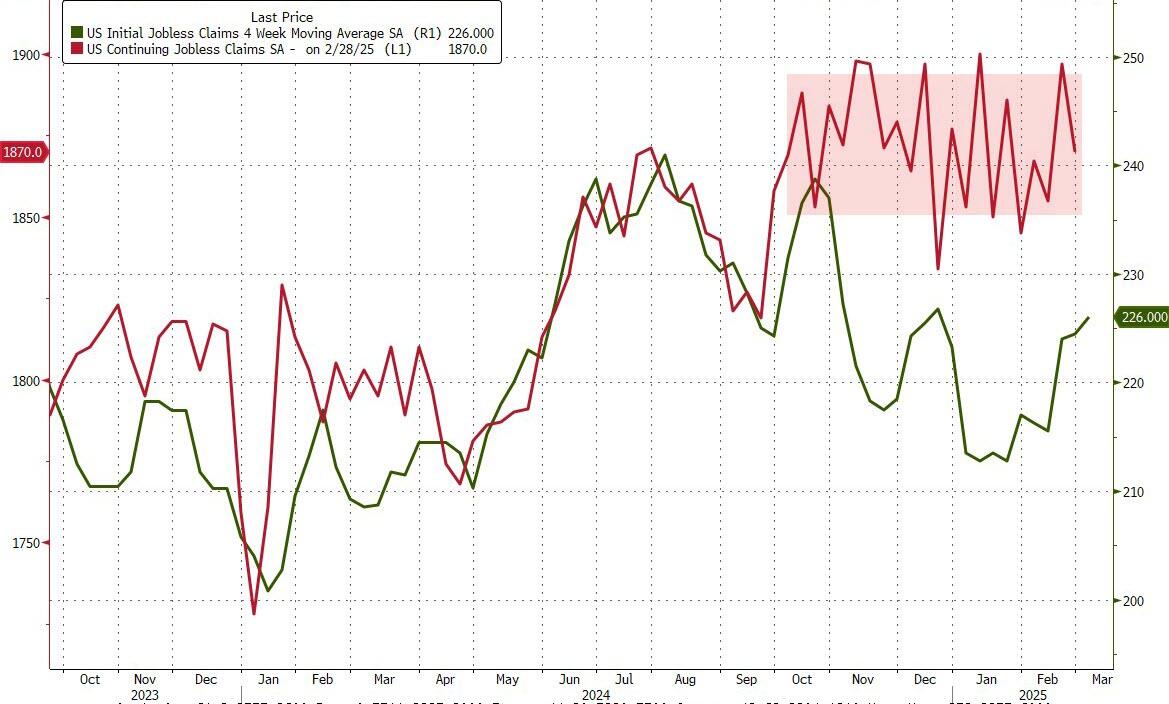
Following the initial surge in jobless claims in the DC area to start the year, things have slowed notably in the last two weeks (although last week saw a modest rise in the number of people filing for first time benefits)…

Source: Bloomberg

Overall, initial claims fell last week – with non-seasonally-adjusted claims now at their lowest since November

Source: Bloomberg

Meanwhile what the fuck is going on with NY jobless claims data?

Last week claims exploded higher in NY…

And this week they collapsed…

Continuing jobless claims remain range-bound for the last six months around the 1.875mm Americans level…

Source: Bloomberg

We wonder if the discrepancy between DOGE-driven layoffs and the lack of signal in the claims data is related to the buyouts offered to federal workers – which may preclude them from applying for unemployment benefits.

Tyler Durden
Thu, 03/13/2025 – 09:30

France “Won’t Give In To Threats” After Trump Threatens 200% Tariff On EU Alcohol Imports

France “Won’t Give In To Threats” After Trump Threatens 200% Tariff On EU Alcohol Imports

Another day, another tariff-based headline…

President Trump threatened to enact a 200% tariff on European wine, champagne and other alcoholic beverages, the latest escalation in a brewing trade war between the US and the EU.

The president in a social media post on Thursday said that he would move forward with the import duties if the EU doesn’t repeal a tax on US whiskey, a measure put in place to retaliate against Trump’s steel and aluminum tariffs that went into effect on Wednesday.

The European Union, one of the most hostile and abusive taxing and tariffing authorities in the World, which was formed for the sole purpose of taking advantage of the United States, has just put a nasty 50% Tariff on Whisky. 

If this Tariff is not removed immediately, the U.S. will shortly place a 200% Tariff on all WINES, CHAMPAGNES, & ALCOHOLIC PRODUCTS COMING OUT OF FRANCE AND OTHER E.U. REPRESENTED COUNTRIES. 

This will be great for the Wine and Champagne businesses in the U.S.

France – the biggest exporter of alcohols to the US – immediately responded after the country’s Trade Minister Laurent Saint-Martin said France won’t give in Trump’s tariff threats and will “always protect” its industries. Trump is “escalating the trade war he chose to unleash,” Saint-Martin said, adding that France is “determined to retaliate with the European Commission and our partners.”

Trump’s jab came a day after E.U. leaders announced that they would respond to the United States imposing 25% tariffs on up to €26 billion ($28.3 billion) worth of steel, aluminum and related products. The EU will also immediately begin consultations with member states, with the aim of adopting the additional lists of agricultural and industrial goods subject to tariffs as high as 25% by mid-April. As reported last night, the 27-nation bloc plans to react to the US in two waves: 

  • First, with tariffs as high as 50 percent on U.S. products including Harley-Davidson motorcycles and Kentucky bourbon, which will take effect on April 1; 

  • and second, a series of measures in mid-April that would target farm products and industrial goods that are important to Republican districts.

“Reimposing these debilitating tariffs at a time when the spirits industry continues to face a slowdown” will “further curtail growth and negatively impact distillers and farmers in states across the country,” Chris Swonger, the chief executive of the Washington-based Distilled Spirits Council, said in a statement on Wednesday.

The euro sold off against the dollar…

And US futures are fading…

European spirits and drinks makers dropped on the news: LVMH, which has wines and spirits divisions, falls 2%; spirits maker Pernod Ricard -3%, cognac producer Remy Cointreau -3.4%, Davide Campari -2.8%, Diageo -0.3%

Cue the re-retaliatory threats from Brussels… and around and around we go.

Tyler Durden
Thu, 03/13/2025 – 09:25

The “Ridiculous Political Puppet Show” Part 2

The “Ridiculous Political Puppet Show” Part 2

As the government shutdown deadline looms, House Democratic leaders took to X overnight to voice support for a four-week funding bill to keep the government open.

But the real story is not the looming shutdown but how the Democratic Party has become a “ridiculous political puppet show” controlled by a higher-power puppeteer. This is the second time in just weeks – read Part 1: Cory Booker Admits To Orchestrating Dem Propaganda…

X user Leftism identified 49 Democratic Congress members who posted nearly identical tweets in the last 12-plus hours about the looming shutdown. 

Here’s the message: 

House Democrats stand united for a four-week funding extension that stops harmful cuts, keeps government open to serve the people, and allows Congress to reach a bipartisan funding agreement. I’m ready to vote tomorrow or Friday to pass a four-week extension.

Repeated across dozens of X accounts controlled by top Democratic lawmakers:

Leftism asked: 

  • Do none of them think for themselves?

  • Do none of them care to use their brains other than to spout the same talking points they’re given?

  • Do none of them actually give a crap about representing their constituents?

Musk chimed in: “You can see the ridiculous political puppet show for what it really is. They are just actors reading a script.” 

Is this the puppeteer pulling the strings for the Democratic Party? 

“If Democrats are all on a script and post the same thing it means they are not in control, someone else is giving the orders. If that’s the case, what’s the point in voting for Congress reps when you don’t get what you vote for? You get what someone else in charge is paying for,” Wall Street Apes said.

Here’s Part 1 … 

Less than two weeks ago, 22 Democratic Senators were caught publishing identical propaganda videos. 

Far-left Sen. Cory Booker (D-NJ) admitted on X that he had been the puppeteer for the rudderless party. 

Meanwhile, the leftists are stealing a page from the Trump victory campaign and dabbling in long-form podcasts after realizing that teleprompter conversations on conspiracy MSM networks have little impact on voters. 

Checking in on the Obamas. Michelle received a whole 12,000 views in 14 hours. 

The rudderless Democratic Party is sinking quickly as its propaganda warfare against the American people no longer works.

Tyler Durden
Thu, 03/13/2025 – 09:15

Core Producer Prices Tumbled Most Since COVID Lockdowns In February

Core Producer Prices Tumbled Most Since COVID Lockdowns In February

Following yesterday’s slower than expected rise in consumer prices, this morning we see producer prices following a similar path with Core PPI dropping by the most MoM since April 2020 (-0.1% MoM vs +0.3% exp), slowing the annual pace of change for producer prices to +3.4%…

Source: Bloomberg

Transportation Services was the biggest downside driver of Core PPI…

Source: Bloomberg

The headline PPI was unchanged MoM (considerably slower than the +0.3% expected)…

Source: Bloomberg

PPI summary: 0.3% increase in prices for final demand goods offset a 0.2% decline in the index for final demand services. The index for final demand less foods, energy, and trade services moved up 0.2% in February after rising 0.3% in January. For the 12 months ended in February, prices for final demand less foods, energy, and trade services advanced 3.3 percent.

PPI Final demand: The index for final demand goods increased 0.3% in February, fifth consecutive rise. Leading the February advance, prices for final demand foods jumped 1.7%. The index for final demand goods less foods and energy moved up 0.4 percent. In contrast, prices for final demand energy fell 1.2%.

Product detail:

  • Two-thirds of the February increase in the index for final demand goods is attributable to prices for chicken eggs, which jumped 53.6 percent. 

  • The indexes for pork, fresh and dry vegetables, electric power, tobacco products, and carbon steel scrap also moved higher.

  • Conversely, prices for gasoline declined 4.7 percent.

  • The indexes for processed young chickens and for primary basic organic chemicals also decreased.

PPI Final demand services: The index for final demand services fell 0.2% in February, the largest decline since moving down 0.2 percent in July 2024. The February decrease can be traced to margins for final demand trade services, which dropped 1.0 percent. In contrast, prices for final demand services less trade, transportation, and warehousing rose 0.2 percent, while the index for final demand transportation and warehousing services was unchanged.

Product detail:

  • Over 40% of the February decline in prices for final demand services is attributable to margins for machinery and vehicle wholesaling, which decreased 1.4 percent.

  • The indexes for food and alcohol retailing; automobiles and automobile parts retailing; apparel, footwear, and accessories retailing; chemicals and allied products wholesaling; and residential real estate loans (partial) also moved lower.

  • Conversely, prices for inpatient care advanced 0.8 percent.

  • The indexes for hospital outpatient care and for machinery and equipment parts and supplies wholesaling also increased

Under the hood, Energy and Trade Services declined the most MoM…

Source: Bloomberg

Margin pressure remains on American corporations, although that pressure did ease a little last month…

Source: Bloomberg

Finally we highlight that, two-thirds of the February increase in the index for final demand goods is attributable to prices for chicken eggs, which jumped 53.6 percent.

And now egg prices are tumbling…

And energy prices are set to drag CPI and PPI even lower in the next month or so…

Source: Bloomberg

More disinflationary impulses to come…

Tyler Durden
Thu, 03/13/2025 – 08:41

Futures Slide Ahead Of PPI As Democrats Prepare To Shut Down Government

Futures Slide Ahead Of PPI As Democrats Prepare To Shut Down Government

US equity futures are again lower, although well off session lows, with small caps leading and tech stocks lagging as concerns over whether Democrats will push the US into a government shutdown over the weekend added to uncertainty around the outlook for the economy. As of 8:00am, S&P futures contracts fell 0.4%, in an extremely illiquid and volatile session, after gains on Wednesday spurred by a softer-than-expected inflation print. Nasdaq futures dropped 0.5%, with most Mag7 names lower; weak earnings hit software firm Adobe and clothing retailer American Eagle in premarket trading, Intel jumped as much as 11% after the chipmaker named a new chief executive officer. Senate Minority Leader Chuck Schumer said Wednesday that Democrats would not provide the necessary votes to pass the Republican plan to avert a shutdown. The yield curve is seeing yields rise in longer-dated bonds by 1-2bps. USD is flat while cmdtys are under pressure, though Ags are stronger. The market seems a bit more resilient to headline risk as macro fundamentals return to focus ahead of next week’s Fed meeting. Today’s macro data focus is on PPI to see if yesterday’s CPI (and PCE mapping) are intact ahead of tmrw’s Univ of Mich sentiment update. 

In premarket trading, Intel shares jump 11% after the chipmaker named Lip-Bu Tan as its CEO. Tan is signaling that he’ll stick with his predecessor Pat Gelsinger’s plan to make chips for other companies, even as he vows to learn from past mistakes. On the other end, Adobe shares slumped 4.6% after the maker of software for creative professionals gave an outlook thatwas mixed relative to expectations. While analysts are generally positive, Evercore wrote that the report wasn’t strong enough to change the narrative around the stock. Here are some other notable movers:

  • Wells Fargo shares edge 1% higher after RBC Capital Markets upgrades to outperform from sector perform, saying the stock’s weakness provides a good entry point.
  • SentinelOne shares slump 14% after the security software company gave a revenue forecast that was weaker than expected.
  • UiPath shares slide 18% after the automation software company gave a forecast that is weaker than expected, raising concerns about the threat it faces from AI.
  • American Eagle shares drop 9.1% after the apparel retailer forecast operating income for the first quarter that missed the average analyst estimate. Analysts note that the clothier’s weak forecast overshadowed its 4Q earnings beat.

The previous day’s CPI reading “has reinvigorated belief in the declining inflation narrative,” said Daniel Murray, CEO of EFG Asset Management in Zurich. Investors are now awaiting readings on US wholesale inflation and initial jobless claims, with price growth seen moderating to 0.3% last month.

Recent weeks have seen a slew of Wall Street banks including Goldman Sachs Group Inc. and Citigroup Inc. cut their forecasts for the S&P 500, predicting a hit from the slowing economy. Yardeni Research added to that bearish chorus, noting that Trump’s tariff policies have heightened the risk of stagflation. Still, some strategists think a bottom for US stocks is “probably” here, with JPMorgan Chase & Co. saying the worst of the correction may be over, with credit markets indicating a lower risk of a recession.

Meanwhile Treasury yields shrugged off the cooler inflation data to edge higher, with investors focusing on the effect higher tariffs could have on prices in the coming months. The Federal Reserve, which meets next week, has already signaled it will take a wait-and-see approach before cutting interest rates further.  

European equities erased a gain of 0.5%, as earlier gains in health care, consumer product and insurance stocks were promptly reversed after Trump threatened the EU with 200% tariffs on alcohol products, and as concerns about trade persist after President Donald Trump said the US would respond to the European Union’s countermeasures to his tariffs on steel and aluminum. Poland’s Allegro leads gains, while Deilveroo and HelloFresh fall. European truckmakers slip after US regulators signaled they would dial back emissions standards, potentially derailing purchases of new trucks. Here are the biggest movers Thursday:

  • Allegro climbs as much as 8.9% in early trading in Warsaw after the Polish e-commerce platform reported better-than-expected adjusted Ebitda in the fourth quarter, announced a first-ever buyback
  • Novo Nordisk shares rise as much as 2.8% after Kepler Cheuvreux raised the stock to buy. The analysts see a recovery in the Danish drugmaker’s shares after sentiment “swung too far the other way”
  • Volution jumps as much as 12%, the most in over five months, after the maker of indoor air quality products delivered a beat in the first half and said annual earnings should be ahead of consensus
  • DFS Furniture gains as much as 12%, the most since July 2023, after the British furniture firm reported “a strong set of interims,” according to Jefferies, with 1H pre-tax profit almost doubling year on year
  • Lotus Bakeries rises as much as 6.1%, most since August, after analysts at KBC Securities upgraded the stock to accumulate from hold, seeing better opportunities for the sweets producer following a selloff
  • Halma advances as much as 4.4% after the health and safety sensor technology group delivers results that analysts view as solid, with consensus estimates now expected to nudge up slightly
  • Daimler Truck falls as much as 15%, leading the rest of European truckmakers lower, after the new head of the US EPA announced potential rollbacks of truck-emissions regulations starting in 2027, which could derail purchases of new trucks to comply with standards
  • DocMorris shares drop as much as 21% and hit a record low after the Swiss-based online pharmacy announced a potential capital increase and didn’t provide any guidance for 2025
  • Valeo falls as much as 5.1% as Exane cuts the car-parts maker to neutral from outperform following a rally over the past six months, preferring outperform-rated peer Forvia
  • Deliveroo shares fall the most in more than two years after the UK food delivery firm forecast earnings that disappointed investors
  • Hugo Boss shares fall as much as 5.1% to their lowest level in over three months after the high-end clothing maker’s sales outlook for 2025 missed estimates amid macroeconomic volatility
  • Trainline shares fall as much as 16%, the most in almost four years, after the train operator reported net ticket sales and group revenue for the full year that missed the average analyst estimate
  • Grenke shares slide as much as 22%, falling to the lowest since June 2012, after the German lease finance provider gave a forecast for 2025 earnings that missed the average estimate
  • Deliveroo shares fall as much as 6.9% to the lowest in almost a year, after the food delivery firm set guidance for adj. Ebitda below estimates, dragged by targeted investments to boost growth

Earlier in the session, Asian equities fell amid a broad risk-off mood, as traders largely looked past weaker-than-expected US inflation data. The MSCI Asia Pacific Index dropped as much as 0.5%, reversing a gain of as much as 0.6%. TSMC was the biggest drag on the gauge, with Taiwan’s benchmark the region’s biggest decliner as the central bank warned of currency risks from stock outflows. Sentiment turned sour as worries mounted about the health of the world’s largest economy amid on-again, off-again trade policies and geopolitical tensions. The regional gauge is down about 1.8% this week. “The general sense is that the world is not in a good place. There’s uncertainty everywhere and nobody wants to put on risk,” said Vey-Sern Ling, a managing director at Union Bancaire Privee. “I think economic uncertainties in the US caused by Trump’s policies will be a constant worry.”

In FX, the Bloomberg Dollar Spot Index rises 0.1%. The yen is off its best levels but still the top G-10 FX performer against the greenback. The Swedish krona is the weakest with a 0.7% drop, closely followed by the Antipodean currencies.

In rates, treasuries dip ahead of US producer price data, with US 10-year yields rising ~2 bp to 4.33%; treasury futures drifted lower as US trading begins after plying narrow ranges during Asia session and London morning, lifting cash yields by 1bp-3bp across maturities and steepening the curve. US 10-year yields around 4.33% are ~2bp cheaper on the day near session high with bunds in the sector lagging by an additional 1bp. Treasury curve spreads are steeper, 2s10s by ~1.5bp day’s high. Bunds have bigger losses as European stocks pare losses. This week’s Treasury auction cycle concludes with $22b 30-year reopening at 1pm New York time; Wednesday’s 10-year note auction stopped through by 0.5bp. WI 30-year yield at around 4.662% is ~9bp richer than February’s auction result. Focal points of US session include February PPI, weekly jobless claims data and 30-year bond supply.

In commodities, oil prices decline, with WTI falling 0.5% to $67.30 a barrel. Spot gold rises $10 to around $2,944/oz with prices rising toward record highs as several banks predicted further gains for the haven asset amid the escalation in global trade tensions. Bitcoin is steady just above $83,000.

The US economic data calendar includes February PPI and jobless claims (8:30am) and 4Q household change in net worth (12pm). Fed officials are in external communications blackout ahead of March 19 policy announcement

Market Snapshot

  • S&P 500 futures down 0.5% to 5,574.00
  • STOXX Europe 600 little changed at 540.95
  • MXAP down 0.3% to 184.55
  • MXAPJ down 0.7% to 576.88
  • Nikkei little changed at 36,790.03
  • Topix up 0.1% to 2,698.36
  • Hang Seng Index down 0.6% to 23,462.65
  • Shanghai Composite down 0.4% to 3,358.73
  • Sensex little changed at 73,993.34
  • Australia S&P/ASX 200 down 0.5% to 7,749.07
  • Kospi little changed at 2,573.64
  • German 10Y yield little changed at 2.89%
  • Euro little changed at $1.0878
  • Brent Futures up 0.2% to $71.12/bbl
  • Gold spot up 0.3% to $2,943.89
  • US Dollar Index little changed at 103.62

Top Overnight News

  • Senate Republicans are planning tax reductions that go well beyond an extension of President Trump’s expiring tax cuts. On the menu: Reviving lapsed business tax breaks, expanding the child tax credit, loosening the cap on the state and local tax deduction and incorporating Trump’s ideas for eliminating taxes on tips, overtime and Social Security benefits, said Finance Committee Chairman Mike Crapo (R., Idaho), who ticked through a list of ideas Wednesday that could easily top $5 trillion or more over a decade. WSJ
  • On the back of Trump’s Yale CEO caucus meeting Tuesday, while CEOs have largely been quiet, they affirmed that things would have to get significantly worse to publicly criticize the President. Asked how much the stock market would need to decline for them to speak out collectively, 44% said it would have to fall 20%. Another 22% said stocks would have to fall 30% before they would take a stand. WSJ
  • US Treasury Secretary Bessent spoke with congressional leaders about making Trump tax cuts permanent and said that is what they will deliver: Fox Business
  • Japanese investors registered the second-largest net purchases of overseas equities on record last week. Funds offloaded a net $2.4 billion of overseas bonds. BBG
  • The BOJ’s terminal rate may be 1.5% or higher, according to JST’s chief economist Hiroshi Ugai. The recent rise in long-term interest rates indicates that a similar view is spreading in markets. BBG
  • Intel soared premarket (INTC +11% premkt) after naming industry veteran Lip-Bu Tan as CEO. He signaled he’ll stick to the firm’s contentious foundry strategy. Chip-related stocks in Asia rallied
  • Poland’s president has called on the US to transfer nuclear weapons to Polish territory as a deterrent against Russian aggression, a request that is likely to be perceived as highly provocative in Moscow. FT
  • Global oil demand is under pressure from the escalating trade war, the IEA said. It expects a surplus of 600,000 barrels a day in 2025, which may jump to 1 million b/d following OPEC+’s decision to revive output. BBG
  • Fentanyl seizures along the US-Mexico border tumbled ~40% M/M in Feb to 590 pounds, hitting the lowest level since Dec ’21. BBG
  • Median Manhattan apartment rents hit a record $4,500 in February, with bidding wars in almost 27% of deals. The competitive market is expected to hold as economic uncertainty keeps potential homebuyers in rentals. BBG

A more detailed look at global markets courtesy of Newsquawk

APAC stocks were subdued as risk appetite soured despite the mostly positive handover from Wall St where sentiment was underpinned after softer-than-expected CPI data but with the upside capped as concerns lingered. ASX 200 was dragged lower by consumer stocks, energy and financials, with the consumer sector pressured as electricity bills are to jump as much as 9% in a cost-of-living blow following the energy regulator’s price ruling. Nikkei 225 initially outperformed and briefly reclaimed the 37,000 level before wiping out the gains. Hang Seng and Shanghai Comp gradually deteriorated following a tepid PBoC liquidity operation and with participants unfulfilled by the lack of policy action so far by the central bank post-NPC, while reports that Hong Kong is mulling reducing thresholds for purchasing the most expensive stocks did little to spur a bid.

Top Asian News

  • PBoC says will lower rates and the RRR at a “proper time”; will keep liquidity ample. Will guide social financing costs lower. Will balance short and long-term developments. Will keep CNY basically stable at a reasonable and balanced level. Will strengthen expectation guidance.
  • BoJ Governor Ueda said underlying inflation remains slightly below 2% but expects it to gradually accelerate as the economy recovers, while he added that the BoJ is gradually shrinking the size of its balance sheet and will take time to assess the ideal size, considering overseas examples. Ueda also said Japan’s monetary base and balance sheet are somewhat too big which is why bond buying is being slowed.
  • Hong Kong mulls reducing thresholds for purchasing the most valuable stocks, according to Bloomberg.
  • Japan’s Bankers Association Chair says market view on BoJ’s terminal rate have risen more than expected; long-term interest rates have scope to rise further due to BoJ rate hikes and bond-buying taper.
  • Acer (2353 TW) FY (TWD): net 5.54bln (+2.1% Y/Y); plans to raise up to TWD 10bln via unsecured bond; cash dividend of 1.7/shr; will de-list its GDR from LSE.

European bourses (STOXX 600 +0.3%) opened mostly lower, but sentiment has improved as the morning progressed to display a modestly positive picture in Europe. European sectors are mixed, and holds a slight defensive bias; Telecoms is towards the top of the pile, joined closely by Healthcare, which is propped up by Novo Nordisk (+3%); the Co. benefits from a broker upgrade at Kepler and as it bounces back from recent losses. Autos sits at the foot of the pile, with no clear driver but with tariff uncertainty still at the forefront of traders minds.

Top European News

  • German Green Party official says there is no progress in talks with CDU/CSU and SPD on debt plans, via an RTL interview.
  • German Greens Spokesperson says there is no rapprochement so far in talks with the SPD and CDU/CSU; will continue to reject the draft legislation of the CDU and SPD.
  • ECB’s Nagel says US trade tariffs on the EU could push Germany into a recession in 2025.
  • ECB’s Kazaks says “I cannot say everything is done on inflation”; rates will be decided meeting by meeting amid uncertainty.
  • ECB’s Rehn says you can only hope that the Trump administration can respect central bank independence; should aim at negotiated solutions for US tariffs, encourage the administration to avoid the unnecessary and harmful measures.
  • IFW Institute says German economy is expected stagnate in 2025 (unchanged from prev. forecast); to grow by 1.5% in 2026 (prev. forecast of 0.9%); anticipates tailwinds from a public spending boost that incoming Chancellor Merz is pushing for.

FX

  • DXY is incrementally firmer/flat and trades within a 103.50-76 range, as traders await US PPI and weekly jobless claims. The former includes key components which feed into the Fed’s preferred US PCE measure; following the softer-than-expected CPI yesterday, JP Morgan provisionally forecasted core PCE to have risen 0.31% M/M; this would lift Y/Y to 2.7% (prev. 2.6%). Trade updates will of course also be in focus, as will any commentary surrounding a potential US shutdown.
  • EUR is a little lower and trades within a 1.0860-97 range, with a slew of ECB speakers set to appear throughout the day. Traders will keep an keen out on any commentary out of Germany, where the Bundestag is set to debate fiscal reform. Commentary this morning has come via a German Green Party official who said there is no progress in talks with CDU/CSU and SPD on debt plans; remarks which sparked some modest pressure in the Single-currency, which entirely pared soon after. Elsewhere, on the growth front for Germany; IfW Institute raised its 2026 GDP forecast, citing tailwinds from a boost in public spending under incoming Chancellor Merz.
  • GBP is a little lower and ultimately trading rangebound, given the lack of UK-specific updates, but ahead of GDP figures on Friday. High for the day sits at 1.2973, a little shy of the prior day’s peak at 1.2987.
  • JPY was the marginal G10 outperformer, before then paring the upside as the day progressed. USD/JPY currently sits at the mid-point of a 147.59-148.37 range. Overnight, BoJ Governor Ueda said underlying inflation remains slightly below 2% but expects it to gradually accelerate as the economy recovers, while he added that the BoJ is gradually shrinking the size of its balance sheet and will take time to assess the ideal size, considering overseas examples.
  • Antipodeans are the clear underperformers today, largely a factor of the subdued risk tone in Asia overnight and in a slight paring of the upside seen on Wednesday.
  • PBoC set USD/CNY mid-point at 7.1728 vs exp. 7.2439 (Prev. 7.1696).
  • Canadian Prime Minister-designate Mark Carney will be officially sworn in on Friday and is to shrink the cabinet when he takes over with the cabinet expected to have between 15 and 20 ministers, down from the current 37, according to Bloomberg

Fixed Income

  • USTs are flat, after spending the early portion of the morning a little firmer following a strong 10yr auction, which garnered strong demand with a stop-through of 0.5bps. Back to today, US paper has held a downward bias, in tandem with pressure seen in Bunds. Focus today will be on the US PPI, where some components will feed into the US PCE metric. Sentiment has also taken a slight hit following updates out of Washington; US Senate Democratic Leader Schumer said Senate Republicans do not have the votes to approve the House-passed government spending bill without amendments. On the supply front, a 30yr auction is due.
  • Bunds are on the backfoot, after spending most of the morning firmer; the complex has slipped from a intraday high of 127.53 to a current trough of 126.93. All eyes are on the German Bundestag today, where the main German officials involved will each outline their approaches and views before a general debate. Pre-debate commentary thus far has come via a German Green Official who said that there has been no progress in talks on debt plans; this sparked some modest upside in German paper, before entirely paring. More recently, a Greens official said there has been no rapprochement so far and will continue to reject the draft legislation; remarks which knee-jerked Bunds, but proved fleeting. Ultimately focus will be on the debate at 11:00 GMT / 07:00 EDT. Ahead, a slew of ECB members are set to speak throughout the day.
  • Gilts are lower by a handful of ticks and directionally in-fitting with peers; UK-specific newsflow has been light this week, but picks up in the form of GDP figures on Friday.
  • Italy sells EUR 6.75bln vs exp. EUR 5.5-6.75bln 2.65% 2028, 2.45% 2033, 4.30% 2054 BTP and EUR 1.5bln vs exp. EUR 1.25-1.5bln 4.00% 2031 Green BTP.

Commodities

  • Crude has been exceptionally choppy today, but is now firmly in the red and resides at session lows. Early morning trade saw a pick up in oil prices, but lacked any fundamental driver. Thereafter, crude dipped off best levels and continued lower after some US-Russia related updates; the first bout of pressure stemmed from reports that US Envoy Witkoff’s plan crossed the Russia border (has since landed). A second leg lower was seen after Russia’s Kremlin said President Putin may have an international call later on Thursday, and also pushed back on reports that it had laid out demands for talks. Brent’May currently at the bottom end of a USD 70.43-71.25/bbl range.
  • Spot gold is firmer by around USD 12/oz, continuing the upward momentum following the US CPI report on Wednesday. Currently sits at the top end of a USD 2,933.03-2,947.15/oz range.
  • Base metals hold a negative bias, following a subdued session in Asia overnight. 3M LME copper resides in a current USD 9,721.42-9,811.90/t range.
  • Citi forecasts Dutch TTF and JKM gas prices are likely to be rangebound in respective EUR 34-35/MWh and USD 11.50-13.50/MMBtu ranges during Q2-2025.
  • IEA OMR: Cuts 2025 oil demand growth forecast to 1.03mln BPD (prev. 1.1mln BPD); “the scope and scale of tariffs remains unclear, and with trade negotiations continuing apace, it is still too early to assess the impact on the market outlook”.
  • Saudi Crude oil supply to China set to fall to 34mln/bbls in April, according to Reuters sources.
  • Qatar set to start supplying Syria with gas via Jordan with Washington’s approval, according to Reuters sources.

Geopolitics: Middle East

  • Hamas official said they welcomed US President Trump’s apparent retreat from calls for the displacement of Gazans.

Geopolitics: Ukraine

  • Russian Foreign Minister says the deployment to Ukraine of foreign military personnel under any flag as unacceptable. Russia considers any foreign military bases in Ukraine as unacceptable. Deployment of troops or building bases in Ukraine would mean direct involvement of these countries into the conflict with Russia. Russia would respond with all available means to deployment of foreign troops and bases in Ukraine.
  • US Envoy Witkoff has arrived in Moscow, according to TASS.
  • Russia’s Kremlin says Russian President Putin may have an international phone call on later on Thursday; on reports that Russia has laid out demands for talks, says there is a huge amount of misinformation out there; confirms US envoy is flying to Russia. US National Security advisor Waltz spoke with Russia’s Ushakov
  • US Envoy Witkoff’s plane has crossed the Russian border, according to Tass citing Flightradar.
  • Russian President Putin said troops should defeat the enemy in the Kursk region and completely liberate the region, while it was also reported that Russia’s Chief of the General Staff said Kyiv’s plans in Kursk region failed and Ukrainian forces in the Kursk region are surrounded, according to IFX. It was later reported that the Kremlin said the operation in the Kursk region is at the final stage, according to TASS.
  • “Kremlin: Putin may comment today on the proposal for a ceasefire in Ukraine”, according to Al Arabiya.

Geopolitics: Other

  • Polish President Duda urged for the US to move nuclear warheads to Polish territory, according to FT.

US Event Calendar

  • 08:30: Feb. PPI Final Demand MoM, est. 0.3%, prior 0.4%
    • Feb. PPI Final Demand YoY, est. 3.3%, prior 3.5%
    • Feb. PPI Ex Food and Energy MoM, est. 0.3%, prior 0.3%
    • Feb. PPI Ex Food and Energy YoY, est. 3.5%, prior 3.6%
  • 08:30: March Initial Jobless Claims, est. 225,000, prior 221,000
    • March Continuing Claims, est. 1.89m, prior 1.9m
  • 12:00: 4Q US Household Change in Net Wor, prior $4.77t

DB’s Jim Reid concludes the overnight wrap

Standby for an exciting special announcement from DB Research this morning. No its not me stepping down and spending more time with my family. That would be far too stressful and unaffordable.

Ahead of our exciting new announcement, the market selloff has finally begun to stabilise over the last 24 hours, with the S&P 500 (+0.49%) posting a recovery that kept it clear of correction territory for now. However the next hurdle is a potential US government shutdown this Saturday if not enough moderate Democrats vote for the Republican stopgap funding bill in the Senate ahead of the weekend. We will see if a deal can be made. The uncertainty has perhaps helped S&P (-0.57%) and Nasdaq (-0.87%) futures to give up their gains from yesterday so we will see how this story plays out.

Before this, the softer-than-expected US CPI print had dominated, reassuring investors that the Fed would still have the space to cut rates if required. But even with the weaker inflation print, the rally faded as the day progressed. There was still a lot of concern about ongoing tariffs, particularly after various retaliatory measures were announced against the United States. So that meant the S&P gave up the bulk of its initial +1.26% move straight after the open, closing at +0.49%, with nearly two thirds of S&P 500 constituents lower on the day and a lot of other risk assets still struggling to gain traction.

In terms of that CPI release, the February numbers were the mirror image of the previous month, as both headline and core CPI surprised on the downside. For instance, headline CPI fell to just +0.22% on the month (vs. +0.3% expected), which pushed the year-on-year rate down to +2.8% (vs. +2.9% expected). That monthly print was the weakest since August, and it meant the 3m annualised rate finally moved down to +4.3%, ending a run of 6 consecutive increases in the measure. Meanwhile for core CPI, there was also a decent story, with the monthly number at +0.23% (vs. +0.3% expected), which pushed the year-on-year rate down to +3.1% (vs. +3.2% expected). You can see our US economists’ full CPI recap here.

As discussed, the release immediately led to a surge in US equity futures, as investors hoped it would keep the Fed on course to cut rates this year. However, that initial positivity began to tail off as the market focus returned back to tariffs, and whether that might lead to a fresh rebound in the inflation numbers. Indeed, yesterday saw Canada retaliate against the latest US steel and aluminium tariffs, announcing tariffs on around C$30bn of US products, targeting steel and aluminium as well. And that followed on from the EU’s own announcement yesterday morning, who proposed countermeasures covering €26bn of American goods, which would come into force over April. So collectively, the fear is that this ratchet could be increasingly hard to climb down from over the months ahead. Amidst a visit to Ireland, Trump himself continued to make comments implying that tariffs would go up, saying that the US would respond to the EU countermeasures, that he wasn’t happy with the EU and that April 2 would be a very big day, when he’s planning to impose reciprocal tariffs. He also referred to Ireland’s large pharmaceuticals trade surplus against the US. Remember as well that Trump has said he considers VAT to be like a tariff, so that could seriously affect a lot of European countries.

With all that in hand, the S&P 500 (+0.49%) ultimately ended the day higher, but that was mainly thanks to a strong bounceback for the Magnificent 7 (+2.27%), which put in their best daily performance in six weeks. Indeed, the recovery was a pretty narrow one, with most constituents in the S&P moving lower on the day (65%), which left the equal-weighted index down -0.46%, while the Dow Jones fell -0.20%. Small-cap stocks also lagged, with the Russell 2000 only up +0.14%. But despite the caveats, the moves took the S&P further away from the -10% threshold that would mark a technical correction, leaving it -8.87% beneath its peak, while moderating volatility saw the VIX index (-2.69pts to 24.23) post its biggest decline of the year so far.

The modest risk-on tone meant that US Treasuries struggled yesterday, despite the softer-than-expected CPI print. So yields rose across the curve, with the 2yr yield (+4.5bps) up to 3.99%, whilst the 10yr yield (+3.2bps) moved up to 4.31%, its highest level in two weeks before dipping back to 4.295% in Asia this morning. In addition, the equity recovery also helped alleviate fears that the US was heading into recession, and investors dialled back their expectations for Fed rate cuts this year, despite the softer CPI print. So by the close, the rate priced in for the December meeting had actually moved up +5.7bps on the day, with futures only pricing in 70bps of cuts this year.

Over in Europe, the narrative was more consistently positive yesterday, with the STOXX 600 (+0.81%) ending a run of 4 consecutive declines, whilst the DAX saw a larger +1.56% gain. For what it’s worth, that’s now the 8th consecutive session where the DAX has moved by at least 1% in either direction, and if we get a 9th today, it would be the first time that’s happened since the pandemic turmoil of H1 2020. Bond yields also came off their recent highs, with yields on 10yr bunds (-1.9bps), OATs (-3.4bps) and BTPs (-2.3bps) all moving lower. And there was a fresh tightening in sovereign bond spreads too, with the Franco-German 10yr spread down to 67.6bps, which is the tightest it’s been since July. Today sees a debate in the reconvened outgoing Bundestag which kicks off the constitutional process leading us to potentially see the largest domestic fiscal stimulus since at least German reunification. See our economists’ note “Crunchtime in the Bundestag” previewing this.

Otherwise yesterday, the Bank of Canada delivered a 25bp rate cut in their latest policy decision, taking their overnight rate down to 2.75%, in line with expectations. Their statement acknowledged the ongoing trade war, saying that “heightened trade tensions and tariffs imposed by the United States will likely slow the pace of economic activity and increase inflationary pressures in Canada.” The Canadian dollar strengthened by +0.45% against the US Dollar yesterday, making it the strongest-performing G10 currency, and the statement acknowledged that they would need to assess “the timing and strength of both the downward pressures on inflation from a weaker economy and the upward pressures on inflation from higher costs.”

Asian equity markets are lower overnight with the Hang Seng (-1.42%) leading losses and heading for its fifth successive loss while the CSI (-0.58%) and the Shanghai Composite (-0.75%) are also trading lower alongside the KOSPI (-0.38%) and the S&P/ASX 200 (-0.48%). The Nikkei (+0.07%) is clinging on to gains after a larger earlier rally.

To the day ahead now, and US data releases include PPI inflation for February and the weekly initial jobless claims. Meanwhile in the Euro Area, we’ll get industrial production for January. Otherwise, central bank speakers include ECB Vice President de Guindos, and the ECB’s Rehn, Vujcic, Makhlouf, Holzmann, Villeroy and Nagel.


Tyler Durden
Thu, 03/13/2025 – 08:27

Europe Faces A MAGA ‘Vibe-Shift’ As Trump Moves To His Primordial Objective – The Global Reset

Europe Faces A MAGA ‘Vibe-Shift’ As Trump Moves To His Primordial Objective – The Global Reset

Authored by Alastair Crooke,

President Trump wants Ukraine settled, full stop. This is so that he can move ahead quickly – to normalise with Russia, and begin the ‘big picture’ project of setting a new World Order, one that will end wars and facilitate business ties.

The point here – which Europe feigns to not understand – is that the end to the Ukraine conflict simply is Trump’s ‘gateway’ to the entire rationale and platform on which he stood: The Great Reset of the Geo-Political landscape. Ukraine, simply said, is the obstacle to Trump’s pursuit of his primordial objective: The Global Reset.

Starmer, Macron and the eastern wing of the Euro-élites are blind to the sheer scale of the global vibe-shift towards traditionalist U.S. politics and ethics. They miss too, the barely concealed fury in the Trump world that exists behind this nascent revolution. 

“The Maga Right has none of the inhibitions of its predecessors. It is planning to leverage the power of a recaptured state to annihilate its enemies”, Allister Heath writes.

The European Ruling Class is in desperate trouble and increasingly isolated, in a world shifting ‘Rightward’ at breakneck speed. “The U.S. is now the enemy of the West”, the FT proclaims. European leaders wantonly won’t understand.

The reality is that the U.S. is engaged now in rolling up Europe’s foreign policy. And, is about to start exporting U.S. traditional Republican values to roll up the European wokeist belief-system. The European Ruling strata – far removed from its base – has failed to grasp the threat to its own interests (a scenario outlined here).

The Trump administration is trying to rebuild the ailing Republic, and Americans in this new era do not care for the European obsession with ancient feuds and their entailing wars.

Trump reportedly views with utter disdain the UK and European boast that should the U.S. not do it, then Europe will. The Brussels class claims to be able still – after three years of losing in Ukraine – to be able to inflict a humiliating defeat on President Putin.

More profoundly, however, Team Trump – committed to the task of taking down the American Deep State as the ‘inexorable enemy’ – perceives (rightly) the British security state to be co-joined at the hip with their American counterparts, as a part of its global meta-structure. And its oldest and deepest component has always been the destruction of Russia, and its dismemberment.

So when Macron, in an address to the nation this week, rejected a ceasefire in Ukraine and declared that “peace in Europe is only possible with a weakened Russia”, calling the country a direct threat to France and the continent, many in ‘Trump world’ will interpret this defiant declaration (that ‘Ukraine defeating Russia is preferable to ‘peace’’) is nothing more than Macron and Starmer ventriloquising the aims of the Meta Deep State.

This notion is lent substance by the sudden plethora of articles appearing in the European-(managed) MSM to the effect that Russia’s economy is much weaker than it appears and might collapse in the next year. Of course it is nonsense. This is about managing the European public to believe that keeping the war going in Ukraine is a ‘good idea’.

The absurdity of the European position was perhaps best captured, as Wolfgang Münchau notes, in its full hubris last year by the historian and writer Anne Applebaum when she won a prestigious German peace prize. During her acceptance speech, she maintained that victory was more important than peace, asserting that the West’s ultimate goal should be regime change in Russia: “We must help Ukrainians achieve victory, and not only for the sake of Ukraine,” she said.

Zelensky and his European fans want ‘to negotiate’ – though later, rather than sooner (perhaps in a year, as one European Foreign Minister reportedly told Marco Rubio privately).

“This”, Münchau writes, “is what the very public disagreement in the Oval Office [last week] was all about. Peace through untrammelled victory — essentially the Second World War model — as the lens through which virtually all European leaders, and most commentators view the Russia-Ukraine conflict”.

America sees things differently: It views almost certainly the European Deep State to be putting a spoke into Trump’s ‘normalisation with Russia’ wheel – a normalisation to which they are viscerally opposed. Or, at the very least, as the Europeans chasing a “mirage that no longer exists, stubbornly hiking ‘tax and spend’, whilst doubling down on mass immigration and overpriced energy, oblivious to the flashing red lights in the [financial markets] as government debt yields rocket to their highest levels since 1998”, as Allister Heath outlines.

In other words, the suggestion is that Friedrich Merz, Macron and Starmer are talking about how they are going to turn around their countries – via a massive infusion of debt – into defence superstates. Yet, at some level of consciousness, they must realise that it is not doable, so they settle instead for presenting themselves as ‘world leaders on the international stage’.

The European élites are deeply unstable ‘leaders’ who are risking the prosperity and stability of the continent. It is clear these countries do not have the military capacity to intervene in any concerted manner. More than anything, it is the European economy circling the drain that is the reality at the gates.

Zelensky is accomplice to the European insistence that defeating Russia takes priority over achieving peace in Ukraine, in spite of lacking any strategic rationale as to how it may be achieved after three years of a worsening military situation. Both plans – crushing the Russian economy with sanctions and attrition of the Russian military to the point of collapse – have failed. Why then does Zelensky resist Trump’s peace proposals? On the surface, it makes no sense.

The explanation likely goes back to the post-Maidan era when the western ‘Meta Security State’ (principally, the British and the Americans) entrenched hardline Banderites (then a tiny minority) into the Ukrainian Police, Intelligence and Security State. They are still today the controlling force. Even were this faction to acknowledge that their war cannot be won, they understand what happens if they lose:

Russia will not deal with them. They view them as extremists (if not war criminals) who are in no way ‘agreement capable’ and must be replaced by a leadership who is actually capable of compromise. Russia would likely pursue and bring these men to trial. Zelensky has to be frightened at what the Banderites might do to him (despite his British team of bodyguards).

Well, Trump is not entertaining these European ‘games’: He is administering a slap-down to Zelensky and European leaders, perhaps bringing Zelensky into line; or perhaps not … Team Trump, Politico reports, has now entered into direct talks with the Ukrainian opposition on holding early elections to unseat Zelensky – who is on his way to being removed, members of Team Trump say.

Zelensky may be finished, but interestingly Zaluzhniy wasn’t discussed either. He is being groomed by the British as a replacement – it looks like the Americans are going to make this decision independently of the British, too.

President Trump has ordered intelligence sharing with Ukraine stopped. What he technically did was to stop allowing Ukraine to use exclusive U.S. targeting systems controlled by U.S. Intelligence, the CIA, the National Reconnaissance Office and the U.S. National Geospatial Intelligence Agency. What has been suspended is the exchange of so-called ‘lethal’ data, including information for HIMARS targeting. However, the defensive information needed for protection is still being provided to Ukraine.

“The extent of the intelligence-sharing freeze, which appears to have been imposed alongside the halt in military aid Mr Trump announced on Monday, initially appeared to be somewhat limited … But by Wednesday afternoon it became clear that the Trump administration, ignoring overtures from Mr Zelensky the previous evening, had gone much further. A military intelligence officer in Kyiv told The Telegraph that the freeze amounted to “more or less a total blackout””.

Put bluntly, the earlier munitions freeze will undoubtedly affect Ukraine’s military abilities over time, however the impact might not be felt for some weeks. The loss of vital intelligence, however, will make its mark immediately. It will – simply put – blind Ukraine. In Ukrainian command posts, the battle tracking and satellite online feeds on tablets and TV screens have indeed been disconnected.

What Trump’s slap-down has done is to puncture the fiction that Ukraine is able to defend itself with a little substitute of European support. That has always been nonsensical bravado. NATO, the CIA and the global Intelligence Community have been in control of the war fighting from the outset. And that, for now, has been switched off.

So, Europe wants to shoulder the U.S. burden? Bloomberg reports that European bond markets are in meltdown. 

If Europe pretends to replace the U.S., it is going to be extremely expensive, very politically costly, and it will fail.

Tyler Durden
Thu, 03/13/2025 – 05:00

EV-Critical Battery Metal Cobalt Soars As Congo’s Export Ban Disrupts Supply Chains

EV-Critical Battery Metal Cobalt Soars As Congo’s Export Ban Disrupts Supply Chains

The Democratic Republic of Congo’s four-month suspension of cobalt exports has driven up prices of the critical metal, which is heavily used in lithium-ion batteries—the backbone of the renewable energy industry. 

New Fastmarkets data shows that a pound of cobalt hydroxide—the main product exported from the DRC, the world’s top producer—has surged 84% since the DRC suspended exports last month to counter a market glut that had pressured prices to multi-year lows. Prices reached $10.50 per pound on Tuesday, the highest level since July 2023. The price of cobalt metal has also soared 43%

Chart courtesy of Bloomberg.

Telf AG, the marketing agent for cobalt mined in the DRC by Eurasian Resources Group, has invoked force majeure clauses in its supply contracts, allowing it to suspend deliveries due to the export ban outside its control. 

Telf told customers that the impact ban is still being assessed and that it will not be able to meet any delivery obligations. 

“The cobalt export ban has been publicly announced by the DRC government, and like many other industry participants, we are currently assessing our options in response to these developments,” a Telf spokesperson told Bloomberg.

According to the US Geological Survey, the DRC produced 76% of the world’s cobalt supplies, critical for the electric vehicle market.

The latest export ban mirrored the 2022-23 suspension when the DRC halted exports of both copper and cobalt from CMOC’s mines due to a tax disagreement with the Chinese company. At the time, CMOC accounted for 10% of global cobalt production. 

A four-month suspension of cobalt exports will likely generate the short-term outcome: higher prices followed by sliding prices… 

Fastmarkets analyst Robert Searle told AFP News that the DRC’s temporary ban may have “significant risks” for “Chinese companies that have invested billions of dollars into the DRC’s mining industry. This uncertainty and the ban caught them off guard and could slow further investment in the country.”

Searle pointed out that “higher cobalt prices and (supply) disruptions could see a greater deployment” of cobalt-free batteries from EV companies pushing away from the metal “in the coming years.” 

“The oversupply in the cobalt market has predominantly been driven by the growth in mined supply in the DRC,” said Searle.

Cobalt prices are expected to continue rising in the coming weeks. However, prices will likely plummet again once the export ban is lifted. Rather than relying on short-term fixes, a long-term supply agreement to balance production is needed… 

Tyler Durden
Thu, 03/13/2025 – 04:15

Romanian Nationalist MPs Begin Parliamentary Strike Over Georgescu’s Election Expulsion

Romanian Nationalist MPs Begin Parliamentary Strike Over Georgescu’s Election Expulsion

Authored by Thomas Brooke via Remix News,

Nationalist MPs in Romania have launched a parliamentary strike in protest against the disqualification of frontrunner Călin Georgescu from the upcoming May presidential elections.

The move, led by the Alliance for the Union of Romanians (AUR), comes amid growing political unrest and public outcry over what critics are calling an attack on democracy.

George Simion, President of AUR, announced the strike on social media, declaring that all AUR MPs would cease attending parliamentary meetings.

“Starting today, all AUR MPs will go on parliamentary strike. They will no longer attend plenary or committee meetings. State institutions have committed an unimaginable abuse against Călin Georgescu. We stand by his side!” Simion wrote.

The Central Electoral Bureau (BEC) rejected Georgescu’s candidacy on Sunday evening with a 10-4 vote. The decision, met with immediate backlash, triggered widespread protests and sharp international criticism.

Following the announcement, demonstrators gathered outside BEC headquarters in Bucharest, waving national flags and chanting for a “revolution.” Some protesters clashed with police, leading to the use of tear gas as authorities attempted to disperse the crowd.

Georgescu appealed the BEC ruling to the Romanian Constitutional Court (CCR), but the court upheld the decision on Tuesday, barring him from running in the election. The ruling is final and binding, eliminating the frontrunner from the race.

Simion, who also serves as vice president of the European Conservatives and Reformist group in the European Parliament, denounced the decision as politically motivated.

“It was rejected without any reason. All the papers were in good order. We live in a dictatorship. Please help us. Please be on our side to restore democracy in Romania,” Simion pleaded.

“The Deep State wants to ban real opposition, rig the elections, and stay in power at any cost. But we are not afraid! We will fight until our country is free from corruption, censorship and political persecution,” he added on Tuesday.

Following the court ruling, Georgescu lamented the demise of democracy in his country.

“Today, the masters have decided: no equality, no liberty, no fraternity for Romanians,” Georgescu wrote on X. “Long live France and Brussels, long live their colony named Romania.

“While America is becoming great again, Europe and Romania have become petty, corrupt and under dictatorship,” he added.

Nationalists are now understood to be preparing a replacement candidate for the presidential elections and have until March 19 to file papers.

The first round re-run is scheduled for May 4, with a run-off set for May 18.

Read more here…

Tyler Durden
Thu, 03/13/2025 – 03:30

Making Sense Of Hemispheric Defense In Trump Era

Making Sense Of Hemispheric Defense In Trump Era

President Trump’s worldview is for greater coordination of national and hemispheric defense across the Americas, hence the push for stronger economic integration between the United States and Canada, coupled with a hardened defense perimeter stretching from the Arctic to the Panama Canal. 

Let’s visualize that…

Steve Bannon’s War Room has extensively covered the Arctic as the “Great Game of the 21st century.” He recently warned that Canada’s military weakness is a “soft underbelly” for North America. 

Bannon argues that Trump will boost hemispheric defense across the Americas by annexing Greenland, reclaiming control of the Panama Canal, and securing Canada’s northern border. 

It’s all about “hemispheric control,” Bannon has previously said, noting that it will be time for a new era of hemispheric defense across the Americas once Trump delivers peace in Eastern Europe.

Bannon continued to add color to Trump’s possible hemispheric defense plan, which might explain the heightened focus on integrating the US and Canadian economies…

Should now make sense… 

On a podcast with far-left California Gov. Gavin Newsom on Wednesday, Bannon provided even more color on how Trump’s hemispheric defense plan could reshape the Pentagon…

“… this is why I think President Trump’s hemisphere – the shift to hemispheric defense, which is from Greenland to the Panama Canal – more of a naval strategy in the Pacific. It’s the three Island chains and really the vast desert of the Pacific is really the American Heartland that’s our defensive barrier – that to me should restructure the entire Pentagon and Armed Forces to that to for structure around that I think Pete Hegseth has got to move immediately. I think there should be significant cuts to the defense department…” 

As Bannon continues laying out what appears to be Trump’s grand plan, historian Arthur Herman penned in the National Interest how “pooling US-Canada resources from energy to AI to defense would be a boon for global and hemispheric security.”

Herman pointed out that the US is “on the brink of what futurist Herman Kahn would term a US-Canada “superstate,” that will dominate the fate of the Western Hemisphere as well as global markets.” 

Despite the US economy being 12 times larger than Canada’s in nominal GDP terms, the planned coordination of US-Canadian resources—from energy to AI—could yield tremendous benefits for North America and comes at a time when the US is locked in a massive great power struggle with China. 

Herman outlined four areas where a US-Canada partnership or “superstate” can have a powerful impact on the future of the Americas: 

  1. The most obvious is energy. Today, Canada is the fourth-largest producer of oil (5.76 million barrels per day in 2023) and the fourth-largest in natural gas (18.1 billion cubic feet per day in 2023). Taken together, the United States and Canada produce about 30 percent of the world’s natural gas and 25 percent of the world’s oil. A North American energy bloc, including LNG exports and cross-border pipelines like the still-suspended XL Pipeline, would dominate global markets as never before, while also reshaping the overall geopolitical landscape of energy production.

  2. The second area is the extraction of strategic minerals. While the proposed mineral deal with Ukraine will take years—even decades—to yield results, Canada is already a major producer of gold, iron, nickel, and copper. It also sponsors important projects involving its rich reserves in rare earth elements such as lithium, cobalt, graphite, and vanadium. The global demand for lithium is expected to more than quadruple from 720,000 metric tons in 2022 to an estimated 3.1 million metric tons in 2030. The IEA projects that demand for cobalt will climb from 215,000 metric tons in 2023 to 454,000 metric tons by 2040. Meanwhile, the demand for nickel is slated to triple by 2030, thanks to the demand for electric vehicles—including in China. While China has sought to dominate supply chains in all these critical minerals, a proactive U.S.-Canada consortium could displace China as a major supplier to world markets. Indeed, Canadian companies could help to revive the United States’ own mining industry, which ceded global leadership to countries like China, Canada, and Australia thanks to outsourcing and over-regulation (the United States even closed its Bureau of Mines in 1996). Working together, the American and Canadian mining sectors can set clean and environmentally safe standards for the extraction of all these materials.

  3. The third area is AI and quantum technology. While we rightly think of the United States as the global leader in AI and machine learning, according to Deloitte’s 2023 AI report, Canada ranks third among G7 countries in total funding per capita for generative AI companies, and first in AI publications per capita. At the same time, Canada has emerged as one of the leading centers for the research and development of quantum technologies, including quantum computing. The University of Calgary in Alberta, the Institute for Quantum Computing at the University of Waterloo, and Sherbrooke University in Quebec are among the world leaders in quantum technology. Together with America’s already established leadership in AI, especially in generative AI and quantum computing, both countries could be on the verge of launching a new era of advanced information technologies—truly a digital Golden Age.

  4. The fourth and final area is coordination on national and hemispheric defense. In addition to border security, coordinating American and Canadian defense spending, including on advanced technologies, should be a major topic of discussion between Ottawa and Washington in the second Trump administration. For example, working together to secure the Arctic region will become a security priority, as the region becomes a focus of great power competition with Russia and China. Coordinating strategic operations in and around Greenland and coordinating space power effects shared between the US Space Force and the Canadian Air Force should also be a significant priority.

As we’ve previously noted, nearly one year ago, Real Clear Defense’s Francis P. Sempa noted that Trump “would settle for a Western Hemispheric defense.” 

This all plays into Trump’s executive order to “Build the Iron Dome for America,” a next-generation missile defense shield for the United States against ballistic, hypersonic, advanced cruise missiles, and other next-generation aerial attacks, as well as the race to the Arctic.

So after a Russian peace deal, the focus should shift to hemispheric defense across the Americas and the cohesion of the US-Canada economies

Tyler Durden
Thu, 03/13/2025 – 02:45