61.5 F
Chicago
Saturday, September 26, 2026
Home Blog Page 1713

‘Ukraine Will Not Recognize Any Territory Occupied By Russia’: Zelensky

‘Ukraine Will Not Recognize Any Territory Occupied By Russia’: Zelensky

Update(1210ET): On Wednesday President Zelensky shut the door on territorial concessions, awkwardly at a moment Ukraine has just agreed to a US plan for a 30-day ceasefire intended to pave the way for extended peace negotiations. An initial statement from the Kremlin said that Putin likely to eventually agree to truce but with own terms as Moscow “studies” the Trump-sponsored proposal hammered out during the Tuesday Jeddah talks.

“We are fighting for our independence. Therefore, we will not recognize any occupied territories as Russia’s. This is a fact,” Zelensky said in the fresh comments.  

“Our people have fought for this, our heroes died. How many injured, how many passed. No one will forget about it… This is the most important red line. We will not let anyone forget about this crime against Ukraine.”

But Russia’s red line in any near-future negotiations will be to demand recognition of the Russian Federations sovereign control over the four easter territories of Donetsk, Luhansk, Kherson and Zaporizhia regions – which President Putin has previously referred to as “our citizens forever.”

As for Zelensky’s new proclamation that he won’t cede territory, US Secretary of State Marco Rubio told reporters just after the Ukraine-US talks in Saudi Arabia that discussions with Kiev’s delegations included “territorial concessions” as part of a negotiated settlement. The suggestion from the US side is that Ukraine showed openness and willingness on this question. So either the two allies can’t get on the same age (which is no surprise), or else Zelensky is trying to tank these negotiation efforts before they ever get off the ground, also as the White House has pressed Kiev to hold new presidential elections.

Fresh comments from Zelensky asserting Ukraine will NOT recognize any territory occupied by Russia…

Certainly Russia sees no need to rush into negotiations, especially if Zelensky is unwilling to budge on territory in the east, given all the battlefield gains of late. Kursk will also soon return to full Russian control, as Ukrainian forces there are reportedly in disarray, and as Moscow has taken back over a dozen key sites just this week.

* * *

The Kremlin says it is “studying” statements issued by the US and Ukrainian delegations following yesterday’s talks in Jeddah, and further describes Russian officials are waiting for a fuller briefing from the US on the proposal. The 30-day ceasefire plan calls for a halt to all the fighting on land, sea and in the air – which can be extended by mutual agreement, with a hoped-for path to a permanent truce based on negotiations in the interim.

President Zelensky in a Tuesday X post said the ceasefire will apply to missile, drone and bomb attacks “not only in the Black Sea, but also along the entire front line” – though its as yet unclear what mechanism there will be to monitor this.

Via AFP

The joint statement issued from Jeddah said the sides “will communicate to Russia that Russian reciprocity is the key to achieving peace.” Thus nothing will happen unless Moscow agrees.

Washington has agreed to lift the Trump ban on arms and intelligence for Kiev, while at the same Kiev and Washington agreed on inking a deal on Ukraine’s critical minerals “as soon as possible”.

Russian state media is meanwhile reporting that President Putin is open to holding a telephone conversation with his US counterpart.

On the potential for a new Trump call to discuss progress toward setting up negotiations and a truce, spokesman Dimitry Peskov said Wednesday, “We also do not rule out that the topic of a call at the highest level may arise. If such a need emerges, it will be organized very quickly. The existing channels of dialogue with the Americans make it possible to do this in a relatively short time.”

If it happens this would mark the second call since Trump’s inauguration, after the prior February 12 call. Theoretically this could lead to an in-person meeting between the two leaders if all goes well. 

Secretary of State Marco Rubio is traveling back from the meeting in Saudi Arabia, and gave some remarks to a press conference in Ireland:

  • Deterrence against future attacks on Ukraine will be a crucial element of future negotiations.
  • The US-Ukraine minerals deal benefits both nations and deepens Washington’s interest in Ukraine, but “I would not couch it as a security guarantee”.
  • European sanctions against Russia will be part of the negotiations, making Europe’s involvement in the process essential.
  • Any truce could be effectively monitored, but “one of the things we’ll have to determine is who both sides trust on the ground” to oversee it.

Ukraine continues to hold little to no leverage, given Russia is fast taking back its territory in Kursk as of mid-week. Over a dozen settlements have been liberated, and by all accounts Ukraine forces are in retreat there, also as Russian troops are currently in the center of Sudzha town.

One regional sources says that the Russian advance has been swift especially after one particularly daring operation: “Reports over the weekend claimed that 800 Russian special forces had crawled for 15 kilometers through an unused section of pipeline, which once carried Russian gas to Europe via Ukraine, in order to carry out a sneak attack on Ukrainian forces in Sudzha,” writes Moscow Times.

These developments mean that Putin is even less likely to agree to any temporary pause in fighting. In January statements he had warned the Kremlin will not sign off on any temporary truces – given Ukraine could just use it to rearm, resupply, and regroup. Moscow has less incentive to sign onto a deal unless territorial concessions are part of it, given that at this rate it can just keep advancing in territory, particularly in the Donbass.

Tyler Durden
Wed, 03/12/2025 – 12:10

Silver As A Hedge Against Market Chaos

Silver As A Hedge Against Market Chaos

Authored by Adam Sharp via DailyReckoning.co,

Headlines blamed yesterday’s crash on Trump. It’s the tariffs!

But I have a much simpler explanation: U.S. stocks have never been so overvalued. With stocks trading at nosebleed valuations, almost anything could catalyze a crash.

Sure, tariffs played a role, but the underlying problem is the bubble itself. American stocks are priced for perfection, so anything less than that is bound to disappoint.

If this is the beginning of a new bear market, gold and silver offer an excellent place to hide out, and even make some gains as the market falls apart.

Gold and Silver Shine

During bear markets in stocks, gold and silver almost always outperform.

Take a look at the chart below, which shows how gold and silver miners performed compared to the Nasdaq Composite index from 2000-2008. Gold and silver miners are yellow, and the Nasdaq is blue.

Source: Crescat Capital

As you can see, as the Nasdaq fell 77% from 3/6/2000 to 9/30/2002, the XAU gold miner index was up 13% over the same period.

Over a longer stretch, from Nov 2000 to March of 2008, XAU rose 393% while the Nasdaq Composite fell 27%. As tech fell apart, gold and silver offered relief from the pain.

After bubbles pop, investors tend to rotate into precious metals and other hard assets. Part of the reason is that the Federal Reserve and other central banks tend to start printing a lot of money as stocks crash, in an attempt to save the market. But it’s also a cyclical thing, as I pointed out in The Gold Bull Cycle Has Just Begun.

Our situation today is not dissimilar to the 2000 internet bubble. We have stocks that are even more expensive, driven higher by tech breakthroughs which haven’t yet produced significant value in the real economy.

Don’t get me wrong, AI is going to change the world Just like the internet did. But that doesn’t mean stocks will continue to rise indefinitely.

Just like the period following the 2000 tech bubble bursting, I expect gold and silver will outperform by a large margin over coming years.

Eyeing Silver Miners

I own both gold and silver, and miners of both types, but lately I’ve been focusing more on the silver half of the equation. The reason is simple: I believe it has more upside.

As I write this near noon on Tuesday March 11th, silver is up about 2% on the day. And miners are up sharply, with the largest silver miner ETF (SIL) up 3.5%.

Meanwhile the largest junior silver miner ETF (SILJ) is up 4.9%.

If silver can break above the $35/oz range with force, I think we’re on our way to $50 and beyond. In the near future I’ll write an article dedicated to explaining my bull case more fully.

For now, my point is that this could be the start of a rotation from tech into precious metal miners. The stock pullback is spooking investors, and they’re desperately searching for alpha.

Precious metals look extremely attractive after a day like yesterday. Eventually investors will catch on to this fact, and even a small rotation from tech into metals will produce explosive results.

I don’t claim to know the future. But the risk/reward for precious metals here is outstanding. Especially compared to the overvalued stock market.

I sleep a lot better knowing 15% of my portfolio is in gold and silver investments.

Tyler Durden
Wed, 03/12/2025 – 12:05

Arrested Container Ship Captain That Hit US Tanker Is Russian National

Arrested Container Ship Captain That Hit US Tanker Is Russian National

The captain of the container ship that collided with a U.S.-flagged tanker carrying jet fuel for the U.S. military off the coast of England has been identified as a Russian national and taken into custody over suspicion of gross negligence manslaughter. 

Maritime experts are searching for answers to how the Portuguese-flagged Solong container ship, equipped with modern navigation equipment, failed to avoid U.S.-registered tanker Stena Immaculate off the East Yorkshire coast on Monday morning.

BBC News said that local area police have launched a criminal investigation into the collision and arrested a 59-year-old Russian national piloting the ship at the time of the incident. He was arrested on suspicion of gross negligence manslaughter. 

“Detectives are continuing to conduct extensive lines of inquiry alongside partners in connection with the collision,” Humberside Police said, adding they were also working with the Maritime and Coastguard Agency on the investigation.

Both the container ship and tanker ignited after the collision on Monday. Coastguard officials said 36 people were rescued from the vessels, and one remains unaccounted for, presumably dead. 

Martyn Boyers, chief executive of the nearby Port of Grimsby East, expressed disbelief to CNN about the maritime incident because ships are equipped with radar and other modern navigation technology to avoid collisions. 

“It seems a mystery, really, because all the vessels now have very highly sophisticated technical equipment to plot courses and to look at any obstacles or anything they’ve got to avoid,” Boyers said.

He continued: “How did that vessel (the Solong) continue plowing into the berth vessel? There must have been some warning signs. They must have been able to detect it on the radar.” 

Some have been fixated on the GPS jamming angle on X while Solong was on autopilot during its transit. This is because the Stena Immaculate is a high-value target for foreign adversaries, as it is part of a fleet of 10 tankers involved in a U.S. government program to supply fuel to the military.

Also, let’s not forget that there is a war in Eastern Europe, and spillovers have been plentiful, including the demolition of Russia’s Nord Stream undersea pipeline. Plus, there has been an increase in Baltic Sea cable-cutting incidents recently, along with a mysterious sinking of a Russian military cargo ship in the Mediterranean late last year.

In the fog of war, it’s difficult to determine whether incidents outside of Ukraine are connected.

Tyler Durden
Wed, 03/12/2025 – 11:50

Lawsuit Alleges Girl Scouts Sold Cookies Containing Heavy Metals, Pesticides

Lawsuit Alleges Girl Scouts Sold Cookies Containing Heavy Metals, Pesticides

Authored by Zachary Stieber via The Epoch Times (emphasis ours),

The Girl Scouts allegedly violated laws when selling cookies containing heavy metals and pesticides, according to a new lawsuit.

The cookies “are contaminated with dangerous heavy metals, including aluminum, arsenic, cadmium, lead, and mercury … and pesticides, including glyphosate,” according to the suit, which was filed on March 10 in federal court in New York.

Cookies are ready for ordering at the Girl Scouts of Northern California’s San Jose office on Feb. 14, 2022. Ilene Eng/The Epoch Times

Amy Mayo, the plaintiff, is seeking class action status in the litigation.

Mayo says she purchased Girl Scout cookies on numerous occasions, including three boxes on Jan. 23.

The suit points to a study conducted by the consumer organization GMOScience. Testing done by the organization found heavy metals and pesticides in cookies sold by the Girl Scouts.

The Girl Scouts said in a February blog post that their cookies “are made with ingredients that adhere to food safety standards set by the FDA and other relevant authorities,” referring to the Food and Drug Administration.

The organization said that nearly all foods may contain trace amounts of contaminants like heavy metals as well as pesticides such as glyphosate.

“Our bakers have confirmed that the levels reported do not pose a food safety concern to our customers,” the organization said.

Mayo said that additional testing also detected toxins such as lead and mercury in the cookies.

“When Plaintiff Mayo, like the other members of the Class, purchased the Products, which were produced in the same facilities as the other Products at issue, she believed that she was purchasing quality and safe cookies consistent with Girl Scouts’ promise of ethical business practices and the representations published on Defendants’ websites. However, this was not the case,” the suit states.

“Had Defendants marketed their Products accurately and refrained from making these vital omissions regarding the presence of Toxins in their Products, Plaintiff Mayo would have been aware of this and would not have purchased the Products or would have paid substantially less for them.”

Mayo, a New York resident, sued the Girl Scouts, which is headquartered in New York, as well as Ferrero and ABC Bakers, which produce cookies for the organization.

The defendants did not respond to requests for comment.

Mayo is asking the U.S. District Court for the Eastern District of New York to certify a class of people who bought Girl Scout cookies. She estimates the class could cover thousands of people who bought nearly $1 billion worth of products.

Mayo also wants an order entered saying the defendants’ conduct violated consumer protection laws and awarding the class damages and restitution.

Tyler Durden
Wed, 03/12/2025 – 11:30

EU Retaliates After Trump Tariffs Take Effect, But UK Breaks With Europe And Refuses To Respond

EU Retaliates After Trump Tariffs Take Effect, But UK Breaks With Europe And Refuses To Respond

The EU has retaliated against Trump’s 25% tariffs on steel and aluminum just hours after  they took effect at midnight New York time, escalating a trade war that has rattled financial markets and threatened the global economy. The European Commission said its measures would affect up to €26bn of American goods, matching the US tariffs on European exports, and would take effect in April, leaving some time to negotiate with Washington. 

European Commission president Ursula von der Leyen said the EU regretted Trump’s decision and that tariffs were “bad for business, and even worse for consumers” adding that “tariffs are disrupting supply chains. They bring uncertainty for the economy. Jobs are at stake. Prices will go up.” They will go up… for Europe, pushing the economy further into stagflation.

Brussels hit back after the US tariffs came into force on Wednesday, as Trump pressed ahead with his trade agenda despite growing concern over the risk of a domestic recession. 

As part of its retaliation, Brussels reinstated measures introduced during Trump’s first term on €4.5bn of US exports from April 1. These include levies of up to 50% on products such as bourbon whiskey, jeans and Harley-Davidson motorcycles. That’s right: when you barely imports goods from the US, these are the “essential” products you are forced to crack down on.

The EU has also drawn up levies on a further €18bn of US goods, which could include cosmetics, clothes, wood, soybeans, chicken, beef and other agricultural produce the FT reported. The measures, which could be expanded to include another €3.5bn of goods, require approval by EU countries and would come into force on April 13. 

A senior EU official said soybeans were on the list of targets because they are grown in Louisiana, home state of House of Representatives Speaker Mike Johnson. 

“We’re happy to buy our soybeans from Brazil or Argentina,” they added. “We want to ensure there is pressure within the American system to lift their tariffs,” a second official said. 

But in a stark example of just how much Trump has broken the world’s resolve, the UK broke with the European Union and its decision to retaliate immediately, and reaffirmed its commitment to US trade talks even as British exports were also swept up in President Donald Trump’s global steel and aluminum tariffs.

UK leftist Prime Minister Keir Starmer said he was “disappointed” by the US decision to impose 25% levies on foreign metal products without exemptions on Wednesday morning, telling the House of Commons that his government would keep “all options” on the table in terms of a response. Yet despite the jawboning, Junior Treasury minister James Murray told Times Radio the UK wouldn’t retaliate immediately while reserving the right to do so in due course. 

Despite the US being the UK steel industry’s second-biggest export market, the UK said it was “focused on a pragmatic approach” as it seeks to negotiate a broader economic deal with the White House.

The US move is a blow to the British premier, whose visit to the White House last month appeared to put the UK on a good footing, with officials holding out hope that the talks for a “new economic deal” touted by Trump and Starmer would spare the country from the initial salvo of tariffs.

They did not. 

Britain had been making the case for an exemption by pointing out that its trade in goods with the US is broadly balanced, and that UK steel and aluminum is a small fraction of that imported by the US.

Nobody cared.

Business and Trade Secretary Jonathan Reynolds held a call with US Commerce Secretary Howard Lutnick on Sunday, in which the tariffs were discussed. Starmer also urged Trump not to target British manufacturers in a call with the president on Monday.

“We are focused on a pragmatic approach and are rapidly negotiating a wider economic agreement with the US to eliminate additional tariffs and to benefit UK businesses and our economy,” Reynolds said on Wednesday in a statement.

The British response, or lack thereof, has set up a split with the continent, call it Brexit #2 if you will, as the European Commission launched what it called “swift and proportionate countermeasures.” While that underscores the extra flexibility afforded to the UK by its formal exit from the bloc since the last Trump-led trade war, it complicates Starmer’s efforts to rebuild economic and security ties with European allies.

Going back to Europe, last month Trump announced that he would impose the duties on metals, ripping up agreements struck between his predecessor Joe Biden and US trading partners to allow certain quantities of steel and aluminum to enter the country duty free. US administration officials have framed the move as a response to “foreign players” that they say are responsible for “surging exports” of metals to America that are undermining domestic producers. 

Trump has also expanded the metals tariffs to apply to a wide range of products containing steel and aluminum, including tennis rackets, exercise bikes, furniture and air conditioning units. China, the world’s largest steelmaker and exporter, warned it would “take all necessary measures to safeguard its legitimate rights and interests” but did not immediately announce retaliatory tariffs. 

Australian Prime Minister Anthony Albanese said the tariffs were “entirely unjustified”, adding: “This is not a friendly act”. The country was exempt from similar tariffs implemented during Trump’s first term, and the country’s steel producers supply the US defence and manufacturing sectors. 

The full list of steel and aluminium products subject to the levies represented $151bn of imported goods in 2024, according to an analysis by Simon Evenett and Johannes Fritz of the St Gallen Endowment for Prosperity Through Trade.

Speaking to the FT, Ted Murphy, a partner at law firm Sidley Austin, said Trump’s sweeping new metals tariffs represented a “big change” from his approach when he introduced similar levies in 2018 and allowed exclusions for some products.

“The product exclusions were vetted through a US government process to confirm the products weren’t available in the US,” said Murphy. “So taking that away will mean a lot of folks will have to pay the tariff because they can’t source these products domestically.”

Trump on Tuesday announced he would double the tariffs applied to steel and aluminium imports from Canada to 50% marking an escalation in his trade war with one of the US’s top three trading partners, before reversing course later in the day after Ontario, which had on Monday announced a 25% surcharge on power exported to the US, capitulated and said it would suspend the charge in a bid to de-escalate the tit-for-tat tariffs.

Tyler Durden
Wed, 03/12/2025 – 10:19

Tokenization: The New Frontier For Capital Markets

Tokenization: The New Frontier For Capital Markets

Authored by Michael Lebowitz via RealInvestmentAdvice.com,

There is tremendous value in the world of crypto! Given some of our recent opinions (linked below), you probably did not expect to hear those words from us. Digital tokenization of assets, made possible by the crypto-blockchain construct, can boost efficiency in the capital markets, thus greasing the wheels that drive the economy.  

Our views on cryptocurrencies and meme coins haven’t changed, but digital asset tokenization is different and could drastically redesign financial markets for the benefit of the capital markets and the economy.

What Is Tokenization?

Asset tokenization is the act of digitizing the ownership of an asset. At a very high level, it is not that different from the way your bank manages your checking account. Your bank doesn’t have a vault stuffed with your cash in it. Instead, it has a computer with a series of 1s and 0s representing your cash balance. Banks essentially digitize our money.

Digital asset tokens represent real-world assets, just as the banks’ 1s and 0s represent your cash. The range of assets that can be tokenized is limitless. Before we get into the details of tokenizing assets, it’s worth sharing some unique examples of how tokenizing assets benefits the sellers and buyers of the tokens. Consider these possibilities:

Movie Property Rights

A movie producer may issue tokens to fund the production of a movie. Not only would this finance the movie creation, but it might allow the producer more artistic freedom by avoiding the large studio companies that often dictate budgets and many aspects of the movie.

In exchange for their funding, the token owners might receive a percentage of future revenue from the film and the rights or partial rights to the film. Furthermore, they might also receive free premiere tickets as a bonus.  

Drug Development

A scientist or pharmaceutical company may source capital to research a new cancer drug via tokens. In exchange for funding, token owners could receive the rights and future revenue from the drug. Not only would this provide a new source of funding for the pharmaceutical industry, but it’s also a new way for individuals to donate to a cause they care about and possibly benefit financially.

Art

A painting might be tokenized to share ownership of one painting or a collection of art. Token holders, for their part, could receive revenue if the art is leased to museums. Further, art enthusiast token holders can own a fraction of a prized piece of art. While revenue may or may not benefit the token holder, some ascribe much non-financial value to owning such works of art. 

Future Earnings of an Athlete

A 16-year-old high school athlete with exceptional baseball skills but little money could tokenize his future baseball income. Token holders who can scout athletes at a young age can provide some income for the kid today and share in his revenue if he makes it to the big leagues.

Hotel Rooms

An investor or company could buy a hotel and fund its purchase with room tokens. The holder of the tokens may receive future revenue whenever the room is rented. Moreover, tokens may give the investor a discount for that room or other rooms owned by the hotel owner.

Here are a few more ideas to highlight just how distinctive and vast the potential to raise and invest capital is:

  • Shipwreck treasure exploration

  • Podcast rights

  • Carbon offset values

  • Vineyards

  • Poker player winnings

  • A patent or copyright

  • Food truck

  • Arcade/vending machines

  • A sports team

We get into the tokenization weeds a bit in the following sections. However, whether you stop reading here or at the end, what we hope you take away from this article is that the tokenization process opens many new doors for those looking for capital funding. Equally, it significantly increases the number of unique and diversified investment opportunities for investors.

More simply, it makes capital markets more effective!

How It Works

The following is a step-by-step summary of the tokenization process:

  • Identify the asset: Select a tangible or non-tangible asset to tokenize.

  • Verify ownership and legal compliance: Confirm the asset’s rightful owner and legal and regulatory compliance with the asset’s sale.

  • Define the structure: Choose the token’s properties, such as its value, divisibility, and the number of tokens to be issued.

  • Create a smart contract: Develop a blockchain-based smart contract to govern the token’s issuance, rules, and transferability rights.

  • Mint the tokens: Make the smart contract live on the blockchain and generate the digital tokens.

  • Sell the tokens: Market and sell the tokens. Numerous ways exist to accomplish this, including an initial coin offering (ICO), security token offering (STO), private sale, or direct issuance to specific investors or stakeholders. All investor accreditation and qualification rules apply to tokens.

  • Manage and trade: Enable the token holders to trade and possibly redeem tokens while maintaining complete transparency of all trading activity on the blockchain.

Token Platforms And Exchanges

The platform and exchanges take the digital token from an idea to a funding mechanism and tradable asset.

The token platform is like the factory for our product. The platform includes the lawyers, technical analysts, and back offices responsible for creating the digital security. Thus, it is where the tokens are created, hosted, and managed. This comprises regulatory compliance, initiation of smart contracts, and token creation. Ethereum, Binance Smart Chain, Polygon, and Solana are a few of the larger platforms. The token issuer is mainly responsible for managing platform-related tasks.

Token exchanges, like the stock exchanges, are where the tokens are traded after they are created on the platform. Some examples include Coinbase, Binance, and Kraken. Traders, investors, and broker/dealers are the primary users of the exchanges.

Some companies like tZERO offer both platform and exchange services. Furthermore, they are an SEC-registered special-purpose broker-dealer for digital tokens.

The importance of blockchain is that it provides much more transparency than the current financial system. A token’s ownership and its entire transaction history are available for anyone to see. Furthermore, the platforms and exchanges ensure that the tokens are tied to an asset and verified by external data sources to ensure the value and veracity of the assets backing the tokens. Lastly, any payments to the investors or the issuer can occur instantly. This avoids the multiple-day settlement process and weeks and months of legal paperwork that many asset transactions currently incur.

Summary

Here are the key benefits of digital tokenization:

  • Better liquidity

  • More transparency

  • Around-the-clock market access

  • Cost-effectiveness

  • Fractionalization

  • It makes capital markets more inclusive for funders and investors

  • Enlarge the pool of investable assets

As judged by the benefits, digital tokenization is a significant upgrade from the current financial system. However, despite the promising outlook, the adaptation process is slow. For the token market to compete against traditional capital markets, more explicit regulations and a greater understanding and trust of the blockchain among retail and institutional investors and the government are required. It will be incumbent on the government, financial industry, and investor alliances to form guidelines, regulations, and governance to help create a solid and trustworthy foundation.

The economic benefits of tokenization are massive. Financial markets for liquid and illiquid assets will be more efficient, cheaper to fund and transact in, and less exclusive. If tokenization takes off as we think it can, the benefits could be substantial for the capital markets, but much more importantly, the economy and the nation’s populace.

Tyler Durden
Wed, 03/12/2025 – 10:05

“We’re Now Facing A New Crisis” – Canada Cuts Rates (As Expected), Announces Retaliatory Tariffs

“We’re Now Facing A New Crisis” – Canada Cuts Rates (As Expected), Announces Retaliatory Tariffs

The Bank of Canada cut interest rates by a quarter percentage point – as expected – and called the trade battle with the US a “new crisis,” but pushed back on expectations that policymakers were on a predetermined cutting path.

“We’re now facing a new crisis. Depending on the extent and duration of new US tariffs, the economic impact could be severe,” Bank of Canada Governor Tiff Macklem said in prepared remarks of an opening statement.

Macklem called the uncertainty of the tariff dispute “pervasive” and said that it was “already causing harm.” 

Officials said the “continuously changing” US tariff threat was hitting consumers’ spending intentions and limiting businesses’ plans to hire and invest.

At the same time, Macklem said the bank “will proceed carefully with any further changes” to borrowing costs, and officials would “need to assess both the upward pressures on inflation from higher costs and the downward pressures from weaker demand.”

There’s lots of red in the red-line from the prior statement:

Breaking down the details:

Economy

  • Past interest rate cuts have boosted consumer spending and business investment, increasing domestic demand in the fourth quarter by a robust

  • 5.6%.

  • Economic data since our January MPR suggests the Canadian economy ended 2024 on a stronger footing than we expected

  • Overall, GDP grew 2.6% in the fourth quarter after upwardly revised growth of 2.2% in the third quarter. This growth path is considerably stronger than we were expecting based on the information we had in January.

  • Looking ahead, the trade conflict with the United States can be expected to weigh on economic activity, while also increasing prices and inflation.

  • Credit has become more difficult to access for some businesses, and with a weaker Canadian dollar, the cost of imported machinery and equipment has risen.

Job market

  • Job growth also strengthened around the end of the year before stalling in February.

  • Growth in employment increased in November through January, surpassing labour force growth, and the unemployment rate declined to 6.6%.

  • There were also signs that wage growth is moderating.

Inflation

  • Inflation has remained close to the 2% target.

  • The temporary GST/HST holiday has lowered some consumer prices, but January inflation came in a little firmer than expected at 1.9%.

  • Inflation is forecast to increase to about 2/% in March with the end of the tax break.

  • It will take some time for the impacts of higher costs and weaker demand to work their way through the economy and affect the prices Canadians will face.

  • Governing Council will be tracing the impact of cost pressures through to consumer prices.

  • They will also be closely monitoring inflation expectations. Keeping medium- and longer-term inflation expectations well anchored is imperative to ensure any rise in inflation is temporary.

  • Our surveys also suggest business intentions to raise prices have increased as they cope with higher costs related to both uncertainty and tariffs. At the same time, inflation expectations have moved up as Canadians brace for the possibility of higher prices.

Tariffs

  • The impacts of uncertainty and tariffs on inflation are more difficult to assess.

  • Uncertainty that weighs on household and business spending tends to put downward pressure on inflation. And new tariffs will hurt our exports and weaken business investment. But costs are rising too, and this will put upward pressure on inflation.

  • A weaker Canadian dollar and new retaliatory tariffs both make imports more expensive. Businesses are also telling them that uncertainty ‘itself imposes new costs.

  • While it is too early to see much impact of new tariffs on economic activity, our surveys suggest that threats of new tariffs and uncertainty about the Canada-US trade relationship are already having a big impact on business and consumer intentions.

  • Monetary policy cannot offset the impacts of a trade war.

Perhaps most notably, Canadian policymakers also reiterated that there’s a limit to how much they think they can intervene. 

The tariff battle will come with an inflation shock, the bank said, and it will “be tracing the impact of cost pressures through to consumer prices.”

“Monetary policy cannot offset the impacts of a trade war. What it can and must do is ensure that higher prices do not lead to ongoing inflation.”

Macklem concluded by noting that the retaliatory measures and the recent depreciation of the loonie against the US dollar are among the rising costs of the trade dispute.

“A weaker Canadian dollar and new retaliatory tariffs both make imports more expensive. Businesses are also telling us that uncertainty itself imposes new costs.”

All of which is wonderfully ironic given the tough talk from newly crowned globalist PM Mark Carney who was full of piss and vinegar towards Trump’s tariff threats:

“My government will keep our tariffs on until the Americans show us respect and make credible, reliable commitments to free and fair trade,” Carney said in a statement.

Good luck Mark.

“President Trump’s latest tariffs are an attack on Canadian workers, families and businesses,” Carney said in the statement. 

“My government will ensure our response has maximum impact in the US and minimal impact here in Canada, while supporting the workers impacted.”

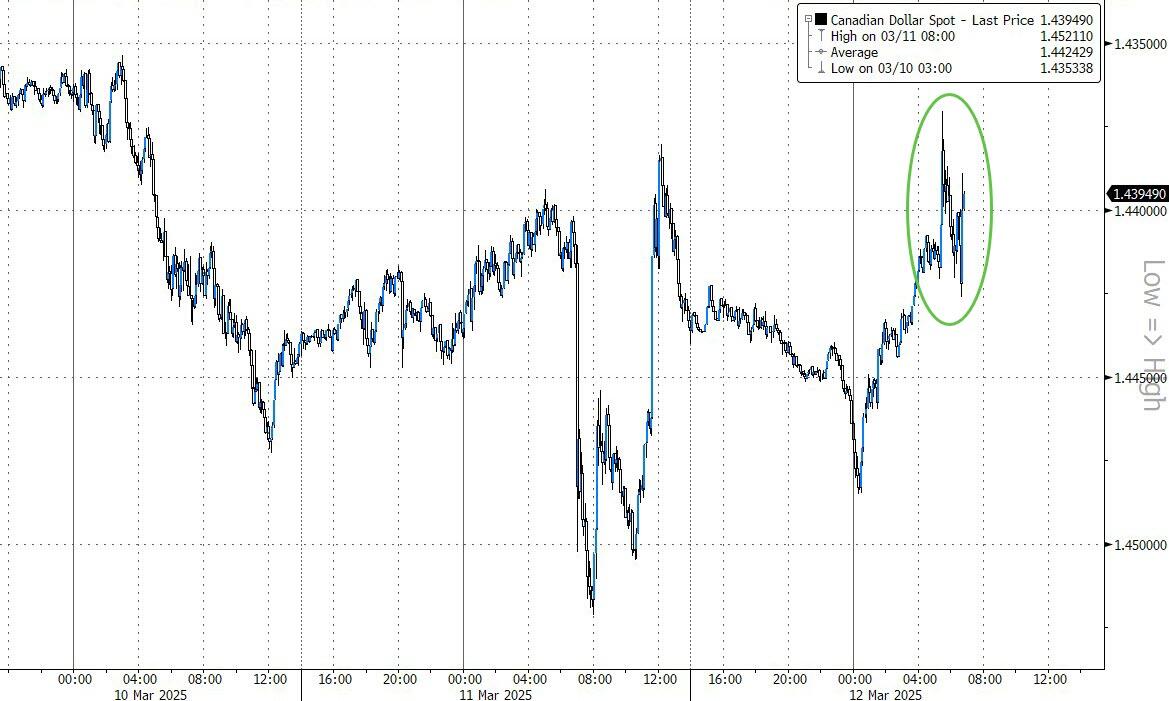
The reaction was muted for now in the Loonie…

BoC’s decision comes just minutes after US Commerce Secretary Howard Lutnick discussed the potential for discussions with Canada on tariffs…

And that followed a Bloomberg report that Canada will announce counter-tariffs on about C$30 billion ($20.8 billion) of US-made products – including hundreds of consumer items such as alcoholic drinks, cosmetics and peanut butter – on Wednesday, according to people familiar with the matter.  

In a news conference Wednesday announcing the retaliatory duties, a Canadian government spokesman called Trump’s tariffs “completely unjustified, unfair and unreasonable.”

“The U.S. administration is once again inserting disruption and disorder into an incredibly successful trading partnership and raising the costs of everyday goods for Canadians and American households alike,” said François-Philippe Champagne, Canada’s minister of innovation, science and industry.

Finance Minister Dominic LeBlanc, the government’s point person on Canada-U.S. relations, said Trump’s attack on Canadian industry is “unjustified and unjustifiable” and the government must hit back as the U.S. inserts “disruption and disorder” into what was once one of the most successful trading relationships in the world.

“We will not stand idly by while our iconic steel and aluminum industries are being unfairly targeted,” he said.

Canada’s announcement comes despite a detente having been reached Tuesday with the Trump administration to resolve threats of a 25% surcharge on American consumers of Canadian electricity. Trump had threatened Canada with steel and aluminum tariffs climbing to 50% if the province of Ontario followed through on the surcharge.

Tyler Durden
Wed, 03/12/2025 – 09:55

Moscow ‘Studying’ 30-day Truce Plan, Makes Steady Battlefield Gains In Meantime

Moscow ‘Studying’ 30-day Truce Plan, Makes Steady Battlefield Gains In Meantime

The Kremlin says it is “studying” statements issued by the US and Ukrainian delegations following yesterday’s talks in Jeddah, and further describes Russian officials are waiting for a fuller briefing from the US on the proposal. The 30-day ceasefire plan calls for a halt to all the fighting on land, sea and in the air – which can be extended by mutual agreement, with a hoped-for path to a permanent truce based on negotiations in the interim.

President Zelensky in a Tuesday X post said the ceasefire will apply to missile, drone and bomb attacks “not only in the Black Sea, but also along the entire front line” – though its as yet unclear what mechanism there will be to monitor this.

Via AFP

The joint statement issued from Jeddah said the sides “will communicate to Russia that Russian reciprocity is the key to achieving peace.” Thus nothing will happen unless Moscow agrees.

Washington has agreed to lift the Trump ban on arms and intelligence for Kiev, while at the same Kiev and Washington agreed on inking a deal on Ukraine’s critical minerals “as soon as possible”.

Russian state media is meanwhile reporting that President Putin is open to holding a telephone conversation with his US counterpart.

On the potential for a new Trump call to discuss progress toward setting up negotiations and a truce, spokesman Dimitry Peskov said Wednesday, “We also do not rule out that the topic of a call at the highest level may arise. If such a need emerges, it will be organized very quickly. The existing channels of dialogue with the Americans make it possible to do this in a relatively short time.”

If it happens this would mark the second call since Trump’s inauguration, after the prior February 12 call. Theoretically this could lead to an in-person meeting between the two leaders if all goes well. 

Secretary of State Marco Rubio is traveling back from the meeting in Saudi Arabia, and gave some remarks to a press conference in Ireland:

  • Deterrence against future attacks on Ukraine will be a crucial element of future negotiations.
  • The US-Ukraine minerals deal benefits both nations and deepens Washington’s interest in Ukraine, but “I would not couch it as a security guarantee”.
  • European sanctions against Russia will be part of the negotiations, making Europe’s involvement in the process essential.
  • Any truce could be effectively monitored, but “one of the things we’ll have to determine is who both sides trust on the ground” to oversee it.

Ukraine continues to hold little to no leverage, given Russia is fast taking back its territory in Kursk as of mid-week. Over a dozen settlements have been liberated, and by all accounts Ukraine forces are in retreat there, also as Russian troops are currently in the center of Sudzha town.

One regional sources says that the Russian advance has been swift especially after one particularly daring operation: “Reports over the weekend claimed that 800 Russian special forces had crawled for 15 kilometers through an unused section of pipeline, which once carried Russian gas to Europe via Ukraine, in order to carry out a sneak attack on Ukrainian forces in Sudzha,” writes Moscow Times.

These developments mean that Putin is even less likely to agree to any temporary pause in fighting. In January statements he had warned the Kremlin will not sign off on any temporary truces – given Ukraine could just use it to rearm, resupply, and regroup. Moscow has less incentive to sign onto a deal unless territorial concessions are part of it, given that at this rate it can just keep advancing in territory, particularly in the Donbass.

Tyler Durden
Wed, 03/12/2025 – 09:30

RFK Jr. Exposes A Truth That Could Bankrupt The Antidepressant Industry

RFK Jr. Exposes A Truth That Could Bankrupt The Antidepressant Industry

Via VigilantFox.com,

RFK Jr. is pulling back the curtain on a reality that could shake the pharmaceutical industry to its core: mental health isn’t just about brain chemistry—it’s about what we eat.

“There are studies coming out of Stanford and Harvard that show a lot of mental illness, including anxiety and depression, are related to food… Food is medicine. By changing your diet, you can lose some of those diagnoses,” Kennedy explained to Fox News Host Sean Hannity.

According to Fox News, 40% of teenagers now struggle with anxiety or depression.

Kennedy says this problem isn’t happening everywhere. In the U.S., about 40% of adults are obese, while in Japan, the number sits at just 5%—and they live about seven years longer on average.

The problem? The poison in our food. Over 1,000 ingredients banned in Europe are still allowed in America’s food supply.

“We are letting down these kids. And there is a moral issue here… it’s a financial issue. Health care costs are going to sink us. And the only way that we’re going to solve it is by changing what we eat,” Kennedy said.

Image: https://www.healthsystemtracker.org/chart-collection/u-s-spending-healthcare-changed-time/

America’s food system is making people sick, and Big Pharma is cashing in on the consequences. The good news is that RFK Jr. is raising awareness, and some restaurant chains are taking notice and making real changes.

Steak ’n Shake, for example, has ditched seed oils in favor of beef tallow for frying their food, a move that aligns with Kennedy’s push to eliminate harmful industrial oils from our diet. Sweetgreen has pledged to remove seed oils entirely from its menu, opting for healthier alternatives like avocado oil. Outback Steakhouse is also reportedly reevaluating its ingredients in response to growing consumer demand for cleaner food.

For decades, Americans have been fed a diet filled with ultra-processed junk while being told that pills were the only solution to their health problems. But now, the truth is coming to light: what we eat matters—not just for our bodies, but for our minds.

Tyler Durden
Wed, 03/12/2025 – 09:15

China Summons Walmart After Asking Suppliers To Absorb Trump’s Tariff Costs

China Summons Walmart After Asking Suppliers To Absorb Trump’s Tariff Costs

China’s Ministry of Commerce and other agencies summoned Walmart officials on Tuesday, days after a Bloomberg report indicated that the US big-box retailer had asked Chinese suppliers—including those producing clothing and kitchenware—to lower prices in response to tariff increases imposed by President Trump.

According to Yuyuantantian, a Weibo account affiliated with state-run China Central Television, officials from the Ministry of Commerce and other authorities in Beijing met with Walmart representatives to address reports about its price negotiations with domestic suppliers.

Walmart’s move to request lower prices from suppliers followed President Trump’s imposition of an additional 10% tariff on all Chinese products last month, which Beijing met with a tit-for-tat 15% tax on US agricultural goods.

“Walmart’s unilateral demand on Chinese firms to cut prices could lead to disruptions of supply chains and hurt the interests of firms and consumers from both countries,” Yuyuantantian wrote in a post, adding, “If Walmart insists on doing so, then what would happen next would be beyond talks.“

Late last week, Bloomberg revealed that the big-box retailer had asked Chinese suppliers, including those producing clothing and kitchenware, for price discounts. 

In a regular press briefing on Wednesday, a Chinese Foreign Ministry spokesperson could not confirm the meeting: “… on this issue, I refer you to relevant Chinese authorities,” without providing further details.

More color from Bloomberg: 

The move marks Beijing’s efforts to show strength as President Donald Trump targets China with consecutive rounds of trade tariffs.

… 

The stakes are high for Walmart. Unlike many global retail brands that have lost their historical dominance in China to local competition, Walmart has defied the country’s consumption slump with robust growth for its membership store Sam’s Club through the sale of premium cuts of meat and other high quality foods increasingly favored by China’s middle class.

Last week, US Treasury Secretary Scott Bessent downplayed the tariff war with China and other top trading partners, indicating: “With the China tariffs, I am highly confident that the Chinese manufacturers will eat the tariffs — prices won’t go up…” 

However, other big box retailers, from Target to Best Buy, have warned about tariff uncertainty and risks of higher prices plagued outlooks.

Tyler Durden
Wed, 03/12/2025 – 07:45